
Name:
Class:
Date:
chapter 11
Copyright Cengage Learning. Powered by Cognero.
Page 1
Indicate whether the statement is true or false.
1. If the Swiss demand for dollars is inelastic, then an appreciation of the dollar against the franc will lead to a greater
quantity of francs being supplied to the foreign exchange market to obtain dollars.
a. True
b. False
2. If it takes 113.28 yen to buy $1, then it takes $.009624 to buy 1 yen.
a. True
b. False
3. Currency arbitrage tends to result in identical yen/dollar exchange rates in New York and in Tokyo.
a. True
b. False
4. If the Swiss demand for dollars is elastic, then a depreciation of the dollar against the franc will lead to a greater
quantity of francs being supplied to the foreign exchange market to obtain dollars.
a. True
b. False
5. If Citibank quoted bid and offer rates for the Swiss franc at $.4850/$.4854, then the bank would be prepared to buy,
say, 1 million francs for $485,000 and sell them for $485,400.
a. True
b. False
6. Futures contracts of the International Monetary Market have no set size, the contracts’ dates of delivery are negotiable,
and their costs are based on the bid-offer spread.
a. True
b. False
7. The euro shows a forward discount against the dollar (the forward rate is less than the spot rate) when interest rates in
Europe are lower than those in the United States.
a. True
b. False
8. International investors who hedge against exchange rate risk often use currency forward contracts.
a. True
b. False
9. A U.S. investor’s extra rate of return on an investment in France, as compared to the United States, equals the interest-
rate differential adjusted for any change in the dollar/franc exchange rate.
a. True
b. False
10. When a bank trades foreign currencies, its offer rate will be less than its bid rate.

Name:
Class:
Date:
chapter 11
Copyright Cengage Learning. Powered by Cognero.
Page 2
a. True
b. False
11. If it takes $1.5515 to buy 1 pound and $0.6845 to buy 1 franc, then it takes 2.27 francs to buy 1 pound.
a. True
b. False
12. In recent years, the estimated amount of foreign exchange transactions is about $1 trillion a day.
a. True
b. False
13. An increase in the trade-weighted value of the dollar indicates a dollar appreciation relative to the currencies of its
major trading partners and a worsening of U.S. international competitiveness.
a. True
b. False
14. A foreign currency trader who works for a bank is assigned a position limit that stipulates the amount of buying and
selling that can be conducted in a given currency.
a. True
b. False
15. Throughout the world, the foreign exchange market is open for business only during the hours of 9 A.M. to 3 P.M.,
Pacific Standard Time.
a. True
b. False
16. As the dollar’s exchange value appreciates against the pound, U.S. residents tend to import more British goods and
thus demand more pounds.
a. True
b. False
17. If Chase Manhattan Bank quotes bid and offer rates for the Swiss franc at $.5250/$.5260, then the bank would realize
profits of $1,000 on the purchase and sale of 1 million francs.
a. True
b. False
18. If the dollar/franc exchange rate is 1 franc = $1.20 in New York and 1 franc = 1.22 in Zurich, then arbitragers would
find it profitable to purchase francs in Zurich and immediately resell them in New York.
a. True
b. False
19. The major banks that trade foreign exchange generally do not deal directly with one another but instead use the
services of foreign exchange brokers.
a. True
b. False

Name:
Class:
Date:
chapter 11
Copyright Cengage Learning. Powered by Cognero.
Page 3
20. With arbitrage, a trader attempts to purchase a foreign currency at a low price and, at a later date, resell the currency at
a higher price in order to make a profit.
a. True
b. False
21. Swap transactions among commercial banks involve the conversion of one currency to another at one point with an
agreement to reconvert it back into the original currency at some point in the future.
a. True
b. False
22. The supply schedule of pesos has a negative-sloping region corresponding to the inelastic region on the Mexican
demand schedule for foreign currency.
a. True
b. False
23. Suppose that Walmart owes 100 million yen to a Japanese radio manufacturer in three-months’ time. To cover itself
against the risk of the dollar appreciating against the yen during this period, Walmart could buy 100 million yen in the
forward market at today’s forward rate for delivery in three months.
a. True
b. False
24. If the dollar cost of the U.K. pound is $1.50, and the dollar cost of the Swiss franc is $1, then the cross-exchange rate
between the pound and the franc is 0.67 francs per pound.
a. True
b. False
25. If interest rates in the U.K. are higher than those in the United States, then the pound shows a forward discount, which
means the forward rate is less than the spot rate.
a. True
b. False
26. Foreign-exchange brokers help commercial banks carry out foreign exchange trading and maintain desired balances of
foreign exchange.
a. True
b. False
27. If the trade-weighted dollar moves from an index value to 100 to 110, then the dollar depreciates by 10 percent against
the trade-weighted averages of the exchange rates of the major trading partners of the United States.
a. True
b. False
28. The supply of francs is derived from the desire of the Swiss to purchase German goods, make investments in
Germany, repay debts to German lenders, and extend transfer payments to German residents.
a. True

Name:
Class:
Date:
chapter 11
Copyright Cengage Learning. Powered by Cognero.
Page 4
b. False
29. Suppose that Sears owes one million yen to a Japanese electronics manufacturer in three months. It could hedge
against the risk of a depreciation of the dollar against the yen by contracting to purchase one million yen in the forward
market, at today’s forward rate, for delivery in three months.
a. True
b. False
30. In 2013, Japanese automakers found that their vehicles were becoming more affordable to American consumers.
Why? The exchange value of the yen was appreciating against the dollar.
a. True
b. False
31. Concerning the volume of foreign exchange market trading, forward transactions and foreign-exchange options are the
two dominant instruments of foreign exchange.
a. True
b. False
32. A currency speculator’s goal is to buy a currency at a low price and immediately resell it at a higher price, thus
realizing a riskless profit.
a. True
b. False
33. If British interest rates are lower than those of the United States, then the pound shows a forward discount, which
means the forward rate is less than the spot rate.
a. True
b. False
34. As the dollar depreciates against the peso, U.S. residents tend to import more Mexican goods and thus demand more
pesos.
a. True
b. False
35. Unlike stock or commodity exchanges, the foreign exchange market is NOT an organized structure; it has no
centralized meeting place and no formal requirements for participation.
a. True
b. False
36. Stabilizing speculation reinforces market forces by intensifying an appreciation or a depreciation in a currency’s
exchange value.
a. True
b. False
37. Concerning foreign exchange trading, the bid rate refers to the price that a bank is willing to pay for a unit of foreign
currency; the offer rate is the price at which the bank is willing to sell a unit of foreign currency.

Name:
Class:
Date:
chapter 11
Copyright Cengage Learning. Powered by Cognero.
Page 5
a. True
b. False
38. Most foreign exchange transactions are conducted between commercial banks and household customers.
a. True
b. False
39. Foreign exchange transactions are generally carried out by smaller banks located in smaller cities throughout the
United States.
a. True
b. False
40. Estimates are that speculation accounts for only about 10 percent of the daily trading activity in the foreign exchange
market.
a. True
b. False
41. Suppose the selling price of one-month forward British pounds is $1.6036 per pound and the spot price of the pound is
$1.6039. This means that there is an annual forward discount on the pound equal to 0.2 percent.
a. True
b. False
42. Concerning the management of foreign exchange risk, some business firms do not hedge at all either because they
cannot determine how much money will be coming in from abroad or because they have a deliberate strategy of allowing
currencies to balance each other out around the world.
a. True
b. False
43. A foreign currency option is an agreement between a holder (corporation) and a writer (commercial bank) that gives
the holder the right to buy or sell a certain amount of foreign currency at any time through some specified date.
a. True
b. False
44. The nominal exchange rate equals the real exchange rate adjusted for changes in the price level.
a. True
b. False
45. Assume that Boeing anticipates receiving 1 billion francs in three months from its exports of jetliners to
Switzerland. To avoid the risk of an appreciation of the dollar against the franc, Boeing could contract to sell its expected
franc receipts in the forward market at today’s forward rate.
a. True
b. False
46. Most foreign exchange trading is carried out in the forward market.
a. True

Name:
Class:
Date:
chapter 11
Copyright Cengage Learning. Powered by Cognero.
Page 6
b. False
47. The trade-weighted dollar is the weighted average of the exchange rates between the dollar and the most important
industrial-country trading partners of the United States.
a. True
b. False
48. Given an upward-sloping supply schedule of pounds and a downward-sloping demand schedule for pounds, an
increase in the supply schedule causes an appreciation of the dollar against the pound.
a. True
b. False
49. If it takes $0.18544 to purchase 1 French franc, then it takes 5.3926 francs to purchase $1.
a. True
b. False
50. In the forward market, the exchange rate is agreed on at the time of the currency contract, but payment is not made
until the future delivery of the currency actually takes place.
a. True
b. False
51. When a foreign currency is worth more in the forward market than in the spot market, it is said to be at a discount in
the forward market.
a. True
b. False
52. Given an upward-sloping supply schedule of pounds and a downward-sloping demand schedule for pounds, an
increase in the demand schedule causes an appreciation of the dollar against the pound.
a. True
b. False
53. A person needing foreign exchange immediately would purchase it on the spot market.
a. True
b. False
54. Assume that Boeing anticipates receiving 20 million yen in three months from exports of jumbo jets to a Japanese
airline. The firm could hedge against the risk of a depreciation of the dollar against the yen by contracting to sell its
expected yen proceeds for dollars in the forward market at today’s forward rate.
a. True
b. False
55. Arbitrage results in a riskless profit because a trader purchases a currency at a low price and simultaneously resells it
at a higher price.
a. True
b. False

Name:
Class:
Date:
chapter 11
Copyright Cengage Learning. Powered by Cognero.
Page 7
56. Most foreign exchange transactions involve the transfer of cash, rather than electronic balances, between commercial
banks or foreign exchange dealers.
a. True
b. False
57. If the spot price of the Swiss franc is $0.4020 and the 90-day forward franc sells for $0.4026, then the franc is at a 90-
day forward discount of $0.0006 or at a 0.2 percent forward discount per annum against the dollar.
a. True
b. False
58. The “spread” is a bank’s profit margin on foreign exchange trading and equals the difference between the bid rate and
the offer rate.
a. True
b. False
59. If a household purchases small amounts of foreign currency from an automated teller machine (ATM), the bank
typically imposes an additional service charge for the transaction.
a. True
b. False
60. If a Citibank dealer expects the Swiss franc to appreciate against the U.S. dollar, then she will attempt to lower both
bid and offer rates for the franc to persuade other dealers to buy francs from Citibank and dissuade other dealers from
selling francs to Citibank.
a. True
b. False
61. Arbitrage tends to bring about an identical price for the same currency in different locations and thus results in one
market.
a. True
b. False
62. The bid rate refers to the price at which a bank is willing to sell a unit of foreign currency; the offer rate is the price at
which a bank is willing to buy a unit of foreign currency.
a. True
b. False
63. Concerning foreign currency trading, an option contract provides the holder the right to buy or sell a fixed amount of
currency at a prearranged price within a few days or a couple of years.
a. True
b. False
64. If the Swiss demand for dollars is elastic, then an appreciation of the dollar against the franc will lead to a greater
quantity of francs being supplied to the foreign exchange market to obtain dollars.
a. True

Name:
Class:
Date:
chapter 11
Copyright Cengage Learning. Powered by Cognero.
Page 8
b. False
65. Movements along the demand schedule for pounds are caused by changes in the pound’s exchange rate.
a. True
b. False
66. Similar to stock and commodity exchanges, the foreign exchange market is an organized structure with a central
meeting place and formal licensing requirements.
a. True
b. False
67. The demand schedule for Swiss francs is always downsloping, while the supply schedule of francs is always
upsloping.
a. True
b. False
68. A speculator engages in a short position by initially selling a currency (that she does not own) at a high price and then
buying it back later at a low price.
a. True
b. False
69. “Futures” currency contracts are issued by commercial banks and are tailored in size to the needs of the exporter or
importer, while “forward” currency contracts are issued by the International Monetary Market in standardized round lots.
a. True
b. False
70. The demand for foreign exchange is derived from credit transactions on the balance of payments.
a. True
b. False
71. Given an upward-sloping supply schedule of pounds and a downward-sloping demand schedule for pounds, a decrease
in the demand schedule causes an appreciation of the dollar against the pound.
a. True
b. False
72. If a Citibank dealer expects the Swiss franc to depreciate in the future, then he will lower bid and offer rates for the
franc in order to discourage other dealers from selling francs to Citibank and persuade other dealers to buy francs from
Citibank.
a. True
b. False
73. The foreign exchange market refers to the organizational setting within which individuals and businesses, but NOT
government and banks, buy and sell foreign currencies and other debt instruments.
a. True
b. False

Name:
Class:
Date:
chapter 11
Copyright Cengage Learning. Powered by Cognero.
Page 9
74. Given an upward-sloping supply schedule of pounds and a downward-sloping demand schedule for pounds, a decrease
in the supply schedule causes an appreciation of the dollar against the pound.
a. True
b. False
75. The supply schedule of yen has a positive-sloping region, which corresponds to the inelastic region on the Japanese
demand schedule for foreign currency.
a. True
b. False
76. If the Swiss demand for dollars is inelastic, then a depreciation of the dollar against the franc will lead to a greater
quantity of francs being supplied to the foreign exchange market to obtain dollars.
a. True
b. False
77. A speculator takes a long position by initially buying a currency at a low price and then selling it at a higher price later
on.
a. True
b. False
78. When conducting foreign exchange trading, commercial banks like Bank of America offer forward contracts. The size
of these contracts can be tailored to the needs of an importer or importer and their date of delivery is negotiable.
a. True
b. False
79. If the dollar’s real exchange rate index increases, then American products become more affordable to foreign buyers.
a. True
b. False
80. The U.S. demand for pounds is derived from U.S. exports to the United Kingdom, U.K. investments in the United
States, and U.K. tourist expenditures in the United States.
a. True
b. False
81. A “call” option gives General Motors the right to sell pounds at a specified price, while a put option gives General
Motors the right to buy pounds at a specified price.
a. True
b. False
82. If the exchange rate is $0.01 per yen in New York and $0.015 per yen in Tokyo, then an arbitrager could profit by
buying yen in Tokyo and simultaneously sell them in New York.
a. True
b. False

Name:
Class:
Date:
chapter 11
Copyright Cengage Learning. Powered by Cognero.
Page 10
83. Hedging is the process of avoiding or covering a foreign exchange risk.
a. True
b. False
84. A commercial bank profits from foreign-exchange trading when its bid rate exceeds its offer rate.
a. True
b. False
85. Trading in foreign currencies can be conducted in the futures market, such as the International Monetary Market of the
Chicago Mercantile Exchange.
a. True
b. False
Indicate the answer choice that best completes the statement or answers the question.
86. If you have a commitment to pay a friend in Britain 1,000 pounds in 30 days, you could remove the risk of loss due to
the appreciation of the pound by
a. buying dollars in the forward market for delivery in 30 days.
b. selling dollars in the forward market for delivery in 30 days.
c. buying the pounds in the forward market for delivery in 30 days.
d. selling the pounds in the forward market for delivery in 30 days.
87. In recent years, the largest amount of foreign-exchange trading has involved
a. foreign-exchange swaps and spot transactions.
b. spot transactions and forward transactions.
c. forward transactions and foreign-exchange swaps.
d. foreign-exchange options and spot transactions.
Table 11.2. Supply and Demand of British Pounds
Quantity Dollars Quantity
of Pounds per of Pounds
Supplied Pound Demanded
1,000 2.00 200
800 1.80 400
600 1.60 600
400 1.40 800
200 1.20 1,000
88. Refer to Table 11.2. At the exchange rate of $1.40 per pound, there is an ____ for pounds. This imbalance causes ____
in the price of the pound, which leads to ____ in the quantity of pounds supplied and ____ in the quantity of pounds
demanded.
a. excess supply, a decrease, an increase, a decrease
b. excess supply, an increase, a decrease, an increase

Name:
Class:
Date:
chapter 11
Copyright Cengage Learning. Powered by Cognero.
Page 11
c. excess demand, an increase, an increase, a decrease
d. excess demand, an increase, a decrease, an increase
89. Suppose that real incomes increase more rapidly in the United States than in Mexico. In the United States, this
situation would likely result in a(n)
a. increase in the demand for pesos.
b. decrease in the demand for pesos.
c. increase in the supply of pesos.
d. decrease in the supply of pesos.
90. Which is NOT a bank that trades in the foreign exchange market?
a. Deutsche Bank
b. Citigroup
c. Barclays
d. Charles Schwab
91. An appreciation in the value of the U.S. dollar against the British pound would tend to
a. discourage the British from buying American goods.
b. discourage Americans from buying British goods.
c. increase the number of dollars that could be bought with a pound.
d. discourage U.S. tourists from traveling to Britain.
92. When the real exchange rate of the Japanese yen depreciates,
a. the yen’s nominal exchange rate must also depreciate.
b. the yen’s nominal exchange rate must remain constant.
c. the yen will trade for more units of a foreign currency.
d. the yen will trade for fewer units of a foreign currency.
Table 11.2. Supply and Demand of British Pounds
Quantity Dollars Quantity
of Pounds per of Pounds
Supplied Pound Demanded
1,000 2.00 200
800 1.80 400
600 1.60 600
400 1.40 800
200 1.20 1,000
93. Refer to Table 11.2. At the exchange rate of $1.80 per pound, there is an ____ for pounds. This imbalance causes ____
in the price of the pound, which leads to ____ in the quantity of pounds supplied and ____ in the quantity of pounds
demanded.
a. excess supply, a decrease, a decrease, an increase
b. excess supply, an increase, a decrease, an increase
c. excess demand, an increase, an increase, a decrease

Name:
Class:
Date:
chapter 11
Copyright Cengage Learning. Powered by Cognero.
Page 12
d. excess demand, an increase, a decrease, an increase
94. Which financial instrument provides a buyer the right to purchase or sell a fixed amount of currency at a prearranged
price within a few days to a couple of years?
a. letter of credit
b. foreign currency option
c. cable transfer
d. bill of exchange
Table 11.4. Forward Exchange Rates
U.S. Dollar Equivalent
Wednesday Tuesday
Switzerland (Franc) .6598 .6590
30-day Forward .6592 .6585
90-day Forward .6585 .6578
180-day Forward .6577 .6572
95. Refer to Table 11.4. On Wednesday, the 30-day forward franc was selling at a
a. 1 percent premium per annum against the dollar.
b. 2 percent premium per annum against the dollar.
c. 1 percent discount per annum against the dollar.
d. 2 percent discount per annum against the dollar.
96. When the exchange rate (dollars per pound) decreases, the
a. quantity of pounds demanded decreases.
b. quantity of pounds demanded decreases.
c. demand curve for pounds shifts rightward.
d. demand curve for pounds shifts leftward.
97. Suppose you can make profits in the foreign exchange market by buying a foreign currency at a low price, then selling
it at a higher price later on. What you are engaging in is a
a. discount position.
b. premium position.
c. short position.
d. long position.
98. Concerning foreign exchange trading, bank purchases from and sales to their customers are classified as retail
transactions when the amount involved
a. is less than 100,000 units of currency.
b. is less than 500,000 units of currency.
c. is less than 1 million units of currency.
d. is greater than 1 million units of currency.

Name:
Class:
Date:
chapter 11
Copyright Cengage Learning. Powered by Cognero.
Page 13
The next five questions refer to the table below, which shows the supply and demand schedules of British pounds.
Exchange Rate:
Quantity of Pounds Supplied Dollars Per Pound Quantity of Pounds Demanded
100 $2.50 20
80 2.00 40
60 1.50 60
40 1.00 80
20 0.50 100
99. In the table above, the equilibrium exchange rate is shown as
a. $2.50 per pound.
b. $2.00 per pound.
c. $1.50 per pound.
d. $1.00 per pound.
100. An increase in the dollar price of other currencies tends to cause
a. U.S. goods to be cheaper than foreign goods.
b. U.S. goods to be more expensive than foreign goods.
c. foreign goods to be more expensive to residents of foreign nations.
d. foreign goods to be cheaper to residents of the United States.
101. A(n) ____ is an arrangement by which two parties exchange one currency for another and agree that the exchange
will be reversed at a stipulated date in the future.
a. arbitrage
b. swap
c. option
d. hedge
102. A major difference between the spot market and the forward market is that the spot market deals with
a. the immediate delivery of currencies.
b. the merchandise trade account.
c. currencies traded for future delivery.
d. hedging of international currency risks.
103. Concerning the spot market for foreign exchange transactions,
a. currencies are bought and sold for delivery at a particular date in the future.
b. currencies are traded for immediate delivery.
c. currency exchange rates are set by government regulatory agencies.
d. currency exchange rates are set by central banks.
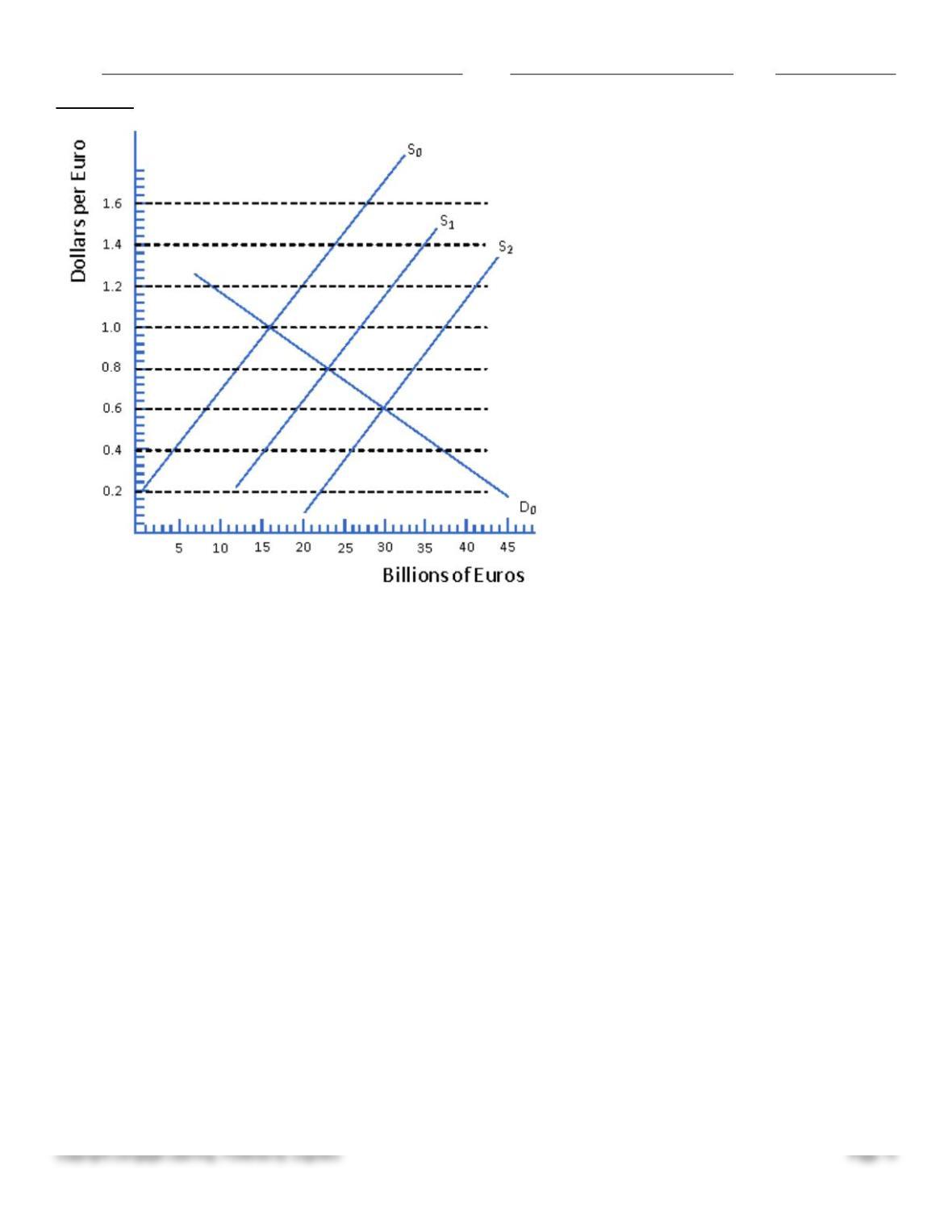
Figure 11.3 The Market for the Euro
Name:
Class:
Date:
chapter 11
Copyright Cengage Learning. Powered by Cognero.
Page 14
104. Refer to Figure 11.3. If the supply curve is represented by S0, then the equilibrium exchange rate is
a. $1.20.
b. $1.00.
c. $0.80.
d. $0.60.
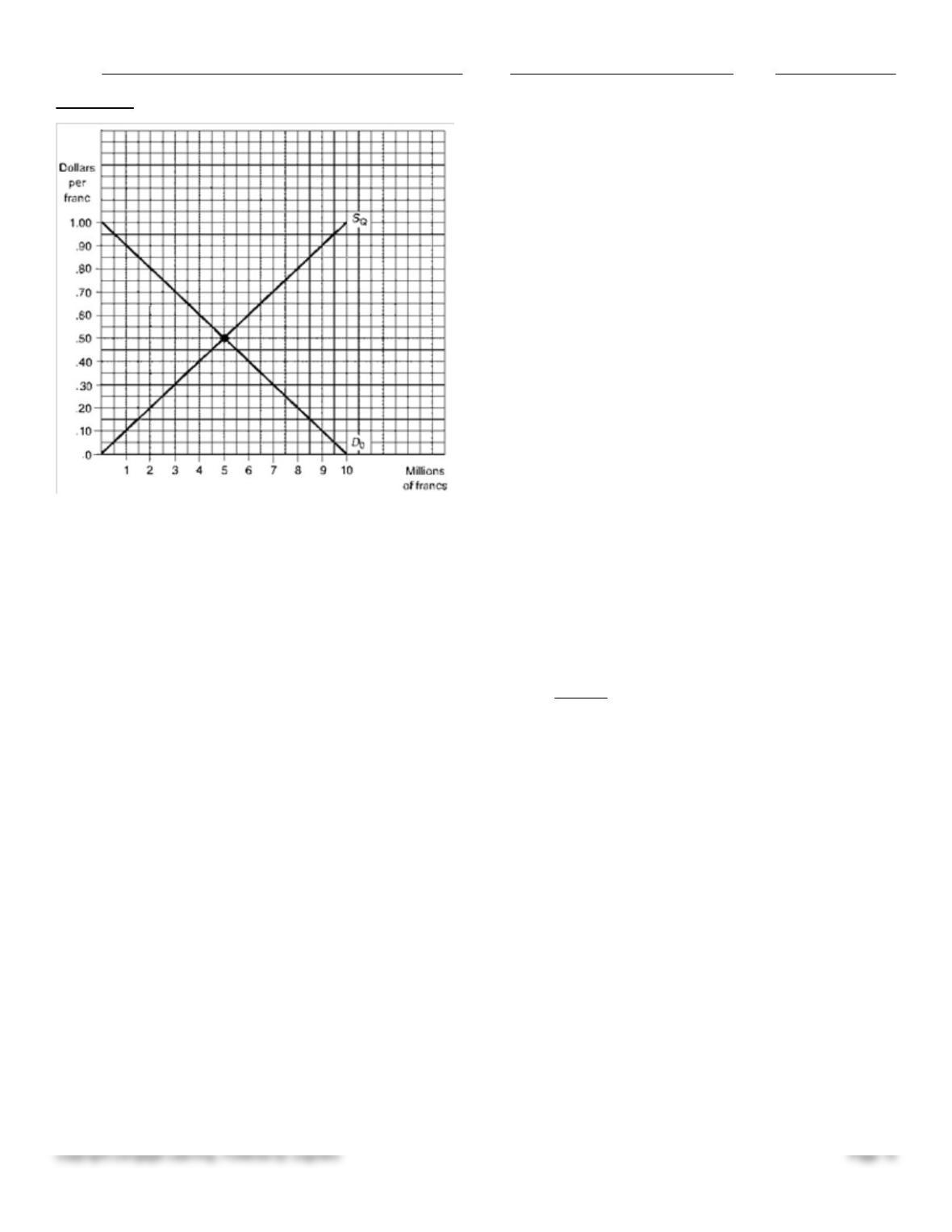
Figure 11.1 illustrates the supply and demand schedules for the Swiss franc. Assume that exchange rates are flexible.
Figure 11.1. Supply and Demand Schedules of Francs
Name:
Class:
Date:
chapter 11
Copyright Cengage Learning. Powered by Cognero.
Page 15
105. Refer to Figure 11.1. Suppose the exchange rate is $.70 per franc. At this exchange rate, there is an ____ of francs
which leads to a ____ in the dollar price of the franc, a(n) ____ in the quantity of francs supplied, and a(n) ____ in the
quantity of francs demanded.
a. excess demand, rise, increase, decrease
b. excess demand, rise, decrease, increase
c. excess supply, fall, decrease, increase
d. excess supply, fall, increase, decrease
106. Concerning the foreign exchange market, which of the following is FALSE?
a. Virtually all foreign exchange trading takes place in London and Zurich.
b. Foreign exchange trading is dominated by the dollar, euro, yen, and pound.
c. Individual households, businesses, governments, and banks buy and sell foreign currencies and other debt
instruments.
d. The foreign exchange market has no centralized meeting place and no formal requirements for participation.
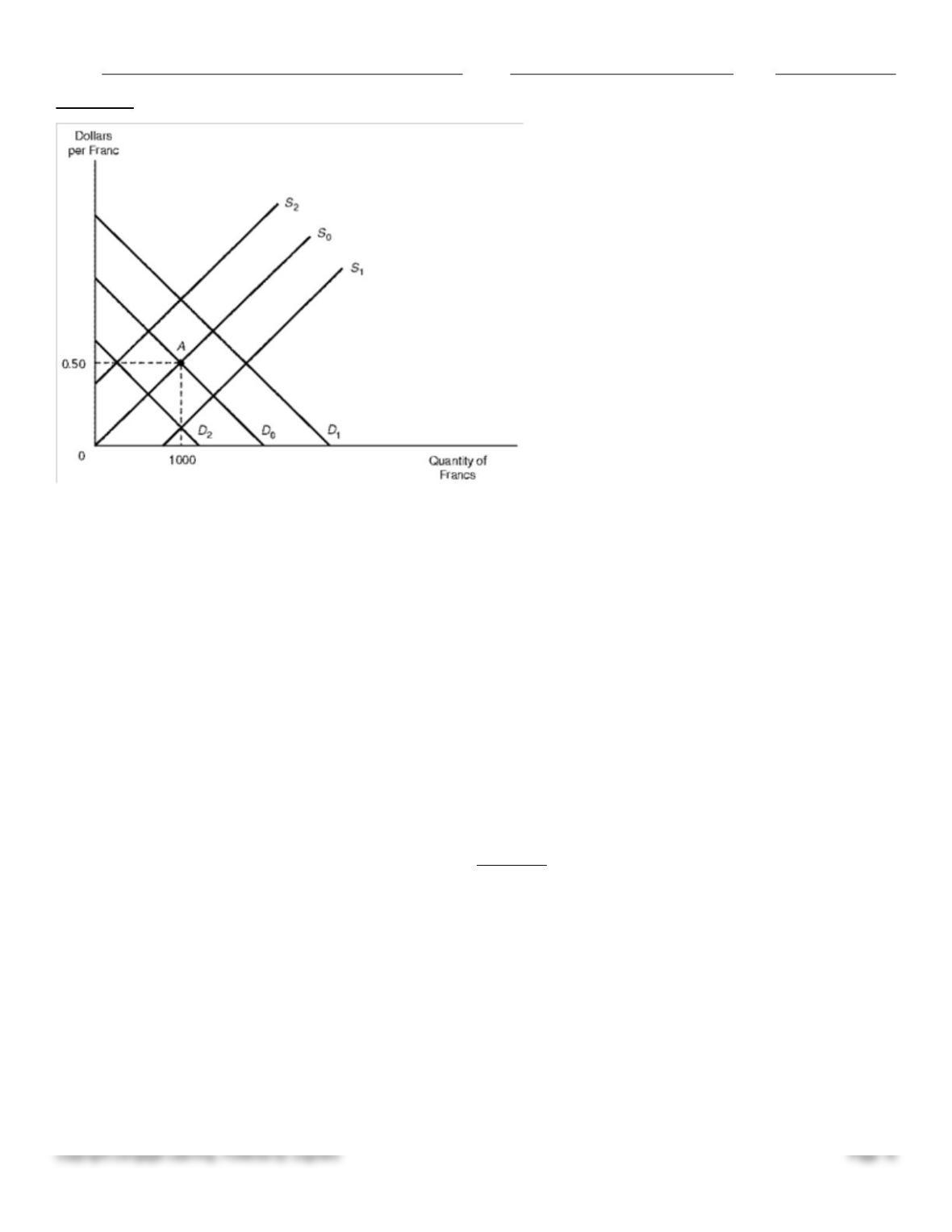
The figure below illustrates the market for Swiss francs in a world of market-determined exchange rates. Assume the
equilibrium exchange rate is $0.5 per franc, given by the intersection of schedules S0 and D0.
Figure 11.2. Market for Francs
Name:
Class:
Date:
chapter 11
Copyright Cengage Learning. Powered by Cognero.
Page 16
107. Refer to Figure 11.2. A shift in the demand for francs from D0 to D2, or a shift in the supply of francs from S0 to S1,
would result in a(n)
a. depreciation in the dollar against the franc.
b. appreciation in the dollar against the franc.
c. no change in the dollar/franc exchange rate.
d. appreciation in the franc against the dollar.
108. Assume that you are the Chase Manhattan Bank of the United States, and you have 1 million Swiss francs in your
vault that you will need to use in 30 days. Moreover, you need 500,000 British pounds for the next 30 days. You arrange
to loan your francs to Barclays Bank of London for 30 days in exchange for 500,000 pounds today and reverse the
transaction at the end of 30 days. You have just arranged a
a. forward contract.
b. futures contract.
c. spot contract.
d. currency swap.
109. Which of the following tends to cause the U.S. dollar to appreciate in value?
a. an increase in U.S. prices above foreign prices
b. rapid economic growth in foreign countries
c. a fall in U.S. interest rates below foreign levels
d. an increase in the level of U.S. income
110. The exchange rate is kept the same in all parts of the market by
a. forward cover.
b. hedging.
c. exchange speculation.
d. exchange arbitrage.
111. A demand for U.S. dollars would result from

Name:
Class:
Date:
chapter 11
Copyright Cengage Learning. Powered by Cognero.
Page 17
a. an American tourist visiting the British Museum in London.
b. a Japanese investor purchasing German securities.
c. Honda, a Japanese auto company, buying land in Alabama.
d. Airbus, a European firm, selling jetliners to airlines in South Korea.
Table 11.1 gives the exchange rate quotations for the U.S. dollar and the British pound.
Table 11.1. Foreign Exchange Quotations
U.S. Dollar Currency Per
Equivalent U.S. Dollar
Tuesday Monday Tuesday Monday
Britain (Pound) 1.4270 1.4390 .7008 .6949
30-day Forward 1.4211 1.4333 .7037 .6977
60-day Forward 1.4090 1.4220 .7097 .7032
180-day Forward 1.3930 1.4070 .7179 .7107
112. Consider Table 11.1. If one were to sell dollars for immediate delivery, on Tuesday the pound cost of each dollar
would be
a. .7008 pounds per dollar.
b. .7037 pounds per dollar.
c. 1.4270 pounds per dollar.
d. 1.4211 pounds per dollar.
113. Which is NOT a characteristic of automated trading?
a. It is logical.
b. It is emotional.
c. It continuously looks for profitable trades.
d. It executes profitable trades immediately.
114. The supply for foreign exchange results from transactions that appear on the
a. credit side of a country’s balance of payments statement.
b. debit side of a country’s balance of payments statement.
c. both the credit side and the debit side of a country’s balance of payments statement.
d. neither the credit side nor the debit side of a country balance of payments statement.
115. Which method of trading currencies involves the conversion of one currency into another at one point in time with an
agreement to reconvert it back to the original currency at some point in the future?
a. forward transaction
b. futures transaction
c. spot transaction
d. swap transaction
116. Grain shortages in countries that buy large amounts of grain from the United States would increase the demand for
American grain and

Name:
Class:
Date:
chapter 11
Copyright Cengage Learning. Powered by Cognero.
Page 18
a. reduce the demand for dollars.
b. increase the demand for dollars.
c. reduce the supply of dollars.
d. increase the supply of dollars.
117. In the interbank market for foreign exchange, the ____ refers to the price that a bank is willing to pay for a unit of
foreign currency.
a. offer rate
b. bid rate
c. spread rate
d. transaction rate
118. Suppose the exchange value of the British pound is $2 per pound while the exchange value of the Swiss franc is 50
cents per pound. The cross-exchange rate between the pound and the franc is
a. 1 franc per pound.
b. 2 francs per pound.
c. 3 francs per pound.
d. 4 francs per pound.
119. When the exchange rate (dollars per pound) falls, the
a. quantity of pounds supplied decreases.
b. quantity of pounds supplied increases.
c. supply curve of pounds shifts rightward.
d. supply curve of pounds shifts leftward.
120. A depreciation of the dollar refers to
a. a fall in the dollar price of foreign currency.
b. an increase in the dollar price of foreign currency.
c. a loss of foreign-exchange reserves for the U.S.
d. an intervention in the international money market.
Table 11.4. Forward Exchange Rates
U.S. Dollar Equivalent
Wednesday Tuesday
Switzerland (Franc) .6598 .6590
30-day Forward .6592 .6585
90-day Forward .6585 .6578
180-day Forward .6577 .6572
121. Refer to Table 11.4. On Wednesday, the 180-day forward franc was selling at a
a. 0.6 percent premium per annum against the dollar.
b. 1.6 percent premium per annum against the dollar.
c. 0.6 percent discount per annum against the dollar.

Name:
Class:
Date:
chapter 11
Copyright Cengage Learning. Powered by Cognero.
Page 19
d. 1.6 percent discount per annum against the dollar.
122. Last month, the exchange rate between the U.S. dollar and the Japanese yen was 100 yen per dollar. The exchange
rate is currently at 110 per dollar. We can say that
a. the dollar appreciated against the yen, and the yen depreciated against the dollar.
b. the dollar depreciated against the yen, and the yen appreciated against the dollar.
c. the dollar and the yen both appreciated.
d. the dollar and the yen both depreciated.
123. In the interbank market for foreign exchange, the ____ refers to the difference between the offer rate and the bid rate.
a. cross rate
b. option
c. arbitrage
d. spread
124. Concerning the foreign exchange market, one can best say that
a. there is a spot market for virtually every currency in the world.
b. the market is highly centralized like the stock exchange.
c. most foreign exchange payments are made with bank notes.
d. the values of the forward and spot rates are always in agreement.
125. In a supply-and-demand diagram for Japanese yen, with the exchange rate in dollars per yen on the vertical axis, the
demand schedule for yen is drawn sloping
a. upward.
b. vertical.
c. downward.
d. horizontal.
126. When the real exchange rate of Japan’s yen appreciates,
a. the yen’s nominal exchange rate must remain constant.
b. the yen’s nominal exchange rate must also appreciate.
c. the yen’s nominal exchange rate must depreciate.
d. Japanese goods are less competitive on international markets.
Table 11.4. Forward Exchange Rates
U.S. Dollar Equivalent
Wednesday Tuesday
Switzerland (Franc) .6598 .6590
30-day Forward .6592 .6585
90-day Forward .6585 .6578
180-day Forward .6577 .6572
Name:
Class:
Date:
chapter 11
Copyright Cengage Learning. Powered by Cognero.
Page 20
127. Refer to Table 11.4. Comparing the franc’s forward rates against the franc’s spot rate, the exchange market’s
consensus is that over the period of a forward contract, the franc’s spot rate will
a. depreciate against the dollar.
b. appreciate against the dollar.
c. remain constant against the dollar.
d. remain constant against the euro.
128. The demand curve for British pounds slopes downward because as the dollar ______ British goods become ______
for Americans. Therefore, Americans purchase ______ British goods, and the quantity of pounds demanded increases.
a. appreciates against the pound; less expensive; more
b. appreciates against the pound; more expensive; fewer
c. depreciates against the pound; less expensive; more
d. depreciates against the pound; more expensive; more
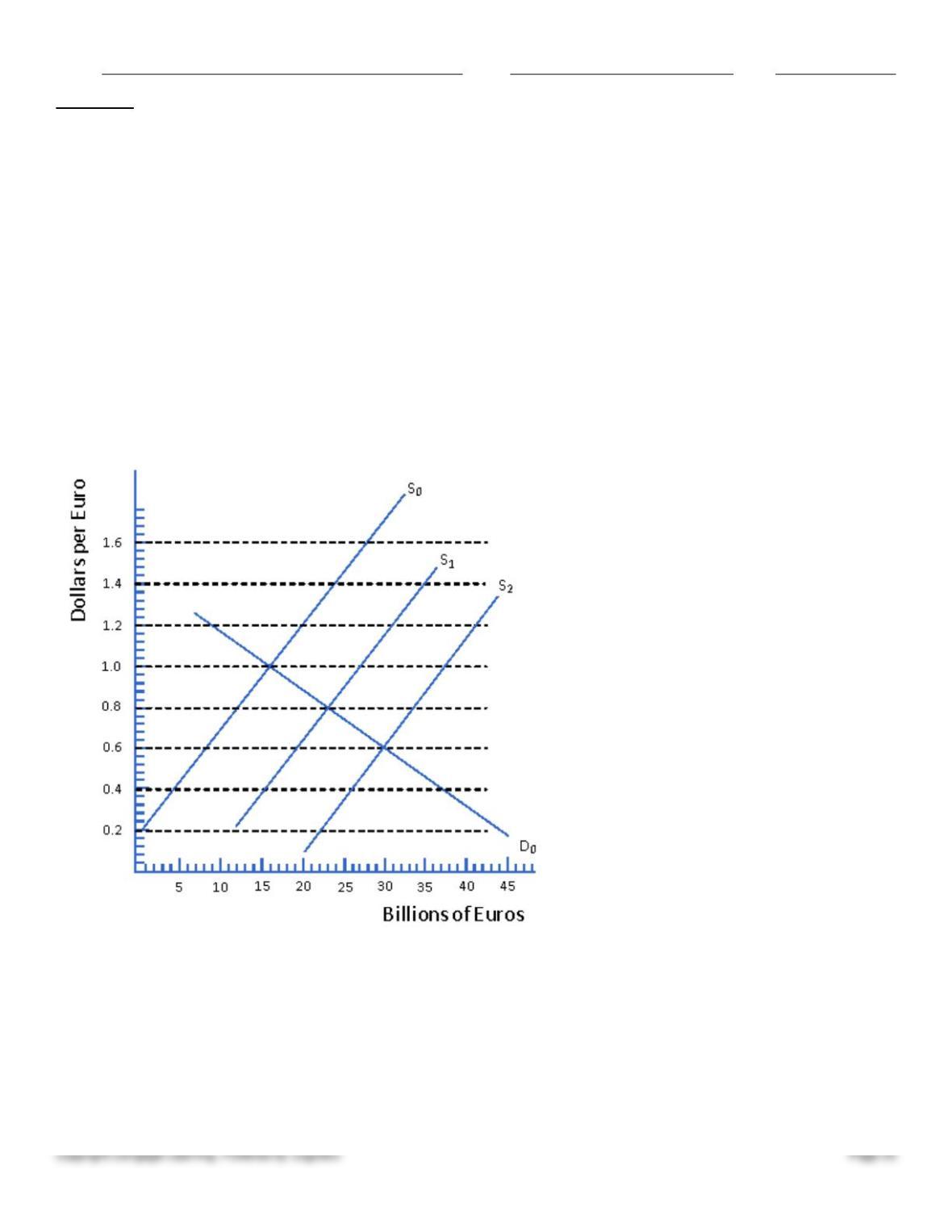
Figure 11.3 The Market for the Euro
129. Refer to Figure 11.3. If the supply curve shifts from S2 to S1, then
a. the dollar has depreciated relative to the euro.
b. the dollar has appreciated relative to the euro.
c. the euro has depreciated relative to the dollar.
d. U.S. consumers will be inclined to buy more European goods.
Table 11.1 gives the exchange rate quotations for the U.S. dollar and the British pound.

Name:
Class:
Date:
chapter 11
Copyright Cengage Learning. Powered by Cognero.
Page 21
Table 11.1. Foreign Exchange Quotations
U.S. Dollar Currency Per
Equivalent U.S. Dollar
Tuesday Monday Tuesday Monday
Britain (Pound) 1.4270 1.4390 .7008 .6949
30-day Forward 1.4211 1.4333 .7037 .6977
60-day Forward 1.4090 1.4220 .7097 .7032
180-day Forward 1.3930 1.4070 .7179 .7107
130. Consider Table 11.1. Comparing Tuesday to the previous Monday, by Tuesday the dollar had
a. depreciated against the pound.
b. appreciated against the pound.
c. not changed against the pound.
d. depreciated against the peso.
131. During 2012–2013, currency speculator George Soros made a lucrative currency trade. Having expectations of a
future depreciation of the yen, Soros made big bets against it. He sold large amounts of yen, pushed its value down, and
profited by re-buying the yen when its price bottomed out. What Soros was engaging in was a
a. long position.
b. short position.
c. premium position.
d. discount position.
132. Over time, a depreciation in the value of a nation’s currency in the foreign exchange market will result in
a. exports rising and imports falling.
b. imports rising and exports falling.
c. both imports and exports rising.
d. both imports and exports falling.
133. The pound shows a forward discount against the dollar (the forward rate is less than the spot rate) when
a. interest rates in the United Kingdom are higher than those in the United States.
b. interest rates in the United Kingdom are lower than those in the United States.
c. real GDP is higher in the United Kingdom than in the United States.
d. real GDP is lower in the United Kingdom than in the United States.
134. A put option provides an options holder
a. the obligation to buy foreign currency at a specific price.
b. the obligation to sell foreign currency at a specific price.
c. the right to buy foreign currency at a specific price.
d. the right to sell foreign currency at a specific price.
135. The supply curve of British pounds slopes upward because as the dollar _____ American goods become ______ for
the British. Therefore, the British purchase ______ American goods, and the quantity of pounds supplied decreases.
a. depreciates against the pound; more expensive; more

Name:
Class:
Date:
chapter 11
Copyright Cengage Learning. Powered by Cognero.
Page 22
b. depreciates against the pound; more expensive; less
c. appreciates against the pound; more expensive; less
d. appreciates against the pound; less expensive; more
136. A U.S. export company scheduled to receive 1 million pounds six months from today can hedge its foreign exchange
risk by
a. buying 1 million pounds in the forward market today for delivery in six months.
b. buying 1 million pounds in the spot market for delivery in six months.
c. selling 1 million pounds in the spot market for delivery in six months.
d. selling 1 million pounds in the forward market today for delivery in six months.
Table 11.3. Key Currency Cross Rates
Dollar Euro Pound Swiss Franc
Canada 1.5326 1.4400 2.2362 0.9790
Japan 124.48 116.96 181.63 79.515
Mexico 9.7410 9.1526 14.213 6.2223
Switzerland 1.5655 1.4709 2.2842 ……….
U.K. .68540 .6440 ………. .4378
Euro 1.06430 ………. 1.5529 .67984
U.S. ………. .9396 1.4591 .63877
137. Referring to Table 11.3, the cross-exchange rate between the euro and Swiss franc is approximately
a. .68 euros per franc.
b. .68 francs per euro.
c. .64 euros per franc.
d. .64 francs per euro.
Table 11.1 gives the exchange rate quotations for the U.S. dollar and the British pound.
Table 11.1. Foreign Exchange Quotations
U.S. Dollar Currency Per
Equivalent U.S. Dollar
Tuesday Monday Tuesday Monday
Britain (Pound) 1.4270 1.4390 .7008 .6949
30-day Forward 1.4211 1.4333 .7037 .6977
60-day Forward 1.4090 1.4220 .7097 .7032
180-day Forward 1.3930 1.4070 .7179 .7107
138. Consider Table 11.1. Concerning the Tuesday quotations: compared to the cost of buying 100 pounds on the spot
market, if 100 pounds were bought for future delivery, then in 180 days the dollar cost of the pounds would be
a. $3.40 higher.
b. $3.40 lower.
c. $6.80 higher.

Name:
Class:
Date:
chapter 11
Copyright Cengage Learning. Powered by Cognero.
Page 23
d. $6.80 lower.
139. All of the following are main centers for foreign exchange trading EXCEPT
a. Tokyo.
b. London.
c. Edmonton.
d. New York.
140. Concerning foreign exchange trading, which of the following characterizes a forward contract?
a. It is an agreement between a holder and a writer.
b. Its contract size can be tailored to the needs of the exporter, importer, and so on.
c. Its date of delivery is non-negotiable.
d. It does not obligate a person to carry out a transaction if the price has changed.
141. A corporation dealing in foreign exchange may desire to obtain an exchange quote between the pound and franc,
whose values are both expressed relative to the dollar. ____ are used to determine such a relationship.
a. Spot exchange rates
b. Forward exchange rates
c. Cross exchange rates
d. Option exchange rates
Table 11.1 gives the exchange rate quotations for the U.S. dollar and the British pound.
Table 11.1. Foreign Exchange Quotations
U.S. Dollar Currency Per
Equivalent U.S. Dollar
Tuesday Monday Tuesday Monday
Britain (Pound) 1.4270 1.4390 .7008 .6949
30-day Forward 1.4211 1.4333 .7037 .6977
60-day Forward 1.4090 1.4220 .7097 .7032
180-day Forward 1.3930 1.4070 .7179 .7107
142. Consider Table 11.1. If one were to buy pounds for immediate delivery, on Tuesday the dollar cost of each pound
would be
a. $0.7008.
b. $0.7037.
c. $1.4211.
d. $1.4270.
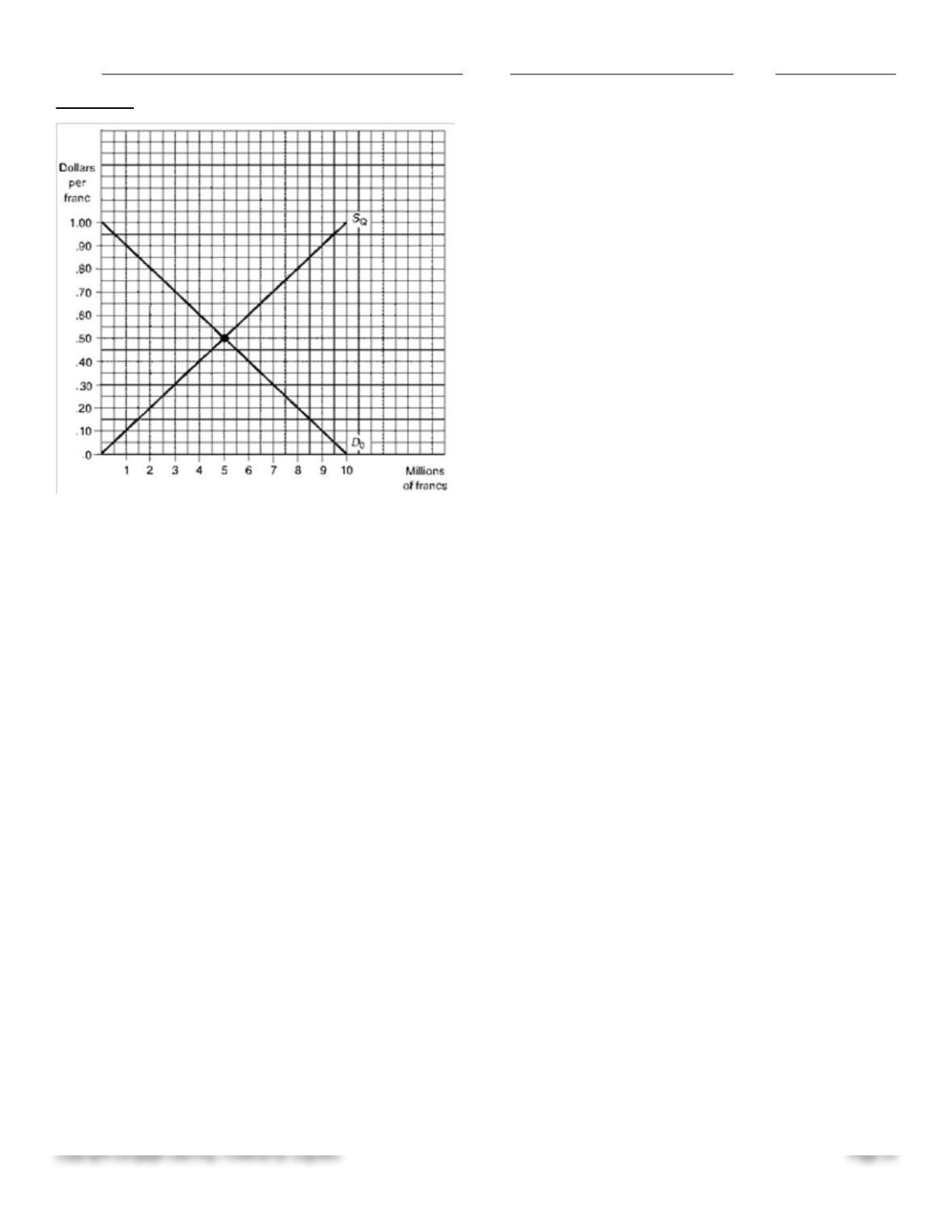
Figure 11.1 illustrates the supply and demand schedules for the Swiss franc. Assume that exchange rates are flexible.
Figure 11.1. Supply and Demand Schedules of Francs
Name:
Class:
Date:
chapter 11
Copyright Cengage Learning. Powered by Cognero.
Page 24
143. Refer to Figure 11.1. Suppose the exchange rate is $.70 per franc. Free-market forces would lead to a(n) ____ of the
dollar against the franc and a(n) ____ in U.S. international competitiveness.
a. depreciation, improvement
b. depreciation, worsening
c. appreciation, improvement
d. appreciation, worsening
144. Under a system of floating exchange rates, the Swiss franc would depreciate in value if which of the following
occurs?
a. price inflation in France
b. an increase in U.S. real income
c. a decrease in the Swiss money supply
d. falling interest rates in Switzerland
145. The nominal exchange rate is the
a. rate at which stocks and bonds may be exchanged for currency.
b. the rate at which domestic bank deposits and foreign bank deposits are exchanged.
c. the price of one country’s currency in terms of another country’s currency.
d. rate of return on Treasury bills, notes, and bonds.
146. Suppose researchers discover that Swiss beer causes cancer when given in large amounts to British mice. This
finding would likely result in a(n)
a. increase in the demand for Swiss francs.
b. decrease in the demand for Swiss francs.
c. increase in the supply of Swiss francs.
d. decrease in the supply of Swiss francs.
147. The offer rate
a. is the price at which the bank is willing to sell a unit of foreign currency.

Name:
Class:
Date:
chapter 11
Copyright Cengage Learning. Powered by Cognero.
Page 25
b. is the price that the bank is willing to pay for a unit of foreign currency.
c. is synonymous with the spread rate.
d. is synonymous with the exchange rate.
148. A call option provides an options holder
a. the obligation to buy foreign currency at a specific price.
b. the obligation to sell foreign currency at a specific price.
c. the right to buy foreign currency at a specific price.
d. the right to sell foreign currency at a specific price.
149. Suppose you have a rule to buy euros once the 50-day average of euros crosses the 200-day average over a period of
five minutes and to exit otherwise. What would happen if the euro rate crosses the 50-day average and lasts in the 200-day
average for a period of three minutes?
a. The trade is executed successfully.
b. The trade is exited.
c. The automated system takes no action.
d. An alert is broadcast for further instructions.
150. If Canadian speculators believed the Swiss franc was going to appreciate against the U.S. dollar, they would
a. purchase Canadian dollars.
b. purchase U.S. dollars.
c. purchase Swiss francs.
d. sell Swiss francs.
151. The soaring (appreciating) value of the trade-weighted dollar in the early 1980s
a. was caused by relatively low interest rates in the United States.
b. decreased the international competitiveness of American exporters.
c. resulted in Americans importing fewer goods and services.
d. increased the demand for American exports of goods and services.
Table 11.3. Key Currency Cross Rates
Dollar Euro Pound Swiss Franc
Canada 1.5326 1.4400 2.2362 0.9790
Japan 124.48 116.96 181.63 79.515
Mexico 9.7410 9.1526 14.213 6.2223
Switzerland 1.5655 1.4709 2.2842 ……….
U.K. .68540 .6440 ………. .4378
Euro 1.06430 ………. 1.5529 .67984
U.S. ………. .9396 1.4591 .63877
152. Referring to Table 11.3, the yen cost of purchasing 100 British pounds is roughly
a. 18,000 yen.
b. 19,000 yen.
c. 20,000 yen.
d. 21,000 yen.

Name:
Class:
Date:
chapter 11
Copyright Cengage Learning. Powered by Cognero.
Page 26
153. During the era of dollar appreciation, in the 1980s, a main reason why the dollar did NOT fall in value was
a. flows of foreign investment into the United States.
b. rising price inflation in the United States.
c. a substantial decrease in U.S. imports.
d. a substantial increase in U.S. exports.
154. Which trading strategy will lead to profit 100 percent of the time?
a. purchase the euro when the 50-day moving average of the euro crosses the 100-day moving average
b. purchase oil when the cost per barrel is $65
c. purchase gold when the cost per ounce is $1200
d. Losses are part of the game.
Exhibit 11.1
Assume the following: (1) the interest rate on six-month treasury bills is 8 percent per annum in the United Kingdom and
4 percent per annum in the United States; (2) today’s spot price of the pound is $1.50, while the six-month forward price
of the pound is $1.485.
155. Refer to Exhibit 11.1. If U.S. investors cover their exchange rate risk, then the extra return for the six months on the
U.K. treasury bills is
a. 1.0 percent.
b. 1.5 percent.
c. 2.0 percent.
d. 2.5 percent.
156. The demand curve for British pounds slopes downward because as the dollar ______ British goods become ______
for Americans. Therefore, Americans purchase ______ British goods, and the quantity of pounds demanded decreases.
a. appreciates against the pound; more expensive; more
b. appreciates against the pound; more expensive; fewer
c. depreciates against the pound; more expensive; more
d. depreciates against the pound; more expensive; fewer
157. The supply of foreign currency may be
a. upward-sloping.
b. backward-sloping.
c. vertical.
d. shifting rightward.
158. You are engaging in a ______ if you initially sell a currency (that you do not own) at a high price and then buy it
back later on at a low price.
a. discount position
b. premium position
c. short position
d. long position

Name:
Class:
Date:
chapter 11
Copyright Cengage Learning. Powered by Cognero.
Page 27
159. Concerning foreign exchange trading, a “futures contract” is characterized by which of the following?
a. The size of the contract is standardized in round lots.
b. The contract’s costs are based on bid/offer spread.
c. Trading happens over the counter by telephone.
d. The date of delivery is negotiable.
160. Concerning the foreign exchange market, which of the following is FALSE?
a. Most foreign exchange transactions involve the transfer of electronic balances between commercial banks or
foreign exchange dealers.
b. The worldwide amount of foreign exchange transactions is about $4 trillion a day.
c. Unlike the stock or commodity exchanges, the foreign exchange market is not an organized structure.
d. Virtually all foreign exchange trading occurs among banks located in New York City.
161. The most important (in terms of dollar value) type of foreign exchange transaction by U.S. banks is the
a. spot transaction.
b. forward transaction.
c. swap transaction.
d. option transaction.
162. The ______ is the price at which a foreign currency option can be exercised—that is, the price at which the foreign
currency is bought or sold
a. strike price
b. terms of trade
c. rate of exchange
d. exercise price
163. Concerning the exchange rate index of the U.S. dollar, suppose that the dollar’s real exchange rate index falls from
125 to 110. This means that
a. U.S. goods are less competitive on foreign markets.
b. U.S. goods are more competitive on foreign markets.
c. the dollar has appreciated against the currencies of its major trading partners.
d. U.S. price levels are identical to its trading partners.
164. In the interbank market for foreign exchange, the ____ refers to the price for which a bank is willing to sell a unit of
foreign currency.
a. offer rate
b. option rate
c. futures rate
d. bid rate
Exhibit 11.1
Assume the following: (1) the interest rate on six-month treasury bills is 8 percent per annum in the United Kingdom and
4 percent per annum in the United States; (2) today’s spot price of the pound is $1.50, while the six-month forward price
of the pound is $1.485.

Name:
Class:
Date:
chapter 11
Copyright Cengage Learning. Powered by Cognero.
Page 28
165. Refer to Exhibit 11.1. By investing in U.K. treasury bills rather than U.S. treasury bills, and NOT covering exchange
rate risk, U.S. investors earn an extra return of
a. 4 percent per year or 1 percent for the 6 months.
b. 4 percent per year or 2 percent for the 6 months.
c. 2 percent per year or 0.5 percent for the 6 months.
d. 2 percent per year or 1 percent for the 6 months.
Answer the next question on the basis of the table below, which shows the exchange rate between various currencies and
the U.S. dollar.
December 2015 Exchange Rate December 2016 Exchange Rate
Currency (dollars per unit of foreign currency) (dollars per unit of foreign currency)
Mexican peso $0.07 $0.09
Swiss franc $1.10 $1.05
Japanese yen $0.010 $0.012
British pound $1.64 $1.58
166. Between 2015 and 2016, the dollar
a. depreciated against the franc; depreciated against the pound.
b. appreciated against the franc; appreciated against the yen.
c. depreciated against the peso; appreciated against the pound.
d. depreciated against the peso; appreciated against the yen.
167. When you arrive at Heathrow Airport in London and go to the foreign exchange kiosk to exchange dollars for
pounds, you are trading in the
a. spot market.
b. forward market.
c. futures market.
d. options market.
168. What is a limitation of the automated trading system?
a. has potential for system quirks
b. generates orders as soon as trade rules are fulfilled
c. trades multiple accounts at one time
d. Traders can backtest their rules to determine if the result is profitable.
169. When short-term interest rates become lower in Tokyo than in New York, interest arbitrage operations will most
likely result in a(n)
a. increase in the spot price of the yen.
b. increase in the forward price of the dollar.
c. sale of dollars in the forward market.
d. purchase of yen in the spot market.
170. Assume that the exchange rate between the euro and the pound has changed from 2 euros per pound to 3 euros per
pound. We can say that the
a. euro appreciated against the pound.
b. euro depreciated against the pound.
c. the euro has been officially revalued.
Name:
Class:
Date:
chapter 11
Copyright Cengage Learning. Powered by Cognero.
Page 29
d. both the euro and the pound have appreciated.
171. Given the foreign currency market for the Swiss franc, the supply of francs slopes upward, because as the dollar price
of the franc rises
a. America’s demand for Swiss merchandise rises.
b. America’s demand for Swiss merchandise falls.
c. Switzerland’s demand for American merchandise rises.
d. Switzerland’s demand for American merchandise falls.
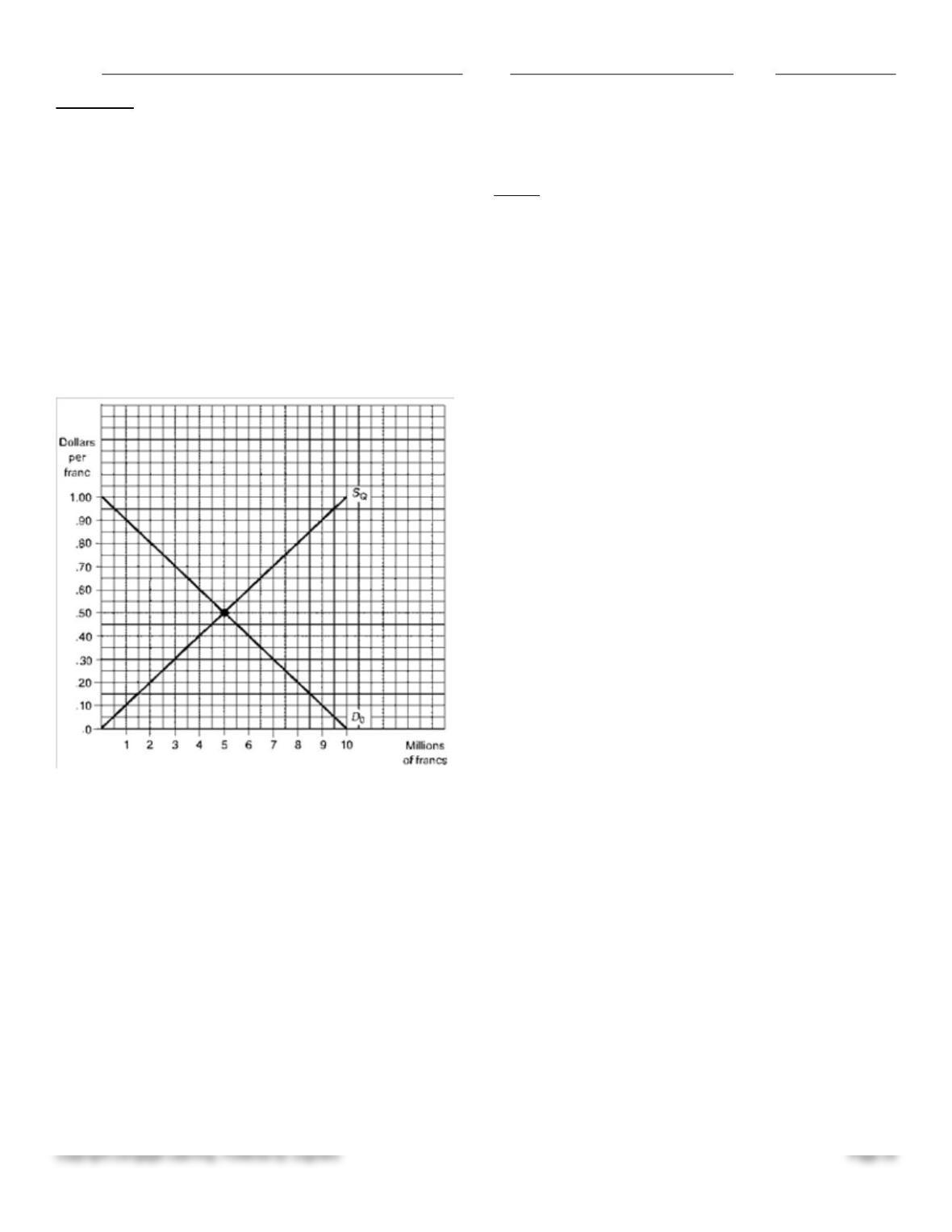
Figure 11.1 illustrates the supply and demand schedules for the Swiss franc. Assume that exchange rates are flexible.
Figure 11.1. Supply and Demand Schedules of Francs
172. Refer to Figure 11.1. Suppose the exchange rate is $.30 per franc. Free-market forces would lead to a(n) ____ of the
dollar against the franc and a(n) ____ in U.S. international competitiveness.
a. depreciation, improvement
b. depreciation, worsening
c. appreciation, improvement
d. appreciation, worsening
173. Concerning foreign exchange trading, wholesale transactions involving more than 1 million currency units generally
a. occur between banks or with large corporate customers.
b. occur only in Hong Kong and Frankfurt.
c. are limited to transactions in the spot market.
d. are limited to transactions in the forward market.
Table 11.2. Supply and Demand of British Pounds
Quantity Dollars Quantity
of Pounds per of Pounds

Name:
Class:
Date:
chapter 11
Copyright Cengage Learning. Powered by Cognero.
Page 30
Supplied Pound Demanded
1,000 2.00 200
800 1.80 400
600 1.60 600
400 1.40 800
200 1.20 1,000
174. Refer to Table 11.2. The equilibrium exchange rate equals
a. $1.20 per pound.
b. $1.40 per pound.
c. $1.60 per pound.
d. $1.80 per pound.
175. The real exchange rate differs from the nominal exchange rate in that the real exchange rate
a. does not account for the purchasing power of the currency.
b. adjusts the nominal exchange rate for interest rate differentials among countries.
c. is fixed, while the nominal exchange rate is flexible.
d. embodies the changes in price levels of countries in its calculation.
The next five questions refer to the table below, which shows the supply and demand schedules of British pounds.
Exchange Rate:
Quantity of Pounds Supplied Dollars Per Pound Quantity of Pounds Demanded
100 $2.50 20
80 2.00 40
60 1.50 60
40 1.00 80
20 0.50 100
176. In the table above, a change in the ______ will result in a movement along the supply schedule of pounds.
a. dollar/pound exchange rate
b. rate of interest in the United States
c. per-capita income of Americans
d. level of technology in the United States
Table 11.4. Forward Exchange Rates
U.S. Dollar Equivalent
Wednesday Tuesday
Switzerland (Franc) .6598 .6590
30-day Forward .6592 .6585
90-day Forward .6585 .6578
180-day Forward .6577 .6572
Name:
Class:
Date:
chapter 11
Copyright Cengage Learning. Powered by Cognero.
Page 31
177. Refer to Table 11.4. On Wednesday, the 90-day forward franc was selling at a
a. 0.8 percent premium per annum against the dollar.
b. 1.6 percent premium per annum against the dollar.
c. 0.8 percent discount per annum against the dollar.
d. 1.6 percent discount per annum against the dollar.
Exhibit 11.1
Assume the following: (1) the interest rate on six-month treasury bills is 8 percent per annum in the United Kingdom and
4 percent per annum in the United States; (2) today’s spot price of the pound is $1.50, while the six-month forward price
of the pound is $1.485.
178. Refer to Exhibit 11.1. If the price of the six-month forward pound were to ____, then U.S. investors would no longer
earn an extra return by shifting funds to the United Kingdom.
a. rise to $1.52
b. rise to $1.53
c. fall to $1.48
d. fall to $1.47
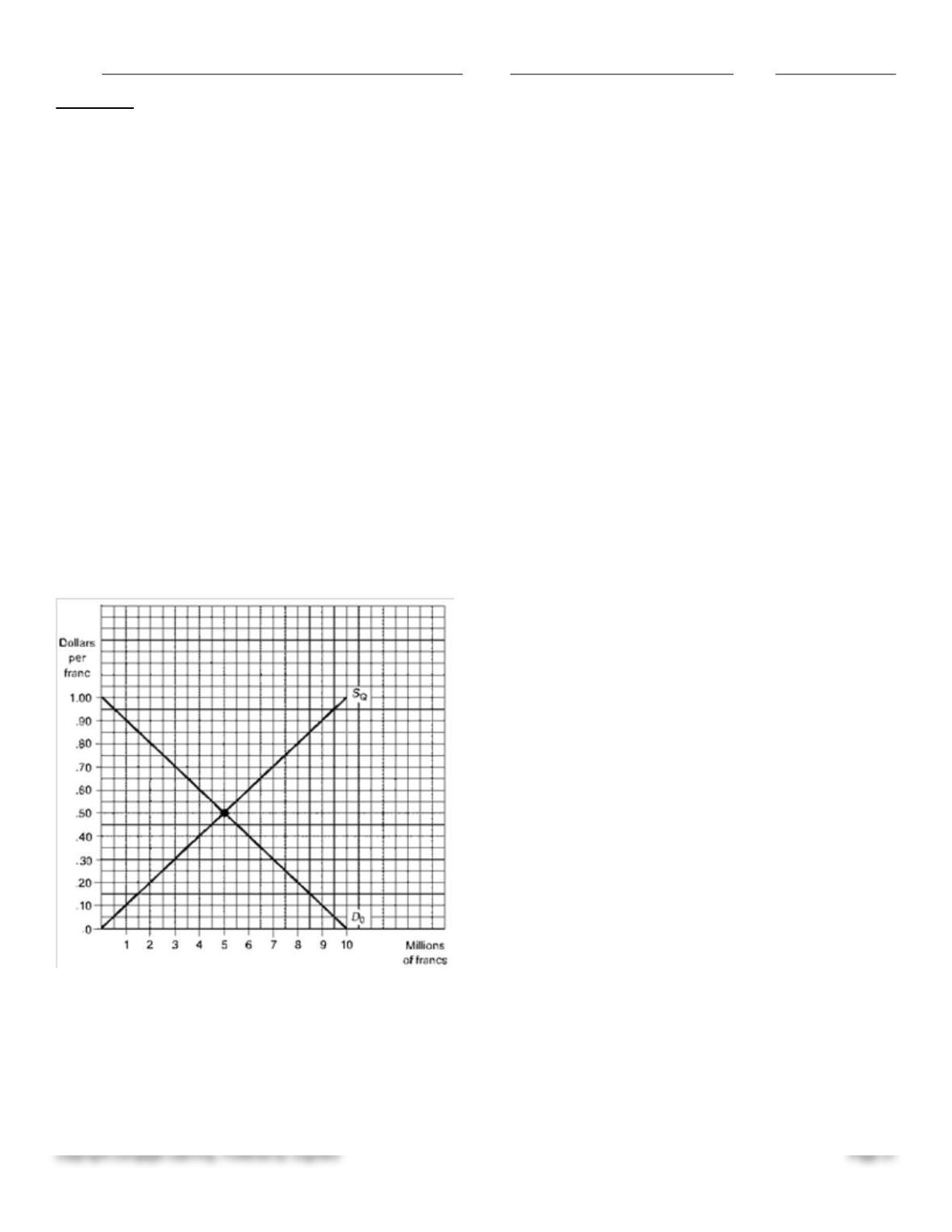
Figure 11.1 illustrates the supply and demand schedules for the Swiss franc. Assume that exchange rates are flexible.
Figure 11.1. Supply and Demand Schedules of Francs
179. Refer to Figure 11.1. At the equilibrium exchange rate of ____ per franc, ____ francs will be purchased at a total
dollar cost of ____.
a. $.50, 5 million, $2.5 million
b. $.50, 5 million, $1.5 million
c. $.70, 3 million, $2.1 million
d. $.70, 7 million, $4.9 million

Name:
Class:
Date:
chapter 11
Copyright Cengage Learning. Powered by Cognero.
Page 32
180. A depreciation of the dollar will have its most pronounced impact on imports if the demand for imports is
a. constant.
b. inelastic.
c. elastic.
d. unitary elastic.
The next five questions refer to the table below, which shows the supply and demand schedules of British pounds.
Exchange Rate:
Quantity of Pounds Supplied Dollars Per Pound Quantity of Pounds Demanded
100 $2.50 20
80 2.00 40
60 1.50 60
40 1.00 80
20 0.50 100
181. In the table above, if the exchange rate is equal to $2.00 per pound, then there is a ______, and the exchange rate
will______.
a. surplus of pounds, decrease
b. surplus of pounds, increase
c. shortage of pounds, decrease
d. shortage of pounds, increase
182. Concerning foreign exchange trading, a “forward contract”
a. has no defined expiration date at which settlement must occur.
b. has contract costs based on the brokerage fees for sell and buy orders.
c. is issued by a major commercial bank, like Citibank or Barclays.
d. is traded on IMM’s market floor.
183. In recent years, the smallest amount of foreign-exchange trading has involved
a. spot transactions.
b. forward transactions.
c. foreign-exchange options.
d. foreign-exchange swaps.
184. Concerning the covering of exchange market risks, assuming that a depreciation of the domestic currency is
anticipated, one can say that there is an incentive for
a. exporters to rush to cover their future needs.
b. importers to rush to cover their future needs.
c. both exporters and importers to rush to cover their future needs.
d. neither exporters nor importers to rush to cover their future needs.
The next five questions refer to the table below, which shows the supply and demand schedules of British pounds.
Exchange Rate:
Quantity of Pounds Supplied Dollars Per Pound Quantity of Pounds Demanded
100 $2.50 20
80 2.00 40
60 1.50 60
Name:
Class:
Date:
chapter 11
Copyright Cengage Learning. Powered by Cognero.
Page 33
40 1.00 80
20 0.50 100
185. In the table above, if the exchange rate is equal to $1.00 per pound, then there is a ______, and the exchange rate
will______.
a. surplus of pounds, decrease
b. surplus of pounds, increase
c. shortage of pounds, decrease
d. shortage of pounds, increase
186. The supply curve of British pounds slopes upward because as the dollar _____ American goods become ______ for
the British. Therefore, the British purchase ______ American goods, and the quantity of pounds supplied increases.
a. depreciates against the pound; less expensive; more
b. depreciates against the pound; more expensive; less
c. appreciates against the pound; more expensive; more
d. appreciates against the pound; less expensive; less
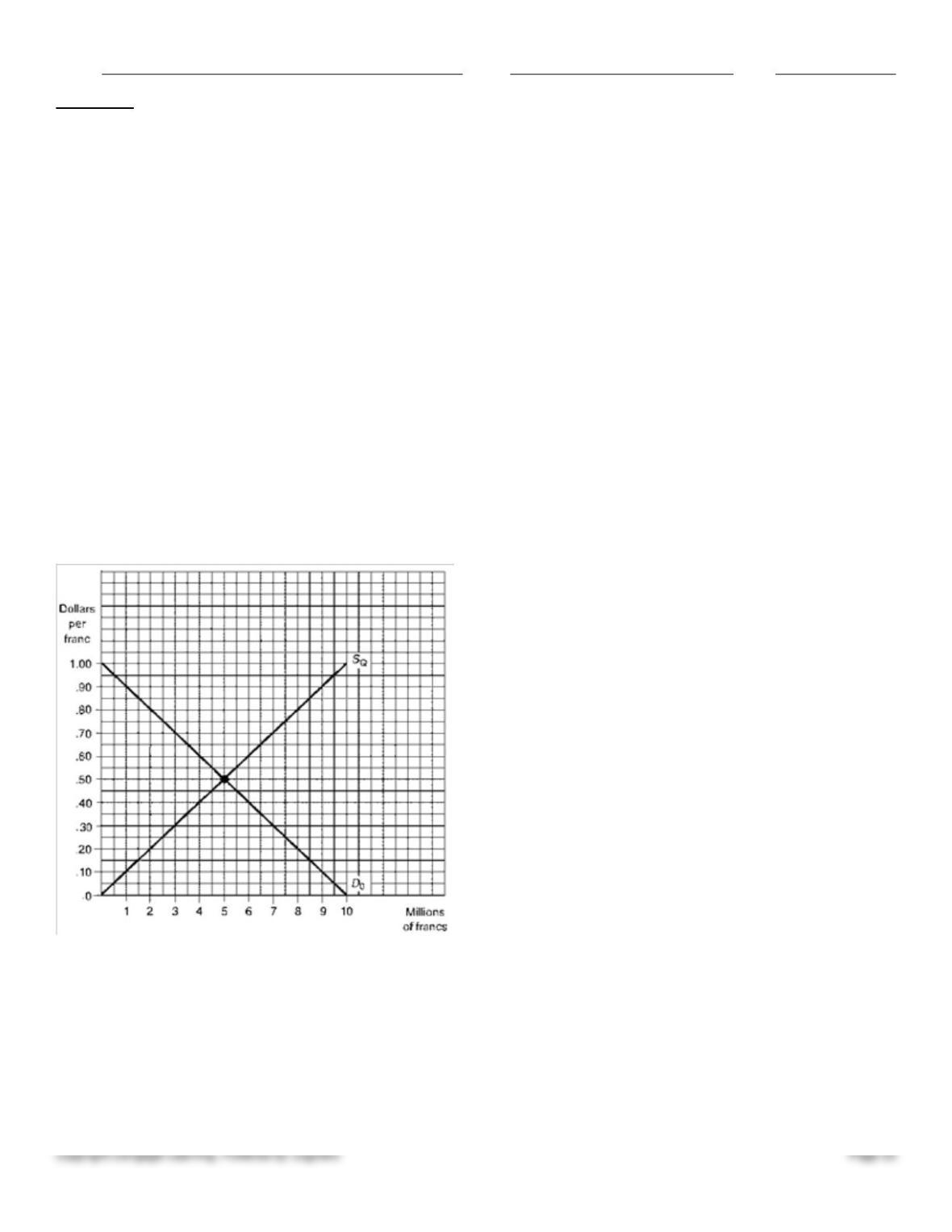
Figure 11.1 illustrates the supply and demand schedules for the Swiss franc. Assume that exchange rates are flexible.
Figure 11.1. Supply and Demand Schedules of Francs
187. Refer to Figure 11.1. Suppose the exchange rate is $.30 per franc. At this exchange rate, there is an ____ of francs,
which leads to a ____ in the dollar price of the franc, a(n) ____ in the quantity of francs supplied, and a(n) ____ in the
quantity of francs demanded.
a. excess demand, rise, increase, decrease
b. excess demand, rise, decrease, increase
c. excess supply, fall, decrease, increase
d. excess supply, fall, increase, decrease
188. Most foreign exchange trading occurs between banks and

Name:
Class:
Date:
chapter 11
Copyright Cengage Learning. Powered by Cognero.
Page 34
a. national governments.
b. other banks.
c. corporations.
d. household investors.
The next five questions refer to the table below, which shows the supply and demand schedules of British pounds.
Exchange Rate:
Quantity of Pounds Supplied Dollars Per Pound Quantity of Pounds Demanded
100 $2.50 20
80 2.00 40
60 1.50 60
40 1.00 80
20 0.50 100
189. In the table above, a change in the ______ will result in a movement along the demand schedule for pounds.
a. dollar/pound exchange rate
b. rate of interest in the United States
c. per-capita income of Americans
d. level of technology in the United States
190. The demand for foreign exchange results from transactions that appear on the
a. credit side of a country’s balance of payments statement.
b. debit side of a country’s balance of payments statement.
c. both the credit side and the debit side of a country’s balance of payments statement.
d. neither the credit side nor the debit side of a country balance of payments statement.
191. When the value of the Mexican peso declines relative to another currency, the exchange rate for the Peso has
a. revalued.
b. appreciated.
c. depreciated.
d. deposited.
192. Concerning the exchange rate index of the U.S. dollar, suppose that the dollar’s real exchange rate index rises from
95 to 115. This means that
a. the dollar has depreciated against the currencies of its major trading partners.
b. the dollar has appreciated against the currencies of its major trading partners.
c. the dollar’s nominal exchange rate index falls.
d. the dollar’s nominal exchange rate index remains constant.
193. In the early 1980s, the Federal Reserve pursued a tight monetary policy. All else being equal, the impact of that
policy was to ____ interest rates in the United States relative to those in Europe and cause the dollar to ____ against
European currencies.
a. decrease, depreciate
b. decrease, appreciate
c. increase, depreciate
d. increase, appreciate
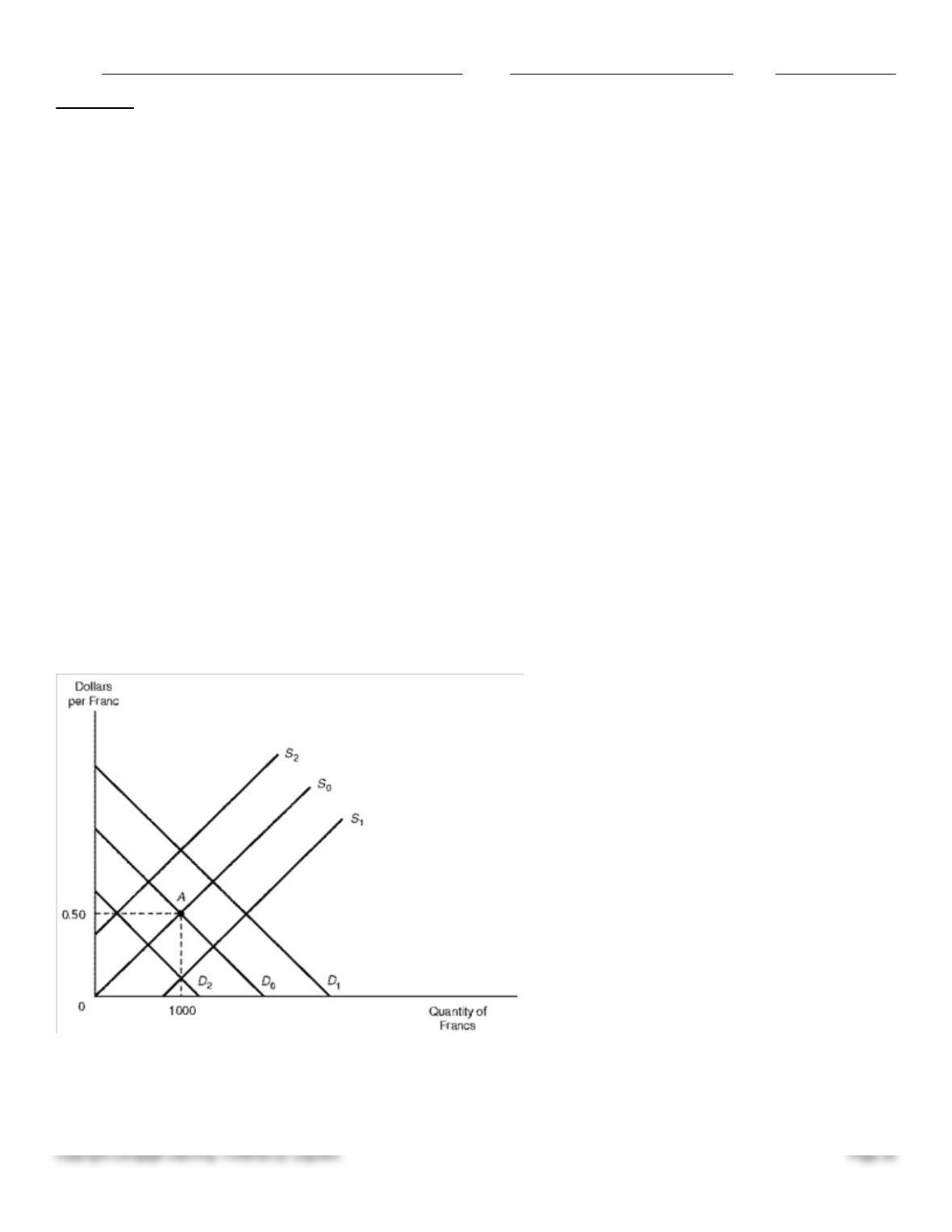
Name:
Class:
Date:
chapter 11
Copyright Cengage Learning. Powered by Cognero.
Page 35
194. Suppose the exchange rate between the Japanese yen and the U.S. dollar is 100 yen per dollar. A Japanese stereo
with a price of 60,000 yen will cost
a. $60.
b. $600.
c. $6000.
d. $5000.
195. Suppose that a Swiss watch that costs 400 francs in Switzerland costs $200 in the United States. The exchange rate
between the franc and the dollar is
a. 2 francs per dollar.
b. 1 franc per dollar.
c. $2 per franc.
d. $3 per franc.
196. When the U.S. dollar appreciates against the Mexican peso, the peso becomes ______, and the U.S. exchange rate
______.
a. less expensive; declines
b. less expensive; rises
c. more expensive; declines
d. more expensive; rises
The figure below illustrates the market for Swiss francs in a world of market-determined exchange rates. Assume the
equilibrium exchange rate is $0.5 per franc, given by the intersection of schedules S0 and D0.
Figure 11.2. Market for Francs
197. Refer to Figure 11.2. A shift in the demand for francs from D0 to D1, or a shift in the supply of francs from S0 to S2,
would result in a(n)
a. depreciation in the dollar against the franc.
b. appreciation in the dollar against the franc.

Name:
Class:
Date:
chapter 11
Copyright Cengage Learning. Powered by Cognero.
Page 36
c. unchanged dollar/franc exchange rate.
d. depreciation in the franc against the dollar.
198. The exchange rate is the price at which the ______ of Switzerland exchanges for the ______ of Germany.
a. francs; goods and services
b. goods and services; goods and services
c. francs; euros
d. euros; francs
199. Assume you are an American exporter and expect to receive 50 pounds sterling at the end of 60 days. You can
remove the risk of loss due to a devaluation of the pound sterling by
a. selling sterling in the forward market for 60-day delivery.
b. buying sterling now and selling it at the end of 60 days.
c. selling the dollar equivalent in the forward market for 60-day delivery.
d. keeping the sterling in Britain after it is delivered to you.
200. When the dollar depreciates,
a. U.S. exporters tend to sell more goods in foreign markets.
b. U.S. consumers see a lower price on foreign goods.
c. More foreign tourists can afford to visit the United States.
d. U.S. inflation is low.
201. In 1987, currency speculator Andy Krieger made a lucrative currency trade. Believing that the New Zealand dollar
was overvalued, Krieger bet on its fall, selling hundreds of millions of dollars at a time and pushing its value down. He
profited by re-buying New Zealand dollars when the price bottomed out. What Krieger was engaging in was a(n)
a. discount position.
b. premium position.
c. short position.
d. long position.
202. The pound shows a forward premium against the dollar (the forward rate is greater than the spot rate) when
a. interest rates in the United Kingdom are higher than those in the United States.
b. interest rates in the United Kingdom are lower than those in the United States.
c. real GDP is higher in the United Kingdom than in the United States.
d. real GDP is lower in the United Kingdom than in the United States.
203. Which of the following would NOT induce the U.S. demand curve for foreign exchange to shift backward to the left?
a. worsening American tastes for goods produced overseas
b. decreasing interest rates in the U.S. compared to those overseas
c. a fall in the level of U.S. income
d. a depreciation in the U.S. dollar against foreign currencies
204. Throughout the foreign exchange market, trading in currencies
a. occurs at any hour of the day or night.
b. occurs at prices established by the U.S. and British governments.
c. is conducted on centralized trading floors in Paris and Hong Kong.

Name:
Class:
Date:
chapter 11
Copyright Cengage Learning. Powered by Cognero.
Page 37
d. is restricted to the hours between 1 P.M and 3 P.M., Eastern Time Zone.
205. Suppose there occurs an increase in the Canadian demand for Japanese computers. This results in
a. an increase in the demand for yen.
b. a decrease in the demand for yen.
c. an increase in the supply of yen to Canada.
d. a decrease in the supply of yen to Canada.
206. When the dollar gets stronger,
a. U.S. firms become more competitive in the international market.
b. foreign tourists travel in the U.S. at a higher cost.
c. U.S. inflation increases.
d. U.S. consumers face higher prices on foreign goods.
207. What foreign exchange transactions do banks typically engage in?
208. How is the equilibrium rate of exchange determined?
209. Is it possible to trade foreign exchange in the futures market? How does such trading differ from the forward market?
210. Where are foreign currency options traded?
Name:
Class:
Date:
chapter 11
Answer Key
1. False
2. False
3. True
Name:
Class:
Date:
Name:
Class:
Date:
Name:
Class:
Date:
Name:
Class:
Date:
Name:
Class:
Date:
Name:
Class:
Date:
Name:
Class:
Date:
Name:
Class:
Date: