CHAPTER 11—FOREIGN EXCHANGE
MULTIPLE CHOICE
1. Assume you are an American exporter and expect to receive 50 pounds sterling at the end of 60 days.
You can remove the risk of loss due to a devaluation of the pound sterling by:
a.
Selling sterling in the forward market for 60-day delivery
b.
Buying sterling now and selling it at the end of 60 days
c.
Selling the dollar equivalent in the forward market for 60-day delivery
d.
Keeping the sterling in Britain after it is delivered to you
2. Which of the following tends to cause the U.S. dollar to appreciate in value?
a.
An increase in U.S. prices above foreign prices
b.
Rapid economic growth in foreign countries
c.
A fall in U.S. interest rates below foreign levels
d.
An increase in the level of U.S. income
3. Concerning the covering of exchange market risks—assuming that a depreciation of the domestic
currency is anticipated, one can say that there is an incentive for:
a.
Exporters to rush to cover their future needs
b.
Importers to rush to cover their future needs
c.
Both exporters and importers to rush to cover their future needs
d.
Neither exporters nor importers to rush to cover their future needs
4. When short-term interest rates become lower in Tokyo than in New York, interest arbitrage operations
will most likely result in a(n):
a.
Increase in the spot price of the yen
b.
Increase in the forward price of the dollar
c.
Sale of dollars in the forward market
d.
Purchase of yen in the spot market
5. An appreciation in the value of the U.S. dollar against the British pound would tend to:
a.
Discourage the British from buying American goods
b.
Discourage Americans from buying British goods
c.
Increase the number of dollars that could be bought with a pound
d.
Discourage U.S. tourists from traveling to Britain
6. Concerning the foreign exchange market, one can best say that:
a.
There is a spot market for virtually every currency in the world
b.
The market is highly centralized like the stock exchange
c.
Most foreign exchange payments are made with bank notes
d.
The values of the forward and spot rates are always in agreement
7. Suppose researchers discover that Swiss beer causes cancer when given in large amounts to British
mice. This finding would likely result in a (an):
a.
Increase in the demand for Swiss francs
b.
Decrease in the demand for Swiss francs
c.
Increase in the supply of Swiss francs
d.
Decrease in the supply of Swiss francs
8. Suppose that real incomes increase more rapidly in the United States than in Mexico. In the United
States, this situation would likely result in a (an):
a.
Increase in the demand for pesos
b.
Decrease in the demand for pesos
c.
Increase in the supply of pesos
d.
Decrease in the supply of pesos
9. A depreciation of the dollar refers to:
a.
A fall in the dollar price of foreign currency
b.
An increase in the dollar price of foreign currency
c.
A loss of foreign-exchange reserves for the U.S.
d.
An intervention in the international money market
10. If Canadian speculators believed the Swiss franc was going to appreciate against the U.S. dollar, they
would:
a.
Purchase Canadian dollars
b.
Purchase U.S. dollars
c.
Purchase Swiss francs
d.
Sell Swiss francs
11. A major difference between the spot market and the forward market is that the spot market deals with:
a.
The immediate delivery of currencies
b.
The merchandise trade account
c.
Currencies traded for future delivery
d.
Hedging of international currency risks
12. The exchange rate is kept the same in all parts of the market by:
a.
Forward cover
b.
Hedging
c.
Exchange speculation
d.
Exchange arbitrage
13. If you have a commitment to pay a friend in Britain 1,000 pounds in 30 days, you could remove the
risk of loss due to the appreciation of the pound by:
a.
Buying dollars in the forward market for delivery in 30 days
b.
Selling dollars in the forward market for delivery in 30 days
c.
Buying the pounds in the forward market for delivery in 30 days
d.
Selling the pounds in the forward market for delivery in 30 days
14. An increase in the dollar price of other currencies tends to cause:
a.
U.S. goods to be cheaper than foreign goods
b.
U.S. goods to be more expensive than foreign goods
c.
Foreign goods to be more expensive to residents of foreign nations
d.
Foreign goods to be cheaper to residents of the United States
15. Which of the following would not induce the U.S. demand curve for foreign exchange to shift
backward to the left?
a.
Worsening American tastes for goods produced overseas
b.
Decreasing interest rates in the U.S. compared to those overseas
c.
A fall in the level of U.S. income
d.
A depreciation in the U.S. dollar against foreign currencies
16. A U.S. export company scheduled to receive 1 million pounds six months from today can hedge its
foreign exchange risk by:
a.
Buying today 1 million pounds in the forward market for delivery in six months
b.
Buying 1 million pounds in the spot market for delivery in six months
c.
Selling 1 million pounds in the spot market for delivery in six months
d.
Selling today 1 million pounds in the forward market for delivery in six months
17. Over time, a depreciation in the value of a nation’s currency in the foreign exchange market will result
in:
a.
Exports rising and imports falling
b.
Imports rising and exports falling
c.
Both imports and exports rising
d.
Both imports and exports falling
18. Grain shortages in countries that buy large amounts of grain from the United States would increase the
demand for American grain and:
a.
Reduce the demand for dollars
b.
Increase the demand for dollars
c.
Reduce the supply of dollars
d.
Increase the supply of dollars
19. Suppose the exchange rate between the Japanese yen and the U.S. dollar is 100 yen per dollar. A
Japanese stereo with a price of 60,000 yen will cost:
a.
$60
b.
$600
c.
$6000
d.
None of the above
20. The supply of foreign currency may be:
a.
Upward-sloping
b.
Backward-sloping
c.
Vertical
d.
None of the above
21. Suppose that a Swiss watch that costs 400 francs in Switzerland costs $200 in the United States. The
exchange rate between the franc and the dollar is:
a.
2 francs per dollar
b.
1 franc per dollar
c.
$2 per franc
d.
$3 per franc
22. In the early 1980s, the Federal Reserve pursued a tight monetary policy. All else being equal, the
impact of that policy was to ____ interest rates in the United States relative to those in Europe and
cause the dollar to ____ against European currencies.
a.
Decrease, depreciate
b.
Decrease, appreciate
c.
Increase, depreciate
d.
Increase, appreciate
23. Under a system of floating exchange rates, the Swiss franc would depreciate in value if which of the
following occurs?
a.
Price inflation in France
b.
An increase in U.S. real income
c.
A decrease in the Swiss money supply
d.
Falling interest rates in Switzerland
24. A depreciation of the dollar will have its most pronounced impact on imports if the demand for
imports is:
a.
Constant
b.
Inelastic
c.
Elastic
d.
Unitary elastic
25. During the era of dollar appreciation, from 1981 to 1985, a main reason why the dollar did not fall in
value was:
a.
Flows of foreign investment into the United States
b.
Rising price inflation in the United States
c.
A substantial decrease in U.S. imports
d.
A substantial increase in U.S. exports
26. Which financial instrument provides a buyer the right to purchase or sell a fixed amount of currency at
a prearranged price, within a few days to a couple of years?
a.
Letter of credit
b.
Foreign currency option
c.
Cable transfer
d.
Bill of exchange
27. Given the foreign currency market for the Swiss franc, the supply of francs slopes upward, because as
the dollar price of the franc rises:
a.
America’s demand for Swiss merchandise rises
b.
America’s demand for Swiss merchandise falls
c.
Switzerland’s demand for American merchandise rises
d.
Switzerland’s demand for American merchandise falls
28. In a supply-and-demand diagram for Japanese yen, with the exchange rate in dollars per yen on the
vertical axis, the demand schedule for yen is drawn sloping:
a.
Upward
b.
Vertical
c.
Downward
d.
Horizontal
29. Suppose there occurs an increase in the Canadian demand for Japanese computers. This results in:
a.
An increase in the demand for yen
b.
A decrease in the demand for yen
c.
An increase in the supply of yen to Canada
d.
A decrease in the supply of yen to Canada
Table 11.1 gives the exchange rate quotations for the U.S. dollar and the British pound.
Table 11.1. Foreign Exchange Quotations
U.S. Dollar
Currency Per
Equivalent
U.S. Dollar
Tuesday
Monday
Tuesday
Monday
Britain (Pound)
1.4270
1.4390
.7008
.6949
30-day Forward
1.4211
1.4333
.7037
.6977
60-day Forward
1.4090
1.4220
.7097
.7032
180-day Forward
1.3930
1.4070
.7179
.7107
30. Consider Table 11.1. If one were to buy pounds for immediate delivery, on Tuesday the dollar cost of
each pound would be:
a.
$0.7008
b.
$0.7037
c.
$1.4211
d.
$1.4270
31. Consider Table 11.1. If one were to sell dollars for immediate delivery, on Tuesday the pound cost of
each dollar would be:
a.
.7008 pounds per dollar
b.
.7037 pounds per dollar
c.
1.4270 pounds per dollar
d.
1.4211 pounds per dollar
32. Consider Table 11.1. Comparing Tuesday to the previous Monday, by Tuesday the dollar had:
a.
Depreciated against the pound
b.
Appreciated against the pound
c.
Not changed against the pound
d.
None of the above
33. Consider Table 11.1. Concerning the Tuesday quotations: compared to the cost of buying 100 pounds
on the spot market, if 100 pounds were bought for future delivery in 180 days the dollar cost of the
pounds would be:
a.
$3.40 higher
b.
$3.40 lower
c.
$6.80 higher
d.
$6.80 lower
34. Which method of trading currencies involves the conversion of one currency into another at one point
in time with an agreement to reconvert it back to the original currency at some point in the future?
a.
Forward transaction
b.
Futures transaction
c.
Spot transaction
d.
Swap transaction
35. Most foreign exchange trading occurs between banks and:
a.
National governments
b.
Other banks
c.
Corporations
d.
Household investors
36. The most important (in terms of dollar value) type of foreign exchange transaction by U.S. banks is
the:
a.
Spot transaction
b.
Forward transaction
c.
Swap transaction
d.
Option transaction
37. In the interbank market for foreign exchange, the ____ refers to the price that a bank is willing to pay
for a unit of foreign currency.
a.
Offer rate
b.
Bid rate
c.
Spread rate
d.
Transaction rate
38. In the interbank market for foreign exchange, the ____ refers to the price for which a bank is willing to
sell a unit of foreign currency.
a.
Offer rate
b.
Option rate
c.
Futures rate
d.
Bid rate
39. In the interbank market for foreign exchange, the ____ refers to the difference between the offer rate
and the bid rate.
a.
Cross rate
b.
Option
c.
Arbitrage
d.
Spread
40. A corporation dealing in foreign exchange may desire to obtain an exchange quote between the pound
and franc, whose values are both expressed relative to the dollar. ____ are used to determine such a
relationship.
a.
Spot exchange rates
b.
Forward exchange rates
c.
Cross exchange rates
d.
Option exchange rates
41. Suppose the exchange value of the British pound is $2 per pound while the exchange value of the
Swiss franc is 50 cents per pound. The cross exchange rate between the pound and the franc is:
a.
1 franc per pound
b.
2 francs per pound
c.
3 francs per pound
d.
4 francs per pound
Exhibit 11.1
Assume the following: (1) the interest rate on 6-month treasury bills is 8 percent per annum in the
United Kingdom and 4 percent per annum in the United States; (2) today’s spot price of the pound is
$1.50 while the 6-month forward price of the pound is $1.485.
42. Refer to Exhibit 11.1. By investing in U.K. treasury bills rather than U.S. treasury bills, and not
covering exchange rate risk, U.S. investors earn an extra return of:
a.
4 percent per year, 1 percent for the 6 months
b.
4 percent per year, 2 percent for the 6 months
c.
2 percent per year, 0.5 percent for the 6 months
d.
2 percent per year, 1 percent for the 6 months
43. Refer to Exhibit 11.1. If U.S. investors cover their exchange rate risk, the extra return for the 6 months
on the U.K. treasury bills is:
a.
1.0 percent
b.
1.5 percent
c.
2.0 percent
d.
2.5 percent
44. Refer to Exhibit 11.1. If the price of the 6-month forward pound were to ____, U.S. investors would no
longer earn an extra return by shifting funds to the United Kingdom.
a.
Rise to $1.52
b.
Rise to $1.53
c.
Fall to $1.48
d.
Fall to $1.47
45. Assume that you are the Chase Manhattan Bank of the United States, and you have 1 million Swiss
francs in your vault that you will need to use in 30 days. Moreover, you need 500,000 British pounds
for the next 30 days. You arrange to loan your francs to Barclays Bank of London for 30 days in
exchange for 500,000 pounds today, and reverse the transaction at the end of 30 days. You have just
arranged a:
a.
Forward contract
b.
Futures contract
c.
Spot contract
d.
Currency swap
Figure 11.1. Supply and Demand Schedules of Francs
46. Refer to Figure 11.1. At the equilibrium exchange rate of ____ per franc, ____ francs will be
purchased at a total dollar cost of ____.
a.
$.50, 5 million, $2.5 million
b.
$.50, 5 million, $1.5 million
c.
$.70, 3 million, $2.1 million
d.
$.70, 7 million, $4.9 million
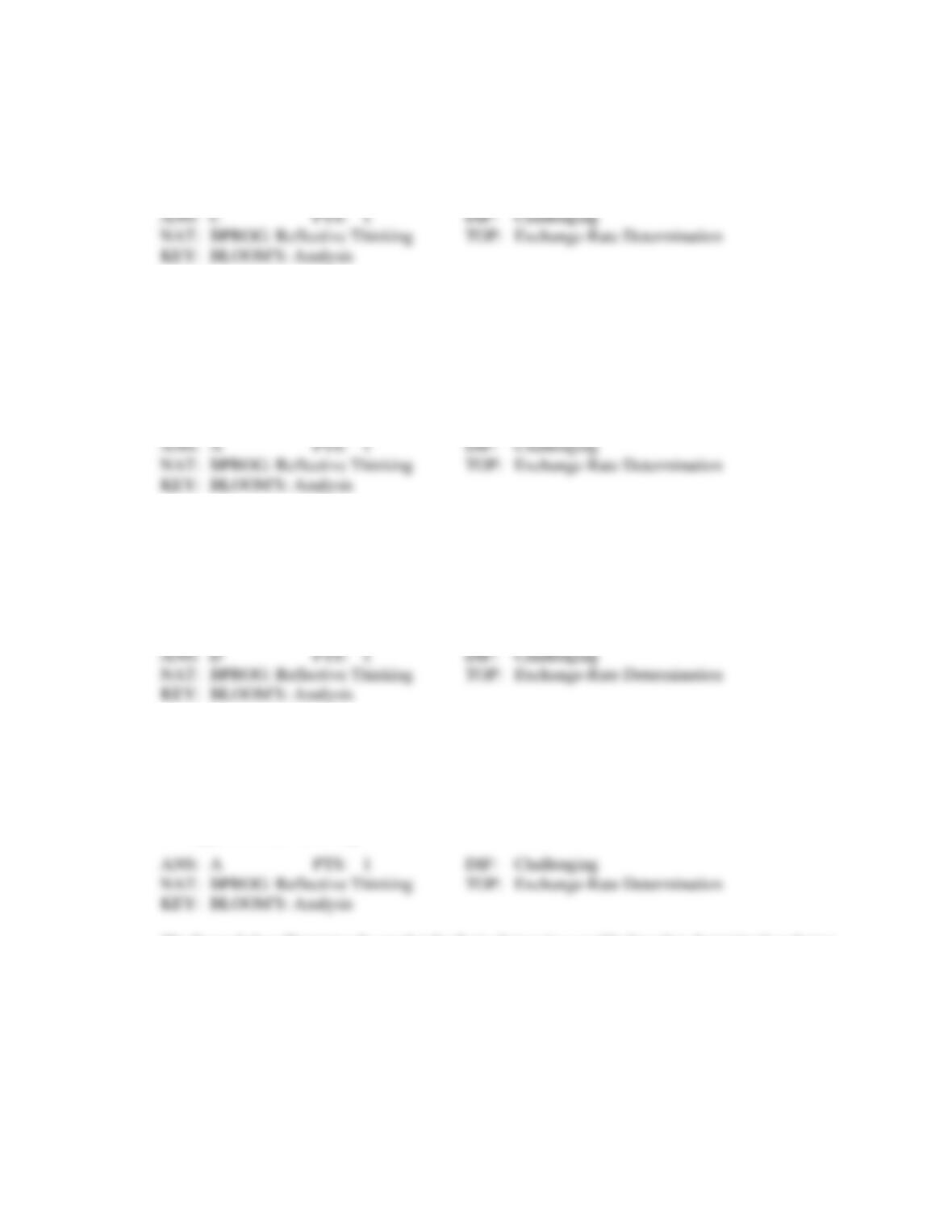
47. Refer to Figure 11.1. Suppose the exchange rate is $.70 per franc. At this exchange rate there is an
____ of francs which leads to a ____ in the dollar price of the franc, a (an) ____ in the quantity of
francs supplied, and a (an) ____ in the quantity of francs demanded.
a.
Excess demand, rise, increase, decrease
b.
Excess demand, rise, decrease, increase
c.
Excess supply, fall, decrease, increase
d.
Excess supply, fall, increase, decrease
48. Refer to Figure 11.1. Suppose the exchange rate is $.30 per franc. At this exchange rate there is an
____ of francs which leads to a ____ in the dollar price of the franc, a (an) ____ in the quantity of
francs supplied, and a (an) ____ in the quantity of francs demanded.
a.
Excess demand, rise, increase, decrease
b.
Excess demand, rise, decrease, increase
c.
Excess supply, fall, decrease, increase
d.
Excess supply, fall, increase, decrease
49. Refer to Figure 11.1. Suppose the exchange rate is $.70 per franc. Free-market forces would lead to a
(an) ____ of the dollar against the franc and a (an) ____ in U.S. international competitiveness.
a.
Depreciation, improvement
b.
Depreciation, worsening
c.
Appreciation, improvement
d.
Appreciation, worsening
50. Refer to Figure 11.1. Suppose the exchange rate is $.30 per franc. Free-market forces would lead to a
(an) ____ of the dollar against the franc and a (an) ____ in U.S. international competitiveness:
a.
Depreciation, improvement
b.
Depreciation, worsening
c.
Appreciation, improvement
d.
Appreciation, worsening
The figure below illustrates the market for Swiss francs in a world of market-determined exchange
rates. Assume the equilibrium exchange rate is $0.5 per franc, given by the intersection of schedules S0
and D0.
Figure 11.2. Market for Francs
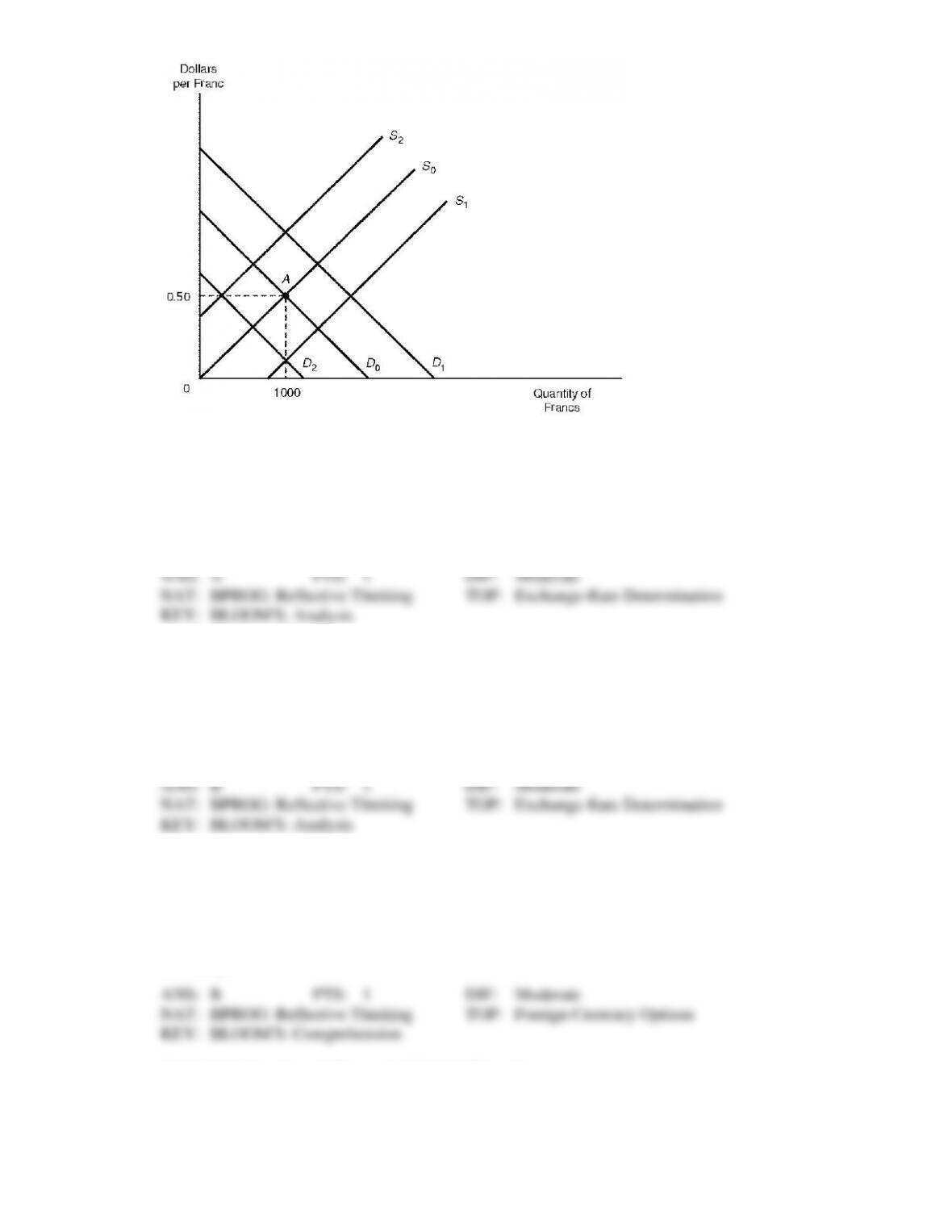
51. Refer to Figure 11.2. A shift in the demand for francs from D0 to D1 or a shift in the supply of francs
from S0 to S2, would result in a (an):
a.
Depreciation in the dollar against the franc
b.
Appreciation in the dollar against the franc
c.
Unchanged dollar/franc exchange rate
d.
None of the above
52. Refer to Figure 11.2. A shift in the demand for francs from D0 to D2, or a shift in the supply of francs
from S0 to S1, would result in a (an):
a.
Depreciation in the dollar against the franc
b.
Appreciation in the dollar against the franc
c.
No change in the dollar/franc exchange rate
d.
None of the above
53. A (An) ____ is an arrangement by which two parties exchange one currency for another and agree that
the exchange will be reversed at a stipulated date in the future:
a.
Arbitrage
b.
Swap
c.
Option
d.
Hedge
Table 11.2. Supply and Demand of British Pounds