CHAPTER 10
POST-HECKSCHER-OHLIN THEORIES OF TRADE
AND INTRA-INDUSTRY TRADE
B. Multiple-Choice Questions
11. In empirical tests of the Linder hypothesis for a given test country, a finding that
conforms to the hypothesis would be that the test country trades more intensely with
countries in which per capita income is __________ the per capita income of the test
country. If the test country does not trade with some countries that have similar per
capita incomes to the test country and these other countries are excluded from the
empirical test, then the results of the empirical test will be __________ confirmation of
the Linder hypothesis.
12. The situation where a country both exports and imports goods in the same product
classification category is known as __________ trade, and such a trade situation for
countries in the real world is likely to be __________ associated with country per capita
income levels.
13. In the Melitz model, when a firm begins to export its product in addition to supplying the
product to the domestic market, the firm encounters __________ additional fixed costs;
with successful exporting taking place by such firms, the level of average aggregate
productivity in this industry __________.
14. Which of the following findings would NOT be consistent with the product cycle theory?
a. a finding that developing countries export “older” manufactured products

15. Suppose that data are assembled on (1) research and development expenditures as a
fraction of industry costs across U.S. industries (ranked from highest to lowest), and (2)
the export success of U.S. industries (ranked from highest to lowest). If the “product
cycle theory” is useful as an explanation for the pattern of U.S. exports, then an analyst
would expect that statistical association (rank correlation coefficient) between these two
series of data would be
16. The Linder theory of trade suggests that
d. the exports of primary products of a country will mainly flow to other countries with
per capita income levels similar to that of the exporting country.
17. The situation where international trade occurs because various stages in the production
process of a good are occurring in different countries is known as
18. The heavy export of a product by developing countries is most likely to occur in which of
the following “stages” of the product cycle theory?
19. In the Krugman model, when a country is opened to international trade, the total output

of each firm __________ and the real wage of workers in the country __________.
a. increases; decreases
20. If the labor required per unit of output falls as output increases (such as is specified in the
Krugman model), this can be thought of as a situation
21. In the Krugman model of trade where there are economies of scale and monopolistic
competition, which one of the following indicates the situation for the typical firm in the
long run (where P = price of output, Q = quantity of output, W = the wage rate,
and a and b are constants that are > 0)?
a. (a + bQ)∙W = P
22. In the Krugman model with economies of scale and monopolistic competition (with L =
amount of labor hired by the firm, Q = quantity of output of the firm, W = wage rate for
labor, P = price of the firm’s product, and a and b are constants), the equation that states
the labor requirement of the firm is __________. In the model, the existence of zero
profits for the firm in long-run equilibrium can be stated as __________.
23. (Questions 23 and 24 pertain to material in Appendix A.)
Given the convex to-the-origin production-possibilities frontier (PPF):
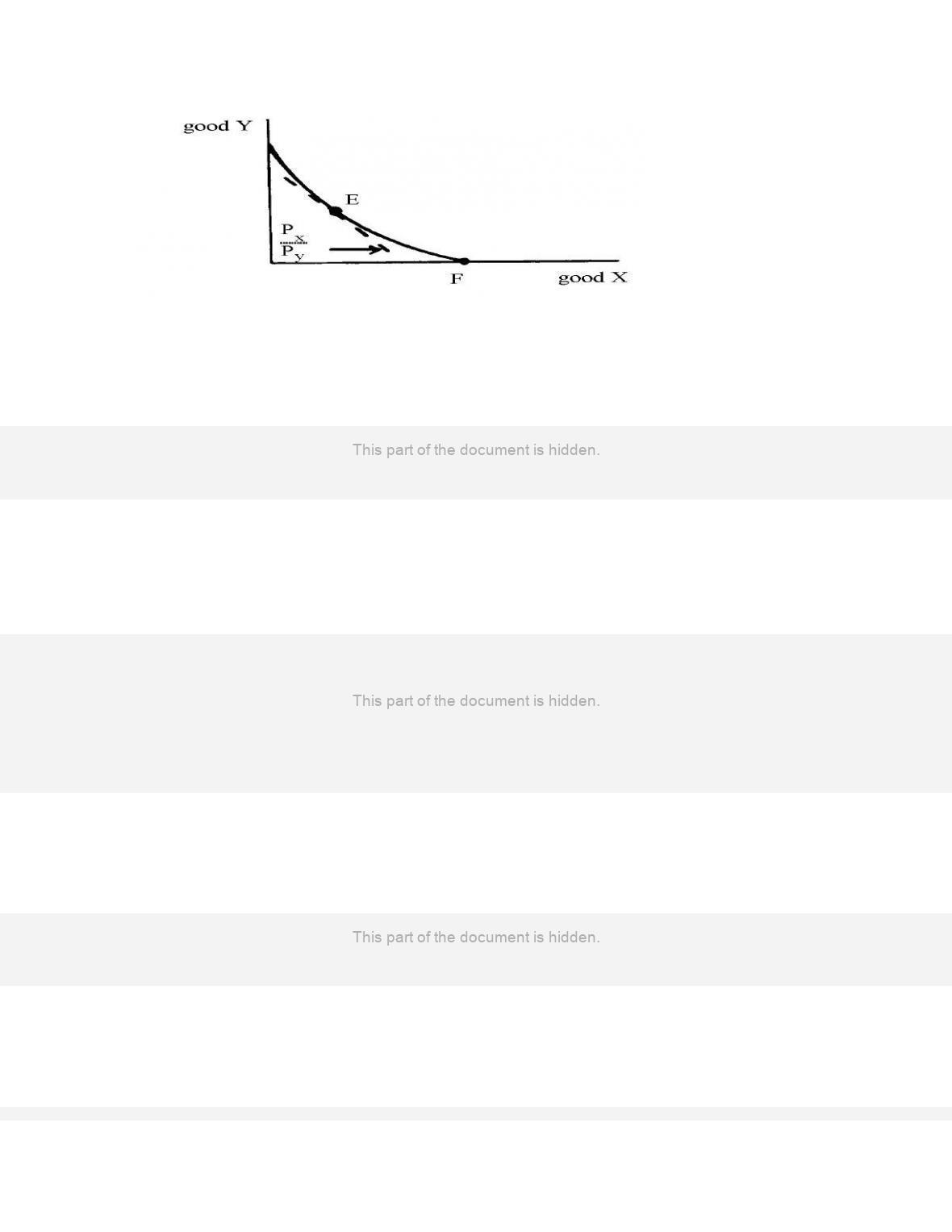
Suppose that we envision a very slight movement of production away from the
equilibrium point E toward point F (with unchanged goods prices). If this movement
takes place, (PX/PY) will be __________ (MCX/MCY), and production will thus move
__________.
a. less than; back to point E
24. Suppose that two countries each have the exact convex-to-the-origin production-
possibilities frontier (PPF) as in Question #23 above (i.e., the countries have identical
PPFs like the Question #12 PPF) and the two countries also have identical tastes. In this
situation,
25. Which expression below indicates the relationship between product price (P), marginal
cost (MC), and the price elasticity of demand facing a firm (eD, which is negative) when
the firm is pricing in order to maximize profit?
26. In the Linder theory of trade, a country sends goods to other countries which
__________, and the greatest trade of a country is expected to be with countries which
have per capita income levels __________ that of the original country.
27. Which one of the following statements pertaining to Vernon’s “product cycle theory” for
explaining U.S. trade is INCORRECT?
a. There is no international trade in the “new product” stage.
28. (This question pertains to material in Appendix C.)
Suppose that country A has only three categories of traded goods and that A’s exports
and imports in the three categories are as shown in the table below:
exports imports
good T $ 30 $100
good W 60 20
good X 60 80
total $150 $200
In this situation, country A’s index of intra-industry trade would have a value of
__________.
a. 0.3
29. Empirical tests pertaining to the determinants of intra-industry trade at the country level
tend to suggest that the amount of intra-industry trade
a. of a country is negatively related to the country’s per capita income level.
30. In the “imitation lag” hypothesis,

a. the period of most intense export by the innovating country is the “imitation lag”
31. In the context of a country’s international trade, a “gravity model” is
usually employed to
investigate, for the country,
d. whether the Stolper-Samuelson theorem is valid for the country.
32. (This question pertains to material in Appendix C.)
Given the following information on the exports of country A in 2009, and assuming that
goods X and Y are the only goods in country A’s trade sector:
exports imports
good X $ 600 $ 0
good Y 400 800
total $1,000 $800
Country A’s “index of intra-industry trade has a value of __________.
d. 200
33. In the “imitation lag hypothesis,” the length of time that elapses between when a new
product is introduced by innovating firms in country I and when consumers in country II
decide that the new product is a good substitute for products in their current consumption
bundle is known as the __________.