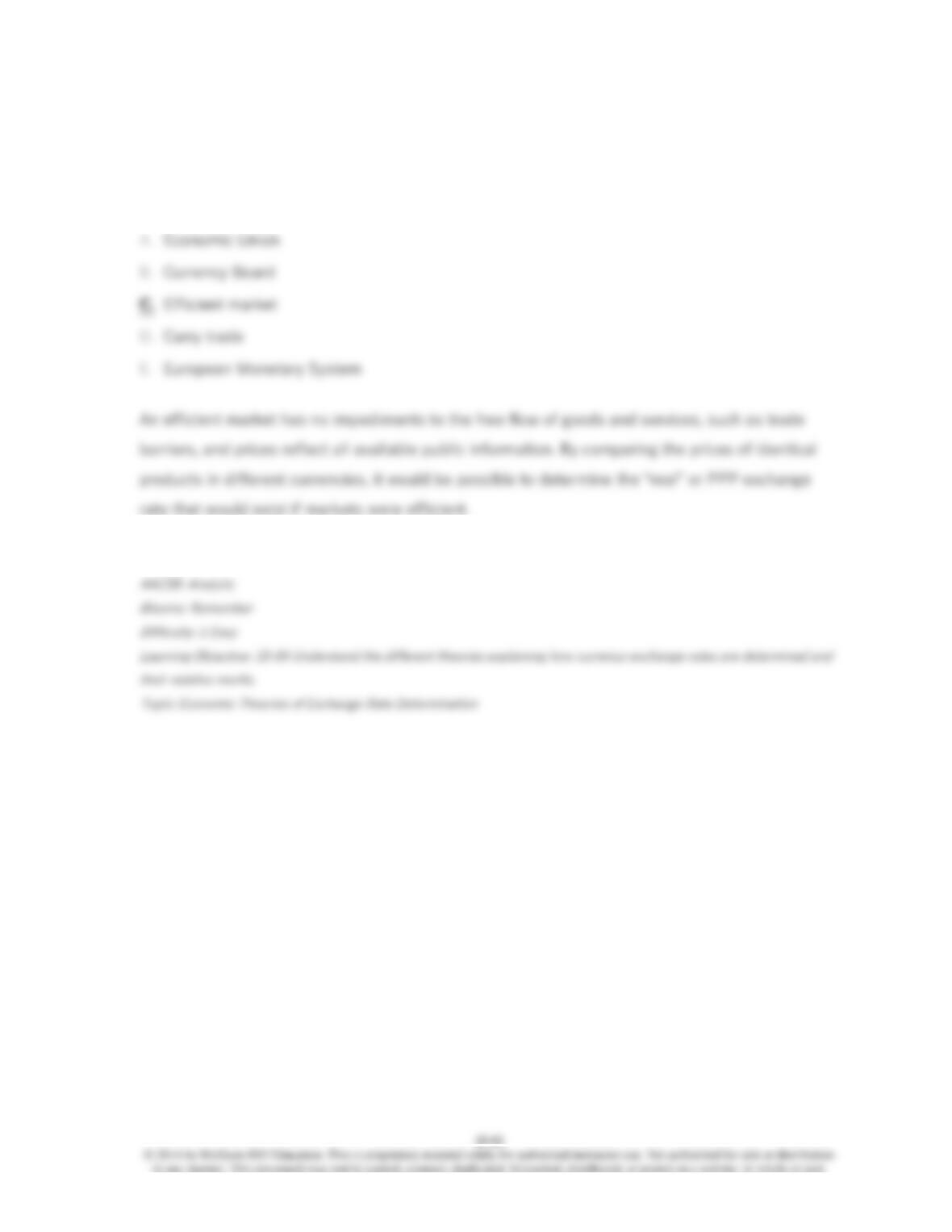
76. Which of the following has no impediments to the free flow of goods and services, such
as trade barriers?
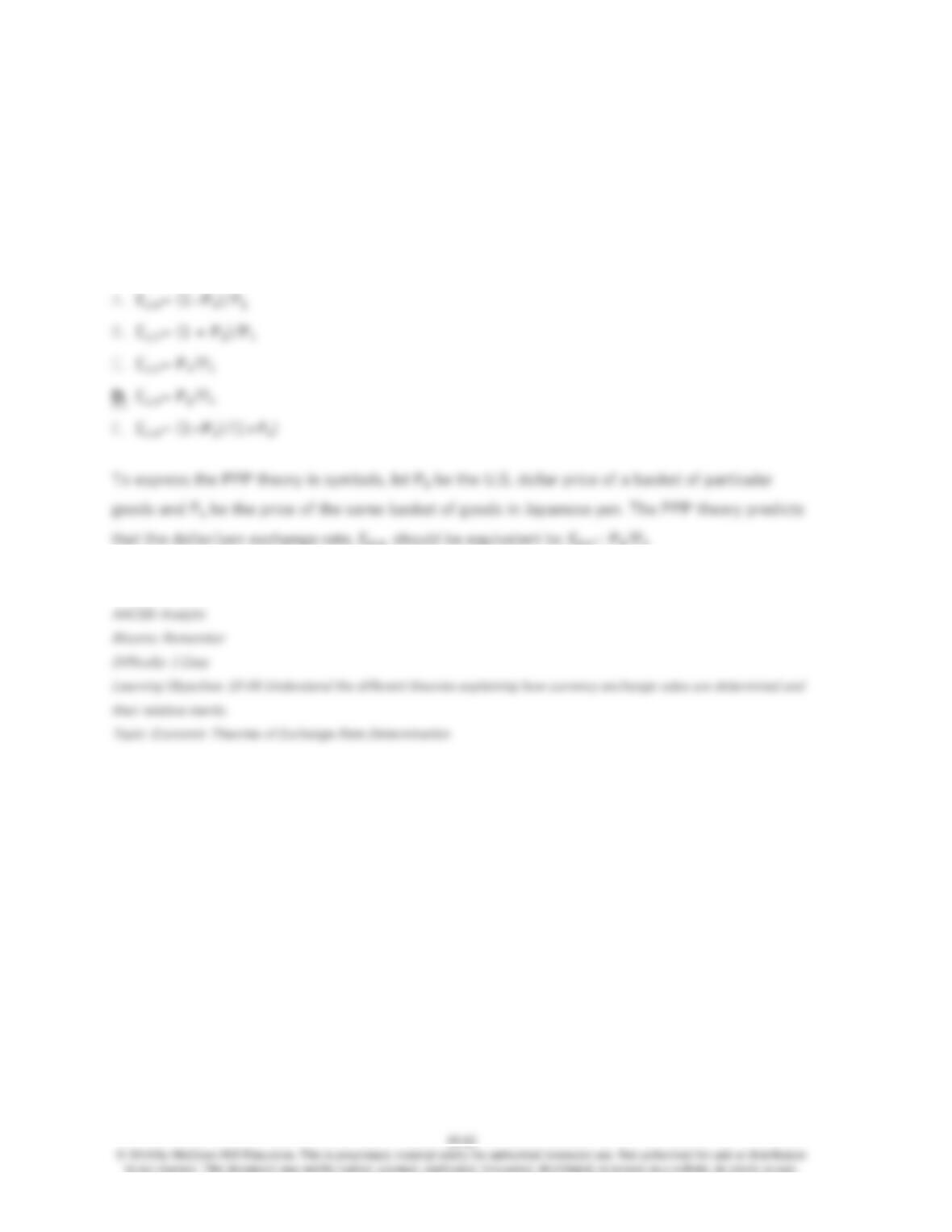
77. To express the PPP theory in symbols, let P$ be the U.S. dollar price of a basket of
particular goods and P¥ be the price of the same basket of goods in Japanese yen. The
(purchasing power parity) PPP theory predicts that the dollar/yen exchange rate, E$/¥, should be
equivalent to _____.
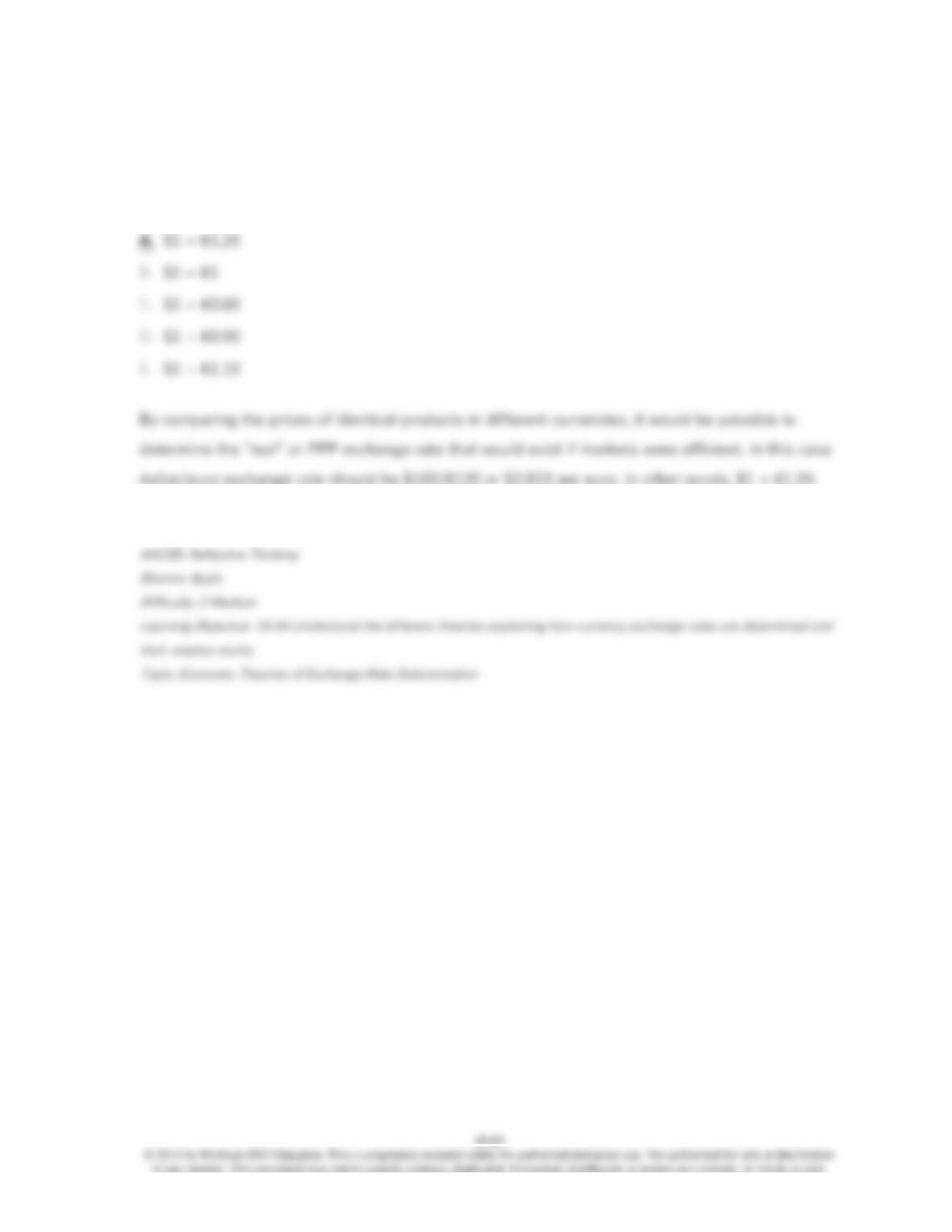
78. If a basket of goods costs $100 in the United States and €120 in Europe, purchasing
power parity theory predicts that the dollar/euro exchange rate should be _____.
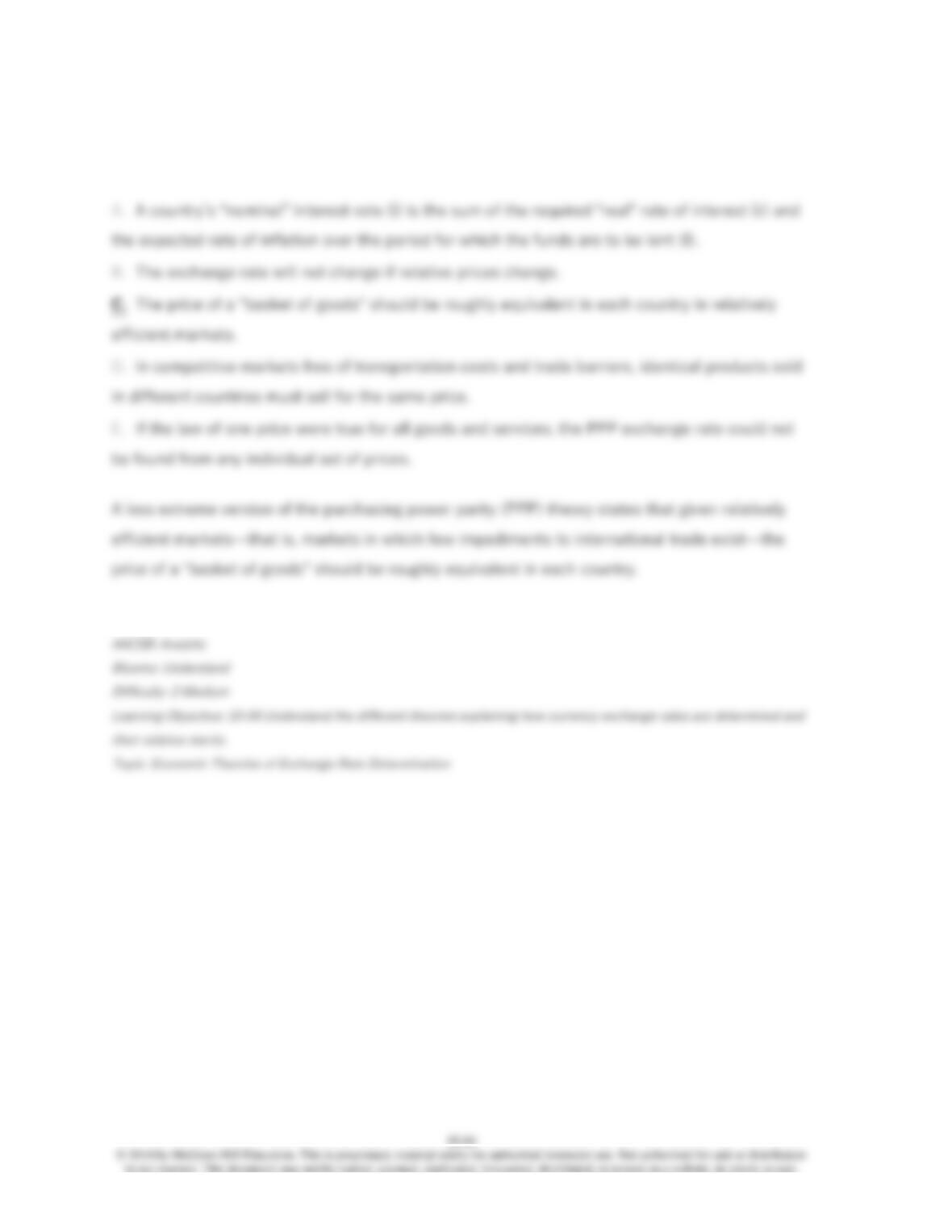
79. Which of the following is true of the purchasing power parity (PPP) theory?
80. Which of the following is illustrated by the Big Mac Index published by
The Economist
?
81. The average price of a Big Mac in the United States is $3.58. Which of the following
currencies is the most overvalued according to the Big Mac Index?
82. Which of the following is true of inflation?
83. Which of the following results from the output of goods and services not matching the
increase in money supply?
84. Which of the following occurs when a government increases money supply?
85. The purchasing power parity (PPP) theory tells us that a country with a high inflation rate
will see:
86. During inflation, an increase in the amount of currency available leads to:
87. Which of the following is true when a government is strongly committed to controlling the
rate of growth in money?
88. If a country’s government does not control the rate of growth in money supply:
89. Which of the following is a drawback of the purchasing power parity theory?
90. The purchasing power parity (PPP) theory best predicts exchange rate changes for
countries with _____.
91. The failure to find a strong link between relative inflation rates and exchange rate
movements has been referred to as the _____.
92. Which of the following is a reason for the failure of the purchasing power parity (PPP)
theory to predict exchange rates accurately?
93. Which of the following weakens the link between relative price changes and changes in
exchange rates predicted by purchasing power parity (PPP) theory by violating the assumption of
efficient markets?
94. When dominant enterprises in an industry exercise a degree of pricing power, setting
different prices in different markets to reflect varying demand conditions, it is referred to as
_____.
95. Which of the following is a way in which enterprises with some market power limit
arbitrage so that their price discrimination policy works?