College Accounting, 12e (Slater)
Chapter 1 Accounting Concepts and Procedures
1.1 Learning Objective 1-1
1) The type of business organization that can continue indefinitely is known as a:
A) sole proprietorship.
B) partnership.
C) corporation.
D) None of the above
2) The purpose of the accounting process is to provide financial information about:
A) sole proprietorships.
B) small businesses.
C) large corporations.
D) All of these answers are correct.
3) Accounting provides information to:
A) managers.
B) government.
C) investors.
D) All of these answers are correct.
4) Which of the following is a characteristic of a sole proprietorship?
A) Business owned by more than one person
B) Easy to form
C) Each stockholder acts as an owner of the company
D) Can continue indefinitely
5) A partnership is a business which is:
A) easy to form.
B) ends with the death of a partner.
C) owned by more than one person.
D) All of these answers are correct.
6) Which is an advantage of a sole proprietorship form of business?
A) There is limited personal risk.
B) The business can continue indefinitely.
C) The owner makes all the decisions.
D) All of these answers are correct.
7) Which of the following is not a type of business organization?
A) Corporation
B) Partnership
C) Sole proprietorship
D) Operation
8) A corporation:
A) can continue indefinitely.
B) is owned by stockholders.
C) has limited risk to stockholders.
D) all of the above.
9) The Sarbanes-Oxley Act was passed to:
A) prevent fraud at public companies.
B) replace all of the old accounting procedures with new ones.
C) improve the accuracy of the company’s financial reporting.
D) Both A and C are correct.
10) A legal firm would be considered a:
A) merchandise company.
B) manufacturer.
C) service company.
D) None of the above are correct.
11) Generally Accepted Accounting Principles are the procedures and guidelines that must be followed
during the accounting process.
12) The function of accounting includes analyzing, recording, classifying, summarizing, reporting, and
interpreting financial information.
13) A sole proprietorship ends with the death of the owner.
14) Put the 7 main steps of the accounting process in order (from 1 -7) below:
________ Classifying
________ Analyzing
________ Recording
________ Interpreting
________ Reporting
________ Communication
________ Summarizing
15) Discuss the advantages and disadvantages of sole proprietorships, partnerships and corporations.
16) What is the difference between Bookkeeping and Accounting?
1) Which of the following will be recorded in the owner’s equity column as an increase?
A) An exchange of assets
B) The purchase of an asset on credit
C) An investment by the owner
D) A withdrawal by the owner
2) The purchase of supplies for cash would affect which account category?
A) Assets
B) Liabilities
C) Capital
D) Expense
3) Items owned by the business such as land, supplies and equipment are:
A) assets.
B) liabilities.
C) owner’s equity.
D) revenue.
4) Which of the following is not an asset?
A) Cash
B) Accounts Receivable
C) Accounts Payable
D) Buildings
5) If total liabilities increased by $6,000 and the assets increased by $8,000 during the accounting period,
what is the change in the owner’s equity amount?
A) Increase of $2,000
B) Decrease of $2,000
C) Increase of $10,000
D) Decrease of $10,000
6) The claims of creditors against the assets are:
A) expenses.
B) revenues.
C) liabilities.
D) owner’s equity.
7) The Owner’s Equity of Logan’s Company is equal to one-quarter of the total assets. Liabilities equal
$60,000. What is the amount of Owner’s Equity?
A) $40,000
B) $20,000
C) $30,000
D) None of these answers are correct.
8) Assets are equal to:
A) liabilities + owner’s equity.
B) liabilities – owner’s equity.
C) liabilities – revenues.
D) revenues – expenses.
9) The basic accounting equation is:
A) Assets = Revenues – Expenses.
B) Assets = Liabilities – Owner’s Equity.
C) Assets = Owner’s Equity – Liabilities.
D) Assets = Liabilities + Owner’s Equity.
10) An acceptable variation of the accounting equation is:
A) Assets – Liabilities = Owner’s Equity.
B) Assets + Owner’s Equity = Liabilities.
C) Assets = Liabilities – Owner’s Equity.
D) All of these answers are correct.
11) If total liabilities are $18,000 and owner’s equity is $21,000, the total assets must be:
A) $39,000.
B) $5,000.
C) $20,000.
D) $17,000.
12) If total liabilities are $1,000 and total assets are $8,000, owner’s equity must be:
A) $7,000.
B) $3,000.
C) $10,000.
D) $13,000.
13) How does the purchase of office equipment on account affect the accounting equation?
A) Assets increase; liabilities decrease
B) Assets increase; owner’s equity increases
C) Assets increase; liabilities increase
D) Liabilities increase; owner’s equity decreases
14) Mary invested cash in her new business. What effect will this have?
A) Increase an asset and increase a liability
B) Decrease an asset and increase a liability
C) Increase an asset and increase owner’s equity
D) Increase an asset and decrease owner’s equity
15) A business paid $5,000 to a creditor in payment of an amount owed. The effect of the transaction on
the accounting equation was to:
A) increase one asset, decrease another asset.
B) increase an asset, increase a liability.
C) decrease an asset, decrease a liability.
D) increase an asset, increase owner’s equity.
16) Strum Hardware has total assets of $50,000. What are the total assets if new equipment is purchased
for $10,000 cash?
A) $45,000
B) $50,000
C) $55,000
D) $60,000
17) Harvest Moon Company has total assets of $15,000. If $3,000 cash is used to purchase a new
computer, the total assets would be:
A) $15,000.
B) $13,000.
C) $17,000.
D) $2,000.
18) Katie’s Vegetarian Restaurant, with total assets of $90,000, borrows $15,000 from the bank. Which of
the following is a true statement upon borrowing the money?
A) Total assets are now $105,000.
B) Total assets are now $80,000.
C) Total assets are now $15,000.
D) Total assets are now $75,000.
19) Logan’s Motor Sports buys $30,000 of equipment on credit. Which of the following is a true
statement?
A) Total assets increase.
B) Total assets are unchanged.
C) Total liabilities decrease.
D) Total liabilities are unchanged.
20) Bonnie’s Baskets purchases $4,000 worth of office equipment on account. This causes:
A) Cash and Capital to decrease.
B) Office Equipment and Accounts Payable to increase.
C) Office Equipment to decrease and Accounts Payable to increase.
D) Accounts Payable to increase and Capital to decrease.
21) Eileen’s Corner Shoppe purchases a new computer for cash. This causes:
A) Cash and Capital to increase.
B) Computer Equipment and Cash to increase.
C) Computer Equipment to increase and Cash to decrease.
D) Accounts Payable to increase and Capital to increase.
22) Bob purchased a new computer for the company on account. The transaction will:
A) increase Computer; increase Capital.
B) decrease Cash; increase Accounts Payable.
C) decrease Cash; increase Computer.
D) increase Computer; increase Accounts Payable.
23) Katelyn purchased $11,000 of new electronic equipment for her DJ Company on account. The effect on
the basic accounting equation was to:
A) decrease Cash $11,000 and increase Equipment $11,000.
B) increase Equipment $11,000 and increase Accounts Payable $11,000.
C) decrease Cash $11,000 and increase Accounts Payable $11,000.
D) increase Cash $11,000 and increase Equipment $11,000.
24) The balance sheet contains:
A) liabilities, expenses and capital.
B) assets, liabilities and revenues.
C) expenses, assets and cash.
D) assets, liabilities and owner’s equity.
25) Which of the following items is not listed on the balance sheet?
A) Accounts Payable
B) Accounts Receivable
C) Revenue
D) Equipment
26) If total assets are $30,000 and total liabilities are $18,000, Capital must equal:
A) $12,000.
B) $28,000.
C) $8,000.
D) $20,000.
27) The purchase of equipment with both cash and on account was recorded as only a credit purchase.
Due to this error:
A) assets would be understated.
B) liabilities would be overstated.
C) owner’s equity would be overstated.
D) None of the above are correct.
28) A purchase of a vehicle for cash would have what affect on the accounting equation?
A) Total asset amount remains the same.
B) Total liabilities are overstated.
C) Total owner’s equity is overstated.
D) Both A and B are correct.
29) The cash purchase of a truck was recorded as a purchase on credit. Due to this error:
A) assets were overstated.
B) liabilities were overstated.
C) answers A and B are both correct.
D) None of the above are correct.
30) Which of the following transactions would cause one asset to increase and another asset to decrease?
A) The owner invested cash in the business.
B) The business paid a creditor.
C) The business incurred an expense on credit.
D) The business bought supplies for cash.
31) Which of the following transactions would cause an asset to increase and the owner’s equity to
increase?
A) The owner invested cash in the business.
B) The business incurred an expense on credit.
C) The business bought supplies on account.
D) The owner withdrew cash from the business.
32) Which of the following would result if the owner invested cash in the business?
A) Cash would increase and Capital would decrease.
B) Cash would increase and Capital would increase.
C) Cash would decrease and Capital would increase.
D) An investment by the owner is not a business transaction.
33) Which of the following would result if the business purchased supplies on credit?
A) Supplies would increase and Cash would decrease.
B) Supplies would increase and Capital would increase.
C) Supplies would increase and Accounts Payable would increase.
D) The purchase of supplies is not a business transaction.
34) Which of the following would result if a business purchased Equipment paying a 40% down payment
in cash?
A) Equipment would increase and Cash would decrease.
B) Accounts Payable would increase.
C) Since the equipment has not been paid in full, there is nothing to record.
D) Both A and B are correct.
35) The left side of the accounting equation shows what is owned by the business.
36) Cash is the same thing as Capital.
37) The balance sheet shows the company‘s financial position as of a particular date.
38) If the liabilities owed by a business total $250,000, then the assets must also total $250,000.
39) The left side of the accounting equation must always equal the right side of the equation.
40) If the assets owned by a business total $100,000, owner’s equity must also total $100,000.
41) In a shift of assets, the composition of the assets changes but total assets do not change.
42) If the assets owned by a business total $60,000 and liabilities total $30,000, then owner’s equity totals
$90,000.
43) To distinguish the total on a financial statement, use double underlines.
44) Creditors’ claims against assets are called owner’s equity.
45) The three elements that make up a balance sheet are assets, liabilities and expenses.
46) The accounting equation states that total assets must always equal total liabilities plus owner’s equity.
47) If liabilities are $10,000 and assets are $20,000, owner’s equity will be $10,000.
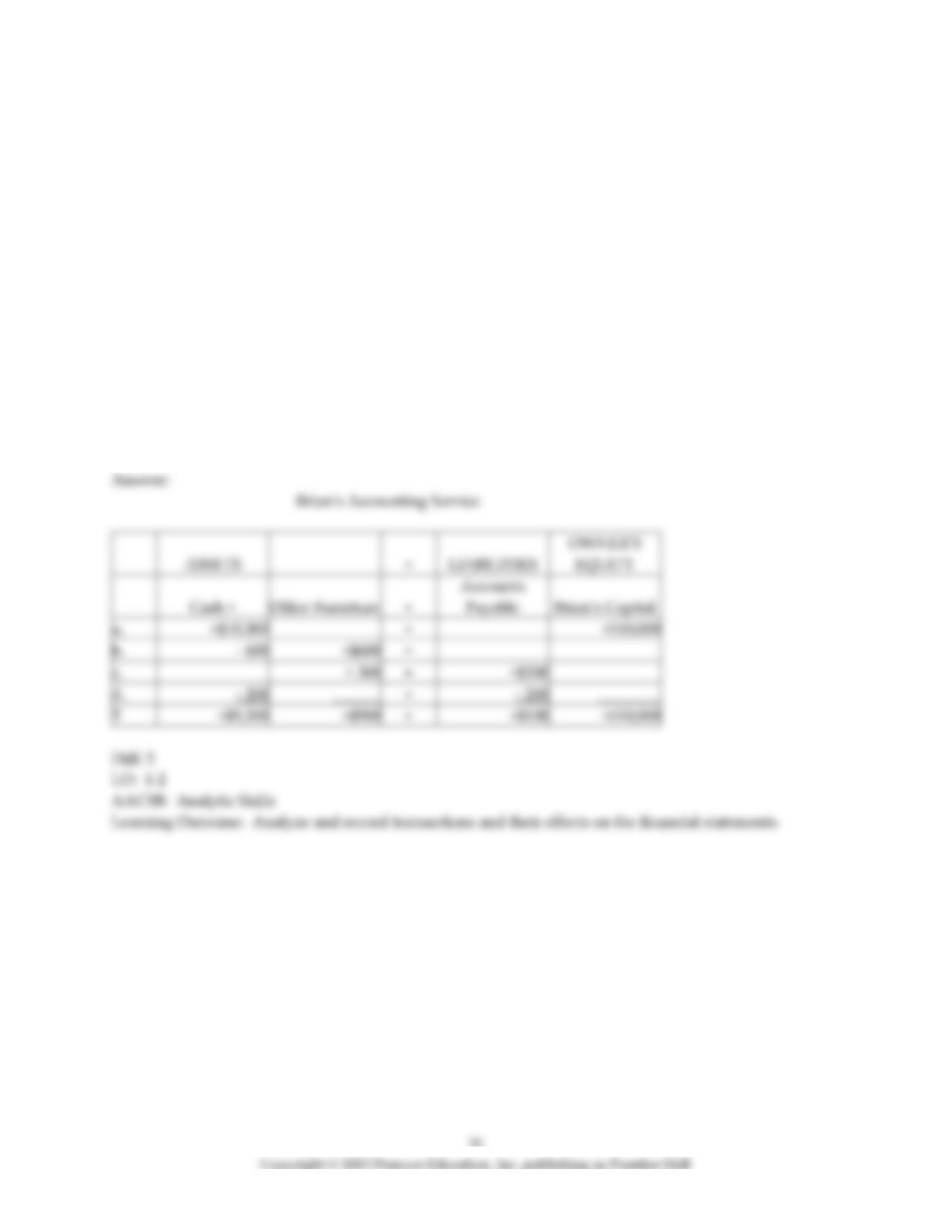
48) Record the following transactions in the basic accounting equation:
a. Brian invests $10,000 cash to begin an accounting service.
b. The company buys office furniture for cash, $600.
c. The company buys additional office furniture on account, $300.
d. The company makes a payment on the office furniture, $200.
Brian’s Accounting Service
ASSETS = LIABILITIES + OWNER’S EQUITY
Cash + Office Furniture = Accounts Payable + Brian’s Capital
a.
b.
c.
d.
Totals
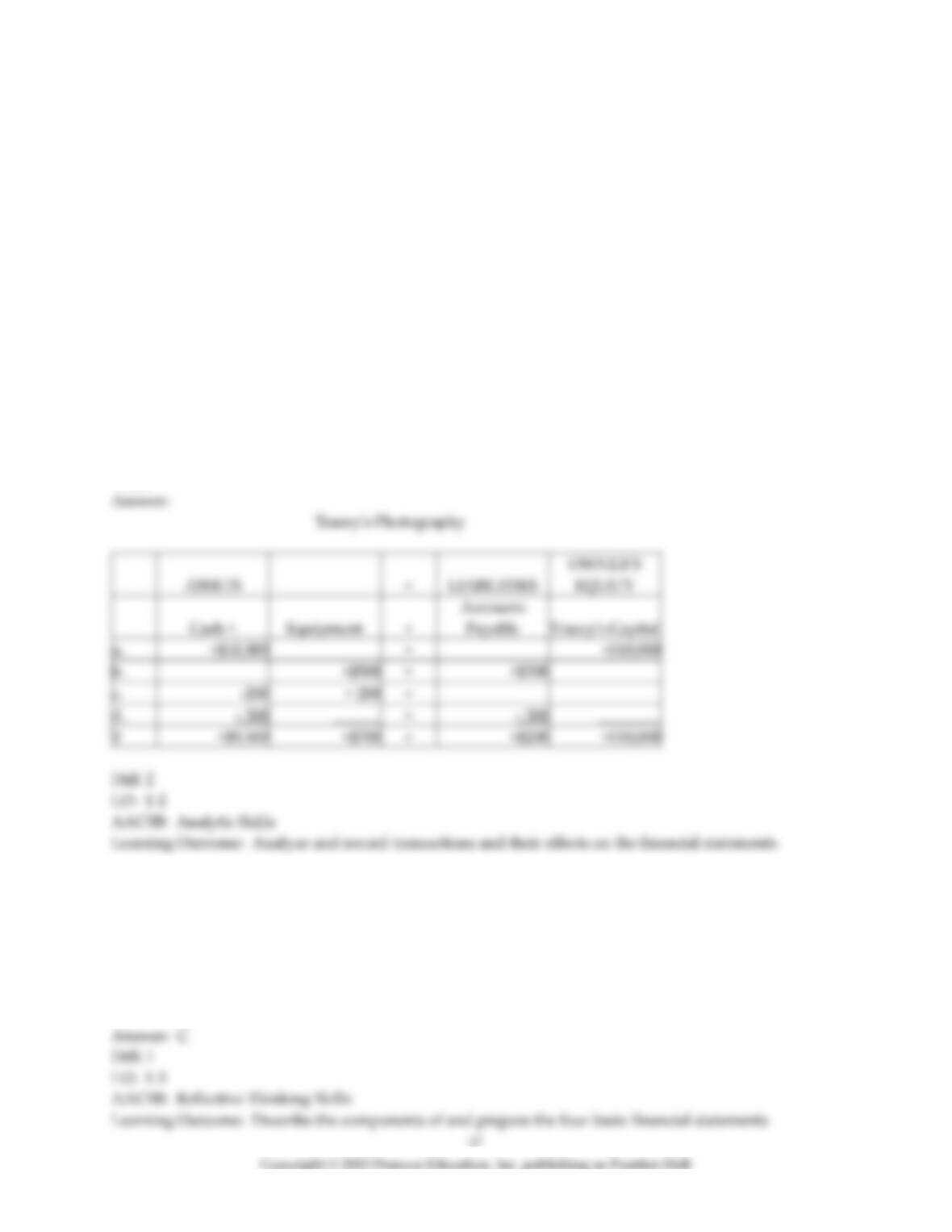
49) Tracey’s Photography completes the following transactions:
a. Tracey invests $10,000 cash in her company.
b. The company purchases equipment on account, $500.
c. The company purchases additional equipment for cash, $200.
d. The company makes a payment on account for the equipment, $300.
Required: Record the above transactions in the basic accounting equation.
Tracey’s Photography
ASSETS = LIABILITIES + OWNER’S EQUITY
Cash + Equipment = Accounts Payable + Tracey’s Capital
a. =
b. =
c. =
d. =
Totals =
1.3 Learning Objective 1-3
1) The net income or net loss is calculated on the:
A) balance sheet.
B) statement of owner‘s equity.
C) income statement.
D) none of these.