58) Regulatory controls or bureaucratic rules designed to impair the rapid flow of imports into a
country are called ________.
A) local content requirements
B) administrative delays
C) voluntary export restraints
D) import quotas
59) Purposely understaffing customs offices to cause time delays, requiring special licenses that
take a long time to obtain, and requiring air carriers to land at inconvenient airports are all
examples of ________.
A) local content requirements
B) import quotas
C) administrative delays
D) voluntary export restraints
60) ________ make it more difficult for importers of nonessential goods to acquire foreign
exchange.
A) Currency controls
B) Restricted access to distribution networks
C) Numerical export controls
D) Public-sector procurement policies
61) ________ can occur when a firm sells its goods in a foreign market at a price below what it
charges in its home market.
A) Predatory pricing
B) Dumping
C) Foreign trade duties
D) Subsidies
62) Which of the following would be Konesia’s least appropriate method to restrict unwanted
trade?
A) introduce an administrative delay
B) impose a quota
C) reduce tariffs
D) impose a currency control
63) If Konesia chooses to levy tariffs as a percentage of the stated price of an imported product,
this would be an example of a(n) ________.
A) compound tariff
B) specific tariff
C) ad valorem tariff
D) tariff-quota
64) Which of the following is the most likely reason for Konesia’s government to impose an
import quota?
A) to maintain adequate supplies of a product in the home market
B) to maintain market shares and prices of domestic producers
C) to restrict the supply of a product to world markets
D) to maintain the exports of a product at target levels
65) Excelsior‘s Limited tried to sell its product in Canada, but was told that at least forty percent
of the product must be manufactured in Canada. This is an example of a(n) ________.
A) administrative delay
B) local content requirement
C) tariff
D) embargo
66) When Excelsior’s Limited tried to convert its earnings from one country, the government
stipulated that the company had to exchange its currency at a very unfavorable rate. This is an
example of a(n) ________.
A) administrative delay
B) currency control
C) subsidy
D) tariff
67) France gave Excelsior’s Limited permission to export its product as long as the company
obtained a special license first. Excelsior has been waiting six months for the license and is
wondering if it will ever arrive. Excelsior’s Limited is experiencing a(n) ________.
A) administrative delay
B) local content requirement
C) embargo
D) currency control
68) A disadvantage of protection from import competition is the added cost of continuing to
produce a good domestically that could be supplied more efficiently by an international supplier.
69) The automobile industry is typically protected for national security reasons.
70) Products that are of use in both industrial and military applications are designated as dual–use
products.
71) Customs duties decrease the total amount of a good’s production cost.
72) An import tariff is levied by the government of a country that a product is passing through on
its way to its final destination.
73) A compound tariff on an imported product is calculated partly as a percentage of its stated
price and partly as a specific fee for each unit.
74) Tariffs are a source of government revenue mostly among developing nations.
75) Tariffs tend to exact a cost on countries as a whole because they reduce consumer choices.
76) Consumers are benefitted when a government imposes import quotas on products.
77) A voluntary export restraint refers to a quota that a nation imposes on its exports, usually at
the request of another nation.
78) An embargo is the most restrictive nontariff trade barrier available.
79) Restrictions on the convertibility of one currency into others is called currency controls.
80) When a company exports a product at a price lower than the price normally charged in its
domestic market, it is said to be dumping.
81) Explain why governments impose restrictions on free trade.
82) Describe the different types of tariffs and provide an example of each.
83) Explain how tariffs protect domestic producers, and describe how a foreign trade zone might
offset the effects of tariffs.
84) What are voluntary export restraints and how are they used?
85) The term protectionism, when applied to international trade, refers to ________.
A) governmental restrictions and competitive support actions to affect trade flows
B) payments to dock workers to prevent pilferage of imported shipments
C) border checks to prevent entry of illegal aliens
D) methods used to prevent intellectual property theft
86) Which of the following is prompting farmers in many developed nations to discover new
ways to manage risk and increase agricultural efficiency?
A) enforcement of trade embargoes and tariffs
B) exposure of agribusiness to market forces
C) provision of extensive government subsidies
D) designation of agricultural products as dual use products
87) The ________ proposes that tariffs be imposed on imported manufactured goods to give U.S.
firms temporary protection from foreign competition until they can fully establish themselves.
A) national defense argument
B) infant industry argument
C) industrial policy
D) strategic trade theory
88) According to the ________ argument, as an industry grows and matures, it gains the
knowledge it needs to become more innovative, efficient, and competitive.
A) maturing industry
B) infant industry
C) standardized product
D) developing economy
89) Which of the following is true regarding the protection of infant industries from international
competition?
A) It is difficult for governments to identify the industries worth protecting.
B) Protection of infant industries helps domestic companies become innovative.
C) Protection from competition leads to improved quality and lower prices.
D) Protection leads to more economic good than harm.
90) Which of the following is a result of the protection of domestic companies from international
competition?
A) Consumers need to pay less for products.
B) There are increased incentives to cut production costs and improve quality.
C) Companies become more reliant on protection.
D) Protection increases a company’s incentives to obtain the knowledge it needs to become more
competitive.
91) Rice imports to a nation under a quota limit of 8,500 tons are charged a tariff of 15 percent.
Imports of rice above the quota limit are charged a tariff of 60 percent. This is an example of a(n)
________.
A) export quota
B) voluntary export restraint
C) ad valorem tariff
D) tariff-quota
92) A(n) ________ is an absolute ban on the exporting and importing of goods to a particular
destination.
A) voluntary export restraint
B) embargo
C) ad valorem tariff
D) tariff rate quota
93) Which of the following statements is true of embargoes?
A) An embargo may be placed on one or a few goods or may completely ban trade in all goods.
B) An embargo is the least restrictive nontariff barrier available.
C) An embargo is usually employed for economic reasons.
D) Embargoes are used frequently today because they are easy to implement.
94) The ________ altered the U.S. trade policy from a stance of free trade to one of
protectionism in the 1930s.
A) Norris–LaGuardia Act
B) Smoot-Hawley Act
C) Wheeler–Lea Act
D) Taft–Hartley Act
95) In which of the following ways did the Uruguay Round of Negotiations modify the original
General Agreement on Tariffs and Trade (GATT) treaty?
A) It helped standardize intellectual property rules around the world.
B) It called on developing and least-developed economies to cut agricultural tariffs significantly.
C) It relaxed the additional tariffs imposed on companies charged with dumping.
D) It increased barriers to trade in all developed, developing and least-developed nations.
96) The Uruguay Round of Negotiations created the TRIPS Agreement to ________.
A) help standardize the intellectual property rules around the world
B) increase the exposure of national agricultural sectors to market forces
C) drastically reduce tariffs and nontariff barriers in agricultural trade
D) include international trade in services for the first time
97) One of the main goals of the World Trade Organization is to ________.
A) encourage dumping among trading nations
B) restrict the free flow of trade
C) provide favorable terms of trade to a few selected countries
D) settle trade disputes among its members
98) A requirement that all WTO members extend the same favorable terms of trade to all
members that they extend to any single member is called ________.
A) normal trade relations
B) antidumping duties
C) local content requirements
D) countervailing duties
99) The belief that Freeland’s emerging industries need protection from international competition
during their development phase is an example of ________.
A) a local content requirement
B) a normal trade relation
C) the infant industry argument
D) the political motive of Freeland
100) Konesia has created a hybrid form of trade restriction-a lower tariff rate for a certain
quantity of imports and a higher rate for quantities that exceed the quota. This is an example of
a(n) ________.
A) compound tariff
B) export quota
C) ad valorem tariff
D) tariff-quota
101) The pattern of imports and exports that occurs in the absence of trade barriers is called free
trade.
102) When one World Trade Organization member files a complaint against another, decisions
are to be rendered in less than one year.
103) The World Trade Organization can punish a company that exports a product at a price that
is either lower than the price normally charged in its domestic market or lower than the cost of
production.
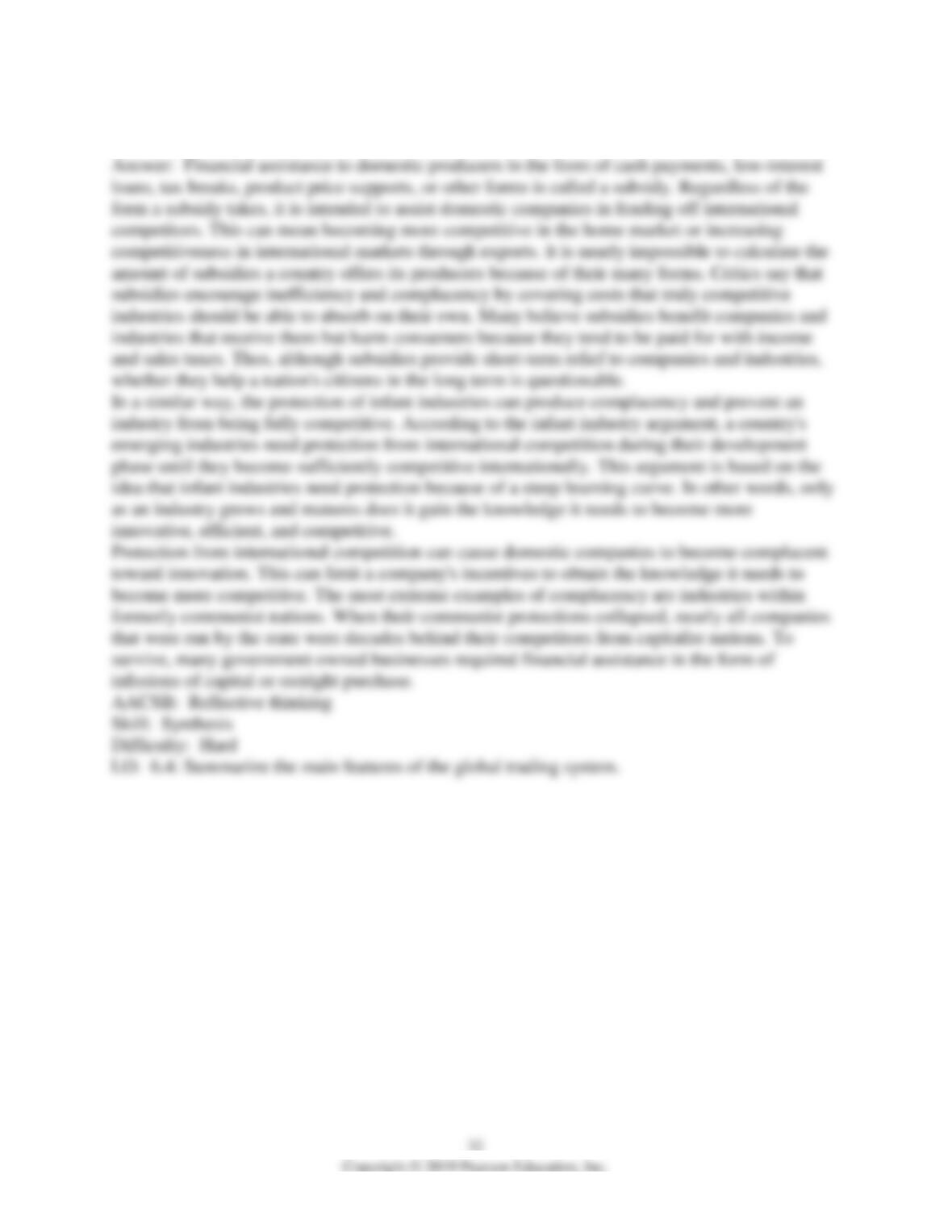
104) Define subsidies. What are their disadvantages? In what ways do the protection of infant
industries produce similar drawbacks?
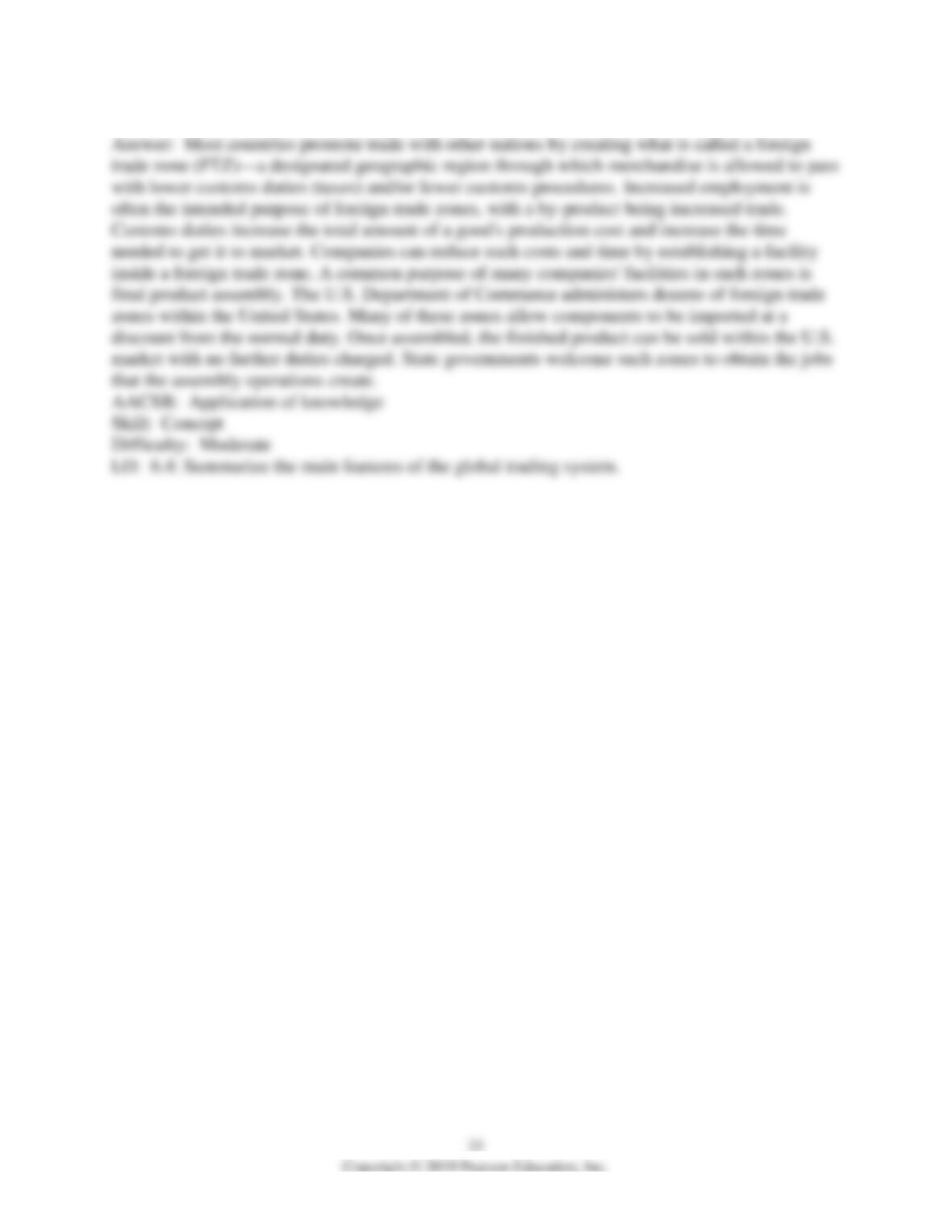
105) Describe the purpose of a foreign trade zone. How is it used to promote trade?
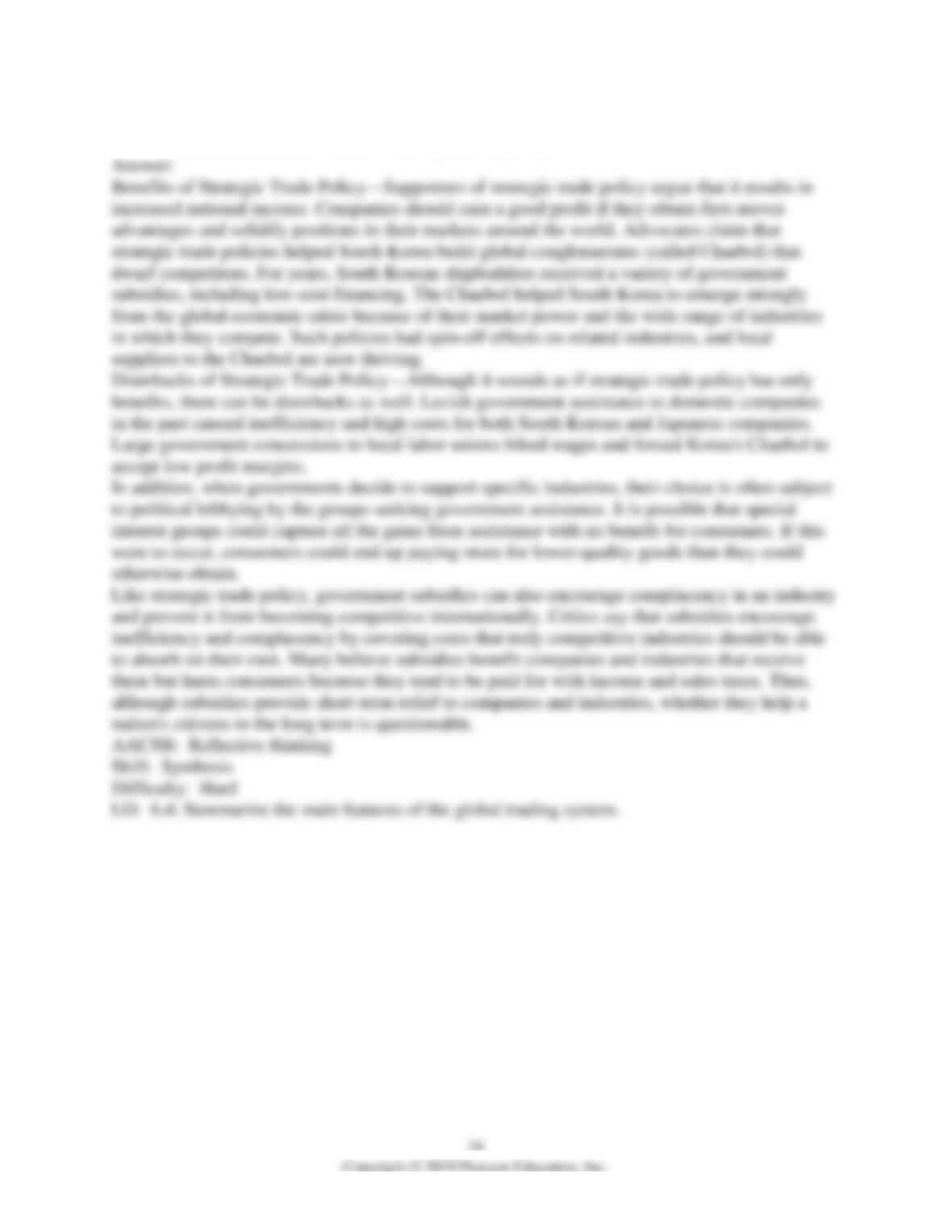
106) Discuss the benefits and drawbacks of strategic trade policy. How are the drawbacks of
subsidies similar to the drawbacks of strategic trade policy?
107) Describe the three categories of tariffs, and explain how the Smoot–Hawley Act of 1930
influenced tariffs in the United States.
108) Write a short note on the World Trade Organization and its influence on the environment.