International Business: The Challenges of Globalization, 9e (Wild)
Chapter 6 Political Economy of Trade
1) Free trade ________.
A) is another term for managed trade
B) implies that the national government exerts minimal influence on the exporting and importing
decisions of private firms
C) proposes that national governments should directly help domestic firms by providing export
subsidies and tax breaks
D) suggests that the national government should actively intervene to ensure that domestic firms’
exports receive an equitable share of foreign markets and that imports are controlled to minimize
losses of domestic jobs and market share in specific industries
2) Which of the following is true of government interventions in a country’s trade practices?
A) Lower restrictions should be placed on products coming from countries where a government
has a large sphere of political influence.
B) A major political motive behind government intervention in trade is the protection of infant
industries.
C) Government interventions help companies take advantage of economies of scale and be the
first movers in their industries.
D) Governments intervene to protect only imports, as the protection of exports is handled by
private agencies.
3) Managers should understand the effect of trade protectionism because ________.
A) trade protectionism may limit the number of people permitted to practice a specific profession
B) trade protectionism requires the payment of high insurance rates to transport goods
internationally
C) trade protectionism may prevent companies’ enactment of merger and acquisition agreements
D) trade protectionism may make it difficult for a company to buy what it needs from foreign
suppliers
4) Which of the following do products designated as dual use require before exports can take
place?
A) currency controls
B) countervailing duties
C) special government approval
D) local content requirements
5) Which of the following is an example of a dual use product?
A) a blowdryer
B) a GPS navigation device
C) a food processor
D) a vacuum cleaner
6) ________ refers to the unwanted cultural influence in a nation that can cause great distress
and lead governments to block imports it believes to be harmful.
A) Cultural imperialism
B) Cultural protectionism
C) Dumping
D) Capitalism
7) Which of the following is the main cultural motive behind government intervention in trade?
A) promotion of strategic trade policies
B) protection of jobs
C) protection of national identity
D) protection of young industries from competition
8) Which of the following statements is true about cultural influences?
A) Culture and trade are independent of each other.
B) Unwanted cultural influence in a nation can cause governments to block imports that it
believes are harmful.
C) The cultures of countries are independent of the effects of exposure to the people and
products of other cultures.
D) The culture of the United States is readily adapted into the local culture of countries all over
the world.
9) Which of the following countries is seen as a threat to national cultures around the world?
A) United States
B) India
C) Russia
D) France
10) The purpose of ________ is to force companies from other nations to use local resources in
their production processes, particularly labor.
A) administrative delays
B) currency controls
C) local content requirements
D) voluntary export restraints
11) Which of the following statements is true of local content requirements?
A) It is a strategy mainly used by developed nations.
B) This strategy enforces companies to locate their manufacturing facilities in their home
countries.
C) Local content requirements hurt domestic producers through their effect on prices.
D) It forces companies from other countries to employ local resources in their production
processes.
12) ________ can occur when a firm sells its goods in a foreign market at a price below what it
charges in its home market.
A) Predatory pricing
B) Dumping
C) Foreign trade duties
D) Subsidies
13) A(n) ________ is calculated to offset the advantage an exporter receives from a subsidy.
A) compound tariff
B) export promotion
C) countervailing duty
D) substitution tariff
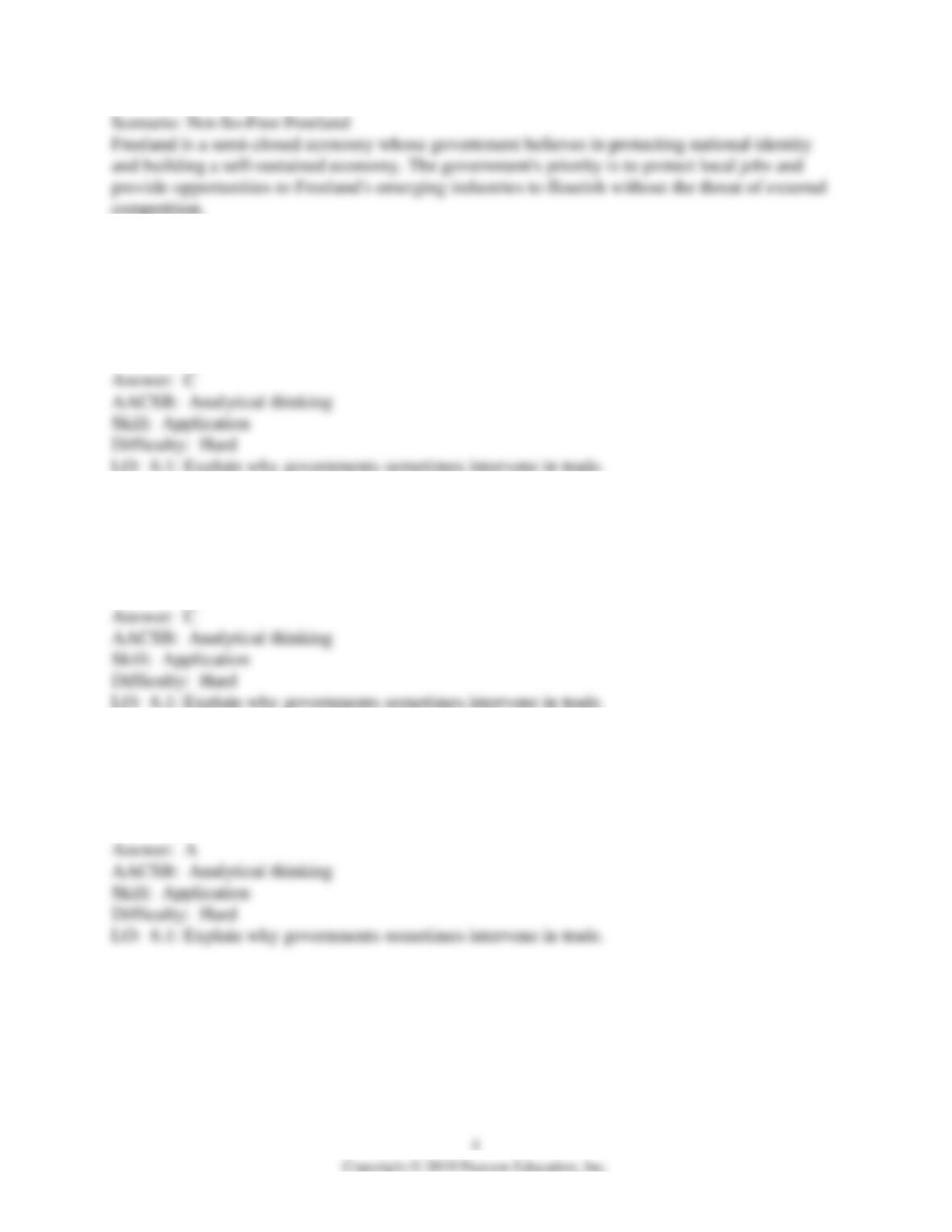
14) Which of the following motives is least likely attributed to Freeland’s restriction on free
trade?
A) political motives
B) economic motives
C) social motives
D) cultural motives
15) Freeland’s protection of its national identity is an example of a(n) ________.
A) political motive
B) economic motive
C) cultural motive
D) social motive
16) Which of the following motives illustrates Freeland’s efforts to protect local jobs?
A) political motive
B) economic motive
C) cultural motive
D) social motive
17) Freeland’s efforts to provide opportunities to its emerging industries is an example of its
________.
A) political motive
B) economic motive
C) cultural motive
D) social motive
18) Industries considered essential to national security often receive government-sponsored
protection.
19) The most common economic reasons for nations’ attempts to influence international trade are
the protection of young industries from competition and the promotion of a strategic trade policy.
20) The protection of infant industries by a nation’s government can cause domestic companies
to become complacent toward innovation.
21) The protection of infant industries by a nation’s government can cause more economic harm
than good.
22) Nations often restrict trade in goods and services to achieve cultural objectives, the most
common being protection of national identity.
23) Unwanted cultural influence in a nation can cause governments to block imports that it
believes are harmful.
24) Tariffs are taxes placed on goods being imported into a country. A tariff can act as a barrier
to trade by increasing the cost of the imported goods to the consumers.
25) Describe the main political motives behind government intervention in trade.
26) Explain why job protection is a political motive for governments to restrict free trade. Why
might a government interested in job protection insist on local content requirements for
international firms doing business in that country?
27) What is meant by dumping? Describe the various roles of the World Trade Organization,
including when a country is accused of dumping.
28) Which of the following is an instrument that governments use to promote trade?
A) embargoes
B) tariffs
C) export financing
D) administrative delays
29) Which of the following would most likely be used as a subsidy to entice firms to locate or
expand facilities in a particular community?
A) quotas
B) an embargo
C) a granting of corporate citizenship status
D) reduced utility rates
30) A(n) ________ is a geographic area where imported or exported goods receive preferential
tariff treatment.
A) free trade zone
B) foreign trade zone
C) fair trade zone
D) economic incentive zone
31) Which of the following statements is true of export financing?
A) Small businesses that have just started to export are financially stable and seldom require
financing from government agencies.
B) The Ex-Im Bank finances the export activities of companies all over the world.
C) Governments usually offer loans to exporters with above-market interest rates.
D) Governments may promote exports by offering loan guarantees.
32) Which of the following financial companies in the United States is involved in activities of
selling of goods abroad, and offers insurance on foreign accounts receivable?
A) National Cooperative Bank
B) Overseas Private Investment Corporation
C) Export-Import Bank
D) Inter-American Development Bank
33) Country X protects its domestic manufacturers from foreign competition by using a variety
of nontariff barriers. Which of the following is not one of those nontariff barriers?
A) foreign trade zones
B) product standards
C) regulatory controls
D) local purchase requirements
34) A foreign trade zone is primarily used by governments to ________.
A) protect currency rates
B) enforce tariffs and duties
C) monitor foreign investments
D) spur economic development
35) Government trade promotion agencies ________.
A) enable imports at discounts
B) set up foreign trade zones across the country
C) advertise in other countries to promote the nation’s exports
D) place voluntary export restraints on companies that fail to export adequately
36) The Export-Import Bank of the United States provides financing for U.S. exports through
direct loans and loan guarantees.
37) The major purpose of foreign trade zones is to implement barriers to trade and commerce.
38) Describe each instrument that governments use to promote trade.
39) Describe the role of special government agencies in promoting exports and imports.
40) Which of the following is a method of restricting trade?
A) export financing
B) local content requirements
C) subsidy
D) foreign trade zones
41) Which of the following will add to the cost of an imported product by levying an additional
tax upon it?
A) tariffs
B) quotas
C) local content requirements
D) embargoes
42) Which of the following is an import tariff?
A) transit tariff
B) ad valorem tariff
C) sua sponte tariff
D) complex tariff
43) Which of the following statements is true of tariffs?
A) Tariffs increase an imported product’s appeal to buyers.
B) Transit tariffs are the most widely–levied tariffs.
C) Ad valorem tariffs are levied as a specific fee for each unit of an imported product.
D) Export tariffs are used by countries when they believe an export’s price is lower than it should
be.
44) Products manufactured in Brazil are transported through Mexico on their way to England.
Mexico applies a tariff on the goods. What type of tariff is implemented by Mexico?
A) transit tariff
B) ad valorem tariff
C) export tariff
D) compound tariff
45) The most common tariffs used today are the ________ tariffs.
A) import
B) transit
C) inverted
D) export
46) A(n) ________ tariff is levied as a percentage of the value of an imported product.
A) specific
B) compound
C) ad valorem
D) transit
47) A(n) ________ tariff (or duty) is levied as a particular fee for each unit of an imported
product.
A) specific
B) compound
C) ad valorem
D) transit
48) A(n) ________ tariff (or duty) is levied on an imported product and calculated partly as a
percentage of its stated price and partly as a specific fee for each unit.
A) specific
B) compound
C) ad valorem
D) transit
49) Which of the following statements is true of tariffs?
A) They are the major source of government revenue in developed nations.
B) They increase products’ appeal to buyers.
C) They lower the effective prices of imports.
D) They protect domestic producers.
50) Using tariffs to generate government revenue is most common among ________.
A) developed countries
B) developing countries
C) western nations
D) First World nations
51) A ________ is a numerical limit on the quantity of a good that may be imported into a
country during some time period.
A) quota
B) numerical export control
C) voluntary export restraint
D) regulatory control
52) Which of the following is true of quotas?
A) They are the most common type of trade barrier.
B) They help domestic producers maintain their market shares and prices.
C) Their licenses are granted by governments to other nation companies on a five-year basis.
D) They lead to a decrease in the prices of intermediate goods.
53) A country imposes a tariff on goods that it sells abroad at the request of another nation. This
is an example of a(n) ________.
A) embargo
B) ad valorem tariff
C) compound tariff
D) voluntary export restraint
54) Countries might impose a(n) ________ in response to the threat of an import quota or total
ban on a product by an importing nation.
A) embargo
B) ad valorem tariff
C) compound tariff
D) voluntary export restraint
55) A(n) ________ imposes a low tariff rate on a limited amount of imports of a specified good,
but imposes a prohibitively high tariff on the good above that limited amount.
A) tariff rate quota
B) numerical export control
C) voluntary export restraint
D) ad valorem tariff
56) The U.S. government has decided to impose a tariff rate quota on sugar imports into the
United States. Which of the following would benefit from this decision?
A) soft drink producers
B) domestic sugar producers
C) steel producers
D) consumers of sugar products
57) A(n) ________ is an absolute ban on the exporting and importing of goods to a particular
destination.
A) voluntary export restraint
B) embargo
C) ad valorem tariff
D) tariff rate quota