CHAPTER 4 PUMPS TEST
1. The first reciprocating pump was invented:
a. 200 BC
b. 100AD
c. 1600
d. 1851
2. NPSH stands for:
a. normal positive suction head
b. national positive suction height
c. net positive standard head
d. net positive suction head
3. Multistage centrifugal pumps include two or more:
a. discharge chambers
b. power gears
c. impellers
d. suction chambers
4. Acceleration head is defined as:
a. the fluctuations of suction pressure created by the intake stroke of a reciprocating
pump.
b. the formation and collapse of gas pockets around the impellers during pump
operation.
c. equivalent head in feet of liquid necessary to push the required fluid into a pump.
d. the percentage of fluid that leaks or slips past the internal clearances of a pump
over a given time.
e. the difference between how much liquid a pump can move versus how much it
actually moves.
5. A pulsation dampener is designed to:
a. absorb cyclical flow variations
b. sends a cancellation pulse into a PD pump
c. provides storage for excess flow
d. electrical pulse converter
6. The first true centrifugal pump was not invented until:
a. 1600
b. 1851
c. 200BC
d. 100AD
7. The advantages of a centrifugal pump include all of the following except:
a. cheaper
b. deliver a more constant rate
c. easier to install
d. work well with liquid & gas phase
8. A progressive cavity pump typically has _____ screw(s).
a. one
b. two
c. three
d. b and c
9. The impeller design on a centrifugal pump come in all the following designs except:
a. inlet vane tip
b. open
c. closed
d. semi-open
10. The two most common classifications for pumps are:
a. centrifugal and positive displacement
b. rotary and reciprocating
c. positive displacement and dynamic
d. axial and centrifugal
11. A safety device used to prevent positive displacement pumps from over pressuring is:
a. safety valve
b. sentinal valve
c. relief valve
d. a & c
12. The first reciprocating pumps were invented by:
a. Ctesibius and Achilles
b. Archimedes and Papin
c. Appold and Thomas
d. Archimedes and Ctesibius
13. The major components of a centrifugal pump and driver include all of the following
except:
a. volute h. shaft
b. outer casing i. shaft coupling
c. suction eye j. discharge
d. impellers k. piston
e. wear rings l. internal gear
f. lobes m. shaft bearings
g. motor n. shaft seals
14. The factors that effect a pumps suction pressure include all of the following except:
a. temperature
b. viscosity
c. pressure
d. type of pump
e. line restriction
15. The best operating condition for a pump can be found on a(n):
a. flow chart trend
b. SPC chart
c. efficiency curve
d. partial correlation curve
16. Dynamic pumps come in all the following designs and applications except:
a. vertical or horizontal
b. single stage or multi-stage
c. rotary
d. axial
17. Select the pumps whose discharge should never be blocked during operation:
a. lobe
b. centrifugal single stage
c. gear
d. vane
e. axial
f. screw
g. centrifugal multi stage
18. Viscosity is defined as:
a. the thickness of a fluid
b. a fluids resistance to flow
c. amount of heat a fluid can absorb
d. fluid density
19. Positive displacement pumps:
a. displace varying volumes of fluid through rotary or reciprocating
b. displace a specific volume of liquid
c. centrifugally spin liquid
d. axially propel a specific volume of liquid
20. Positive displacement pumps come in ________ basic designs.
a. one
b. two
c. three
d. four
21. An external gear pump includes all of the following components except:
a. power gear
b. casing
c. idler gear
d. spacer
22. If the upper gear in an external gear pump is turning counter-clockwise, which way is the
lower gear turning?
a. counter-clockwise
b. clockwise
23. In a centrifugal pump, liquid is ___________ into the suction eye.
a. sucked
b. pushed
24. Fluid movement through an external gear pump most closely reflects which statement(s):
a. trapped between teeth and swept around the outside casing
b. trapped between teeth and swept around and between the gears
c. swept counter-clockwise and clockwise around the outer casing
d. a & c
25. Cavitation occurs when:
a. suction pressure drops below NPSH
b. suction pressure drops below NPDH
c. liquid in the pumping chamber boils
d. a & c
26. List six rotary type pumps:
a.
b.
c.
d.
e.
f.
27. List three reciprocating pumps:
a.
b.
c.
28. Internal slip is defined as:
a. fluctuations of suction pressure created by the intake stroke.
b. % of fluid that leaks by the internal clearances over a given time.
c. difference between how much liquid a pump can move versus how much it
actually does.
d. b & c
29. The basic components of a centrifugal pump include all of the following except:
a. volute
b. impeller
c. piston
d. suction eye
30. The modern replacement for a pump’s stuffing box is:
a. they have not been replaced
b. carbon rings
c. mechanical seals
d. spring cartridges
31. List two drivers commonly used in industry:
a.
b.
32. Positive displacement pumps come in two basic designs:
a. rotary and reciprocating
b. screw and vane
c. piston and plunger
d. axial and centrifugal
33. The inlet side of a pump is often referred to by operators as the:
a. discharge side
b. suction side
c. volute eye side
d. process lift side
34. A ________________ consists of two sealing elements; one is stationary, usually carbon,
the other rotates with the shaft providing an air tight seal that requires little maintenance.
a. labyrinth seal
b. radial bearing
c. packing gland and packing
d. mechanical seal
35. A pump curve identifies:
a. a pumps unique characteristics
b. the best operating condition for a pump
c. life time rates for pumps
d. PD pump and centrifugal pump comparisons
36. Shaft thrust can be minimized in a multi-stage centrifugal pump by:
a. inserting multiple thrust seals
b. opposite alignment of impellers
c. use of balance device
d. b & c
37. The following device(s) are/is equipped with a spacer:
a. external gear pump
b. internal gear pump
c. lobe
d. screw
38. Which side of the impeller in a centrifugal pump exerts the most force on the shaft:
a. suction
b. discharge
c. balanced force on each side
39 A jet pump is classified as:
a. axial pump
b. dynamic pump
c. positive displacement pump
d. centrifugal pump
40. The effect of temperature on viscosity is generally:
a. viscosity increases as temperature decreases
b. viscosity decreases as temperature decreases
c. viscosity increases as temperature increases
d. viscosity is not affected by temperature
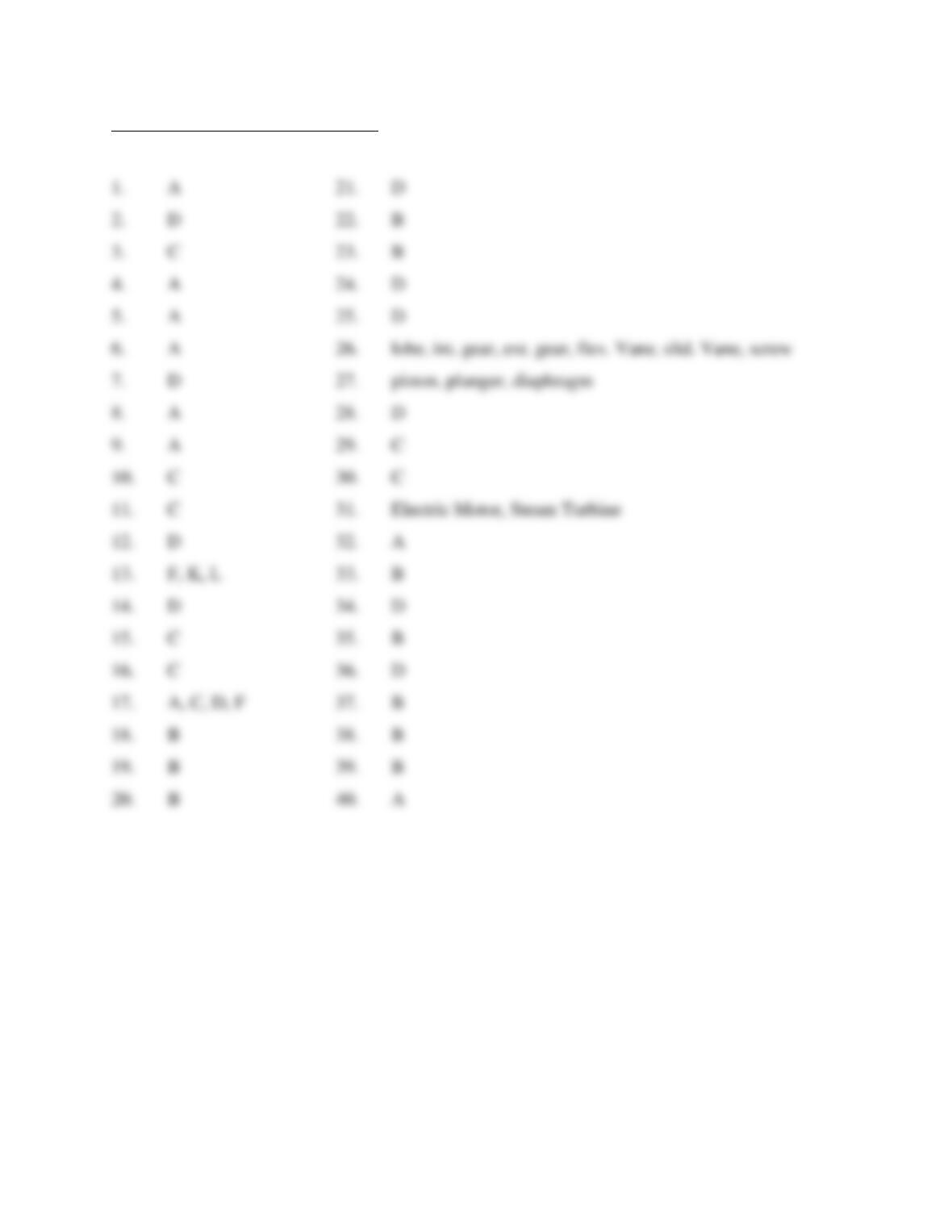
Answer Key CHAPTER 4 Pumps