CHAPTER 6:
EQUIPMENT TWO
OBJECTIVES
• Describe the purpose and components of different types of heat exchangers.
• Describe the key components and operation of a cooling tower.
• List the primary components of a water tube and fire tube boiler.
• Describe the primary components and operation of a cabin, box, and cylindrical furnace.
• Describe the purpose and components of a plate and packed distillation columns.
REVIEW QUESTIONS
1. Draw a shell and tube heat exchanger. Label and show flows with a red pen.
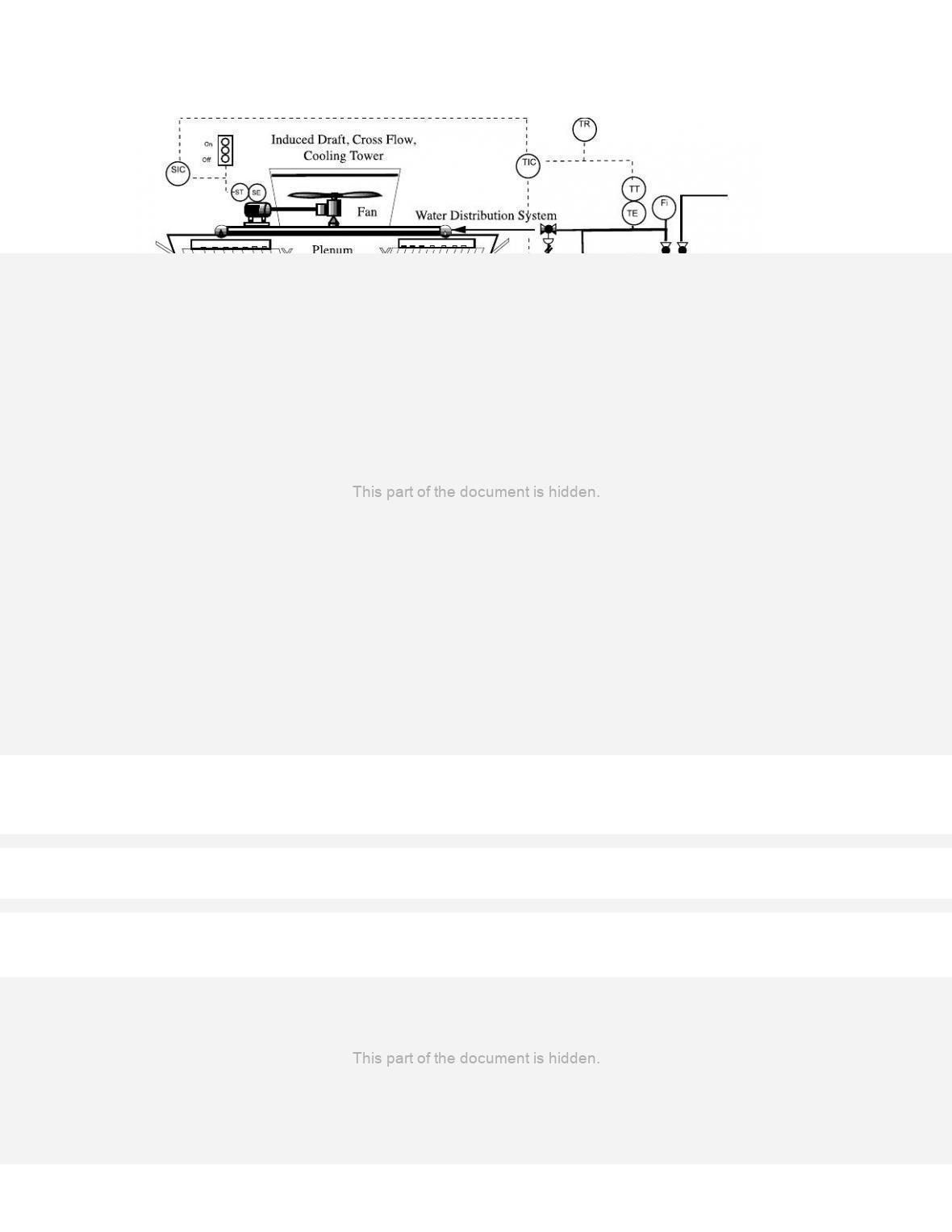
2. Draw and label a cooling tower. Label and show flows with a red pen.
4. Draw and label a box furnace with an air preheater system. Label and show flows with a
red pen.
5. Draw and label a water tube boiler. Illustrate flows with a red pen.
6. Compare water tube and fire tube boilers.
Fire-tube boilers are typically smaller in application and use than the large commercial
7. List the four basic furnace designs discussed in this chapter.
8. List four different types of fired heater burner classifications.
9. Explain how a furnace supports the various processes found in the chemical processing
industry.
10. Compare a kettle reboiler with a thermosyphon reboiler. Explain how each works and the
primary differences.
11. What are the primary differences between a forced and induced draft cooling tower? The
12. Identify and list each type of heat exchanger and describe the basic operation. Answer:
13. The primary purpose(s) of a heat exchanger is to:
14. The primary purpose of a cooling tower is to:
15. Select the primary method a cooling tower uses to transfer heat:
16. Fluid flow is characterized as:

17. The primary methods of heat transfer include:
18. Heat exchangers can be found in all the following categories except:
19. Shell and tube heat exchangers can be broken into all of the following except:
20. Reboilers have two basic designs:
21. Heat energy is transferred from areas of:
22. The primary difference between a kettle reboiler and other heat exchangers is:
23. Kettle reboilers typically have _____ connections.
24. Kettle reboilers are used to:
25. Cooling towers are classified by:
CHAPTER 6 TEST
EQUIPMENT 2
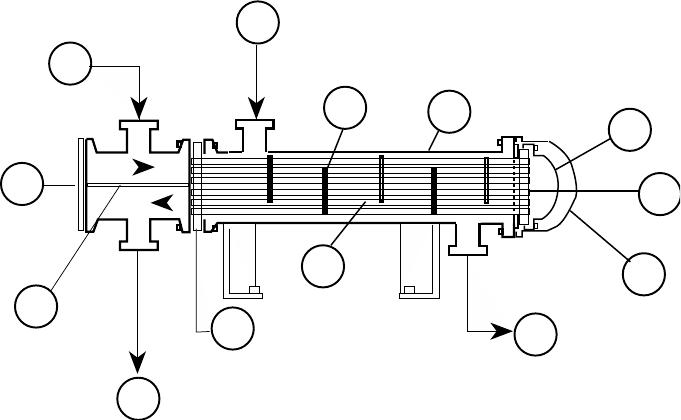
1. Label the following shell and tube heat exchanger.
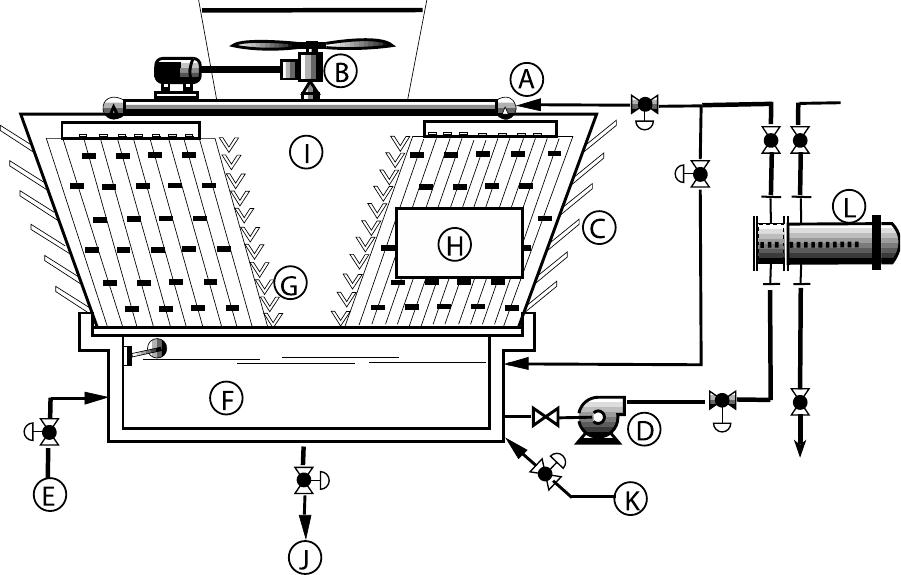
2. Please label the following cooling tower.
A
B
C
D
E
F
G
H
IJ
K
L
M
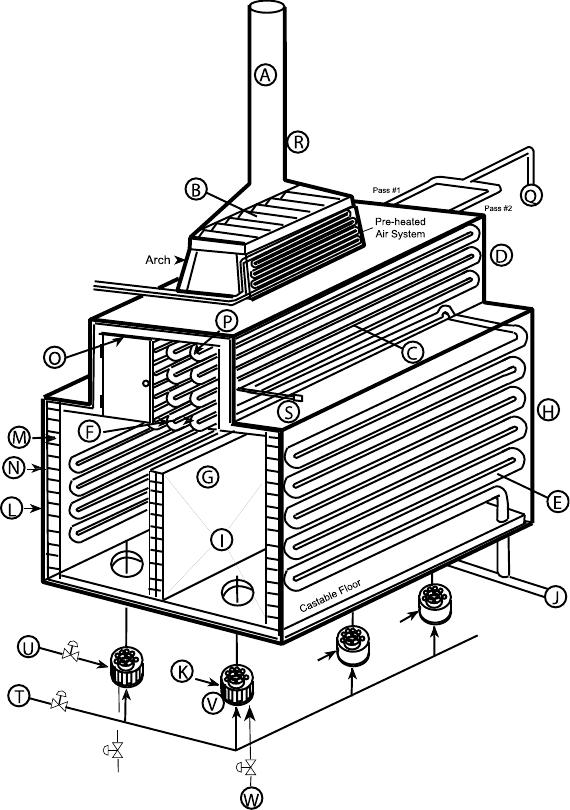
3. Please label the following furnace.
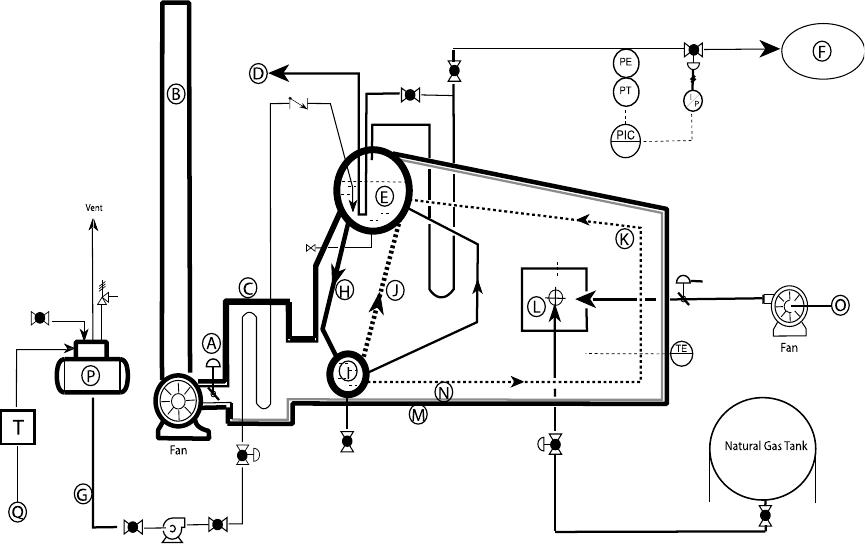
1. Please label the following boiler
5. The basic furnace designs include;
a. cabin, radiant, coil
b. box, water tube, helical
c. spiral, natural, balanced
d. cabin, box, cylindrical
6. The primary purpose(s) of a heat exchanger is;
a. heat or cool a substance
b. transfer heat energy between two fluid streams
c. convert hot vapor to liquid or preheat liquid
d. all the above
7. The primary purpose of a cooling tower is;
a. cool water
b. circulate hot water
c. boil water
d. provide cooling for heat exchangers
8. Select the primary method a cooling tower uses to transfer heat;;
a. convection
b. sensible heat
c. evaporation
d. a & c
9. Fluid flow is characterized as;
a. laminar
b. turbulent
c. parallel, series, counterflow, cross flow
d. all the above
10. The primary methods of heat transfer include;
a. evaporation, sensible
b. conduction, convection, and radiant
c. vaporization, latent, condensation
d. solid, liquid, vapor
11. Heat exchangers can be found in all the following categories except;
a. shell and tube
b. fire tube
c. plate and frame
d. air-cooled
12. Shell and tube heat exchangers can be broken into all the following except;
a. double-pipe and reboilers
b. u-tube and fixed head, single pass
c. pot belly and kettle reboiler
d. floating head, multipass and fixed head, multipass
13. Reboilers have two basic designs;
a. pot belly and kettle
b. thermal and radiant
c. kettle and thermosyphon
d. shell & tube and air cooled
14. Heat energy is transferred from areas of;
a. hot to cold
b. cold to hot
c. conduction to convection
d. cross flow to counterflow
15. The primary difference between a kettle reboiler and other heat exchangers is;
a. a vapor disengaging cavity
b. single-pass operation
c. shell and tube design
d. air-cooling chamber
16. Kettle reboilers have _____ connections;
a. three
b. four
c. five
d. six
17. Kettle reboilers are used to;
a. control liquid level
b. control temperature of column
c. control product purity in bottom of column
d. all the above
18. Sensible heat transfer accounts for ___% in a cooling tower;
a. 10-20%
b. 20-30%
c. 70-80%
d. 80-90%
19. Cooling towers are classified by;
a. How it produces airflow
b. relative humidity and wet-bulb
c. Airflow vs. downward flow of water
d. a & c
20. Steam Generators, commonly called boilers, are used by industrial manufacturers to;
a. drive electric generators
b. drive steam turbines
c. heat water
d. produce steam
21. Furnaces are classified as;
a. direct fired
b. box or A-frame
c. indirect fired
d. a & c
22. List the types of problems a fired heater typically encounters;
a.
b.
c.
d.
23. Furnace mechanical draft comes in four designs; List them!
a.
b.
c.
d.
24. List two processes furnaces support;
a.
b.
25. Heat exchangers can be used in all the following applications except;
a. preheat feed
b. condense overhead vapor
c. maintain energy balance on a column
d. remove impurities from cold water
ANSWERS TO CHAPTER 6 TEST