CHAPTER 4:
APPLIED PHYSICS ONE
OBJECTIVES
• Describe key terms and definitions used in basic process principles.
• Describe and apply the basic principles of pressure.
• Perform pressure calculations.
• Analyze the scientific principles of heat, heat transfer, and temperature.
• Perform simple temperature conversions between ºF,ºC, K, and ºR.
• Examine the principles of fluid flow in process equipment.
• Solve basic mathematical problems encountered in industry.
REVIEW QUESTIONS
1. Bernoulli’s principle states that in a closed process with a constant flow rate
a. changes in fluid velocity (kinetic energy) decrease or increase pressure.
2. As the pressure increases inside a confined space
a. the boiling point increases
3. Solve for y: 62 = 13y – 3
4. Solve for x: 2x = 9
5. Pressure is directly proportional to
6. Atmospheric pressure is
8. An example of fluid flow is
9. Boyle’s Law describes how
d. kinetic energy and pressure energy changes correspond to pipe size changes
process of evaporation.
11. Calculate the pressure produced by a 2000 -lb stone block, 12-in. length X 12-in. width
X 12-in. height.
Pressure = Force (weight) ÷ Area
12. Calculate the pressure exerted on a 26 ft column filled with 13 ft of gasoline. The vapor
pressure of gasoline at 100 F is 12 psi.
13. If K = ºC + 273, convert 2,432ºF to K.
a. 2016.67K
14. Convert 84.7 psig to psia.
a. 70 psia
15. Calculate the pressure exerted halfway up a 30-ft tank. The liquid level in the tank is 22
ft. Specific gravity is .79. Vapor pressure at 100°F equals 12.2 psi. The tank operates at
36 psi.
a. 2.394 psi
16. If Fahrenheit = 1.8°C + 32, then convert 760°C to Fahrenheit.
17. If R = ºF + 460, convert 549°C to R.
18. If ºC = (ºF-32) ÷1.8 then convert 298ºF to Celsius.
d. 146.9ºC
19. Calculate the ∆p between 7 psia and 20 psig.
20. Convert 720ºR to K.
CHAPTER 4 TEST
PHYSICS 1
1. Calculate the pressure produced by a 2,500-lb block, 40″ length x 20″ wide x 35″ high.
a. 6.25 psi
b. 3.125 psi
c. .089 psi
d. .043 psi
2. Convert 84.7 psig to psia.
a. 70 psia
b. 99.4 psia
c. 84.7 psia
d. 99.4 psiv
3. Liquids must reach their boiling point in order to evaporate.
a. true
b. false
4. Turbulent fluid flow transfers heat within a confined system better than laminar.
a. true
b. false
5. Molecular motion in water _______________.
a. decreases as heat is added
b. stays the same when heat is added
c. increases as heat is added
d. cannot be measured
6. If K = ºC + 273, convert 2,432F to K.
a. 2016.67 K
b. 1606.33 K
c. 768.19 K
d. 1333.33 K
7. As pressure increases, the _______________.
a. escape of molecules from the surface of the liquid is reduced proportionally
b. boiling point increases
c. gas or vapor molecules are forced closer together
d. all of the above
8. When a vacuum is pulled on a distillation column, the boiling point _______________.
a. is lowered
b. is increased
c. is stabilized
d. of some components is changed
9. The standard used to measure non-hydrocarbon heaviness is _______________.
a. density
b. specific gravity
c. API
d. baume
10. A specially designed hydrometer used to determine the density or heaviness of a
hydrocarbon mixture shows _______________.
a. API gravity
b. baume gravity
c. specific gravity
d. density
11. Heat required to melt a substance defines latent heat of _______________.
a. fusion
b. radiation
c. vaporization
d. condensation
12. The boiling point of a substance is _______________.
a. the temperature at which the vapor exceeds atmospheric pressure
b. when bubbles become visible in the liquid
c. when vaporization begins
d. all of the above
13. Solve 3 + 6(2 + x) = 45.
a. 3
b. 5
c. 10
d. 7
14. Vacuum technology is used to _______________.
a. minimize damage from overheating
b. mix components
c. reduce energy costs
d. a and c
15. A change in pressure will _______________.
a. maintain the boiling points of raw materials and products
b. enhance the boiling points of raw materials and products
c. shift the boiling points of raw materials and products
d. shift the boiling points of lighter materials only
16. The French scientist who discovered that pressure in a fluid is transmitted equally in all
directions is _______________.
a. J. Lockett
b. B. Pascal
c. R. Boyle
d. L. LaParmontia
17. Dalton’s law states that _______________.
a. in a closed process with a constant flow rate changes in fluid velocity effect
pressure
b. the total pressure of a gas mixture is the sum of the pressures of the individualized
gases
c. objects in motion tend to stay in motion
d. for every action there is an equal and opposite reaction
18. Calculate the pressure produced by a 8,500-lb block, 2′ length x 4′ wide x 6′ high.
a. 0.1 psi
b. 7.38 psi
c. 1062.5 psi
d. 531.25 psi
19. Calculate the pressure at the base of a 200 foot column with a 20 foot liquid level in the
lower stripping section. The column is operating under 55 psig. Specific gravity of
bottom product is .85.
a. 128.61 psi
b. 73.61 psi
c. 62.361 psi
d. 7.361 psi
20. Calculate the pressure exerted half way up a 30-foot tank. The liquid level in the tank is
22 feet. Specific gravity is .79. Vapor pressure at 100F equals 12.2 psi. The tank
operates at 36 psi.
a. 2.394 psi
b. 38.39 psi
c. 14.59 psi
d. 50.59 psi
21. The Irish scientist who developed the law that describes how the volume of a gas
responds to pressure changes is _______________.
a. J. Lockett
b. B. Pascal
c. R. Boyle
d. L. LaParmontia
22. Liquid pressure is directly proportional to _______________.
a. density and height
b. temperature and time
c. vacuum and volume
d. energy and power
23. Convert 14.7 psia to psig.
a. 60 psig
b. 0 psig
c. 29.4 psig
d. 14.7 psig
24. Liquids are typically considered _______________.
a. compressible
b. non-compressible
25. Heat that can be sensed or measured is _______________.
a. latent heat
b. sensible heat
c. specific heat
d. Btu
26. Vapor pressure is _______________.
a. the separation of molecules from an adhesive liquid surface
b. vapor under pressure
c. the weight of the liquids vapor
d. the measurement of molecular motion
27. Calculate the pressure produced at the base of a half full water tank 80 feet tall with a 60–
foot diameter.
a. 17.32 psi
b. 34.64 psi
c. 69.28 psi
d. 8.6 psi
28. Pressure __________ impacts the boiling point of a substance.
a. indirectly
b. directly
29. Latent heat comes in all the following forms except latent heat of _______________.
a. fusion
b. radiation
c. vaporization
d. condensation
30. ______________ is defined as the hotness or coldness of a substance.
a. Heat
b. Temperature
c. Energy
d. Transfer
31. Heat removed to freeze a substance is called latent heat of _______________.
a. fusion
b. radiation
c. vaporization
d. condensation
32. Heat required to change a liquid to a gas is called latent heat of _______________.
a. fusion
b. radiation
c. vaporization
d. condensation
33. Heat removed to condense a gas is called latent heat of _______________.
a. fusion
b. radiation
c. vaporization
d. condensation
34. One calorie is roughly equal to the heat energy required to raise the temperature of one
gram of water _______________.
a. one degree Celsius
b. one degree Fahrenheit
c. one Btu
d. one degree Rankine
35. The required Btu needed to raise one pound of a specific substance one degree Fahrenheit
is called _______________.
a. Btu
b. calorie
c. specific heat
d. joule
36. Heat is measured in _______________.
a. calories
b. Celsius
c. Btu
d. a and c
37. Heat moves from areas of _______________.
a. hot to cold
b. cold to hot
38. A British thermal unit is _______________.
a. the heat energy required to raise the temperature of one gram of water one degree
Fahrenheit
b. the heat energy required to raise the temperature of one gram of water one degree
Rankine
c. the amount of heat needed to raise one pound of water one degree
d. the amount of heat needed to raise one cubic foot of water one degree
39. If Fahrenheit = 1.8C + 32, then convert 760C to Fahrenheit.
a. 1400C
b. 42.75F
c. 1,400F
d. 1,310F
40. If R = F + 460, convert 549C to R.
a. 988.2R
b. 1020.2R
c. 1598.4R
d. 1480.2R
41. Temperature is measured in _______________.
a. Fahrenheit and Celsius
b. Rankine and Kelvin
c. Btu and calorie
d. a and b
42. According to Bernoulli, changes in fluid velocity inside a closed system increase and
decrease _______________.
a. temperature
b. pressure
c. velocity
d. b and c
43. If ºC = (ºF-32) ÷ 1.8 then convert 298F to Celsius.
a. 147.78C
b. 478.8C
c. 215.7C
d. 146.9C
44. Industry uses all of the following methods to determine a fluid’s heaviness except
_______________.
a. density
b. specific gravity
c. baume
d. APP
45. The density of a substance divided by the density of water is _______________.
a. specific gravity
b. bulk density
c. baume
d. APP
46. Atmospheric pressure at sea level is _______________ psi
a. – 14.7
b. 14.0
c. 0
d. 14.7
47. The effects of absorbed heat include all of the following except _______________.
a. increase in volume
b. increase in temperature
c. change of state
d. initiate endothermic reaction
48. The stronger the bonds or molecular attraction, the _________ the vapor pressure.
a. higher
b. denser
c. lower
d. warmer
49. A fluid can be considered a _______________.
a. gas
b. vapor
c. liquid
d. all of the above
50. ___________ is a term used to describe a fluid’s ability to resist flow.
a. Turbulence
b. Viscosity
c. Laminar
d. Density
51. Convert 200 psig to psia.
52. Convert 390 psig to psia.
53. Convert 226 psia to psig.
54. Convert 450 psia to psig.
55. Convert 5.5 psia to psiv.
56. Convert 14.2 psia to psiv.
57. Calculate the ∆p between 7 psia and 20 psig.
58. Calculate the ∆p between 14 psia and 150 psig.
59. Convert 270ºF to ºC.
60. Convert 440ºF to ºC.
61. One bar is equal to how many psi?
62. Convert 325ºC to ºF.
63. Convert 1010ºC to ºF.
64. Convert 510ºC to K.
65. Convert 1125ºC to K.
66. Convert 215ºF to ºR.
67. Convert 1515ºF to ºR.
68. Convert 1220K to ºR.
69. Convert 666K to ºR.
70. Convert 720ºR to K.
71. Convert 1956ºR to K.
72. Solve for x:
x – 10 = 14 – 3
73. 2x = 8 + x
74. A rectangular tank is 30 ft. long, 16 ft. tall, and 6 ft. wide, what is the volume?
75. A vertical tank is 30 ft tall with a diameter of 10 ft. Product level is 15 foot. What is the
volume of the product?
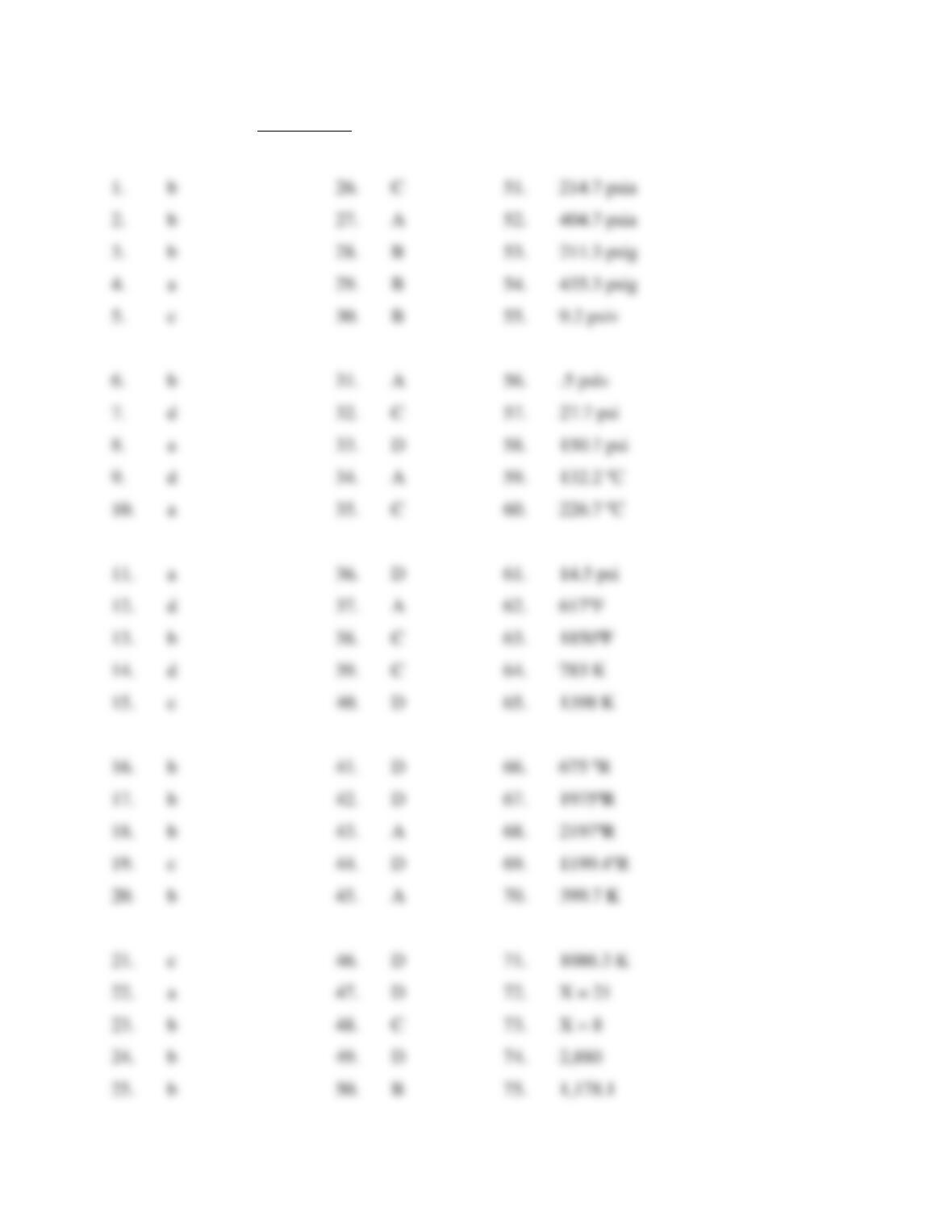
ANSWER KEY – PHYSICS 1