CHAPTER 17
PROCESS TROUBLESHOOTING
OBJECTIVES
• Describe the various troubleshooting models.
• Describe how different variables affect each other.
• Explain how problems with process equipment affect other systems.
• Analyze process problems and provide solutions.
• Troubleshoot specific troubleshooting scenarios.
REVIEW QUESTIONS
1. List the various types of troubleshooting models.
2. Compare and contrast troubleshooting methods with models.
3. Describe the term process troubleshooting.
4. Explain how control loops are used in process technology.
5. Compare and contrast primary and secondary problems on an operating system.
6. How are checklists used to troubleshoot problems?
7. List the various types of instruments used in troubleshooting.
8. In Figure 17-11, what would happen if the heat was lost?
9. Draw a pressure and level control chart.
10. In Figure 17-2, what would happen if the pressure increased 50 psi?
11. In Figure 17-1, what happens when the steam flow increases?
CHAPTER 17 TEST
PROCESS TROUBLESHOOTING
1. List five process troubleshooting models.
a. _________________________________
b. _________________________________
c. _________________________________
d. _________________________________
2. Primary operational problems are best described as:
a. Problems created or responded to during a process upset.
b. Catastrophic shutdown events.
c. A term used to describe the first problem that created a process upset.
d. Those conditions linked to hard wire interlocks.
3. Identify the most important instrumentation used to troubleshoot process problems.
Circle all that apply!
a. Control loops- pressure, temperature, level, flow, analytical
b. Analyzers and alarms
c. Video trends and chart recorders
d. Gauges & indicators
4. Redundancy is a process that:
a. Shuts down the unit in an emergency.
b. Bypasses problem areas.
c. Stores spare parts in warehouse.
d. Uses backup systems for critical equipment.
5. Check sheets are used to:
a. Qualification document for new technicians
b. Collect large quantities of data.
c. Approve purchase of equipment
d. Management document used in HR for OSHA employee checks.
6. Process control instrumentation is used to:
a. Guide process production and quality.
b. Control each variable in the system.
c. Monitor each variable in the system.
d. B & C
7. Troubleshooting the operation of process equipment requires: Circle all that apply!
a. Good understanding of basic equipment components
b. Good understanding of how the equipment operates
c. A technical degree
d. Five years experience with operating systems
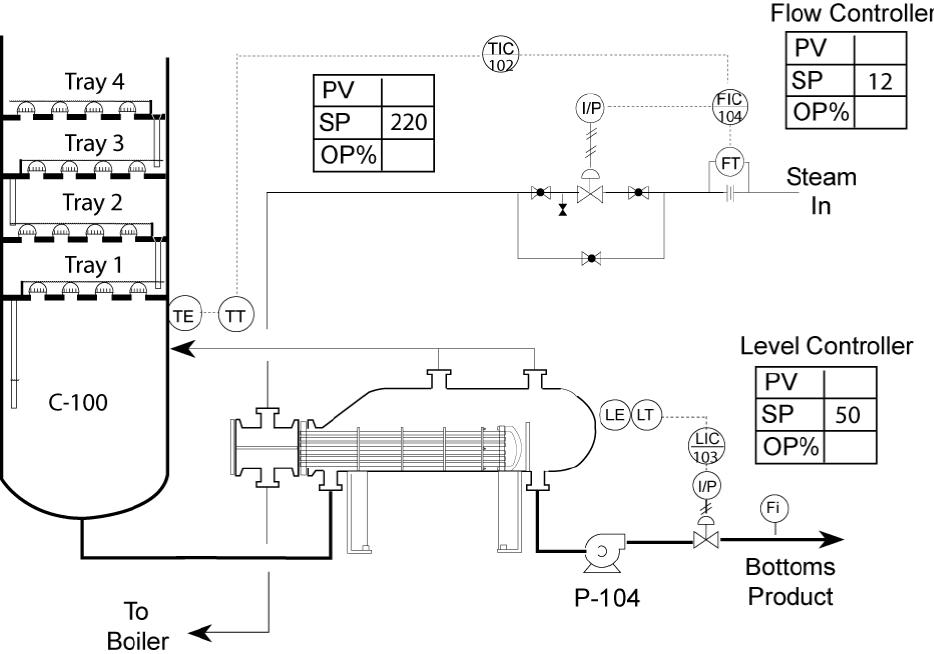
8. In the following graphic, what would happen if P-104 failed and could not be restarted?
a. Steam flow will. . . b. Bottoms flow rate will. . .
– increase – increase
– decrease – decrease
– stay the same – stay the same
c. Bottoms temperature will. . . d. The bottoms level will. . .
– increase – increase
– decrease – decrease
– stay the same – stay the same
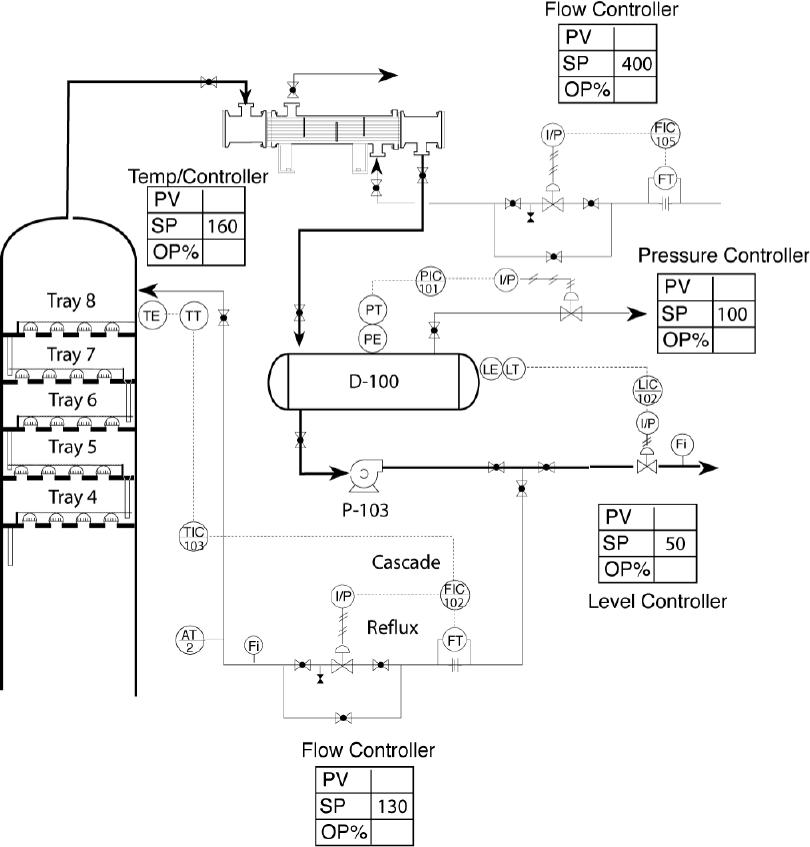
9. In the following graphic, what would happen if the reflux control valve failed closed?
a. Column pressure will. . . b. Reflux flow rate will. . .
– increase – increase
– decrease – decrease
– stay the same – stay the same
c. Column top temperature will. . . d. The level in D-100 will. . .
– increase – increase
– decrease – decrease
– stay the same – stay the same
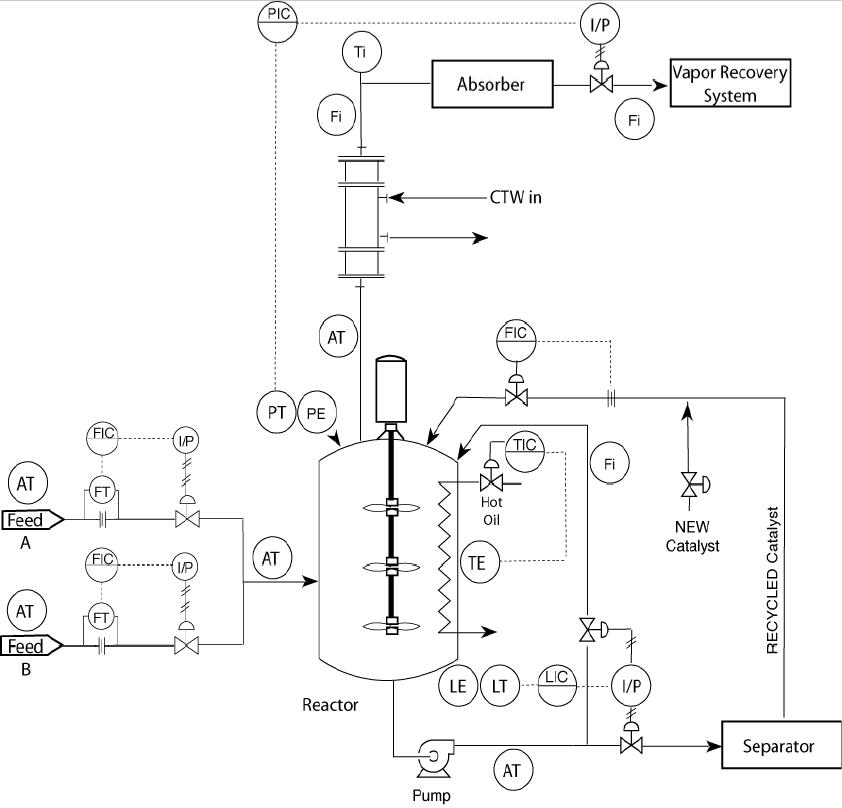
10. In the following graphic, what would happen if the hot oil system failed?
a. Reactor pressure will. . . b. Vapor production will. . .
– increase – increase
– decrease – decrease
– stay the same – stay the same
c. Agitation and catalyst flow will. . . d. The level in the reactor will. . .
– increase – increase
– decrease – decrease
– stay the same – stay the same
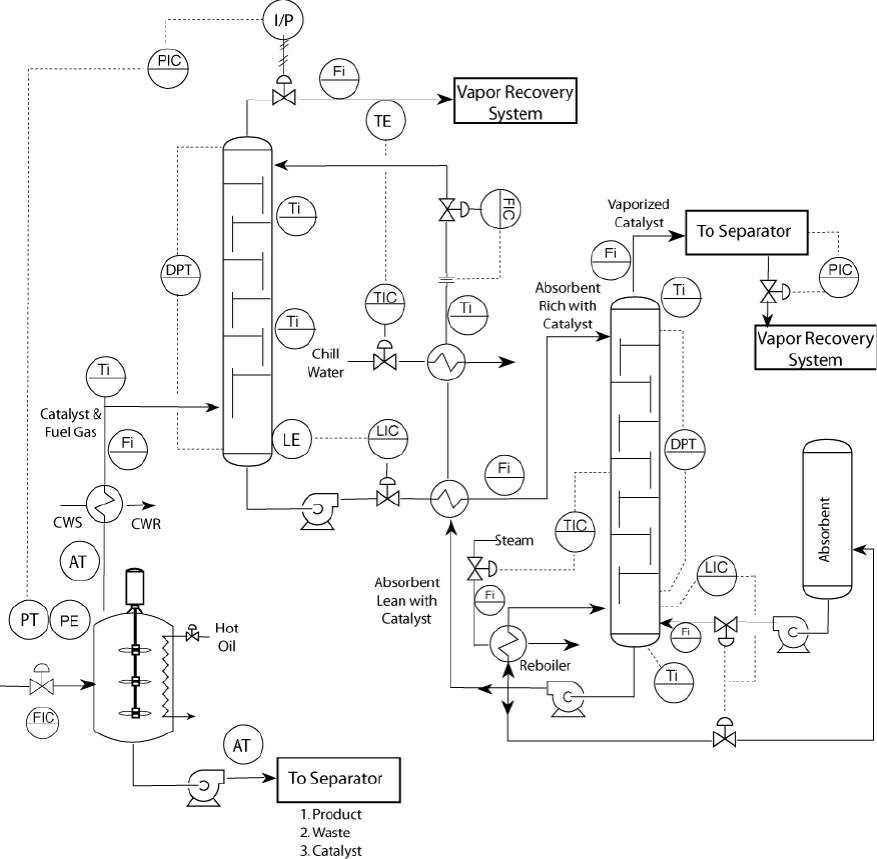
11. In the following graphic, what would happen if the hot oil system in the reactor failed?
a. Absorber column pressure will. . . b. Vapor recovery flow rate will. . .
– increase – increase
– decrease – decrease
– stay the same – stay the same
c. Vapor catalyst flow to separator will. d. The level in the columns will. . .
– increase – increase
– decrease – decrease
– stay the same – stay the same
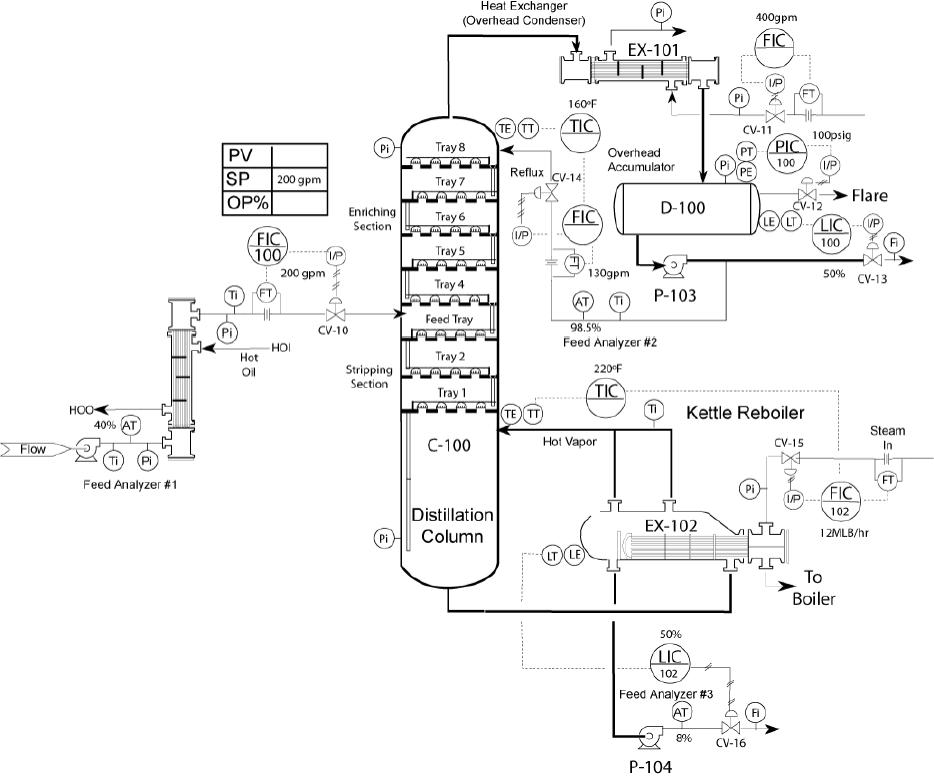
12. In this graphic, what would happen if CV-15 failed open?
a. Tray 8 temperature will. . . b. Reflux flow rate will. . .
– increase – increase
– decrease – decrease
– stay the same – stay the same
c. P-104 flow rate will. . . d. P-103 flow rate will. . .
– increase – increase
– decrease – decrease
– stay the same – stay the same
13. List the four troubleshooting methods described in this chapter.
a.
b.
c.
d.
14. List the five elements of a control loop.
a.
b.
c.
d.
e.
15. Draw a flow control loop.
ANSWER KEY CHAPTER 17 PROCESS TROUBLESHOOTING