Version 1 1
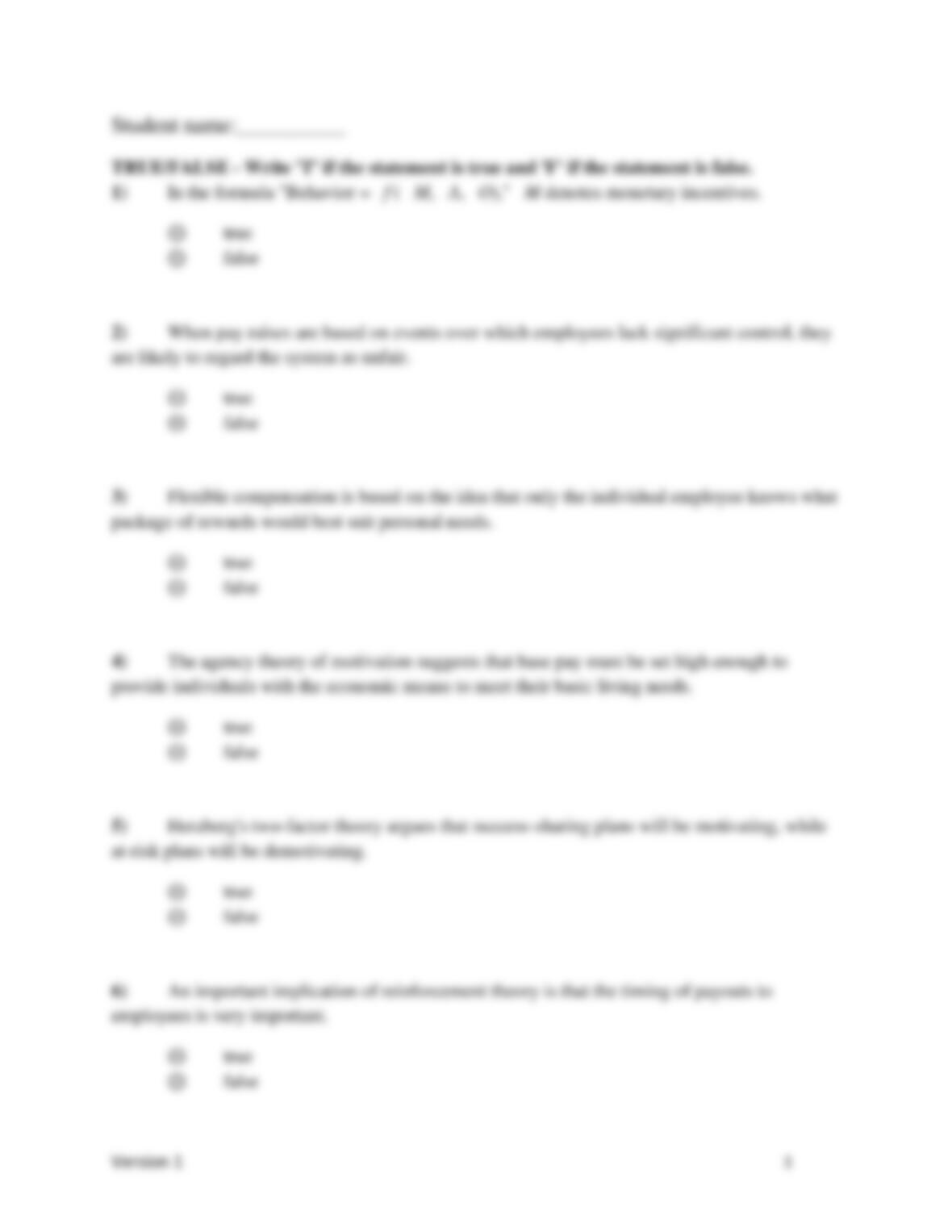
Student name:__________
TRUE/FALSE – Write ‘T’ if the statement is true and ‘F’ if the statement is false.
1) In the formula “Behavior = f ( M, A, O),” M denotes monetary incentives.
⊚ true
⊚ false
2) When pay raises are based on events over which employees lack significant control, they
are likely to regard the system as unfair.
⊚ true
⊚ false
3) Flexible compensation is based on the idea that only the individual employee knows what
package of rewards would best suit personal needs.
⊚ true
⊚ false
4) The agency theory of motivation suggests that base pay must be set high enough to
provide individuals with the economic means to meet their basic living needs.
⊚ true
⊚ false
5) Herzberg’s two-factor theory argues that success-sharing plans will be motivating, while
at-risk plans will be demotivating.
⊚ true
⊚ false
6) An important implication of reinforcement theory is that the timing of payouts to
employees is very important.
⊚ true
⊚ false
Version 1 2
7) Goal-setting theory argues that employees’ performance is maximized when performance
targets are unchallenging and unspecific.
⊚ true
⊚ false
8) Employee decisions to leave are influenced by their performance and the degree to which
pay is performance-based.
⊚ true
⊚ false
9) According to agency theory, because employees prefer a salary, they will demand a wage
premium in exchange for accepting performance-based pay.
⊚ true
⊚ false
10) Workload and work variety are both components of a total reward system.
⊚ true
⊚ false
11) Employees increasingly are expected to bear a share of the risks that businesses have
solely born in the past.
⊚ true
⊚ false
12) The trend today is toward less stable and less secure compensation packages.
⊚ true
⊚ false
Version 1 3
13) The authors of the text argue that a system of flexible compensation could lead to more
desirable employee behaviors at a lower total cost.
⊚ true
⊚ false
14) Gain sharing poses greater risk to individual employees than profit sharing.
⊚ true
⊚ false
15) Risk-sharing plans include a provision for cuts in base pay that are only recaptured in
years when an organization meets performance objectives.
⊚ true
⊚ false
16) Evidence suggests that talented people are motivated to join organizations with strong
links between performance and pay.
⊚ true
⊚ false
17) Group incentive pay increases the turnover of better performers, while individual
incentive increases the turnover of poorer performers.
⊚ true
⊚ false
18) Evidence suggests that skill-based pay may not increase productivity.
⊚ true
⊚ false
19) A problem with incentive pay plans is workers may end up focusing exclusively on
behaviors that are rewarded.
Version 1 4
⊚ true
⊚ false
20) Group pay is always more effective than individual pay.
⊚ true
⊚ false
MULTIPLE CHOICE – Choose the one alternative that best completes the statement or
answers the question.
21) The motivation triangle includes
A) selection.
B) organization design.
C) culture.
D) organization development.
22) The ability triangle includes
A) selection.
B) performance management.
C) compensation.
D) organization development.
23) When employee performance measures are ambiguous and vary from time to time, but
the organization’s performance is fairly stable over time, the most effective type of compensation
is to offer
A) a large base pay and low incentive pay.
B) an increase in base pay.
C) a variety of rewards with significant incentive pay.
D) monetary rewards with no benefits.
Version 1 5
24) When an organization’s performance has frequent highs and lows, but individual
performance is fairly stable and performance measures are clear, the most effective
compensation mix is to offer
A) a base pay with low incentives and a variety of rewards.
B) monetary rewards with large incentives.
C) a large base pay and low incentive pay.
D) a wide range of rewards and significant incentives.
25) The corporate performance of Yellow Corp. is fairly stable. However, it is difficult to
measure individual performance. In this case, the most effective compensation mix is to offer
A) a high base pay with high incentives.
B) monetary rewards alone.
C) a large base pay and low incentive pay.
D) a wide range of awards beyond just money.
26) When employee performance is easily measured and the organization’s performance is
fairly stable over time, the most effective type of compensation is to offer
A) a large base pay and low incentive pay.
B) a variety of rewards in addition to base pay.
C) a variety of rewards with significant incentive pay.
D) monetary rewards with large incentives.
27) When an organization’s performance has regular and large swings and individual
performance is unclear and hard to measure, the most effective compensation mix is to offer
Version 1 6
A) a base pay with low incentives and a wide array of awards.
B) monetary rewards with large incentives.
C) a large base pay and low incentive pay.
D) a wide range of rewards and significant incentives.
28) Which of the following motivational theories states that performance-based payments
work best when they closely follow performance?
A) Reinforcement theory
B) Equity theory
C) Expectancy theory
D) Agency theory
29) According to the ________ theory of motivation, employees prefer certain or fixed
income flows, such as wage or salary, to variable income flows, such as performance-based pay.
A) reinforcement
B) equity
C) agency
D) expectancy
30) The ________ theory of motivation states that employee motivation is the product of
instrumentality and valence.
A) equity
B) expectancy
C) reinforcement
D) agency
31) ________ is the value employees attach to the organization rewards received for job
performance.
Version 1 7
A) Equity
B) Instrumentality
C) Valence
D) Reinforcement
32) ________ is employees’ beliefs that higher job performance will be rewarded by the
organization.
A) Valence
B) Expectancy
C) Instrumentality
D) Utility
33) According to ________ theory, relative pay is important as employees evaluate the
adequacy of their pay via comparisons with other employees.
A) equity
B) expectancy
C) agency
D) reinforcement
34) ________ theory argues that pay should be based on outcomes if monitoring of behaviors
is difficult or costly and if risk due to variability in outcomes is not large.
A) Reinforcement
B) Goal-setting
C) Agency
D) Expectancy
35) Which of the following theories states that people choose the behavior that leads to the
most satisfactory exchange?
Version 1 8
A) Maslow’s need hierarchy
B) Expectancy theory
C) Herzberg’s two-factor theory
D) Goal-setting theory
36) ________ is a variable pay plan where payout depends not on company level
performance such as profitability, but rather on performance at some subunit such as a plant or
facility.
A) Individual incentive
B) Profit sharing
C) Merit bonus
D) Gain sharing
37) Grabhouse, Inc. is experiencing an increase in the turnover rates of its top employees.
Upon consulting with its managers for the reasons for this increase, Grabhouse finds that
employees are uneasy about the current pay mix as it involves too many risky elements. In order
to make its pay mix less risky, Grabhouse needs to:
A) increase the base pay component of its pay mix.
B) introduce a profit-sharing plan to its pay mix.
C) introduce a risk-sharing plan to its pay mix.
D) increase the merit bonus component of its pay mix.
38) ________ is a nonpermanent (variable) payment (bonus or lump sum) form of variable
pay granted to employee as function of some (typically primarily subjective) assessment of
individual employee performance.
A) Risk sharing
B) Gain sharing
C) Merit bonus
D) Success sharing
Version 1 9
39) In the context of a pay-for-performance plan, which of the following questions is related
to equity?
A) Does the plan help improve quality of service?
B) How far down the organization will the plan run?
C) Does the reward system maintain and enhance the reputation of the firm?
D) Do employees view the amount of compensation received as fair?
40) A person with low self-esteem is likely to seek
A) a small, hierarchical organization with pay plans based upon individual performance.
B) a flat organization with a significant amount of pay based upon performance.
C) a small organization with large benefits based on group performance.
D) a large, decentralized organization with little pay for performance.
41) Which of the following is an example of the sorting effect in action?
A) An employee leaving a high-paying job for one that provides more work/life balance
B) The provision of across-the-board pay increases by a company
C) The provision of cost-of-living increases by a company
D) An employee choosing fewer incentives in his flexible compensation plan
42) Droppiece, Inc. is a company that provides more performance-based pay and less base
pay than its competitors. Who among the following is most likely to join Droppiece?
A) George, a recently married man who wants a stable income
B) Stella, a recent college graduate who loves to take on a challenge
C) Mark, a musician who wants to supplement his income
D) Sara, a senior citizen who wants a job only to keep herself busy
43) When pay is based on individual performance, turnover tends to be highest among
Version 1 10
A) poor performers.
B) good performers.
C) single women with children.
D) ethnic minorities.
44) When a company moves from an individual incentive plan to a group incentive plan, the
company is most likely to experience
A) higher turnover among high performers.
B) an increase in instrumentality.
C) higher turnover among poor performers.
D) an increase in perceived equity.
45) Available evidence indicates that managers believe the most important factor for pay
increases is
A) experience.
B) nature of the job.
C) seniority.
D) performance.
46) Company X pays for performance. Allan, an employee of the company, is not in favor of
this reward system and, therefore, leaves Company X in search of another company with
different rules for getting rewards. This is an example of the:
A) design effect.
B) compensation effect.
C) sorting effect.
D) incentive effect.
47) The most obvious sorting factor is
Version 1 11
A) seniority.
B) ability.
C) experience.
D) educational qualification.
48) In the context of pay influencing turnovers, which of the following is a result of too little
pay?
A) Higher individual performance among employees
B) Feelings of unfair treatment among employees
C) More employees requesting for training
D) Employees finding the company more attractive
49) One review of the evidence suggests that employees do not begin to consider changing
their behavior unless raises are at least an increase of ________ percent.
A) 5
B) 6-7
C) 20
D) 10
50) The amount of fairness given to employees refers to
A) total justice.
B) quantitative justice.
C) procedural justice.
D) distributive justice.
SHORT ANSWER. Write the word or phrase that best completes each statement or
answers the question.
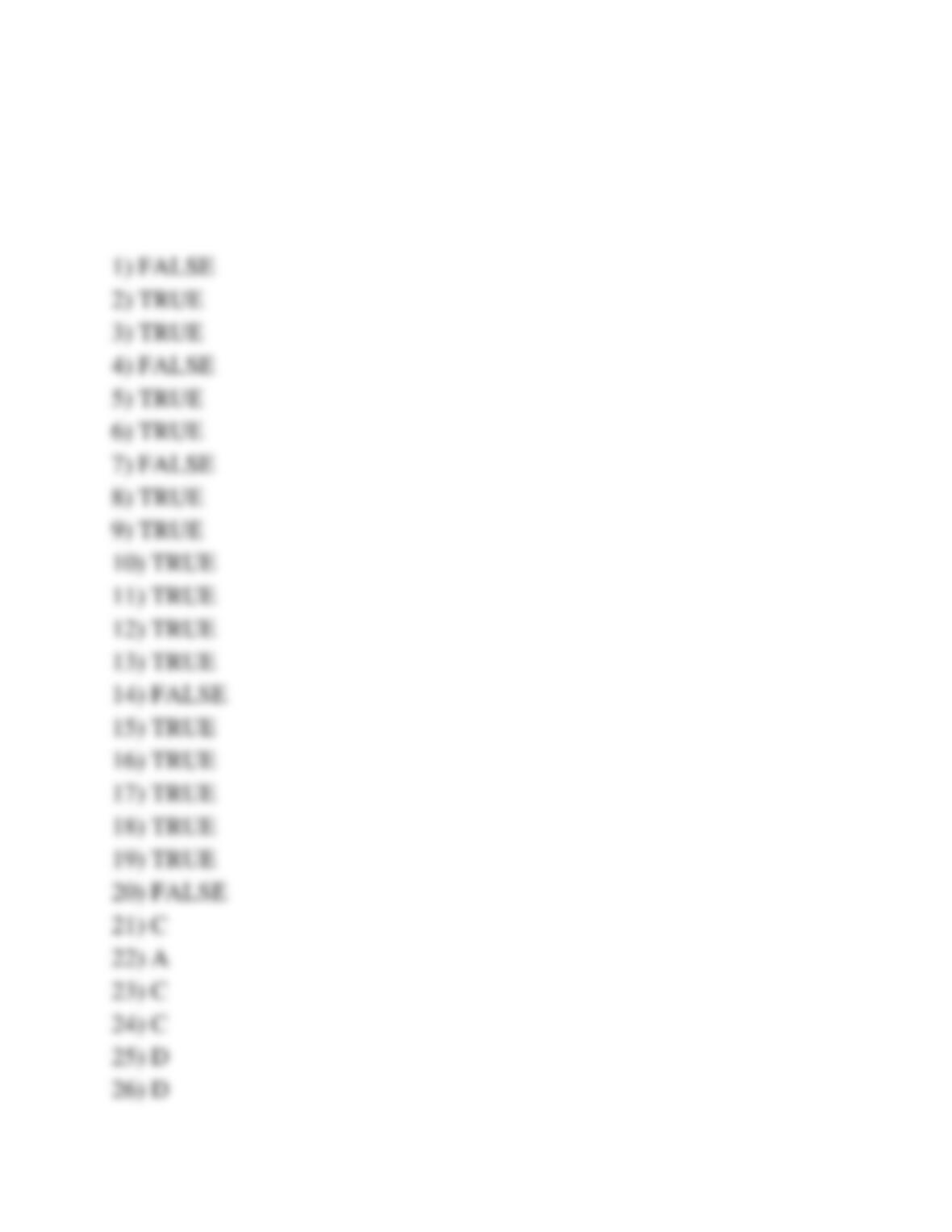
51) What are the behaviors that compensation needs to enforce?
Version 1 12
52) In the context of the pay model, explain how effectiveness is dependent on equity in
designing a pay system.
53) Briefly explain the concept of flexible compensation.
54) Explain the expectancy theory of motivation.
55) Compare risk-sharing and success-sharing plans.
Version 1 13
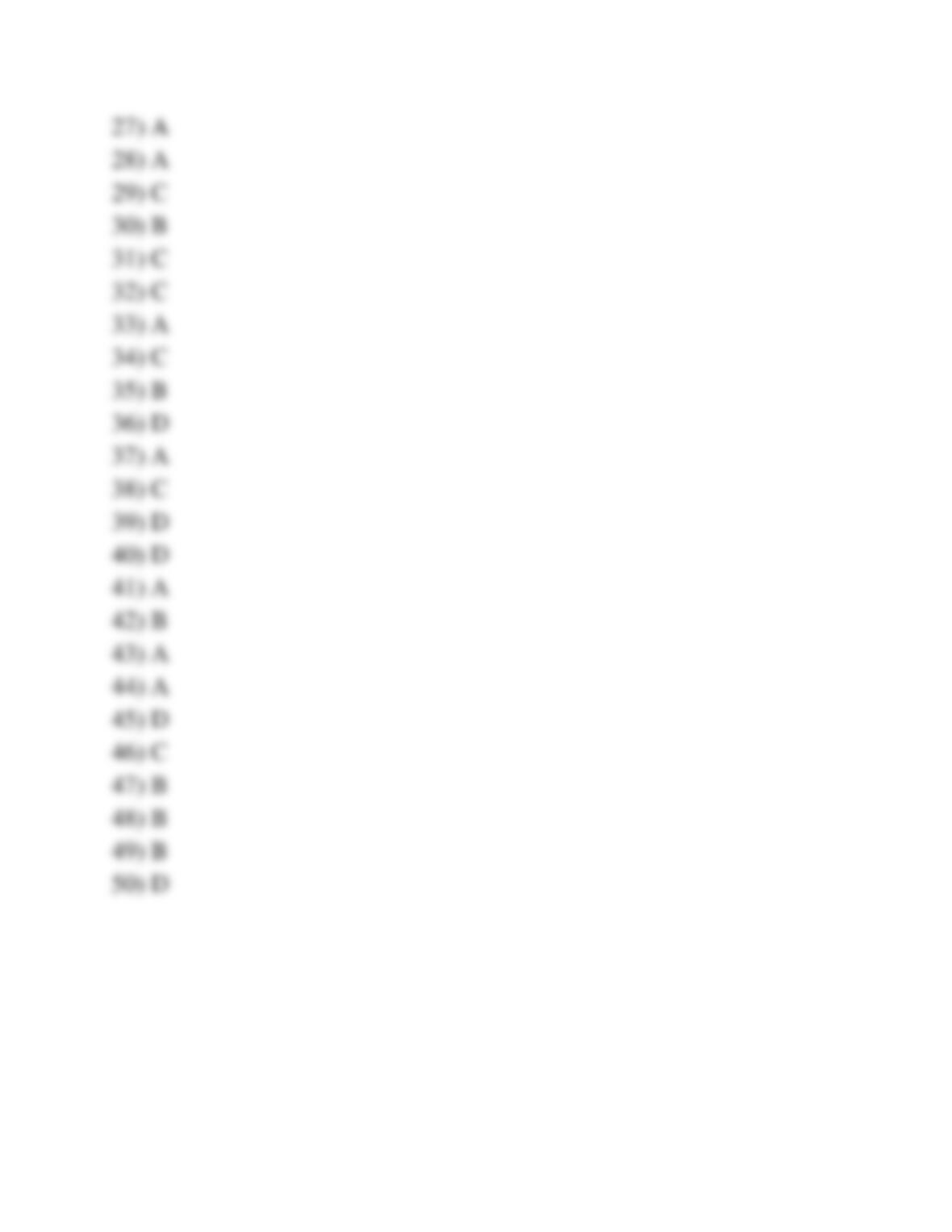
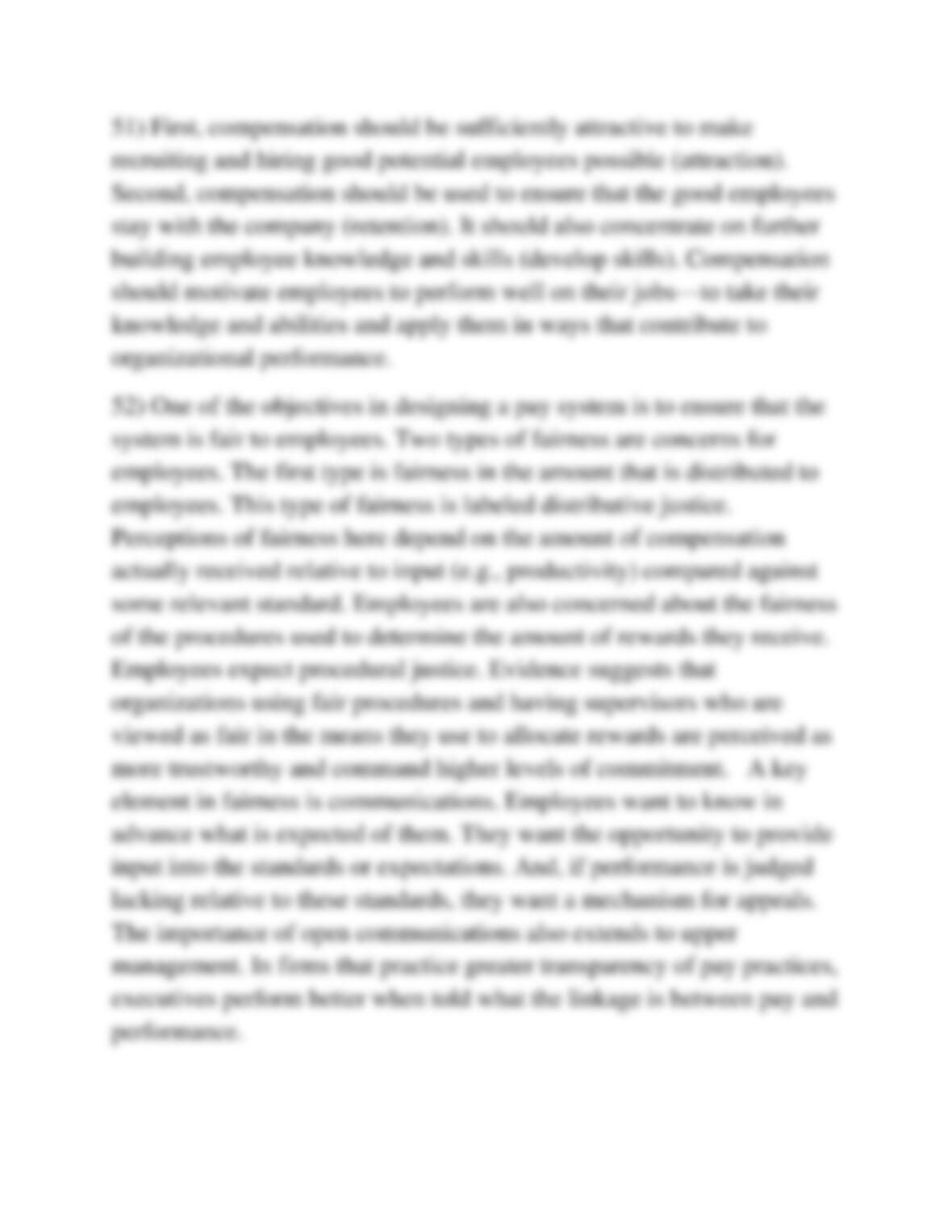
Answer Key
Test name: chapter 9
Version 1 14
Version 1 15
Version 1 16