Version 1 1
Student name:__________
1) A fellow student states the stress is more than simply a response to a stressor. Do you
agree? Justify your answer.
2) Describe the components of the organizational stress model.
3) Name the changes in behavior that are common warning signs of stress.
4) Explain the differences in a problem-focused versus an emotion-focused strategy for
coping with stress.
Version 1 2
5) The Diagnostic and Statistical Manual of Mental Disorders lists ten symptoms that, when
present for two weeks or more, indicate that a person is depressed. What are these symptoms?
6) How are body systems affected by stress?
7) How do organizations contribute to employee job burnout?
8) Identify several moderators of the stress process.
Version 1 3
9) What is the relationship between stress and personality? What aspects of personality
might tend to increase stress? Decrease it?
10) What kinds of things could an organization do to better maximize person-environment
fit?
11) How can P-E fit impact stress?
12) Stress is the result of dealing with something placing a special demand on us. Special
means a(n) _______________ experience.
Version 1 4
A) physically threatening
B) psychologically threatening
C) unusual
D) All of the choices are correct.
13) All of the following factors determine whether an experience is likely to result in stress
except:
A) Importance
B) Uncertainty
C) Duration
D) Distance
14) An individual difference, such as _______________, is a potential stress moderator.
A) age
B) social support mechanisms
C) personality
D) All of the choices are correct.
15) The experience of work-related and non-work (extraorganizational) stress produces
_______________ outcomes.
A) behavioral
B) cognitive
C) physiological
D) Any or all of the choices are correct.
Version 1 5
16) Long duration stress is sometimes referred to as _______________.
A) contextual stress
B) superior stress
C) continuous stress
D) chronic stress
17) Which of the following is a stressor at the individual level?
A) Technology
B) Management styles
C) Intragroup conflict
D) Role overload
18) The intention of most stress prevention programs is to reduce the _______________ of
an individual’s stress.
A) occurrence
B) intensity
C) negative impact
D) All of the choices are correct.
19) Which of the following is a stressor at the group level?
Version 1 6
A) Lack of cohesiveness
B) Management styles
C) Role overload
D) All of the choices are correct.
20) Which of the following is a stressor at the non-work level?
A) Pace of change
B) Harassment
C) The economy
D) All of the choices are correct
21) Virtually everyone has experienced work overload, and the incidence rate is increasing.
Overload ________________.
A) is said to be caused by “qualitative” factors
B) us said to be caused by “quantitative” factors
C) may be of two types: qualitative or quantitative
D) in the context of scientific management was seen as desirable
22) _______________ is present whenever compliance by an individual to one set of
expectations about a job conflicts with compliance to another set of expectations.
A) Peripheral interference
B) Role conflict
C) Job overlap
D) Role enrichment
Version 1 7
23) The optimal stress level _______________.
A) is near zero
B) is characterized in research as Type “O” stress
C) provides the best balance of challenge, responsibility, and reward
D) All of the choices are correct.
24) Which of the following is a symptom of stress caused by work overload?
A) Insomnia
B) Apathy
C) Absenteeism
D) All of the choices are correct.
25) All of the following are the result of an optimal level of stress except:
A) High motivation
B) Calmness
C) Sharp perception
D) Indecisiveness
26) Which of the following is a symptom of stress caused by work underload?
A) Apathy
B) Irritability
C) Increased errors
D) Sharp perception
Version 1 8
27) All of the following are characteristics of a hardy person except:
A) The hardy person assumes that he or she is in control
B) The hardy person ignores changes
C) The hardy person responds to stress by coping
D) The hardy person treats change as a challenge
28) _______________ refers to the extent that a person’s knowledge, opinions, and ideas are
included in the decision-making process.
A) Control
B) Integration
C) Participation
D) Pervasiveness
29) Disability claims _______________ in companies that have recently downsized.
A) decrease dramatically
B) increase dramatically
C) stabilize
D) are no longer an issue
30) A study of 2,100 employees, chosen from 23 different occupations, found that
_______________ reported the most boredom and apathy with their job conditions.
Version 1 9
A) blue-collar
B) unskilled workers
C) gray-collar, nonprofessional workers
D) white-collar, professional workers
31) When assessing a situation an individual may first evaluate a stressor as positive,
negative or meaningless. The secondary appraisal then follows and involves a(n) ____________.
A) reexamination of the situation intentionally changing perspective
B) determination of the negative and potential outcomes from the anticipated stress
C) assessment of “fight or flight” responses
D) determination whether something can be done to reduce the stress
32) Which one of the following statements about depression is incorrect?
A) Depression costs billions of dollars a year in medical bills, lost productivity, and
absenteeism.
B) The World Health Organization predicts that by 2030, more people in the world will
be affected by depression than any other health problem.
C) Depression is easy to detect, especially within the current health care system.
D) Depression leads to higher absenteeism and decreased worker productivity.
33) Stress outcomes have been classified as _______________.
A) cognitive and emotional
B) cognitive and behavioral
C) cognitive, behavioral and physiological
D) cognitive, behavioral, psychological and financial
Version 1 10
34) Polls indicate that over 40 percent of Japanese workers aged 30 to 60 believe that they
will die from _______________.
A) the stress of overwork
B) cancer
C) heart attacks
D) their poor diet
35) _______________ outcomes of stress include sweating, hot and cold flashes, and
increased heart rate.
A) Cognitive
B) Behavioral
C) Physiological
D) Behavioral and physiological
36) During a crisis, a neurotransmitter called catecholamine suppresses parts of the brain
dealing with all of the following except:
A) Memory
B) Concentration
C) Motor skills
D) Rational thought
37) Burnout is a psychological process that typically results in all of the following except:
Version 1 11
A) Enhanced immunity functions
B) Emotional exhaustion
C) Depersonalization
D) Feelings of decreased accomplishment
38) Which of the following burnout symptoms indicates low personal accomplishment?
A) Cannot deal with problems effectively
B) Feels fatigued in the morning
C) Does not want to work with other people
D) A and B are Correct.
39) While the organizational consequences of stress are many and varied, they share one
common feature: stress costs organizations _______________.
A) tempo
B) their reputations
C) customer loyalty
D) money
40) A _______________ is a condition, behavior, or characteristic that qualifies the
relationship between two variables.
A) moderator
B) modulation
C) bridge
D) regulator
Version 1 12
41) Which of the following are moderators of stress?
A) Personality
B) Type A behavior
C) Social Support
D) All of the above
42) Which of the following statements about the organizational costs associated with stress is
false?
A) The American Medical Association claims that stress was the cause of up to 85
percent of all human illness and disease
B) Stressed workers smoke more, eat less well, and have more family problems
C) Forty percent of employee turnover is due to excessive stress
D) All of the above
43) Which of the following Big Five personality dimensions is most clearly related to stress?
A) Emotional stability
B) Extroversion
C) Agreeableness
D) Conscientiousness
44) Those that score high on _______________ are better prepared to deal with stressors
associated with change because they view change as a challenge.
Version 1 13
A) extroversion
B) conscientiousness
C) openness to experience
D) emotional stability
45) The term _______________ refers to a relatively stable set of characteristics,
temperaments, and tendencies that shape the similarities and differences in people’s behavior.
A) character
B) personality
C) persona
D) talent
46) If you are low on _______________, you tend to be antagonistic, unsympathetic, and
even rude toward others.
A) emotional stability
B) extroversion
C) agreeableness
D) conscientiousness
47) Two major components of a Type A Behavior Pattern are:
A) Impatience and hostility
B) Impatience and arrogance
C) Ambition and arrogance
D) Ambition and hostility
Version 1 14
48) Analysis showed that _______________ was related to the presence of arteriosclerosis
more than any other Type A Behavior Pattern dimension.
A) ambition
B) impatience
C) work orientation
D) hostility
49) _______________ was defined in the text as the comfort, assistance, or information one
receives through formal or informal contacts with individuals or groups.
A) Social support
B) Emotional support
C) Companionship
D) All of the choices are correct.
50) What is the first step in any attempt to deal with stress?
A) Calming down
B) Identifying the source of the stress
C) Recognizing that stress exists
D) Removing the source of the stress
51) Ideally, the process for maximizing person-environment fit begins _______________.
Version 1 15
A) at the first sign of job-related stress
B) before the individual joins the organization
C) during job orientation
D) at the request of the employee
52) Employee assistance programs are designed to deal with a wide range of stress-related
problems. General elements of such a program include all of the following except:
A) Diagnosis
B) Screening
C) Full sharing with the sponsoring employer
D) Treatment
53) Two types of organizational programs have become particularly popular during the last
two decades: employee assistance programs and _______________ programs.
A) health care
B) wellness
C) physical fitness
D) biofeedback
54) For any employee assistance program to be a success, employees must trust in all of the
following except:
A) The program can and will provide real help
B) The program will be available on a long-term basis
C) Confidentiality will be maintained
D) Use of the program carries no negative job implications
Version 1 16
55) Any activity that an organization engages in that is designed to identify and assist in
preventing or correcting _______________ can be thought of as wellness-related.
A) health hazards
B) negative health habits
C) specific health problems
D) All of the choices are correct.
56) _______________ has been cited as the greatest cause of poor health habits.
A) Alcoholism
B) Drug abuse
C) Poor health education
D) Stress
57) All of the following are cognitive distortions except:
A) Magnifying
B) Overgeneralizing
C) Personalization
D) Distancing
58) Which of the following can be brought under voluntary control through the use of
biofeedback techniques?
Version 1 17
A) Brain waves
B) Heart rate
C) Muscle tension
D) All of the choices are correct.
59) Relaxation training generally results in all of the following except:
A) Increased heart rate
B) A clear sense of being in control
C) A reduction in anxiety and tension
D) Slowed breathing
60) Stress is the result of dealing with something placing special demands on us. In this
context, what does special mean?
61) In the Model of Stressors, Stress, and Outcomes, stressors were presented in four main
categories, what are they?
62) What is role conflict? Provide an example.
Version 1 18
63) There are two types of work overload, what are they?
64) How does hardiness impact stress?
65) Explain the typical workweek of a eurocommuter.
66) Provide an example of problem-focused coping.
67) Provide an example of emotion-focused coping.
Version 1 19
68) Research has identified several factors that are important contributors to burnout. Identify
four of them.
69) Name four negative psychological consequences of stress.
70) How is job commitment related to burnout?
71) Is conscientiousness related to stress?
72) The text identified eight characteristics of people with Type A behavior patterns. List
four of them.
Version 1 20
73) Why is social support effective as a stress moderator?
74) Name three actions that you, as a manager, can take to develop social support and build a
supportive work environment.
75) What is the underlying assumption of all cognitive stress management techniques?
76) Stress is an adaptive response, moderated by individual differences; that is a consequence
of any action, situation, or event that places special demands on a person.
⊚ true
⊚ false
77) Rumors of an impending layoff are typically never as stressful as actually being laid off.
⊚ true
⊚ false
Version 1 21
78) Generally, the longer special demands are placed on us, the less stressful they become.
⊚ true
⊚ false
79) Research has found a relatively small number of events actually create “stress.”
⊚ true
⊚ false
80) The greater the power or authority of the person sending conflicting messages, the greater
the job dissatisfaction produced by role conflict.
⊚ true
⊚ false
81) Executives in the low end of the stress range, report less serious medical problems.
⊚ true
⊚ false
82) The negative effects of overload can be increased when overload is coupled with low
ability to control the demands of work.
⊚ true
⊚ false
Version 1 22
83) Research suggests that when individuals experience high work demands with little or no
control over these demands, any physiological changes that occur in that physical setting fade
promptly after the individual has left the situation.
⊚ true
⊚ false
84) Most people would prefer not to know how management views the quality of their work.
⊚ true
⊚ false
85) A primary appraisal of stressors involves a determination of whether something can be
done to reduce a stressor.
⊚ true
⊚ false
86) Polls indicate that over 40 percent of Japanese workers aged 30 to 60 believe they will
die from the stress of overwork, what the Japanese call “corporate samurai.”
⊚ true
⊚ false
87) It is unwise for managers to attempt to counsel workers suspected of being depressed.
⊚ true
⊚ false
88) Burnout tends to be less of a problem for people whose jobs require extensive contact
with other people.
Version 1 23
⊚ true
⊚ false
89) A high degree of involvement in, identification with, or commitment to one’s job or
profession is a necessary prerequisite for burnout.
⊚ true
⊚ false
90) Workers’ compensation laws are increasingly eliminating benefits for injuries stemming
from workplace stress.
⊚ true
⊚ false
91) Some people are predisposed to stress.
⊚ true
⊚ false
92) Stress is the consequence of the interaction between an environmental stimulus and the
individual’s response.
⊚ true
⊚ false
93) Stress is not likely to result from a mismatch between an employee’s talents and the job
requirements.
⊚ true
⊚ false
Version 1 24
94) The person-environment fit approach is related to the concept of the psychological
contract.
⊚ true
⊚ false
95) Job skills and knowledge are not the only factors to consider in employee selection, in
order to ensure person-environment fit.
⊚ true
⊚ false
96) Once a person is working in the organization, a critical variable in maximizing fit and
preventing stress is effective socialization.
⊚ true
⊚ false
97) Employee assistance programs were originally conceived as stress reduction programs.
⊚ true
⊚ false
98) Research supports the conclusion that humor boosts the human immune system, but has
little effect on stress.
⊚ true
⊚ false
Version 1 25
99) While generally seen as effective in promoting health, current trends indicate wellness
programs have lost favor, as fewer employers are offering these programs.
⊚ true
⊚ false
100) The greatest payoff from stress prevention and management comes from ongoing and
sustained effort, rather than one-time activities.
⊚ true
⊚ false
Version 1 26
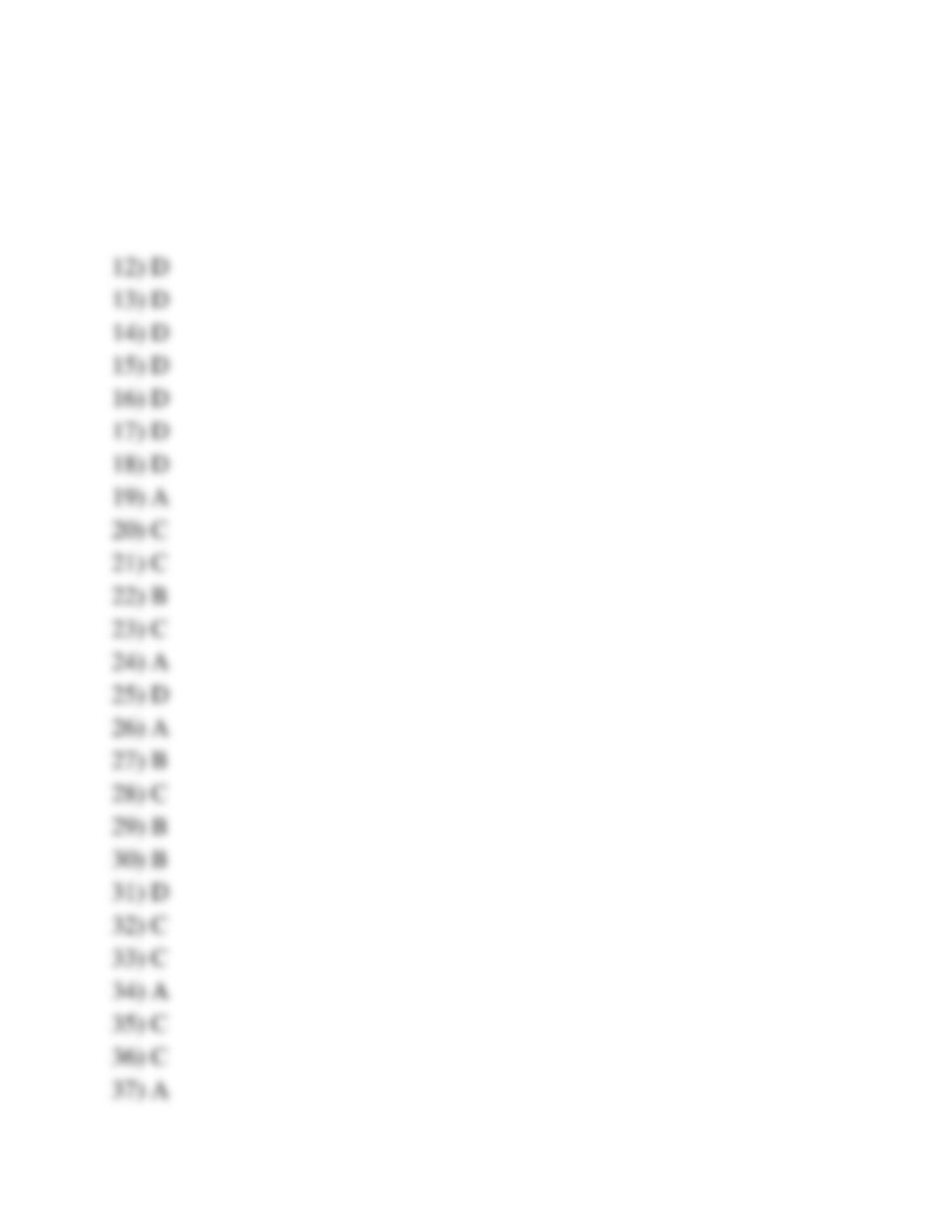
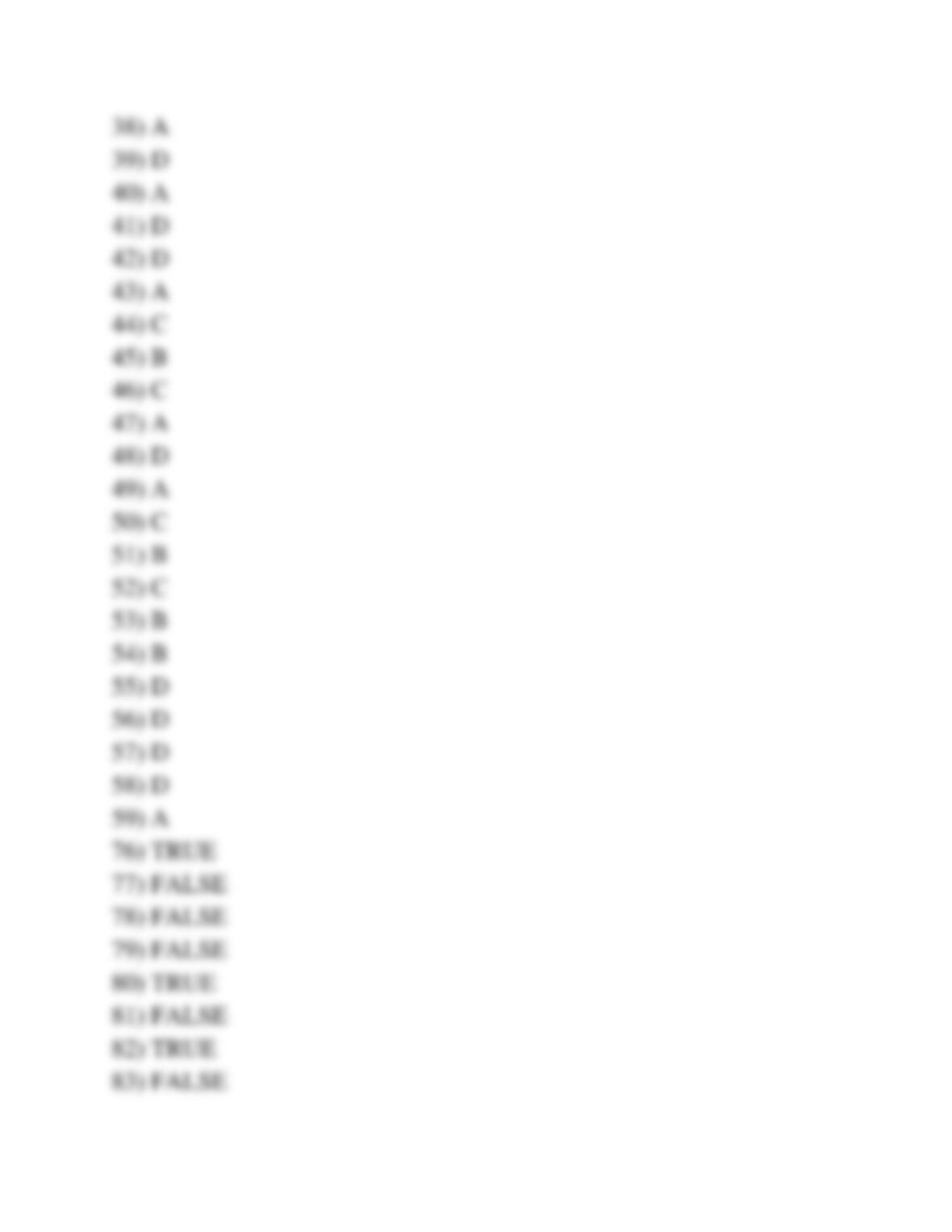
Answer Key
Test name: chapter 9
Version 1 27
Version 1 28