Fundamentals of Organizational Behaviour, Fifth Canadian Edition
Chapter 2— Perception, Personality, and Emotions
high-performance level, Ron treats his employees in a way that supports his expectations.
Research shows that it is highly likely that the Ron’s expectations will become reality.
a. True
b. False
79) The terms self-fulfilling prophecy and Pygmalion effect have evolved to characterize
the fact that people’s expectations determine their behaviour.
a. True
b. False
80) Individuals who are open to new experiences tend to be creative, flexible, curious,
and artistic.
a. True
b. False
81) The personality trait where an individual is concerned about the ability to gain and
use power to reach a desired end result and then uses manipulation to do so, is called
locus of control.
a. True
b. False
Fundamentals of Organizational Behaviour, Fifth Canadian Edition
Chapter 2— Perception, Personality, and Emotions
82) An adult’s personality is now generally considered to be made up of both hereditary
and environmental factors, influenced by situational conditions.
a. True
b. False
83) The extraversion/introversion personality trait is a dimension that refers to how
people focus themselves.
a. True
b. False
84) Openness to experience is a personality dimension that characterizes someone in
terms of how agreeable and trusting they are.
a. True
b. False
85) Nadia is sociable, talkative, assertive, and has always maintained good working
relationships with those at work. It is likely that Nadia’s personality is characterized as
extraversion.
Fundamentals of Organizational Behaviour, Fifth Canadian Edition
Chapter 2— Perception, Personality, and Emotions
a. True
b. False
86) Those with low self-esteem are more likely than those with high self-esteem to
choose more unconventional jobs, and to also take more risks in job selection, because
they are unsure of their skills and competencies.
a. True
b. False
87) Great salespeople usually have Type A personalities.
a. True
b. False
88) Janet keeps an emotional distance from her co-workers and believes that ends can
justify the means. Janet would rate high in Machiavellianism.
a. True
b. False
Fundamentals of Organizational Behaviour, Fifth Canadian Edition
Chapter 2— Perception, Personality, and Emotions
Objective: 2-2 What is personality and how does it affect behaviour?
89) Justin is a person with a high self-monitoring personality trait. He would likely make
a good politician and leader.
a. True
b. False
90) Everett is an individual with a Type B personality. Everett’s career will likely be very
progressive because Type B personality characteristics are more highly prized by the
North American culture than personality Type A characteristics.
a. True
b. False
91) There are specific common personality types for any given country.
a. True
b. False
92) Ryan is always moving and appears to be impatient. He prefers work to leisure and
seems obsessed with numbers. Ryan is probably a Type A.
a. True
b. False
Fundamentals of Organizational Behaviour, Fifth Canadian Edition
Chapter 2— Perception, Personality, and Emotions
93) Type B personalities feel no need to display or discuss their achievements unless such
exposure is demanded by the situation.
a. True
b. False
94) Sean has a proactive personality. He will likely achieve career success because he
will select, create, and influence work situations to his favour, develop the right contacts
in higher places, and seek out job and organizational information.
a. True
b. False
95) Narcissism describes a person who has a grandiose sense of self-importance, requires
excessive admiration, has a sense of entitlement, and is arrogant.
a. True
b. False
Fundamentals of Organizational Behaviour, Fifth Canadian Edition
Chapter 2— Perception, Personality, and Emotions
96) Emotional labour is an employee’s expression of organizationally desired emotions
while at work.
a. True
b. False
97) Emotional stability is a personality dimension that influences a person’s ability to
withstand stress.
a. True
b. False
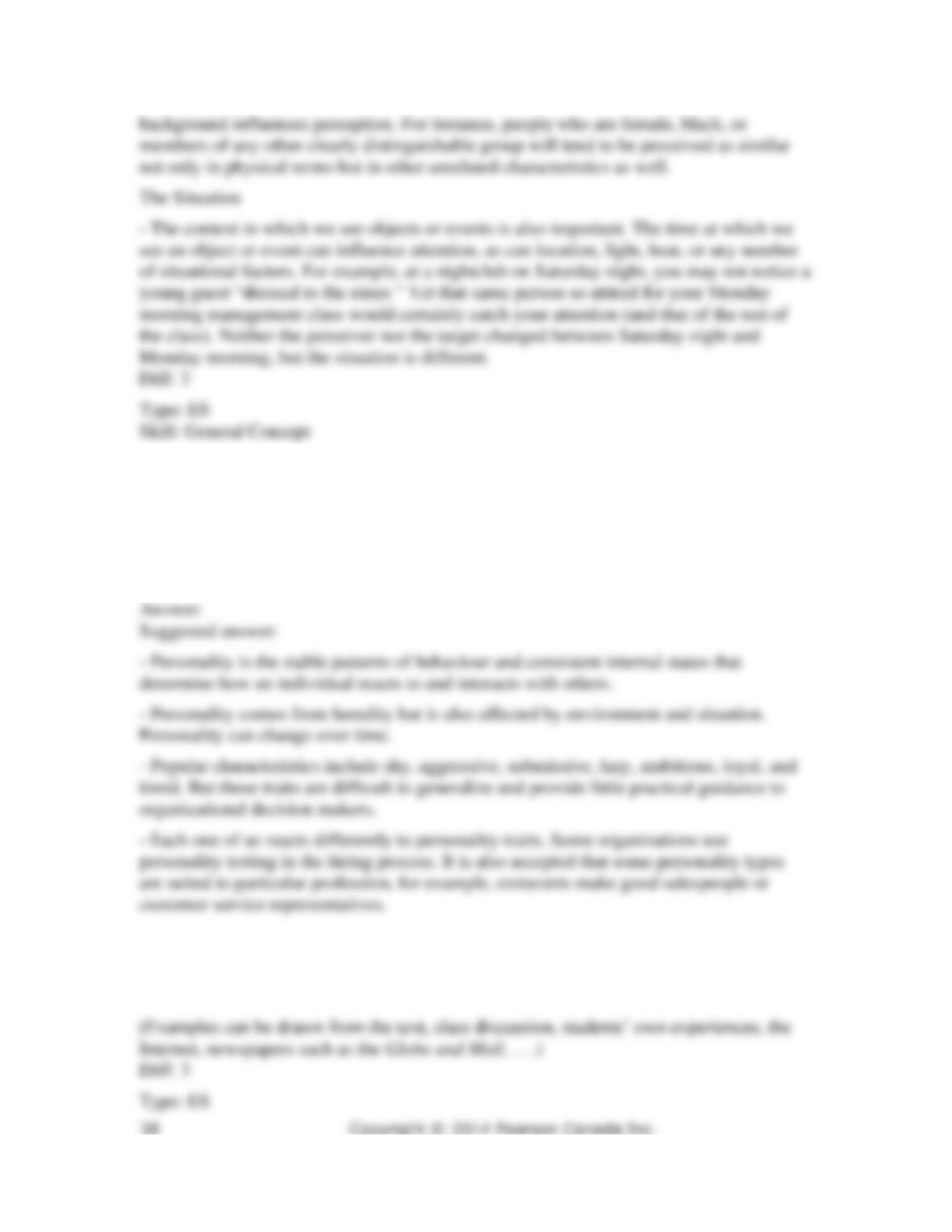
98) What is perception? Describe in detail the three factors that influence perception.
Give specific examples to illustrate your answers.
Suggested answer:
Fundamentals of Organizational Behaviour, Fifth Canadian Edition
Chapter 2— Perception, Personality, and Emotions
Objective: 2-1 What is perception?
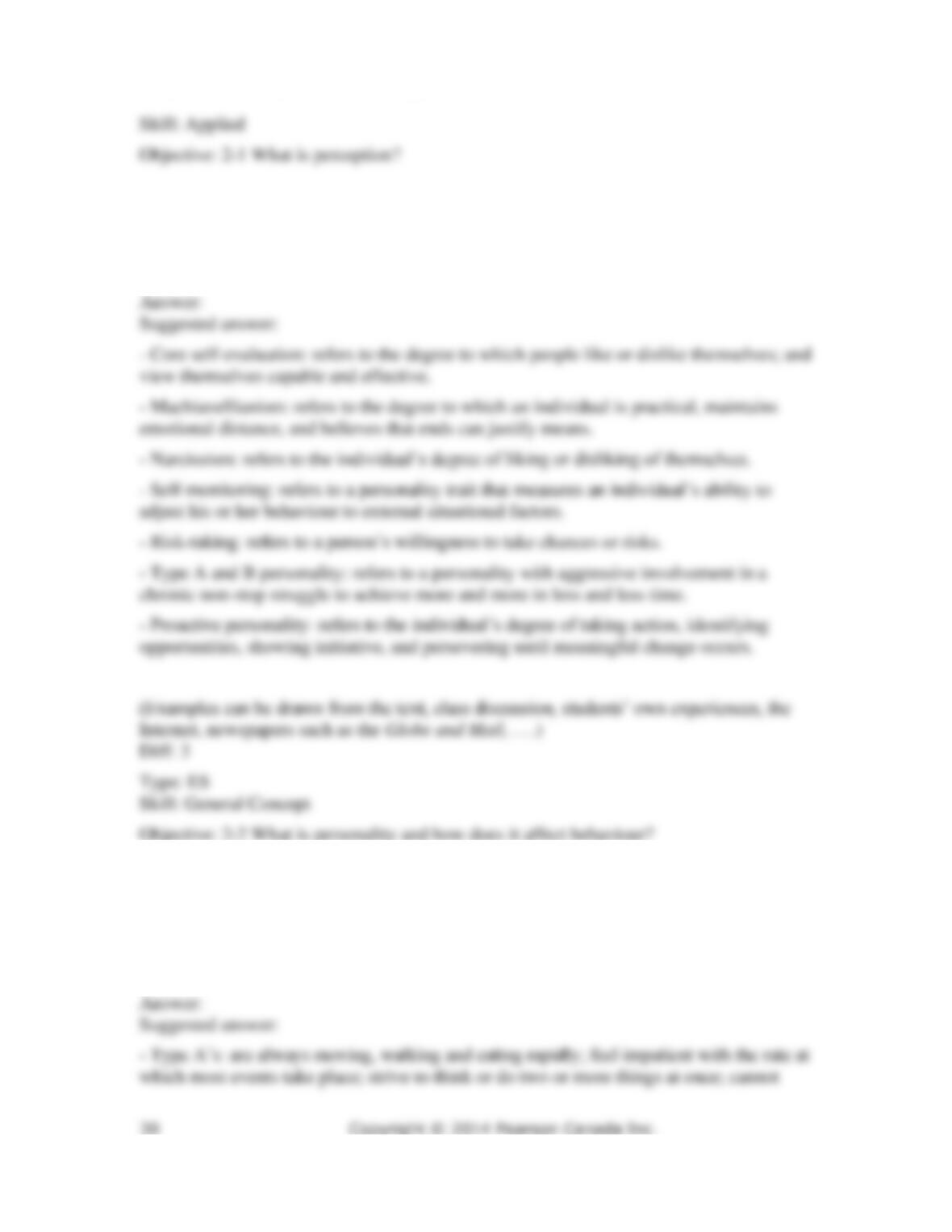
99) Explain in detail what personality is, what determines one’s personality, and what are
some general personality characteristics. Give specific examples of why the personality
of employees might be important in organizations.
Fundamentals of Organizational Behaviour, Fifth Canadian Edition
Chapter 2— Perception, Personality, and Emotions
100) Discuss briefly the seven personality attributes that influence OB, which are
presented in your textbook. Give detailed examples of the characteristics of each and how
they might impact organizations.
101) Compare and contrast the characteristics and behavioural traits found in Type A and
Type B personalities, their application in the workplace, and their relationship to
leadership in organizations. Provide specific examples of each whenever possible in your
answer.
102) Discuss in detail what are emotions and moods, and why organizations should care
about employees’ emotions in the workplace.
Fundamentals of Organizational Behaviour, Fifth Canadian Edition
Chapter 2— Perception, Personality, and Emotions
103) Discuss in detail the concept of emotional intelligence and how it relates to
employee effectiveness in the workplace. Give specific examples of the support for and
opposition to EI in the workplace.
Suggested answer:
104) Describe in detail the Big Five dimensions of personality and how each one
influences workplace behaviour. Give specific examples to illustrate your answer.
Fundamentals of Organizational Behaviour, Fifth Canadian Edition
Chapter 2— Perception, Personality, and Emotions