Version 1 1
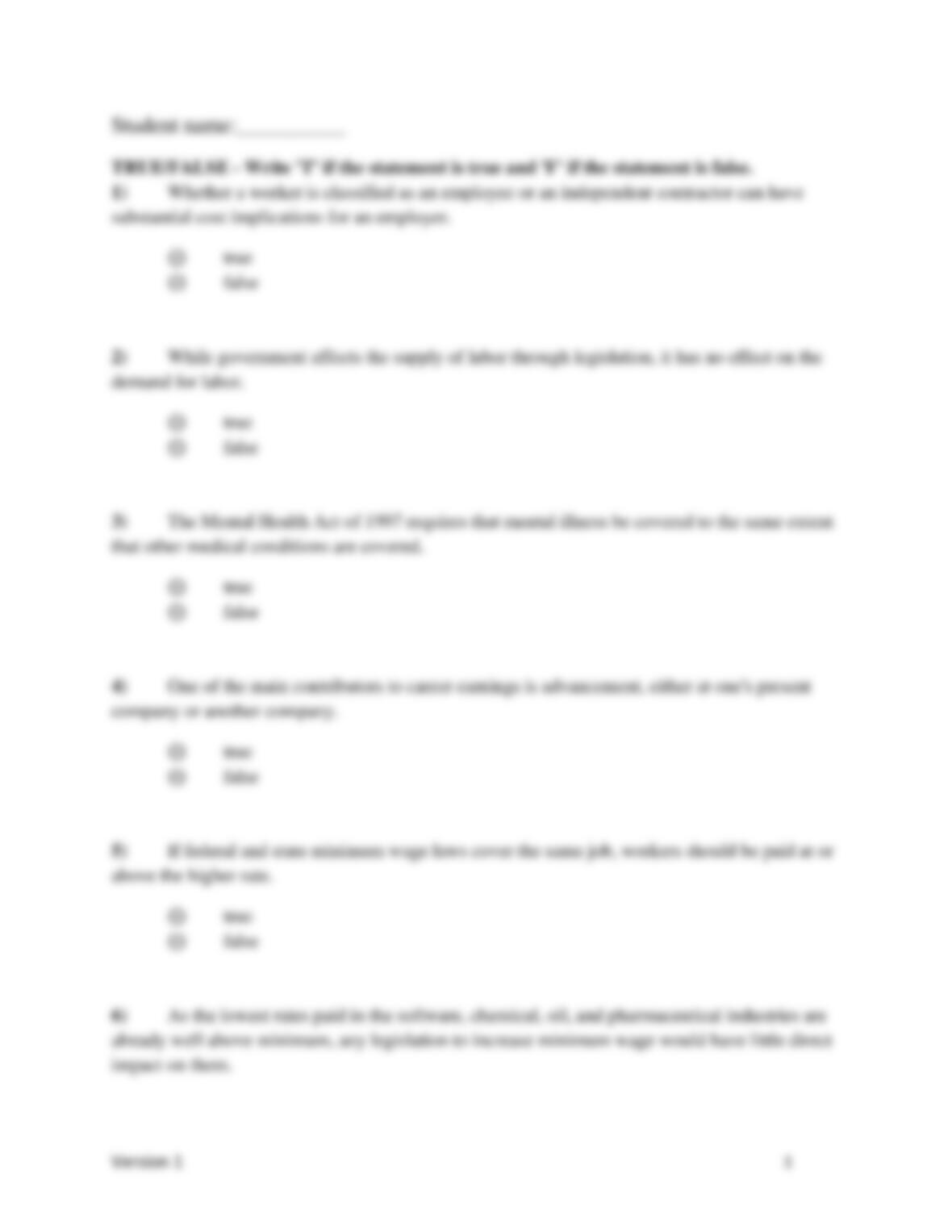
Student name:__________
TRUE/FALSE – Write ‘T’ if the statement is true and ‘F’ if the statement is false.
1) Whether a worker is classified as an employee or an independent contractor can have
substantial cost implications for an employer.
⊚ true
⊚ false
2) While government affects the supply of labor through legislation, it has no effect on the
demand for labor.
⊚ true
⊚ false
3) The Mental Health Act of 1997 requires that mental illness be covered to the same extent
that other medical conditions are covered.
⊚ true
⊚ false
4) One of the main contributors to career earnings is advancement, either at one’s present
company or another company.
⊚ true
⊚ false
5) If federal and state minimum wage laws cover the same job, workers should be paid at or
above the higher rate.
⊚ true
⊚ false
6) As the lowest rates paid in the software, chemical, oil, and pharmaceutical industries are
already well above minimum, any legislation to increase minimum wage would have little direct
impact on them.
Version 1 2
⊚ true
⊚ false
7) Astute professionals must be aware of legislative and judicial currents to protect both
employers’ and employees’ interests and to ensure that compensation practices conform to
judicial interpretation.
⊚ true
⊚ false
8) A GAO study found that 9 of 10 cases brought by GAO undercover agents posing as
workers were mishandled by the Wage and Hour division of the Labor Department.
⊚ true
⊚ false
9) A government-defined prevailing wage is the minimum wage that must be paid for work
done on covered government projects or purchases.
⊚ true
⊚ false
10) Prevailing wages protect foreign workers working as registered nurses.
⊚ true
⊚ false
11) The two types of discrimination recognized by law are valuation discrimination and
access discrimination.
⊚ true
⊚ false
12) It is illegal to pay men and women who perform substantially equal work differently if
the pay system is designed to recognize differences in performance, seniority, quality, and
quantity of results.
Version 1 3
⊚ true
⊚ false
13) Of the four affirmative defenses for unequal pay for equal work, “a factor other than sex”
has prompted the most court cases.
⊚ true
⊚ false
14) Pay differences for equal work may be justified for demonstrably business-related
reasons.
⊚ true
⊚ false
15) Practices that have a differential effect on members of protected groups are illegal, unless
the differences are work-related.
⊚ true
⊚ false
16) The key to a comparable-worth system is a single job evaluation plan for jobs with
dissimilar content.
⊚ true
⊚ false
17) Differences in the firm’s compensation policies within a specific industry is a factor that
accounts for some of the earnings gap.
⊚ true
⊚ false
18) The gender wage gap is moderate for recent college graduates and decreases as the cohort
ages.
Version 1 4
⊚ true
⊚ false
19) A higher proportion of women are employed by small firms compared to large firms.
⊚ true
⊚ false
20) The gender pay gap is common across countries and is smaller in some countries than in
the United States.
⊚ true
⊚ false
MULTIPLE CHOICE – Choose the one alternative that best completes the statement or
answers the question.
21) The executive branch of the federal government
A) enforces laws through agencies and its other bodies.
B) passes new laws.
C) interprets laws and considers their constitutionality.
D) changes existing laws.
22) The ________ Act extends the prevailing-wage concept to manufacturers or suppliers of
goods for government contracts.
A) Sarbanes-Oxley
B) Walsh-Healey Public Contracts
C) Fair Labor Standards
D) Davis-Bacon
23) The Davis-Bacon Act
Version 1 5
A) states that income from most stock plans need not be included in calculating
overtime pay.
B) increases the burden of proof on employers to rebut some discrimination claims.
C) requires that mechanics and laborers on public construction projects be paid the
prevailing wage in an area.
D) extends the prevailing-wage concept to manufacturers or suppliers of goods for
government contracts.
24) Under the ________ Act, executives cannot retain bonuses or profits from selling
company stock if they mislead the public about the financial health of the company.
A) Worker Economic Opportunity
B) Davis-Bacon
C) Walsh-Healey
D) Sarbanes-Oxley
25) The ________ prohibits use of several compensation programs, including, but not limited
to bonuses, retention awards, and incentive pay, except where part of a preexisting employment
contract, during the period Troubled Asset Relief Program funds are received.
A) American Recovery and Reinvestment Act
B) Lilly Ledbetter Fair Pay Act
C) Sarbanes-Oxley Act
D) Americans with Disabilities Act
26) The Worker Economic Opportunity Act
Version 1 6
A) states that income from most stock plans need not be included in calculating
overtime pay.
B) requires the value of all employee stock options to be expensed at estimates of fair
value on financial statements.
C) gives the Securities and Exchange Commission the authority to grant shareholders
proxy access to nominate directors.
D) extends the Securities and Exchange Commission pay disclosure requirements to
highly paid executives.
27) Under the ________, employers can be liable for current pay differences that are a result
of discrimination that occurred many years earlier.
A) Sarbanes-Oxley Act
B) Lilly Ledbetter Fair Pay Act
C) Equal Pay Act
D) Fair Labor Standards Act
28) Which of the following includes a provision that requires public companies to set policies
to allow executive compensation to be taken back if it was based on inaccurate financial
statements that did not comply with accounting standards?
A) The American Recovery and Reinvestment Act
B) The Troubled Asset Relief Program
C) The Financial Accounting Standards Board Statement 123 R
D) The Dodd-Frank Wall Street Reform and Consumer Protection Act
29) Which of the following is a test that must be met to qualify for the administrative
employee exemption?
Version 1 7
A) The employee must be compensated on a salary or fee basis at a rate not less than
$455 per week.
B) The employee’s primary duty must be performance of manual work.
C) The employee must customarily and regularly direct the work of at least two or more
other full-time employees or their equivalent.
D) The employee must have the authority to hire or fire other employees.
30) Which of the following groups can qualify for the exemptions under the Fair Labor
Standards Act of 1938?
A) Computer employees
B) Police and other first responders
C) Paramedics
D) Fire fighters
31) The ________ specifies the number of breaks that must be provided in an eight-hour
workday.
A) Portal-to-Portal Act
B) Occupational Safety and Health Administration legislation
C) Walsh-Healey Public Contracts legislation
D) Equal Pay Act
32) Susan works in a sterile laboratory that requires her to scrub and put on protective
clothing. Which of the following acts determines whether she should be paid for this time?
A) The Fair Labor Standards Act
B) The Occupational Safety and Health Administration Act
C) The Portal-to-Portal Act
D) The Health Care Workers Protection Act
Version 1 8
33) In the context of child labor, which of the following statements is true?
A) The steepest declines in child labor in Brazil and Mexico are among children 17
years and younger.
B) Population growth in Latin American countries has led to replacement of child
laborers with adult workers.
C) The lowest rates of child labor are in sub-Saharan Africa.
D) Child labor has decreased in most countries across the world in recent years.
34) The highest rates of child labor are in
A) China.
B) India.
C) Latin America.
D) sub-Saharan Africa.
35) Who among the following has violated the Fair Labor Standards Act of 1938?
A) Rachel, who pays all her workers a minimum wage of $13
B) Sally, who does not consider the time her employees spend travelling to work as
compensable time
C) Jeremy, who employs his 16-year-old cousin in his meat-packing plant
D) Randy, who employs his 17-year-old son in his stationery store as a cashier
36) An early study of the effects of the living wage law in Los Angeles found all of the
following EXCEPT that
A) 7,735 of the employees covered by the law received an average wage increase of 20
percent.
B) 1 percent of covered jobs were lost.
C) a higher proportion of new hires were female.
D) turnover and absenteeism declined.
Version 1 9
37) Prevailing-wage laws
A) set pay for work done to produce goods and services contracted by the state
government.
B) specify that a government-defined prevailing wage is the maximum wage that must
be paid for work done on covered government projects.
C) give contractors the right to drive down wages using their size.
D) were passed in response to conditions on projects such as the construction of the
Hoover Dam during the Depression.
38) The denial of jobs, promotions, or training opportunities to qualified women or minorities
are examples of
A) access discrimination.
B) valuation discrimination.
C) treatment discrimination.
D) hostile environment.
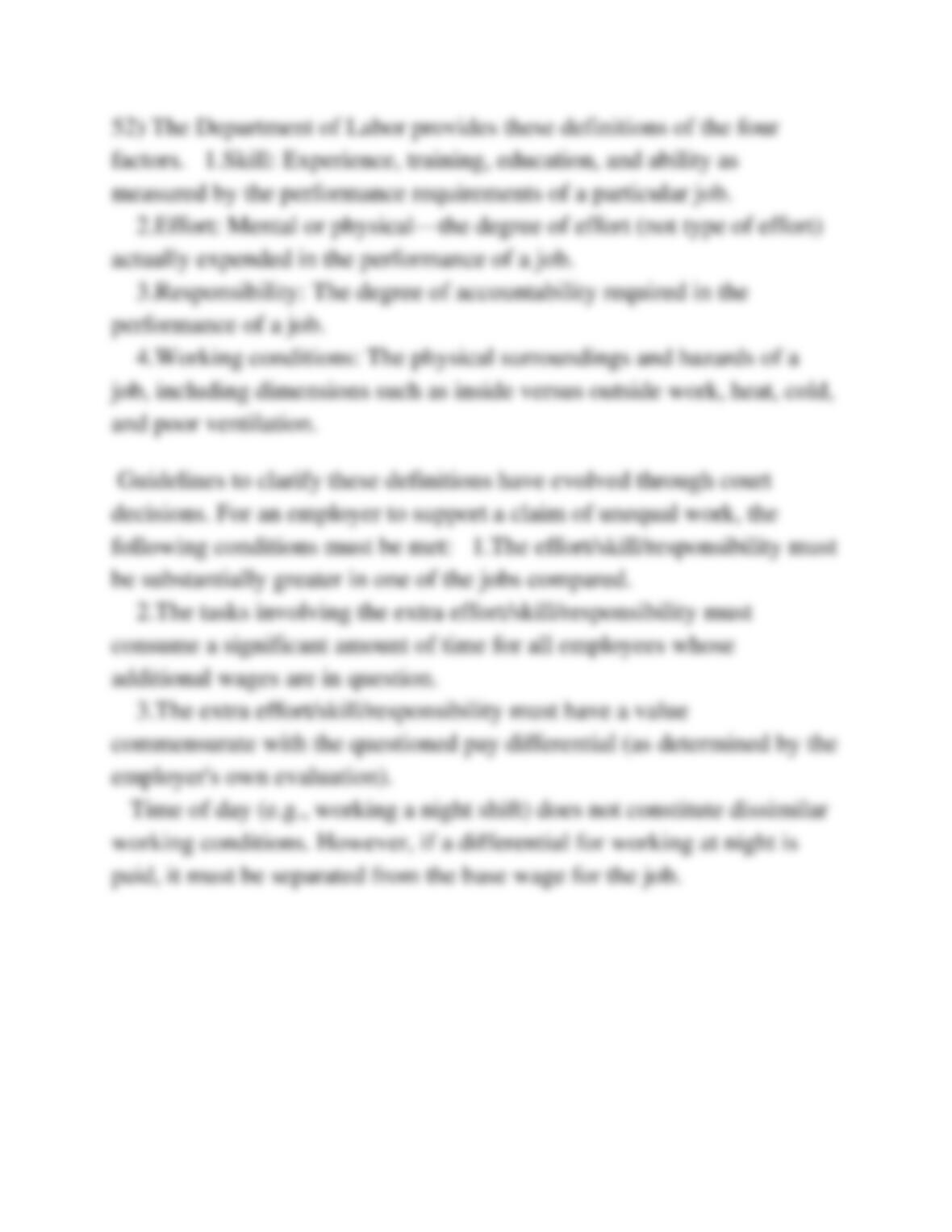
39) ________ is defined by the Department of Labor as experience, training, education, and
ability as measured by the performance requirements of a particular job.
A) Effort
B) Skill
C) Responsibility
D) Working condition
40) Meltrop Corp. employs two store clerks, Sam and Stella. Stella sues Meltrop claiming
unequal pay as she earns $500 a week less than Sam does despite doing the same work as Sam.
Which of the following is most likely to be the result of the litigation?
Version 1 10
A) Meltrop will win the litigation as blue-collar workers are exempt from the Equal Pay
Act.
B) Meltrop will win the litigation if it can prove that Stella is Sam’s senior.
C) Meltrop will lose the litigation as it has committed access discrimination.
D) Meltrop will lose the litigation as it has committed valuation discrimination.
41) Which of the following is true of the Age Discrimination in Employment Act?
A) It protects employees aged 30 and over against age discrimination.
B) It was amended in 1990 to include the Older Workers Benefit Protection Act.
C) It mandates employers with 50 or more employees to provide qualifying health
insurance coverage or face financial penalties.
D) It formed the Securities and Exchange Commission, which ensures that companies
having more than $10 million in assets report information periodically.
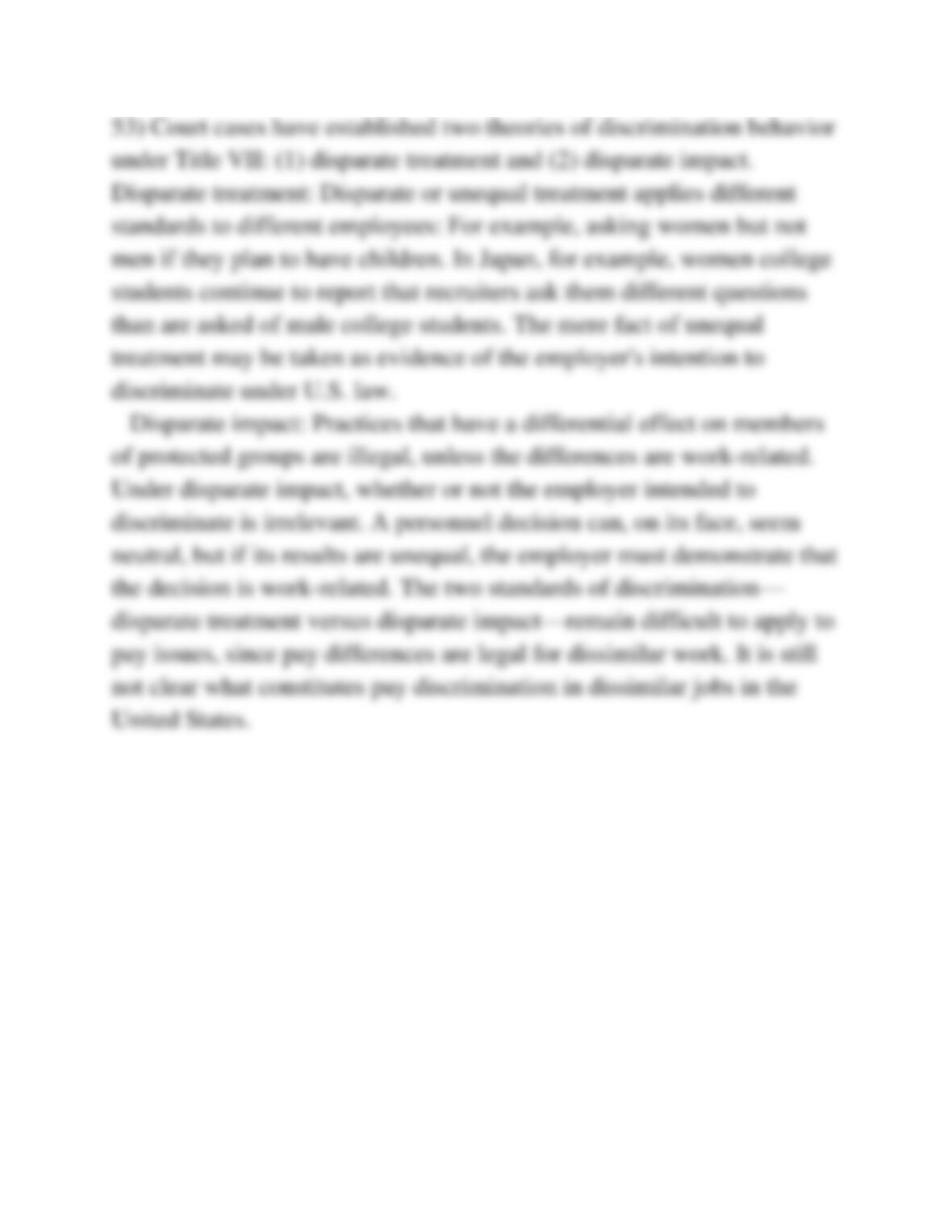
42) In which of the following types of cases is the focus on the discriminatory consequences
rather than the intent to discriminate?
A) Disparate treatment
B) Access discrimination
C) Disparate impact
D) Valuation discrimination
43) MNTX University requires that all its female professors score higher than the male
professors in their appraisal rating to qualify for a pay bonus as there are more female professors
than male professors in the university. Which of the following statements is true in this case?
Version 1 11
A) MNTX is liable for access discrimination against women.
B) MNTX is liable for disparate treatment of women.
C) MNTX’s pay policy is legal as educational institutions are exempt under the Equal
Pay Act.
D) MNTX’s pay policy is legal as its intention is to reduce the overall costs of the
company and not to discriminate.
44) ________ prohibits discrimination on the basis of race, color, religion, sex, or national
origin.
A) Executive Order 11452
B) The FMLA
C) Executive Order 11246
D) The Rehabilitation Act
45) The Equal Pay Act is a part of the
A) the Securities Exchange Act.
B) the Title VII of Civil Rights Act.
C) the Fair Labor Standards Act.
D) the Walsh-Healey Public Contracts Act.
46) Regarding pay differences for different jobs,
A) courts continue to rely on the use of employer opinion surveys to justify differences.
B) the courts favor reliance on the use of statistical models.
C) court decisions have been inconclusive.
D) courts continue to uphold the use of market data to justify differences.
Version 1 12
47) The determination of pay discrimination on jobs of dissimilar content requires a standard
that allows jobs of dissimilar content to be declared comparable and that allows pay differences
for jobs that are not comparable. This standard is
A) job evaluation.
B) comparable worth analysis.
C) disparate impact analysis.
D) point factor market comparison.
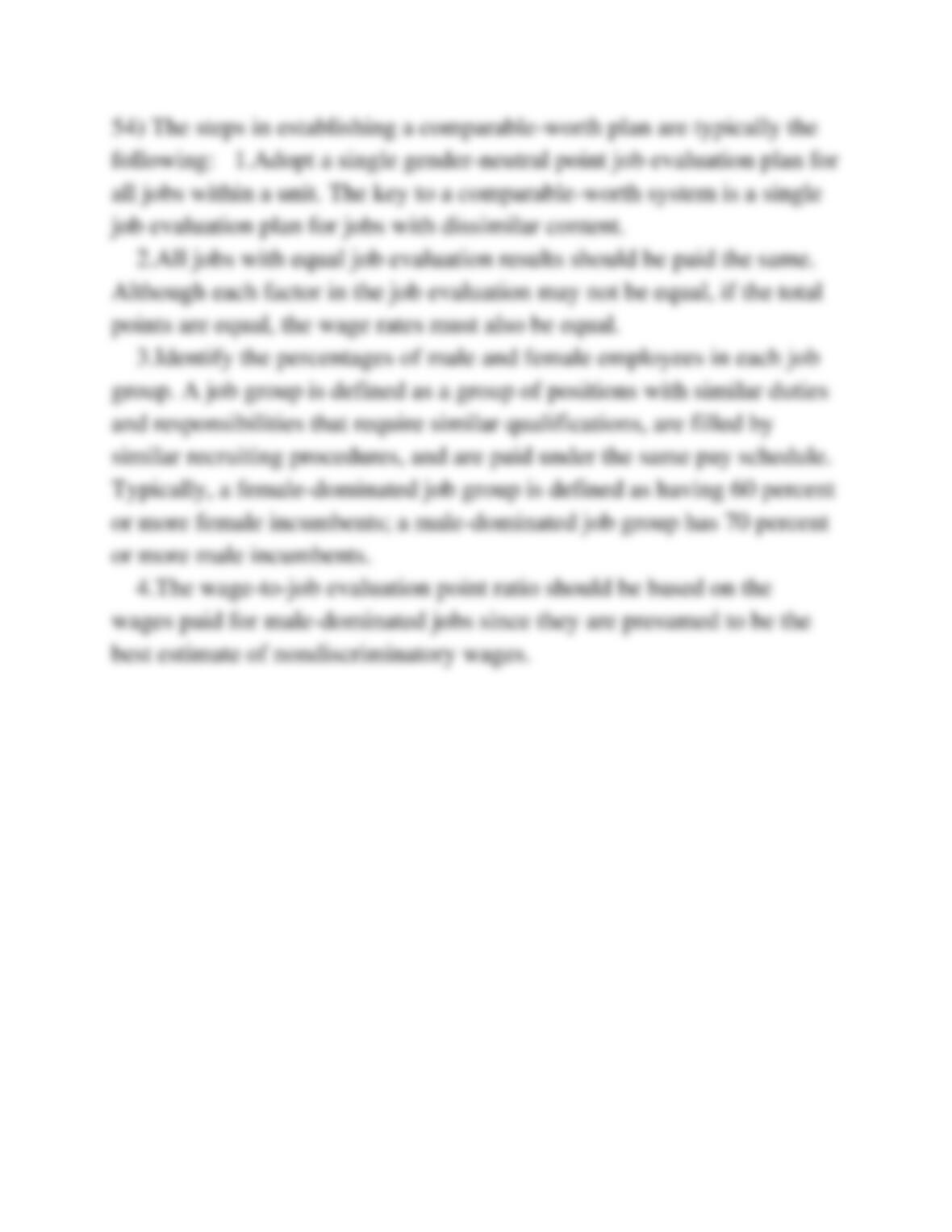
48) Which of the following is one of the basic steps in establishing a comparable-worth pay
plan?
A) Adopting multiple gender neutral point job evaluation plans for all jobs within a unit
B) Paying jobs with different evaluation results with different wage rates
C) Basing the wage-to-job evaluation point ratio on the wages paid for female-
dominated jobs
D) Identifying the percentages of male and female employees in each job group
49) ________ has produced more comparable-worth pay increases than any other approach.
A) Integrative bargaining
B) Win-win bargaining
C) Interest-based bargaining
D) Collective bargaining
50) Which of the following statements regarding wage differences in industries and firms is
NOT true?
A) Wages of men in large firms are 54 percent higher than wages of men in small firms.
B) Hispanic men are concentrated in construction and service firms.
C) Female employment is more heavily concentrated in large firms.
D) The pay premium associated with changing jobs is enjoyed primarily by white males.
Version 1 13
SHORT ANSWER. Write the word or phrase that best completes each statement or
answers the question.
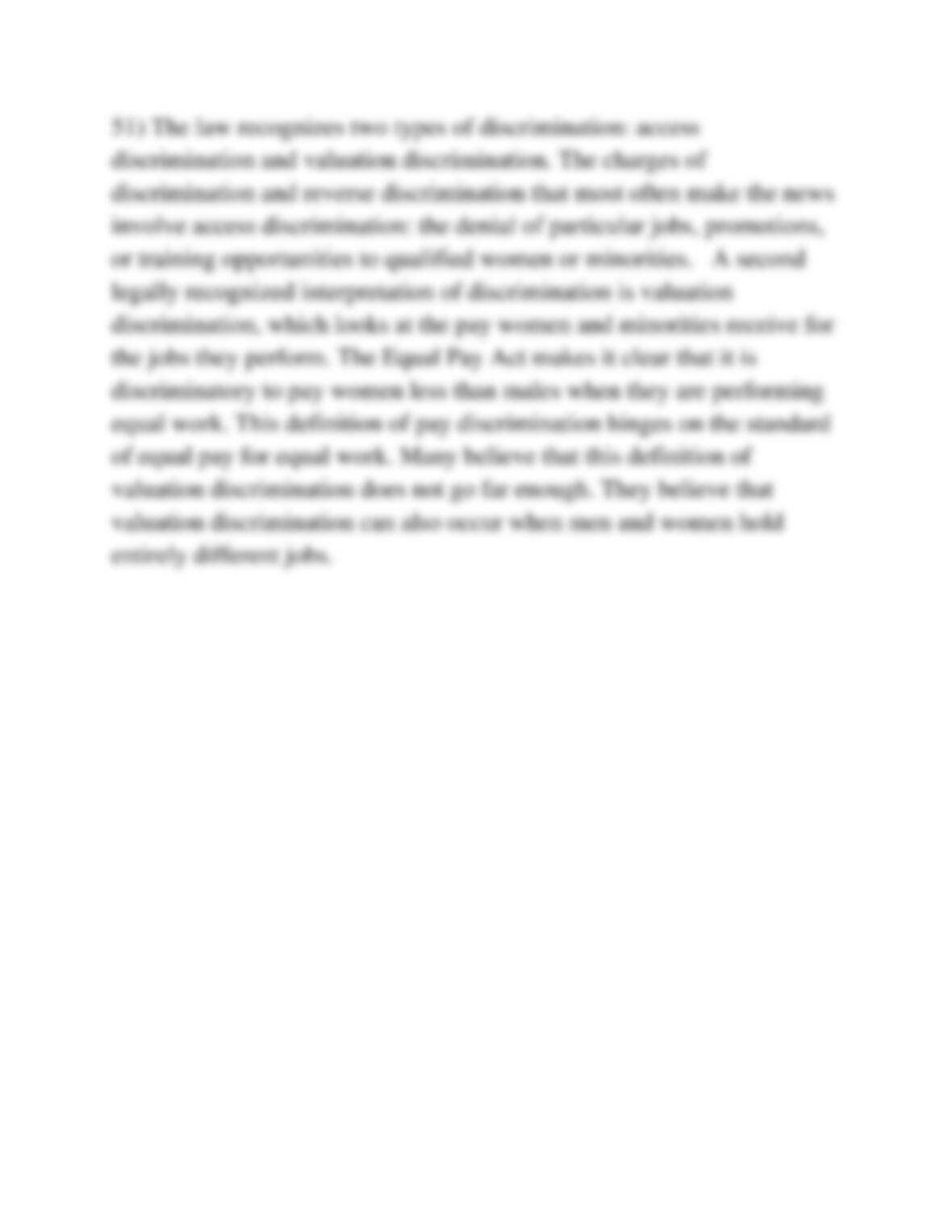
51) Distinguish between access discrimination and valuation discrimination.
52) What are the definitions of skill, effort, responsibility, and working conditions according
to the Department of Labor? What are the conditions that must be met for an employer to support
a claim of unequal work?
53) Compare and contrast disparate treatment and disparate impact.
54) What are the four basic steps in establishing a comparable-worth plan?
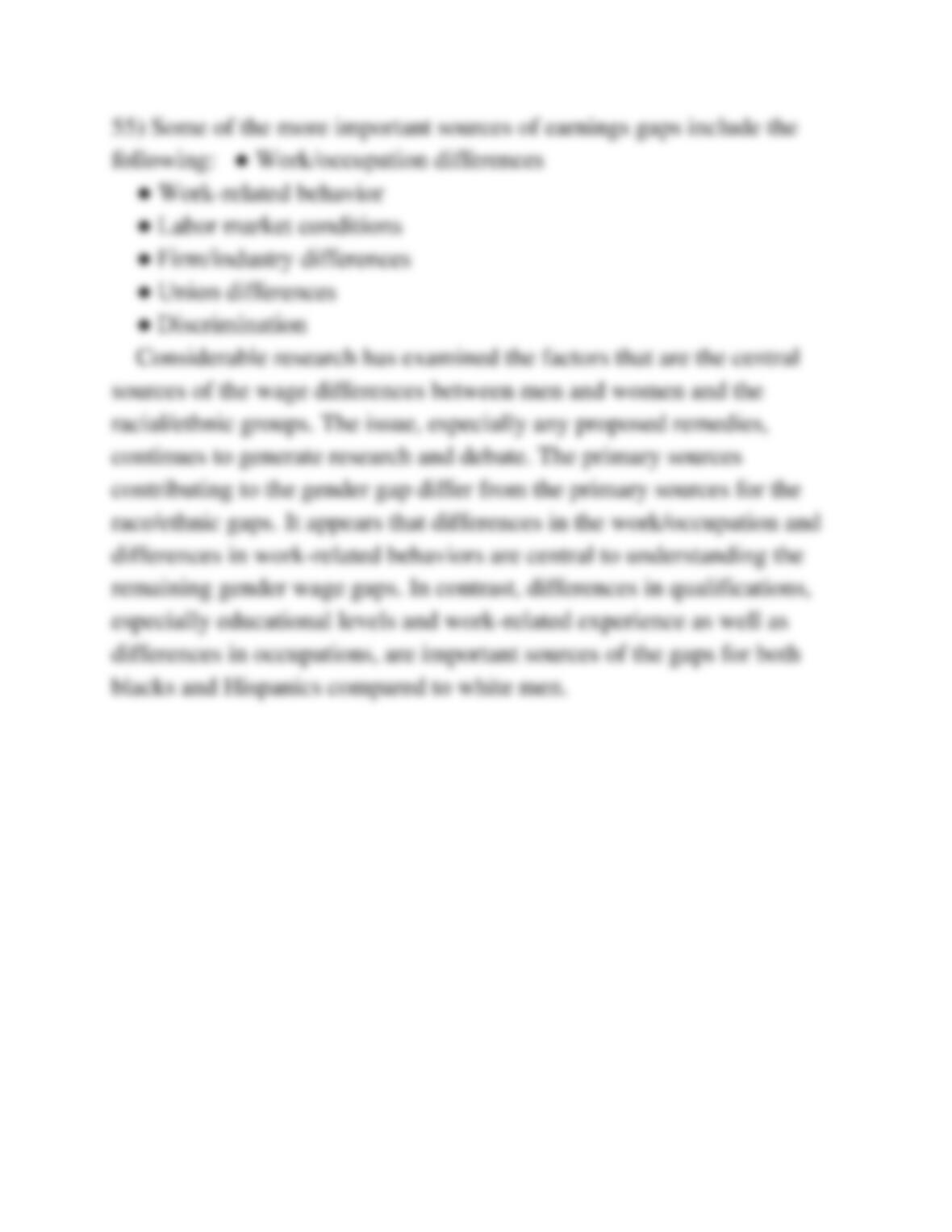
55) What are the sources of earnings gaps?
Version 1 14
Answer Key
Test name: chapter 17
Version 1 15
Version 1 16
Version 1 17
Version 1 18
Version 1 19
Version 1 20