Version 1 1
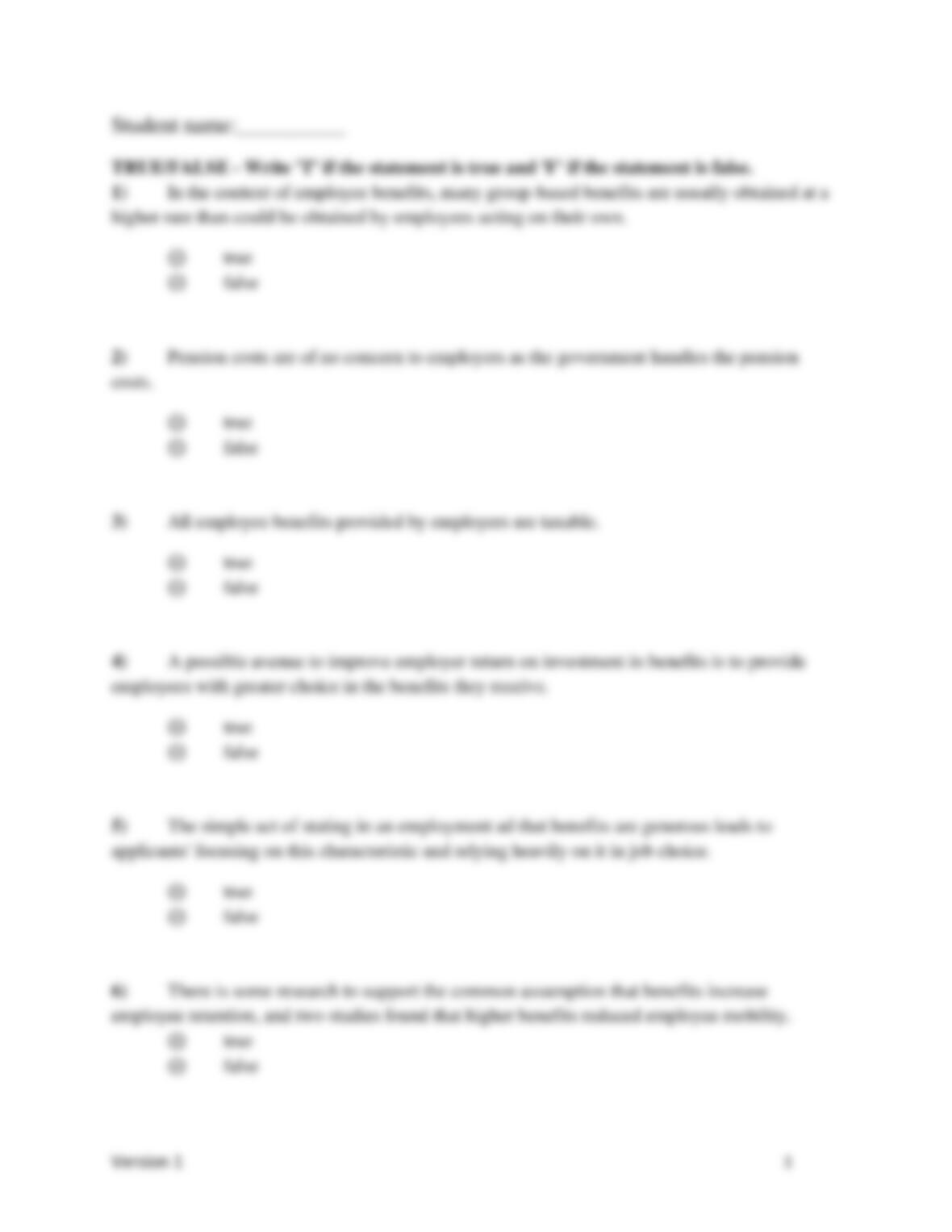
Student name:__________
TRUE/FALSE – Write ‘T’ if the statement is true and ‘F’ if the statement is false.
1) In the context of employee benefits, many group-based benefits are usually obtained at a
higher rate than could be obtained by employees acting on their own.
⊚ true
⊚ false
2) Pension costs are of no concern to employers as the government handles the pension
costs.
⊚ true
⊚ false
3) All employee benefits provided by employers are taxable.
⊚ true
⊚ false
4) A possible avenue to improve employer return on investment in benefits is to provide
employees with greater choice in the benefits they receive.
⊚ true
⊚ false
5) The simple act of stating in an employment ad that benefits are generous leads to
applicants’ focusing on this characteristic and relying heavily on it in job choice.
⊚ true
⊚ false
6) There is some research to support the common assumption that benefits increase
employee retention, and two studies found that higher benefits reduced employee mobility.
⊚ true
⊚ false
Version 1 2
7) Cost pressures related to the increasing diversity of the workforce is one of the reasons
why companies offer flexible benefit plans.
⊚ true
⊚ false
8) Flexible benefit programs eliminate the involvement of employees.
⊚ true
⊚ false
9) A disadvantage of flexible benefit programs is that they increase administrative burdens
and expenses.
⊚ true
⊚ false
10) Employers prefer the noncontributory approach to financing benefit plans because this
allows them to significantly control their costs.
⊚ true
⊚ false
11) A major reason for the proliferating cost of benefit programs is that too frequently the
costs/advantages of a particular benefit inclusion are viewed in isolation.
⊚ true
⊚ false
12) If a benefit forecast suggests future cost containment may be difficult, the benefit should
be offered to employees only on a noncontributory basis.
⊚ true
⊚ false
Version 1 3
13) Studies found that the only two specific benefits that curtailed employee turnover were
pensions and medical coverage.
⊚ true
⊚ false
14) The Family Medical Leave Act (1993) mandates a minimum of 20 weeks of leave for all
workers at companies that employ less than 10 people.
⊚ true
⊚ false
15) The Employee Retirement Income Security Act (1974) requires employers to mandatorily
offer some form of pension.
⊚ true
⊚ false
16) A “bandwagon” effect, in which new benefits offered by a competitor are adopted
without careful consideration, is particularly apparent for employers with strong commitments to
maintaining a totally or partially nonunion workforce.
⊚ true
⊚ false
17) One of the best strategies for determining external equity is to conduct a benefit survey.
⊚ true
⊚ false
18) No strong data exist linking benefits level and employee productivity.
⊚ true
⊚ false
Version 1 4
19) The first step in claims processing is to determine if the employee who is claiming the
payment is eligible for the payment benefits.
⊚ true
⊚ false
20) The practice of administrative cost containment practice primarily focuses on providing
accommodations for employees to return to work after illness or disability.
⊚ true
⊚ false
MULTIPLE CHOICE – Choose the one alternative that best completes the statement or
answers the question.
21) All of the following factors are reasons for the growth of benefits EXCEPT:
A) foreign lawsuits.
B) unions.
C) cost effectiveness of benefits.
D) government impetus.
22) Which of the following benefits is NOT mandated by either the state or federal
government?
A) Workers’ compensation
B) Work/life balance
C) Social security
D) Unemployment insurance
23) Which of the following statements is true of employee benefits?
Version 1 5
A) Employers can substitute insurance benefits for job security.
B) Group insurance has relatively easy qualification standards.
C) Most employee benefits are taxable.
D) Many group-based benefits are obtained at a higher rate than could be obtained by
employees acting on their own.
24) The typical employee can recall ________ percent of the benefits he or she receives.
A) almost 50
B) less than 15
C) over 30
D) 40
25) Surveys show that the most highly valued employee benefit is:
A) dental coverage.
B) life insurance.
C) paid vacation and holidays.
D) medical insurance.
26) A survey shows that most employers are responding to increased benefit costs by
A) requiring employees to pay higher deductibles and copays.
B) laying off employees.
C) dropping health care plans.
D) relying on the Patient Protection and Affordable Care Act.
27) The first issue in setting up a benefits package is:
Version 1 6
A) finding out who should be protected or benefited.
B) figuring out how much choice should employees have among benefits.
C) determining how benefits should be financed.
D) choosing legally defensible benefits.
28) A benefit plan that allocates a set dollar amount to employees and allows them to select
benefits is called a ________ plan.
A) a select choice
B) a no-deductible
C) a flexible benefit
D) a flat dollar benefit
29) Which of the following is NOT a disadvantage of flexible benefit programs?
A) Administrative burdens and expenses increase.
B) Adverse selection of benefits by employees results in increase in costs.
C) New benefits are highly difficult to introduce.
D) Flexible benefits are subject to nondiscrimination requirements in Section 125 of the
Internal Revenue Code.
30) Which of the following is an advantage of flexible benefit plans?
A) They require no expenditure from the employers.
B) They decrease the administrative burdens of employers.
C) They ensure that employees pick only those benefits that they will use, thereby
reducing costs.
D) They increase the involvement of employees in choosing benefit plans.
31) All of the following are advantages of flexible benefits EXCEPT:
Version 1 7
A) containment of benefit costs.
B) increased understanding of benefits by employees.
C) reduced expense of introducing new benefits.
D) decreased administrative expenses.
32) If a benefit forecast suggests future cost containment may be difficult, the benefit should:
A) be completely paid for by employees.
B) be offered on a noncontributory basis.
C) not be used.
D) be offered to employees only on a cost-sharing basis.
33) DrenchFort Corp. is a small company that pays high wages. As its wages are high, it does
not provide any benefits. Recently, it has noticed that its employee turnover has increased, so it
decides to provide benefits to retain employees. Which of the following benefits is most likely to
reduce turnover?
A) Counseling services
B) An early retirement plan
C) Medical coverage
D) A profit-sharing plan
34) Which of the following best describes the impact of the Maintenance Act (1973) on
employee benefits?
A) It ensured that benefits were administered in a manner that did not discriminate
against protected groups.
B) It created time-and-a-half overtime pay.
C) It required employers to offer alternative health coverage options to employees.
D) It mandated 12 weeks of leave for all workers at companies that employed 50 or
more people.
Version 1 8
35) Which of the following requires individuals to maintain minimal essential health
insurance coverage or pay a penalty unless exempted for religious beliefs or financial hardship?
A) The Maintenance Act (1973)
B) The Fair Labor Standards Act (1938)
C) The Consolidated Omnibus Budget Reconciliation Act (1984)
D) The Patient Protection and Affordable Care Act (2010)
36) The most widely used benefit survey is conducted by:
A) the U.S. Chamber of Commerce.
B) Watson Wyatt.
C) the Society for Human Resource Management.
D) the American Compensation Association.
37) Various studies have found that only two specific benefits curtailed employee turnover,
namely ________ and ________.
A) vacation days; dental plans
B) profit-sharing plans; life insurance
C) retirement benefits; paid vacations
D) pensions; medical coverage
38) In an extensive review of employee preference literature, Glueck traced patterns of group
preferences for particular benefits. Identify the results of the study.
Version 1 9
A) Among the benefits available, profit sharing and early retirement are highly preferred
benefits.
B) Among the benefits available, health/medical and stock plans are highly preferred
benefits.
C) Contrary to expectations, families with no dependents have stronger preferences for
health/medical coverage than families with dependents.
D) Contrary to expectations, younger workers show stronger preferences than older
workers for pension plans.
39) How many weeks of leave does the Family Medical Leave Act (1993) mandate for all
workers at companies that employ 50 or more people?
A) 4 weeks
B) 8 weeks
C) 12 weeks
D) 16 weeks
40) ________ allows employees who resign or are laid off through no fault of their own to
continue receiving health coverage under their employer’s plan at a cost borne by the employee.
A) The Maintenance Act (1973)
B) The Fair Labor Standards Act (1938)
C) The Tax reforms of 1982
D) The Consolidated Omnibus Budget Reconciliation Act (1984)
41) The ________ requires individuals to maintain minimal essential health insurance
coverage or pay a penalty unless exempted for religious beliefs or financial hardship.
A) Patient Protection and Affordable Care Act
B) Family Medical Leave Act
C) Maintenance Act
D) Consolidated Omnibus Budget Reconciliation Act
Version 1 10
42) One of the most preferred benefits is
A) stock plans.
B) profit sharing.
C) shorter working hours.
D) early retirement.
43) In the context of benefits communication methods, which of the following is mostly true
about an information portal?
A) It fosters open communication.
B) It requires ongoing maintenance and an intuitive user interface.
C) It primarily allows for personalized communication methods.
D) It essentially requires coordination and planning.
44) Which of the following benefits communication methods allows for personalized
communication methods and requires current contact information?
A) Face-to–face methods
B) Virtual methods
C) Use of materials
D) Use of information portals
45) Trumbrella Corp. is a pharmaceutical company. One of its employees reports that he has
suffered an on-the-job injury caused by the slippery factory floor that resulted in severe damage
to his backbone. When Trumbrella initiates its claims processing, it should first:
A) determine whether the accident actually happened.
B) determine if the employee is eligible for any benefit.
C) calculate the payment required to be paid to the employee.
D) contact the insurance companies to enquire about the possibility of a joint payment.
Version 1 11
46) Which of the following companies uses probationary periods as a cost-containment
measure?
A) Alpha Corp., which combines the benefits offered for couples who work within the
organization
B) DLG Corp., which excludes its new recruits from benefit coverage until they
complete a year
C) Kimberly Corp., which requires employees in the lowest salary quartile to pay for 20
percent of their benefits
D) Amethyst Corp., which limits its employees to coverage for only two dentist visits
every six months
47) In the context of cost containment, which of the following best describes the practice of
“copay”?
A) Controlling costs through policies such as seeking competitive bids for program
delivery
B) Requiring that employees pay a fixed or percentage amount for coverage
C) Negotiating the lowest possible fees by providers
D) Limiting disability income payments to some maximum percentage of income
48) The biggest cost-containment strategy in recent years is the movement to:
A) benefit limitations.
B) HMOs.
C) outsourcing.
D) high deductibles.
49) Limiting the liability for an employee’s extended hospital stay costs to $200,000 is a cost-
containment measure known as:
Version 1 12
A) dual coverage.
B) benefit ceiling.
C) coinsurance.
D) deductible.
50) In an attempt to reduce the employee benefits cost to the company, GrindStop Corp.
restricts the number of visits to the dentists covered in the dental plan to two per year for each
employee. Which of the following cost-containment strategies is being used by GrindStop?
A) Copay
B) Benefit limitations
C) Administrative cost containment
D) Wellness programs
SHORT ANSWER. Write the word or phrase that best completes each statement or
answers the question.
51) Explain how the government has played an important role in the growth of employee
benefits.
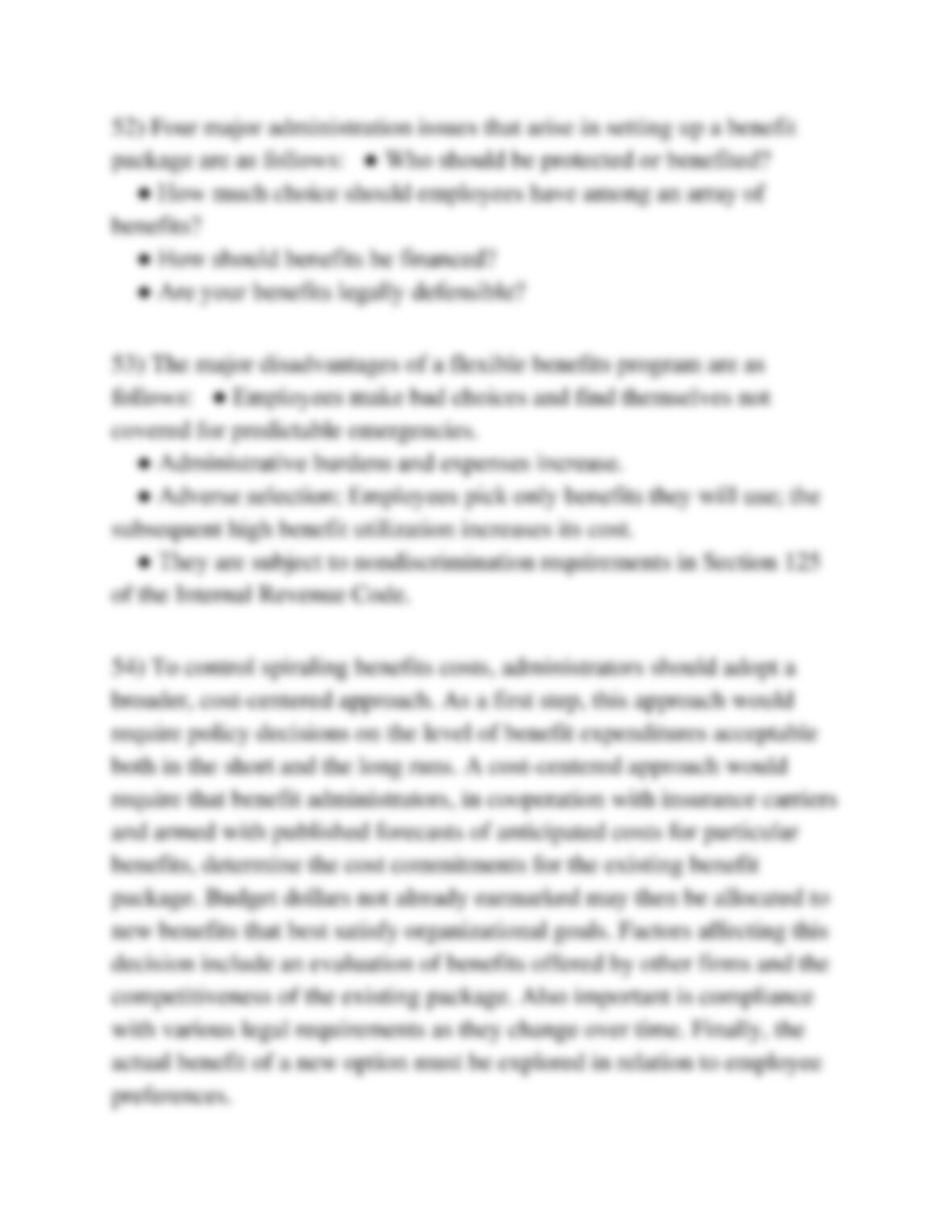
52) What are four major administration issues that arise in setting up a benefit package?
53) What are the major disadvantages of a flexible benefits package?
Version 1 13
54) What can administrators do to control increasing benefits costs?
55) What are some of the common cost-containment practices with regard to benefits
administration?
Version 1 14
Answer Key
Test name: chapter 12
Version 1 15
Version 1 16
Version 1 17