Version 1 1
Student name:__________
TRUE/FALSE – Write ‘T’ if the statement is true and ‘F’ if the statement is false.
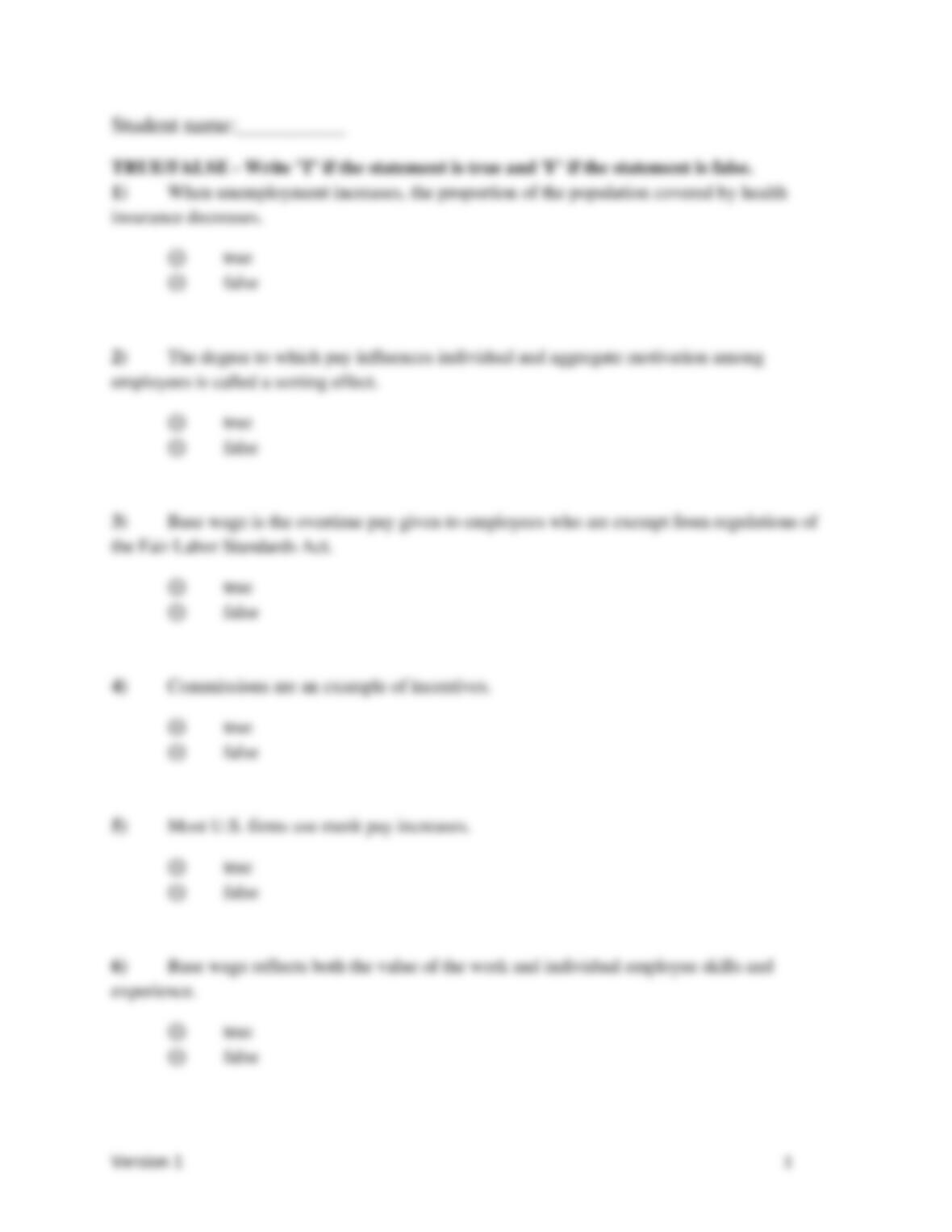
1) When unemployment increases, the proportion of the population covered by health
insurance decreases.
⊚ true
⊚ false
2) The degree to which pay influences individual and aggregate motivation among
employees is called a sorting effect.
⊚ true
⊚ false
3) Base wage is the overtime pay given to employees who are exempt from regulations of
the Fair Labor Standards Act.
⊚ true
⊚ false
4) Commissions are an example of incentives.
⊚ true
⊚ false
5) Most U.S. firms use merit pay increases.
⊚ true
⊚ false
6) Base wage reflects both the value of the work and individual employee skills and
experience.
⊚ true
⊚ false
Version 1 2
7) Pension and health benefits are a very large component of total compensation for many
large companies such as American Airlines and GM.
⊚ true
⊚ false
8) Unlike for merit adjustments, the potential size of an incentive payment will generally be
known before receiving the payment.
⊚ true
⊚ false
9) Procedural fairness suggests that the way a pay decision is made is of less importance to
employees than the results of the decision.
⊚ true
⊚ false
10) If the objective is to increase customer satisfaction, then incentive programs and merit
pay might be used to pay for performance.
⊚ true
⊚ false
11) Objectives guide the design of pay systems and provide standards for evaluating their
effectiveness.
⊚ true
⊚ false
12) Even if federal compensation laws change, it is unnecessary to change pay systems to
ensure continued compliance.
⊚ true
⊚ false
Version 1 3
13) Internal alignment pertains to the pay rates both for employees doing equal work and for
those doing dissimilar work.
⊚ true
⊚ false
14) Since HR research contains information useful to managers, most managers read research
in HR management and compensation journals.
⊚ true
⊚ false
15) Management and HR research has conclusively shown that goal setting and job
enrichment produce the largest and most reliable increases in job performance.
⊚ true
⊚ false
16) Fairness is affected through employees’ comparisons of their pay to the pay of others in
the organization.
⊚ true
⊚ false
17) Consultant surveys are often presented as studies that reveal cause and effect.
⊚ true
⊚ false
18) In Japan, the traditional characters for the word “compensation” are based on the symbols
for logs and water, suggesting that compensation provides the necessities in life.
⊚ true
⊚ false
Version 1 4
19) The relationship between variables is most often addressed through the use of statistical
analysis.
⊚ true
⊚ false
20) The R 2, which is an output from a regression analysis, is different from correlation in
that it tells us what percentage of the variation is accounted for by the variables we are using to
predict or explain.
⊚ true
⊚ false
MULTIPLE CHOICE – Choose the one alternative that best completes the statement or
answers the question.
21) Which of the following programs introduced by Congress includes restrictions on
executive pay that are designed to discourage executives from taking “unnecessary and excessive
risks”?
A) Corporate Welfare Program
B) Employee Welfare Program
C) Troubled Asset Relief Program
D) Corporate Liability Relief Program
22) ________ is defined as employee belief that returns and/or rewards are due regardless of
individual or company performance.
A) Entitlement
B) Ability
C) Compliance
D) Motivation
23) One of the reasons why the great majority of the uninsured in the United States are from
working families is that
Version 1 5
A) many larger employers do not offer health insurance as it does not guarantee an
increase in productivity levels.
B) health insurance is costlier for larger employers.
C) many small employers are much less likely than larger employers to offer health
insurance to their employees.
D) most workers decline health insurance when it is offered by their employers.
24) The degree to which pay influences individual and aggregate motivation among
employees at any point in time is referred to as a(n):
A) sorting effect.
B) incentive effect.
C) turnover effect.
D) directional effect.
25) Which of the following is an example of a relational return?
A) A short-term incentive
B) Employment security
C) A long-term incentive
D) Income protection
26) Which of the following is given as an increment to base pay in recognition of past work
behavior?
A) Base pay
B) A long-term incentive
C) Merit pay
D) A short-term incentive
Version 1 6
27) GreenRain Corp. faces an increase in its employee turnover rate. The CEO calls for a
board meeting with the senior executives to discuss the issue. Who among the following suggests
increasing the relational returns that employees receive to reduce the turnover rate at GreenRain?
A) Tom, who suggests increasing the decision-making authorities given to the
employees to make work more challenging
B) Deena, who suggests providing more work/life balance to the employees by
increasing the number of paid leaves
C) Syed, who suggests increasing the medical insurance coverage offered to the
employees
D) Liam, who suggests increasing merit bonuses
28) Which form of pay does not permanently increase labor costs?
A) Incentives
B) Merit pay
C) Cost-of-living adjustments
D) Base pay
29) Which of the following is true of incentives?
A) They reward past behavior to influence future behavior.
B) They are linked to subjective performance measures.
C) They permanently increase labor costs.
D) They are re-earned each pay period.
30) Which of the following companies is taking efforts to improve the work/life balance of its
employees?
Version 1 7
A) MH Corp., which increases the number of paid holidays given to its senior
employees
B) Kay Corp., which increases the transport allowance for its employees by 10 percent
C) Haywire Corp., which allows its employees to buy company stocks at a reduced price
of $30 per share
D) Halo Corp., which increases the variable pay of its employees
31) Variable pay may also be called
A) relational returns.
B) pensions.
C) stock options.
D) incentives.
32) Which of the following is often the largest component in an executive pay package?
A) Base pay
B) Stock options
C) Merit pay
D) Perks
33) Unlike merit increases, merit bonuses are:
A) distributed in every quarter.
B) based on duration of service.
C) paid in the form of a lump sum.
D) included in the base salary.
34) Robert, the CEO of GameTrack Corp., wants to restructure its pay plan without
increasing labor costs in the long run. He is most likely to achieve this, while retaining his top
employees, by:
Version 1 8
A) increasing base pay and decreasing variable pay.
B) increasing incentive pay and decreasing base pay.
C) hiring more employees and reducing marginal product output requirements.
D) providing across-the-board increases on a monthly basis.
35) Incentives do not permanently increase labor costs because:
A) they rely on a subjective rating of performance.
B) they are given based on the past performances of employees.
C) they increase the base wage.
D) they are one-time payments.
36) A difference between incentives and merit increases is that incentives:
A) do not increase the base wage, whereas merit increases increase the base wage.
B) cannot be tied to the performance of an individual, whereas merit increases can be
tied to the performance of an individual.
C) rely on a subjective measure of performance, whereas merit increases rely on an
objective measure of performance.
D) are relational returns, whereas merit increases are part of the total compensation.
37) Which of the following is a fundamental objective, and NOT a policy, of the pay model?
A) Fairness
B) Competitiveness
C) Contributions
D) Alignment
38) Which of the following is a policy, and NOT an objective, of the pay model?
Version 1 9
A) Ethics
B) Competitiveness
C) Efficiency
D) Fairness
39) Which of the following are defined as comparisons among individuals doing the same job
for the same organization?
A) Merit bonuses
B) Merit increases
C) Employee contributions
D) Relational returns
40) ________ refers to comparisons among jobs or skill levels inside a single organization.
A) External competitiveness
B) Internal alignment
C) Compliance
D) A merit increase
41) In the context of pay relationships, which of the following is illegal in the United States?
A) Paying on the basis of the nature of jobs
B) Paying on the basis of pay comparisons with competitors
C) Paying on the basis of one’s age
D) Paying on the basis of one’s skill level
42) Managers seek internal alignment within their organization by:
Version 1 10
A) matching competitors’ pay rates.
B) following Fair Labor Standards Act guidelines.
C) using fair merit increases.
D) paying on the basis of similarities among jobs.
43) Compensation policy choices that affect the pay level relative to other companies are
most closely associated with the ________ aspect of the pay model.
A) internal alignment
B) external competitiveness
C) employee contribution
D) pay system management
44) The decisions to implement pay for performance, flat rate pay, and profit sharing are
examples of ________ policy decisions.
A) internal alignment
B) efficiency
C) employee contribution
D) management
45) According to the text, which of the following decisions should be made jointly?
A) Internal alignment and management decisions
B) External competitiveness and employee contribution decisions
C) Employee contribution and internal alignment decisions
D) Management and external competitiveness decisions
46) Which of the following policy decisions directly affects employees’ attitudes and work
behaviors?
Version 1 11
A) Employee contributions
B) Internal alignment
C) External competitiveness
D) Management
47) You are an HR manager, and your boss has told you to find the best way to raise job
performance. After some research, you find that ________ have the greatest instrumental value.
A) job responsibilities
B) training and skill development programs
C) goal setting and job enrichment
D) monetary incentives
48) In a study, causation can be best established by:
A) considering a single explanation.
B) evaluating the methodologies used.
C) accounting for competing explanations.
D) analyzing the scope of the study.
49) A measure of how changes in one variable are related to changes in another variable is
the:
A) standard deviation.
B) analysis of variance.
C) correlation coefficient.
D) mean deviation.
50) ________ refers to the process used to make pay decisions.
Version 1 12
A) Procedural fairness
B) Relational return
C) Regression analysis
D) Internal alignment
SHORT ANSWER. Write the word or phrase that best completes each statement or
answers the question.
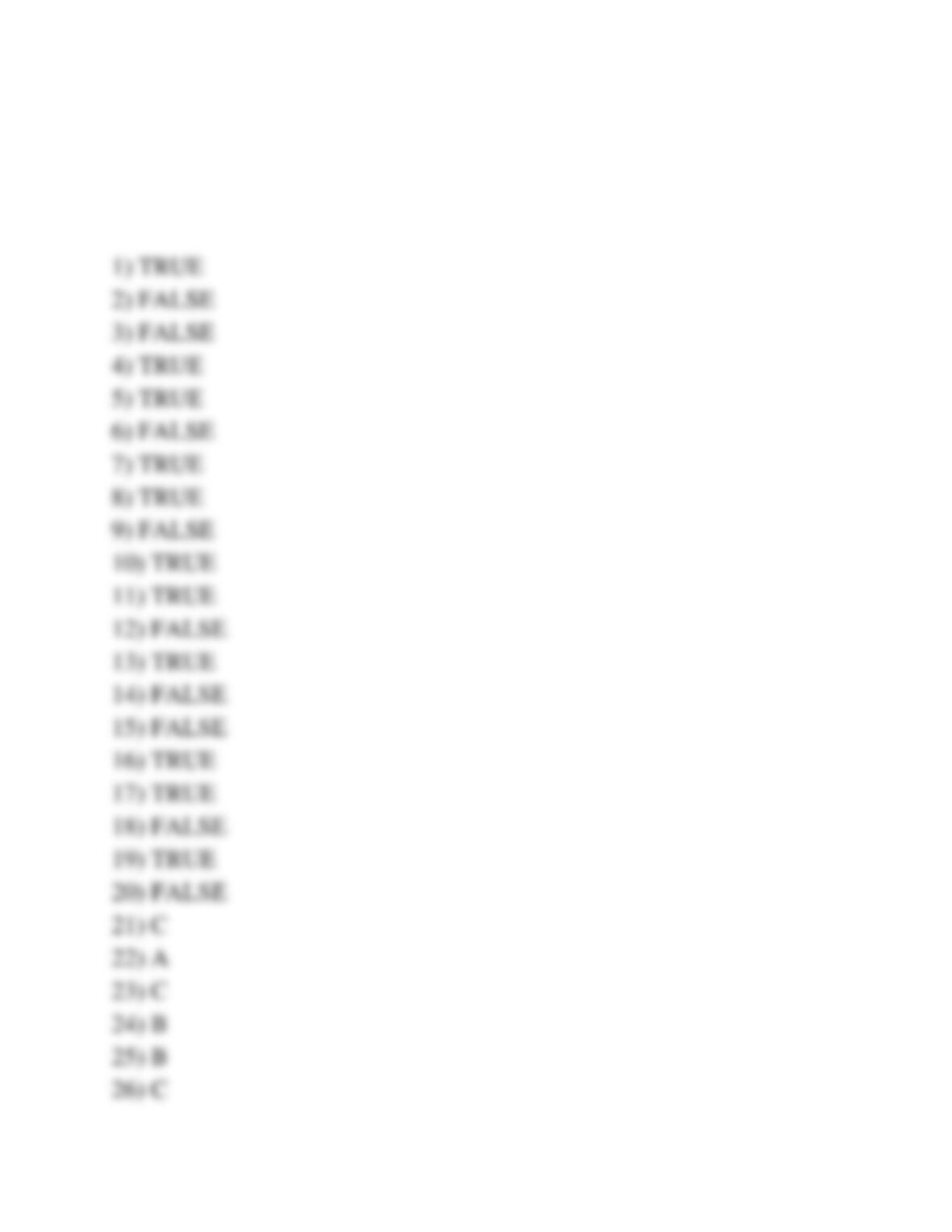
51) Describe the perspective of stockholders on compensation.
52) What are the different ways in which pay can influence employee motivation and
behavior?
53) Describe the various returns received from work.
54) List the basic elements of the pay model.
55) Explain the basic compensation objectives of pay systems.
Version 1 13
Version 1 14
Answer Key
Test name: chapter 1
Version 1 15
Version 1 16
Version 1 17