1) Which of the following is a feature of fluoride in nutrition?
a. Most bottled waters are fluoridated.
b. A severe deficiency is known as fluorosis.
c. Fluorapatite refers to an increase in the desire to eat fluoride-rich foods.
d. A deficiency contributes to the most widespread health problem in the United States.
e. Fluoride supplementation is no longer necessary in much of the U.S.
2) Which compound is missing four or more hydrogen atoms?
a. Monounsaturated fatty acid
b. Polyunsaturated fatty acid
c. Long-chain saturated fatty acid
d. Short-chain saturated fatty acid
e. Triglycerides
3) Which of the following is characteristic of the tocopherols?
a.Good food sources include lean meats and dairy.
b.The various tocopherols perform similar roles in the body.
c.They are usually found in foods high in polyunsaturated fats.
d.The various tocopherol compounds can be converted to the active alpha-tocopherol.
e.The upper level for adults in 2000 mg/day.
4) What is a significant factor associated with the interpretation of body composition
values?
a.The values include fat and protein but not water.
b.Sedentary, normal-weight people are rarely over-fat.
c.Muscular people may be classified as overweight.
d.Body composition can be accurately assessed by measuring body weight.
e.In middle-aged people, body composition is unrelated to morbidity and mortality.
5) What is the process by which heat or acidity disrupts the normal shape of a protein
chain?
a. Digestion
b. Condensation
c. Denaturation
d. Hydrogenation
e. Hydrolysis
6) According to the FDA, a food label that reads “improves memory” is an example of a
____.
a.health claim
b.Daily Value claim
c.qualified health claim
d.structure-function claim
e.unsupported claim
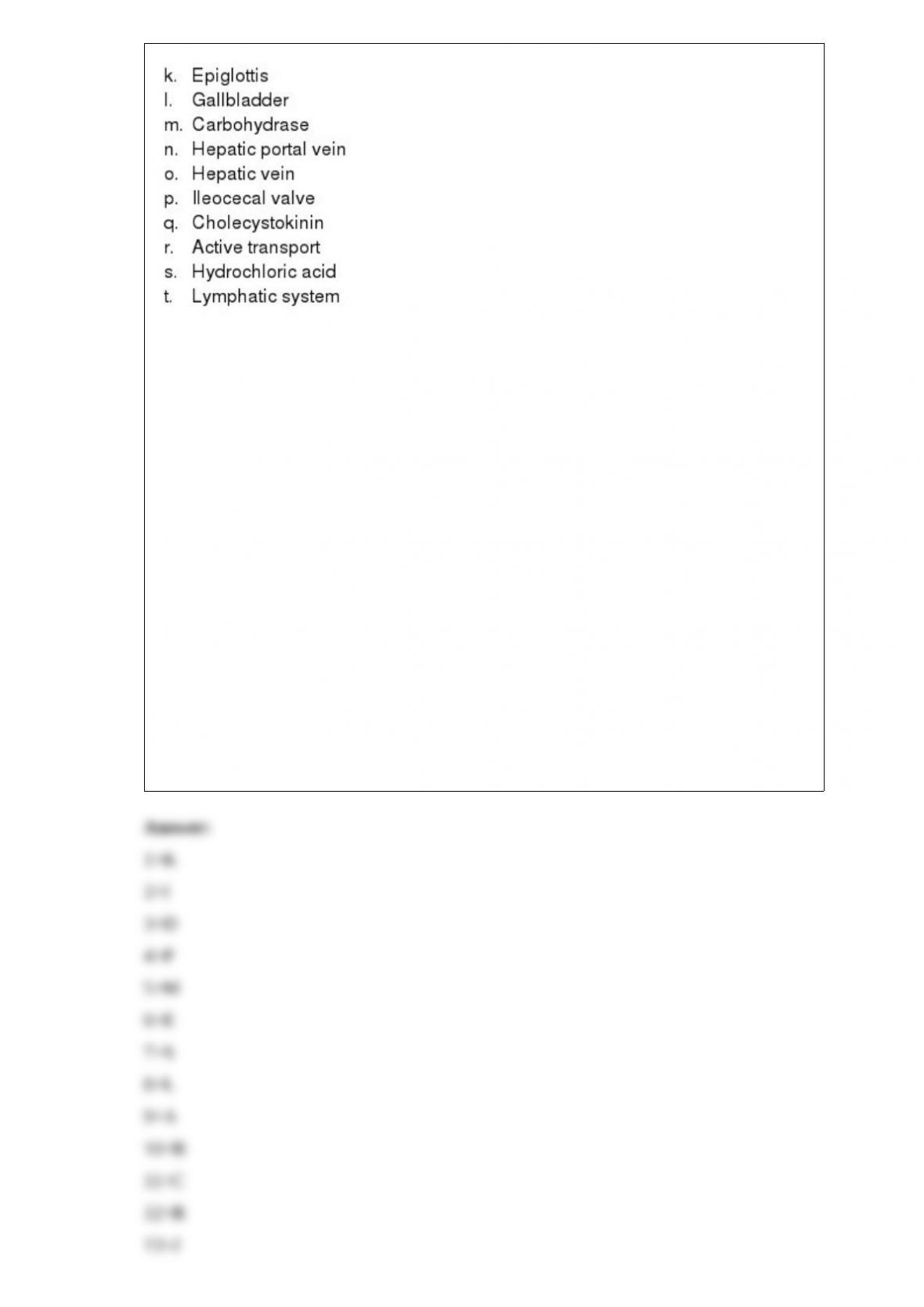
7) Matching
a. Liver
b. Villus
c. Goblet
d. Pylorus
e. Enzyme
f. Gastrin
g. Secretin
h. Capillary
i. Appendix
j. Diffusion
1>Prevents food from entering the windpipe when swallowing
2>Organ that stores lymph cells
3>Controls the entry of chyme into the duodenum
4>Controls the entry of chyme into the colon
5>Enzyme that digests starch
6>Substance that helps make or break a chemical bond
7>A component of gastric juice
8>Organ that releases bile into the small intestine
9>Organ that synthesizes bile
10>Fingerlike projection of small intestinal lining
11>Type of cell that secretes mucus
12>Absorption mechanism that requires energy
13>Absorption mechanism that does not require energy
14>Connects an artery to a vein
15>Vessel that carries blood from liver to heart
16>Vessel that carries blood from GI tract to liver
17>Carries fat-soluble vitamins
18>Hormone that signals release of pancreatic bicarbonate
19>Hormone that triggers release of gastric acid
20>Hormone that signals release of bile
8) A child develops a strong dislike of noodle soup after she consumes a bowl while
sick with the flu. Her reaction is an example of a food-related ____.
a.habit
b.social interaction
c.emotional turmoil
d.negative association
e.comfort eating
9) Approximately how many years is the maximum human life span?
a. 75
b. 100
c. 115
d. 130
e. 145
10) How does aspirin reduce inflammation and pain?
a. It acts as a sedative and barbiturate.
b. It promotes wound healing and blood clotting.
c. It interferes with the synthesis of prostaglandins.
d. It binds to nerve receptors involved in pain perception.
e. It stimulates endorphin release.
11) What function does a buffer perform?
a. It helps emulsify fats.
b. It helps maintain a constant pH.
c. It facilitates chemical reactions.
d. It helps protect against plaque buildup.
e. It prevents degradation of proteins.
12) Which food item is a healthy choice for protein in the USDA Food Patterns?
a.nuts
b.bacon
c.luncheon meats
d.sweet potatoes
e.marbled meats
13) Which of the following is a feature of calcium nutrition in pregnancy?
a. The RDA increases by over 100%.
b. Calcium absorption increases substantially.
c. Supplements are required for most women due to the increased needs.
d. Transfer of calcium from maternal stores to the fetus increases rapidly at the
beginning of the second trimester and falls during the last trimester.
e. During the last trimester, about 500 mg of calcium are transferred from the mother to
the fetus each day.
14) Describe foodborne infections that are early onset (within 1-2 days), mid-onset (3-6
days), and late onset (after 7 days).
15) What are the concerns of iron nutrition in vegetarians?
16) The simplest amino acid, ____________________, has a hydrogen atom as its side
group.
17) Discuss the functions of lipids in the body. What is the role of the liver in
metabolizing and processing fats?
18) Breaking down reactions are called ____________________ and building up
reactions are called ____________________.
19) What is the role of the placenta and how does it develop?
20) List the reasons why sugars are used as additives by the food industry.
21) List the complications experienced by low-birthweight infants.
22) The “bag of waters” in the uterus, in which the fetus floats is called the
____________________.