Version 1 1
Student name:__________
1) Identify three major differences between society and life on the cotton frontier and in the
Tidewater region. What was the significance of these differences?
Question Details
Accessibility : Keyboard Navigation
Bloom’s : Understand
Learning Objective : Detail the distinctive cultural and societal characteristics of the South that r
Topic : Class Structure of the White South
Gradable : manual
2) Describe the class structure of the Old South. What was the relationship of slavery to this
class structure?
Question Details
Accessibility : Keyboard Navigation
Bloom’s : Understand
Learning Objective : Detail the distinctive cultural and societal characteristics of the South that r
Topic : Class Structure of the White South
Gradable : manual
3) What pressures did slavery place on plantation mistresses?
Version 1 2
Question Details
Accessibility : Keyboard Navigation
Bloom’s : Understand
Learning Objective : Detail the distinctive cultural and societal characteristics of the South that r
Topic : Class Structure of the White South
Gradable : manual
4) What united slaves in the Old South? Were there significant divisions among slaves?
Question Details
Accessibility : Keyboard Navigation
Bloom’s : Understand
Topic : The Culture of the Enslaved
Learning Objective : Describe the culture of enslaved people.
Gradable : manual
5) How did slaves resist slavery?
Version 1 3
Question Details
Accessibility : Keyboard Navigation
Bloom’s : Understand
Topic : The Peculiar Institution
Learning Objective : Examine the organization and maintenance of slave labor and the resistance effor
Gradable : manual
6) What role did religion play in the lives of slaves? How did that role differ from the role of
religion encouraged by many white masters?
Question Details
Accessibility : Keyboard Navigation
Bloom’s : Understand
Topic : The Culture of the Enslaved
Learning Objective : Describe the culture of enslaved people.
Gradable : manual
7) Describe the change in attitudes toward slavery in the South before and after the early
1830s. What events contributed to that change?
Question Details
Accessibility : Keyboard Navigation
Bloom’s : Understand
Learning Objective : Identify the arguments used to defend the practice of slavery.
Gradable : manual
Topic : Southern Society and the Defense of Slavery
Version 1 4
8) What arguments did southerners use to defend slavery?
Question Details
Accessibility : Keyboard Navigation
Bloom’s : Understand
Learning Objective : Identify the arguments used to defend the practice of slavery.
Gradable : manual
Topic : Southern Society and the Defense of Slavery
9) Compare and contrast slave revolts in North America and Latin America.
Question Details
Accessibility : Keyboard Navigation
Bloom’s : Understand
Topic : The Peculiar Institution
Learning Objective : Examine the organization and maintenance of slave labor and the resistance effor
Gradable : manual
10) The chapter introduction profiles several southerners: Colonel Daniel Jordan, a plantation
master in South Carolina; a planter from the Red River country of Texas; Sam Williams, a
skilled ironworker slave from Virginia, and his wife Nancy; Octave Johnson, a slave in
Louisiana; and Ferdinand Steel, a farmer in Mississippi. Using what you have learned from the
text about the class structure of the Old South, to which class does each of these people belong?
Explain how each class differs from the others.
Version 1 5
Question Details
Accessibility : Keyboard Navigation
Bloom’s : Understand
Learning Objective : Detail the distinctive cultural and societal characteristics of the South that r
Topic : Class Structure of the White South
Gradable : manual
11) What were the major geographical regions of the Old South? Explain how the geography
of the South was a force of both unity and division.
Question Details
Accessibility : Keyboard Navigation
Bloom’s : Understand
Learning Objective : Describe the culture and environment of the cotton kingdom.
Topic : The Social Structure of the Cotton Kingdom
Gradable : manual
12) How did the conditions of slavery make it especially difficult for slaves to establish their
own culture? How did slave communities work to overcome this?
Version 1 6
Question Details
Accessibility : Keyboard Navigation
Bloom’s : Understand
Topic : The Culture of the Enslaved
Learning Objective : Describe the culture of enslaved people.
Gradable : manual
13) “Some [southern plantation] women drew a parallel between their situation and that of
the slaves,” the text reports. What parallels could plantation mistresses draw? Where do the
parallels break down? Do you agree with the mistresses’ observations?
Question Details
Accessibility : Keyboard Navigation
Bloom’s : Understand
Learning Objective : Detail the distinctive cultural and societal characteristics of the South that r
Topic : Class Structure of the White South
Gradable : manual
14) Do you believe slavery was the most important factor in shaping southern society? If so,
explain why, especially since only one-third of southerners were African American and only
one-quarter of southern whites owned slaves or were members of slave-owning families. If you
do not believe slavery was the most important factor shaping southern society, what factor was
(or factors were) more important?
Version 1 7
Question Details
Accessibility : Keyboard Navigation
Bloom’s : Understand
Learning Objective : Detail the distinctive cultural and societal characteristics of the South that r
Topic : Class Structure of the White South
Gradable : manual
15) Give three major differences between the North and the South in this period. What was
the significance of each of these differences? Which one do you think was the most important,
and why?
Question Details
Accessibility : Keyboard Navigation
Bloom’s : Understand
Learning Objective : Describe the culture and environment of the cotton kingdom.
Topic : The Social Structure of the Cotton Kingdom
Gradable : manual
16) Explain why the South’s dependence on exports made it difficult for an internally
diversified economy to develop. How did this dependence retard southern economic
development?
Question Details
Accessibility : Keyboard Navigation
Bloom’s : Understand
Learning Objective : Describe the culture and environment of the cotton kingdom.
Topic : The Social Structure of the Cotton Kingdom
Gradable : manual
Version 1 8
17) ________ was the major source of southern wealth and the major stimulus to national
economic growth.
17) ______
Question Details
Accessibility : Keyboard Navigation
Learning Objective : Describe the culture and environment of the cotton kingdom.
Bloom’s : Remember
Topic : The Social Structure of the Cotton Kingdom
Gradable : automatic
18) The ________ system of social stratification separates individuals by various distinctions,
such as heredity, rank, profession, wealth, and race.
18) ______
Question Details
Accessibility : Keyboard Navigation
Bloom’s : Remember
Topic : The Peculiar Institution
Learning Objective : Examine the organization and maintenance of slave labor and the resistance effor
Gradable : automatic
19) The backbone of southern society, accounting for more than half the southern population
and typically owning no slaves, was ________ farm families.
19) ______
Question Details
Accessibility : Keyboard Navigation
Bloom’s : Remember
Learning Objective : Detail the distinctive cultural and societal characteristics of the South that r
Topic : Class Structure of the White South
Gradable : automatic
Version 1 9
20) In the organization of slave labor, under the ________ system a specific assignment was
given to each slave, with the incentive that the workday was over when it was completed.
20) ______
Question Details
Accessibility : Keyboard Navigation
Bloom’s : Remember
Topic : The Peculiar Institution
Learning Objective : Examine the organization and maintenance of slave labor and the resistance effor
Gradable : automatic
21) Within the slave community, the house servants and the ________, who supervised the
field hands, enjoyed the highest status.
21) ______
Question Details
Accessibility : Keyboard Navigation
Bloom’s : Remember
Topic : The Peculiar Institution
Learning Objective : Examine the organization and maintenance of slave labor and the resistance effor
Gradable : automatic
22) The ________ system of slave labor predominated in the cotton districts.
22) ______
Question Details
Accessibility : Keyboard Navigation
Bloom’s : Remember
Topic : The Peculiar Institution
Learning Objective : Examine the organization and maintenance of slave labor and the resistance effor
Gradable : automatic
Version 1 10
23) Particularly disturbing to southerners was the 1831 revolt led by the slave named
________. (Provide the individual’s last name only.)
23) ______
Question Details
Accessibility : Keyboard Navigation
Bloom’s : Remember
Topic : The Peculiar Institution
Learning Objective : Examine the organization and maintenance of slave labor and the resistance effor
Gradable : automatic
24) In the 1850s more than half the slave population of the South lived in the ________
South.
24) ______
Question Details
Accessibility : Keyboard Navigation
Learning Objective : Describe the culture and environment of the cotton kingdom.
Bloom’s : Remember
Topic : The Social Structure of the Cotton Kingdom
Gradable : automatic
25) A major difference between slavery in North America and Latin America is that in Latin
America, ________ were much more frequent.
25) ______
Question Details
Accessibility : Keyboard Navigation
Bloom’s : Remember
Topic : The Peculiar Institution
Learning Objective : Examine the organization and maintenance of slave labor and the resistance effor
Gradable : automatic
Version 1 11
26) The chapter introduction tells the stories of several southerners—Colonel Daniel Jordan;
a nameless Texan; Sam Williams and his wife Nancy; Octave Johnson; and Ferdinand Steel—to
make the point that
26) ______
A) the antebellum South was marked by great diversity, but at its core it was unified by
its slave-based agricultural economy.
B) the antebellum South had a reputation for being unified in its views of slavery, but
actually only a few in the South actively supported the slave-based agricultural economy.
C) the South was unique among the sections of the U.S. because of racist attitudes and
the speculative approach to farming that characterized all classes of its citizens.
D) the South was not much different from other sections, except that the income of the
majority of southerners came from slave-grown cotton, while elsewhere the majority of
Americans grew corn or wheat with their own labor.
Question Details
Accessibility : Keyboard Navigation
Bloom’s : Understand
Learning Objective : Describe the culture and environment of the cotton kingdom.
Topic : The Social Structure of the Cotton Kingdom
Gradable : automatic
27) When cotton farmers were opening up new land for cotton cultivation, they typically
planted ________ the first year after clearing the new fields.
27) ______
A) cotton
B) corn
C) wheat
D) soybeans
Version 1 12
Question Details
Accessibility : Keyboard Navigation
Learning Objective : Describe the culture and environment of the cotton kingdom.
Bloom’s : Remember
28) Where was the Black Belt region described in the text located?
28) ______
A) in central Alabama, in the heart of the deep South, where the rich soil was ideal for
cotton
B) in the Tennessee River valley, where devastating flooding was frequent
C) along the Gulf Coast, where the slave population was concentrated
D) in an arc from South Carolina to Mississippi, where in most counties Blacks
outnumbered whites
Question Details
Accessibility : Keyboard Navigation
Learning Objective : Describe the culture and environment of the cotton kingdom.
Bloom’s : Remember
Topic : The Social Structure of the Cotton Kingdom
Gradable : automatic
29) “Cotton was king in the Old South.” Which of the following statements about cotton is
true?
29) ______
A) It was grown primarily in the Upper South.
B) It was grown only by the larger slaveholders.
C) Cultivation migrated gradually westward to new agricultural frontiers.
D) By 1860 the United States produced almost half of the world’s cotton supply.
Version 1 13
Question Details
Accessibility : Keyboard Navigation
Learning Objective : Describe the culture and environment of the cotton kingdom.
Bloom’s : Remember
Topic : The Social Structure of the Cotton Kingdom
Gradable : automatic
30) In which of the following states did slaves outnumber white southerners by the 1850s?
30) ______
A) Alabama
B) Georgia
C) South Carolina
D) North Carolina
Question Details
Accessibility : Keyboard Navigation
Learning Objective : Describe the culture and environment of the cotton kingdom.
Bloom’s : Remember
Topic : The Social Structure of the Cotton Kingdom
Gradable : automatic
31) Which of the following crops were grown extensively in the Upper South?
31) ______
A) cotton
B) rice
C) wheat
D) sugar
Version 1 14
Question Details
Accessibility : Keyboard Navigation
Learning Objective : Describe the culture and environment of the cotton kingdom.
Bloom’s : Remember
Topic : The Social Structure of the Cotton Kingdom
Gradable : automatic
32) Which of the following was NOT true about slavery as a labor system?
32) ______
A) Slavery was worth more in terms of investment than all the land in the South.
B) As slavery spread into the Deep South, wealth and power became more equally shared
among the various classes of white southerners.
C) It was slavery that made possible the South’s “mass production” of agriculture
products for export.
D) Only a minority of southerners owned slaves.
Question Details
Accessibility : Keyboard Navigation
Bloom’s : Understand
Learning Objective : Describe the culture and environment of the cotton kingdom.
Topic : The Social Structure of the Cotton Kingdom
Gradable : automatic
33) What was true about slavery as a labor system?
33) ______
A) As the institution spread throughout the Deep South, a majority of white families
came to own slaves.
B) By the 1850s, the United States was the only remaining slaveholding society in the
Americas.
C) The gang and task systems were the two main ways of organizing slaves’ work.
D) The most arduous toil was done by field hands, who were all male.
Version 1 15
Question Details
Accessibility : Keyboard Navigation
Bloom’s : Understand
Topic : The Peculiar Institution
Learning Objective : Examine the organization and maintenance of slave labor and the resistance effor
Gradable : automatic
34) Which statement best summarizes the effects of slavery on the southern economy?
34) ______
A) It was a highly efficient mode of production.
B) It helped diversify the southern economy, but was not highly profitable.
C) It released capital for investment that would otherwise have been tied up in wages.
D) It concentrated wealth and power in the hands of the planter class.
Question Details
Accessibility : Keyboard Navigation
Bloom’s : Understand
Learning Objective : Describe the culture and environment of the cotton kingdom.
Topic : The Social Structure of the Cotton Kingdom
Gradable : automatic
35) Manufacturing lagged in the South because
35) ______
A) whites believed slaves could not do industrial work.
B) slaveholders lacked capital to invest in manufacturing.
C) high profits from agriculture discouraged other possible investments.
D) the South lacked a suitable white workforce, since immigrants settled in the North.
Version 1 16
Question Details
Accessibility : Keyboard Navigation
Bloom’s : Understand
Learning Objective : Describe the culture and environment of the cotton kingdom.
Topic : The Social Structure of the Cotton Kingdom
Gradable : automatic
36) The slave population
36) ______
A) was concentrated in the Deep South.
B) moved steadily south and east.
C) was concentrated in the East.
D) was concentrated west of the Mississippi River.
Question Details
Accessibility : Keyboard Navigation
Bloom’s : Understand
Learning Objective : Describe the culture and environment of the cotton kingdom.
Topic : The Social Structure of the Cotton Kingdom
Gradable : automatic
37) The slave population was concentrated in all of the following places EXCEPT
37) ______
A) the Deep South.
B) the Upper South.
C) areas of fertile soil and relatively flat terrain.
D) in areas accessible to transportation.
Version 1 17
Question Details
Accessibility : Keyboard Navigation
Bloom’s : Understand
Learning Objective : Describe the culture and environment of the cotton kingdom.
Topic : The Social Structure of the Cotton Kingdom
Gradable : automatic
38) Southern slave trading firms included all of the following in their facilities, EXCEPT
38) ______
A) showrooms.
B) jails.
C) hospitals.
D) nursing rooms.
Question Details
Accessibility : Keyboard Navigation
Learning Objective : Describe the culture and environment of the cotton kingdom.
Bloom’s : Remember
Topic : The Social Structure of the Cotton Kingdom
Gradable : automatic
39) American investors from New England and New York came to hold one third of
________’s wealth and thousands of its slaves.
39) ______
A) Cuba
B) Mississippi
C) Kentucky
D) Virginia
Version 1 18
Question Details
Accessibility : Keyboard Navigation
Learning Objective : Describe the culture and environment of the cotton kingdom.
Bloom’s : Remember
Topic : The Social Structure of the Cotton Kingdom
Gradable : automatic
40) “Middling” slaveholders, which made up about a quarter of all slaveholders, owned
approximately how many slaves?
40) ______
A) 5 to 10
B) 10 to 20
C) 15 to 50
D) 50 to 150
Question Details
Accessibility : Keyboard Navigation
Bloom’s : Remember
Learning Objective : Detail the distinctive cultural and societal characteristics of the South that r
Topic : Class Structure of the White South
Gradable : automatic
41) Which of the following ensured yeomen’s loyalty to large slaveholders?
41) ______
A) a common pride in being white
B) the patterns of land distribution
C) the power yeomen held over transportation
D) yeomen’s independence from planters’ credit
Version 1 19
Question Details
Accessibility : Keyboard Navigation
Bloom’s : Understand
Learning Objective : Detail the distinctive cultural and societal characteristics of the South that r
Topic : Class Structure of the White South
Gradable : automatic
42) Slaveholders made up ________ of the southern white population, but the true “planters
of consequence,” with at least 50 slaves, ________.
42) ______
A) the great majority; were found only in the older Tidewater region
B) about half; dominated politics
C) roughly a quarter; made up less than 1 percent of the total white population
D) a small minority; constituted a majority of those slaveholders
Question Details
Accessibility : Keyboard Navigation
Bloom’s : Remember
Learning Objective : Detail the distinctive cultural and societal characteristics of the South that r
Topic : Class Structure of the White South
Gradable : automatic
43) The Tidewater planter ________, while the planter of the Deep South ________.
43) ______
A) raised primarily rice; raised primarily cotton
B) aspired to the ideal of the English country gentleman; was an entrepreneur bound on
making a fortune
C) dealt brutally with his slaves; tended to treat slaves more humanely
D) defended slavery as a positive good; was often troubled by the immorality of the slave
system
Version 1 20
Question Details
Accessibility : Keyboard Navigation
Bloom’s : Remember
Learning Objective : Detail the distinctive cultural and societal characteristics of the South that r
Topic : Class Structure of the White South
Gradable : automatic
44) The upper-class plantation mistress
44) ______
A) accepted a sexual code that kept white women pure but tolerated sexual relations
between white men and slave women.
B) lived a life of leisure centered around artistic and literary pursuits.
C) enjoyed the unique luxury of criticizing her own role in society as well as the slave
system in general.
D) faced an unexpected variety of burdensome managerial and service duties.
Question Details
Accessibility : Keyboard Navigation
Bloom’s : Understand
Learning Objective : Detail the distinctive cultural and societal characteristics of the South that r
Topic : Class Structure of the White South
Gradable : automatic
45) Yeoman farmers in the South
45) ______
A) owned only a few slaves.
B) hated the planter class.
C) opposed slavery because it hurt them economically.
D) suffered from isolation, a limited market, and chronic money shortage.
Version 1 21
Question Details
Accessibility : Keyboard Navigation
Bloom’s : Remember
Learning Objective : Detail the distinctive cultural and societal characteristics of the South that r
Topic : Class Structure of the White South
Gradable : automatic
46) In terms of sheer numbers, which of the following groups made up the backbone of
southern society?
46) ______
A) the planters of consequence
B) whites who owned only a few slaves
C) whites who owned between 20 and 50 slaves
D) yeoman farmers who owned no slaves
Question Details
Accessibility : Keyboard Navigation
Bloom’s : Remember
Learning Objective : Detail the distinctive cultural and societal characteristics of the South that r
Topic : Class Structure of the White South
Gradable : automatic
47) The gang and task systems
47) ______
A) were used alternately in the spring and fall.
B) were the two main ways of organizing slave labor.
C) were used for rice and sugar production, but not cotton.
D) required constant supervision of the slaves.
Version 1 22
Question Details
Accessibility : Keyboard Navigation
Bloom’s : Remember
Topic : The Peculiar Institution
Learning Objective : Examine the organization and maintenance of slave labor and the resistance effor
Gradable : automatic
48) In spite of poor diet, lack of medical care, and a high infant mortality rate, the United
States was the only slave society in the Americas where the
48) ______
A) white population grew significantly faster than the slave population.
B) slave population increased naturally.
C) slave population’s life expectancy was greater than that of white Americans.
D) slave population grew at a faster rate than the white population.
Question Details
Accessibility : Keyboard Navigation
Bloom’s : Understand
Topic : The Peculiar Institution
Learning Objective : Examine the organization and maintenance of slave labor and the resistance effor
Gradable : automatic
49) In the 1830s, reacting to Nat Turner’s Rebellion and the growing abolitionist movement,
southern slaveholders developed the argument that slavery was a positive good. Which of the
following assertions was NOT part of their proslavery argument?
49) ______
A) Slavery was a beneficial status for Blacks, as they required white guardianship.
B) Slavery was sanctioned by the Bible and history.
C) Slavery was more consistent with the humanitarian spirit of the age than the northern
wage labor system.
D) Slavery’s opponents could build no persuasive argument against it.
Version 1 23
Question Details
Accessibility : Keyboard Navigation
Bloom’s : Remember
Learning Objective : Identify the arguments used to defend the practice of slavery.
Gradable : automatic
Topic : Southern Society and the Defense of Slavery
50) Nat Turner
50) ______
A) became a leading advocate of slavery as a “positive good.”
B) strongly defended humane treatment of slaves as the slaveholders’ paternalistic
obligation.
C) led a slave revolt despite enjoying relatively humane treatment by his master.
D) was an escaped slave who returned to the South to lead other runaways to freedom.
Question Details
Accessibility : Keyboard Navigation
Bloom’s : Remember
Topic : The Peculiar Institution
Learning Objective : Examine the organization and maintenance of slave labor and the resistance effor
Gradable : automatic
51) Which of the following is NOT true of Nat Turner’s Rebellion?
51) ______
A) Turner rebelled due to extreme mistreatment by a series of harsh Louisiana masters.
B) It was small and spontaneous, in contrast with earlier noteworthy slave uprisings.
C) Turner was eventually captured and executed.
D) It prompted a debate in the Virginia legislature on the merits of slavery.
Version 1 24
Question Details
Accessibility : Keyboard Navigation
Bloom’s : Remember
Topic : The Peculiar Institution
Learning Objective : Examine the organization and maintenance of slave labor and the resistance effor
Gradable : automatic
52) The most common form of slave resistance was
52) ______
A) theft.
B) refusal to work.
C) escape.
D) rebellion.
Question Details
Accessibility : Keyboard Navigation
Bloom’s : Understand
Topic : The Peculiar Institution
Learning Objective : Examine the organization and maintenance of slave labor and the resistance effor
Gradable : automatic
53) Most often the slave family
53) ______
A) was sold as a unit, according to laws in the Upper South.
B) consisted of the nuclear unit (father, mother, and their children).
C) did not exist in a functional way on large plantations.
D) was essentially impossible to sustain under the conditions of bondage.
Version 1 25
Question Details
Accessibility : Keyboard Navigation
Bloom’s : Remember
Topic : The Culture of the Enslaved
Learning Objective : Describe the culture of enslaved people.
Gradable : automatic
54) What is NOT true of slave religion?
54) ______
A) It was expressed in secret meetings beyond white supervision.
B) It was central to the culture of most slave communities.
C) It featured songs with both earthly and heavenly applications.
D) It remained largely unaffected by Christianity until the 1860s.
Question Details
Accessibility : Keyboard Navigation
Bloom’s : Remember
Topic : The Culture of the Enslaved
Learning Objective : Describe the culture of enslaved people.
Gradable : automatic
55) Free Blacks in the South
55) ______
A) developed an internal hierarchy favoring darker or “more African” skin colors.
B) lived mostly in urban centers.
C) lived mostly in the Upper South.
D) were primarily mulattoes.
Version 1 26
Question Details
Accessibility : Keyboard Navigation
Bloom’s : Remember
Topic : The Culture of the Enslaved
Learning Objective : Describe the culture of enslaved people.
Gradable : automatic
56) While the Old South was a diverse region of the United States, it was united in its
56) ______
A) belief in the 1830s that slavery was on the decline.
B) dependence on staple crops such as tobacco, cotton, and rice.
C) dependence on the labor of women.
D) belief that slavery was central only to the economy and not to southern culture and
identity.
Question Details
Accessibility : Keyboard Navigation
Bloom’s : Understand
Learning Objective : Describe the culture and environment of the cotton kingdom.
Topic : The Social Structure of the Cotton Kingdom
Gradable : automatic
57) After 1830, southerners defended slavery more aggressively for all of the following
reasons EXCEPT
57) ______
A) a perceived decline in southern influence in national politics.
B) the rise of the abolitionist movement with its threatening literature.
C) the increasing dependence of the southern economy on slave-grown staples.
D) Nat Turner’s Rebellion.
Version 1 27
Question Details
Accessibility : Keyboard Navigation
Bloom’s : Understand
Learning Objective : Identify the arguments used to defend the practice of slavery.
Gradable : automatic
Topic : Southern Society and the Defense of Slavery
58) The Virginia debate of 1832
58) ______
A) led to a resolution declaring slavery a positive good.
B) caused the legislature to condemn slavery but adopt no program to deal with it.
C) led to the adoption of a program of gradual emancipation.
D) was the last significant attempt by white southerners to take action against slavery.
Question Details
Accessibility : Keyboard Navigation
Bloom’s : Remember
Learning Objective : Identify the arguments used to defend the practice of slavery.
Gradable : automatic
Topic : Southern Society and the Defense of Slavery
59) The proslavery argument
59) ______
A) was fully developed before 1830 as part of the anti-tariff campaign.
B) refused to consider the Bible, depending instead on racist scientific treatises.
C) was successful in influencing northern public opinion on slavery.
D) was developed primarily to satisfy the consciences of southerners.
Version 1 28
Question Details
Accessibility : Keyboard Navigation
Bloom’s : Understand
Learning Objective : Identify the arguments used to defend the practice of slavery.
Gradable : automatic
Topic : Southern Society and the Defense of Slavery
60) Which of the following was NOT an element of the proslavery argument developed in the
1830s?
60) ______
A) None of the Biblical prophets or Christ himself had ever condemned slavery.
B) Slavery was an unfortunate legacy of earlier tyrannical acts of the English Parliament
and northern colonial merchants.
C) Southern slaves lived better lives than northern factory workers.
D) Slaves belonged to an inferior race.
Question Details
Accessibility : Keyboard Navigation
Bloom’s : Remember
Learning Objective : Identify the arguments used to defend the practice of slavery.
Gradable : automatic
Topic : Southern Society and the Defense of Slavery
61) What group was vehemently opposed to ending slavery even though they sometimes
traded with slaves and keenly resented planters?
61) ______
A) poor whites
B) yeoman farmers
C) drivers
D) overseers
Version 1 29
Question Details
Accessibility : Keyboard Navigation
Bloom’s : Remember
Learning Objective : Detail the distinctive cultural and societal characteristics of the South that r
Topic : Class Structure of the White South
Gradable : automatic
62) In North America, slave revolts were ________. In Latin American slave societies, full-
scale revolts were ________.
62) ______
A) common; extremely rare
B) very rare; nearly nonexistent
C) extremely rare; common, and involved large numbers of slaves
D) numerous but small; nearly impossible to organize
Question Details
Accessibility : Keyboard Navigation
Bloom’s : Remember
Topic : The Peculiar Institution
Learning Objective : Examine the organization and maintenance of slave labor and the resistance effor
Gradable : automatic

Version 1 30
Answer Key
Test name: chapter 13
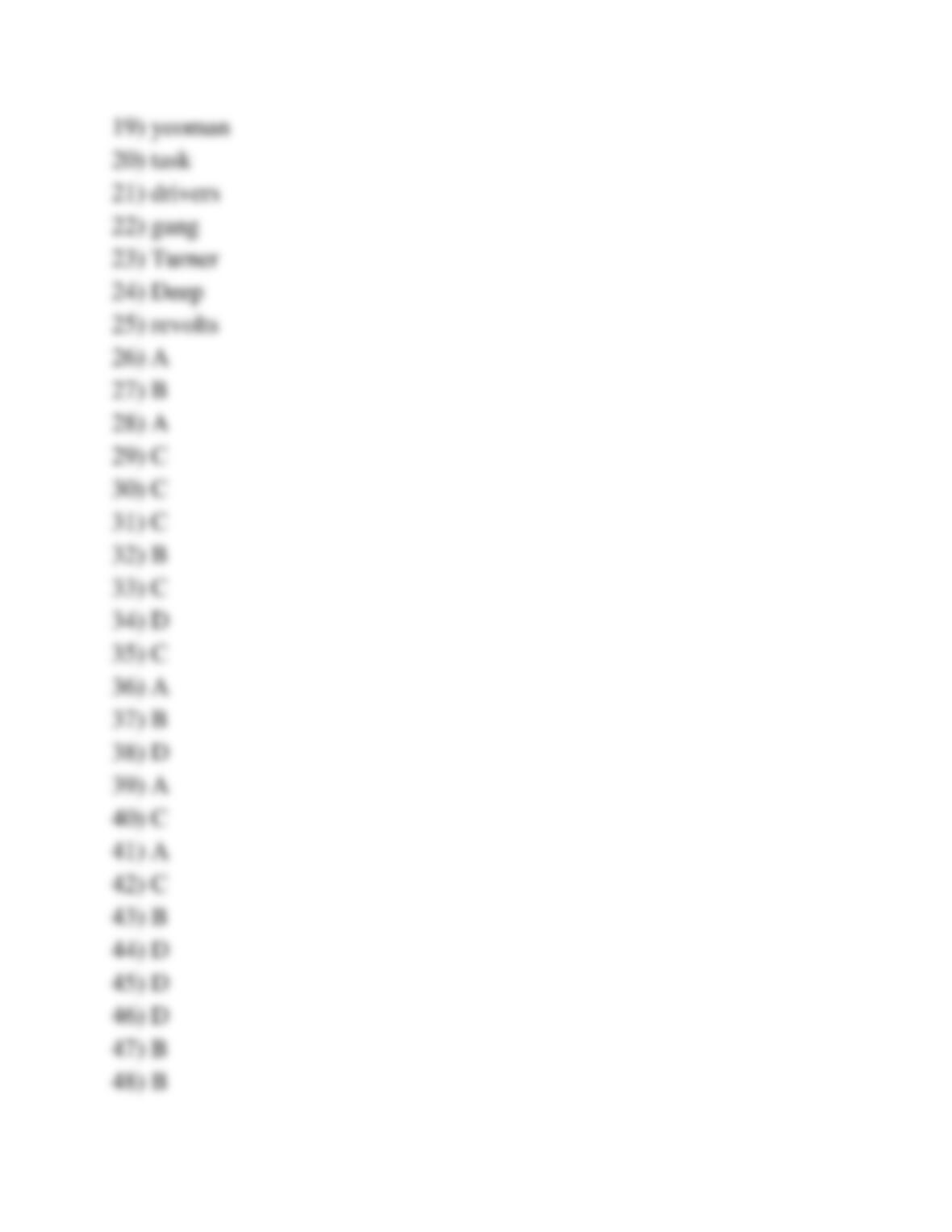
Version 1 31

Version 1 32