
Suppose the growth rate of the firms profit is 4 percent, the interest rate is 5 percent,
and the current profits of the firm are $75 million. What is the value of the firm?
A. $2,111.5 million
B. $7,766.6 million
C. $10,600 million
D. None of the statements associated with this question are correct.
You are the manager of a gas station and your goal is to maximize profits. Based on
your past experience, the elasticity of demand by Ohioans for a car wash is -3, while the
elasticity of demand by non-Ohioans for a car wash is -1.5. If you charge Ohioans $9
for a car wash, how much should you charge a man with a Kentucky license plate for a
car wash?
A. $6
B. $15
C. $18
D. $9
If A and B are substitute goods, a decrease in the price of good A would:
A. have no effect on the quantity demanded of B.
B. lead to an increase in demand for B.
C. lead to a decrease in demand for B.
D. none of the statements associated with this question are correct.
A risk-loving individual would:
A. prefer $5 with certainty to a risky prospect with the expected value of $5.
B. prefer a risky prospect with an expected value of $5 to a certain amount of $5.
C. be indifferent between a risky prospect with an expect value of $5 and a certain
amount of $5.
D. prefer a risky prospect with the expected value of $0.50 to $5 with certainty.
Which of the following is NOT an important determinant of collusion in pricing games?
A. The number of firms
B. The importance and magnitude of the item in a consumers budget
C. History
D. All the statements associated with this question are important.

Consider the following entry game: Here, firm B is an existing firm in the market, and
firm A is a potential entrant. Firm A must decide whether to enter the market (play
“enter”) or stay out of the market (play “not enter”). If firm A decides to enter the
market, firm B must decide whether to engage in a price war (play “hard”), or not (play
soft”). By playing “hard,” firm B ensures that firm A makes a loss of $1 million, but
firm B only makes $1 million in profits. On the other hand, if firm B plays soft,”, the
new entrant takes half of the market, and each firm earns profits of $5 million. If firm A
stays out, it earns zero while firm B earns $10 million. Which of the following are Nash
equilibrium strategies?
A. (enter, hard) and (not enter, hard)
B. (enter, soft) and (not enter, soft)
C. (not enter, hard) and (enter, soft)
D. (enter, hard) and (not enter, soft)
Many gourmet shops go out of business during recessions since they sell almost
exclusively:
A. inferior goods.
B. normal goods.
C. substitutes.
D. complements.
Consider a Stackelberg duopoly with the following inverse demand function: P = 100 –
2Q1 – 2Q2. The firms marginal costs are identical and are given by MCi = 2. Based on
this information, the Stackelberg followers reaction function is:
A. QF = 24.5 – 0.25QL.
B. QF = 49 – 0.25QF.
C. QF = 24.5 – 0.5QL.
D. QF = 24.5 – QL.
Which of the following would not shift the demand for good A?
A. Drop in price of good A.
B. Drop in price of good B.
C. Consumer income.
D. Change in the level of advertising of good A.
You are a hotel manager and you are considering four projects that yield different
payoffs, depending upon whether there is an economic boom or a recession. The

potential payoffs and corresponding payoffs are summarized in the following table.
A risk-loving manager will prefer project:
A. A.
B. B.
C. C.
D. D.
Suppose the demand for X is given by Qx
d = 100 – 2PX + 4PY + 10M + 2A, where PX
represents the price of good X, PY is the price of good Y, M is income and A is the
amount of advertising on good X. Based on this information, we know that good Y is
A. a substitute for good X.
B. a complement for good X.
C. an inferior good.
D. a normal good.
For the cost function C(Q) = 1000 + 14Q + 9Q2 + 3Q3, what is the marginal cost of
producing the fourth unit of output?

A. $42
B. $295
C. $230
D. $116
Suppose that there are two industries, A and B. There are five firms in industry A with
sales at $5 million, $2 million, $1 million, $1 million, and $1 million, respectively.
There are four firms in industry B with equal sales of $2.5 million for each firm. The
HHI for industry B is:
A. 2,500.
B. 1,800.
C. 3,200.
D. 2,800.
Which of the following is NOT a valuable role of government in a free market society?
A. To reduce negative externalities.
B. To enhance rent-seeking activities.
C. To reduce market power.
D. To provide public goods.
Firm A has a higher marginal cost than firm B. They compete in a homogeneous
product Cournot duopoly. Which of the following results will NOT occur?
A. QA < QB
B. ProfitA < ProfitB
C. Revenue of firm A < Revenue of firm B
D. PriceA < PriceB
In general, automobile manufacturers produce their own engines but purchase tires
from independent suppliers. Why?
The (inverse) demand in a Cournot duopoly is P = a – b (Q1 + Q2), and costs are C1(Q1)
= c1Q1 and C2(Q2) = c2Q2. Show that the Cournot equilibrium levels of output are
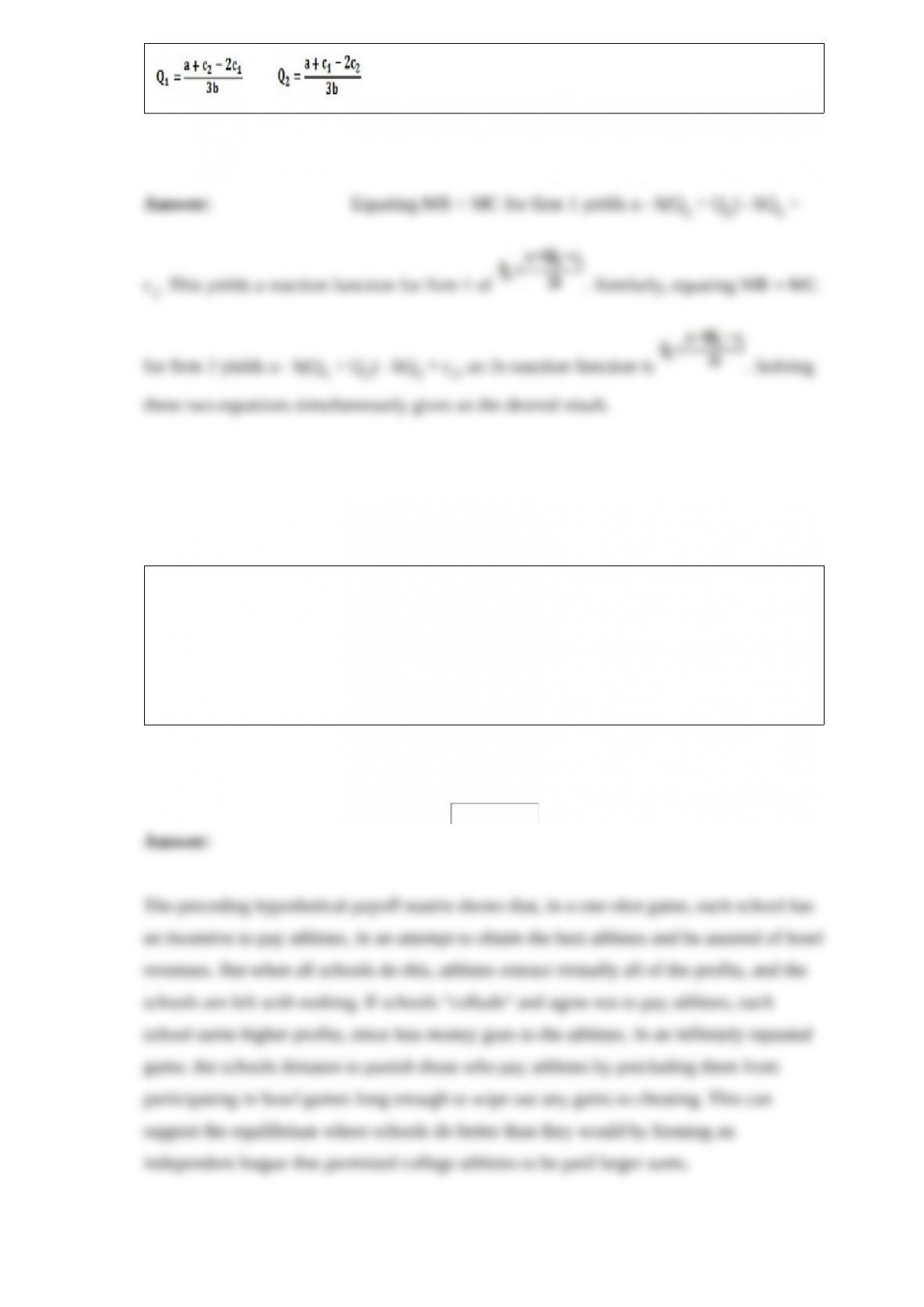
and .
The NCAA prohibits schools that are caught paying athletes from participating in bowl
games, and sometimes the punishment is even more severe. Explain why schools dont
break away from the NCAA and form a league in which athletes can legitimately be
paid. (Hint: Use hypothetical payoffs to construct an illustrative normal-form game in
which the strategies are “pay players” and “dont pay players.” Then analyze the game in
one-shot and infinitely repeated contexts.)
You are the CEO of Comchip, a monopoly that sells specialized computers. Each of the
firms computers contains a unique chip that is produced at Comchips West Coast plant
at a cost of Cw(Qc) = Qc
2. Once produced, the chips are shipped exclusively to the firms
East Coast plant. There, the computers are assembled, boxed, and shipped to the market
at a cost of Ce(Q) = 200Q. An economic consultant recently estimated the demand for
Comchips computers and found it to be P = 5,000 – Q. Determine Comchips optimal
output and price for computers, and explain how it can induce plant managers to
produce the required number of chips and computers.
Grocery stores make most of their profits on soft drinks, beer, chips, and candy. A
casual look at prices of these items reveals that these prices change extremely often and
can vary as much as 50 percent. Is this because the wholesale price of these items
fluctuates this dramatically, or is there some other possible explanation?
You are a truck farmer and bring produce to a farmers market every Wednesday. You
have found that on a typical day, five other farmers bring their produce to market. Years
of experience have taught you that you make the most money by pricing your produce
at 1.15 times your marginal cost. What is your elasticity of demand in this Cournot
oligopoly? What is the market elasticity of demand?
You are the manager of Door-to-Door Vacuum Cleaners, Inc. Each salesperson is paid a
base salary plus a percentage of the revenues she or he generates. In addition, each
salesperson drives his or her car to and from each sales call and is reimbursed $0.40 per
mile driven. On average, each salesperson drives about 150 miles per day and 240 days
per year. As manager of Door-to-Door, how might you restructure the compensation of
your sales force to enhance your profits? Are there any potential disadvantages of your
plan? Explain.
You are the manager of a firm that has just created a new and improved version of a
product you know to be superior to every other product on the market. To signal your
quality, you have instructed your marketing department to change the label of your
firms product to include the phrase, “New and Improved.” Based on this information,
do you think it is prudent to contact your production department and instruct them to
significantly expand capacity? Explain.
In most cities all lumber yards advertise that they have the lowest price in town. In
addition, they often claim that they will match the prices of any other lumber yards. Is
this Bertrand competition that brings about zero economic profits? Explain.