
The primary inducement for new firms to enter an industry is:
A. increased technology.
B. availability of labor.
C. low capital costs.
D. presence of economic profits.
Transaction costs refer to:
A. fixed costs of capital.
B. variable costs of labor.
C. costs of exchange unrelated to production costs.
D. economies of scale.
The ranking of industries by the four-firm concentration ratio usually, but not always,
reveals the same pattern as ranking by HHI. When a discrepancy is found it is usually
due to the following:
A. The four-firm concentration index contains data on only the largest four firms, while
the HHI is based on data for all firms in the industry.
B. The HHI is based on squared market shares, while the four-firm concentration ratio
is not.

C. The four-firm concentration index contains data on only the largest four firms, while
the HHI is based on data for all firms in the industry and the HHI is based on squared
market shares, while the four-firm concentration ratio is not.
D. The two indices are designed to measure two different attributes of markets.
Which of the following sets of economic data is minimizing the cost of producing a
given level of output?
A. MPL = 20, MPK = 40, w = $16, r = $32.
B. MPL = 20, MPK = 40, w = $32, r = $16.
C. MPL = 40, MPK = 20, w = $16, r = $32.
D. MPL = 40, MPK = 40, w = $16, r = $32.
What is the level of net benefits when 20 units are produced?
A. -100
B. 80
C. 100
D. 10

Suppose a firm manager has a base salary of $85,000 and earns 0.5 percent of all sales.
Determine the managers income if revenues are $2,000,000 and profits are $500,000.
A. $50,000
B. $87,500
C. $95,000
D. $170,000
Suppose you compete in a Cournot oligopoly market consisting of six firms. The
equilibrium market price and quantity are $5 and 10 units, respectively. The marginal
cost for each firm is $3. Based on this information, we know the price elasticity of the
market demand is:
A. -0.417.
B. 0.167.
C. -2.4.
D. There is insufficient information to answer this question.

Refer to the following payoff matrix:
Suppose the simultaneous-move game depicted in the payoff matrix could be turned
into a sequential-move game with player 1 moving first. In this case, the equilibrium
payoffs will be:
A. ($20, $1).
B. ($50, $5).
C. ($40, $2).
D. ($15, $30).
If you advertise and your rival advertises, you each will earn $4 million in profits. If
neither of you advertises, you will each earn $10 million in profits. However, if one of
you advertises and the other does not, the firm that advertises will earn $1 million and
the non-advertising firm will earn $5 million. Which of the following is true?
A. A secure strategy for firm A is to not advertise.
B. A secure strategy for firm B is to advertise.
C. Firm A does not have a secure strategy.
D. None of the answers is correct.

A secure strategy is a strategy that:
A. results in the highest payoff to a player regardless of the opponents action.
B. guarantees the highest payoff given the worst possible scenario.
C. describes a set of circumstances in which no player can improve her payoff by
unilaterally changing her own strategy, given the other players strategies.
D. randomizes over two or more available actions in order to keep rivals from being
able to predict a players action.
Refer to the following game.
Which of the following is true?
A. A dominant strategy for firm A is “high price.”
B. There does not exist a dominant strategy for firm A.
C. A dominant strategy for firm B is “low price.”
D. None of the answers is correct.
Suppose compensation is given by W = 500,000 + 200 + 17S, where W =
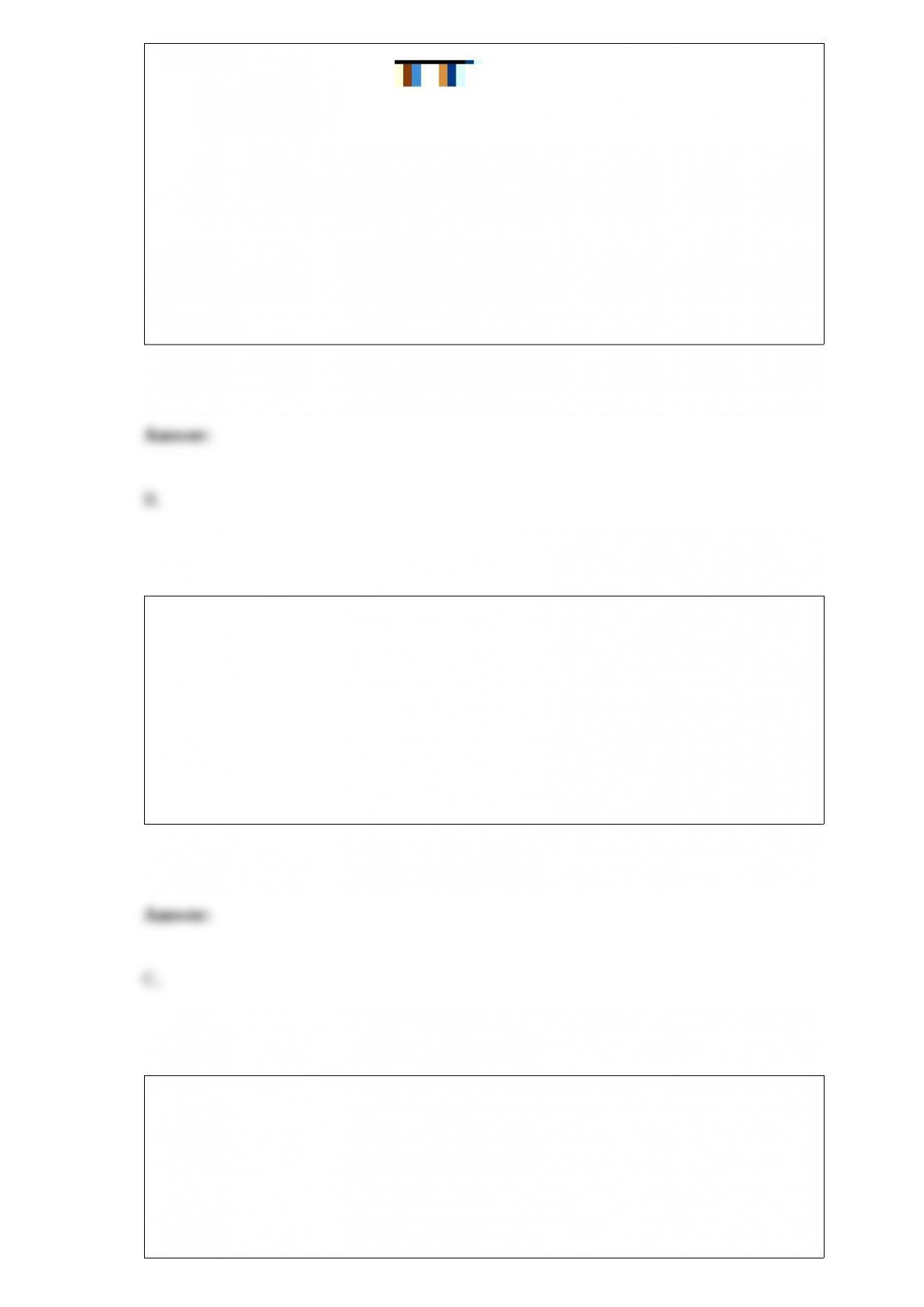
total compensation of the CEO, = company profits (in millions) = $400,
and S = sales (in millions) = $700. What percentage of the CEOs total earnings is tied
to profits of the firm?
A. 2.0 percent
B. 13.5 percent
C. 19.6 percent
D. 31.4 percent
Changes in the price of good A lead to a change in:
A. demand of good A.
B. demand of good B.
C. the quantity demanded of good A.
D. the quantity demanded of good B.
Consider a Cournot oligopoly consisting of five identical firms producing good X. If
the firms produce good X at a marginal cost of $7 per unit and the market elasticity of
demand is -3, determine the profit-maximizing price.
A. $7.50 per unit
B. $5.25 per unit

C. $7 per unit
D. $4.20 per unit