
The total earnings of a worker are represented by E = 100 + $10(24 – L), where E is
earnings and L is the number of hours of leisure. How much will the worker earn if he
takes 14 hours of leisure per day?
A. $150
B. $240
C. $100
D. $200
You are the manager of a gas station and your goal is to maximize profits. Based on
your past experience, the elasticity of demand by Texans for a car wash is -4, while the
elasticity of demand by non-Texans for a car wash is -6. If you charge Texans $20 for a
car wash, how much should you charge a man with Oklahoma license plates for a car
wash?
A. $1.50
B. $15.00
C. $18.00
D. $20.00
Which of the following is true under monopolistic competition in the long run?
A. Profits are always zero.
B. P > MC.
C. P = MR.
D. All of the choices are true in monopolistic competition.
Which of the following pairs of goods are probably complements?
A. Electricity and natural gas.
B. Butter and margarine.
C. Steak and chicken.
D. Ketchup and French fries.
Suppose the market for good X has a four-firm concentration ratio of 0.70. Having
worked for the four largest firms in the industry, you know the sales for these four firms
are given by $200,000, $225,000, $250,000, and $275,000. Based on this information,
we know that sales for the remaining firms in the industry are:
A. $943,332.
B. $687,500.
C. $550,500.
D. $407,143.
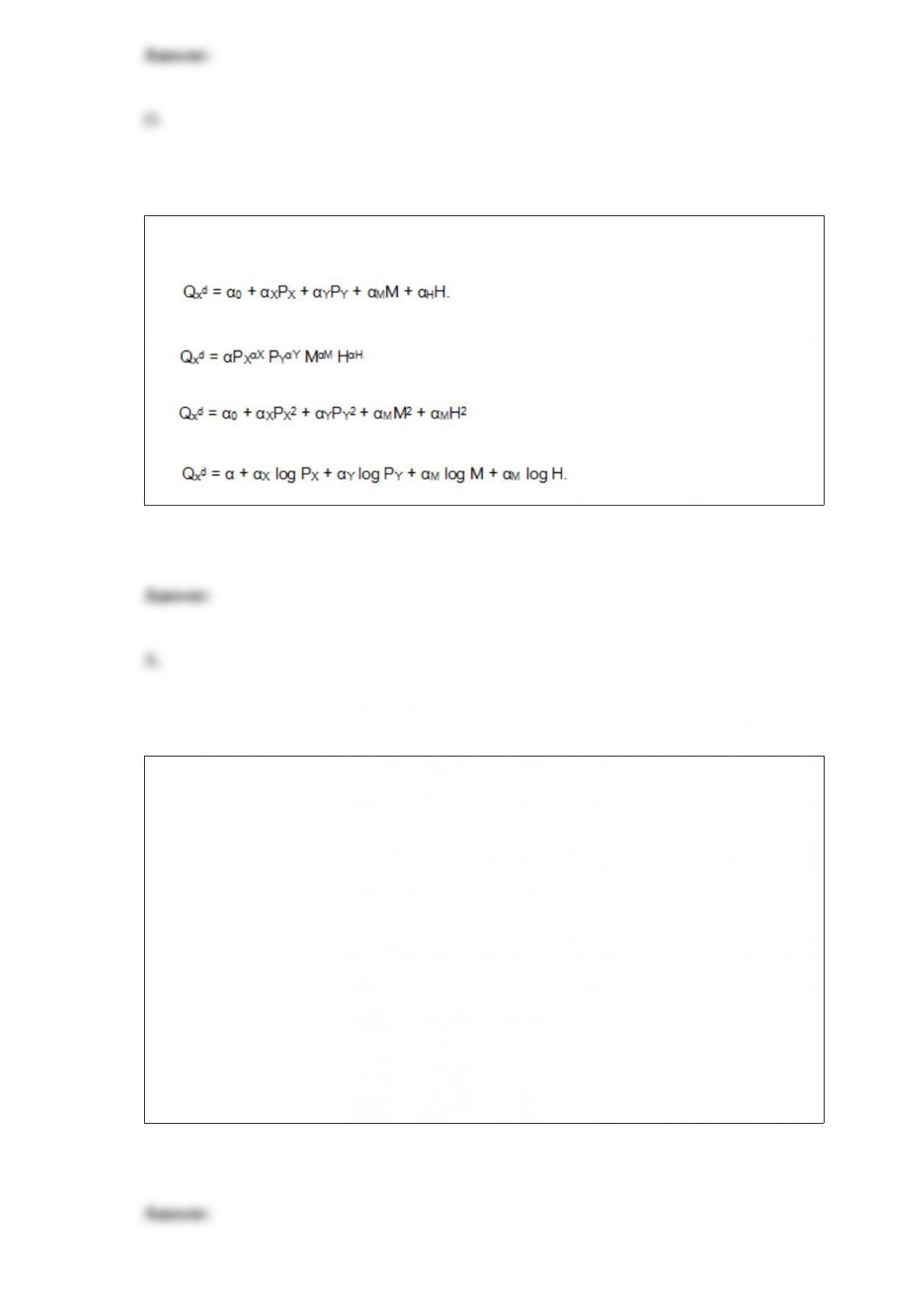
Which of the following is a linear demand function?
A.
B. .
C. .
D.
If you advertise and your rival advertises, you each will earn $5 million in profits. If
neither of you advertises, you will each earn $10 million in profits. However, if one of
you advertises and the other does not, the firm that advertises will earn $15 million and
the non-advertising firm will earn $1 million. Suppose this game is repeated for a finite
number of times, but the players do not know the exact date at which the game will end.
The players can earn collusive profits as a Nash equilibrium to the repeated play of the
game if the probability the game terminates in any period is:
A. 1
B. greater than 1
C. close to zero.
D. None of the answers is correct.
Which of the following integration types has the potential problem of increasing the
firms market power?
A. Vertical integration
B. Horizontal integration
C. Cointegration
D. Conglomerate integration
“Our marginal revenue is greater than our marginal cost at the current production level.”
This statement indicates that the firm:
A. is maximizing profits.
B. should increase the quantity produced to increase profits.
C. should decrease the quantity produced to increase profits.
D. None of the statements associated with this question are correct.
John provides cheese (H) and milk (M) to the market with the following total cost
function C(H, M) = 8 + 0.5H2 + 0.1M2. The prices of cheese and milk in the market are
$3 and $4 respectively. Assume that the cheese and milk markets are perfectly

competitive. What output of milk maximizes profits?
A. 10
B. 20
C. 30
D. 40
Which of the following is NOT an example of a managerial decision with risk-averse
consumers?
A. The presence of insurance for certain events
B. The existence of chain stores
C. The existence of different product qualities
D. All of the statements associated with this question illustrate examples of managerial
decisions with risk-averse consumers.
You are a hotel manager and you are considering four projects that yield different
payoffs, depending upon whether there is an economic boom or a recession. The
potential payoffs and corresponding payoffs are summarized in the following table.
Which project has the lowest expected value?

A. A
B. B
C. C
D. D
Suppose the market supply for good X is given by QX
S = -100 + 5PX. If the equilibrium
price of X is $100 per unit then producer surplus is
A. $400.
B. $1,600.
C. $16,000.
D. none of the statements associated with this question are correct.