The industry elasticity of demand for gadgets is -2, while the elasticity of demand for
an individual gadget manufacturers product is -2. Based on the Rothschild approach to
measuring market power, we conclude that:
A. there is little monopoly power in this industry.
B. there is significant monopoly power in this industry.
C. the Herfindahl index for this industry is -2
D. the Herfindahl index for this industry is 2
Discuss the benefits and costs of the following methods of monitoring worker
performance:a. Hidden video cameras in the workplace.b. Time clocks.c. Paying
workers based on the output they produce.
The idea of charging two different groups of consumers two different prices is practiced
in:
A. two-part pricing.

B. price matching.
C. commodity bundling.
D. None of the answers are correct.
A payment plan that induces better worker effort by linking compensation to revenues
of the firm is known as:
A. revenue sharing.
B. profit sharing.
C. piece rate sharing.
D. spot checking.
An oligopolist faces a demand curve that is steeper at higher prices than at lower prices.
Which of the following is most likely?
A. The firm competes with others in the Cournot fashion.
B. Other firms match price increases but do not match price reductions.
C. Other firms match price reductions but do not match price changes.
D. The firm competes with others in the Bertrand fashion.

Given that income is $500 and PX = $20 and PY = $5, what is the market rate of
substitution between goods X and Y?
A. 100
B. -4
C. -20
D. 25
Suppose you are an aide to a U.S. Senator who is concerned about the impact of a
recently proposed excise tax on the welfare of her constituents. You explained to the
Senator that one way of measuring the impact on her constituents is to determine how
the tax change affects the level of consumer surplus enjoyed by the constituents. Based
on your arguments, you are given the go-ahead to conduct a formal analysis, and obtain
the following estimates of demand and supply:.
a. Graph the supply and demand curves.
b. What are the equilibrium quantity and equilibrium price?
c. How much consumer surplus exists in this market?
d. If a $2 excise tax is levied on this good, what will happen to the equilibrium price
and quantity?
e. What will the consumer surplus be after the tax?
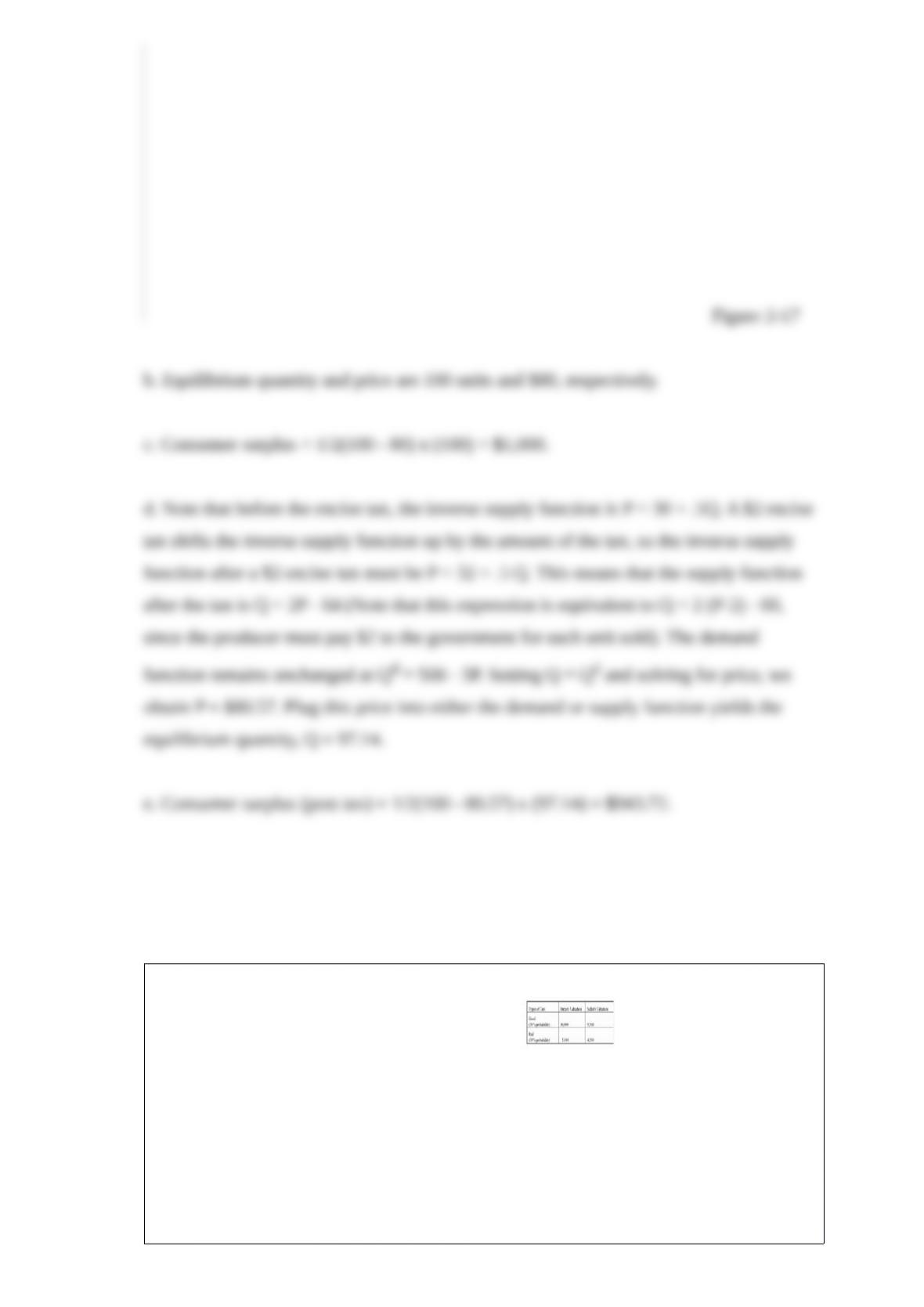
Based on the following table, what is the highest price that risk-neutral buyers will offer
for a used car if they recognize adverse selection?
A. $7,500
B. $5,000
C. $7,000
D. $4,500

If the profit-maximizing markup factor in a three-firm Cournot oligopoly is 2, what is
the corresponding market elasticity of demand?
A. -1/2
B. -2/3
C. -1.0
D. -2.0
The production function for good X in the table below exhibits increasing marginal
returns to capital over what output range?
A. Between 0 and 1,524
B. Between 0 and 2,991
C. Between 2,391 and 3,048
D. Between 3,016 and 2,945

The idea that a consumer is limited to selecting a bundle of goods that is affordable is
captured by the:
A. budget constraint.
B. indifference curve.
C. consumer equilibrium.
D. price changes.
The purpose of randomized pricing is to reduce:
A. consumer price information only.
B. competitor price information only.
C. both customer and competitor information about price.
D. the firms pricing inflexibility.
A price ceiling is
A. the minimum legal price that can be charged in a market.
B. the maximum legal price that can be charged in a market.

C. above the initial equilibrium price.
D. equal to the initial equilibrium price.
Consider two firms competing to sell a homogeneous product by setting price. The
inverse demand curve is given by P = 6 – Q. If each firms cost function is Ci(Qi) = 2Qi,
then consumer surplus in this market is:
A. $2.
B. $4.
C. $8.
D. There is insufficient information to determine consumer surplus in this market.
A firm has a marginal cost of $18 and charges a price of $27. The Lerner index for this
firm is:
A. 0.33.
B. 0.50.
C. 0.67.
D. 0.75.