Competitive tensions often cause one partner to acquire the other.
If the combined resources and capabilities resulting from a merger or acquisition are
complementary, the competitive advantage is usually short term in nature.
Misappropriation occurs when one partner misrepresents the quality of a resource or
capability.
As industries enter periods of rapid growth, early movers are virtually guaranteed rapid
growth.

If the industry analysis is too exclusive, important threats may be omitted.
An individual must be the CEO of a company to carry out bold strategy moves.
A complementary relationship between tangible resources and capabilities gives a firm
a competitive advantage.
The global structure resembles a decentralized federation similar to the relationship
between the U.S. federal government and the fifty state governments.

As negotiator, the CEO designs the firm’s strategy and supervises its implementation.
Professional management may come from executives experienced with running rapidly
growing firms.
The process of financial budgeting is useful only as a feedback tool.
Corporate strategies are used by businesses that compete in a single industry or business
segment.

A conglomerate is a business that is so diversified it does not fit into one specific
industry category.
Entrepreneurship is the outcome of the entrepreneurial process.
Some codes of conduct require managers to either comply with the standards or explain
why they have not complied.
Strategy formulation is a part of strategic management that focuses on the specific
actions that a firm uses to achieve strategic goals and objectives.

Research suggests that U.S. managers are better at strategy implementation than
strategy formulation.
Sometimes the parties that exercise significant power over firm decisions don’t register
as having a significant stake in the firm.
Capabilities refer to a firm’s skill in using its resources to create goods and services.
During the industry’s growth phase, differentiators will increase their efforts toward
differentiation.

A performance-management system that can be used to gauge the success with which
implementation levers are aligned with strategic objectives is call the balanced
________.
A) scorecard
B) metric
C) matrix
D) network
Price competition increases when buyers experience low switching costs and ________.
A)industry products are standardized
B)the industry is characterized by high fixed costs
C)when there are limited competitors
D)the industry is a monopoly

All of the following are ways in which managers can assess relatedness among
geographic national markets except ________.
A)laws
B)customs
C)language
D)geology
Which of the following is characteristic of an industry that is experiencing
commoditization?
A)The products are becoming more unique.
B)The products are not technological in nature.
C)The products are competing more on price.
D)The products are becoming more differentiated.
The Economic Logic vs Scope of Arena model identifies four generic strategic
positions that result from a firm’s starting strategic position. Which is not one of these
four positions?
A)broad differentiation
B)focused cost leadership

C)focused differentiation
D)narrow differentiation
All of the following are drivers for the low-cost strategic position except ________.
A)customization
B)economies of scale
C)superior product design
D)learning
A form of organization in which small, semiautonomous, and potentially temporary
groups are brought together for specific purposes is referred to as a ________.
A) functional structure
B) multi-divisional structure
C) network
D) matrix

The ________ tends to work best in smaller firms and those with few products or
services.
A) functional structure
B) multidivisional structure
C) network
D) matrix
_____ strategies are designed to eliminate, reduce, create, or raise some previously
assumed dimension of product/market supply and demand.
A) New-market creation
B) New-market disruption
C) Low-end disruption
D) High-end disruption
A value chain is the sequential steps of value-added activities that are necessary to
create ________.

A)a competitive advantage in a crowded industry
B)differentiation among industry leaders
C)low-cost alternatives to the products of industry leaders
D)a product or service that is used by the end consumer
Which of the following statements about the external perspective of competitive
advantage is most accurate?
A.The success of a strategy is determined by the forces within the firm’s external
environment and industry.
B.The firm’s internal resources and capabilities represent the foundation for
development of a value-creating strategy.
C.Internationalization is a factor that leads to globalization.
D.Firms should seek to maximize their returns by changing organizational structure in a
manner consistent with the most efficient producers in any given industry.
Which of the following statements is not true regarding strategic change?
A) Strategic change could include changes taken to inform the firm of a new vision.
B) Strategic changes will bring about changes in resource-allocation choices.

C) Strategic changes are more difficult when strict orthodoxies are present.
D) Strategic change is a relatively simple process.
The process of ________ focuses on acquiring new capabilities, new operations, and
new products.
A) financial budgeting
B) operational budgeting
C) strategic budgeting
D) innovation budgeting
When a firm is experiencing difficulties, managers should ask all of the following
questions except ________
A) Is the strategy flawed?
B) Is our strategy incompatible with our competitors’ strategies?
C) Is the implementation of the strategy flawed?
D) Are both the strategy and implementation flawed?

All of the following are performance perspectives encouraged by the balanced
scorecard except the ________.
A) financial perspective
B) strategy perspective
C) learning-and-growth perspective
D) external-relations perspective
The requisite skills that all firms in an industry must possess in order to be viable
competitors are called ________.
A)strengths
B)rare resources
C)key success factors
D)dynamic capabilities

_____ are sometimes used to alleviate problems caused by potential conflicts of interest
between shareholders and CEOs.
A) incentives
B) buyouts
C) mergers
D) acquisitions
The more ________ a firm, the more its structure should be designed to emphasize
control.
A) focused
B) diversified
C) simple
D) concentrated
The extent to which a firm participates in related market segments or industries outside
its existing value-chain activities is called ________.
A)vertical scope
B)horizontal scope
C)geographic scope

D)vertical differentiation
Discuss the performance of companies that participate most actively in alliances.
Compare the corporate governance practices around the world.

What are some of the characteristics of professional management?
What are the four ways horizontal alliance can create value?
What are the three criteria required for effective teamwork?

Who are an organization’s external stakeholders?
Compare related and unrelated diversification. Give an example of each.
What are some of the ways in which complementary resources represent a possible
competitive advantage?

What are the conditions under which a first-mover advantage is valuable?
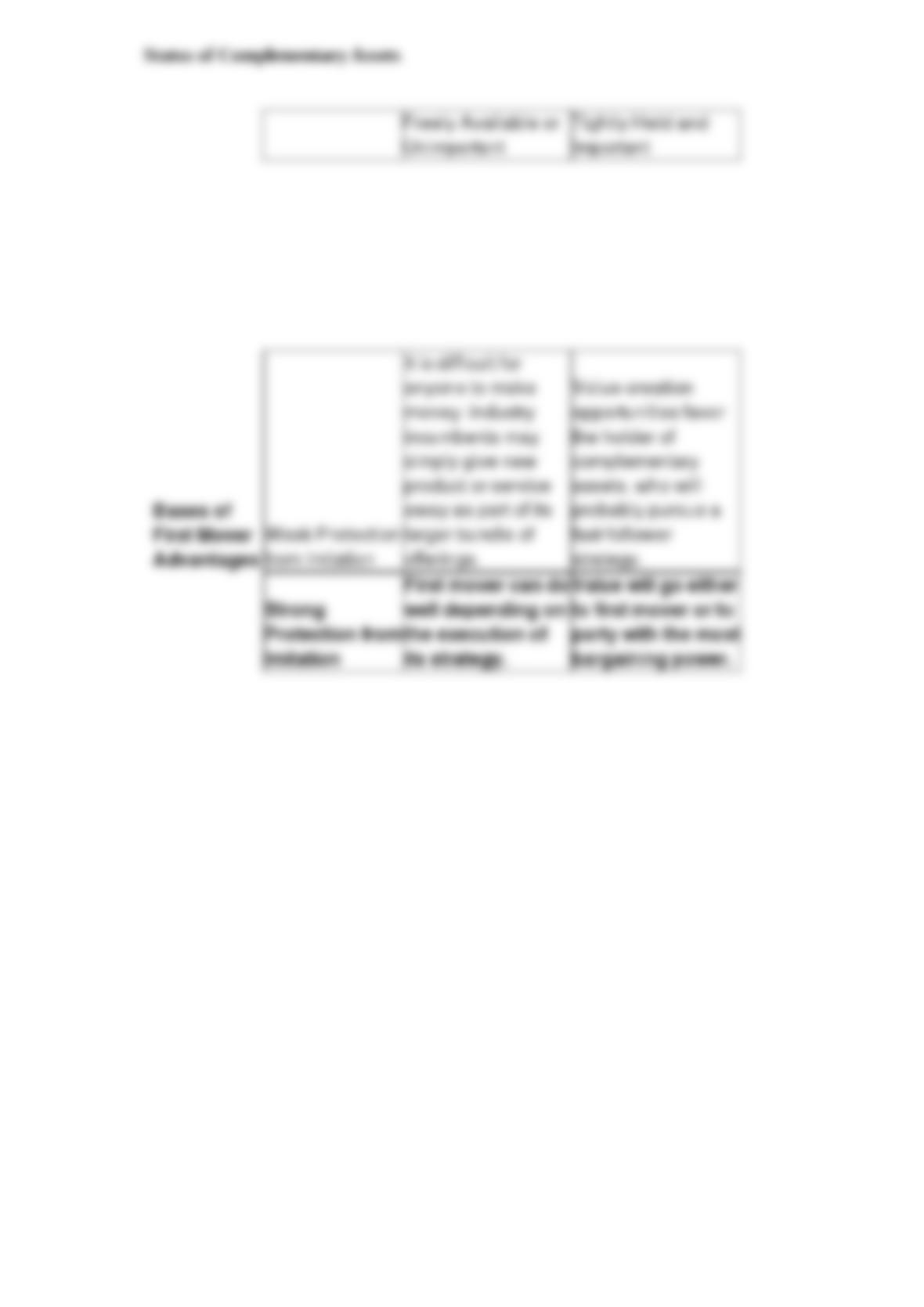
Diagram the relationship between the status of complementary assets and the bases of
first-mover advantages.