
Causal ambiguity is a condition where a resource is considered valuable and rare
because it is difficult to identify and understand.
Orthodoxies represent the status quo of an industry.
Making assumptions about sociocultural norms in your home market can cause early
failure when entering new markets.
Mergers of equals are typically between firms of relatively equal size and influence.

Executives often make international strategy choices based on what competitors are
doing instead of starting with answers to fundamental strategy diamond questions.
In the 1980s, alliances focused on product and service performance.
Culture can usually be adapted to fit the strategy relatively easily and quickly.
Major actions taken by one firm are usually noticed by competitors.

If a company improves its competitive position by means of a merger or acquisition, it
may be possible to derive potential market power from the deal.
The political environment can have a significant influence on consumer confidence.
There are certain generic resources available that any firm could acquire.
A special and intensive case of technological change in action is known as a
technological discontinuity.

During the final stage of turnaround, companies may initiate new marketing programs
to increase market penetration.
Different geographic markets can exhibit different degrees of relatedness.
The Cadbury Code resulted in the creation of the Public Company Accounting
Oversight Board.
A goal of implementation is to ensure that strategy formulation is comprehensive and
well informed.

The ‘short tail” is the concept that selling many individual products that each have low
sales volume can add up to huge total revenues.
The focus position usually involves eliminating some services or features in order to
drive costs down.
The motives behind mergers and acquisitions can fall into a basic category called
synchronicity.
Research suggests that stock-option pay induces executives to make decisions aimed at
enhancing the firm’s long-term performance.

A ________ is a business that has a weak competitive position but is in a high-growth
industry.
A)cash cow
B)dog
C)star
D)problem child
Which of the following is not a nonfinancial performance metric?
A)customer retention
B)employee turnover
C)inventory turn
D)new products released

Most institutional investors and watchdog groups prefer a large majority of independent
directors on a board to avoid ________ while carrying out fundamental responsibilities.
A) information leaks
B) conflicts of interest
C) personality conflicts
D) unnecessary expenses
In labor-intensive industries, the most serious threat faced by low-cost competitors is
________.
A)increased use of technology
B)increased public awareness of questionable labor practices
C)increased product efficiency
D)increased competition
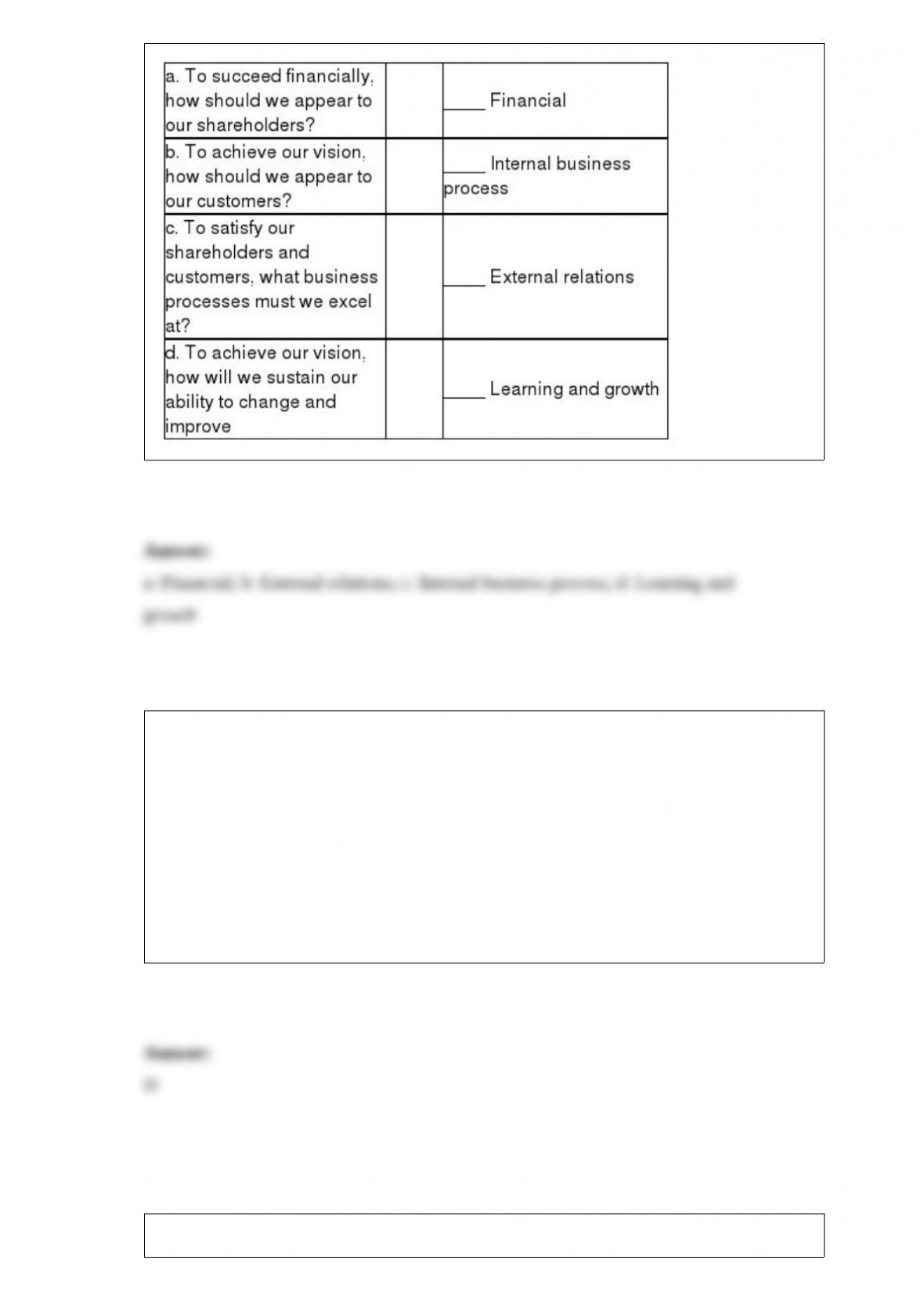
Match the following strategic questions with their corresponding balanced scorecard
perspectives:
Revolutionary strategies can be created by searching for industries that have
opportunities to benefit from increases in ________.
A)population
B)technological advances
C)public awareness
D)economies of scale
An alliance in which two firms make equity investments in a third legal entity is

referred to as a(n) ________.
A)equity alliance
B)joint venture
C)strategic alliance
D)consortium
Which of the following is the best example of complementor products?
A)peas and carrots
B)hotdogs and buns
C)airlines and cars
D)soft drinks and bottled water
The internationalization life cycle starts with a firm ________.
A)exporting products or raw materials abroad
B)importing some of its raw materials or finished product for resale at home
C)buying part or full ownership in a plant or equipment in a foreign country
D)moving all operations to a foreign country

The entrepreneurial process may either lead to an IPO and professional management or
provide an impetus for ________.
A) corporate renewal
B) divestiture
C) corporate spinoffs
D) all of the above
During the industry’s maturity phase, companies will choose the global or diversified
arena.
Effective strategic leaders craft vision and mission statements because ________.
A)they provide measurable outcomes
B)they are the basis for a balanced scorecard

C)they influence strategy formulation and implementation
D)they provide a rigid framework for strategic management
Firms can expand internationally in all of the following ways except ________.
A)exporting
B)direct domestic investment
C)contractual agreements
D)alliances
The three Cs of strategy communication are ________.
A) content, contacts, and credibility
B) contacts, cultural understanding, and convincing
C) content, cultural understanding, and credibility
D) contacts, cultural understanding, and credibility

Failure is generally the result of ________.
A) a bad strategy
B) poor executive judgment
C) financial mismanagement
D) all of the above
Transition vehicles that are commonly used to facilitate expansion of a successful firm
include all of the following except ________.
A) alliances
B) mergers
C) IPOs
D) divestitures
The ________ configuration uses a structure that is designed to achieve efficiency, local

responsiveness, and innovation.
A) multinational
B) international
C) transnational
D) global
The scorecard and ________ process pushes a company to act on what it said it was
going to do in terms of strategy.
A) production
B) mapping
C) cascading
D) iterative
Which of the following is not a support activity on the value chain?
A)sales
B)accounting
C)procurement
D)human resources

Which of the following is a characteristic of new entrants’ disruptive strategies?
A)These firms emphasize product standardization.
B)These firms start out as high-margin businesses.
C)These new models are easily imitated.
D)These firms can take away market share.
With ________ options, an entry investment may create opportunities to pursue
valuable follow-up projects.
A)waiting-to-invest
B)growth
C)flexibility
D)learning

Significant changes in resource-allocation choices in the business and implementation
activities that align the firm’s strategy with its vision are referred to as ________.
A) process changes
B) vision changes
C) strategic changes
D) allocation changes
Goals can be achieved by analyzing a firm’s closest competitors. These goals include all
but which of the following?
A)influence competitors’ behavior in a favorable way
B)gain an understanding of what competitors’ future strategies might be
C)gain a better appreciation for how competitors will respond to a firm’s strategic
initiatives
D)share findings with competitors so that all firms benefit
Give three examples of economic factors.

What are the three things managers can do to redefine their arenas?
What are the three basic questions that international strategy must answer on the 1-2-3
Model?
Define profit pool. What is its purpose?

Discuss the differing corporate ownership roles and their impact on corporate
governance.
How can poor management lead to failure?

What is the performance implication of valuable resources and capabilities?
Explain what complementors are and how they affect the business environment.