
Using the telescope, Galileo discovered that the planet Mars had polar ice caps not
unlike those on Earth.
Bajadas develop from coalescence of alluvial fans along fronts of mountain ranges in
arid lands.
The ecliptic and zodiac are different names for the same thing
Closely spaced isobars indicate high wind speeds.

Running water is an important erosional agent in many arid lands despite infrequent
rainfalls.
The Cenozoic era is the age of mammals.
Solar eclipses are more common than are lunar eclipses.
Sedimentary rocks make up approximately 60 percent of the rocks in the Earth’s crust.

Dark Energy and Dark Matter are similar in that they both appear to be slowing the
expansion of the universe.
An unconformity involving older metamorphic rocks and younger sedimentary strata is
termed a nonconformity.
A surface low pressure system will not strengthen unless there is high pressure aloft.

The length of a lunar day and the period of the lunar cycle seen from earth are the same
because the moon rotates once per revolution around the earth.
The source of heat for most hot springs is hot igneous material beneath the surface.
Stars spend most of their life span as giants.
Earth is closest to the Sun in January.

If the barometer indicated 1020 millibars, air pressure would be considered high.
Our galaxy is currently absorbing other galaxies.
Large impact craters and large, domal features (probably representing viscous lava
flows) have been imaged on the surface of Venus.

Weather and climate are synonymous terms.
Positive feedback mechanisms produce results that are opposite of the initial change
and tend to offset it.
As a result of global warming, a significant melting of glaciers is expected during the
next century.
Most of the energy that is consumed is passed on to the next trophic level so there is no
need for a huge biomass in some areas.

Sand transport parallel to the shoreline is common on beaches and is called longshore
transport.
The “Big Bang” is an example of theory.
The Cassini gap refers to the planetless belt of asteroids between Mars and Earth.

Bowen’s reaction series predicts the sizes of the different mineral grains that grow from
crystallizing magmas.
The most abundant gas in the planetary atmospheres in nitrogen.
The neritic zone is where the land and ocean meet and overlap.
According to the nebular theory, all of the bodies in the universe evolved from a
rotating cloud of gases and dust about five billion years ago.

Electrically neutral atoms have equal numbers of electrons and protons.
Alfred Wegener developed the theory of Plate Tectonics.
All atoms of the same element have the same atomic number.
Mineral luster is broadly classified as either being metallic or opaque.

There are thousands of earthquakes around the world every day.
Probably the single most characteristic feature of the Precambrian is its great abundance
of fossil evidence.
Glassy igneous rocks form when magma cools too fast for mineral grains to grow.

Rocks and sand on beaches become rounded rapidly because ________.
A) rip currents move the sand offshore rapidly, abrading the fragments
B) the swash action of waves rolls loose material up and down the beach, where it is
abraded rapidly to produce rounded grains
C) Beach sand is mostly calcium carbonate from reefs and so gets rounded easily
D) There is nothing particularly prominent in beaches that produces more rounding than
other sedimentary processes.
In much of what is now Canada, glaciers covered the land as little as 12,000 years ago
and glacial erosion scoured the land surface leaving very thin soil or bare rock over
large areas. The Midwestern United States was also covered in ice at this time, yet this
area contains some of the richest farm land in the world with thick soils. These soils are
formed on glacial sediments and windblown dust deposits from the ice age. Why are the
soil conditions between these areas so different when the soils are virtually identical in
age?
A) It is much colder in Canada so chemical weather is much slower; thus and soils have
not had time to form.
B) The Midwestern soils are transported soils with soil development on materials that
were already loose, unconsolidated materials.
C) Sea level rose following the ice age and covered the Midwest with an inland sea,
rapidly forming soil.
D) The Midwestern U.S. is much flatter than Canada, allowing soils to develop more
quickly.

Consider the names of the eras in the geologic time scale. What is meant by “zoic”?
A) life; living things
B) rocks; lithified strata
C) time; recording of events
D) places; geographic references
When a TV weather forecaster gives a forecast for “widely scattered afternoon
thunderstorms,” these storms are probably associated with ________.
A) an unstable air mass, probably maritime tropical air with thunderstorms driven by
thermals in an unstable air mass
B) a cold front generating thunderstorms along it
C) a warm front generating thunderstorms along it
D) the core of a midlatitude cyclone

The wavelength or the distance from peak to peak of energy waves is a characteristic of
________.
A) conduction
B) convection
C) contraction
D) radiation
Material that was once considered to be asthenosphere can change to lithosphere by
________.
A) rising to a shallow level
B) thickening to 100 km
C) heating so that it will flow
D) cooling so that it will break
Who made the first clear statement of the law of superposition? When?
A) John Wesley Powell, nineteenth century
B) William Smith, eighteenth century

C) John Stuart Priestly, nineteenth century
D) Nicolaus Steno, seventeenth century
The boundary between two terranes or two continents that have collided is called a
________.
A) suture
B) join
C) weld
D) stitch
A wintertime form of precipitation that consists of small ice particles is called
________.
A) rime
B) glaze
C) hail
D) sleet

Sediment production occurs primarily in ________ part of a river system.
A) the head waters
B) the drainage divide
C) the trunk stream
D) the outlet
E) the flood plain
Which of the following is not considered to be part of a typical ocean basin?
A) a linear chain of volcanoes
B) large expanses of flat plains
C) granitic intrusions
D) deep canyons

When the environmental lapse rate is greater than the dry adiabatic rate, ________.
A) surface air will rise and fall
B) surface air will rise, form clouds, and fall
C) surface air cannot rise and will be trapped beneath colder air above
D) surface air will rise and continue to rise
E) surface air will not rise because this is the normal condition
A spring tide occurs ________.
A) once a year at the first full moon after the vernal equinox
B) twice a year at the new or full moon closest to the vernal and autumnal equinox
C) about 26 times per year, at every full and new moon
D) once a month, or 12 times a year

In a climatological sense, dryness is a function of both annual rainfall and ________.
A) altitude
B) solar radiation
C) wind direction
D) slope
E) evaporation
All of the following are factors affecting mass wasting except for ________.
A) gravity
B) water
C) slope angle
D) geologic age
Low latitude dry regions tend to ________.
A) have high cirrus clouds
B) be cloud free

C) have stratocumulus clouds
D) have high winds due to downward plunging air masses
Rare, but complete preservation of fossils occurs in ________.
A) limestone
B) shale
C) amber
D) mudstone
At the beginning of spring, the vernal equinox, what is the right ascension of the sun?
A) 0
B) 12 hr
C) 18 hr
D) 90 degrees

Why do lunar scientists think the surface of the moon was once a magma ocean?
A) The lunar highlands contain large amounts of the rock anorthosite, which is the light
material that “floated” on the top of the magma ocean.
B) The surface of the moon is entirely volcanic.
C) Early lunar craters show a morphology suggesting impact with a liquid.
D) None of these is correct.
Which of the following statements best describes the big Hawaiian volcanoes?
A) They lie directly above a transform plate boundary that cuts deeply into the mantle.
B) They lie directly above an active subduction zone where the Pacific plate is sinking
into the mantle.
C) They lie along the crest of the East Pacific Rise, a mid-ocean ridge or spreading
center.
D) They are situated in the interior of a large, Pacific plate above a hot spot deep in the
mantle.

One type of fossil that can preserve details of organic soft parts is ________.
A) permineralization
B) cast
C) coprolites
D) carbonized imprints
How do astronomers believe an irregular galaxy forms?
A) Several regular galaxies of different sizes merge.
B) They form when an elliptical and a spiral galaxy merge.
C) They are regular galaxies that are distorted by the gravity field of a large nearby
galaxy.
D) They are two or more galaxies that have not completed their merger.
E) They are young galaxies that have not yet developed a more regular form.

The slopes of most cinder cones are usually about 30 degrees because ________.
A) the loose materials ejected from the cone form slopes at the angle of repose
B) cinder cones are mostly basalt and basalt is too weak to maintain a slope greater than
30 degrees
C) they are composites of loose material and lava and the viscosity of the lava requires
the slopes to form at about 30 degrees
D) The statement is false; most cinder cones have slopes less than 10 degrees because
of the low viscosity of basalt lava flows.
The air masses that have the greatest influence on weather conditions in the central
United States are ________.
A) cP and mT
B) mP and cP
C) cT and cP
D) mP and mT
Paricutin is an example of a ________.
A) shield volcano

B) cinder cone
C) lava dome
D) composite volcano
Temperature and precipitation are the most important elements in describing a climate
because ________.
A) they are the major indicators of what is happening in the atmosphere
B) they are the elements that have the greatest impact on humans
C) they are the elements that have the greatest impact on the hydrosphere
D) they are the major indicators of what is happening in the biosphere
E) they are what controls our climate
________ tend to increase the explosive potential of a magma body beneath a volcano.
A) High viscosity and dissolved gas
B) High viscosity and low dissolved gas content
C) Low silica content and low viscosity

D) Low viscosity and low dissolved gas content
Which of the following is not part of the water cycle?
A) water evaporating from a lake
B) water infiltrating into the soil and bedrock
C) calcium carbonate dissolving in soil water and groundwater
D) water moving into creeks and streams following a rainstorm
Most of the Moon’s craters were produced by ________.
A) the impact of meteoroids
B) volcanic eruptions
C) faulting
D) radial implosions

Why did Hubble think the Cepheid variables he saw in “Fuzzy Patches” were outside
the milky way?
A) They were dim.
B) They were small.
C) Their brightness varied.
D) They had a red shift character.
Some iron-rich minerals will align themselves with the existing magnetic field when
they cool from a magma.
Moving from the shoreline towards the deep-ocean basin, the continental margin
includes the ________.

Why do most sediments end up being deposited in oceans instead of other parts of the
Earth?
Talc and graphite are two of the lowest minerals on the hardness scale. They are also
described by terms like greasy or soapy. Both have a crystal structure characterized by
sheet-structures at the atomic level, yet they don’t behave like micas. What accounts for
their unusual physical properties?
Half Dome in Yosemite National Park, California, and Stone Mountain in Georgia are
shaped mainly by what mechanical weathering process?

The ________ is the solid, rocky shell between the crust and outer core.
Examine the words and/or phrases for each question below and determine the
relationship among the majority of words/phrases. Choose the option which does not fit
the pattern.
Would most features of alpine glaciation be preserved in the geologic record? Why or
why not? What about continental glaciation?
When examining the geology of a region for potential aquifers, what characteristics or
factors would you consider? Also, what areas (based on natural and human factors)
would you avoid?
Examine the words and/or phrases for each question below and determine the
relationship among the majority of words/phrases. Choose the option which does not fit
the pattern.
protosun Oort cloud planetesimals
meteorites
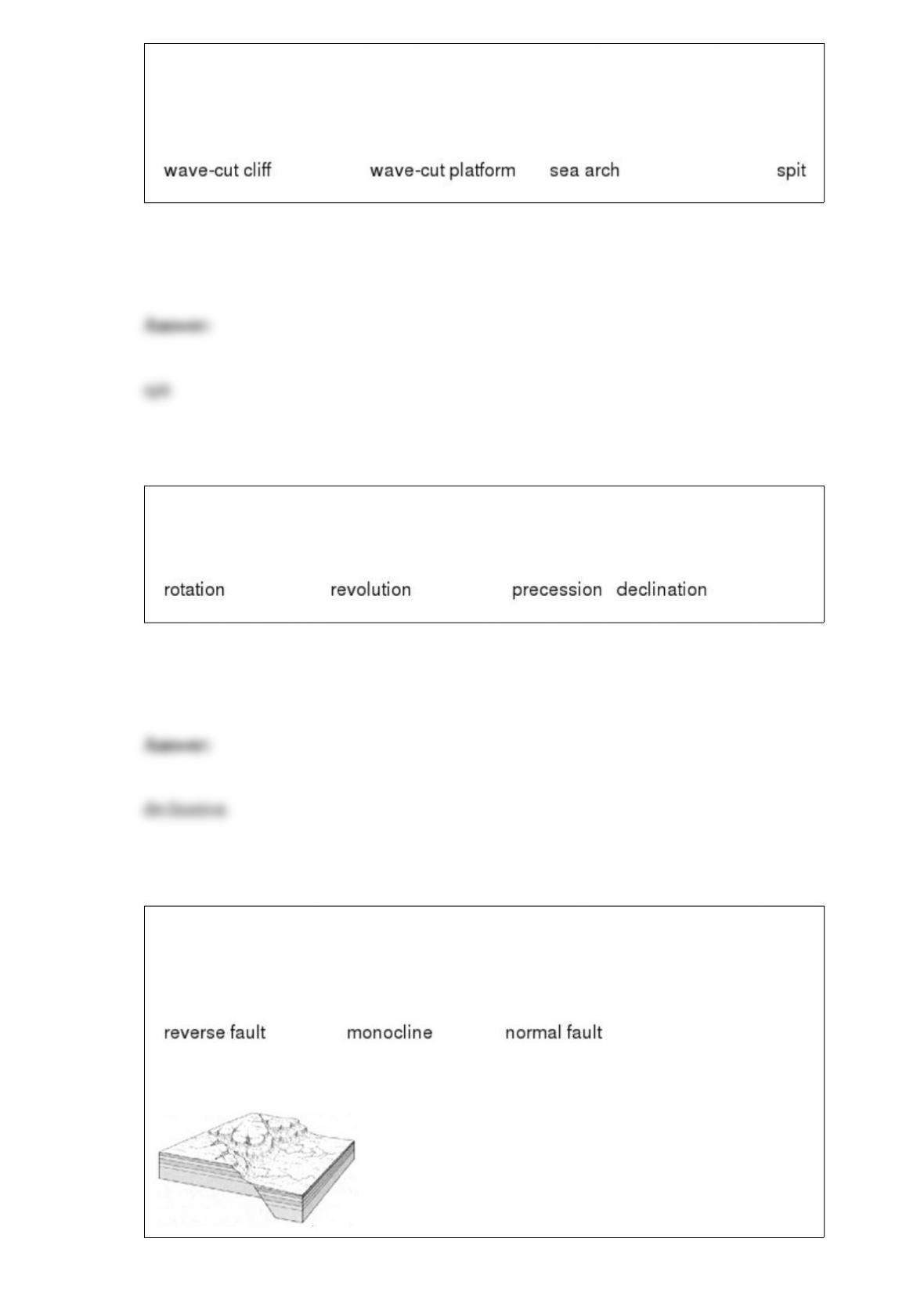
Examine the words and/or phrases for each question below and determine the
relationship among the majority of words/phrases. Choose the option which does not fit
the pattern.
Examine the words and/or phrases for each question below and determine the
relationship among the majority of words/phrases. Choose the option which does not fit
the pattern.
Carefully study each illustration below to determine the type(s) of geologic
structure(s) it contains. Match each one to the correct answers listed.
________

Which slender, conical speleothem grows from water dripping from the ceiling of a
cavern?
Examine the words and/or phrases for each question below and determine the
relationship among the majority of words/phrases. Choose the option which does not fit
the pattern.
A compound is a stable chemical substance composed of two or more ________.
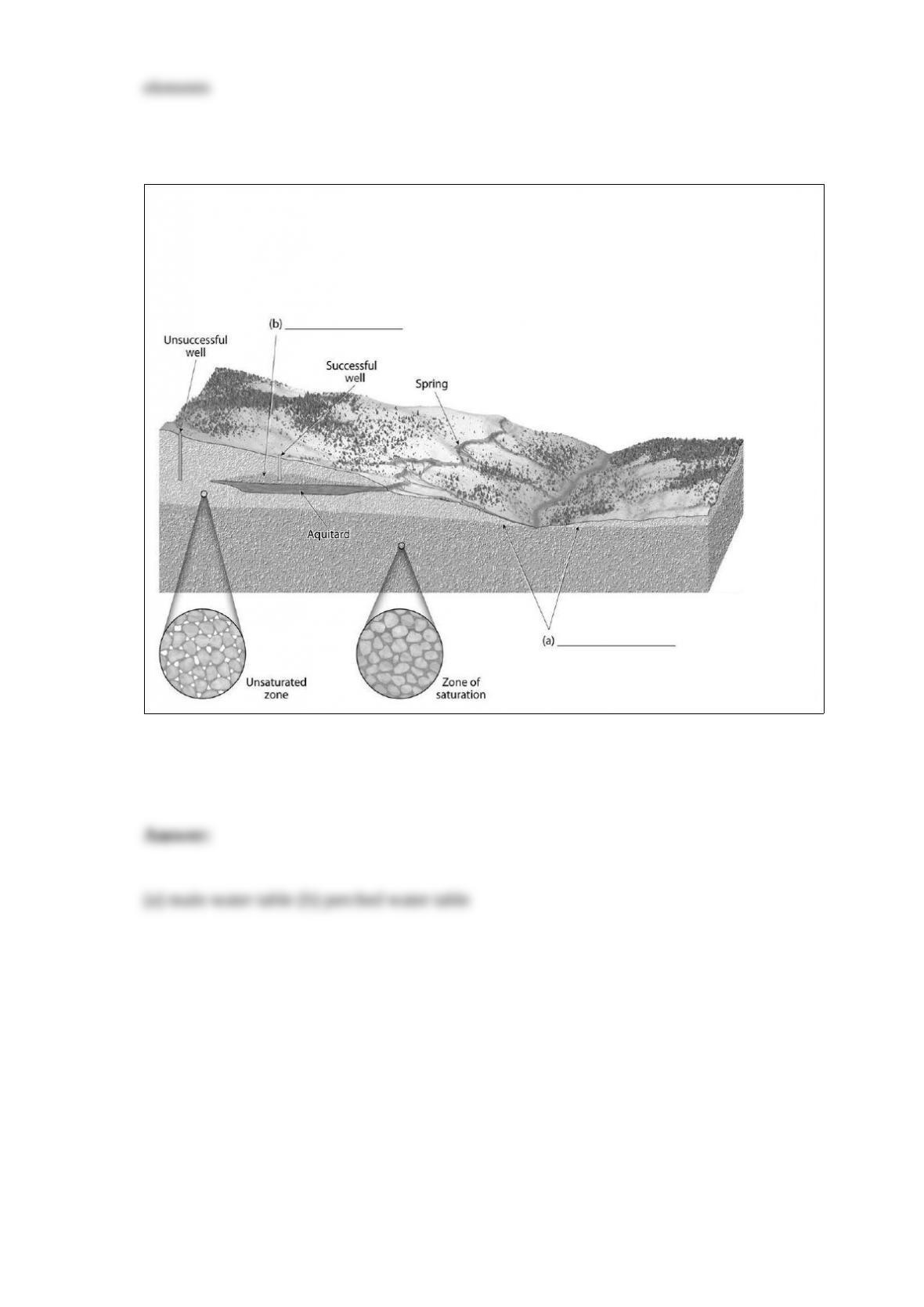
On the cutaway sides of the illustration below, areas shaded light represent the zone of
aeration, and areas that are darkly shaded represent the zone of saturation. All rock
types are aquifers except for the labeled aquitard. On the blanks provided, fill in the
name of the labeled features.