
Where are the deepest parts of the oceans?
A) along the base of the continental slope
B) in rift valleys at sea floor spreading center
C) in the abyssal plain
D) in trenches
In order to get oil and gas in sufficient quantities to make a profit, an oil trap must exist
with ________.
A) no fractures or structure
B) permeability and porosity
C) lateral continuity that allows fluids to migrate
D) shale with little or no sulfur.
The process by which water vapor changes directly to a solid is called ________.
A) evaporation
B) deposition

C) condensation
D) melting
Fish most commonly live ________.
A) in the deepest parts of the ocean
B) near islands and continents
C) far from islands and continents
D) in the upper part of the oceans
E) in the thermoclines
A land breeze usually originates during the ________.
A) evening and flows toward the land
B) day and flows toward the land
C) evening and flows toward the water
D) day and flows toward the water

In a monocline, one of the limbs of the fold ________.
A) is horizontal
B) is vertical
C) dips in the same direction as the other limb, but at a lower angle
D) has a shallower dip in the opposite direction of the other limb
Flat, stable areas of continental crust tend to be located ________.
A) along coastlines
B) near desert regions
C) in the interior of continents
D) in areas that receive large amounts of rainfall

The asthenosphere is the second layer of the Earth characterized by ________.
A) soft rocks that flow easily
B) hard rocks that break
C) layers of both hard and soft rocks
D) magma
Which of the following is not a significant volcanic hazard?
A) injury or death by inhalation of air heavily laden with volcanic ash
B) being overrun by a fast moving basaltic lava flow
C) being caught in a river valley and being overcome by a volcanic mudflow/lahar
D) a tsunami generated by a massive submarine volcanic eruption
Select from the list below the coarse-grained rock which is composed mainly of quartz
and potassium feldspar.
A) basalt
B) andesite

C) granite
D) diorite
The Mississippi River today is a classic meandering river. 20,000 years ago the
Mississippi River was a major outwash channel for the Laurentide ice sheet, and was
characterized by dramatic variations in flow with huge discharge during summer ice
melt and a dramatic falloff in discharge during the winter. The river also carried coarser
sediment than today, with abundant sand and even gravel in its upper reaches. What
does this suggest about the ancient Mississippi?
A) It probably looked similar to the river today, but was characterized by more dramatic
summer floods that occurred every year.
B) It probably resembled modern rivers in Alaska with a broad braided stream valley
that dried up during the winter months, producing winter dust storms.
C) It was probably a lush heavily vegetated valley due to the nutrients brought down by
the glacial meltwater, producing a swampy landscape with numerous channels.
D) It is impossible to predict what the river might have looked like.
How did the lunar maria most likely originate?
A) Huge impact basins were nearly filled with basaltic lava flows.
B) Huge impact craters filled with frozen carbon dioxide and dark-colored silt and dust.

C) Massive, basaltic comets melted when they hit the lunar surface.
D) The solar wind eroded very wide, shallow basins that filled with lunar dust.
The ________ explains how our solar system probably formed from a giant cloud of
gases and dispersed solid particles.
A) protogalactic theory
B) nebular hypothesis
C) extrastellar solar hypothesis
D) planetary compression theory
Active mountain belts are most likely to be found ________.
A) along the margins of continents
B) in the interior regions of continents
C) scattered throughout continents
D) along only the eastern margins of continents

A(n) ________ represents a former meltwater channel or tunnel in glacial ice that was
filled with sand and gravel.
A) esker
B) yazoo ridge
C) valley plain
D) kettle
Which one of the following statements is true about the equinoxes?
A) They occur in June and December.
B) The Sun’s vertical rays are striking either the Tropic of Cancer or the Tropic of
Capricorn.
C) Days and nights are equal in length everywhere.
D) The length of daylight at the Arctic and Antarctic Circles is 24 hours.

A ridge of sand projecting into a bay and often having a hooked end is a ________.
A) spit
B) jetty
C) groin
D) sea stack
The cloud form that consists of globular cloud masses that take on a billowy or
“cauliflowerlike” structure is called ________.
A) cumulus
B) stratus
C) cirrus
D) alto
Nearly all large optical telescopes built today are ________.
A) reflectors

B) refractors
C) radio
When waves crash against a sea cliff, what is the main process that erodes the cliff?
A) abrasion by rocks flung against the cliff by the waves
B) water flowing upward against the cliff, washing the cliff face of loose debris
C) hydraulic pressure driven by the waves forcing water, air, or both into cracks,
dislodging rocks from the cliff
D) impact of the wave causing vibrations that trigger landslides
Which of the following energy sources is thought to drive the lateral motions of Earth’s
lithospheric plates?
A) gravitational attractive forces of the Sun and Moon
B) electrical and magnetic fields localized in the inner core
C) heat transfer between the earth’s interior and the surface of the earth
D) swirling movements of the molten iron particles in the outer core

Which of the following organisms would be most likely to be preserved in the geologic
record?
A) the bones of a dinosaur that lived on semi-arid plains
B) a clam with a thick calcite shell that lived on a mudflat
C) a tree
D) a mussel that clings to rock outcrops in the surf zone
Fetch refers to ________.
A) the beachfront area where rapid erosion is taking place
B) a large expanse of open water over which the wind blows and generates waves
C) the rotational movements of water particles beneath a passing surface wave
D) ocean currents moving parallel to the beach

The movement of water within the surf zone that parallels the shore is termed
________.
A) tidal current
B) salinity current
C) beach drift
D) longshore current
Which of the following would not typically be considered an Earth Science study?
A) studies of volcanic eruptions
B) studies of impact craters on the moon
C) studies of acid mine waters and the bacteria that live in those waters
D) chemical refining of petroleum
A dark gray cloud that blankets the sky and often generates precipitation is called
________.
A) cirrostratus

B) nimbostratus
C) altostratus
D) cirrus
Which color stars have the highest surface temperature?
A) red
B) orange
C) yellow
D) blue
The ________ is thought to be a liquid, metallic region in the earth’s interior.
A) inner core
B) lithosphere
C) mantle
D) outer core

The best definition of the outer edge of the continental shelf is that point where
________.
A) the gradient becomes very gentle
B) the water depth reaches 100 fathoms
C) it meets an oceanic ridge
D) a rapid steepening of the gradient occurs
Inselbergs are ________.
A) insulated icebergs floating in a hot spring
B) blowouts cut from bedrock in mountainous areas
C) lithified rock formed by cementation of wind-deposited, dune sands
D) bedrock hills in a highly eroded desert landscape

The electrical discharge of lightning rapidly heats the air, which in turn causes it to
expand explosively to produce ________.
The two types of dry climates are ________, or desert, and ________, or steppe.
How do we calculate or determine the distances to stars? What units do we use and
what are the limitations (if any) of the method used for such calculations?

Examine the words and/or phrases for each question below and determine the
relationship among the majority of words/phrases. Choose the option which does not fit
the pattern.
The planets, Moon, and the Sun lie along nearly the same plane and therefore move
along the same region of the sky that is called the ________.
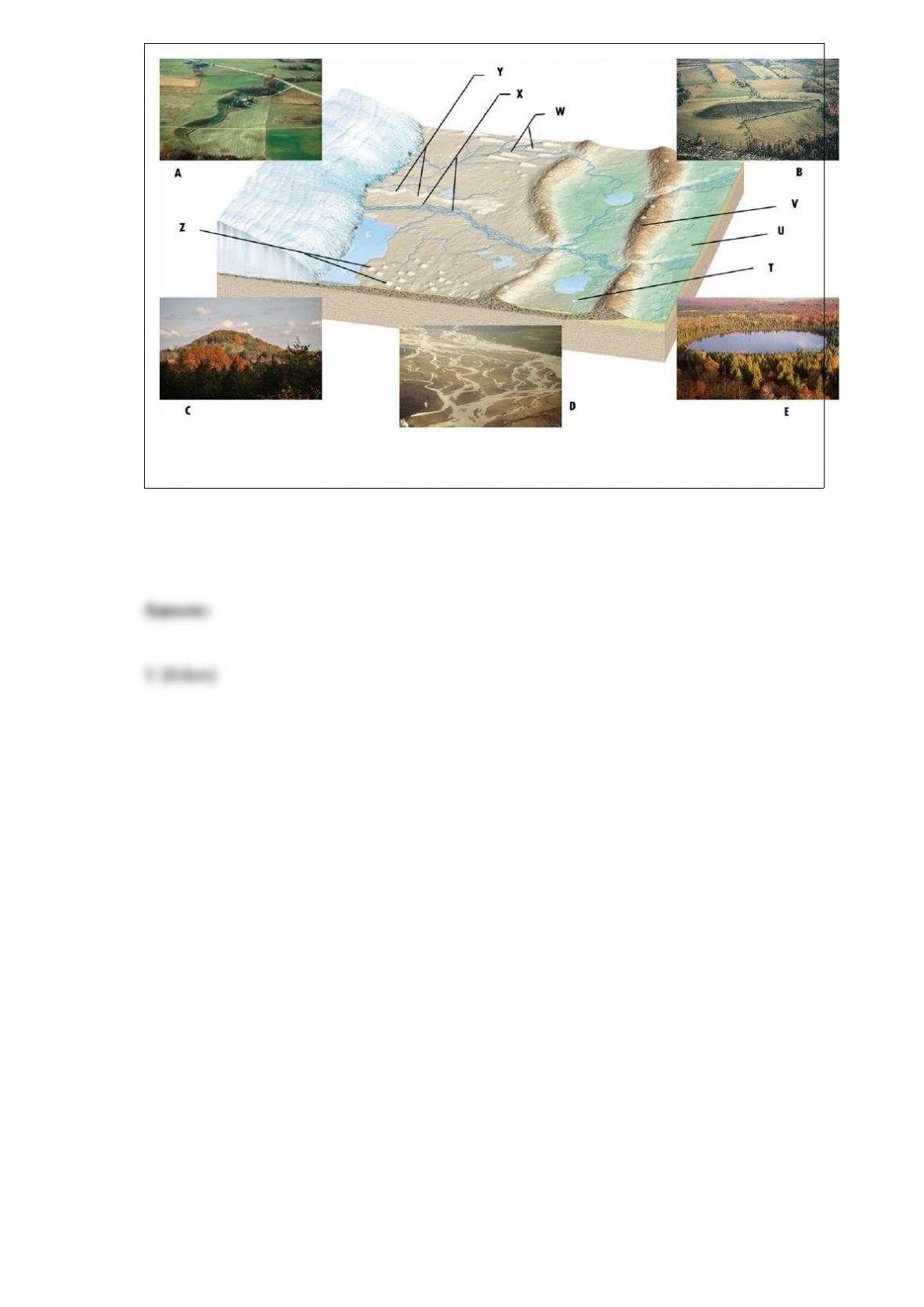
Which letter, T thru Z, corresponds to the object in the photo labeled “A”?