CHAPTER 21—SUPPLY CHAINS AND WORKING CAPITAL MANAGEMENT
124. Taylor Textbooks Inc. buys on terms of 2/15, net 50 days. It does not take discounts, and it typically pays on time, 50
days after the invoice date. Net purchases amount to $450,000 per year. On average, what is the dollar amount of costly
trade credit (total credit − free credit) the firm receives during the year? (Assume a 365-day year, and note that purchases
are net of discounts.)
a.
$43,151
b.
$45,308
c.
$47,574
d.
$49,952
e.
$52,450
a
125. Fairweather Corporation purchases merchandise on terms of 2/15, net 40, and its gross purchases (i.e., purchases
before taking off the discount) are $800,000 per year. What is the maximum dollar amount of costly trade credit the firm
could get, assuming it abides by the supplier’s credit terms? (Assume a 365-day year.)
a.
$53,699
b.
$56,384
c.
$59,203
d.
$62,163
e.
$65,271
a
CHAPTER 21—SUPPLY CHAINS AND WORKING CAPITAL MANAGEMENT
126. Hinkle Corporation buys on terms of 2/15, net 60 days. It does not take discounts, and it typically pays on time, 60
days after the invoice date. Net purchases amount to $550,000 per year. On average, what is the dollar amount of total
trade credit (costly + free) the firm receives during the year, i.e., what are its average accounts payable? (Assume a 365–
day year, and note that purchases are net of discounts.)
a.
$90,411
b.
$94,932
c.
$99,678
d.
$104,662
e.
$109,895
a
127. Noddings Inc. needs to raise more capital because its business is booming. The company purchases supplies on terms
of 1/10 net 20, and it currently takes the discount. One way of getting the needed funds would be to forgo the discount,
and the firm’s owner believes she could delay payment to 40 days without adverse effects. What would be the effective
annual percentage cost of funds raised by this action? (Assume a 365-day year.)
a.
10.59%
b.
11.15%
c.
11.74%
d.
12.36%
e.
13.01%
e
CHAPTER 21—SUPPLY CHAINS AND WORKING CAPITAL MANAGEMENT
128. Sanders Enterprises arranged a revolving credit agreement of $9,000,000 with a group of banks. The firm paid an
annual commitment fee of 0.5% of the unused balance of the loan commitment. On the used portion of the revolver, it
paid 1.5% above prime for the funds actually borrowed on a simple interest basis. The prime rate was 3.25% during the
year. If the firm borrowed $6,000,000 immediately after the agreement was signed and repaid the loan at the end of one
year, what was the total dollar annual cost of the revolver?
a.
$285,000
b.
$300,000
c.
$315,000
d.
$330,750
e.
$347,288
CHAPTER 21—SUPPLY CHAINS AND WORKING CAPITAL MANAGEMENT
Revolving credit agreement
TYPE: Multiple Choice: Problem
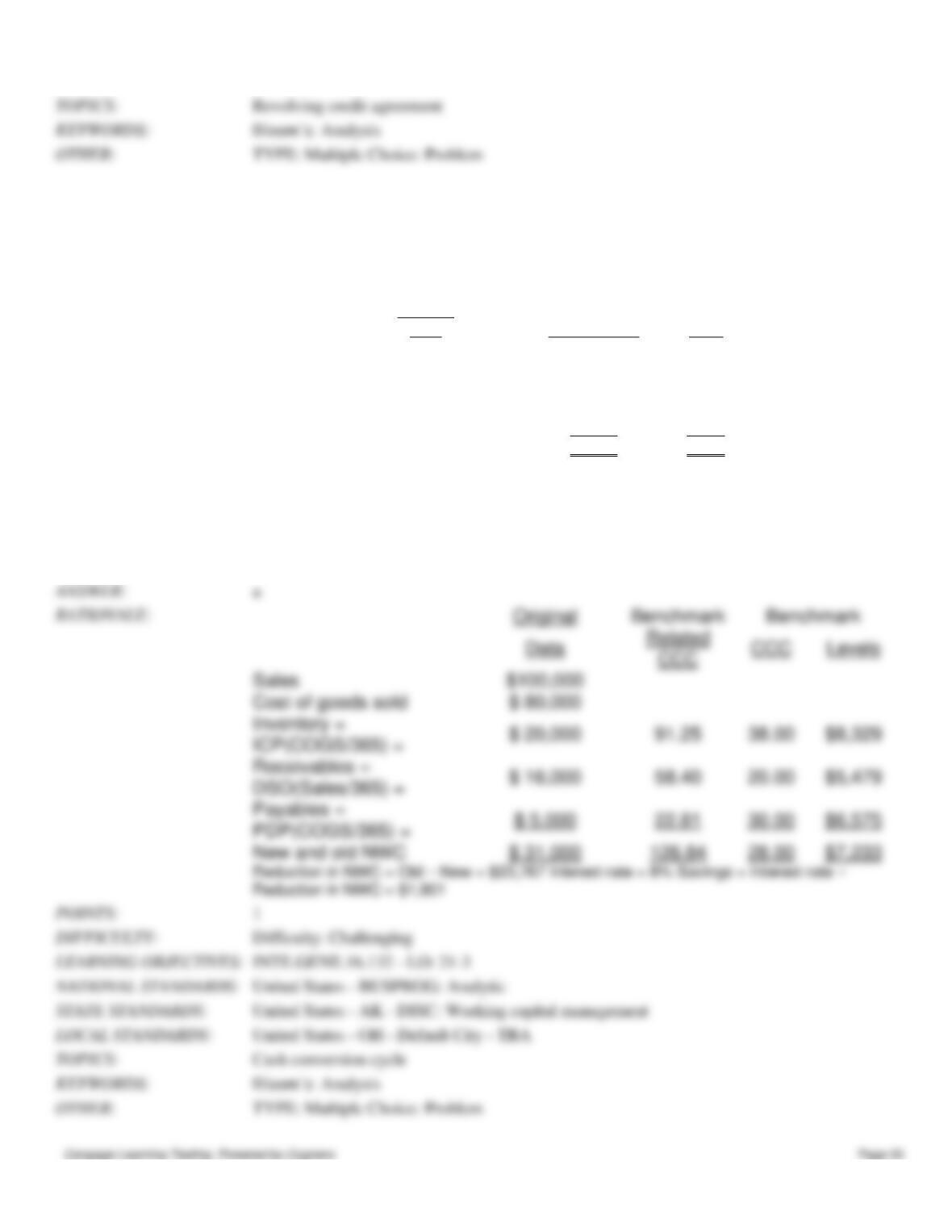
129. Fontana Painting had the following data for the most recent year (in millions). The new CFO believes that the
company could improve its working capital management sufficiently to bring its NWC and CCC up to the benchmark
companies’ level without affecting either sales or the costs of goods sold. Fontana finances its net working capital with a
bank loan at an 8% annual interest rate, and it uses a 365-day year. If these changes had been made, by how much would
the firm’s pre-tax income have increased?
Original
Benchmark
Data
Related CCC
CCC
Sales
$100,000
Cost of goods sold
$ 80,000
Inventory (ICP)
$ 20,000
91.25
38.00
Receivables (DSO)
$ 16,000
58.40
20.00
Payables (PDP)
$ 5,000
22.81
30.00
126.84
28.00
a.
1,901
b.
2,092
c.
2,301
d.
2,531
e.
2,784
a
Difficulty: Challenging
INTE.GENE.16.132 – LO: 21-3
United States – BUSPROG: Analytic
United States – AK – DISC: Working capital management
United States – OH – Default City – TBA
Cash conversion cycle
TYPE: Multiple Choice: Problem
CHAPTER 21—SUPPLY CHAINS AND WORKING CAPITAL MANAGEMENT
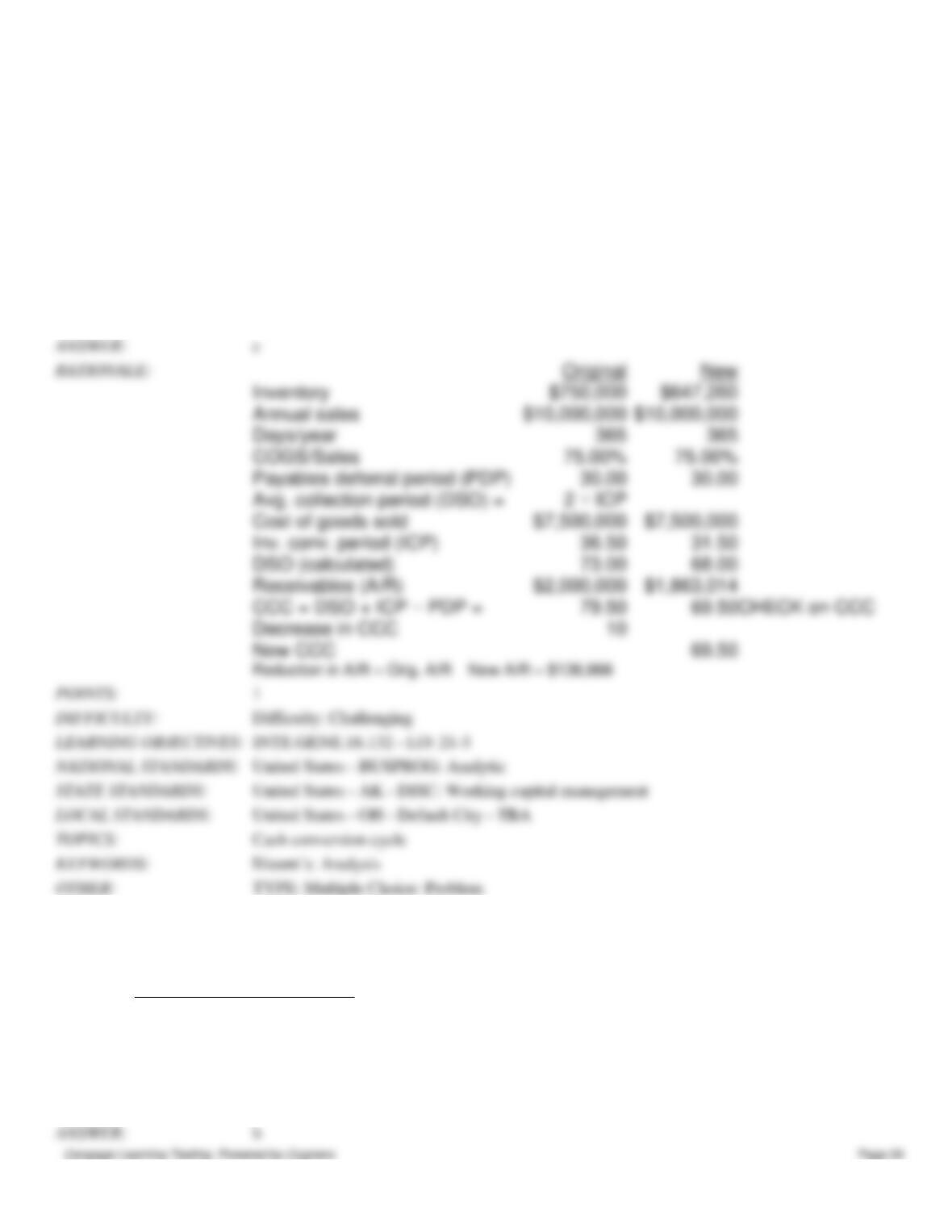
130. Monar Inc.’s CFO would like to decrease its cash conversion cycle by 10 days (based on a 365 day year). The
company carries average inventory of $750,000. Its annual sales are $10 million, its cost of goods sold is 75% of annual
sales, and its average collection period is twice as long as its inventory conversion period. The firm buys on terms of net
30 days, and it pays on time. The CFO believes he can reduce the average inventory to $647,260 with no effect on sales.
By how much must the firm also reduce its accounts receivable to meet its goal in the reduction of the cash conversion
cycle?
a.
$123,630
b.
$130,137
c.
$136,986
d.
$143,836
e.
$151,027
c
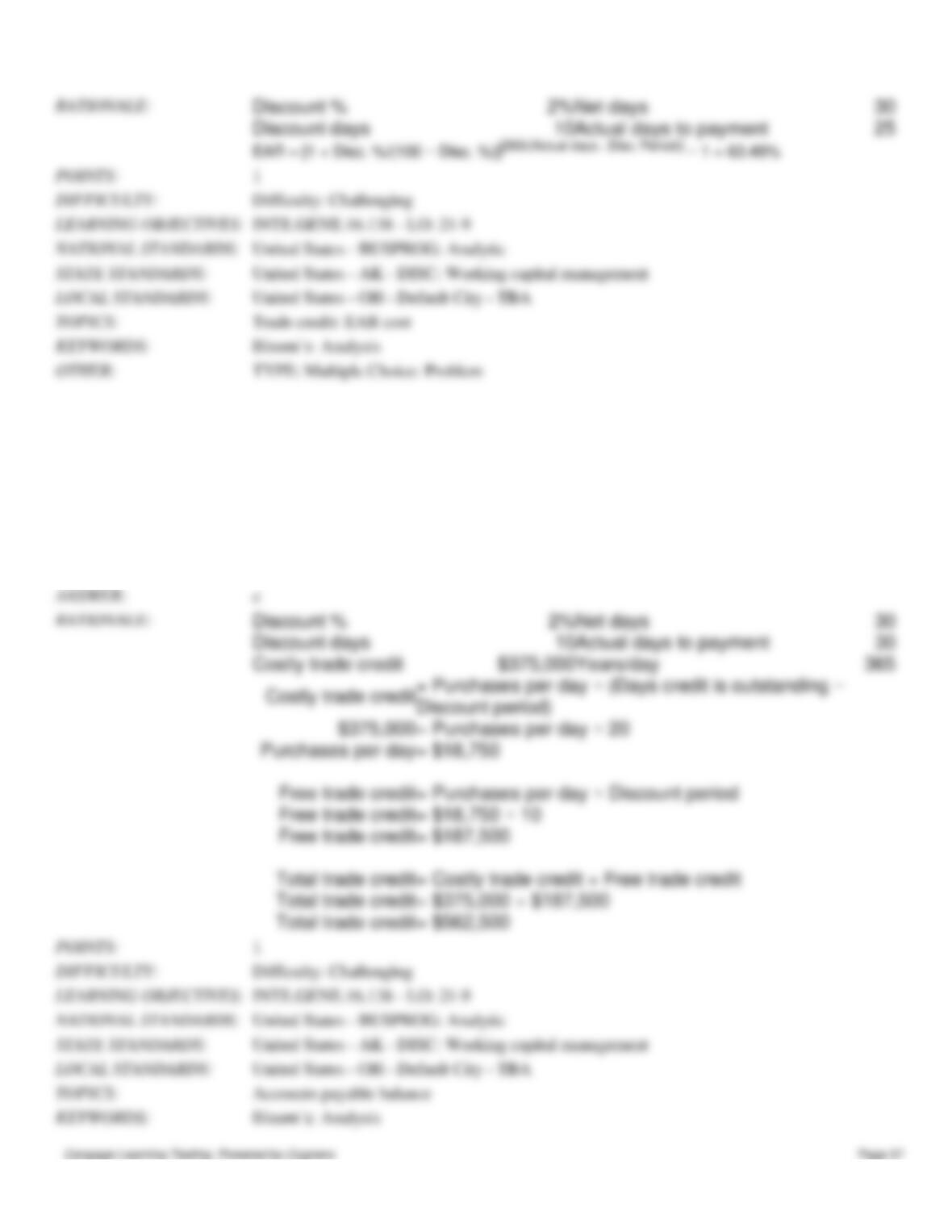
131. Suppose the suppliers of your firm offered you credit terms of 2/10 net 30 days. Your firm is not taking discounts,
but is paying after 25 days instead of waiting until Day 30. You point out that the nominal cost of not taking the discount
and paying on Day 30 is approximately 37%. But since your firm is neither taking discounts nor paying on the due date,
what is the effective annual percentage cost (not the nominal cost) of its costly trade credit, using a 365-day year?
a.
60.3%
b.
63.5%
c.
66.7%
d.
70.0%
e.
73.5%
CHAPTER 21—SUPPLY CHAINS AND WORKING CAPITAL MANAGEMENT
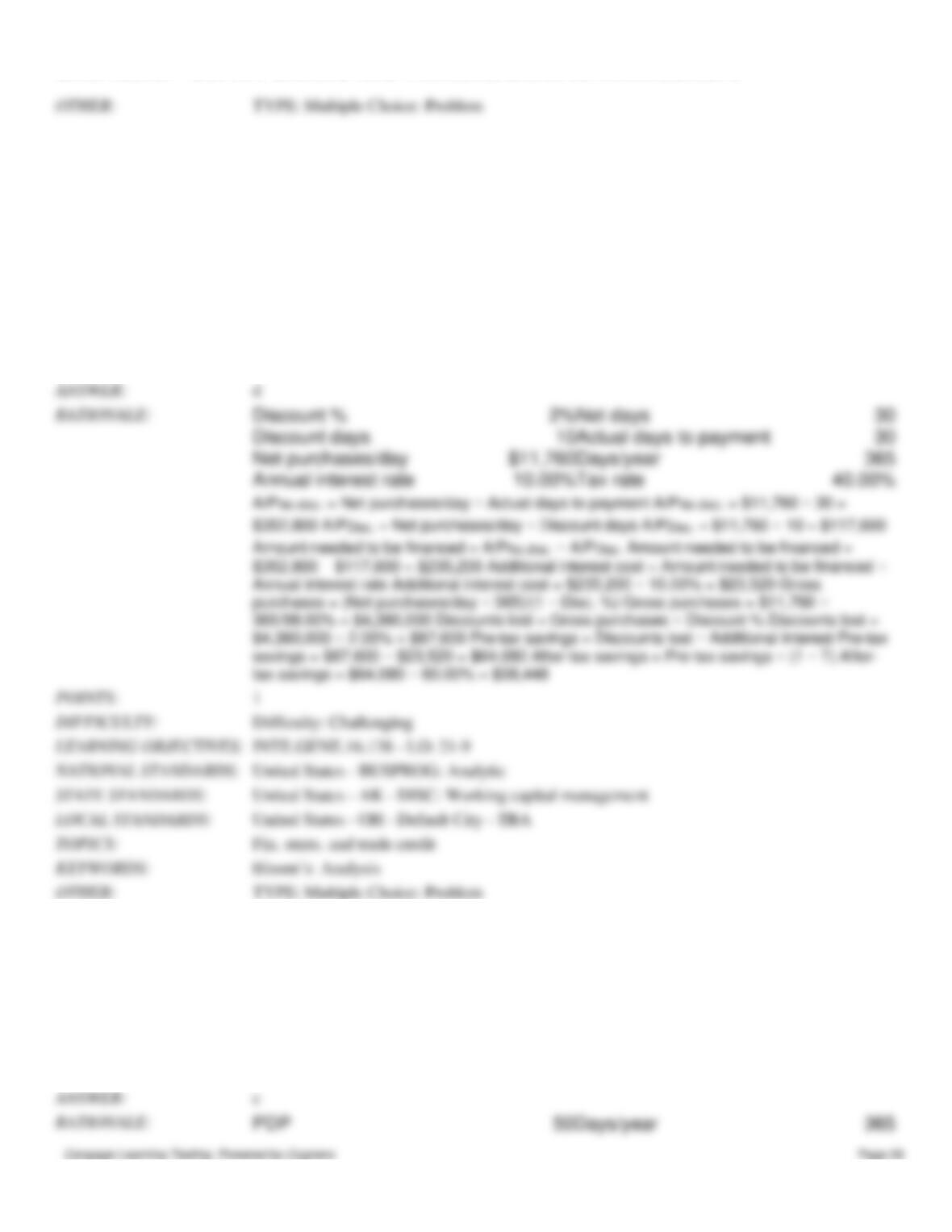
132. Arnold Inc. purchases merchandise on terms of 2/10 net 30, and it always pays on the 30th day. The CFO calculates
that the average amount of costly trade credit carried is $375,000. What is the firm’s average accounts payable balance?
(Assume a 365-day year.)
a.
$458,160
b.
$482,273
c.
$507,656
d.
$534,375
e.
$562,500
e
CHAPTER 21—SUPPLY CHAINS AND WORKING CAPITAL MANAGEMENT
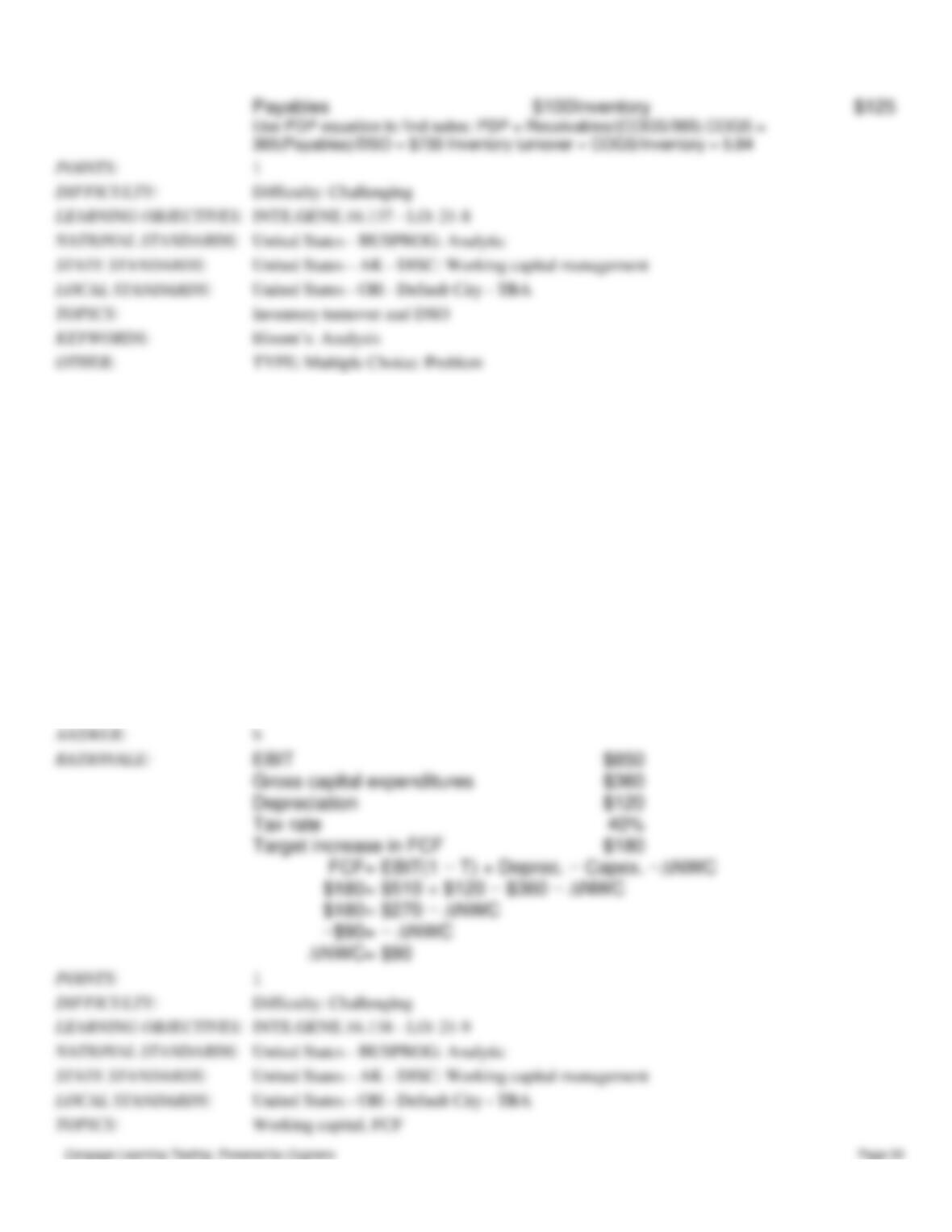
133. Blueroot Inc. is considering a change in its financing policy. Currently, it uses maximum trade credit by not taking
discounts on its purchases. The standard industry credit terms offered by all its suppliers are 2/10 net 30 days, and the firm
pays on time. The new CFO is considering borrowing from its bank, using short-term notes payable, and then taking
discounts. The firm wants to determine the effect of this policy change on its net income. Its net purchases are $11,760 per
day, using a 365-day year. The interest rate on the notes payable is 10%, and the tax rate is 40%. If the firm implements
the plan, what is the expected change in net income?
a.
$32,964
b.
$34,699
c.
$36,526
d.
$38,448
e.
$40,370
134. Famous Farm’s payables deferral period (PDP) is 50 days (on a 365-day basis), accounts payable are $100 million,
and its balance sheet shows inventory of $125 million. What is the inventory turnover ratio?
a.
4.73
b.
5.26
c.
5.84
d.
6.42
e.
7.07
c
CHAPTER 21—SUPPLY CHAINS AND WORKING CAPITAL MANAGEMENT
135. During the coming year, Gold & Gold wants to increase its free cash flow by $180 million, which should result in a
higher EVA and stock price. The CFO has made these projections for the upcoming year:
∙
EBIT is projected to equal $850 million.
∙
Gross capital expenditures are expected to total to $360 million versus depreciation of $120
million, so its net capital expenditures should total $240 million.
∙
The tax rate is 40%.
∙
There will be no changes in cash or marketable securities, nor will there be any changes in
notes payable or accruals.
What increase in net working capital (in millions of dollars) would enable the firm to meet its target increase in FCF?
a.
$72
b.
$90
c.
$108
d.
$130
e.
$156
Difficulty: Challenging
INTE.GENE.16.138 – LO: 21-9
United States – BUSPROG: Analytic
United States – OH – Default City – TBA
Working capital, FCF
Difficulty: Challenging
INTE.GENE.16.137 – LO: 21-8
United States – BUSPROG: Analytic
United States – AK – DISC: Working capital management
United States – OH – Default City – TBA
Inventory turnover and DSO
TYPE: Multiple Choice: Problem
CHAPTER 21—SUPPLY CHAINS AND WORKING CAPITAL MANAGEMENT
Exhibit 21.1
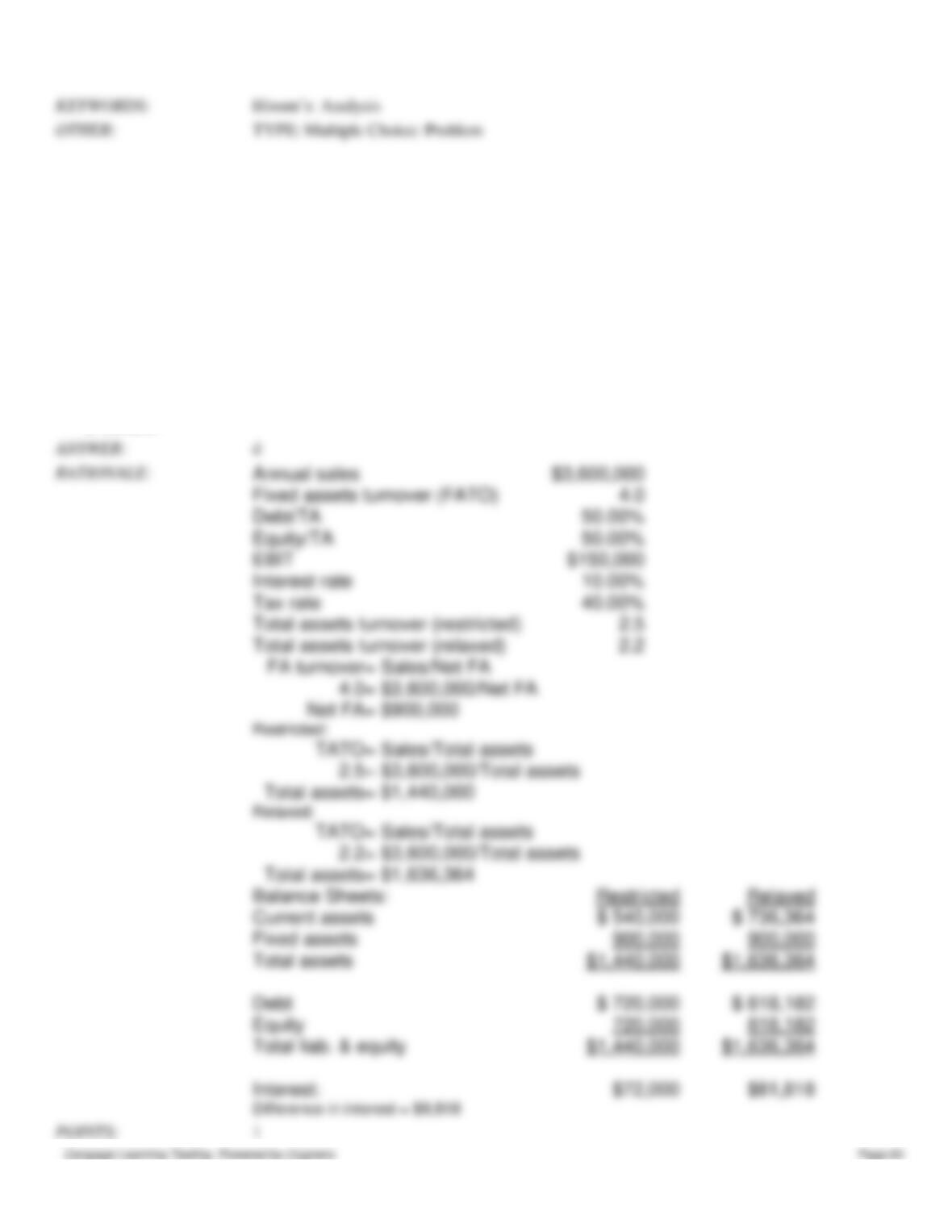
Hardwig Inc. is considering whether to pursue a restricted or relaxed current asset investment policy. The firm’s annual
sales are expected to total $3,600,000, its fixed assets turnover ratio equals 4.0, and its debt and common equity are each
50% of total assets. EBIT is $150,000, the interest rate on the firm’s debt is 10%, and the tax rate is 40%. If the company
follows a restricted policy, its total assets turnover will be 2.5. Under a relaxed policy its total assets turnover will be 2.2.
136. Refer to Exhibit 21.1. If the firm adopts a restricted policy, how much lower would its interest expense be than under
the relaxed policy?
a.
$8,418
b.
$8,861
c.
$9,327
d.
$9,818
e.
$10,309
TYPE: Multiple Choice: Problem
CHAPTER 21—SUPPLY CHAINS AND WORKING CAPITAL MANAGEMENT
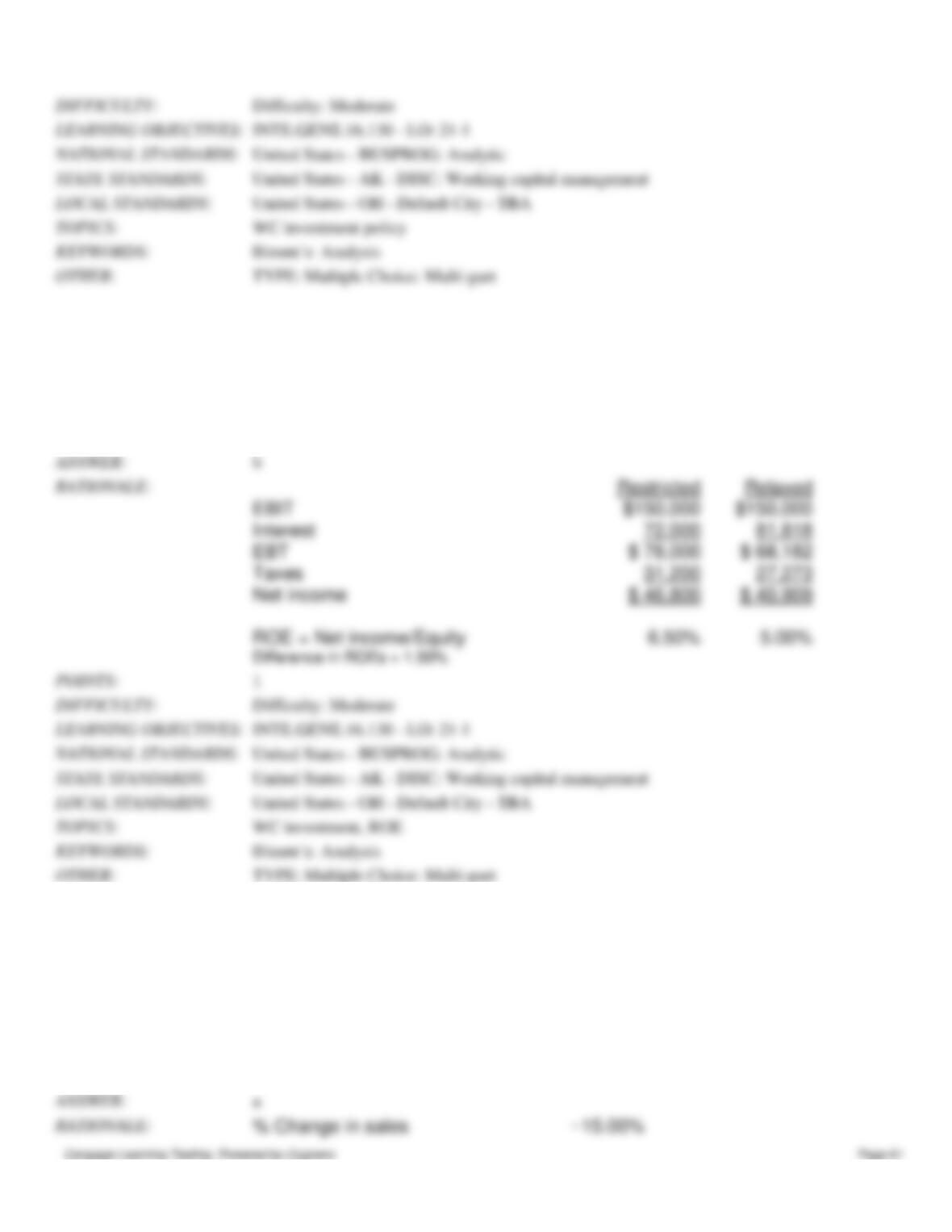
137. Refer to Exhibit 21.1. What’s the difference in the projected ROEs under the restricted and relaxed policies?
a.
1.20%
b.
1.50%
c.
1.80%
d.
2.16%
e.
2.59%
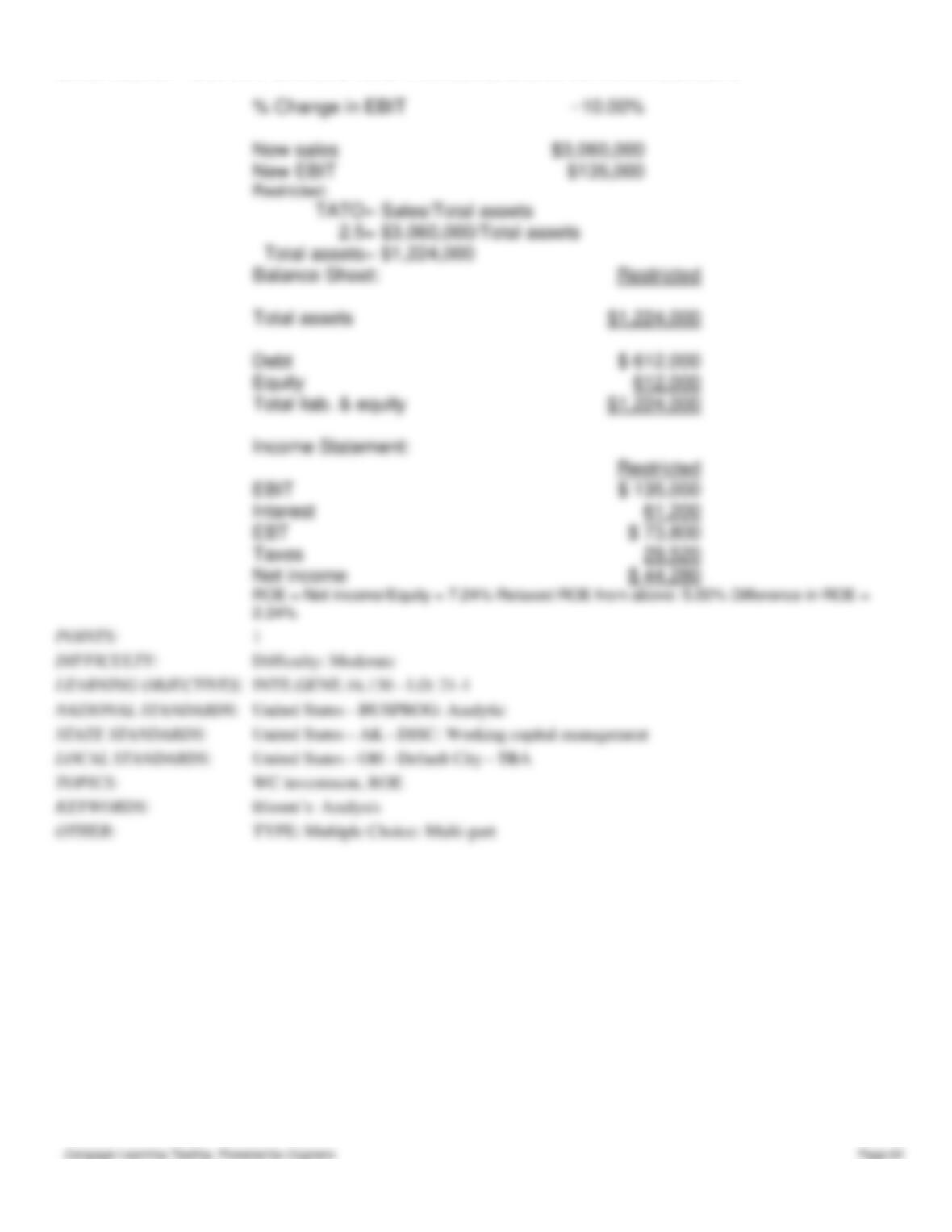
138. Refer to Exhibit 21.1. Assume now that the company believes that if it adopts a restricted policy, its sales will fall by
15% and EBIT will fall by 10%, but its total assets turnover, debt ratio, interest rate, and tax rate will all remain the same.
In this situation, what’s the difference between the projected ROEs under the restricted and relaxed policies?
a.
2.24%
b.
2.46%
c.
2.70%
d.
2.98%
e.
3.27%
a
CHAPTER 21—SUPPLY CHAINS AND WORKING CAPITAL MANAGEMENT