
Chapter 16: Supply Chains and Working Capital Management
a. $1,092
b. $1,150
c. $1,210
d. $1,271
e. $1,334
110. Cash is often referred to as a “non-earning” asset. Thus, one goal of cash management is to minimize the amount of
cash necessary for conducting a firm’s normal business activities.
a. True
b. False

Chapter 16: Supply Chains and Working Capital Management
111. Firms hold cash balances in order to complete transactions (both routine and precautionary) that are necessary in
business operations and as compensation to banks for providing loans and services.
a. True
b. False
112. For a firm that makes heavy use of net float, being able to forecast collections and disbursement check clearings is
essential.
a. True
b. False
113. Setting up a lockbox arrangement is one way for a firm to speed up the collection of payments from its customers.
a. True
b. False

Chapter 16: Supply Chains and Working Capital Management
114. Synchronization of cash flows is an important cash management technique, as proper synchronization can reduce the
required cash balance and increase a firm’s profitability.
a. True
b. False
115. On average, a firm collects checks totaling $250,000 per day. It takes the firm approximately 4 days from the day the
checks were mailed until they result in usable cash for the firm. Assume that (1) a lockbox system could be employed
which would reduce the cash conversion procedure to 2 1/2 days and (2) the firm could invest any additional cash
generated at 6% after taxes. The lockbox system would be a good buy if it costs $25,000 annually.
a. True
b. False
116. A lockbox plan is
a. used to identify inventory safety stocks.
b. used to slow down the collection of checks our firm writes.
c. used to speed up the collection of checks received.

Chapter 16: Supply Chains and Working Capital Management
d. used primarily by firms where currency is used frequently in transactions, such as fast food restaurants, and less
frequently by firms that receive payments as checks.
e. used to protect cash, i.e., to keep it from being stolen.
117. A lockbox plan is most beneficial to firms that
a. have widely dispersed manufacturing facilities.
b. have a large marketable securities portfolio and cash to protect.
c. receive payments in the form of currency, such as fast food restaurants, rather than in the form of checks.
d. have customers who operate in many different parts of the country.
e. have suppliers who operate in many different parts of the country.
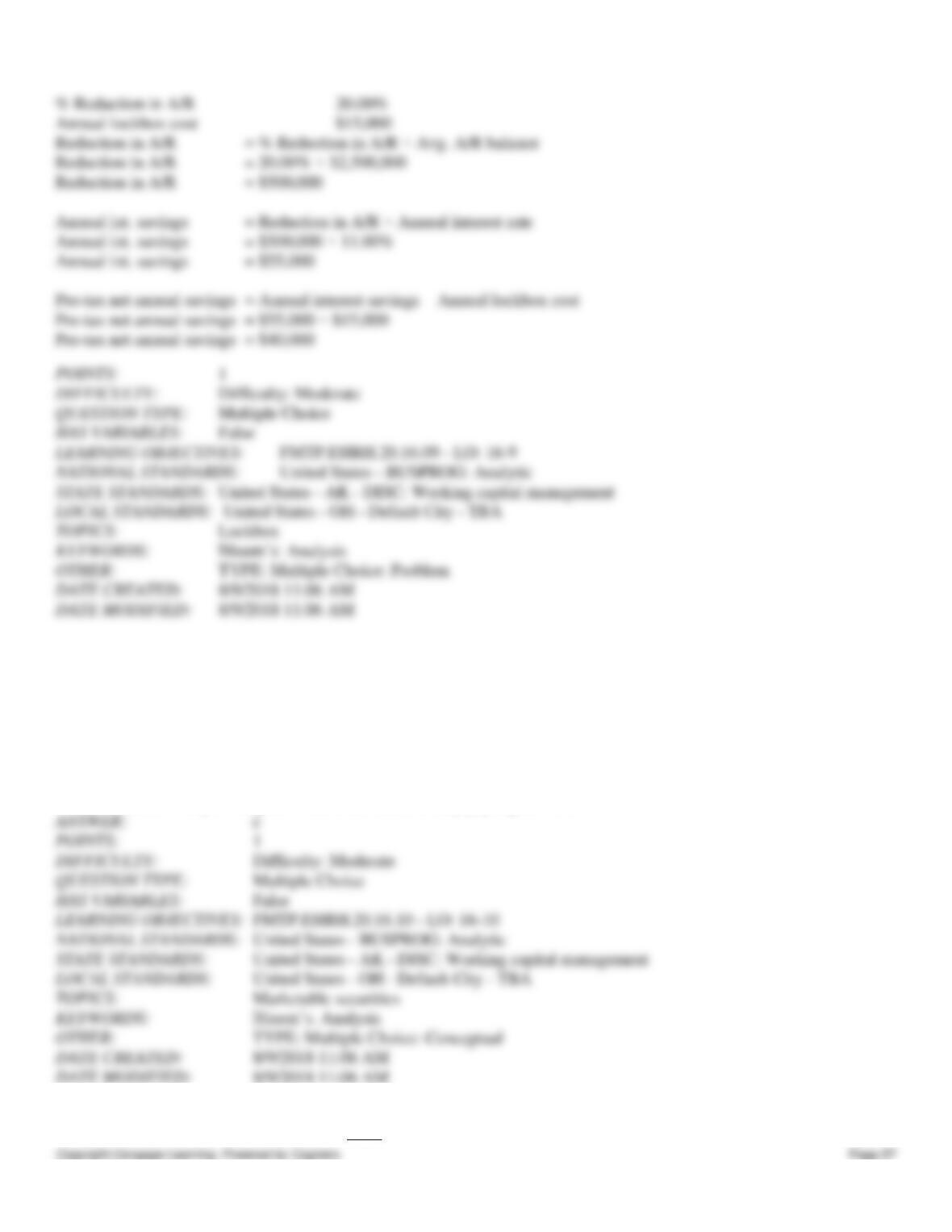
118. Carter & Carter is considering setting up a regional lockbox system to speed up collections. The company sells to
customers all over the U.S., and all receipts come in to its headquarters in San Francisco. The firm’s average accounts
receivable balance is $2.5 million, and they are financed by a bank loan at an 11% annual interest rate. The firm believes
this new lockbox system would reduce receivables by 20%. If the annual cost of the system is $15,000, what pre-tax net
annual savings would be realized?
a. $29,160
b. $32,400
c. $36,000
d. $40,000
e. $44,000
Chapter 16: Supply Chains and Working Capital Management
119. Which of the following statement completions is CORRECT? If the yield curve is upward sloping, then the
marketable securities held in a firm’s portfolio, assumed to be held for emergencies, should
a. consist mainly of short-term securities because they pay higher rates.
b. consist mainly of U.S. Treasury securities to minimize interest rate risk.
c. consist mainly of short-term securities to minimize interest rate risk.
d. be balanced between long- and short-term securities to minimize the adverse effects of either an upward or a
downward trend in interest rates.
e. consist mainly of long-term securities because they pay higher rates.
120. Which of the following statements is NOT CORRECT?

Chapter 16: Supply Chains and Working Capital Management
a. Credit policy has an impact on working capital because it influences both sales and the time before receivables are
collected.
b. The cash budget is useful to help estimate future financing needs, especially the need for short-term working
capital loans.
c. If a firm wants to generate more cash flow from operations in the next month or two, it could change its credit
policy from 2/10 net 30 to net 60.
d. Managing working capital is important because it influences financing decisions and the firm’s profitability.
e. A company may hold a relatively large amount of cash and marketable securities if it is uncertain about its
volume of sales, profits, and cash flows during the coming year.
121. An informal line of credit and a revolving credit agreement are similar except that the line of credit creates a legal
obligation for the bank and thus is a more reliable source of funds for the borrower.
a. True
b. False
122. The maturity of most bank loans is short term. Bank loans to businesses are frequently made as 90-day notes which
are often rolled over, or renewed, rather than repaid when they mature. However, if the borrower’s financial situation
deteriorates, then the bank may refuse to roll over the loan.
a. True
b. False

Chapter 16: Supply Chains and Working Capital Management
123. Loans from commercial banks generally appear on balance sheets as notes payable. A bank’s importance is actually
greater than it appears from the dollar amounts shown on balance sheets because banks provide nonspontaneous funds to
firms.
a. True
b. False
124. A promissory note is the document signed when a bank loan is executed, and it specifies financial aspects of the loan.
a. True
b. False
125. A line of credit can be either a formal or an informal agreement between a borrower and a bank regarding the
maximum amount of credit the bank will extend to the borrower during some future period, assuming the borrower
maintains its financial strength.
a. True
b. False

Chapter 16: Supply Chains and Working Capital Management
126. If a firm has set up a revolving credit agreement with a bank, the risk to the firm of being unable to obtain funds
when needed is lower than if it had an informal line of credit.
a. True
b. False
127. A revolving credit agreement is a formal line of credit. The firm must generally pay a fee on the unused balance of
the committed funds to compensate the bank for the commitment to extend those funds.
a. True
b. False
128. Which of the following statements is CORRECT?
a. Conservative firms generally use no short-term debt and thus have zero current liabilities.
Chapter 16: Supply Chains and Working Capital Management
b. A short-term loan can usually be obtained more quickly than a long-term loan, but the cost of short-term debt is
normally higher than that of long-term debt.
c. If a firm that can borrow from its bank at a 6% interest rate buys materials on terms of 2/10 net 30, and if it must
pay by Day 30 or else be cut off, then we would expect to see zero accounts payable on its balance sheet.
d. If one of your firm’s customers is “stretching” its accounts payable, this may be a nuisance but it will not have an
adverse financial impact on your firm if the customer periodically pays off its entire balance.
e. Under normal conditions, a firm’s expected ROE would probably be higher if it financed with short-term rather
than with long-term debt, but using short-term debt would probably increase the firm’s risk.
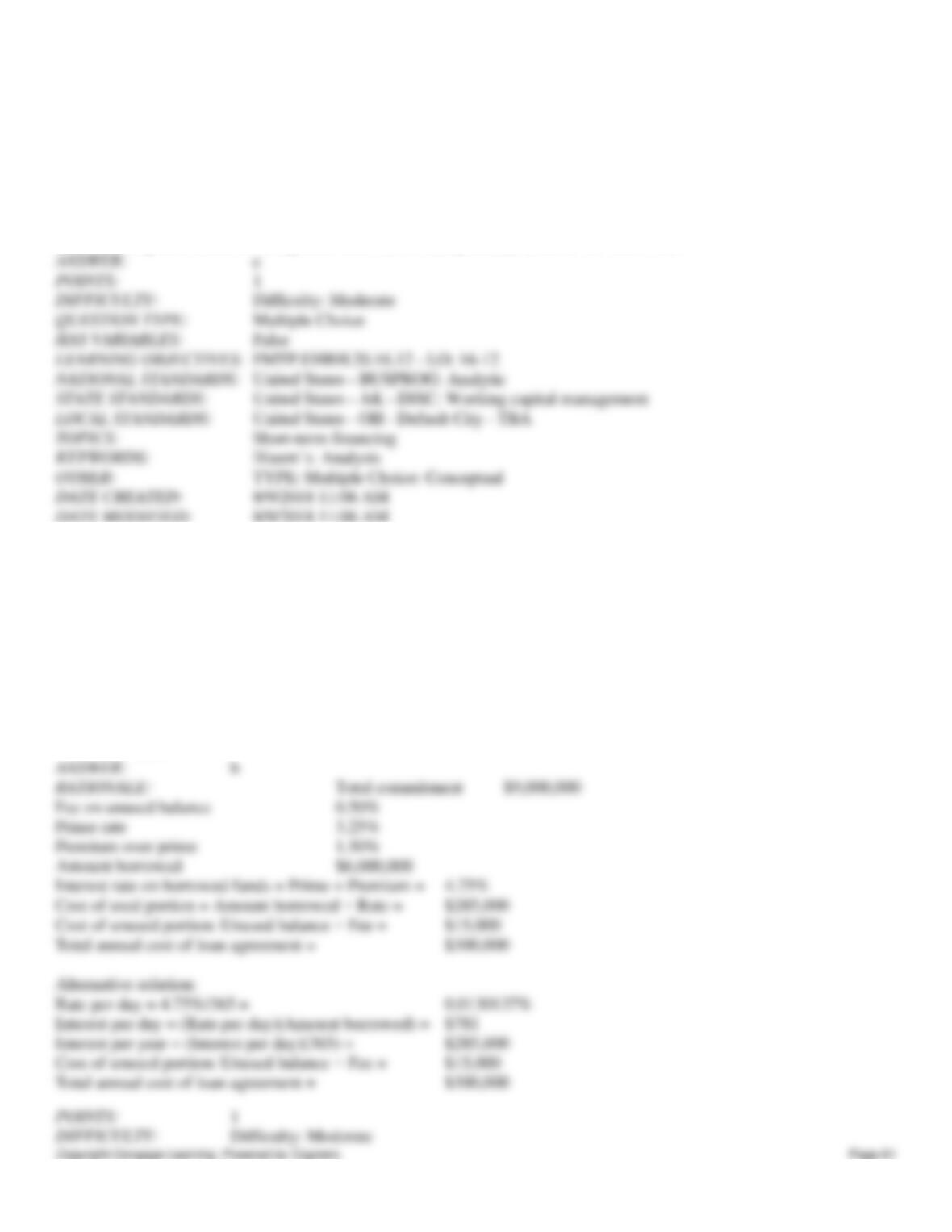
129. Sanders Enterprises arranged a revolving credit agreement of $9,000,000 with a group of banks. The firm paid an
annual commitment fee of 0.5% of the unused balance of the loan commitment. On the used portion of the revolver, it
paid 1.5% above prime for the funds actually borrowed on a simple interest basis. The prime rate was 3.25% during the
year. If the firm borrowed $6,000,000 immediately after the agreement was signed and repaid the loan at the end of one
year, what was the total dollar annual cost of the revolver?
a. $285,000
b. $300,000
c. $315,000
d. $330,750
e. $347,288

Chapter 16: Supply Chains and Working Capital Management
130. Which of the following statements is CORRECT?
a. Commercial paper is a form of short-term financing that is primarily used by large, strong, financially stable
companies.
b. Short-term debt is favored by firms because, while it is generally more expensive than long-term debt, it exposes
the borrowing firm to less risk than long-term debt.
c. Commercial paper can be issued by virtually any firm so long as it is willing to pay the going interest rate.
d. Commercial paper is typically offered at a long-term maturity of at least five years.
e. Trade credit is provided only to relatively large, strong firms.
131. Which of the following statements is NOT CORRECT?
a. Accruals are “free” in the sense that no explicit interest is paid on these funds.
b. A conservative approach to working capital management will result in most, if not all, permanent current
operating assets being financed with long-term capital.
c. The risk to a firm that borrows with short-term credit is usually greater than if it borrowed using long-term debt.
This added risk stems from the greater variability of interest costs on short-term debt and possible difficulties with rolling
over short-term debt.
d. Bank loans generally carry a higher interest rate than commercial paper.
e. Commercial paper can be issued by virtually any firm so long as it is willing to pay the going interest rate.

Chapter 16: Supply Chains and Working Capital Management