Chapter 16: Supply Chains and Working Capital Management
86. Freeman Builders, Inc. buys on terms of 2/15, net 30. It does not take discounts, and it typically pays 60 days after the
invoice date. Net purchases amount to $720,000 per year. What is the nominal annual percentage cost of its non-free trade
credit, based on a 365-day year?
a. 10.86%
b. 12.07%
c. 13.41%
d. 14.90%
e. 16.55%
87. The company you just started has been offered credit terms of 4/30, net 90 days. What will be the nominal annual
percentage cost of its non-free trade credit if it pays 120 days after the purchase? (Assume a 365-day year.)
a. 16.05%
b. 16.90%
c. 17.74%
d. 18.63%
e. 19.56%
Chapter 16: Supply Chains and Working Capital Management
88. Howes Inc. purchases $4,562,500 in goods per year from its sole supplier on terms of 2/15, net 50. If the firm chooses
to pay on time but does not take the discount, what is the effective annual percentage cost of its non-free trade credit?
(Assume a 365-day year.)
a. 20.11%
b. 21.17%
c. 22.28%
d. 23.45%
e. 24.63%
89. Andrews Corporation buys on terms of 2/8, net 45 days, it does not take discounts, and it actually pays after 58 days.
What is the effective annual percentage cost of its non-free trade credit? (Use a 365-day year.)
a. 14.34%
b. 15.10%
c. 15.89%
d. 16.69%
e. 17.52%
Chapter 16: Supply Chains and Working Capital Management
90. Safety Window and Door Co. buys on terms of 2/15, net 60 days. It does not take discounts, and it typically pays on
time, 60 days after the invoice date. Net purchases amount to $450,000 per year. On average, how much “free” trade
credit does the firm receive during the year? (Assume a 365-day year, and note that purchases are net of discounts.)
a. $18,493
b. $19,418
c. $20,389
d. $21,408
e. $22,479
91. Taylor Textbooks Inc. buys on terms of 2/15, net 50 days. It does not take discounts, and it typically pays on time, 50
days after the invoice date. Net purchases amount to $450,000 per year. On average, what is the dollar amount of costly
trade credit (total credit − free credit) the firm receives during the year? (Assume a 365-day year, and note that purchases
are net of discounts.)
a. $43,151
b. $45,308
c. $47,574
d. $49,952
e. $52,450
Chapter 16: Supply Chains and Working Capital Management
92. Fairweather Corporation purchases merchandise on terms of 2/15, net 40, and its gross purchases (i.e., purchases
before taking off the discount) are $800,000 per year. What is the maximum dollar amount of costly trade credit the firm
could get, assuming it abides by the supplier’s credit terms? (Assume a 365-day year.)
a. $53,699
b. $56,384
c. $59,203
d. $62,163
e. $65,271
93. Hinkle Corporation buys on terms of 2/15, net 60 days. It does not take discounts, and it typically pays on time, 60
days after the invoice date. Net purchases amount to $550,000 per year. On average, what is the dollar amount of total
trade credit (costly + free) the firm receives during the year, i.e., what are its average accounts payable? (Assume a 365-
day year, and note that purchases are net of discounts.)
a. $90,411
b. $94,932
c. $99,678
d. $104,662
e. $109,895
Chapter 16: Supply Chains and Working Capital Management
94. Noddings Inc. needs to raise more capital because its business is booming. The company purchases supplies on terms
of 1/10 net 20, and it currently takes the discount. One way of getting the needed funds would be to forgo the discount,
and the firm’s owner believes she could delay payment to 40 days without adverse effects. What would be the effective
annual percentage cost of funds raised by this action? (Assume a 365-day year.)
a. 10.59%
b. 11.15%
c. 11.74%
d. 12.36%
e. 13.01%
95. Suppose the suppliers of your firm offered you credit terms of 2/10 net 30 days. Your firm is not taking discounts, but
is paying after 25 days instead of waiting until Day 30. You point out that the nominal cost of not taking the discount and
paying on Day 30 is approximately 37%. But since your firm is neither taking discounts nor paying on the due date, what
is the effective annual percentage cost (not the nominal cost) of its costly trade credit, using a 365-day year?
a. 60.3%
Chapter 16: Supply Chains and Working Capital Management
b. 63.5%
c. 66.7%
d. 70.0%
e. 73.5%
96. Arnold Inc. purchases merchandise on terms of 2/10 net 30, and it always pays on the 30th day. The CFO calculates
that the average amount of costly trade credit carried is $375,000. What is the firm’s average accounts payable balance?
(Assume a 365-day year.)
a. $458,160
b. $482,273
c. $507,656
d. $534,375
e. $562,500
Chapter 16: Supply Chains and Working Capital Management
97. Blueroot Inc. is considering a change in its financing policy. Currently, it uses maximum trade credit by not taking
discounts on its purchases. The standard industry credit terms offered by all its suppliers are 2/10 net 30 days, and the firm
pays on time. The new CFO is considering borrowing from its bank, using short-term notes payable, and then taking
discounts. The firm wants to determine the effect of this policy change on its net income. Its net purchases are $11,760 per
day, using a 365-day year. The interest rate on the notes payable is 10%, and the tax rate is 25%. If the firm implements
the plan, what is the expected change in net income?
a. $41,202
b. $43,370
c. $45,657
d. $48,060
e. $50,463
98. During the coming year, Gold & Gold wants to increase its free cash flow by $180 million, which should result in a
higher stock price. The CFO has made these projections for the upcoming year:
∙ EBIT is projected to equal $852 million.
Chapter 16: Supply Chains and Working Capital Management
∙ Gross capital expenditures are expected to total to $360 million versus depreciation of $120 million, so its net capital
expenditures should total $240 million.
∙ The tax rate is 25%.
∙ There will be no changes in cash or marketable securities, nor will there be any changes in notes payable or accruals.
What increase in net working capital (in millions of dollars) would enable the firm to meet its target increase in FCF?
a. $175
b. $219
c. $263
d. $316
e. $379
99. Shorter-term cash budgets⎯say a daily cash budget for the next month⎯are generally used for actual cash control while
longer-term cash budgets⎯say monthly cash budgets for the next year⎯are generally used for planning purposes.
a. True
b. False
Chapter 16: Supply Chains and Working Capital Management
100. A firm’s peak borrowing needs will probably be overstated if it bases its monthly cash budget on the assumption that
both cash receipts and cash payments occur uniformly over the month but in reality payments are concentrated at the
beginning of each month.
a. True
b. False
101. A firm’s peak borrowing needs will probably be overstated if it bases its monthly cash budget on the assumption that
both cash receipts and cash payments occur uniformly over the month but in reality receipts are concentrated at the
beginning of each month.
a. True
b. False
102. The cash budget and the capital budget are handled separately, and although they are both important, they are
developed completely independently of one another.
a. True
b. False
Chapter 16: Supply Chains and Working Capital Management
103. Since depreciation is a non-cash charge, it neither appears on nor has any effect on the cash budget. Thus, if the
depreciation charge for the coming year doubled or halved, this would have no effect on the cash budget.
a. True
b. False
104. Which of the following is NOT directly reflected in the cash budget of a firm that is in the zero tax bracket?
a. Depreciation.
b. Cumulative cash.
c. Repurchases of common stock.
d. Payment for plant construction.
e. Payments lags.
105. Which of the following statements concerning the cash budget is CORRECT?
a. Cash budgets do not include financial items such as interest and dividend payments.
b. Cash budgets do not include cash inflows from long-term sources such as the issuance of bonds.
c. Changes that affect the DSO do not affect the cash budget.
d. Capital budgeting decisions have no effect on the cash budget until projects go into operation and start producing
revenues.
Chapter 16: Supply Chains and Working Capital Management
e. Depreciation expense is not explicitly included, but depreciation’s effects are reflected in the estimated tax
payments.
106. Which of the following items should a company report directly in its monthly cash budget?
a. Cash proceeds from selling one of its divisions.
b. Accrued interest on zero coupon bonds that it issued.
c. New shares issued in a stock split.
d. New shares issued in a stock dividend.
e. Its monthly depreciation expense.
107. Which of the following statements is CORRECT?
a. The cash budget and the capital budget are developed separately, and although they are both important to the firm,
one does not affect the other.
b. Since depreciation is a non-cash charge, it neither appears on nor has any effect on the cash budget.
c. The target cash balance should be set such that it need not be adjusted for seasonal patterns and unanticipated
fluctuations in receipts, although it should be changed to reflect long-term changes in the firm’s operations.
d. The typical cash budget reflects interest paid on loans as well as income from the investment of surplus cash.
These numbers, as well as other items on the cash budget, are expected values; hence, actual results might vary from the
budgeted amounts.
e. Shorter-term cash budgets, in general, are used primarily for planning purposes, while longer-term budgets are
used for actual cash control.
Chapter 16: Supply Chains and Working Capital Management
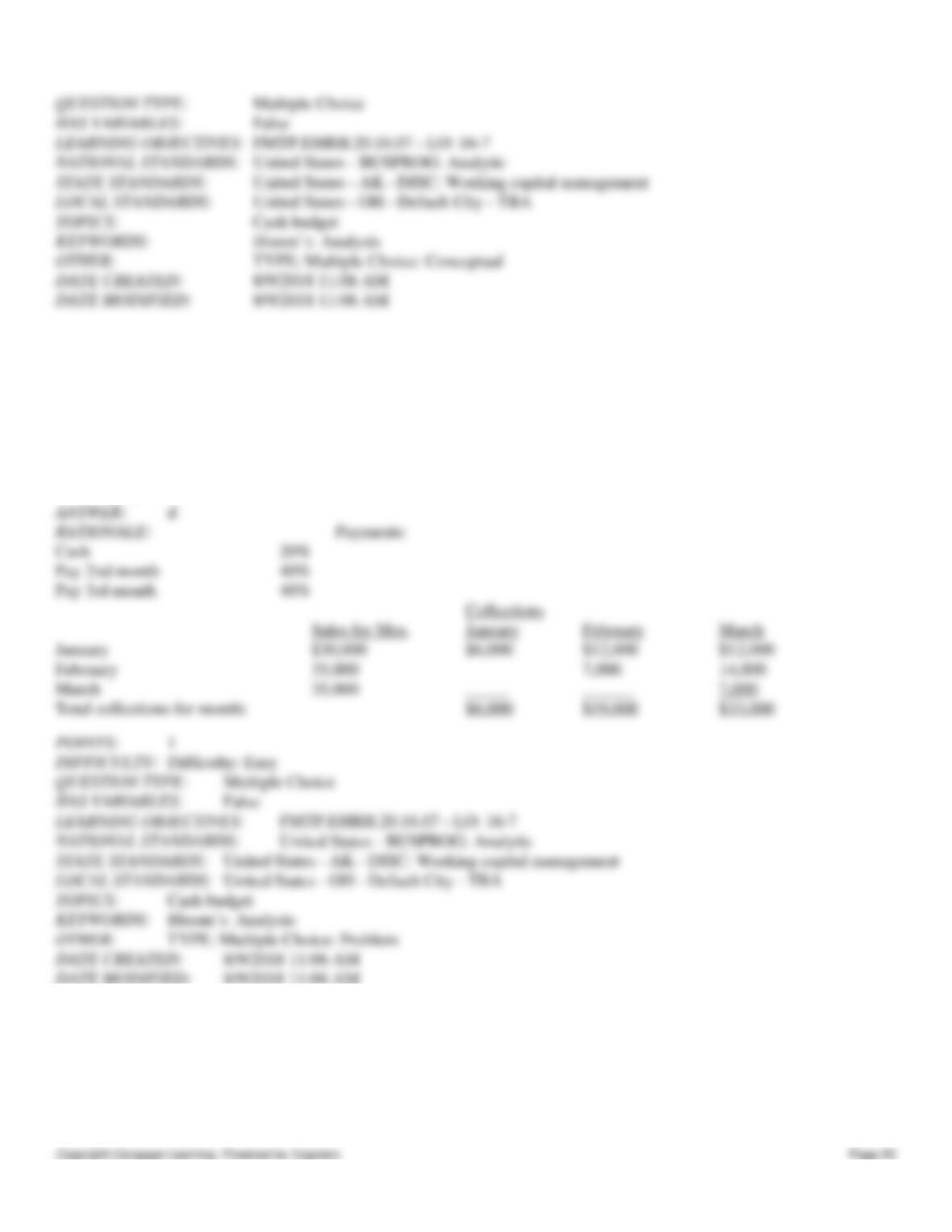
108. Baltimore Baking is preparing its cash budget and expects to have sales of $30,000 in January, $35,000 in February,
and $35,000 in March. If 20% of sales are for cash, 40% are credit sales paid in the month after the sale, and another 40%
are credit sales paid 2 months after the sale, what are the expected cash receipts for March?
a. $24,057
b. $26,730
c. $29,700
d. $33,000
e. $36,300
109. Tierney Enterprises is constructing its cash budget. Its budgeted monthly sales are $5,000, and they are constant from
month to month. 40% of its customers pay in the first month and take the 2% discount, while the remaining 60% pay in
the month following the sale and do not receive a discount. The firm has no bad debts. Purchases for next month’s sales
are constant at 50% of projected sales for the next month. “Other payments,” which include wages, rent, and taxes, are
25% of sales for the current month. Construct a cash budget for a typical month and calculate the average net cash flow
during the month.