Chapter 16: Supply Chains and Working Capital Management
b. 28 days
c. 31 days
d. 35 days
e. 38 days
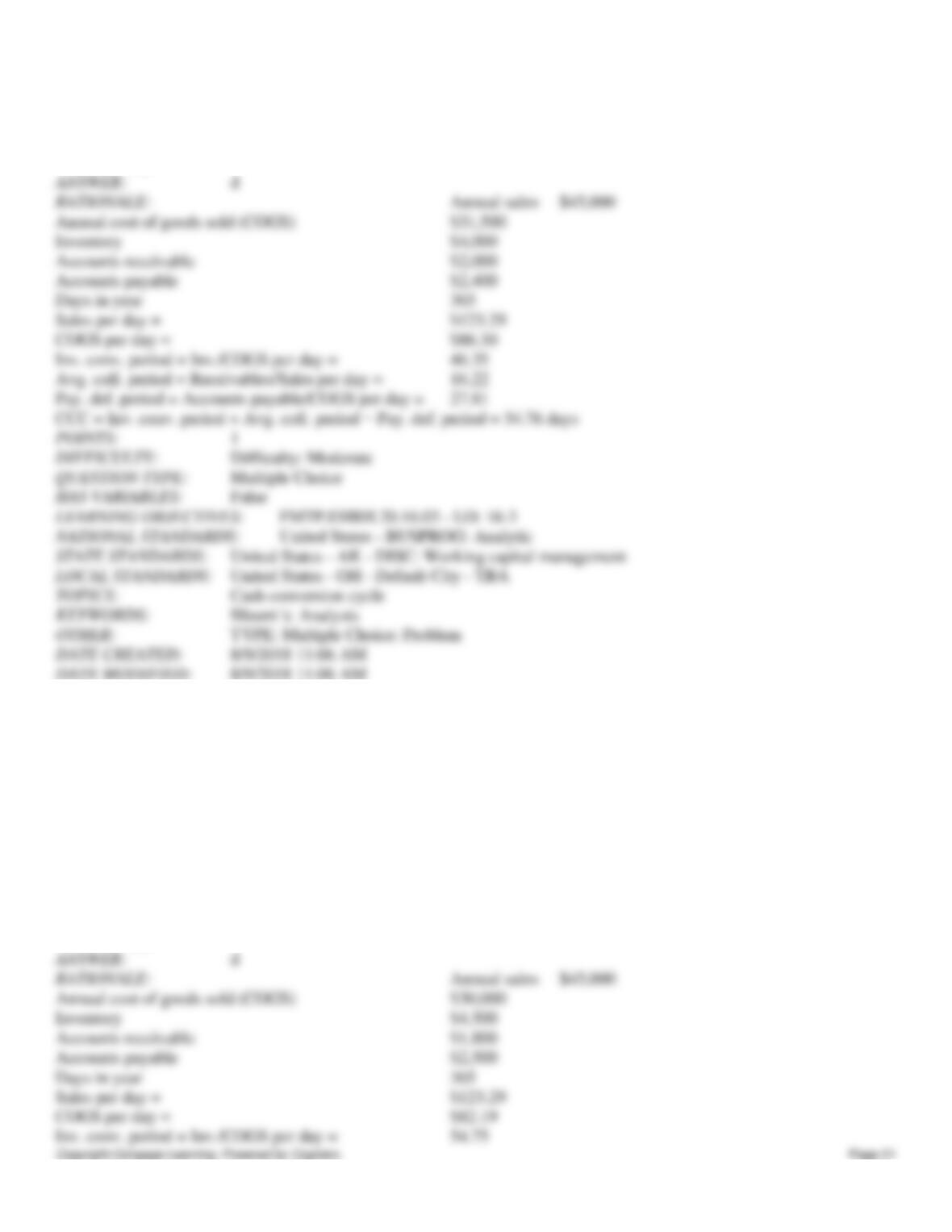
41. Shulman Inc. has the following data, in thousands. Assuming a 365-day year, what is the firm’s cash conversion cycle?
Annual sales = $45,000
Annual cost of goods sold = $30,000
Inventory = $4,500
Accounts receivable = $1,800
Accounts payable = $2,500
a. 28 days
b. 32 days
c. 35 days
d. 39 days
e. 43 days
Chapter 16: Supply Chains and Working Capital Management
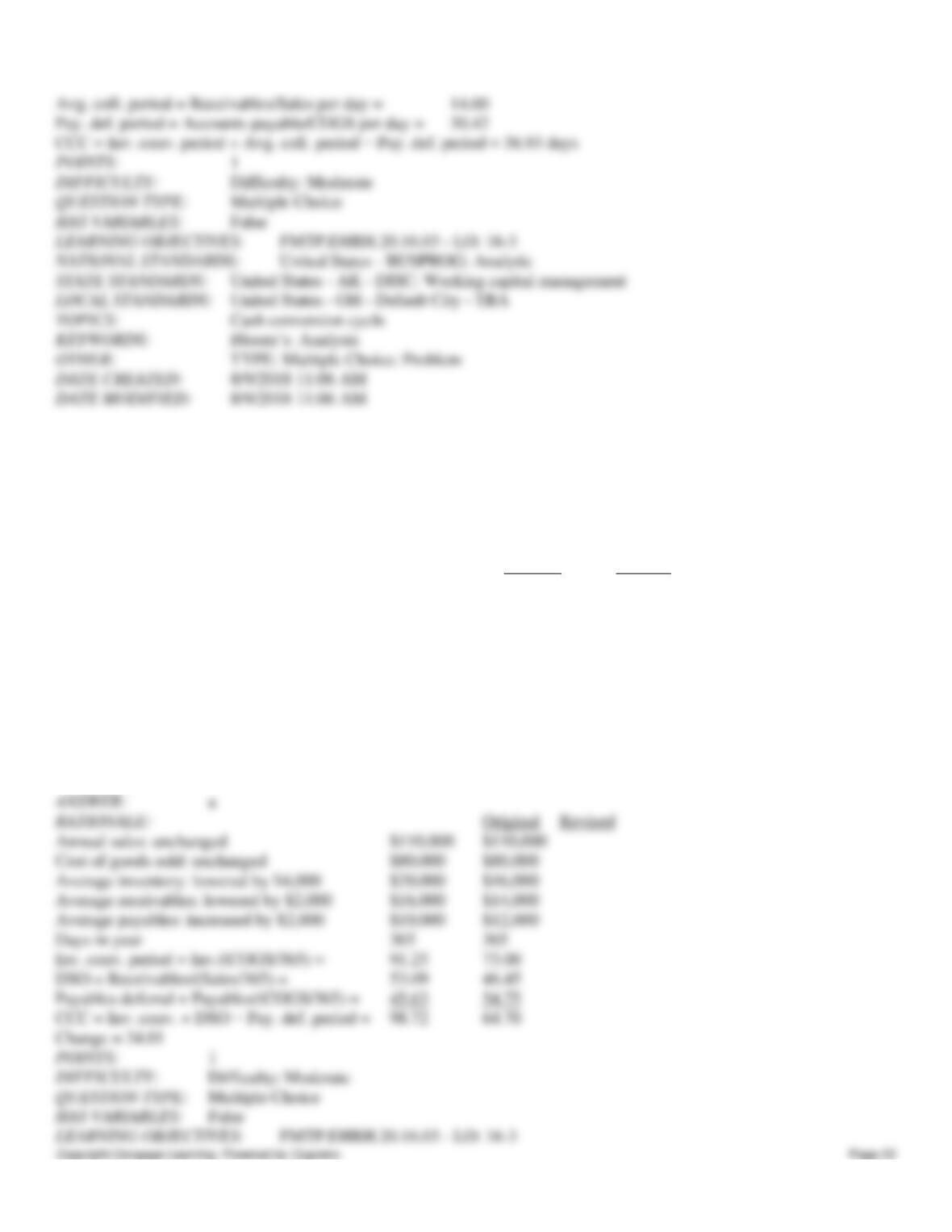
42. Kiley Corporation had the following data for the most recent year (in millions). The new CFO believes (1) that an
improved inventory management system could lower the average inventory by $4,000, (2) that improvements in the credit
department could reduce receivables by $2,000, and (3) that the purchasing department could negotiate better credit terms
and thereby increase accounts payable by $2,000. Furthermore, she thinks that these changes would not affect either sales
or the costs of goods sold. If these changes were made, by how many days would the cash conversion cycle be lowered?
Original Revised
Annual sales: unchanged $110,000 $110,000
Cost of goods sold: unchanged $80,000 $80,000
Average inventory: lowered by $4,000 $20,000 $16,000
Average receivables: lowered by $2,000 $16,000 $14,000
Average payables: increased by $2,000 $10,000 $12,000
Days in year 365 365
a. 34.0
b. 37.4
c. 41.2
d. 45.3
e. 49.8
Chapter 16: Supply Chains and Working Capital Management
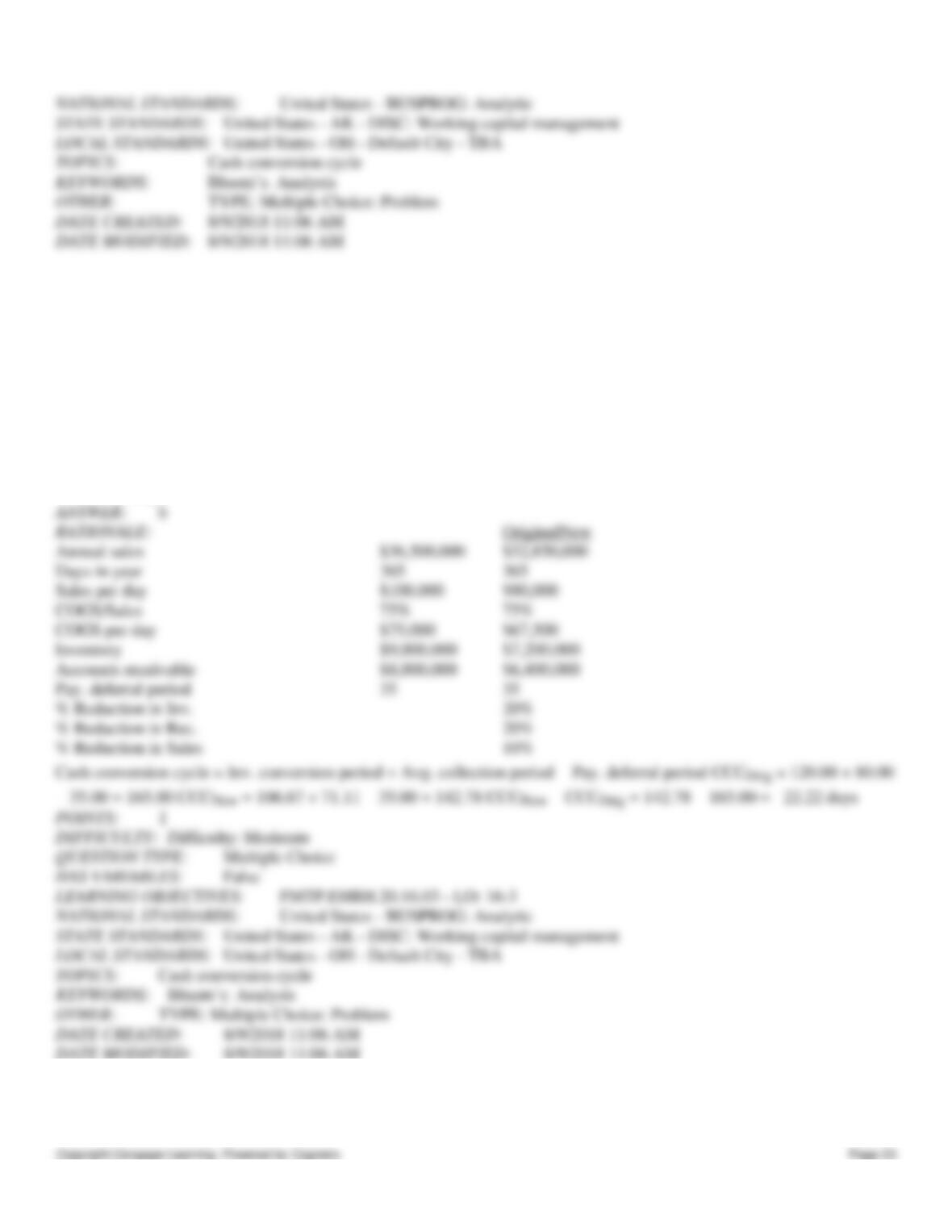
43. Whitson Co. is looking for ways to shorten its cash conversion cycle. It has annual sales of $36,500,000, or $100,000
a day on a 365-day basis. The firm’s cost of goods sold is 75% of sales. On average, the company has $9,000,000 in
inventory and $8,000,000 in accounts receivable. Its CFO has proposed new policies that would result in a 20% reduction
in both average inventories and accounts receivable. She also anticipates that these policies would reduce sales by 10%,
while the payables deferral period would remain unchanged at 35 days. What effect would these policies have on the
company’s cash conversion cycle? Round to the nearest whole day.
a. −26 days
b. −22 days
c. −18 days
d. −14 days
e. −11 days
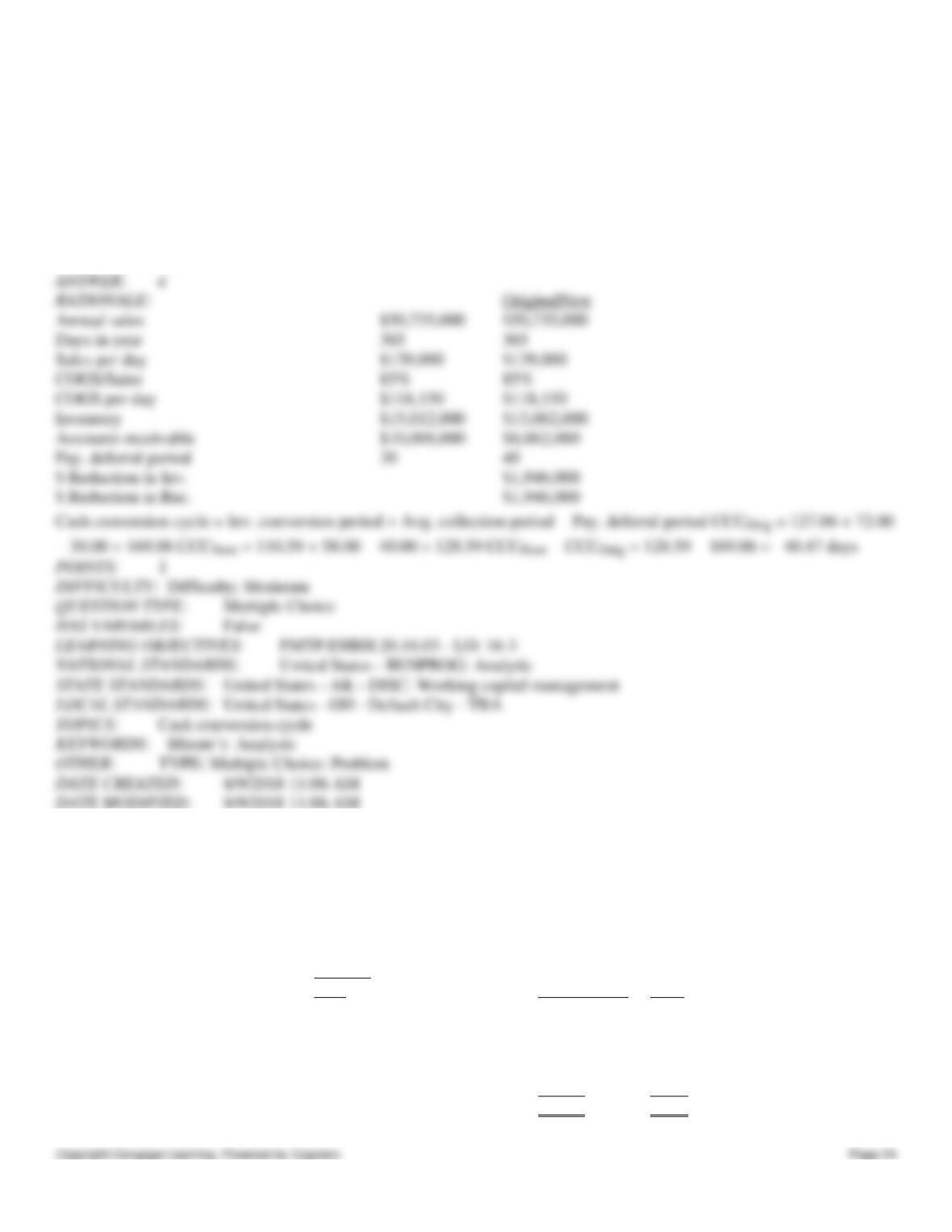
44. Pascarella Inc. is revising its payables policy. It has annual sales of $50,735,000, an average inventory level of
$15,012,000, and average accounts receivable of $10,008,000. The firm’s cost of goods sold is 85% of sales. The company
Chapter 16: Supply Chains and Working Capital Management
makes all purchases on credit and has always paid on the 30th day. However, it now plans to take full advantage of trade
credit and to pay its suppliers on the 40th day. The CFO also believes that sales can be maintained at the existing level but
inventory can be lowered by $1,946,000 and accounts receivable by $1,946,000. What will be the net change in the cash
conversion cycle, assuming a 365-day year?
a. −26.6 days
b. −29.5 days
c. −32.8 days
d. −36.4 days
e. −40.5 days
45. Fontana Painting had the following data for the most recent year (in millions). The new CFO believes that the
company could improve its working capital management sufficiently to bring its NWC and CCC up to the benchmark
companies’ level without affecting either sales or the costs of goods sold. Fontana finances its net working capital with a
bank loan at an 8% annual interest rate, and it uses a 365-day year. If these changes had been made, by how much would
the firm’s pre-tax income have increased?
Original Benchmark
Data Related CCC CCC
Sales $100,000
Cost of goods sold $ 80,000
Inventory (ICP) $ 20,000 91.25 38.00
Receivables (DSO) $ 16,000 58.40 20.00
Payables (PDP) $ 5,000 22.81 30.00
126.84 28.00
a. 1,901
Chapter 16: Supply Chains and Working Capital Management
b. 2,092
c. 2,301
d. 2,531
e. 2,784
46. Monar Inc.’s CFO would like to decrease its cash conversion cycle by 10 days (based on a 365 day year). The
company carries average inventory of $750,000. Its annual sales are $10 million, its cost of goods sold is 75% of annual
sales, and its average collection period is twice as long as its inventory conversion period. The firm buys on terms of net
30 days, and it pays on time. The CFO believes he can reduce the average inventory to $647,260 with no effect on sales.
By how much must the firm also reduce its accounts receivable to meet its goal in the reduction of the cash conversion
cycle?
a. $123,630
b. $130,137
c. $136,986
d. $143,836
e. $151,027
Chapter 16: Supply Chains and Working Capital Management
47. The overriding goal of inventory management is to ensure that the firm never suffers a stock-out, i.e., never runs out
of an inventory item.
a. True
b. False
48. The twin goals of inventory management are (1) to ensure that the inventories needed to sustain operations are
available, but (2) to hold the costs of ordering and carrying inventories to the lowest possible level.
a. True
b. False
Chapter 16: Supply Chains and Working Capital Management
49. Which of the following statements is most consistent with efficient inventory management? The firm has a
a. low incidence of production schedule disruptions.
b. below average total assets turnover ratio.
c. relatively high current ratio.
d. relatively low DSO.
e. below average inventory turnover ratio.
50. The average accounts receivable balance is a function of both the volume of credit sales and the days sales
outstanding.
a. True
b. False
51. If a firm has a large percentage of accounts over 30 days old, this is proof positive that its receivables manager is not
doing a good job.
a. True
b. False
Chapter 16: Supply Chains and Working Capital Management
52. The aging schedule is a commonly used method for monitoring receivables.
a. True
b. False
53. The four primary elements in a firm’s credit policy are (1) credit standards, (2) cash discounts offered, (3) credit
period, and (4) collection policy.
a. True
b. False
54. Changes in a firm’s collection policy can affect sales, working capital, and profits.
a. True
b. False
Chapter 16: Supply Chains and Working Capital Management
55. Not taking cash discounts is costly, and as a result, firms that do not take them are usually those that are performing
poorly and have inadequate cash balances.
a. True
b. False
56. Suppose a firm changes its credit policy from 2/10 net 30 to 3/10 net 30. The change is meant to meet competition, so
no increase in sales is expected. The average accounts receivable balance will probably decline as a result of this change.
a. True
b. False
57. Since receivables and payables both result from sales transactions, a firm with a high receivables-to-sales ratio must
also have a high payables-to-sales ratio.
a. True
b. False
Chapter 16: Supply Chains and Working Capital Management
58. Dimon Products’ sales are expected to be $5 million this year, with 90% on credit and 10% for cash. Sales are
expected to grow at a stable, steady rate of 10% annually in the future. Dimon’s accounts receivable balance will remain
constant at the current level, because the 10% cash sales can be used to support the 10% growth rate, other things held
constant.
a. True
b. False
59. For a zero-growth firm, it is possible to increase the percentage of sales that are made on credit and still keep accounts
receivable at their current level, provided the firm can shorten the length of its collection period sufficiently.
a. True
b. False
Chapter 16: Supply Chains and Working Capital Management
60. A firm’s collection policy, i.e., the procedures it follows to collect accounts receivable, plays an important role in
keeping its average collection period short, although too strict a collection policy can reduce profits due to lost sales.
a. True
b. False
61. Because money has time value, a cash sale is always more profitable than a credit sale.
a. True
b. False
62. If a firm sells on terms of 2/10 net 30 days, and its DSO is 28 days, then the fact that the 28-day DSO is less than the
30-day credit period tells us that the credit department is functioning efficiently and there are no past-due accounts.
a. True
b. False
Chapter 16: Supply Chains and Working Capital Management
63. Which of the following is NOT commonly regarded as being a credit policy variable?
a. Collection policy.
b. Credit standards.
c. Cash discounts.
d. Payments deferral period.
e. Credit period.
64. Which of the following statements is CORRECT?
a. In managing a firm’s accounts receivable, it is possible to increase credit sales per day yet still keep accounts
receivable fairly steady, provided the firm can shorten the length of its collection period (its DSO) sufficiently.
b. Because of the costs of granting credit, it is not possible for credit sales to be more profitable than cash sales.
c. Since receivables and payables both result from sales transactions, a firm with a high receivables-to–sales ratio
must also have a high payables-to–sales ratio.
d. Other things held constant, if a firm can shorten its DSO, this will lead to a higher current ratio.
e. A firm that makes 90% of its sales on credit and 10% for cash is growing at a constant rate of 10% annually. Such
a firm will be able to keep its accounts receivable at the current level, since the 10% cash sales can be used to finance the
10% growth rate.
65. Which of the following statements is CORRECT?
Chapter 16: Supply Chains and Working Capital Management
a. If a firm that sells on terms of net 30 changes its policy to 2/10 net 30, and if no change in sales volume occurs,
then the firm’s DSO will probably increase.
b. If a firm sells on terms of 2/10 net 30, and its DSO is 30 days, then the firm probably has some past-due accounts.
c. If a firm sells on terms of net 60, and if its sales are highly seasonal, with a sharp peak in December, then its DSO
as it is typically calculated (with sales per day = Sales for past 12 months/365) would probably be lower in January than in
July.
d. If a firm changed the credit terms offered to its customers from 2/10 net 30 to 2/10 net 60, then its sales should
increase, and this should lead to an increase in sales per day, and that should lead to a decrease in the DSO.
e. Other things held constant, the higher a firm’s days sales outstanding (DSO), the better its credit department.
66. Which of the following statements is CORRECT?
a. If cash inflows from collections occur in equal daily amounts but most payments must be made on the 10th of
each month, then a regular monthly cash budget will be misleading. The problem can be corrected by using a daily cash
budget.
b. Sound working capital policy is designed to maximize the time between cash expenditures on materials and the
collection of cash on sales.
c. If a firm wants to generate more cash flow from operations in the next month or two, it could change its credit
policy from 2/10 net 30 to net 60.
d. If a firm sells on terms of net 90, and if its sales are highly seasonal, with 80% of its sales in September, then its
DSO as it is typically calculated (with sales per day = Sales for past 12 months/365) would probably be lower in October
than in August.
e. Depreciation is included in the estimate of cash flows (Cash flow = Net income = Depreciation); hence
depreciation is set forth on a separate line in the cash budget.
Chapter 16: Supply Chains and Working Capital Management
67. Krackle Korn Inc. had credit sales of $3,500,000 last year and its days sales outstanding was DSO = 35 days. What
was its average receivables balance, based on a 365-day year?
a. $335,616
b. $352,397
c. $370,017
d. $388,518
e. $407,944
68. Famous Farm’s payables deferral period (PDP) is 50 days (on a 365-day basis), accounts payable are $100 million, and
its balance sheet shows inventory of $125 million. What is the inventory turnover ratio?
a. 4.73
b. 5.26
c. 5.84
d. 6.42
e. 7.07
69. If a firm busy on terms of 2/10 net 30, it should pay as early as possible during the discount period.
Chapter 16: Supply Chains and Working Capital Management
a. True
b. False
70. Trade credit can be separated into two components: free trade credit, which is credit received after the discount period
ends, and costly trade credit, which is the cost of discounts not taken.
a. True
b. False
71. As a rule, managers should try to always use the free component of trade credit but should use the costly component
only if the cost of this credit is lower than the cost of credit from other sources.
a. True
b. False
Chapter 16: Supply Chains and Working Capital Management
72. If a firm’s suppliers stop offering cash discounts, then its use of trade credit is more likely to increase than to decrease,
other things held constant.
a. True
b. False
73. When deciding whether or not to take a cash discount, the cost of borrowing from a bank or other source should be
compared to the cost of trade credit to determine if the cash discount should be taken.
a. True
b. False
74. The calculated cost of trade credit can be reduced by paying late.
a. True
b. False
Chapter 16: Supply Chains and Working Capital Management
DATE MODIFIED: 8/9/2018 11:06 AM
75. The calculated cost of trade credit for a firm that buys on terms of 2/10 net 30 is lower (other things held constant) if
the firm plans to pay in 40 days than in 30 days.
a. True
b. False
76. One of the effects of ceasing to take trade credit discounts is that the firm’s accounts payable will rise, other things
held constant.
a. True
b. False
77. “Stretching” accounts payable is a widely accepted, entirely ethical, and costless financing technique.
a. True
b. False
Chapter 16: Supply Chains and Working Capital Management
78. Accruals are “free” capital in the sense that no explicit interest must normally be paid on accrued liabilities.
a. True
b. False
79. Accruals are “spontaneous,” but unfortunately, due to law and economic forces, firms have little control over the level
of these accounts.
a. True
b. False
80. The facts (1) that no explicit interest is paid on accruals and (2) that the firm can control the level of these accounts at
will makes them an attractive source of funding to meet working capital needs.
a. True
b. False
Chapter 16: Supply Chains and Working Capital Management
81. If a firm switched from taking trade credit discounts to paying on the net due date, this might cost the firm some
money, but such a policy would probably have only a negligible effect on the income statement and no effect whatever on
the balance sheet.
a. True
b. False
82. If a profitable firm finds that it simply must “stretch” its accounts payable, then this suggests that it is
undercapitalized, i.e., that it needs more working capital to support its operations.
a. True
b. False
83. If one of your firm’s customers is “stretching” its accounts payable, this may be a nuisance but it does not represent a
real financial cost to your firm as long as the customer periodically pays off its entire balance.
a. True
b. False
Chapter 16: Supply Chains and Working Capital Management
84. Which of the following statements is CORRECT?
a. A conservative financing policy is one where the firm finances part of its fixed assets with short-term capital and
all of its net working capital with short-term funds.
b. If a company receives trade credit under terms of 2/10 net 30, this implies that the company has 10 days of free
trade credit.
c. One cannot tell if a firm uses a current asset financing policy that matches maturities, is conservative, or is
aggressive without an examination of its cash budget.
d. If a firm has a relatively aggressive current asset financing policy vis-á-vis other firms in its industry, then its
current ratio will probably be relatively high.
e. Accruals are an expensive but commonly used way to finance working capital.
85. Newsome Inc. buys on terms of 3/15, net 45. It does not take the discount, and it generally pays after 60 days. What is
the nominal annual percentage cost of its non-free trade credit, based on a 365-day year?
a. 25.09%
b. 27.59%
c. 30.35%
d. 33.39%
e. 36.73%