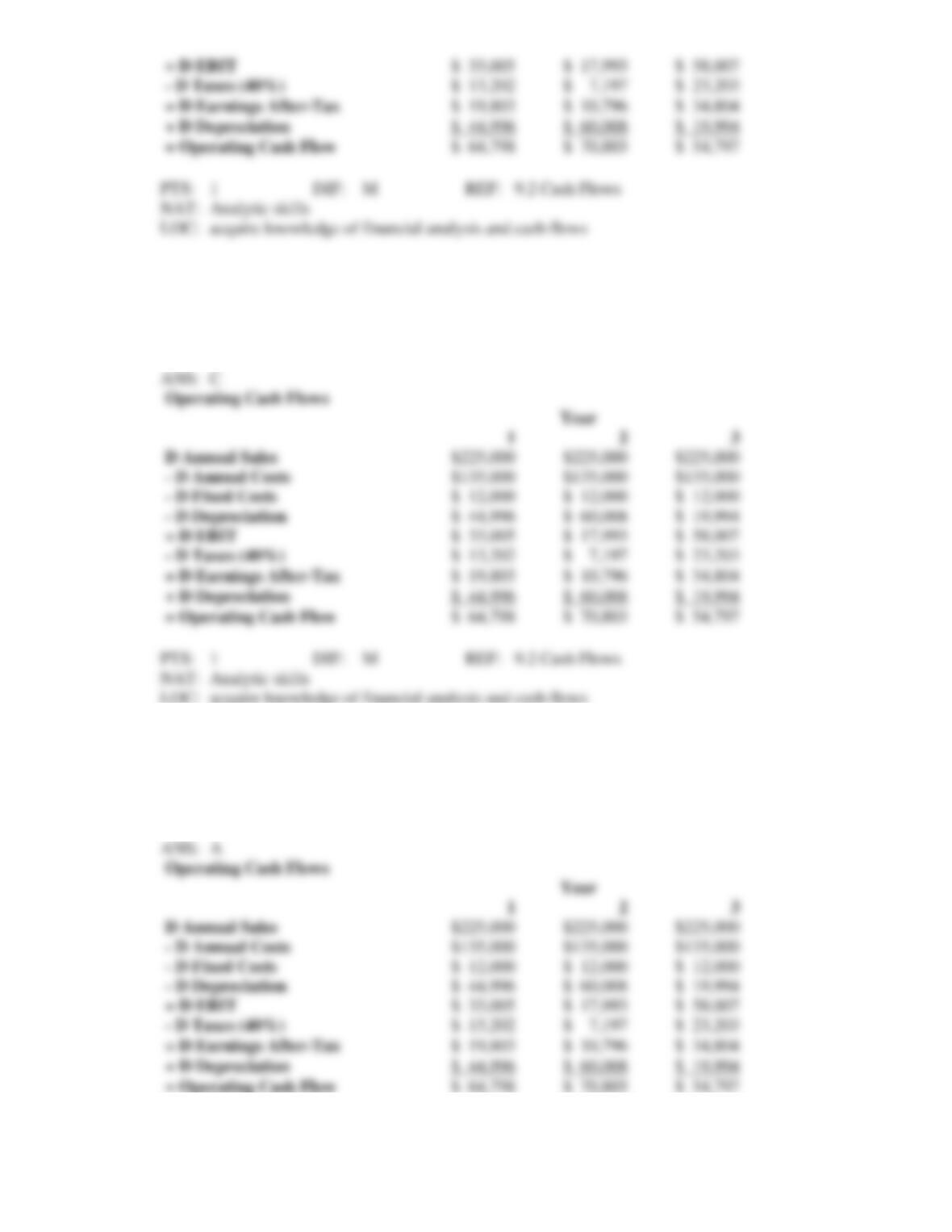
54. Refer to DSSS Corporation. What is the operating cash flow for year 2?
a.
$54,797
b.
$64,798
c.
$70,803
d.
$10,487
55. Refer to DSSS Corporation. What is the operating cash flow for year 3?
a.
$54,797
b.
$64,798
c.
$70,803
d.
$10,487
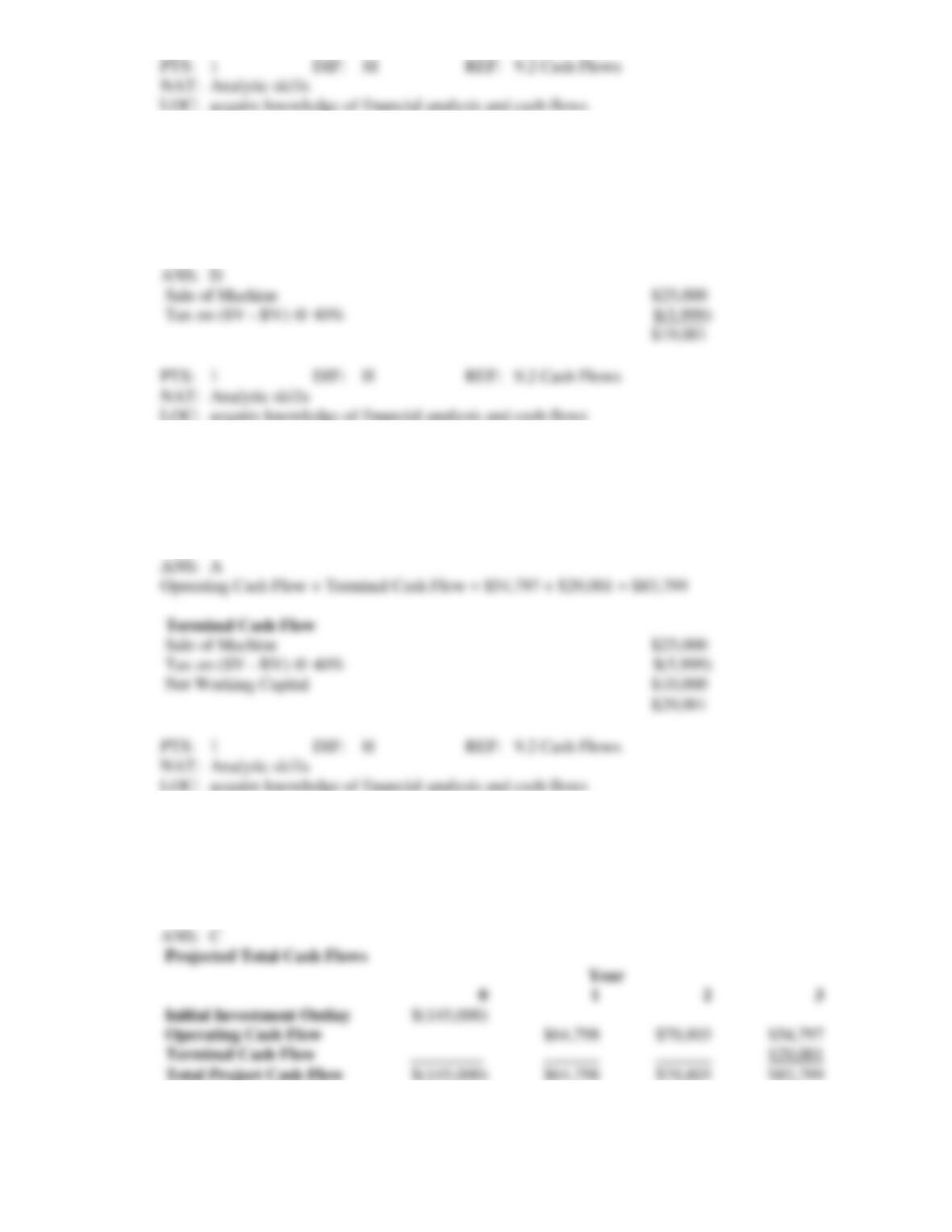
56. Refer to DSSS Corporation. What is the after-tax cash flow from selling the machine at the end of year
3?
a.
$25,000
b.
$5,999
c.
$7,214
d.
$19,001
Sale of Machine
57. Refer to DSSS Corporation. What is the total cash flow generated in year 3?
a.
$83,799
b.
$54,797
c.
$29,001
d.
$15,098
Tax on (SV – BV) @ 40%
58. Refer to DSSS Corporation. What is the NPV of the project?
a.
$14.732
b.
$12,986
c.
$19,983
d.
-$19,983
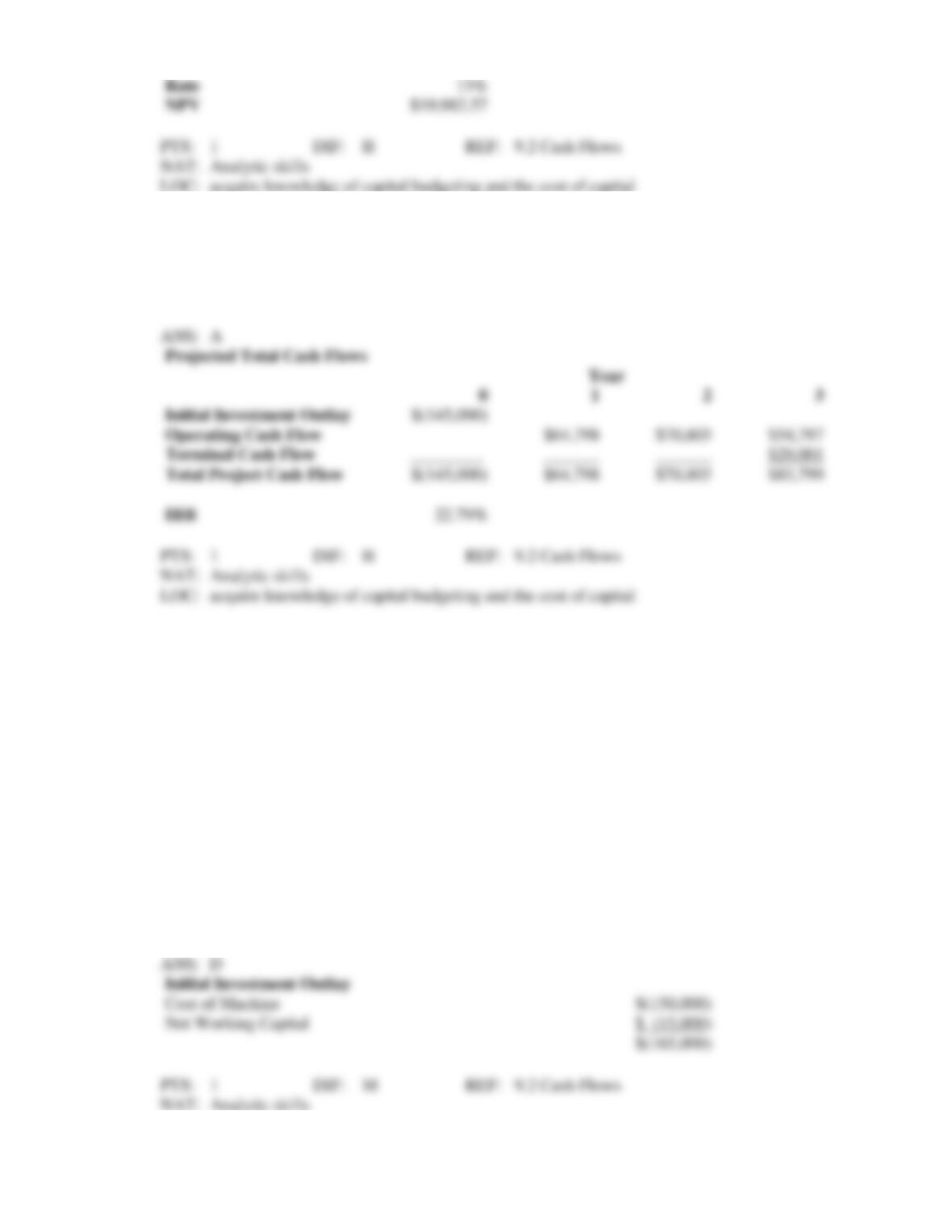
59. Refer to DSSS Corporation. What is the IRR of the project?
a.
22.79%
b.
-10.01%
c.
19.47%
d.
27.36%
NARRBEGIN: FAR Corporation
FAR Corporation
FAR Corporation is considering a new project to manufacture widgets. The cost of the manufacturing
equipment is $150,000. The cost of shipping and installation is an additional $15,000. The asset will
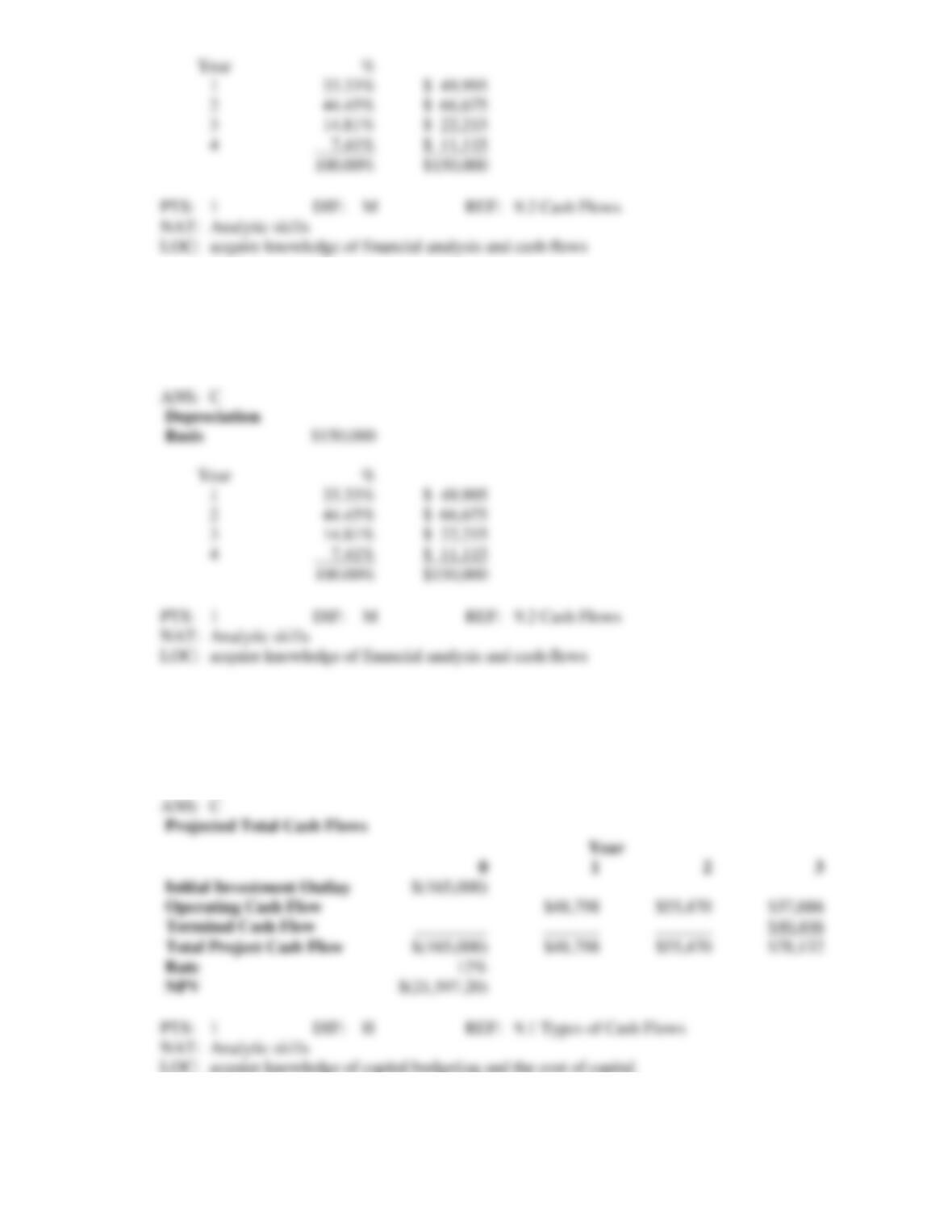
fall into the 3-year MACRS class. The year 1-4 MACRS percentages are 33.33%, 44.45%, 14.81%,
and 7.41%, respectively. Sales are expected to be $300,000 per year. Cost of goods sold will be 80%
of sales. The project will require an increase in net working capital of $15,000. At the end of three
years, FAR plans on ending the project and selling the manufacturing equipment for $35,000. The
marginal tax rate is 40% and FAR Corporation’s appropriate discount rate is 12%.
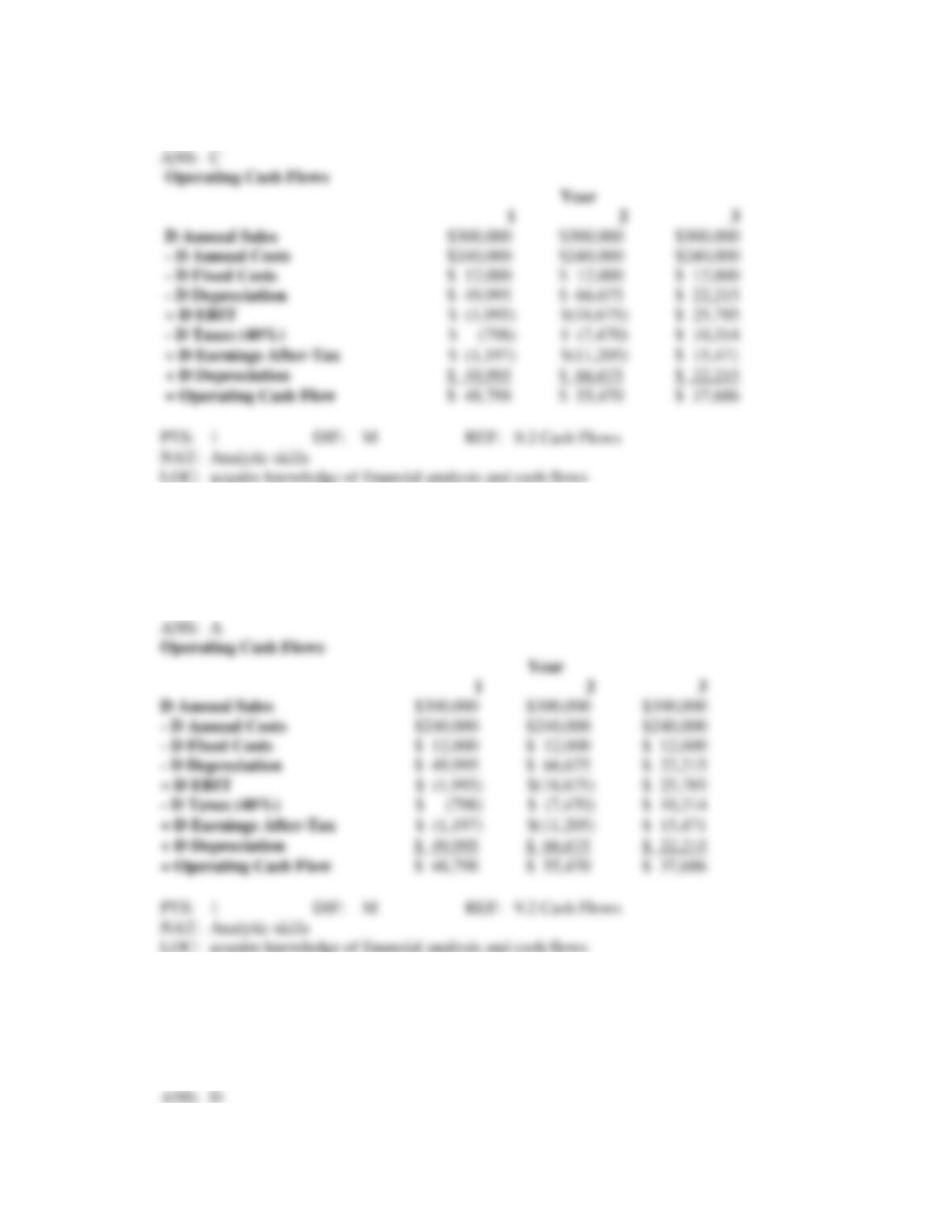
NARREND
60. Refer to FAR Corporation. What is the initial investment outlay for this project?
a.
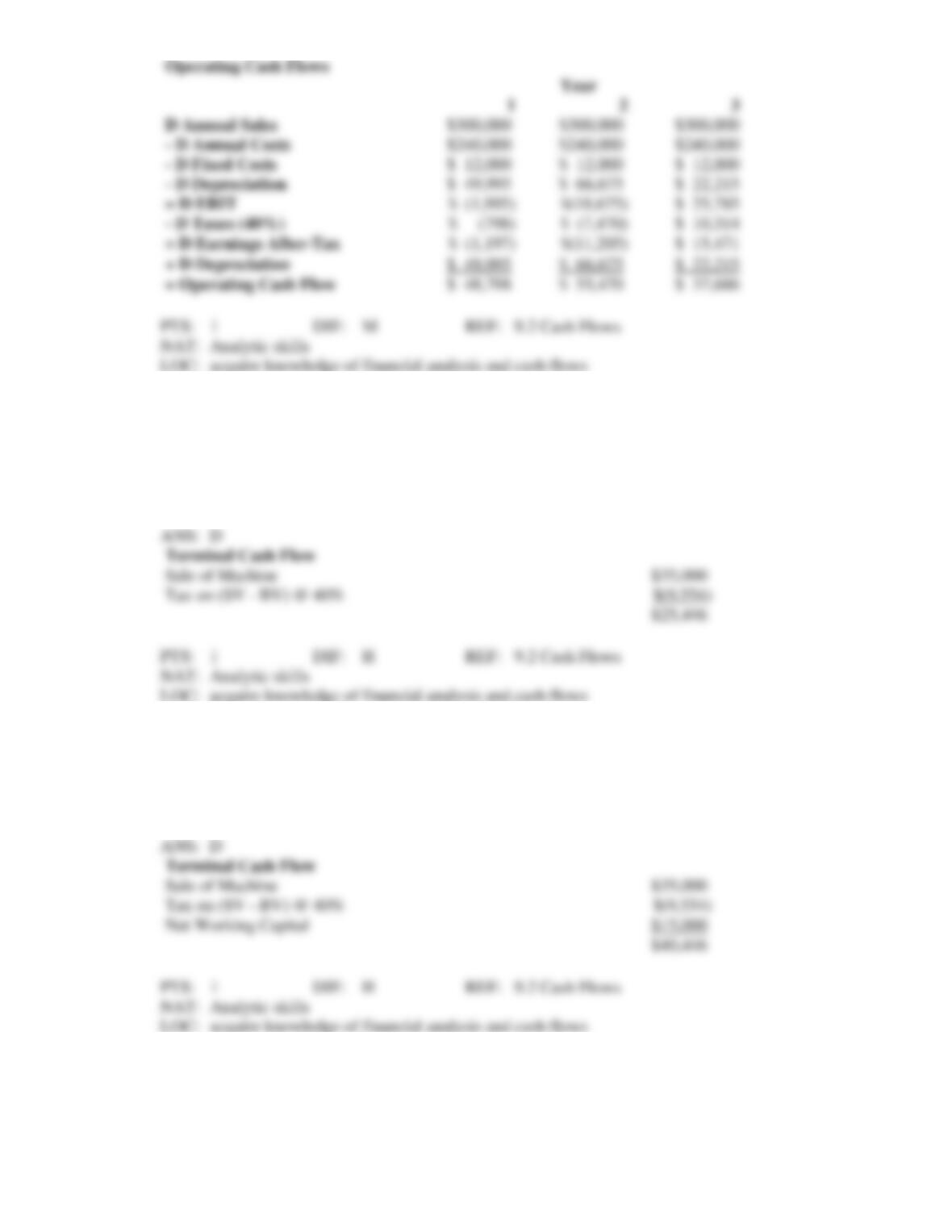
$10,000
b.
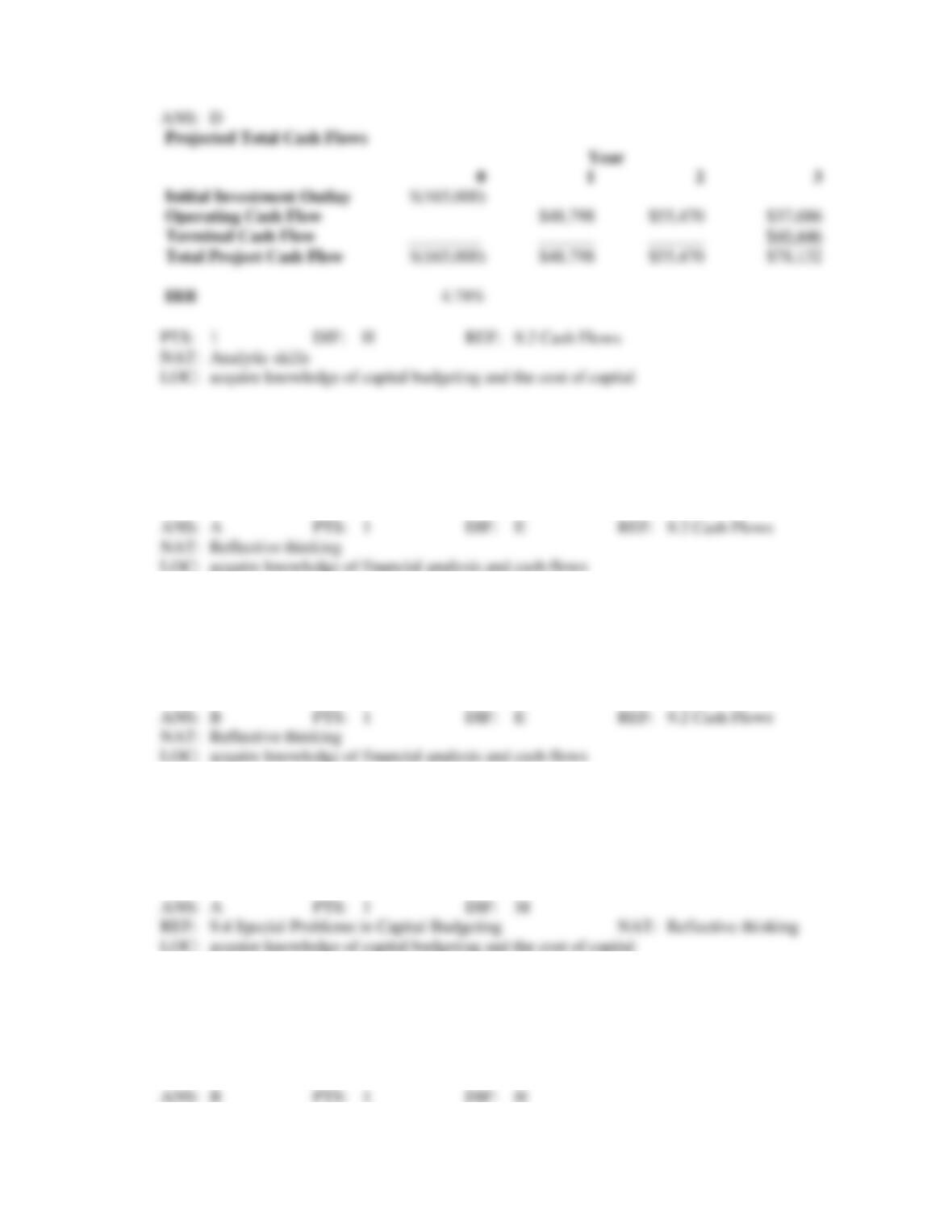
$135,000
c.
$145,000
d.
$165,000
Cost of Machine
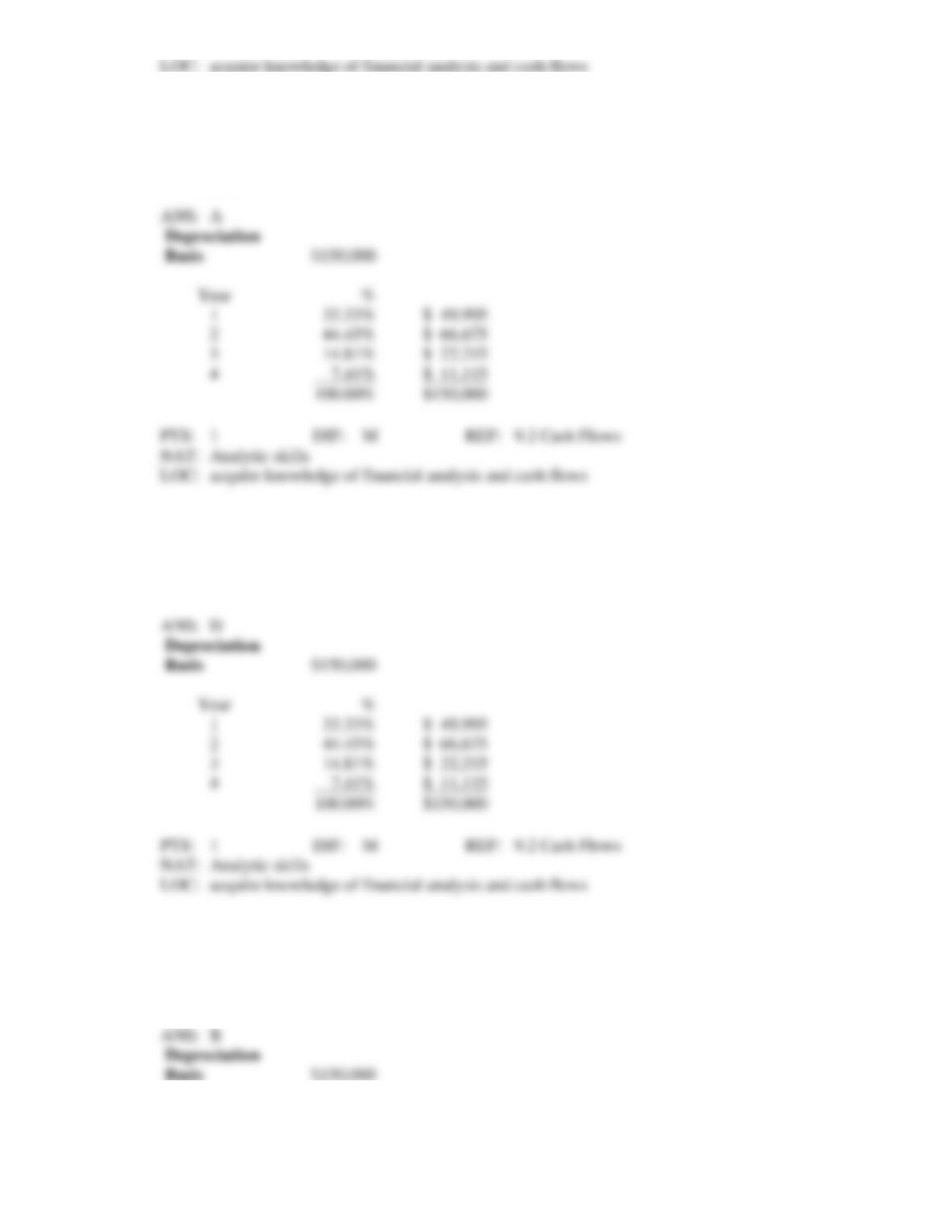
61. Refer to FAR Corporation. What is the depreciation expense in year 1?
a.
$49,995
b.
$22,215
c.
$11,115
d.
$66,675
62. Refer to FAR Corporation. What is the depreciation expense in year 2?
a.
$49,995
b.
$22,215
c.
$11,115
d.
$66,675
63. Refer to FAR Corporation. What is the depreciation expense in year 3?
a.
$49,995
b.
$22,215
c.
$11,115
d.
$66,675
64. Refer to FAR Corporation. What is the book value of the machine at the end of year 3?
a.
$44,995
b.
$22,215
c.
$11,115
d.
$66,675
65. Refer to FAR Corporation. What is the NPV of the project?
a.
$21,597
b.
$73,548
c.
-$21,597
d.
-$52,489
66. Refer to FAR Corporation. What is the operating cash flow for year 1?
a.
$55,470
b.
$60,000
c.
$48,798
d.
$37,686
67. Refer to FAR Corporation. What is the operating cash flow for year 2?
a.
$55,470
b.
$60,000
c.
$48,798
d.
$37,686
68. Refer to FAR Corporation. What is the operating cash flow for year 3?
a.
$55,470
b.
$60,000
c.
$48,798
d.
$37,686
69. Refer to FAR Corporation. What is the after-tax cash flow from selling the machine at the end of year
3?
a.
-$9,554
b.
$35,000
c.
$9,554
d.
$25,446
70. Refer to FAR Corporation. What is the total cash flow generated in year 3?
a.
$35,000
b.
$9,554
c.
$15,000
d.
$40,446
71. Refer to FAR Corporation. What is the IRR of the project?
a.
12.01%
b.
8.74%
c.
5.92%
d.
4.78%
72. Sunk costs:
a.
are irrelevant.
b.
should be considered when determining an investment’s relevant cash flows.
c.
are equal to the firm’s opportunity costs.
d.
all of the above.
73. Opportunity costs:
a.
are irrelevant.
b.
should be considered when determining an investment’s relevant cash flows.
c.
are equal to the firm’s sunk costs.
d.
all of the above.
74. To help rank projects in a capital rationing environment, managers often use the:
a.
profitability index.
b.
internal rate of return.
c.
payback method.
d.
accounting rate of return.
75. The ____ makes capital budgeting ____ complicated.
a.
human element, less
b.
human element, more
c.
human analysis, more
d.
human analysis, less
76. Which of the following statements is true?
a.
Accountants measure cash flows on a cash basis rather than an accrual basis.
b.
Financial analysts focus solely on accrual basis values rather than cash flows when
evaluating potential investments.
c.
Incremental cash flows effectively represent the marginal costs and marginal benefits
expected to result from undertaking a proposed investment.
d.
Both (a) and (c) are true.
e.
All of the above statements are true.
77. Which of the following statements is false with regard to cash flows resulting from financing costs?
a.
They should be included in the cash flow calculations.
b.
Financing cash flows can include dividend payments to stockholders and interest
payments to bondholders.
c.
Financing costs are captured in the discount of a project’s cash flows.
d.
If cash outflows associated with financing costs were deducted from the cash flows for a
project, it would be double-counting the financing costs of the investment.
e.
All of the above statements are false.
78. Which of the following statements is true?
a.
Depreciation is a noncash expense and reduces taxable income thereby reducing the cash
outflow associated with tax payments.
b.
Depreciation’s impact upon cash flows can be accounted for by adding depreciation back
to net income before interest and after taxes.
c.
Depreciation’s impact upon cash flows can be accounted for by adding the tax savings
associated with the depreciation to net income before interest and after taxes.
d.
All of the above statements are true.
e.
Only (a) and (b) are true.
79. When evaluating a potential capital budgeting decision, fixed asset expenditures
a.
should be ignored.
b.
often appear as the initial cash outflow for a project.
c.
can be significantly increased due to the costs of installing the equipment.
d.
All of the above are true.
e.
Only (b) and (c) are true.
80. Which of the following would fall under the definition of cannibalism as it applies to capital
budgeting?
a.
If a firm offered a ‘low–fat’ version of a current product and sales of that new product
were expected to reduce sales of the current version.
b.
The eating of the flesh of an animal by another animal.
c.
If a competitor were to offer a similar or identical product to one your company already
offers and this would lead to reduced sales of your product.
d.
Both (a) and (c) are true.
e.
None of the above is true.
81. The idea that a company may be unable to accept all projects that are expected to have positive NPVs
due to the lack of funds is known as:
a.
capital rationing
b.
capital budgeting
c.
capital constraints
d.
cannibalization
e.
capital structure
82. A firm may be unable to accept all projects that are expected to have positive NPVs due to:
a.
the lack of funds
b.
the lack of trained and reliable personnel
c.
conflicting decisions by the IRR method
d.
both (a) and (b) are true
e.
All of the above are true
83. Which of the following is a reason why firms do not tend to issue new shares of common stock to fund
new projects?
a.
Raising new capital via equity may send a unintended negative signal to the market.
b.
Issuing new equity dilutes a manager’s ownership stake in the firm (unless they purchase
at least an equal proportion of the new shares as they currently own).
c.
By rationing capital senior managers hope to weed out investments with an optimistic bias
built into the cash flow projections.
d.
All of the above are reasons.
e.
Only (b) and (c) are reasons.
84. If a firm is subject to capital rationing, when choosing a set of potential investments the firm should
rank the projects by:
a.
NPV and choose the best ones until funding is exhausted.
b.
IRR and choose the best ones until funding is exhausted.
c.
PI and choose the best ones until funding is exhausted.
d.
ARR and choose the best ones until funding is exhausted.
85. When a firm operates at less than full capacity
a.
managers should charge the cost of accelerating new capacity development against the
current proposal for using excess capacity.
b.
treating that excess capacity as a free asset is a good idea in both the long- and short-run.
c.
treating that excess capacity as a free asset may accelerate the need for more capacity in
the future.
d.
All of the above are true.
e.
Both (a) and (c) are true.
86. Which of the following statements is true?
a.
To help combat optimistic bias when estimating a project’s cash flows, companies place
responsibility for analyzing an investment proposal under an independent authority from
the group proposing the project.
b.
Financial experts need to have a sense of what is reasonable when forecasting a potential
project’s profit margin and growth potential.
c.
Financial analysts need to be prepared to defend their assumptions for a potential project
and explain why their estimates do not agree with those offered by the project’s advocates.
d.
All of the above are true.
e.
Only (a) and (c) are true.
87. Consider the following MACRS Table for a 5-year asset. If an asset is purchased for $100,000; with
a shipping and istallation cost of $10,000 and an expected salvage value of $20,000; what is the
depreciation expense in the second year?
Year
Exp. Ratio
1
20.00
2
32.00
3
19.20
4
11.52
5
11.52
6
5.76
a.
$ 35,200.00
b.
$ 32,000.00
c.
$ 28,800.00
d.
$ 25,600.00
88. Consider the following MACRS Table for a 5-year asset. If an asset is purchased for $250,000; with
a shipping and istallation cost of $35,000 and an expected salvage value of $20,000; what is the
depreciation expense in the second year?
Year
Exp. Ratio
1
20.00
2
32.00
3
19.20
4
11.52
5
11.52
6
5.76
a.
$ 80,000.00
b.
$ 91,200.00
c.
$ 84,800.00
d.
$ 73,600.00
89. Consider the following MACRS Table for a 5-year asset. If an asset is purchased for $200,000; with
a shipping and istallation cost of $15,000 and an expected salvage value of $30,000; what is the
depreciation expense in the second year?
Year
Exp. Ratio
1
20.00
2
32.00
3
19.20
4
11.52
5
11.52
6
5.76
a.
$ 64,000.00
b.
$ 62,400.00
c.
$ 68,800.00
d.
$ 57,600.00
90. If you have an increase in accounts recieveable of $20,000; an increase in inventory of $10,000; and an
increase in accounts payable of $6,000, what is the change in net working capital?
a.
$ (24,000.00)
b.
$ 36,000.00
c.
$ 24,000.00
d.
$ (16,000.00)
91. If you have an increase in accounts recieveable of $10,000; an increase in inventory of $15,000; and an
increase in accounts payable of $4,000, what is the change in net working capital?
a.
$ 29,000.00
b.
$ 21,000.00
c.
$ (19,000.00)
d.
$ (21,000.00)
92. If you have an decrease in accounts recieveable of $10,000; an increase in inventory of $15,000; and
an increase in accounts payable of $4,000, what is the change in net working capital?
a.
$ 9,000.00
b.
$ (1,000.00)
c.
$ 1,000.00
d.
$ (19,000.00)
93. You are considering buying carpet for your university; Grade A carpet costs $17.10 a square yard and
lasts 5 years and Grade B costs $12.50 a square yard and lasts 3 years; Grade C costs $8 a yard and
lasts 2 years; which carpet should be chosen if the discount rate is 10%? Assume that due to a large
endowment given by the state’s”carpet king” the university is committed to continued carpet use.
Which carpet should be chosen?
a.
Grade A
b.
Grade B
c.
Grade C
94. You are considering buying carpet for your university; Grade A carpet costs $19.25 a square yard and
lasts 5 years and Grade B costs $12.25 a square yard and lasts 3 years; Grade C costs $9.25 a yard
and lasts 2 years; which carpet should be chosen if the discount rate is 10%? Assume that due to a
large endowment given by the state’s”carpet king” the university is committed to continued carpet use.
Which carpet should be chosen?
a.
Grade A
b.
Grade B
c.
Grade C
95. You are considering buying carpet for your university; Grade A carpet costs $25.25 a square yard and
lasts 5 years and Grade B costs $18.25 a square yard and lasts 3 years; Grade C costs $12.10 a yard
and lasts 2 years; which carpet should be chosen if the discount rate is 5%? Assume that due to a large
endowment given by the state’s”carpet king” the university is committed to continued carpet use.
Which carpet should be chosen?
a.
Grade A
b.
Grade B
c.
Grade C
96. You are considering buying carpet for your university; Grade A carpet costs $25.25 a square yard and
lasts 5 years and Grade B costs $18.25 a square yard and lasts 3 years; Grade C costs $12.10 a yard
and lasts 2 years; which carpet should be chosen if the discount rate is 5%? Assume that due to a large
endowment given by the state’s”carpet king” the university is committed to continued carpet use.
What is the EAC of Grade A carpet?
a.
$ (4.44)
b.
$ (4.36)
c.
$ (4.22)
d.
none of the above
97. You are considering buying carpet for your university; Grade A carpet costs $25.25 a square yard and
lasts 5 years and Grade B costs $18.25 a square yard and lasts 3 years; Grade C costs $12.10 a yard
and lasts 2 years; which carpet should be chosen if the discount rate is 5%? Assume that due to a large
endowment given by the state’s”carpet king” the university is committed to continued carpet use.
What is the EAC of Grade B carpet?
a.
$ (4.44)
b.
$ (4.36)
c.
$ (4.22)
d.
none of the above
98. You are considering buying carpet for your university; Grade A carpet costs $25.25 a square yard and
lasts 5 years and Grade B costs $18.25 a square yard and lasts 3 years; Grade C costs $12.10 a yard
and lasts 2 years; which carpet should be chosen if the discount rate is 5%? Assume that due to a large
endowment given by the state’s”carpet king” the university is committed to continued carpet use.
What is the EAC of Grade C carpet?
a.
$ (4.44)
b.
$ (4.36)
c.
$ (4.22)
d.
none of the above