Corporate Finance, 4e (Berk / DeMarzo)
Chapter 9 Valuing Stocks
9.1 The Dividend-Discount Model
1) Which of the following is NOT a way that a firm can increase its dividend?
A) By increasing its retention rate
B) By decreasing its shares outstanding
C) By increasing its earnings (net income)
D) By increasing its dividend payout rate
2) Which of the following statements is false regarding profitable and unprofitable growth?
A) If a firm wants to increase its share price, it must cut its dividend and invest more.
B) If the firm retains more earnings, it will be able to pay out less of those earnings, which means that
the firm will have to reduce its dividend.
C) A firm can increase its growth rate by retaining more of its earnings.
D) Cutting the firm’s dividend to increase investment will raise the stock price if, and only if, the new
investments have a positive NPV.
3) Which of the following statements is FALSE?
A) Estimating dividends, especially for the distant future, is difficult.
B) A firm can only pay out its earnings to investors or reinvest their earnings.
C) Successful young firms often have high initial earnings growth rates.
D) According to the constant dividend growth model, the value of the firm depends on the current
dividend level, divided by the equity cost of capital plus the growth rate.
4) Which of the following statements is FALSE?
A) We should use the general dividend discount model to value the stock of a firm with rapid or
changing growth.
B) As firms mature, their growth slows to rates more typical of established companies.
C) The dividend discount model values the stock based on a forecast of the future dividends paid to
shareholders.
D) The simplest forecast for the firm’s future dividends states that they will grow at a constant rate, g,
forever.
5) Which of the following statements is FALSE?
A) A common approximation is to assume that in the long run, dividends will grow at a constant rate.
B) The dividend each year is the firm’s earnings per share (EPS) multiplied by its dividend payout rate.
C) There is a tremendous amount of uncertainty associated with any forecast of a firm’s future
dividends.
D) During periods of high growth, it is not unusual for firms to pay out 100% of their earnings to
shareholders in the form of dividends.
6) Which of the following statements is FALSE?
A) As firms mature, their earnings exceed their investment needs and they begin to pay dividends.
B) Total return equals earnings multiplied by the dividend payout rate.
C) Cutting the firm’s dividend to increase investment will raise the stock price if, and only if, the new
investments have a positive NPV.
D) We cannot use the constant dividend growth model to value the stock of a firm with rapid or
changing growth.
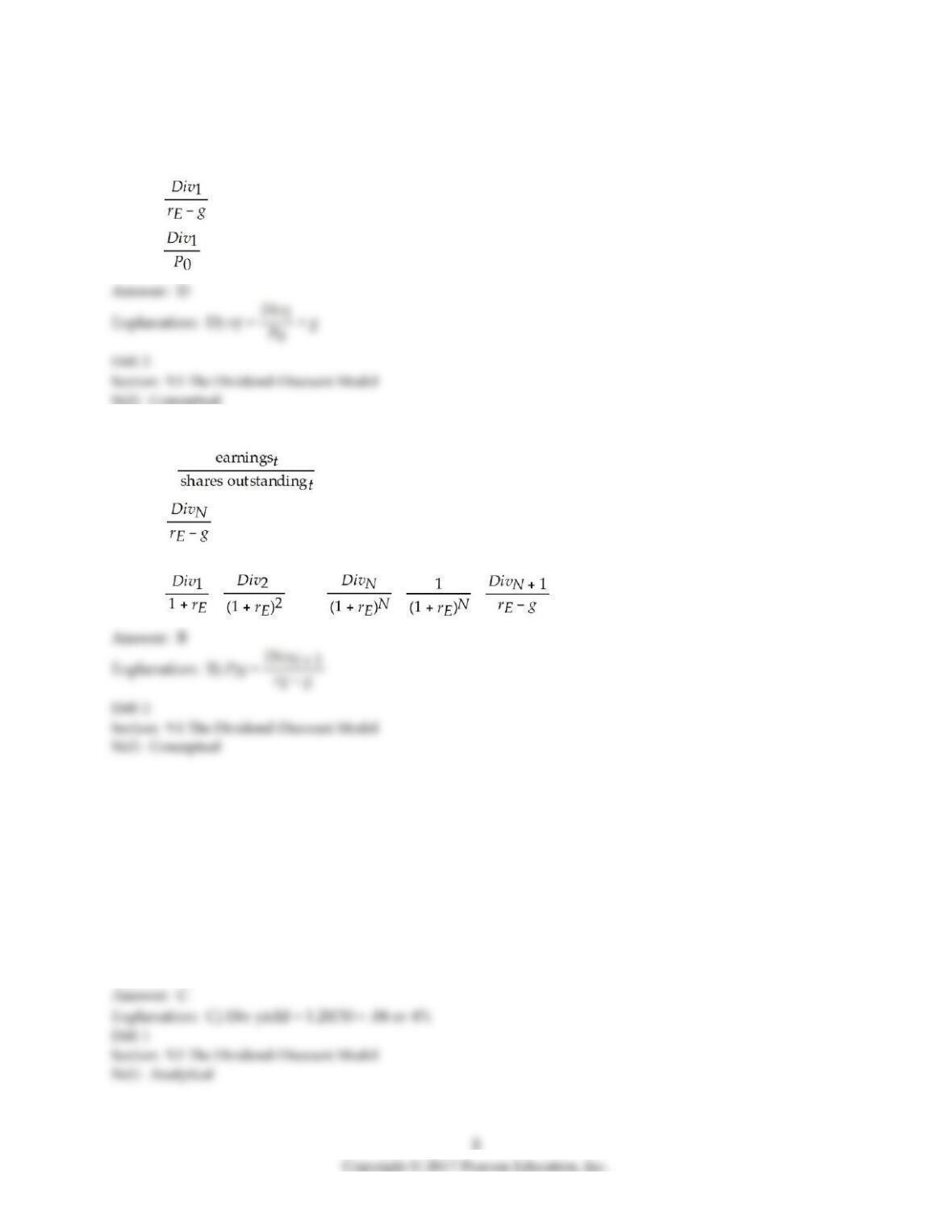
7) Which of the following formulas is INCORRECT?
A) g = retention rate × return on new investment
B) Divt = EPSt × Dividend Payout Rate
C) P0 =
D) rE = – g
8) Which of the following formulas is INCORRECT?
A) Divt = × Dividend Payout Rate
B) PN =
C) earnings growth rate = retention rate × return on new investment
D) P0 = + + … + + ×
Use the following information to answer the question(s) below.
Rearden Metals has a current stock price of $30 share, is expected to pay a dividend of $1.20 in one year,
and its expected price right after paying that dividend is $33.
9) Rearden’s expected dividend yield is closest to:
A) 3.40%
B) 3.65%
C) 4.00%
D) 4.20%
10) Rearden’s expected capital gains yield is closest to:
A) 4.0%
B) 6.4%
C) 8.2%
D) 10.0%
11) Rearden’s equity cost of capital is closest to:
A) 4.0%
B) 6.4%
C) 8.2%
D) 14.0%
12) Nielson Motors has a share price of $25 today. If Nielson Motors is expected to pay a dividend of
$0.75 this year, and its stock price is expected to grow to $26.75 at the end of the year, then Nielson’s
dividend yield and equity cost of capital are:
A) 3.0% and 7.0% respectively.
B) 3.0% and 10.0% respectively.
C) 4.0% and 6.0% respectively.
D) 4.0% and 10.0% respectively.
13) NoGrowth industries presently pays an annual dividend of $1.50 per share and it is expected that
these dividend payments will continue indefinitely. If NoGrowth’s equity cost of capital is 12%, then
the value of a share of NoGrowth’s stock is closest to:
A) $10.00
B) $15.00
C) $14.00
D) $12.50
14) Von Bora Corporation (VBC) is expected to pay a $2.00 dividend at the end of this year. If you
expect VBC’s dividend to grow by 5% per year forever and VBC’s equity cost of capital is 13%, then the
value of a share of VBS stock is closest to:
A) $25.00
B) $40.00
C) $15.40
D) $11.10
15) Luther Industries has a dividend yield of 4.5% and and a cost of equity capital of 12%. Luther
Industries dividends are expected to grow at a constant rate indefinitely. The grow rate of Luther’s
dividends are closest to:
A) 7.5%
B) 5.5%
C) 16.5%
D) 12%
16) The Sisyphean Company’s common stock is currently trading for $25.00 per share. The stock is
expected to pay a $2.50 dividend at the end of the year and the Sisyphean Company’s equity cost of
capital is 14%. If the dividend payout rate is expected to remain constant, then the expected growth rate
in the Sisyphean Company’s earnings is closest to:
A) 8%
B) 6%
C) 4%
D) 2%
17) You expect KT Industries (KTI) will have earnings per share of $3 this year and expect that they will
pay out $1.50 of these earnings to shareholders in the form of a dividend. KTI’s return on new
investments is 15% and their equity cost of capital is 12%. The expected growth rate for KTI’s dividends
is closest to:
A) 6.0%
B) 7.5%
C) 4.5%
D) 3.0%
18) You expect KT Industries (KTI) will have earnings per share of $3 this year and expect that they will
pay out $1.50 of these earnings to shareholders in the form of a dividend. KTI’s return on new
investments is 15% and their equity cost of capital is 12%. The value of a share of KTI’s stock is closest
to:
A) $39.25
B) $20.00
C) $33.35
D) $12.50
19) JRN Enterprises just announced that it plans to cut its dividend from $2.50 to $1.50 per share and use
the extra funds to expand its operations. Prior to this announcement, JRN’s dividends were expected to
grow at 4% per year and JRN’s stock was trading at $25.00 per share. With the new expansion, JRN’s
dividends are expected to grow at 8% per year indefinitely. Assuming that JRN’s risk is unchanged by
the expansion, the value of a share of JRN after the announcement is closest to:
A) $25.00
B) $15.00
C) $31.25
D) $27.50
20) You expect that Bean Enterprises will have earnings per share of $2 for the coming year. Bean plans
to retain all of its earnings for the next three years. For the subsequent two years, the firm plans on
retaining 50% of its earnings. It will then retain only 25% of its earnings from that point forward.
Retained earnings will be invested in projects with an expected return of 20% per year. If Bean’s equity
cost of capital is 12%, then the price of a share of Bean’s stock is closest to:
A) $17.00
B) $10.75
C) $27.75
D) $43.50
21) Monsters Inc. is a utility company that recently paid a common stock dividend of $2.35 per share.
Determine the current price of a share of Monsters’ common stock if its divided growth rate is expected
to remain at 7 percent per year indefinitely and its equity cost of capital is 12 percent.
22) MJ LTD is expected to grow at various rates over the next five years. The company just paid a $1.00
dividend. The company expects to grow at 20% for the next two years (effecting D1 and D2), then the
company expects to grow at 10% for three additional years (D3, D4, D5) after which the company
expects to grow at a constant rate of 5% per year indefinitely. If the required rate of return on MJ’s
common stock is 12%, then what is a share of MJ’s stock worth?
23) Growing Real Fast Company (GRF) is expected to have a 25 percent growth rate for the next four
years (effecting D1, D2, D3, and D4). Beginning in year five, the growth rate is expected to drop to 7
percent per year and last indefinitely. If GRF just paid a $2.00 dividend and the appropriate discount
rate is 15 percent, then what is the value of a share of GRE?
24) Which of the following statements is FALSE?
A) There are two potential sources of cash flows from owning a stock.
B) An investor will be willing to pay a price today for a share of stock up to the point that this
transaction has a zero NPV.
C) An investor might generate cash by choosing to sell the shares at some future date.
D) Because the cash flows from stock are known with certainty, we can discount them using the risk–
free interest rate.
25) When discounting dividends you should use:
A) the weighted average cost of capital.
B) the after tax weighted average cost of capital.
C) the equity cost of capital.
D) the before tax cost of debt.
26) Which of the following statements is FALSE?
A) The equity cost of capital for a stock is the expected return of other investments available in the
market with equivalent risk to the firm‘s shares.
B) The price of a share of stock is equal to the present value of the expected future dividends it will pay.
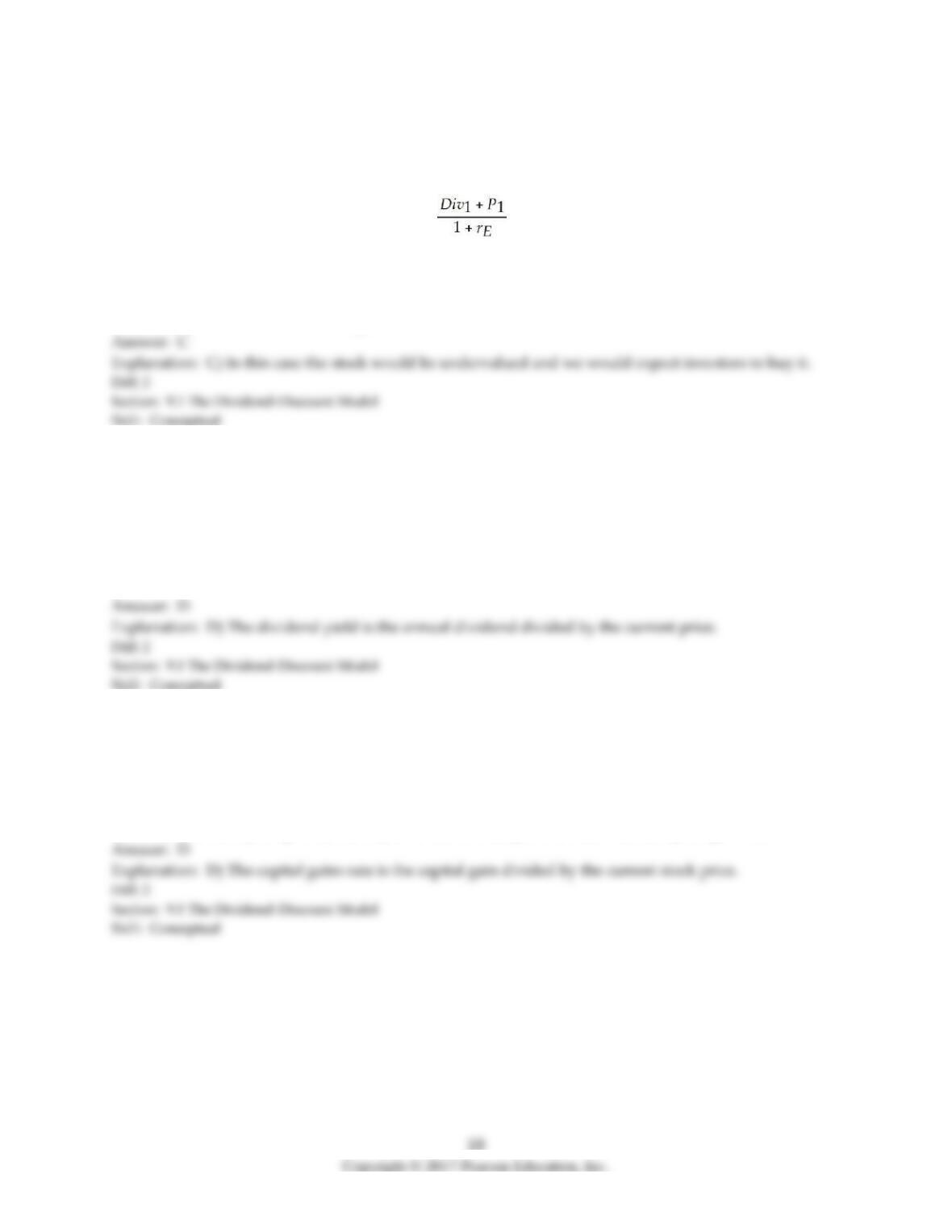
C) If the current stock price were less than P0 = , it would be a negative NPV investment, and
we would expect investors to rush in and sell it, driving down the stocks price.
D) The law of one price implies that to value any security, we must determine the expected cash flows
an investor will receive from owning it.
27) Which of the following statements is FALSE?
A) We must discount the cash flows from stock based on the equity cost of capital for the stock.
B) The divided yield is the percentage return the investor expects to earn from the dividend paid by the
stock.
C) The firm might pay out cash to its shareholders in the form of a dividend.
D) The dividend yield is the expected annual dividend of a stock, divided by its expected future sale
price.
28) Which of the following statements is FALSE?
A) Future dividend payments and stock prices are not known with certainty; rather these values are
based on the investor’s expectations at the time the stock is purchased.
B) The capital gain is the difference between the expected sale price and the purchase price of the stock.
C) The sum of the dividend yield and the capital gain rate is called the total return of the stock.
D) We divide the capital gain by the expected future stock price to calculate the capital gain rate.
29) Which of the following statements is FALSE?
A) An investor will be willing to pay up to the point at which the current price of a share of stock equals
the present value of the expected future dividends and the expected future sale price.
B) The expected total return of a stock should equal the expected return of other investments available
in the market with equivalent risk.
C) The total amount received in dividends and from selling the stock will depend on the investor’s
investment horizon.
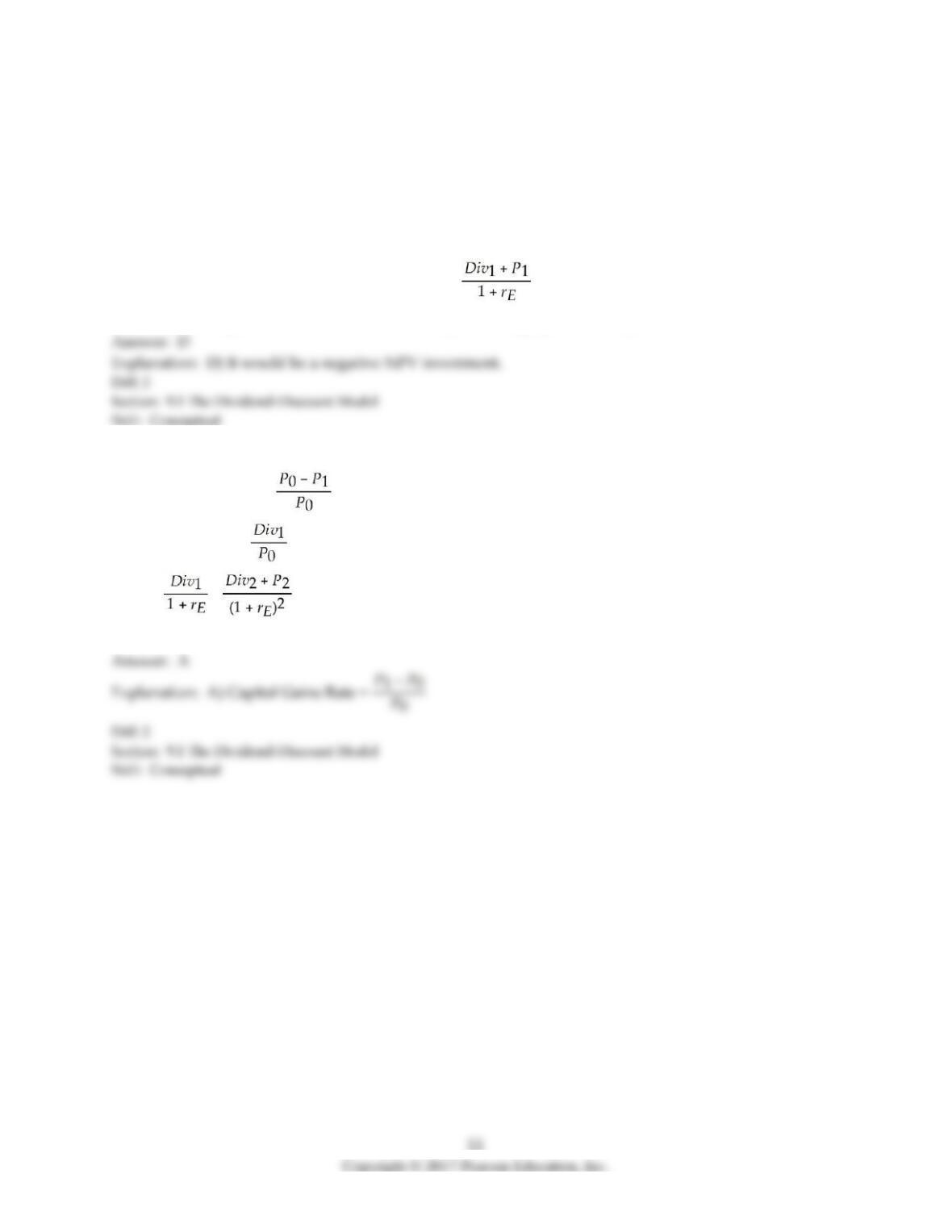
D) If the current stock price were greater than P0 = , it would be a positive NPV investment,
and we would expect investors to rush in and buy it, driving up the stocks price.
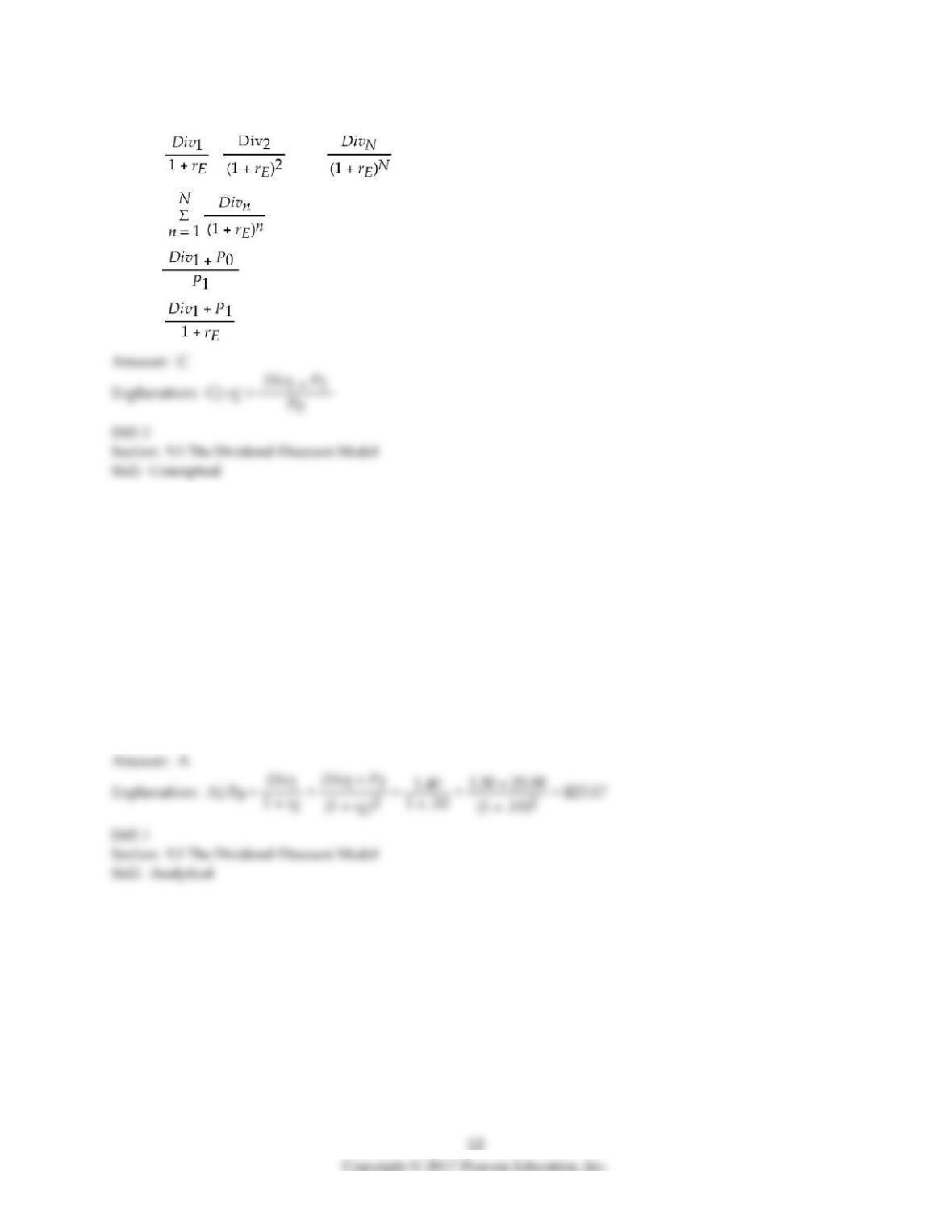
30) Which of the following formulas is INCORRECT?
A) Capital Gains Rate =
B) Dividend Yield =
C) P0 = +
D) rE = Capital Gains Rate + Dividend Yield
31) Which of the following formulas is INCORRECT?
A) P0 = + + … +
B) P0 =
C) rE =
D) P0 =
Use the information for the question(s) below.
Von Bora Corporation is expected pay a dividend of $1.40 per share at the end of this year and a $1.50
per share at the end of the second year. You expect Von Bora‘s stock price to be $25.00 at the end of two
years. Von Bora’s equity cost of capital is 10%.
32) The price you would be willing to pay today for a share of Von Bora stock, if you plan to hold the
stock for two years is closest to:
A) $23.15
B) $20.65
C) $21.95
D) $21.90
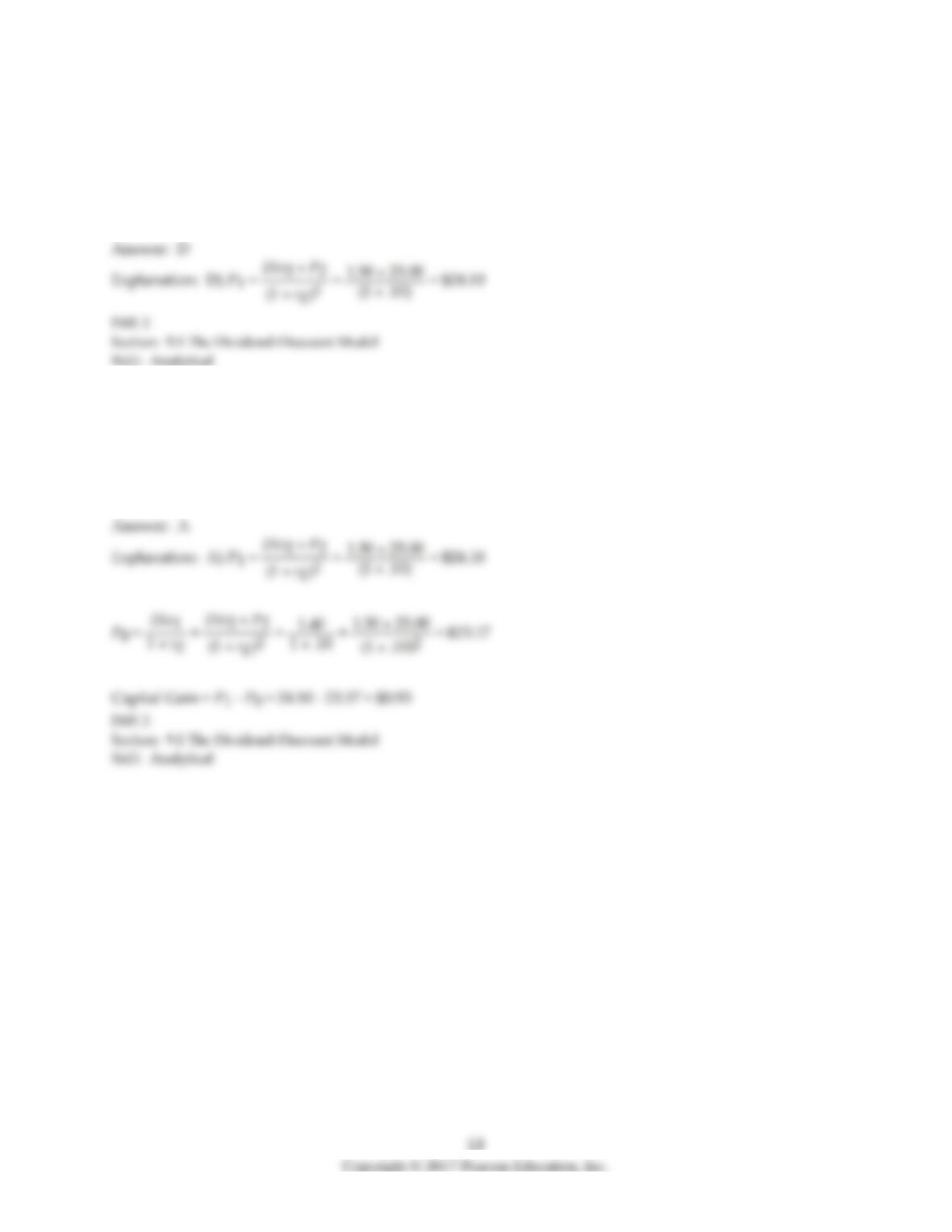
33) Suppose you plan to hold Von Bora stock for one year. The price one would expect to be able to sell
a share of Von Bora stock for in one year is closest to:
A) $26.50
B) $22.70
C) $23.15
D) $24.10
34) Suppose you plan to hold Von Bora stock for only one year. Your capital gain from holding Von
Bora stock for the first year is closest to:
A) $0.95
B) $1.40
C) $1.85
D) $1.25
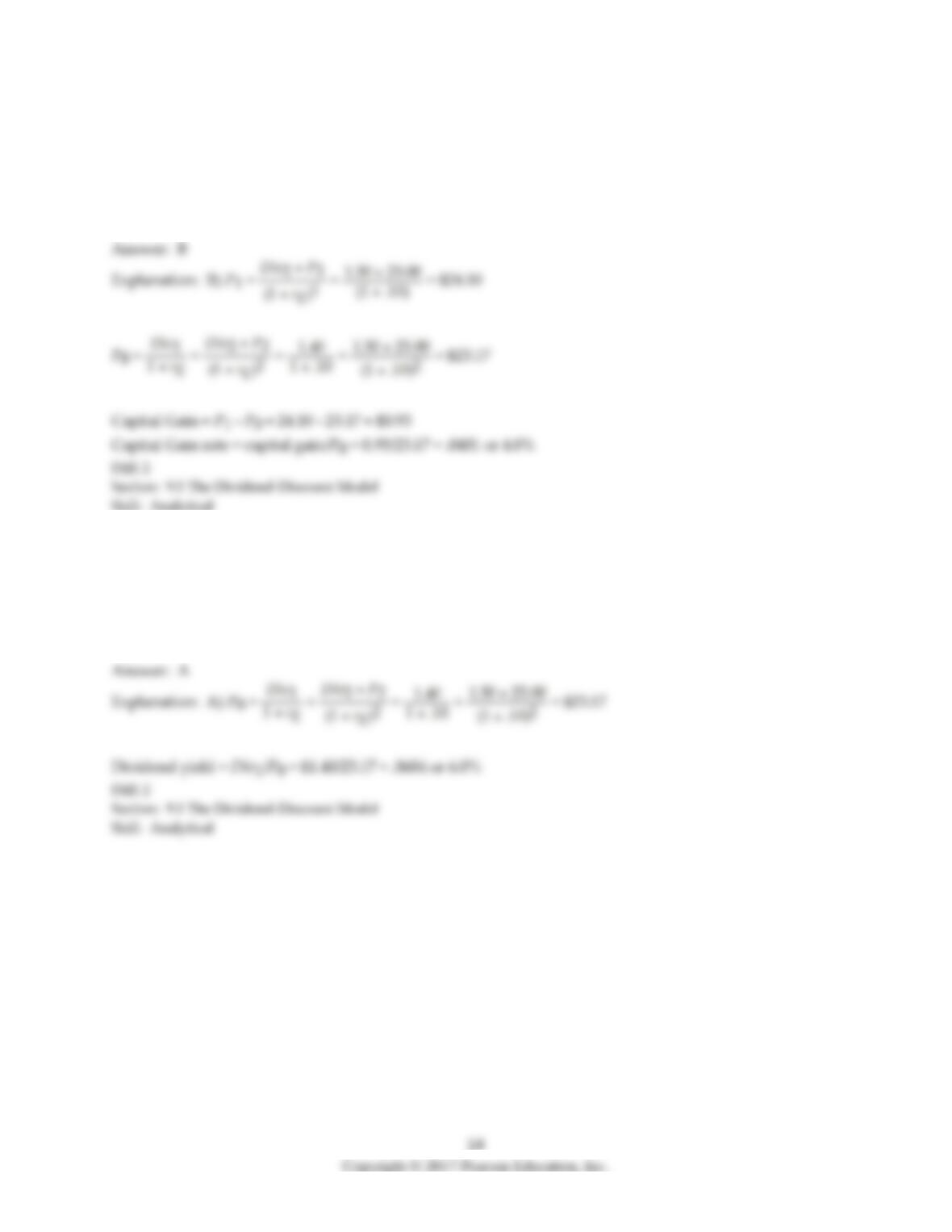
35) Suppose you plan to hold Von Bora stock for only one year. Your capital gain rate from holding
Von Bora stock for the first year is closest to:
A) 3.5%
B) 4.0%
C) 6.0%
D) 4.5%
36) Suppose you plan to hold Von Bora stock for only one year. Your dividend yield from holding Von
Bora stock for the first year is closest to:
A) 6.0%
B) 4.0%
C) 6.5%
D) 5.5%
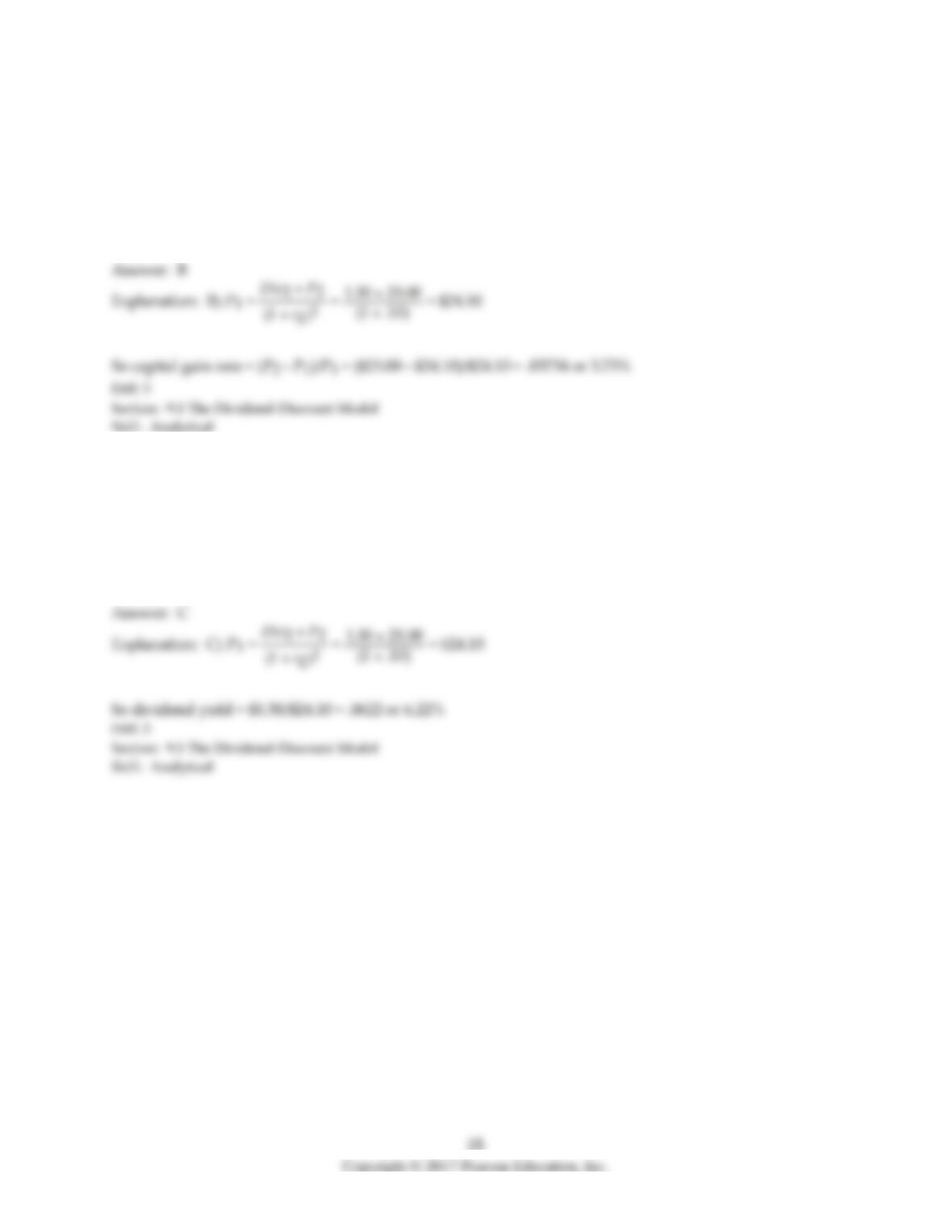
37) Suppose you plan on purchasing Von Bora stock in one year, right after the $1.40 dividend is paid.
You then plan on selling your stock at the end of year two, right after the $1.50 dividend is paid. The
capital gain rate that you will receive on your investment is closest to:
A) 4.00%
B) 3.75%
C) 6.25%
D) 3.50%
38) Suppose you plan on purchasing Von Bora stock in one year, right after the $1.40 dividend is paid.
You then plan on selling your stock at the end of year two, right after the $1.50 dividend is paid. The
dividend yield that you will receive on your investment is closest to:
A) 5.75%
B) 6.50%
C) 6.25%
D) 4.00%
16
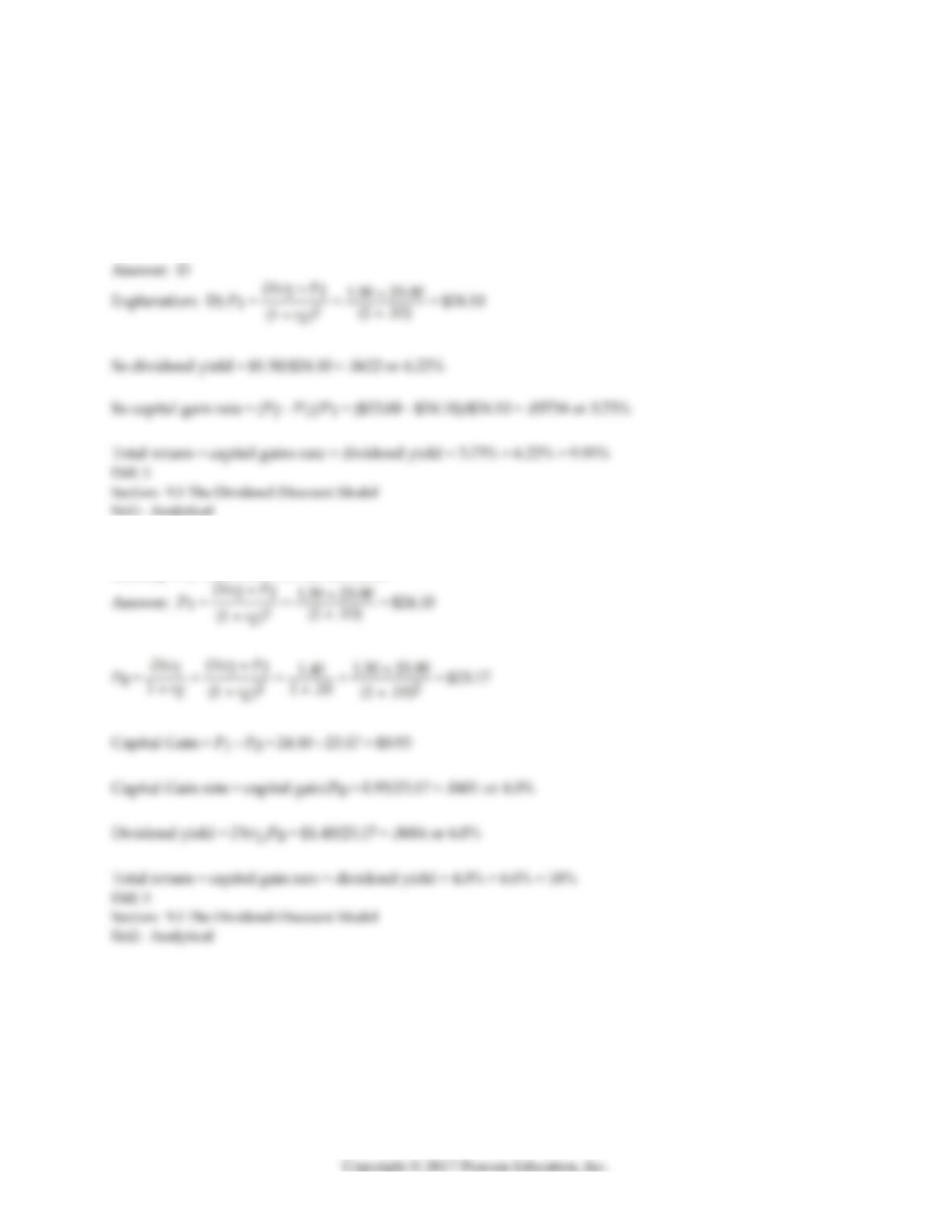
39) Suppose you plan on purchasing Von Bora stock in one year, right after the $1.40 dividend is paid.
You then plan on selling your stock at the end of year two, right after the $1.50 dividend is paid. The
total return that you will receive on your investment is closest to:
A) 9.50%
B) 10.75%
C) 10.25%
D) 10.00%
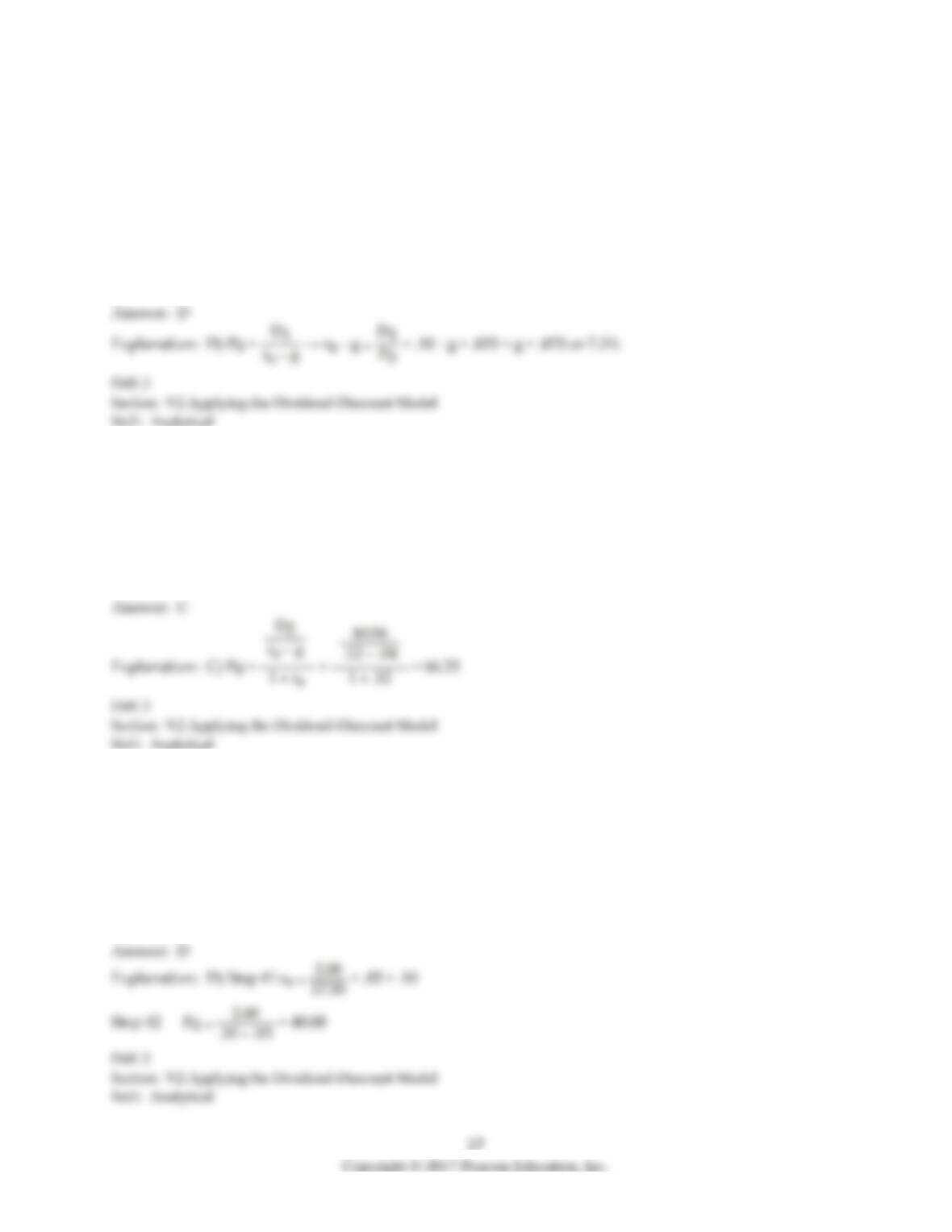
40) Suppose you plan to hold Von Bora stock for only one year. Calculate your total return from
holding Von Bora stock for the first year.
9.2 Applying the Dividend-Discount Model
1) Taggart Transcontinental has a divided yield of 2.5%. Taggart’s equity cost of capital is 10%, and its
dividends are expected to grow at a constant rate. Based on this information, Taggart’s constant growth
rate in dividends is closest to:
A) 2.5%
B) 5.0%
C) 10.0%
D) 7.5%
2) Wyatt Oil presently pays no dividend. You anticipate Wyatt Oil will pay an annual dividend of $0.56
per share two years from today and you expect dividends to grow by 4% per year thereafter. IF Wyatt
Oil’s equity cost of capital is 12%, then the value of a share of Wyatt Oil today is:
A) $4.67
B) $5.00
C) $6.25
D) $7.00
3) Kinston Industries just announced that it will cut its dividend from $3.00 to $2.00 per share and use
the extra funds to expand its operations. Kinston’s dividends were expected to grow at a 2% rate, and its
share price was $37.50. With the new expansion, Kinston dividends are expected to grow at a 5% rate.
Kinston’s share price following this announcement should be:
A) $20.00
B) $30.00
C) $37.50
D) $40.00
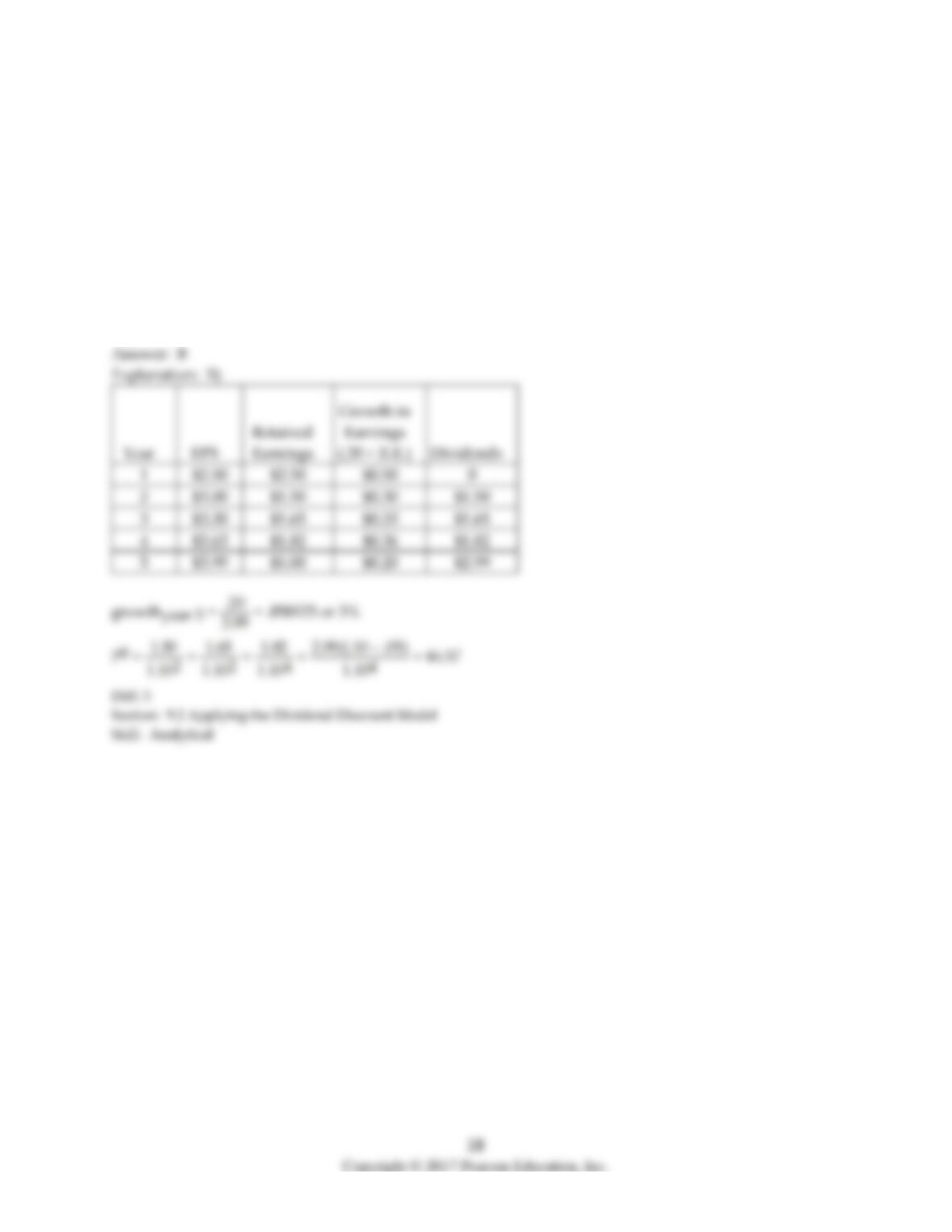
4) Rearden Metals expects to have earnings this coming year of $2.50 per share. Rearden plans to retain
all of its earnings for the next year. For the subsequent three years, the firm will retain 50% of its
earnings. It will ten retain 25% of its earnings from that point onward. Each year, retained earnings will
be invested in new projects with an expected return of 20% per year. Any earnings that are not retained
will be paid out as dividends. Assume Rearden’s shares outstanding remains constant and all earnings
growth comes from the investment of retained earnings. If Rearden’s equity cost of capital is 10%, then
Rearden’s stock price is closest to:
A) $40.80
B) $44.60
C) $59.80
D) $63.50
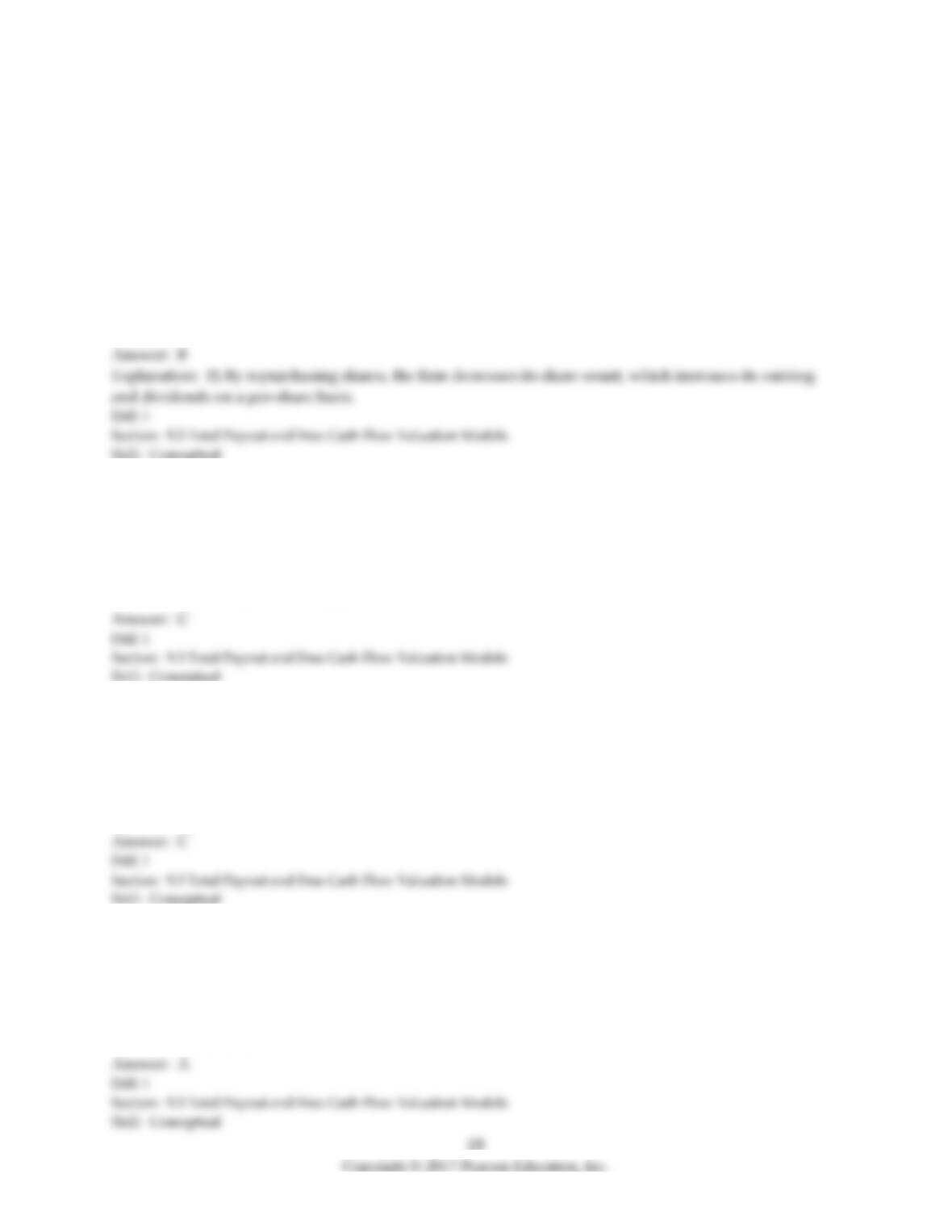
9.3 Total Payout and Free Cash Flow Valuation Models
1) Which of the following statements is FALSE?
A) The total payout model allows us to ignore the firm’s choice between dividends and share
repurchases.
B) By repurchasing shares, the firm increases its share count, which decreases its earning and dividends
on a per-share basis.
C) The total payout model discounts the total payouts that the firm makes to shareholders, which is the
total amount spent on both dividends and share repurchases.
D) In the dividend discount model, we implicitly assume that any cash paid out to the shareholders
takes the form of a dividend.
2) If you want to value a firm that consistently pays out its earnings as dividends, the simplest model
for you to use is the:
A) enterprise value model.
B) total payout model.
C) dividend discount model.
D) discounted free cash flow model.
3) If you want to value a firm that has consistent earnings growth, but varies how it pays out these
earnings to shareholders between dividends and repurchases, the simplest model for you to use is the:
A) enterprise value model.
B) dividend discount model.
C) total payout model.
D) discounted free cash flow model.
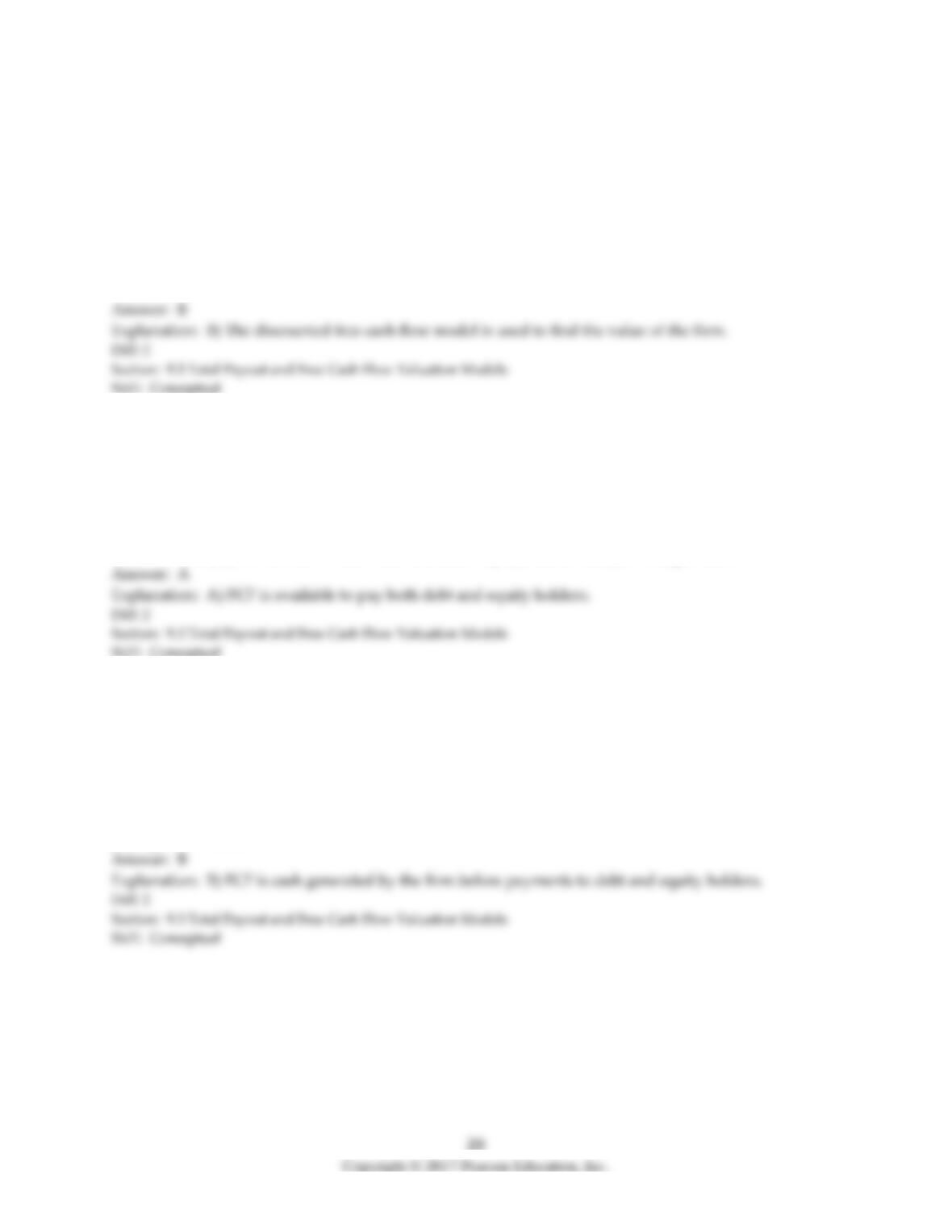
4) If you want to value a firm but don’t want to explicitly forecast its dividends, share repurchases, or its
use of debt, what is the simplest model for you to use?
A) Discounted free cash flow model
B) Dividend discount model
C) Enterprise value model
D) Total payout model
5) Which of the following statements is FALSE?
A) In a share repurchase, the firm uses excess cash to buy back its own stock.
B) The discounted free cash flow model begins by determining the value of the firm’s equity.
C) The discounted free cash flow model focuses on the cash flows to all of the firm’s investors, both debt
and equity holders, and allows us to avoid estimating the impact of the firm’s borrowing decisions on
earnings.
D) In recent years, an increasing number of firms have replaced dividend payouts with share
repurchases.
6) Which of the following statements is FALSE?
A) To estimate a firm’s enterprise value, we compute the present value of the free cash flows (FCF) that
the firm has available to pay equity holders.
B) The NPV of any individual project represents its contribution to the firm’s enterprise value.
C) When using the total payout model, we discount total dividends and share repurchases, and use the
growth rate in earnings when forecasting the growth of the firm’s payout.
D) In the total payout model, we first value the firm’s equity, rather than just a single share.
7) Which of the following statements is FALSE?
A) The more cash the firm uses to repurchase shares, the less it has available to pay dividends.
B) Free cash flow measures the cash generated by the firm after payments to debt or equity holders are
considered.
C) We estimate a firm’s current enterprise value by computing the present value of the firm’s free cash
flow.
D) We can interpret the enterprise value as the net cost of acquiring the firm’s equity, taking its cash and
paying off all debts.