Chapter 9—Cash Flow and Capital Budgeting
MULTIPLE CHOICE
1. Gamma Electronics is considering the purchase of testing equipment that will cost $500,000. The
equipment has a 5-year lifetime with no salvage value. Assume the new machine will generate
after-tax savings of $100,000 per year for the five years.
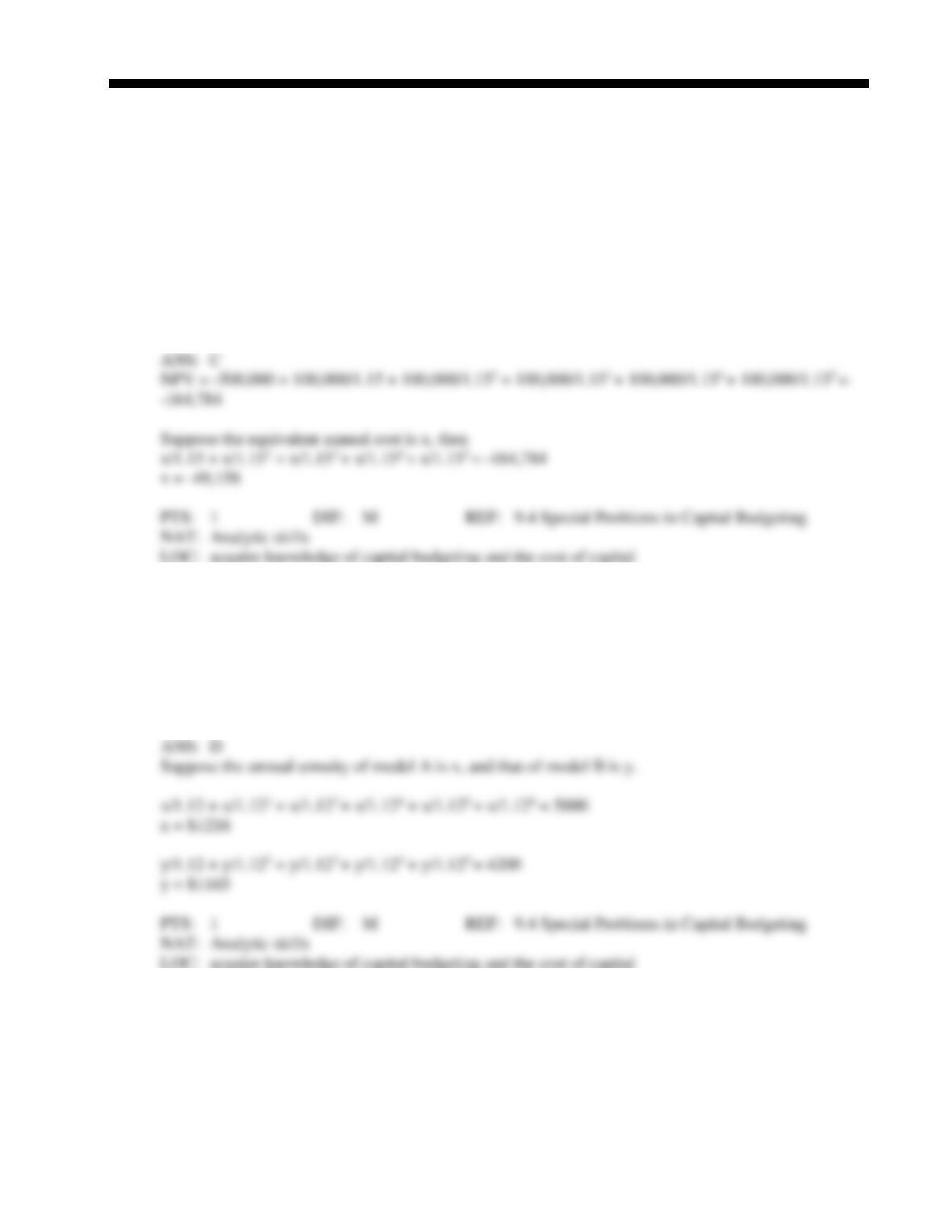
If the firm has a 15% cost of capital, what is the equivalent annual cost of the equipment?
a.
$32,924
b.
$42,746
c.
$49,158
d.
$37,863
2. Thompson Manufacturing must choose between two types of furnaces to install. Model A has a 6-year
life, and an NPV of $5,000. Model B has a 5-year life, and an NPV of $4,200. The relevant discount
rate is 12%. Which model should be chosen? What’s the annual cash flow from that model?
a.
Model B; $1,165
b.
Model B; $840
c.
Model A; $833
d.
Model A; $1,216
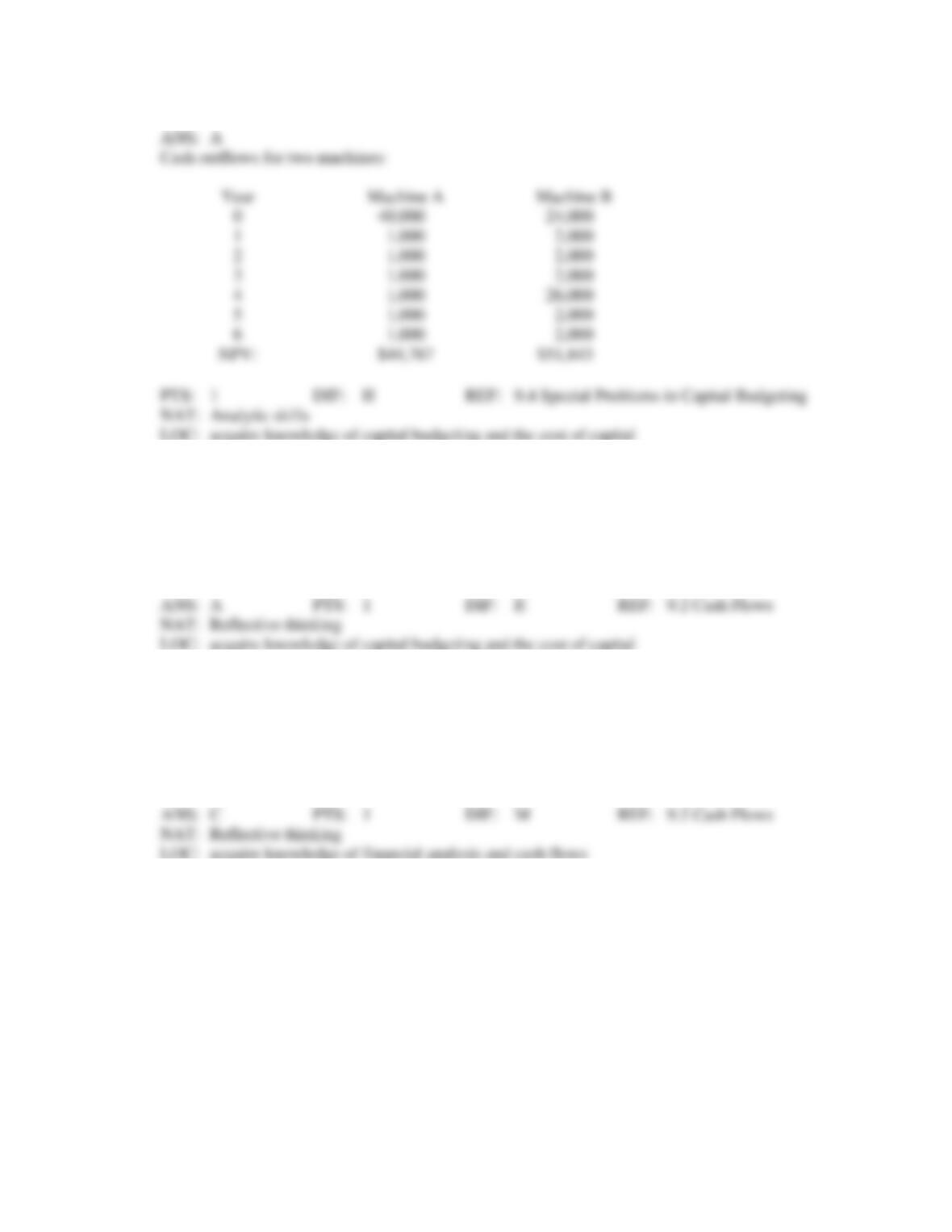
3. A firm is evaluating two machines. Both machines meet the firm’s quality standard. Machine A costs
$40,000 initially and $1,000 per year to maintain. Machine B costs $24,000 initially and $2,000 per
year to maintain. Machine A has a 6-year useful life and machine B has a 3-year useful life. Both
machines have zero salvage value. Assume the firm will continue to replace worn-out machines with
similar machines, and the discount rate is 7%. Which machine should the firm purchase?
a.
Machine A
b.
Machine B
c.
The firm is indifferent to the two machines
d.
Can’t tell from the given information
4. Capital budgeting must be placed on an incremental basis. This means that ____ must be ignored and
____ must be considered.
a.
sunk cost; opportunity cost
b.
sunk cost; financing cost
c.
cannibalization; opportunity cost
d.
opportunity cost; net working capital
5. Roger is considering the expansion of his business into a property he purchased two years ago. Which
of the following items should not be included in the analysis of this expansion?
a.
Roger can lease the property to another company for $12,000 per year.
b.
Costs of hiring additional staff
c.
The property was extensively renovated last year at a cost of $15,000.
d.
The expansion will result in a slight increase of inventory carried.
6. You are given the following information. What is the initial cash outflow?
Purchase and installation of new equipment
$12,000
Sale price of replaced equipment
$ 4,000
Book value of replaced equipment
$ 3,000
When the new equipment is installed:
Inventory increase
$ 2,000
Accounts payable increase
$ 1,000
Tax rate
40%
a.
$9,400
b.
$9,000
c.
$13,000
d.
$10,600
7. A machine costs $3 million and has zero salvage value. Assume a discount rate of 10% and a 40% tax
rate. The machine is depreciated straight-line over 3 years for tax purpose. What is the present value of
depreciation tax savings associated with this machine?
a.
$1,200,000
b.
$994,741
c.
$1,090,900
d.
$400,000
8. A machine costs $3 million and has zero salvage value. The machine qualifies under the 3-year
MARCS category. Assume a discount rate of 10% and a 40% tax rate. What is the present value of
depreciation tax savings associated with this machine? (MARCS tax depreciation schedule of a 3-year
class asset: 33.33% in year 1, 44.45% in year 2, 14.81% in year 3, and 7.41% in year 4)
a.
$1,090,900
b.
$1,200,000
c.
$994,741
d.
$998,684
1
33.33%*3m
0.4*33.33%*3m = 399960
363600
2
44.45%*3m
0.4*44.45%*3m = 533400
440826
3
14.81%*3m
0.4*14.81%*3m = 177720
133524
4
7.41%*3m
0.4*7.41%*3m = 88920
60734
998684
9. Alpha Car Rental purchased 5 cars for a total of $100,000 three years ago. Now it is replacing the cars
with newer vehicles. The company has depreciated 92.59% of the old cars, and sold these cars for a
total of $ 25,000. Assume a tax rate of 40%. What is the cash inflow from the sale of these vehicles?
a.
$25,000
b.
$15,000
c.
$17,964
d.
$16,500
10. Net working capital decreases when
a.
inventory falls, accounts receivable falls, or accounts payable increases
b.
inventory increases, accounts receivable increases, or accounts payable falls
c.
cost of goods sold falls, or interest rate falls
d.
operating expenses fall, or current assets increase
11. The cash flows associated with an investment project are as follows:
Cash Flows
Initial Outflow
-$7,000,000
Year 1
$ 100,000
Year 2
$ 200,000
Year 3
$ 540,000
In year 4 and beyond, cash flows would continue to grow at 4 percent per year. Assume a discount rate
of 10%. What is the NPV of this investment?
a.
$385,220
b.
$423,742
c.
$631,104
d.
$694,215
12. Georgia Food is exploring the possibility of bringing a new frozen pasta to the market. Which of the
following items are not relevant for the project’s analysis?
a.
Cost of increasing shelf space at grocery stores
b.
Lost revenue from its frozen pizza sales since some customers will switch to purchase the
new frozen pasta
c.
Cost of advertising the new product
d.
Market research funds the company has spent on testing the viability of the new product
13. A certain investment will require an immediate cash outflow of $3 million. At the end of each of the
next three years, the investment will generate cash inflows of $1.3 million. If the discount rate is 10%,
what is the project’s NPV?
a.
$211,734
b.
-$303,886
c.
$232,908
d.
-$276,260
NARRBEGIN: Exhibit 9-1
Exhibit 9-1
A project requires an initial investment in equipment and machinery of $10 million. The equipment is
expected to have a 5-year lifetime with no salvage value and will be depreciated on a straight-line
basis. The project is expected to generate revenues of $5.1 million each year for the 5 years and have
operating expenses (not including depreciation) amounting to 1/3 of revenues.
NARREND
14. Refer to Exhibit 9-1. The tax rate is 40%. What is the net cash flow in year 1?
a.
2.84m
b.
3.40m
c.
0.84m
d.
2.04m
15. Refer to Exhibit 9-1. Assume the tax rate is 40%, and the cost of capital is 10%. What is the present
value of cash inflows from year 1 to year 5? What percentage of this present value is attributed to the
tax benefits accruing from depreciation?
a.
$12.89m; 24%
b.
$10.77m; 28%
c.
3.18m; 95%
d.
7.73m; 39%
e.
$10.77m; 24%
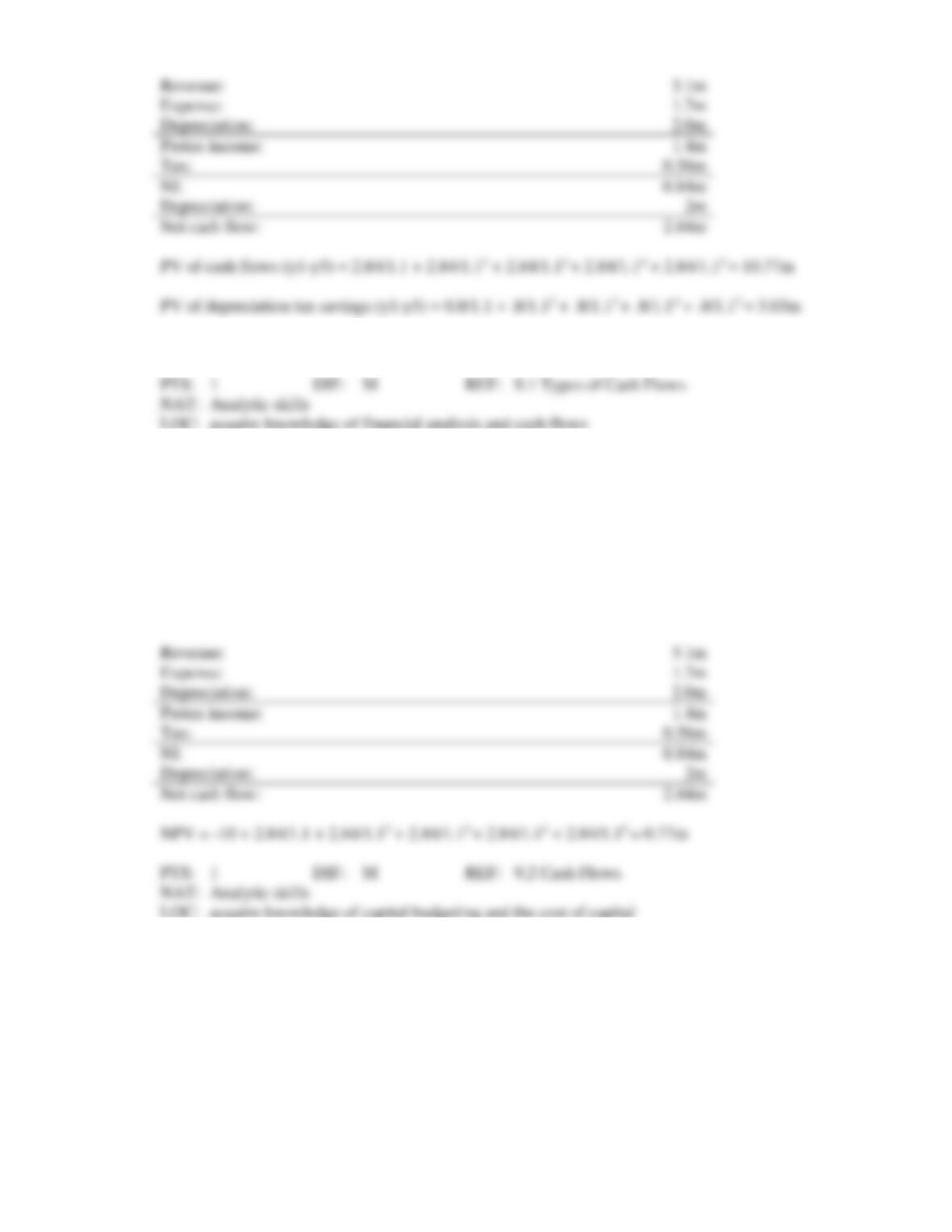
3.03/10.77 = 28%
16. Refer to Exhibit 9-1. Assume the tax rate is 40%, and the cost of capital is 10%. What is the net
present value of the project?
a.
$2.89m
b.
$0.77m
c.
-$6.82m
d.
-$2.27m
ANS: B
Cash flow from year 1 to year 5 is the same.
17. Johnson Chemicals is considering an investment project. The project requires an initial $3 million
outlay for equipment and machinery. Sales are projected to be $1.5 million per year for the next four
years. The equipment will be fully depreciated straight-line by the end of year 4. Cost of goods sold
and operating expense (not including depreciation) are predicted to be 30% of sales. The equipment
can be sold for $400,000 at the end of year 4. Johnson Chemicals also needs to add net working capital
of $100,000 immediately. The net working capital will be recovered in full at the end of the fourth
year. Assume the tax rate is 40% and the cost of capital is 10%.
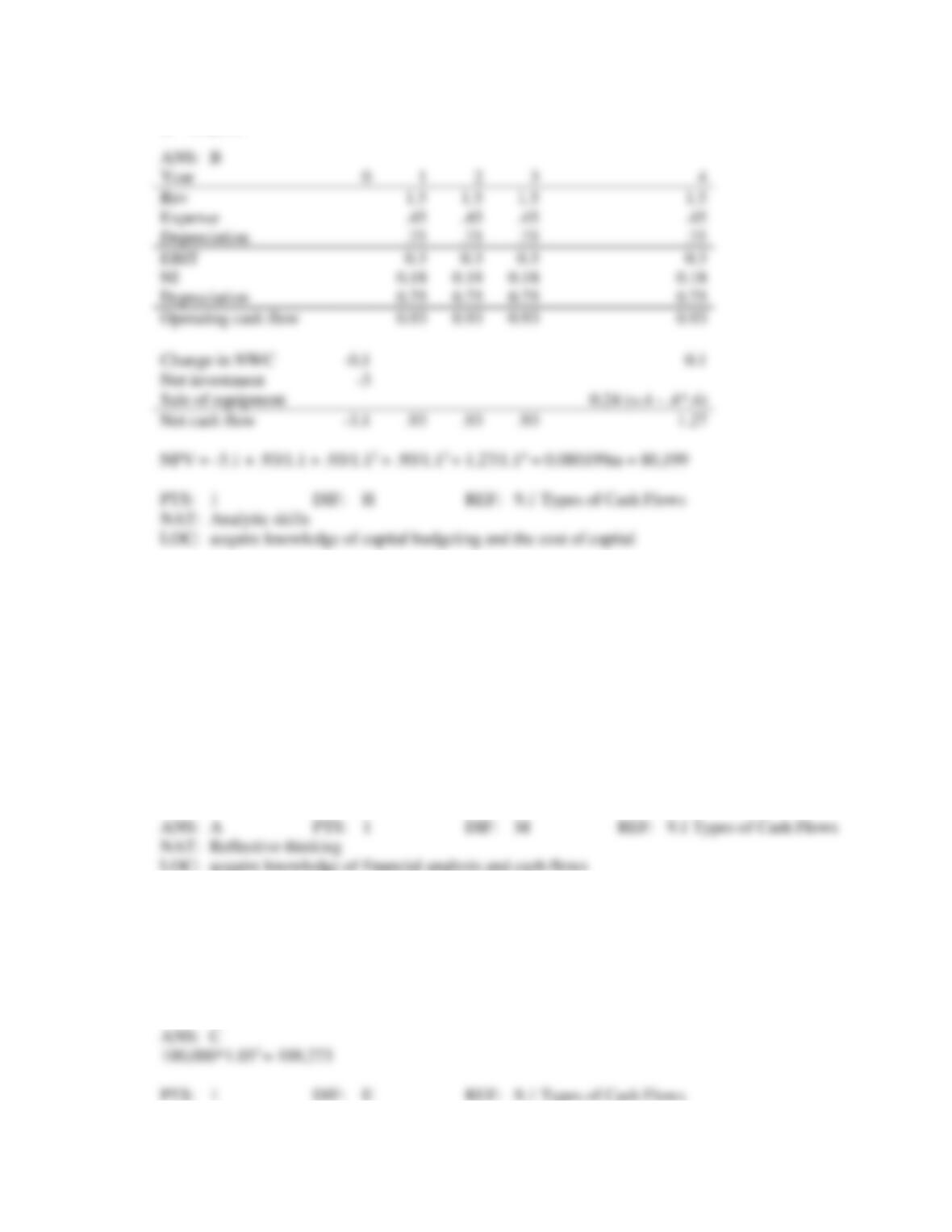
What is the NPV of this investment?
a.
$89,290
b.
$80,199
c.
$189,482
d.
$72,909
18. Which of the following items will lead to a rise in net working capital?
A.
Raw materials are purchased prior to the sale of finished goods
B.
The firm increases its cash balance
C.
The firm makes a sale on credit
D.
The firm buys inventory on credit
E.
Short-term interest rates fall
a.
A,B,C
b.
A,B,D,E
c.
A,C
d.
A,B,C,D
19. A project will generate a real cash flow three years from now of $100,000. If the nominal discount rate
is 10% and expected inflation is 3%, what is the nominal cash flow for year 3?
a.
$112,551
b.
$106,090
c.
$109,273
d.
$122,504
Year
Rev
Expense
Depreciation
EBIT
Depreciation
Change in NWC
Net investment
Sale of equipment
Net cash flow

20. Paul earns $60,000 as an engineer, and he is considering quitting his job and going to graduate school.
This $60,000 should be treated as a ____ if Paul runs an NPV analysis of his graduate degree.
a.
sunk cost
b.
opportunity cost
c.
fixed cost
d.
cannibalization cost
21. Fox Entertainment is evaluating the NPV of launching a new iPet product. Fox paid a market research
firm $120,000 last year to test the market viability of iPet. Fox Entertainment should treat this
$120,000 as a ____ for the capital budgeting decision now confronting the firm.
a.
fixed cost
b.
opportunity cost
c.
sunk cost
d.
cannibalization cost
NARRBEGIN: Exhibit 9-2
Exhibit 9-2
The following data are projected for a possible investment project:
1
2
3
4
Revenues
$120,000
$140,000
$160,000
$180,000
Cost of Goods Sold
$ 36,000
$ 42,000
$ 48,000
$ 54,000
Depreciation
$ 80,000
$ 60,000
$ 40,000
$ 20,000
EBIT
$ 4,000
$ 38,000
$ 72,000
$106,000
NARREND
22. Refer to Exhibit 9-2. The project requires an initial investment of $300,000. Working capital is
anticipated to be variable at 10% of revenues; the working capital investment must be made at the
beginning of each period, and will be recaptured in full at the end of year 4. The tax rate is 40%.
What is the initial cash outlay?
a.
$300,000
b.
$312,000
c.
$232,000
d.
$220,000
23. Refer to Exhibit 9-2. The project requires an initial investment of $300,000. Working capital is
anticipated to be variable at 10% of revenues; the working capital investment must be made at the
beginning of each period, and will be recaptured in full at the end of year 4. The tax rate is 40%.
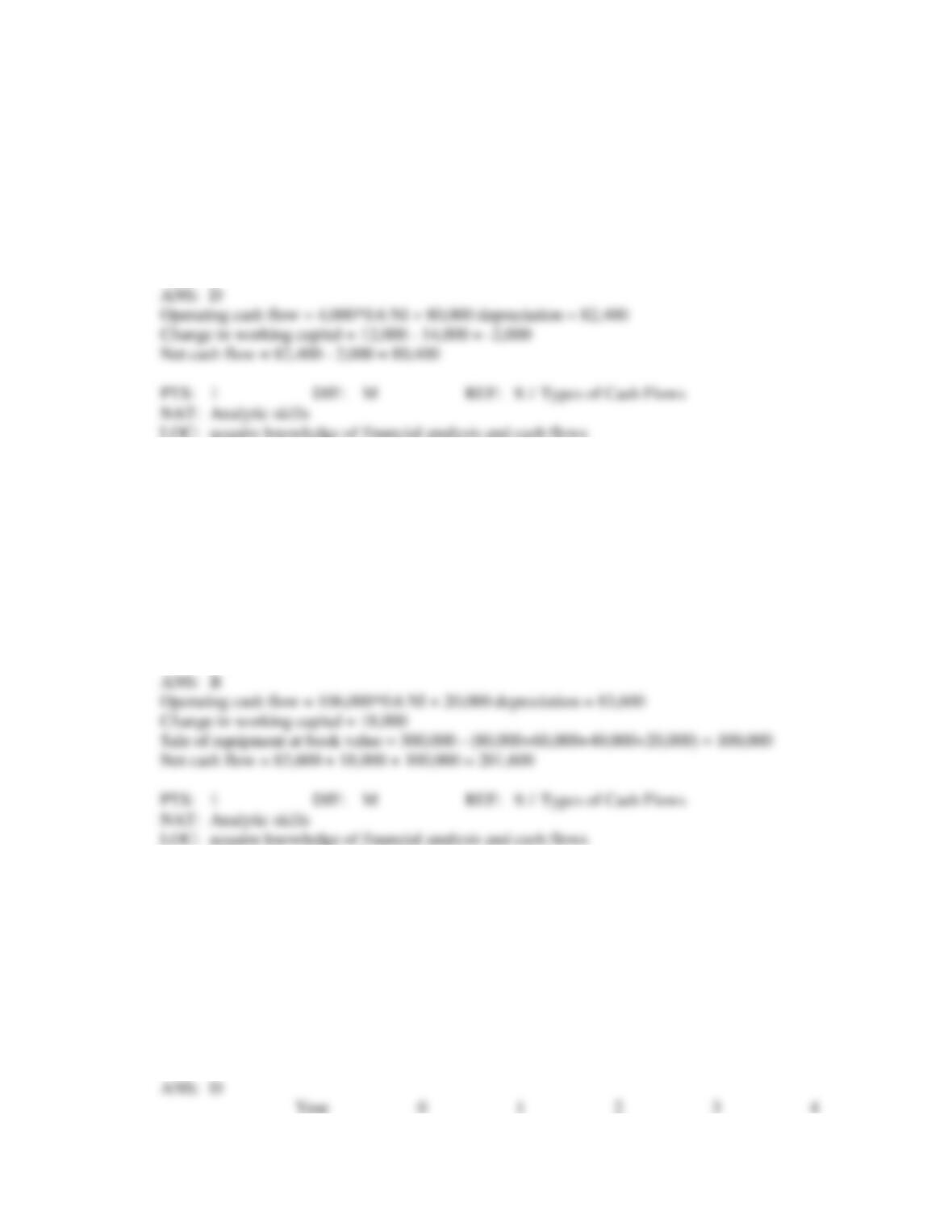
What is the net cash flow to the firm in year 1?
a.
$400
b.
$82,400
c.
$68,400
d.
$80,400
e.
$2,400
24. Refer to Exhibit 9-2. The project requires an initial investment of $300,000 on equipment. Working
capital is anticipated to be variable at 10% of revenues; the working capital investment must be made
at the beginning of each period, and will be recovered in full at the end of year 4. Equipment will be
sold at its book value at the end of year 4. The tax rate is 40%.
What is the net cash flow to the firm in year 4?
a.
$101,600
b.
$201,600
c.
$183,600
d.
$161,600
25. Refer to Exhibit 9-2. The project requires an initial investment of $300,000 on equipment. Working
capital is anticipated to be variable at 10% of revenues; the working capital investment must be made
at the beginning of each period, and will be recovered in full at the end of year 4. Equipment will be
sold at its book value at the end of year 4. The tax rate is 40%.
What is the net present value of the project if the firm’s discount rate is 10%?
a.
-$20,225
b.
-$41,731
c.
$24,155
d.
$26,570
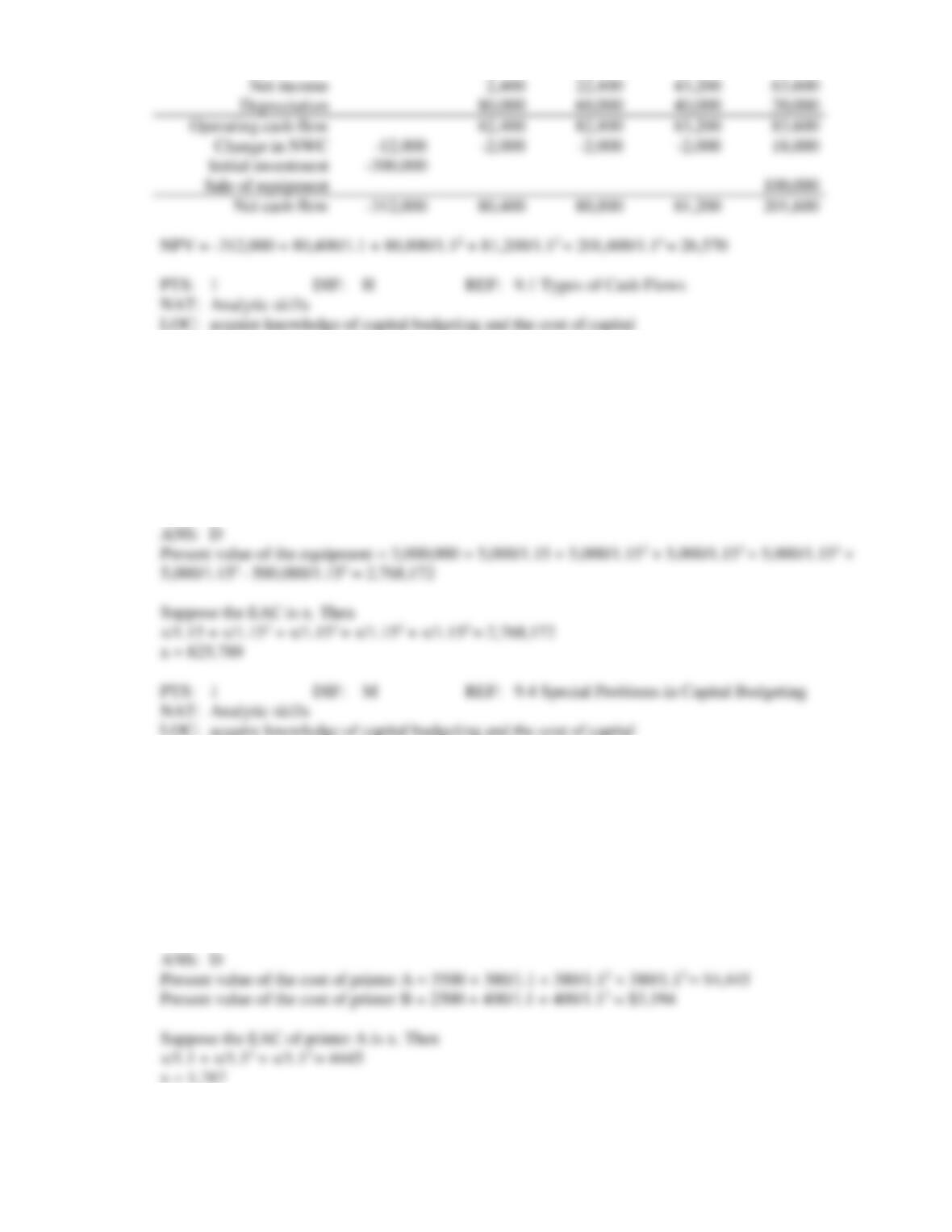
26. Future Semiconductor is considering the purchase of photolithography equipment that will cost $3
million. The equipment requires maintenance of $5,000 at the end of each of the next five years. After
five years it will be sold for $500,000. Assume a cost of capital of 15% and no taxes. What is the
present value of the cost of the equipment? What is the equivalent annual cost of the equipment?
a.
$3,016,761; $899,947
b.
$2,516,760; $750,789
c.
$2,407,106; $718,077
d.
$2,768,172; $825,789
27. Sam’s Insurance must choose between two types of printers. Both printers meet the firm’s quality
standard. Printer A costs $3,500 and is expected to last 3 years with operating costs of $380 per year.
Printer B costs $2,500 and is expected to last 2 years with operating costs of $400 per year. Assume a
discount rate of 10%. Which printer should Sam’s Insurance purchase? What is the equivalent annual
cost of this machine?
a.
Printer B; $3,194
b.
Printer A; $1,625
c.
Printer B; $2,904
d.
Printer A; $1,787
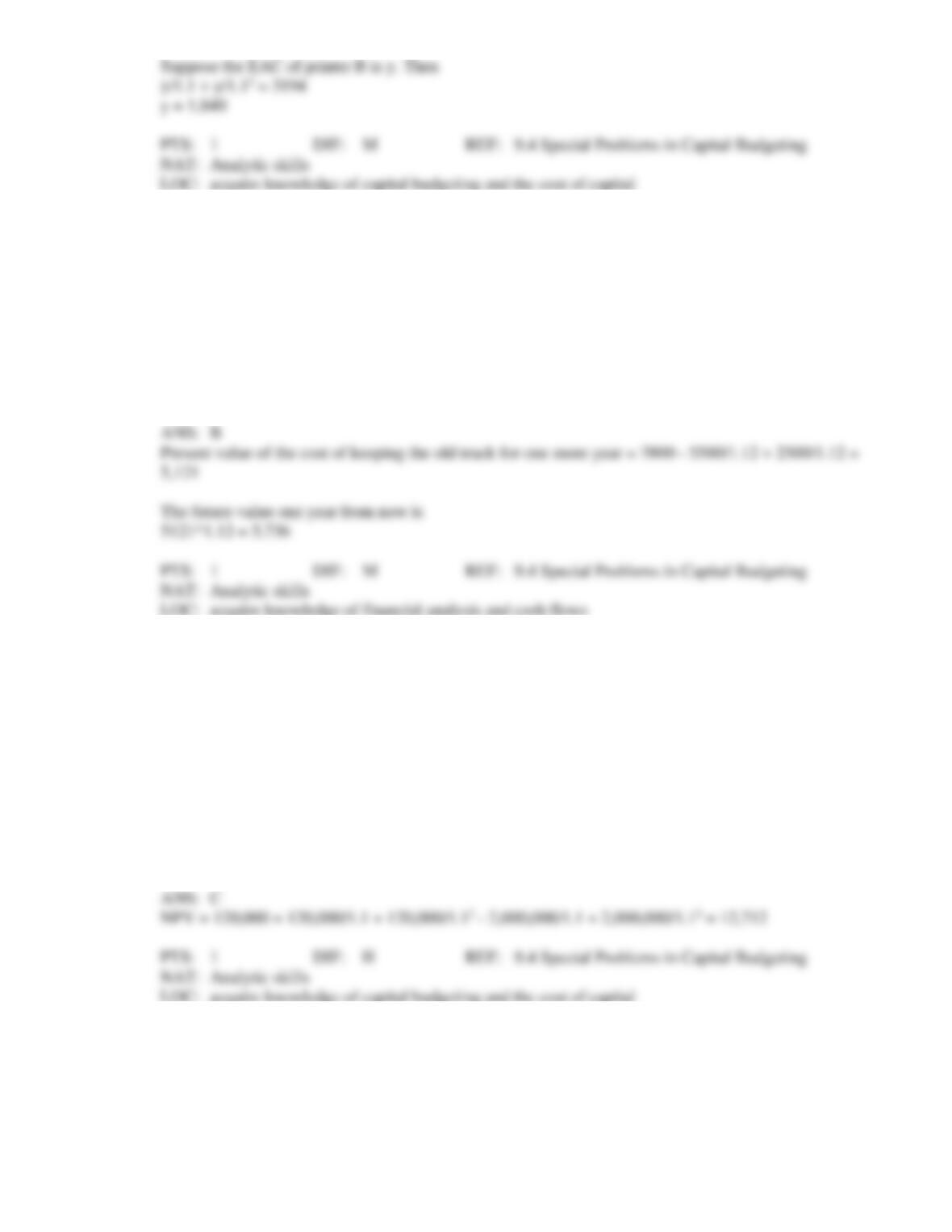
28. Arizona Truck Company (ATC) is considering the replacement of an old truck. The old truck can be
sold for $7,800 now. If it is sold in one year, the resale price will be $5,500, but ATC will spend
$2,500 just before selling the truck to make it attractive to a buyer. Assume a cost of capital of 12%.
What is the total cost of keeping the old truck for one more year? Express the cash flow in terms of its
future value one year from now.
a.
$5,121
b.
$5,736
c.
$4,800
d.
$5,376
e.
None of the above
29. A firm that manufactures DVD players for automakers currently has excess capacity. The firm expects
that it will exhaust its excess capacity in three years. At that time it will have to invest $2 million to
build new capacity. Suppose that the firm can accept additional work as a subcontractor for another
company. By doing so, the firm will receive a net cash inflow of $120,000 immediately and in each of
the next two years. However, the firm will have to begin expansion two years earlier than originally
planned to bring new capacity on line. Assume a discount rate of 10%.
What is the NPV if the firm accepts the subcontractor job?
a.
$328,264
b.
-$18,843
c.
$12,712
d.
$298,422
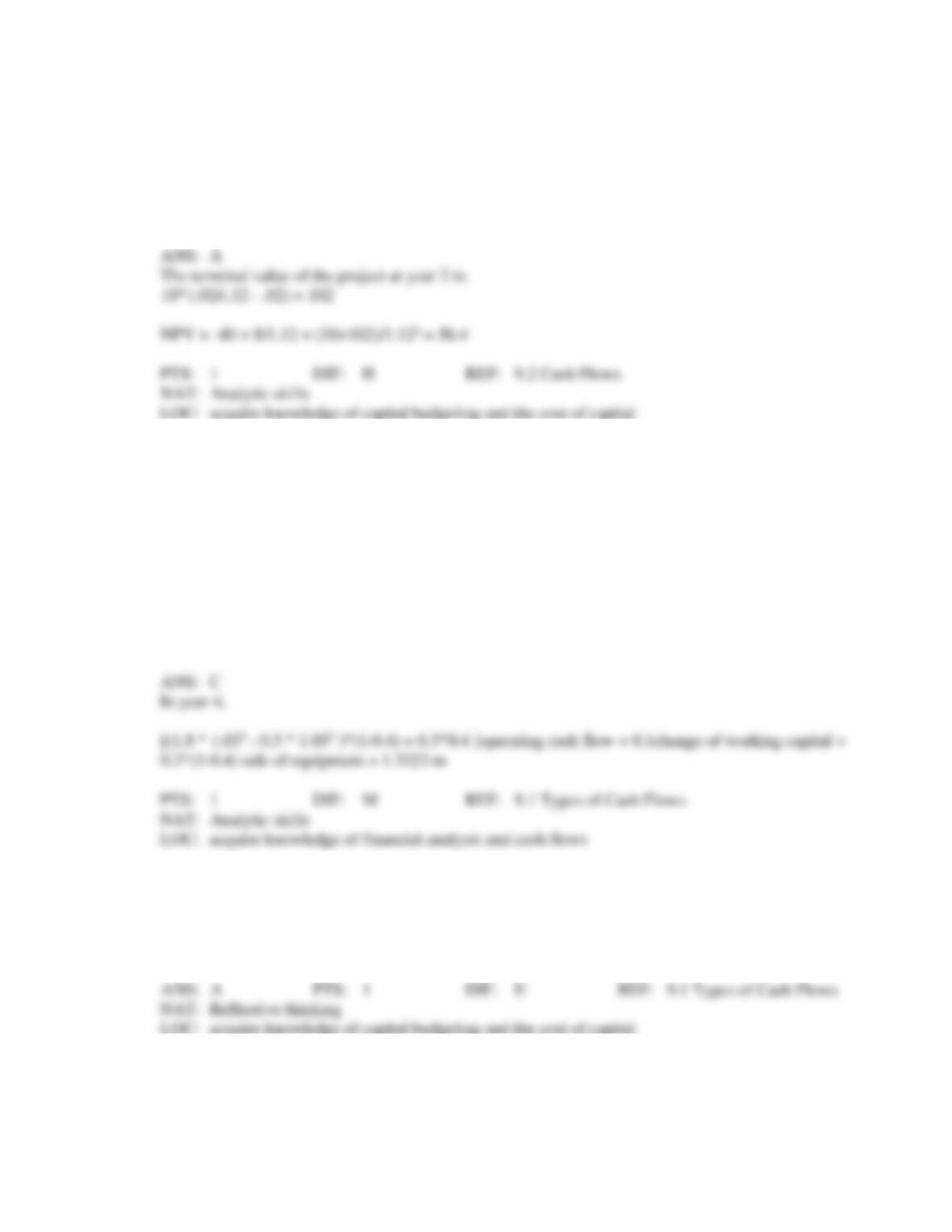
30. A project generates the following sequence of cash flows over two years:
Year
Cash Flow ($ in millions)
0
-40.00
1
8.00
2
10.00
Assume that cash flows after the second year grow at 2% annually in perpetuity, and the discount rate
is 12%. What is the NPV of the project?
a.
$56.4m
b.
$54.8m
c.
$47.7 m
d.
$50.4m
31. Kelley Group is considering an investment of $2 million in an asset with an economic life of four
years. The cash revenues and expenses in year 1 are expected to be $1.8m and $0.5m respectively.
Both revenues and expenses are expected to grow at 3 percent per year. The asset will be fully
depreciated to zero using the straight line method over its economic life. The salvage value of the asset
is expected to be $0.3m at the end of the fourth year. Kelley Group also needs to add net working
capital of $0.1m immediately, and this capital will be recovered in full at the end of the project’s life.
The tax rate is 40%. What is the investment’s cash flow in year 4?
a.
$1.1323m
b.
$1.4523m
c.
$1.3323m
d.
$1.3579m
32. The value of a project at a given future point in time is known as:
a.
the terminal value.
b.
net working capital.
c.
opportunity cost.
d.
sunk cost.
33. The percentage of taxes owed on an incremental dollar of income is called:
a.
the minimum tax rate.
b.
the marginal tax rate.
c.
the average tax rate.
d.
the maximum tax rate.
34. Cash Flows that occur if and only if a project is accepted are:
a.
sunk costs.
b.
terminal costs.
c.
incremental cash flows.
d.
current cash flows.
35. Cash flows on an alternative investment that a firm decides not to make are a(n):
a.
opportunity cost.
b.
sunk cost.
c.
terminal value.
d.
incremental cash flow.
36. A cash outlay that has already been committed whether a project is accepted or not is known as a:
a.
opportunity cost.
b.
terminal value.
c.
net cost.
d.
sunk cost.
37. The difference between current assets and current liabilities is known as:
a.
working capital.
b.
net working capital.
c.
terminal capital.
d.
marginal capital.
38. When a firm introduces a new product and some of the new product’s sales come at the expense of the
firm’s existing products, this is known as:
a.
sunk costs.
b.
incremental costs.
c.
marginal costs.
d.
cannibalization.
39. The system in the U.S. which defines the allowable annual depreciation deductions for various classes
of assets is known as:
a.
MACRS
b.
CAMRS
c.
RCMAS
d.
SCRMA
40. Accountants measure inflows and outflows of business operations on:
a.
a cash basis.
b.
a profit basis.
c.
an accrual basis.
d.
an expense basis.
41. Financial analysts focus on ____ when evaluating potential investments.
a.
cash
b.
profit
c.
accruals
d.
expenses
42. The relevant tax rate for capital budgeting purposes is the:
a.
average tax rate.
b.
maximum tax rate.
c.
minimum tax rate.
d.
marginal tax rate.
43. An asset that falls into the 3-year MACRS asset class is fully depreciated over:
a.
2 years.
b.
3 years.
c.
4 years.
d.
5 years.
44. An increase in net working capital represents:
a.
a cash inflow.
b.
a cash outflow.
c.
an increase in fixed assets.
d.
a decrease in fixed assets.
45. An increase in inventory will ____ net working capital.
a.
increase
b.
decrease
c.
have no affect on
d.
cannot be determined.
46. A decrease in accounts receivable will ____ net working capital.
a.
increase
b.
decrease
c.
have no affect on
d.
cannot be determined.
47. When a firm cannot invest in every positive NPV project because of limited funds, this is known as:
a.
capital budgeting.
b.
capital investing.
c.
capital rationing.
d.
capital financing.
NARRBEGIN: DSSS Corporation
DSSS Corporation
DSSS Corporation is considering a new project to manufacture widgets. The cost of the manufacturing
equipment is $125,000. The cost of shipping and installation is an additional $10,000. The asset will
fall into the 3-year MACRS class. The year 1- 4 MACRS percentages are 33.33%, 44.45%, 14.81%,
and 7.41%, respectively. Sales are expected to be $225,000 per year. Cost of goods sold will be 60%
of sales. The project will require an increase in net working capital of $10,000. At the end of three
years, DSSS plans on ending the project and selling the manufacturing equipment for $25,000. The
marginal tax rate is 40% and DSSS Corporation’s appropriate discount rate is 15%.
NARREND
48. Refer to DSSS Corporation. What is the initial investment outlay for this project?
a.
$10,000
b.
$135,000
c.
$145,000
d.
$155,000
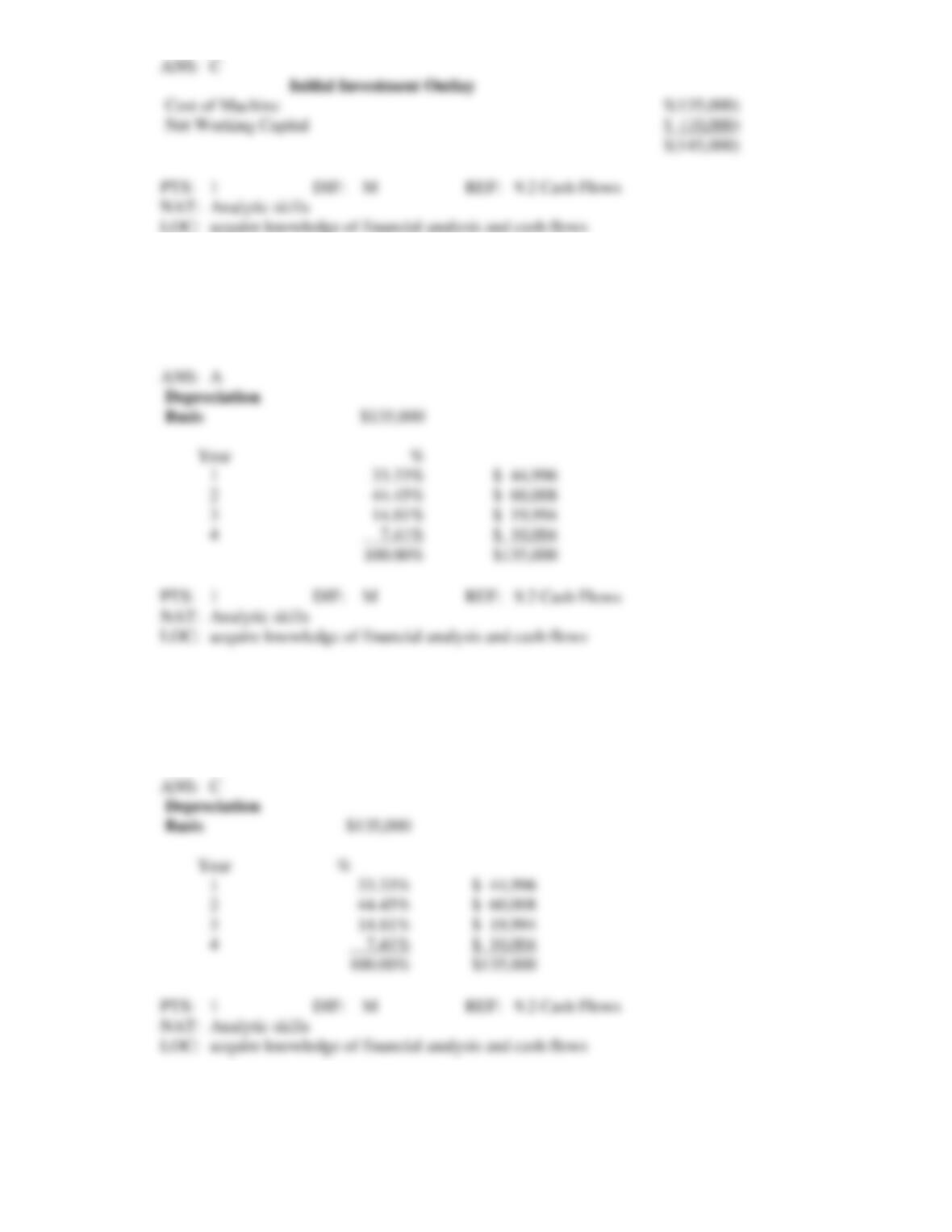
49. Refer to DSSS Corporation. What is the depreciation expense in year 1?
a.
$44,996
b.
$10,004
c.
$60,008
d.
$19,994
50. Refer to DSSS Corporation. What is the depreciation expense in year 2?
a.
$44,996
b.
$10,004
c.
$60,008
d.
$19,994
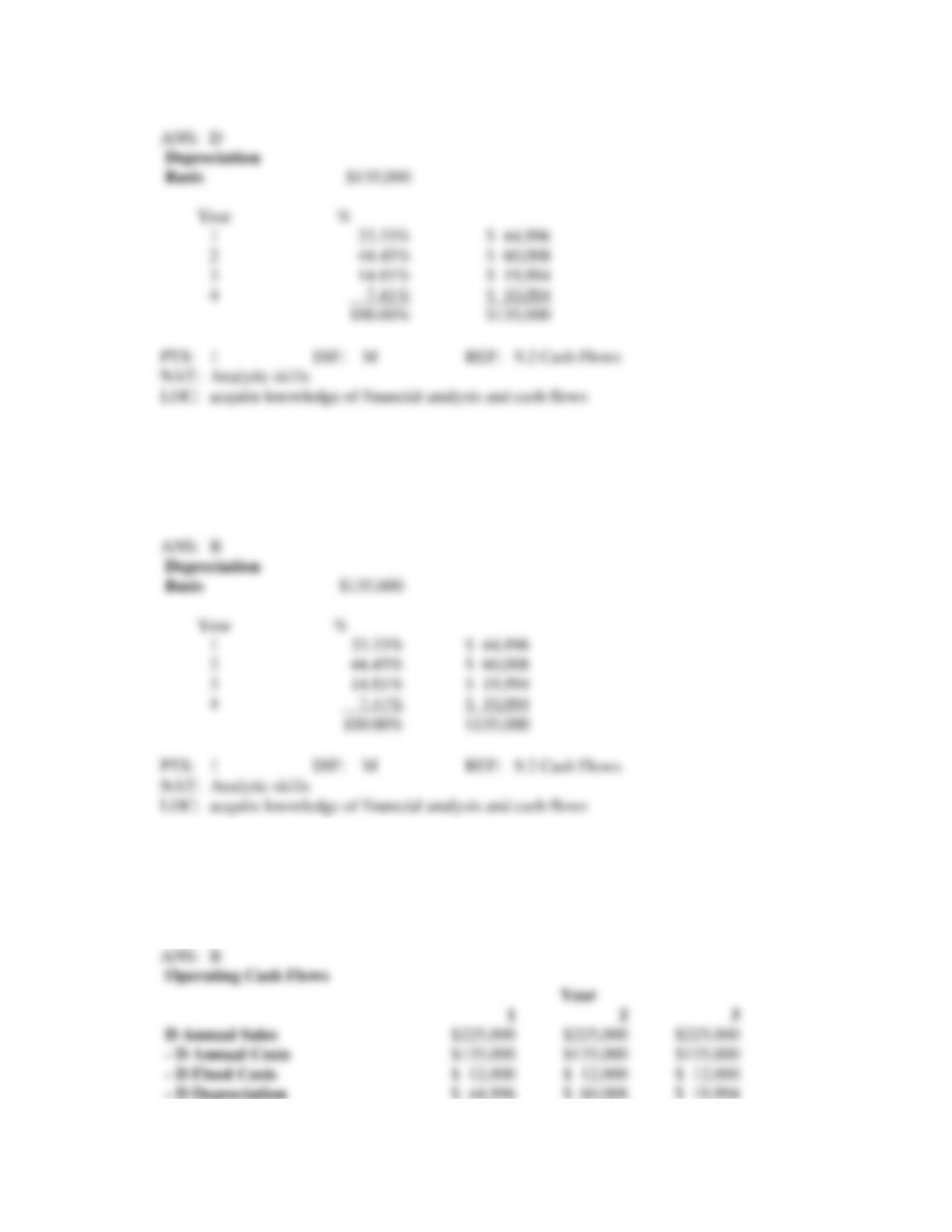
51. Refer to DSSS Corporation. What is the depreciation expense in year 3?
a.
$44,996
b.
$10,004
c.
$60,008
d.
$19,994
52. Refer to DSSS Corporation. What is the book value of the machine at the end of year 3?
a.
$44,996
b.
$10,004
c.
$60,008
d.
$19,994
53. Refer to DSSS Corporation. What is the operating cash flow for year 1?
a.
$54,797
b.
$64,798
c.
$70,803
d.
$10,487