
Name:
Class:
Date:
Chapter 09: Capital Budgeting and Cash Flow Analysis
Multiple Choice
1. Sale of an asset for less than book value creates an operating loss that effectively reduces the company’s taxes by an
amount equal to ____ times ____.
a.
one-half the loss; the company’s marginal tax rate
b.
the loss; one minus the company’s marginal tax rate
c.
one-half the loss; one minus the company’s marginal tax rate
d.
the loss; the company’s marginal tax rate
d
2. The value of resources used in an investment project should be measured in terms of their ____ cost.
a.
acquisition
b.
historical
c.
opportunity
d.
depreciated
c
3. There is neither a gain nor a loss on the sale of a depreciable asset for an amount exactly equal to its ____.
a.
acquisition cost
b.
tax book value
c.
opportunity cost
d.
historical cost
b
4. The ____ curve is a schedule of projects arranged in ____ order according to their expected rates of return.
a.
investment opportunity; ascending
b.
marginal cost of capital; ascending
c.
investment opportunity; descending
d.
marginal cost of capital; descending
c
5. Which of the following would not be classified as a capital expenditure for decision-making purposes?
a.
purchase of a building
b.
investment in a management training program
c.
purchase of 90-day Treasury bills
d.
development of a major advertising campaign
c
6. A firm’s cost of capital is ____.
a.
an important financial ratio
b.
equal to 10 percent
c.
rarely used in practice
d.
an important input in the capital budgeting process
d

Name:
Class:
Date:
Chapter 09: Capital Budgeting and Cash Flow Analysis
7. The decision by the Municipal Transportation Authority to either refurbish existing buses, to buy new large buses, or to
supplement the existing fleet with mini-buses is an example of ____.
a.
independent projects
b.
mutually exclusive projects
c.
contingent projects
d.
separable projects
b
8. Which of the following is NOT a major difficulty in implementing the basic capital budgeting model?
a.
determining the schedule of available projects before a decision on any one project can be made
b.
accounting for the risk of individual projects
c.
projecting the cost of funds over the investment decision horizon
d.
choosing an appropriate criterion for selecting among various investment alternatives
d
9. Which of the following is NOT a major step in the capital budgeting process?
a.
generating investment project proposals
b.
estimating cash flows
c.
analyzing the effect of a project on the firm’s financial ratios
d.
performing a project post-audit and review
10. Which of the following is a basic principle when estimating a project’s cash flows?
a.
Cash flows should be measured on a pretax basis
b.
Cash flows should ignore depreciation because it is a noncash charge
c.
Only direct effects of a project should be included in cash flow calculations
d.
Cash flows should be measured on an incremental basis
d
11. Which of the following items is NOT considered as a part of the net investment calculation?
a.
the first year’s net cash flow
b.
increase in net working capital
c.
salvage of an old piece of equipment that is being replaced
d.
installation and shipping charges
12. The effect of a one-dollar increase in depreciation expenses is to ____ the typical firm’s net cash flows by ____ one
dollar.
a.
increase; less than
b.
increase; exactly
c.
decrease; more than
d.
increase; more than

Name:
Class:
Date:
Chapter 09: Capital Budgeting and Cash Flow Analysis
13. The dollar amount of interest charges is ____.
a.
always considered in the net cash flow calculation
b.
normally not considered in the net cash flow calculation
c.
always considered as a part of the net investment
d.
never a consideration
b
14. Raider Productions has to decide whether to build its warehouse in Dallas or Houston. This decision falls into the class
of ____.
a.
independent projects
b.
mutually exclusive projects
c.
contingent projects
d.
marginal projects
b
15. The determination of net cash flows (NCF) should NEVER include
a.
changes in depreciation
b.
changes in operating costs
c.
interest charges
d.
indirect effects
16. Which of the following is generally considered a problem associated with cash flow estimation?
a.
Uncertainty about the value of future cash flows
b.
Bias in the estimation of cash flows
c.
Different levels of uncertainty among different types of projects
d.
All of these are correct
d
17. Most firms choose accelerated depreciation methods because ____.
a.
reported net income is higher
b.
tax payments are made sooner, resulting in a lower deferred tax liability
c.
operating expenses are correspondingly reduced
d.
income taxes are deferred
d
18. Cash flows for all investment projects should be projected over the ____ of the project.
a.
MACRS recovery period
b.
depreciable life
c.
economic life
d.
smaller of depreciable or economic lives

Name:
Class:
Date:
Chapter 09: Capital Budgeting and Cash Flow Analysis
19. When a firm sells an asset for ____, it realizes a capital gain and must pay income taxes on it.
a.
book value
b.
less than book value
c.
more than book value but less than original cost
d.
more than its original cost
d
20. ____ is the term used when the initial cost of all acceptable capital budgeting projects is greater than the total funds
the firm has available.
a.
Profit maximization
b.
Funds constraint
c.
Mutually exclusive
d.
Contingent
b
21. In estimating the net investment, an outlay that has already been made is known as a(n) ____.
a.
sunk cost
b.
cash outflow
c.
opportunity cost
d.
expansion cost
a
22. Depreciation is based on the asset cost plus all of the following EXCEPT ____.
a.
shipping costs
b.
increase in inventory
c.
installation
d.
cost of attached equipment acquired at the same time
b
23. Depreciation ____ reported profits and it ____ taxes paid by a firm.
a.
increases; reduces
b.
reduces; reduces
c.
reduces; increases
d.
increases; increases
b
24. If a firm sells an asset for less than its book value, ____.
a.
there are no tax consequences
b.
the loss is treated as lost depreciation
c.
the loss reduces depreciation expenses
d.
the loss may be used to offset operating income
d
25. The ____ the amount of depreciation charged in a period, the ____ will be the firm’s taxable income.

Name:
Class:
Date:
Chapter 09: Capital Budgeting and Cash Flow Analysis
a.
greater; lower
b.
lower; lower
c.
lower; greater
d.
greater; higher
26. In terms of the capital budgeting process, net cash flows are the ____.
a.
net cash outlays required to place a project in service
b.
funds invested in additional assets
c.
incremental changes in a firm’s cash flow
d.
outlays that have already been made
27. A recent survey of Fortune 500 firms regarding their cash flow estimation procedures indicated that ____.
a.
few firms prepared formal cash flow estimates
b.
the majority produced detailed cash flow projections
c.
a majority estimated cash flows for a range of estimates
d.
about 50 percent made comparisons between actual and projected cash flows
b
28. Depreciation ____.
a.
does not affect cash flows
b.
does not affect profits
c.
is not a cash outflow
d.
is a cash inflow
29. The capital budgeting process is very important to the firm because it ____.
a.
highlights the impacts of a project on net income
b.
essentially plots the company’s future direction
c.
is used in working capital analysis
d.
indicates the net cash flows available for employee education
b
30. A(n) ____ is a cash outlay that is expected to generate a flow of future cash benefits lasting longer than 1 year.
a.
depreciation charge
b.
operating expenditure
c.
capital expenditure
d.
capital gain
31. The set of investment projects arranged in descending order according to their expected rates of return is known as the
____.
a.
marginal cost of capital schedule

Name:
Class:
Date:
Chapter 09: Capital Budgeting and Cash Flow Analysis
b.
schedule of mutually exclusive projects
c.
schedule of contingent projects
d.
simplified capital budgeting model
d
32. A(n) ____ project is one whose acceptance is dependent on the adoption of one or more other projects.
a.
contingent
b.
mutually exclusive
c.
independent
d.
perfectly correlated
a
33. The net cash flows for any year during the life of a capital expenditure project are equal to the change in ____ plus the
change in ____.
a.
earnings before interest and taxes; depreciation
b.
earnings before taxes; depreciation
c.
earnings after taxes; depreciation
d.
revenues; costs
c
34. The net investment calculation for an ____ project normally includes ____.
a.
asset expansion; pretax proceeds from the sale of the old asset
b.
asset replacement; pretax proceeds from the sale of the old asset
c.
asset expansion; after-tax proceeds from the sale of the old asset
d.
asset replacement; after-tax proceeds from the sale of the old asset
d
35. The total accumulated net working capital of a project is normally recovered in the project’s ____ year.
a.
last
b.
first
c.
second
d.
second to last
a
36. The net investment calculation for an asset replacement decision normally includes any ____.
a.
after-tax salvage value of the old asset
b.
increase in net working capital
c.
installed asset costs
d.
All of these are correct
d
37. When calculating the net cash flow in a project’s expected final year, the ____.
a.
recovery of any working capital invested is disregarded
b.
after-tax salvage value of any project equipment is considered

Name:
Class:
Date:
Chapter 09: Capital Budgeting and Cash Flow Analysis
c.
remaining principal on any borrowed funds is considered
d.
sales proceeds from any land associated with the project is disregarded
b
38. When managers knowingly bias estimates of cash flows from investment projects in order to serve their personal
objectives, they are ____.
a.
performing management by exception
b.
increasing their total compensation
c.
departing from the shareholder wealth maximization goal
d.
increasing their confidence level
c
39. Capital expenditure projects may be classified in all the following types EXCEPT ____.
a.
growth opportunities
b.
obligations to meet legal requirements
c.
cost reduction opportunities
d.
capital rationing
d
40. ____ have cash flow patterns with more than one sign change.
a.
Conventional projects
b.
Nonnormal projects
c.
Normal projects
d.
Contingent projects
b
41. A drill press costs $30,000 and is expected to have a 10-year life. The drill press will be depreciated on a straight-line
basis over 10 years to a zero estimated salvage value. This machine is expected to reduce the firm’s cash operating costs
by $4,500 per year. Assuming the firm is in the 40 percent marginal tax bracket, determine the annual net cash flows
generated by the drill press.
a.
$4,500
b.
$900
c.
$5,700
d.
$3,900
d
42. An investment project is expected to generate earnings before taxes (EBT) of $60,000 per year. Annual depreciation
from the project is $30,000, and the firm’s tax rate is 40 percent. Determine the project’s annual net cash flows.
a.
$48,000
b.
$66,000
c.
$36,000
d.
$52,000
b
43. Ten years ago J-Bar Company purchased a lathe for $250,000. It was being depreciated on a straight-line basis to an

Name:
Class:
Date:
Chapter 09: Capital Budgeting and Cash Flow Analysis
estimated $25,000 salvage value over a 15-year period. The firm is considering selling the old lathe and purchasing a new
one. The new lathe would cost $500,000. The firm’s marginal tax rate 40 percent. Determine the net investment required
to purchase the new lathe, if the old lathe is sold for $100,000.
a.
$380,000
b.
$397,500
c.
$400,000
d.
$418,000
c
44. Little Giant is building a manufacturing plant that will require a cash outlay of $300,000 for the initial purchase of a
building, $450,000 for remodeling the first year, and $710,000 for new equipment in the second year. If the firm’s cost of
capital is 12 percent, what is the present value of the net investment at time 0?
a.
$1,460,000
b.
$1,132,070
c.
$1,267,720
d.
$300,000
c
45. In-Step Video is considering expanding its video rental library to 8,000 DVDs. The purchase price of the additional
DVDs will be $80,000, and the shipping cost is another $4,000. To house the media, the owner will have to spend another
$10,000 for display shelves, increase net working capital by $5,000, and interest expenses will add another $8,000 to the
operating cost. What is the net investment to In-Step Video for this project?
a.
$95,000
b.
$99,000
c.
$84,000
d.
$107,000
b
46. What is the net investment for an extruder that costs $42,000, if shipping costs are $1,500 and installation is $4,800?
Assume this efficient machine is replacing an older extruder with a book and market value of zero. The replacement
investment will reduce operating costs by $6,600 a year.
a.
$48,300
b.
$54,900
c.
$43,500
d.
$51,000
a
47. Shunt Technology will spend $800,000 on a piece of equipment that will manufacture fine wire for the electronics
industries. The shipping and installation charges will be $240,000 and net working capital will increase $48,000.The
equipment will replace an existing machine that has a salvage value of $75,000 and a book value of $125,000. If Shunt
has a current marginal tax rate of 34 percent, what is the net investment?
a.
$1,030,000
b.
$1,163,000
c.
$1,033,000
d.
$996,000

Name:
Class:
Date:
Chapter 09: Capital Budgeting and Cash Flow Analysis
d
48. Capital Foods purchased an oven 5 years ago for $45,000. The oven is being depreciated over its estimated 10-year
life using the straight-line method to a salvage value of $5,000. Capital is planning to replace the oven with a more
automated one that will cost $150,000 installed. If the old oven can be sold for $30,000, what is the tax liability? Assume
a marginal tax rate of 40 percent.
a.
$900
b.
$2,000
c.
$127,000
d.
$25,000
b
49. The management of Jasper Equipment Company is planning to purchase a new milling machine that will cost
$160,000 installed. The old milling machine has been fully depreciated but can be sold for $15,000. The new machine will
be depreciated on a straight-line basis over its 10-year economic life to an estimated salvage value of $10,000. If this
milling machine will save Jasper $20,000 a year in production expenses, what are the annual net cash flows associated
with the purchase of this machine? Assume a marginal tax rate of 40 percent.
a.
$15,000
b.
$18,000
c.
$27,000
d.
$21,000
b
50. Jim Bo’s currently has annual cash revenues of $240,000 and annual operating expenses of $185,000, including
$35,000 in depreciation. The firm’s marginal tax rate is 40 percent. A new cutting machine can be purchased for $120,000,
which will increase revenues by $50,000 per year while operating expenses would increase to $205,000, including
$42,000 in depreciation. Compute Jim Bo’s annual incremental after-tax net cash flows.
a.
$25,000
b.
$20,800
c.
$93,000
d.
$19,000
a
51. Moon Pie Company is considering automated baking equipment that costs $500,000 installed and would replace the
present handmade production method. The present equipment has a zero book and salvage value. The new equipment will
not increase revenues but will reduce operating costs from a current level of $600,000 to $300,000 per year. The
depreciation of the new equipment will be $73,000 per year. What are the annual incremental net cash flows? Assume a
marginal tax rate of 40 percent.
a.
$296,800
b.
$136,200
c.
$192,200
d.
$209,200
d
52. LISP Inc. is planning to purchase a new mixer/dubber for $50,000. The new equipment will replace an older mixer
that has been fully depreciated but has a salvage value of $5,000. Compute the net investment required for this project.

Name:
Class:
Date:
Chapter 09: Capital Budgeting and Cash Flow Analysis
Assume a marginal tax rate of 40 percent.
a.
$47,000
b.
$45,000
c.
$48,000
d.
$55,000
a
53. LISP Inc. is planning to purchase a new mixer for $50,000 that will qualify as MACRS 3-year property (first-year
depreciation rate = 33.33%). The new mixer should increase revenues by $20,000 per year, with no increase in operating
cost. If LISP’s marginal tax rate is 40 percent, what is the net cash flow in the first year?
a.
$22,665
b.
$19,000
c.
$18,666
d.
$21,500
c
54. Outback is purchasing a new machine that will cost $98,000. The machine will qualify as MACRS 5-year property but
has an economic life of 8 years. The new machine is expected to increase revenues by $35,000 per year, and operating
costs are expected to increase by $15,000 per year. If the firm’s marginal tax rate is 34 percent and the first year’s
depreciation rate is 20 percent, what is the net cash flow in the first year.
a.
$264
b.
$7,984
c.
$19,864
d.
$26,034
c
55. What is the net investment required for a pitting machine that will cost $35,000 including installation? The machine
replaces a machine that cost $5,000 when purchased five years ago. The old machine has been fully depreciated but has a
market value of $6,000. Assume the marginal tax rate is 40 percent.
a.
$29,000
b.
$31,400
c.
$32,600
d.
$34,505
b
56. Allen Company is considering an investment project that is expected to generate $100,000 in annual earnings before
taxes. Annual depreciation will be $50,000. Allen’s marginal tax rate is 40%. Determine the project’s annual net cash
flows.
a.
$150,000
b.
$110,000
c.
$90,000
d.
$60,000
b
57. Baker Company is considering an investment in a new metal lathe. If the new lathe is purchased, revenues will

Name:
Class:
Date:
Chapter 09: Capital Budgeting and Cash Flow Analysis
increase by $5,000 per year and cash operating costs will decline by $10,000 per year. The lathe will cost $60,000 and
will be depreciated on a straight-line basis over 10 years to a zero estimated salvage value. Baker’s marginal tax rate is
40%. Determine the annual net cash flows generated by the lathe.
a.
$11,400
b.
$9,000
c.
$600
d.
$5,400
a
58. Basin Manufacturing (40% marginal tax rate) is considering a plant expansion project. The equipment will cost
$100,000 and will require an additional $10,000 for delivery and installation. The expansion also will require Basin to
increase immediately its net working capital by $25,000. The expansion is expected to generate revenues of $150,000 per
year. Calculate the project’s net investment.
a.
$81,000
b.
$125,000
c.
$131,000
d.
$135,000
d
59. Maritech purchased a pellet mill 4 years ago for $60,000. The mill is being depreciated over 7 years using MACRS.
Maritech is planning to replace the mill with a higher volume unit that will cost $110,000 installed. If the old mill can be
sold for $25,000, what is the tax liability? Assume a marginal tax rate of 40%. Use the rounded MACRS schedule listed
below.
(7-Year Depreciation Schedule: 14%, 25%, 18%, 12%, 9%, 9%, 9%, 4%)
a.
$3,754
b.
$7,498
c.
$2,560
d.
$16,502
c
60. Rupp Pumps is purchasing an extruder for $80,000. The extruder will require an expenditure of $12,000 for
installation and $4,000 for training new operators. The new equipment will require an increase of $5,000 in inventory,
$4,000 in accounts receivable, and $3,000 in accounts payable. What is the net investment for this project?
a.
$108,000
b.
$102,000
c.
$98,000
d.
$99,000
b
61. Airstat is replacing an old stamping line that cost $80,000 five years ago, with a new, more efficient machine that will
cost $225,000. Shipping and installation will cost an additional $20,000. The old machine has a book value of $15,000 but
will be sold as scrap for $5,000. The new machine will be depreciated with a 7-year life under MACRS guidelines. With
the increased production, inventories will increase $4,000, accounts receivable will increase $16,000, and accounts
payable will increase $14,000. If Airstat has a marginal tax rate of 40 percent, what is the net investment?
a.
$274,000
b.
$242,000

Name:
Class:
Date:
Chapter 09: Capital Budgeting and Cash Flow Analysis
c.
$260,000
d.
$274,000
b
62. Ripstart is replacing an old, fully depreciated stamping line with a more efficient machine that will cost $245,000. The
line will be depreciated as a 7-year MACRS asset. With the increased production, Ripstart expects revenues to increase by
$55,000, and operating expenses to increase by $20,000. The MACRS depreciation rate during the fifth year is 8.93%,
and the accumulated MACRS depreciation after five years totals 77.69 percent of the cost of the asset. Assume the firm’s
marginal tax rate is 40 percent and that the company does get to take the full benefit of year 5 depreciation. If Ripstart
expects to sell the new machine at the end of year 5 for $40,000, what will be the net cash flow in the fifth year?
a.
$29,751
b.
$53,736
c.
$75,615
d.
$69,751
c
63. Felix Industries purchased a grinder 5 years ago for $15,000. It is being depreciated on a straight-line basis over 15
years to an estimated salvage value of zero. It could be sold now for $6,000. The firm is considering selling it and
purchasing a new one. The new grinder would cost $25,000 installed and would be depreciated on a straight-line basis
over 10 years to a zero estimated salvage value. The company’s marginal tax rate is 40%. Determine the net investment if
the old grinder is sold and the new one purchased.
a.
$19,000
b.
$16,600
c.
$17,400
d.
cannot be computed
c
64. Consider a capital expenditure project with an expected 10-year economic life and forecasted revenues equal to
$40,000 per year; cash expenses are estimated to be $29,000 per year. The cost of the project equipment is $23,000, and
the equipment’s estimated salvage value at the end of the project is $9,000. The equipment’s $23,000 cost will be
depreciated using MACRS depreciation (7-year asset). The project requires a $7,000 working capital investment in year 0
and another $5,000 in year 5. The company’s marginal tax rate is 40%. Calculate the expected net cash flow in year 10 of
the project.
a.
$32,000
b.
$27,000
c.
$24,000
d.
$18,000
c
65. The Johnson Drum Company is planning to build a new factory. The purchase of the land, building the plant, and
installation of equipment will take place over a 2-year period. The following are planned cash outflows:
Year
Cash Outflow
0
$3,500,000
1
$4,750,000
2
$6,100,000
Johnson Drum’s cost of capital is 14%, and its marginal tax rate is 35%. What is the NINV measured in present value

Name:
Class:
Date:
Chapter 09: Capital Budgeting and Cash Flow Analysis
terms today?
a.
$14,350,000
b.
$12,356,650
c.
$9,327,500
d.
$8,035,788
b
66. Anderson Clayton will purchase a new pellet mill that will replace an older, less efficient mill. The new mill costs
$360,000 and shipping costs are $10,000. Improving the steam lines to the new mill will cost an additional $22,000. The
old mill has a book value of $25,000 and can be sold for $12,000. The installation of the new mill will cause inventories
to increase by $8,000, accounts receivable will go up $20,000, and accounts payable will increase $10,000. If Anderson
Clayton has a marginal tax rate of 40%, what is the NINV for the new mill?
a.
$392,800
b.
$412,800
c.
$374,800
d.
$398,000
a
67. A Lotta Bread Corp. is replacing an entire baking line that was purchased for $420,000 and currently has a book value
of $60,000. The new more efficient line will cost $940,000 installed and can be depreciated as a 7-year MACRS asset.
With the increased efficiency, Lotta expects annual revenues to increase by $425,000 and operating expenses to increase
by $170,000. The older machine, which was being depreciated at the straight-line rate of $20,000/year, will be sold for
$30,000. What are the net cash flows for year 2? Assume the firm’s marginal tax rate is 40% and that the year 2
depreciation rate is 24.49%.
a.
$26,996
b.
$332,206
c.
$237,082
d.
$383,206
c
68. Parker Chemicals purchased a hexene extractor 10 years ago for $120,000. It is being depreciated on a straight-line
basis over 15 years to an estimated salvage value of zero. It can be sold today for $10,000. Parker is considering
purchasing a new more efficient extractor that would cost $270,000 installed and would be depreciated as a 10-year
MACRS asset. The company’s marginal tax rate is 40%. Determine the NINV if the old extractor is sold and the new one
is purchased.
a.
$252,000
b.
$228,000
c.
$260,000
d.
$248,000
d
69. Parker Chemicals purchased a hexene extractor 10 years ago for $120,000. It is being depreciated on a straight-line
basis over 15 years to an estimated salvage value of zero. It can be sold today for $10,000. Parker is considering
purchasing a new more efficient extractor that would cost $270,000 installed and would be depreciated as a 10-year
MACRS asset. (The depreciation rate for year one is 10 percent for this asset.) The company’s marginal tax rate is 40%. If
the new extractor is purchased, annual revenues will increase by $10,000 and annual operating expenses will decrease by
$10,000. What is the net cash flow in year 1?

Name:
Class:
Date:
Chapter 09: Capital Budgeting and Cash Flow Analysis
a.
$7,600
b.
$19,600
c.
$24,200
d.
$600
b
70. Com-Cat is considering expanding their current production facility. This year Com-Cat had an operating income
(EBIT) of $760,000, interest expenses of $120,000, depreciation expenses of $45,000, and capital expenditures of
$160,000. Next year, after the expansion is completed, operating income is expected to be $880,000, interest expenses
will remain at $120,000, but depreciation will increase to $61,000. To support the expansion, cash is expected to increase
by $5,000, accounts receivable by $12,000, inventories by $8,000, and accounts payable by $7,000. What is the change in
Com-Cat’s net operating cash flows attributable to this project if the tax rate is 40%?
a.
$80,400
b.
$88,000
c.
$106,000
d.
$70,000
d
71. The Weis Corp. purchased a new conveyor system to replace an older less automated system. The old system, which
was 10 years old, was being depreciated on a straight-line basis over its 20-year life at $25,000 per year. The new system
will be depreciated as a 7-year asset for MACRS purposes. The more efficient machine, which costs $520,000 installed,
will reduce operating costs by $74,000 per year. Compute the net cash flows in year 3 for the new system. Assume a 40%
tax rate. Use the rounded MACRS schedule listed below:
(7-Year Depreciation Schedule: 14%, 25%, 18%, 12%, 9%, 9%, 9%, 4%)
a.
$71,840
b.
$80,779
c.
$68,600
d.
$149,917
a
72. Seduck has just replaced a set of hydraulic screens that had been in operation for 6 years with a newer screening
system that cost $180,000 installed. The old system cost $140,000 and had been depreciated as a 10-year MACRS asset.
Its salvage value is $10,000. What is the NINV for the new equipment? Assume a 40% tax rate. Use the rounded MACRS
schedule listed below:
(10-Year Depreciation Schedule: 10%, 18%, 14%, 12%, 9%, 7%, 7%, 7%, 7%, 6%, 3%)
a.
$170,000
b.
$157,200
c.
$202,514
d.
$151,228
b
73. Martin Tartans Inc. is considering the purchase of a new argyle sock knitting machine to replace a less automated one.
The new machine will cost $220,000 plus $30,000 for shipping and installation. The machine being replaced was
purchased five years ago for $140,000 and depreciated as a 7-year MACRS property. It can be sold for $24,000. Martin
has a marginal tax rate of 35%. Compute the NINV for the project. Use the rounded MACRS schedule listed below:
(7-Year Depreciation Schedule: 14%, 25%, 18%, 12%, 9%, 9%, 9%, 4%)

Name:
Class:
Date:
Chapter 09: Capital Budgeting and Cash Flow Analysis
a.
$250,000
b.
$226,000
c.
$221,298
d.
$223,620
d
74. Pixaire purchased a new mixer to replace an older system. The older system, which cost $100,000, is 5 years old now
and was being depreciated over a MACRS life at 7 years. The new mixer, which will cost $270,000, will also be
depreciated as a 7-year asset for MACRS purposes. The new mixer is expected to increase revenues by $64,000 with no
additional operating expenses. Determine the net operating cash flows in year 2 for the new mixer. Assume a 40% tax
rate. Use the rounded MACRS schedule listed below:
(7-Year Depreciation Schedule: 14%, 25%, 18%, 12%, 9%, 9%, 9%, 4%)
a.
$66,974
b.
$66,124
c.
$61,277
d.
$64,229
c
75. Rough & Tumble Clothiers is considering the purchase of a new loom to replace a less efficient one. The new machine
will cost $240,000 including installation. The machine being replaced was purchased 5 years ago for $150,000 and is
being depreciated as a 7-year MACRS property. It can be sold for $40,000. Compute the NINV for this project if KC has
a marginal tax rate of 40%. Use the rounded MACRS schedule listed below:
(7-Year Depreciation Schedule: 14%, 25%, 18%, 12%, 9%, 9%, 9%, 4%)
a.
$200,000
b.
$197,386
c.
$202,614
d.
$216,000
c
76. Adler is replacing its old packing line with a more efficient line. The old line was being depreciated on a straight-line
basis at a rate of $20,000 per year. The old machine has a current book value of $100,000. The new line, which costs
$910,000, will be depreciated on a 10-year MACRS schedule. The more efficient operation is expected to increase
revenues by $50,000 per year and reduce annual operating costs by $80,000. Compute the net cash flows for Adler in year
2. Assume Adler has a marginal tax rate of 40%. Use the rounded MACRS schedule listed below:
(10-Year Depreciation Schedule: 10%, 18%, 14%, 12%, 9%, 7%, 7%, 7%, 7%, 6%, 3%)
a.
$143,520
b.
$135,520
c.
$39,520
d.
$47,520
b
77. The difference between a capital expenditure and an operating expenditure is that a capital expenditure ____.
a.
is expected to generate returns greater than 10%
b.
involves replacement of a money market account with three-month treasury bills.
c.
is expected to generate future cash benefits lasting longer than one year.
d.
involves a combined effort of the accounting department and the marketing department.

Name:
Class:
Date:
Chapter 09: Capital Budgeting and Cash Flow Analysis
c
78. Of the following, an example of a component of a firm’s cost of capital is ____.
a.
repurchase of company stock
b.
investment of corporate funds into a money market account
c.
the purchase of another company’s bonds
d.
the return on common stock required by investors
d
79. A contractor has a team of plumbers and assigns those plumbers to a new construction site. The fact that the plumbers
are unavailable for any other job makes the construction site project a(n) ____ project.
a.
independent
b.
qualified
c.
mutually exclusive
d.
contingent
c
80. The ____ of an asset are the cash flows that the asset could generate if it were not used in the project under
consideration.
a.
sunk costs
b.
opportunity costs
c.
marginal costs
d.
net investments
b
81. A term meaning that the firm has limited funds and must choose only those projects that will be profitable is ____.
a.
capital refunding
b.
capital debt
c.
capital rationing
d.
capital choice
c
82. A poker player calls a large bet early in the hand and another large bet later in the hand. At the end of the hand, her
opponent makes a small bet. The poker player is almost positive that her opponent has superior cards, but she decides to
call the small bet anyway, reasoning that she cannot fold because she has already invested so much money in the hand.
The poker player’s reasoning error is analogous to a manager violating which of the following principles of cash flow
estimation?
a.
Sunk costs should not be considered when evaluating a project.
b.
Cash flows should be measured on an incremental basis.
c.
The value of resources used in a project should be measured in terms of their opportunity costs.
d.
All the indirect effects of a project should be included in the cash flow calculations.
a
83. Projects are often classified based on the type of capital expenditure. All of the following are project classifications
EXCEPT projects generated ____.

Name:
Class:
Date:
Chapter 09: Capital Budgeting and Cash Flow Analysis
a.
by growth opportunities
b.
by cost reduction opportunities
c.
to meet legal requirements and health and safety standards
d.
to meet the needs of customers
d
84. Most existing products become obsolete. For a firm to continue to grow, it must do all of the following EXCEPT
____.
a.
move all production to the firm’s existing facilities for economies of scale
b.
generate research and development investment proposals
c.
invest in marketing research
d.
invest in new plants
a
85. Projects that begin with an initial investment and then are expected to generate a stream of cash inflows are considered
____ projects.
a.
contingent
b.
nonconventional
c.
normal
d.
non-normal
c
86. What type of tax consequence is associated with the recovery of net working capital?
a.
A firm must pay tax and a penalty.
b.
There is no tax consequence.
c.
The firm must pay capital gains tax.
d.
The firm must pay ordinary income tax.
b
87. A conventional project can also be considered ____.
a.
a normal project
b.
a project that has both positive and negative cash flow patterns
c.
one that has a high required rate of return
d.
nonnormal project
a
Essay
88. List the steps that a firm uses in the capital budgeting process:
project after its termination.
Name:
Class:
Date:
Chapter 09: Capital Budgeting and Cash Flow Analysis
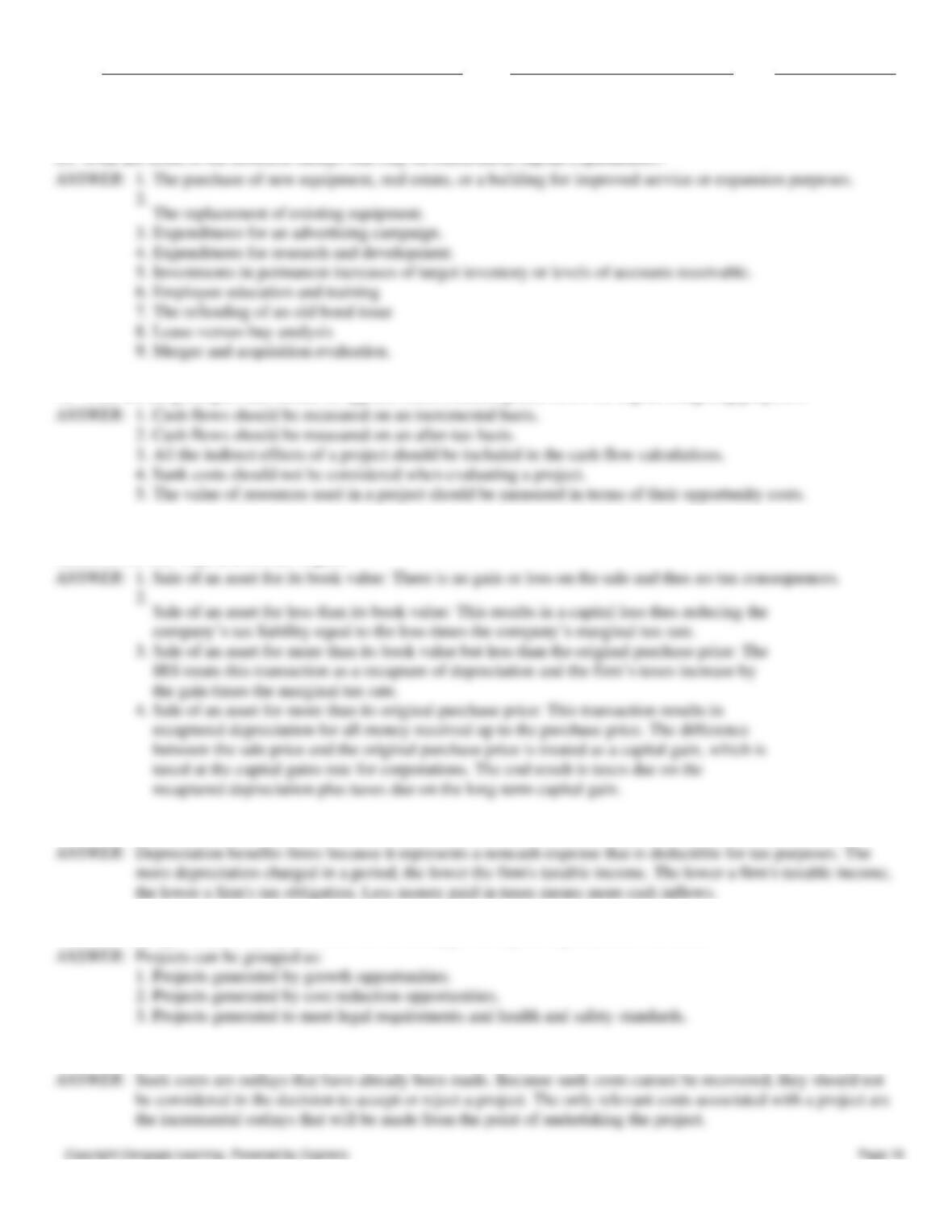
90. What are the principles that should be applied when estimating cash flows for capital budgeting purposes?
91. There are four ways tax consequences may affect the after-tax net proceeds received from the sale of an asset.
Describe the four ways and the tax impact.
92. Why is depreciation beneficial to firms?
93. In classifying investment projects, there are several types of capital expenditures. List them.
94. Why should sunk costs not be considered when evaluating a project?
Name:
Class:
Date:
Chapter 09: Capital Budgeting and Cash Flow Analysis
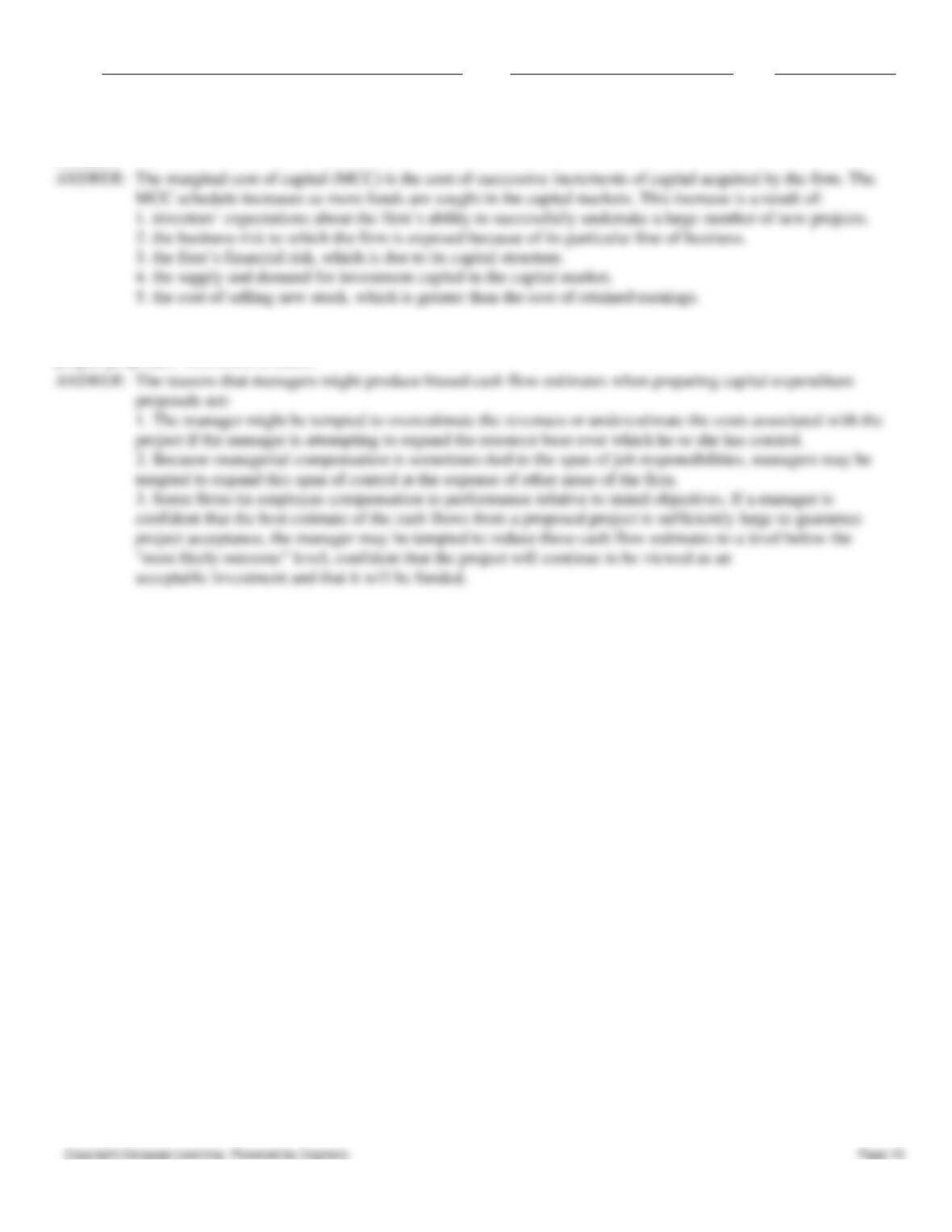
95. What is the marginal cost of capital and why does the MCC schedule increase as more funds are sought in the capital
markets?
96. There are several reasons why managers might produce biased cash flow estimates when preparing capital expenditure
project proposals. List some of them.