Chapter 09: The Cost of Capital
64. If the expected dividend growth rate is zero, then the cost of external equity capital raised by issuing new common
stock (re) is equal to the cost of equity capital from retaining earnings (rs) divided by one minus the percentage flotation
cost required to sell the new stock, (1 − F). If the expected growth rate is not zero, then the cost of external equity must be
found using a different formula.
a. True
b. False
65. Trahern Baking Co. common stock sells for $32.50 per share. It expects to earn $3.50 per share during the current
year, its expected dividend payout ratio is 65%, and its expected constant dividend growth rate is 6.0%. New stock can be
sold to the public at the current price, but a flotation cost of 5% would be incurred. What would be the cost of equity from
new common stock?
a. 12.70%
b. 13.37%
c. 14.04%
d. 14.74%
e. 15.48%
Chapter 09: The Cost of Capital
66. You are a finance intern at Chambers and Sons and they have asked you to help estimate the company’s cost of
common equity. You obtained the following data: D1 = $1.25; P0 = $27.50; gL = 5.00% (constant); and F = 6.00%. What
is the cost of equity raised by selling new common stock?
a. 9.06%
b. 9.44%
c. 9.84%
d. 10.23%
e. 10.64%
Chapter 09: The Cost of Capital
67. You were recently hired by Garrett Design, Inc. to estimate its cost of common equity. You obtained the following
data: D1 = $1.75; P0 = $42.50; gL = 7.00% (constant); and F = 5.00%. What is the cost of equity raised by selling new
common stock?
a. 10.77%
b. 11.33%
c. 11.90%
d. 12.50%
e. 13.12%
68. As the winner of a contest, you are now CFO for the day for Maguire Inc. and your day’s job involves raising capital
for expansion. Maguire’s common stock currently sells for $45.00 per share, the company expects to earn $2.75 per share
during the current year, its expected payout ratio is 70%, and its expected constant growth rate is 6.00%. New stock can
be sold to the public at the current price, but a flotation cost of 8% would be incurred. By how much would the cost of
new stock exceed the cost of common from reinvested earnings?
a. 0.09%
b. 0.19%
c. 0.37%
d. 0.56%
e. 0.84%
Chapter 09: The Cost of Capital
69. For a typical firm, which of the following sequences is CORRECT? All rates are after taxes, and assume that the firm
operates at its target capital structure.
a. re > rs > WACC > rd.
b. WACC > re > rs > rd.
c. rd > re > rs > WACC.
d. WACC > rd > rs > re.
e. rs > re > rd > WACC.
70. Which of the following statements is CORRECT?
a. The WACC is calculated using a before-tax cost for debt that is equal to the interest rate that must be paid on new
debt, along with the after-tax costs for common stock and for preferred stock if it is used.
b. An increase in the risk-free rate is likely to reduce the marginal costs of both debt and equity.
c. The WACC for a firm that pays dividends and regularly issues new equity will be greater than the WACC for an
otherwise identical company that pays lower dividends and that rarely issues new equity.
d. Beta measures market risk, which is generally the most relevant risk measure for a publicly-owned firm that seeks
to maximize its intrinsic value. However, this is not true unless all of the firm’s stockholders are well diversified.
Chapter 09: The Cost of Capital
e. The bond-yield-plus-risk-premium approach to estimating the cost of common equity involves adding a risk
premium to the interest rate on the company’s own long-term bonds. The size of the risk premium for bonds with different
ratings is published daily in The Wall Street Journal.
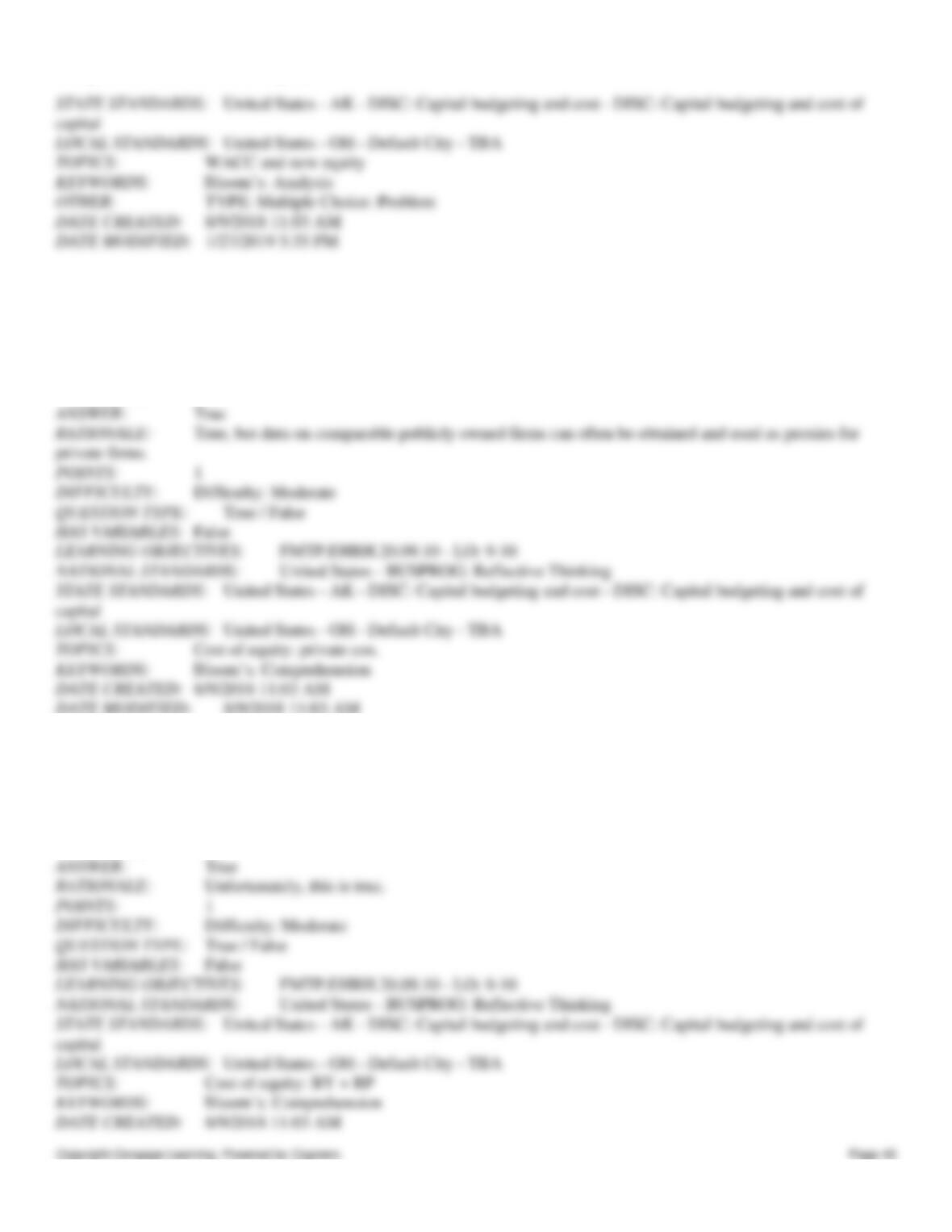
71. Assume that you are an intern with the Brayton Company, and you have collected the following data: The yield on the
company’s outstanding bonds is 7.75%; its tax rate is 25%; the next expected dividend is $0.65 a share; the dividend is
expected to grow at a constant rate of 6.00% a year; the price of the stock is $15.00 per share; the flotation cost for selling
new shares is F = 10%; and the target capital structure is 45% debt and 55% common equity. What is the firm’s WACC,
assuming it must issue new stock to finance its capital budget?
a. 7.34%
b. 7.73%
c. 8.14%
d. 8.56%
e. 8.99%
Chapter 09: The Cost of Capital
72. If a firm is privately owned, and its stock is not traded in public markets, then we cannot measure its beta for use in
the CAPM model, we cannot observe its stock price for use in the dividend growth model, and we don’t know what the
risk premium is for use in the bond-yield-plus-risk-premium method. All this makes it especially difficult to estimate the
cost of equity for a private company.
a. True
b. False
73. When estimating the cost of equity by use of the bond-yield-plus-risk-premium method, we can generally get a good
idea of the interest rate on new long-term debt, but we cannot be sure that the risk premium we add is appropriate. This
problem leaves us unsure of the true value of rs.
a. True
b. False
Chapter 09: The Cost of Capital
74. Your consultant firm has been hired by Eco Brothers Inc. to help them estimate the cost of common equity. The yield
on the firm’s bonds is 8.75%, and your firm’s economists believe that the cost of common can be estimated using a risk
premium of 3.85% over a firm’s own cost of debt. What is an estimate of the firm’s cost of common from reinvested
earnings?
a. 12.60%
b. 13.10%
c. 13.63%
d. 14.17%
e. 14.74%
75. Firms raise capital at the total corporate level by retaining earnings and by obtaining funds in the capital markets.
They then provide funds to their different divisions for investment in capital projects. The divisions may vary in risk, and
the projects within the divisions may also vary in risk. Therefore, it is conceptually correct to use different risk-adjusted
costs of capital for different capital budgeting projects.
a. True
b. False
Chapter 09: The Cost of Capital
76. Bloom and Co. has no debt or preferred stock⎯it uses only equity capital, and has two equally-sized divisions.
Division X’s cost of capital is 10.0%, Division Y‘s cost is 14.0%, and the corporate (composite) WACC is 12.0%. All of
Division X’s projects are equally risky, as are all of Division Y’s projects. However, the projects of Division X are less
risky than those of Division Y. Which of the following projects should the firm accept?
a. A Division Y project with a 12% return.
b. A Division X project with an 11% return.
c. A Division X project with a 9% return.
d. A Division Y project with an 11% return.
e. A Division Y project with a 13% return.
77. The Tierney Group has two divisions of equal size: an office furniture manufacturing division and a data processing
division. Its CFO believes that stand-alone data processor companies typically have a WACC of 9%, while stand-alone
furniture manufacturers typically have a 13% WACC. She also believes that the data processing and manufacturing
divisions have the same risk as their typical peers. Consequently, she estimates that the composite, or corporate, WACC is
11%. A consultant has suggested using a 9% hurdle rate for the data processing division and a 13% hurdle rate for the
manufacturing division. However, the CFO disagrees, and she has assigned an 11% WACC to all projects in both
divisions. Which of the following statements is CORRECT?
a. The decision not to adjust for risk means, in effect, that it is favoring the data processing division. Therefore, that
division is likely to become a larger part of the consolidated company over time.
b. The decision not to adjust for risk means that the company will accept too many projects in the manufacturing
division and too few in the data processing division. This will lead to a reduction in the firm’s intrinsic value over time.
c. The decision not to risk-adjust means that the company will accept too many projects in the data processing
business and too few projects in the manufacturing business. This will lead to a reduction in its intrinsic value over time.
d. The decision not to risk-adjust means that the company will accept too many projects in the manufacturing
business and too few projects in the data processing business. This may affect the firm’s capital structure but it will not
affect its intrinsic value.
e. While the decision to use just one WACC will result in its accepting more projects in the manufacturing division
and fewer projects in its data processing division than if it followed the consultant’s recommendation, this should not
affect the firm’s intrinsic value.
Chapter 09: The Cost of Capital
78. Careco Company and Audaco Inc are identical in size and capital structure. However, the riskiness of their assets and
cash flows are somewhat different, resulting in Careco having a WACC of 10% and Audaco a WACC of 12%. Careco is
considering Project X, which has an IRR of 10.5% and is of the same risk as a typical Careco project. Audaco is
considering Project Y, which has an IRR of 11.5% and is of the same risk as a typical Audaco project.
Now assume that the two companies merge and form a new company, Careco/Audaco Inc. Moreover, the new company’s
market risk is an average of the pre-merger companies’ market risks, and the merger has no impact on either the cash
flows or the risks of Projects X and Y. Which of the following statements is CORRECT?
a. If evaluated using the correct post-merger WACC, Project X would have a negative NPV.
b. After the merger, Careco/Audaco would have a corporate WACC of 11%. Therefore, it should reject Project X
but accept Project Y.
c. Careco/Audaco’s WACC, as a result of the merger, would be 10%.
d. After the merger, Careco/Audaco should select Project Y but reject Project X. If the firm does this, its corporate
WACC will fall to 10.5%.
e. If the firm evaluates these projects and all other projects at the new overall corporate WACC, it will probably
become riskier over time.
79. Which of the following statements is CORRECT? Assume that the firm is a publicly-owned corporation and is
seeking to maximize shareholder wealth.
a. If a firm’s managers want to maximize the value of their firm’s stock, they should, in theory, concentrate on
project risk as measured by the standard deviation of the project’s expected future cash flows.
Chapter 09: The Cost of Capital
b. If a firm evaluates all projects using the same cost of capital, and the CAPM is used to help determine that cost,
then its risk as measured by beta will probably decline over time.
c. Projects with above-average risk typically have higher than average expected returns. Therefore, to maximize a
firm’s intrinsic value, its managers should favor high-beta projects over those with lower betas.
d. Project A has a standard deviation of expected returns of 20%, while Project B’s standard deviation is only 10%.
A’s returns are negatively correlated with both the firm’s other assets and the returns on most stocks in the economy, while
B’s returns are positively correlated. Therefore, Project A is less risky to a firm and should be evaluated with a lower cost
of capital.
e. If a firm has a beta that is less than 1.0, say 0.9, this would suggest that the expected returns on its assets are
negatively correlated with the returns on most other firms’ assets.
80. Which of the following statements is CORRECT?
a. The tax-adjusted cost of debt is always greater than the interest rate on debt, provided the company does in fact
pay taxes.
b. If a company assigns the same cost of capital to all of its projects regardless of each project’s risk, then the
company is likely to reject some safe projects that it actually should accept and to accept some risky projects that it should
reject.
c. Because no flotation costs are required to obtain capital as reinvested earnings, the cost of reinvested earnings is
generally lower than the after-tax cost of debt.
d. Higher flotation costs tend to reduce the cost of equity capital.
e. Since debt capital can cause a company to go bankrupt but equity capital cannot, debt is riskier than equity, and
thus the after-tax cost of debt is always greater than the cost of equity.
Chapter 09: The Cost of Capital
81. Taylor Inc. estimates that its average-risk projects have a WACC of 10%, its below-average risk projects have a
WACC of 8%, and its above-average risk projects have a WACC of 12%. Which of the following projects (A, B, and C)
should the company accept?
a. Project C, which is of above-average risk and has a return of 11%.
b. Project A, which is of average risk and has a return of 9%.
c. None of the projects should be accepted.
d. All of the projects should be accepted.
e. Project B, which is of below-average risk and has a return of 8.5%.
82. Weatherall Enterprises has no debt or preferred stock⎯it is an all-equity firm⎯and has a beta of 2.0. The chief financial
officer is evaluating a project with an expected return of 14%, before any risk adjustment. The risk-free rate is 5%, and the
market risk premium is 4%. The project being evaluated is riskier than an average project, in terms of both its beta risk
and its total risk. Which of the following statements is CORRECT?
a. The project should definitely be rejected because its expected return (before risk adjustment) is less than its
required return.
b. Riskier-than-average projects should have their expected returns increased to reflect their higher risk. Clearly, this
would make the project acceptable regardless of the amount of the adjustment.
c. The accept/reject decision depends on the firm’s risk-adjustment policy. If Weatherall’s policy is to increase the
required return on a riskier-than-average project to 3% over rS, then it should reject the project.
d. Capital budgeting projects should be evaluated solely on the basis of their total risk. Thus, insufficient
information has been provided to make the accept/reject decision.
e. The project should definitely be accepted because its expected return (before any risk adjustments) is greater than
its required return.
Chapter 09: The Cost of Capital
83. The Anderson Company has equal amounts of low-risk, average-risk, and high-risk projects. The firm’s overall
WACC is 12%. The CFO believes that this is the correct WACC for the company’s average-risk projects, but that a lower
rate should be used for lower-risk projects and a higher rate for higher-risk projects. The CEO disagrees, on the grounds
that even though projects have different risks, the WACC used to evaluate each project should be the same because the
company obtains capital for all projects from the same sources. If the CEO’s position is accepted, what is likely to happen
over time?
a. The company will take on too many low-risk projects and reject too many high-risk projects.
b. Things will generally even out over time, and, therefore, the firm’s risk should remain constant over time.
c. The company’s overall WACC should decrease over time because its stock price should be increasing.
d. The CEO’s recommendation would maximize the firm’s intrinsic value.
e. The company will take on too many high-risk projects and reject too many low-risk projects.
84. Suppose Acme Industries correctly estimates its WACC at a given point in time and then uses that same cost of capital
to evaluate all projects for the next 10 years, then the firm will most likely
a. become less risky over time, and this will maximize its intrinsic value.
b. accept too many low-risk projects and too few high-risk projects.
c. become more risky and also have an increasing WACC. Its intrinsic value will not be maximized.
d. continue as before, because there is no reason to expect its risk position or value to change over time as a result of
its use of a single cost of capital.
e. become riskier over time, but its intrinsic value will be maximized.
Chapter 09: The Cost of Capital
85. Suppose the debt ratio (D/TA) is 50%, the interest rate on new debt is 8%, the current cost of equity is 16%, and the
tax rate is 25%. An increase in the debt ratio to 60% would decrease the weighted average cost of capital (WACC).
a. True
b. False
86. With its current financial policies, Flagstaff Inc. will have to issue new common stock to fund its capital budget. Since
new stock has a higher cost than reinvested earnings, Flagstaff would like to avoid issuing new stock. Which of the
following actions would REDUCE its need to issue new common stock?
a. Increase the percentage of debt in the target capital structure.
b. Increase the proposed capital budget.
c. Reduce the amount of short-term bank debt in order to increase the current ratio.
d. Reduce the percentage of debt in the target capital structure.
e. Increase the dividend payout ratio for the upcoming year.
Chapter 09: The Cost of Capital
87. Burnham Brothers Inc. has no retained earnings since it has always paid out all of its earnings as dividends. This same
situation is expected to persist in the future. The company uses the CAPM to calculate its cost of equity, and its target
capital structure consists of common stock, preferred stock, and debt. Which of the following events would REDUCE its
WACC?
a. The flotation costs associated with issuing new common stock increase.
b. The company’s beta increases.
c. Expected inflation increases.
d. The flotation costs associated with issuing preferred stock increase.
e. The market risk premium declines.