Chapter 09: The Cost of Capital
1. “Capital” is sometimes defined as funds supplied to a firm by investors.
a. True
b. False
2. The cost of capital used in capital budgeting should reflect the average after-tax cost of providing required returns to
investors.
a. True
b. False
3. The component costs of capital are market-determined variables in the sense that they are based on investors’ required
returns.
a. True
b. False
Chapter 09: The Cost of Capital
4. Which of the following is NOT a capital component when calculating the weighted average cost of capital (WACC) for
use in capital budgeting?
a. Accounts payable.
b. Common stock “raised” by reinvesting earnings.
c. Common stock raised by new issues.
d. Preferred stock.
e. Long-term debt.
5. The before-tax cost of debt, which is lower than the after-tax cost, is used as the component cost of debt for purposes of
developing the firm’s WACC.
a. True
b. False
6. Which of the following statements is CORRECT?
a. All else equal, an increase in a company’s stock price will increase its marginal cost of reinvested earnings (not
newly issued stock), rs.
b. All else equal, an increase in a company’s stock price will increase its marginal cost of new common equity, re.
Chapter 09: The Cost of Capital
c. Since the money is readily available, the after-tax cost of reinvested earnings (not newly issued stock) is usually
much lower than the after-tax cost of debt.
d. If a company’s tax rate increases but the YTM on its noncallable bonds remains the same, the after-tax cost of its
debt will fall.
e. When calculating the cost of preferred stock, a company needs to adjust for taxes, because preferred stock
dividends are deductible by the paying corporation.
7. The cost of debt is equal to one minus the marginal tax rate multiplied by the average coupon rate on all outstanding
debt.
a. True
b. False
8. The cost of debt is equal to one minus the marginal tax rate multiplied by the interest rate on new debt.
a. True
b. False
Chapter 09: The Cost of Capital
9. If a firm’s marginal tax rate is increased, this would, other things held constant, lower the cost of debt used to calculate
its WACC.
a. True
b. False
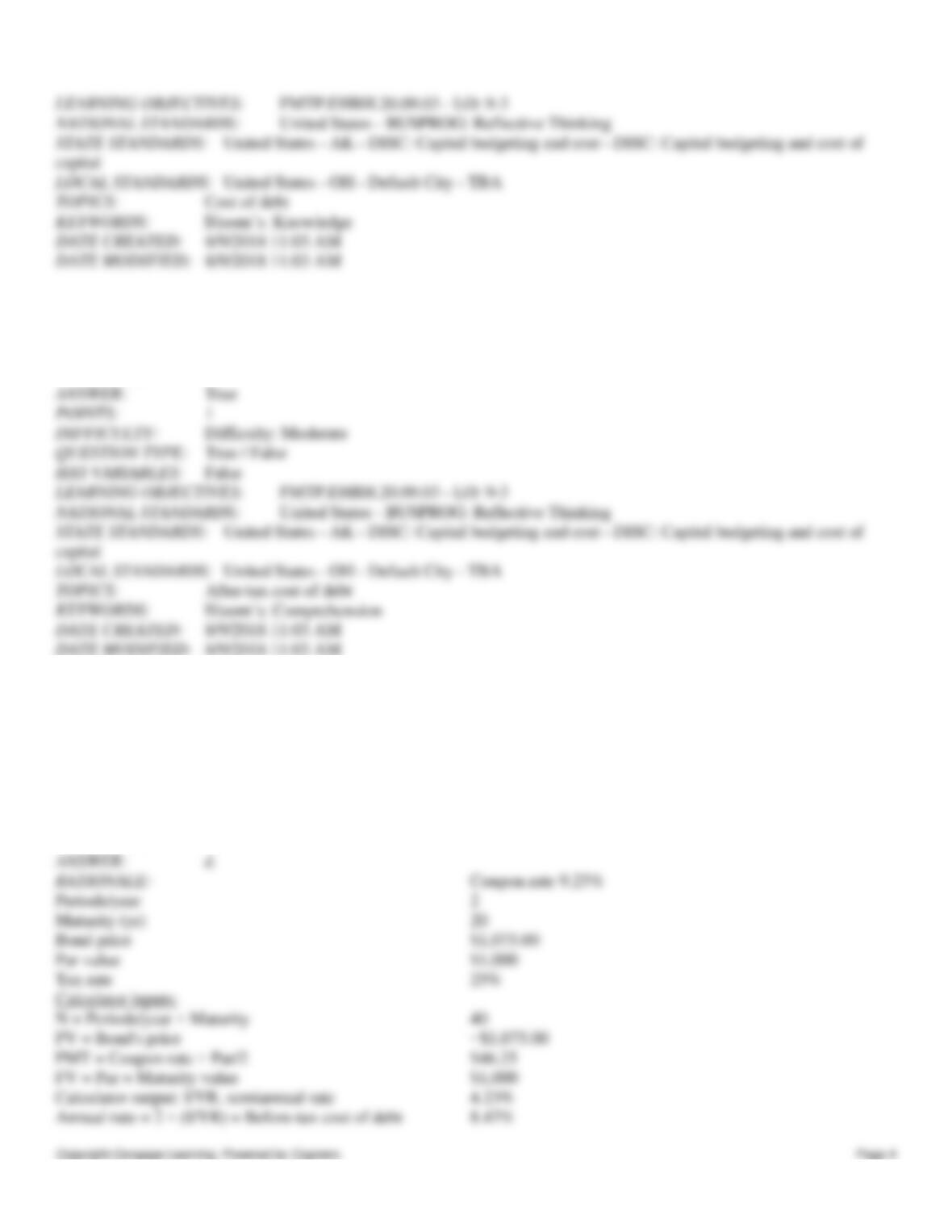
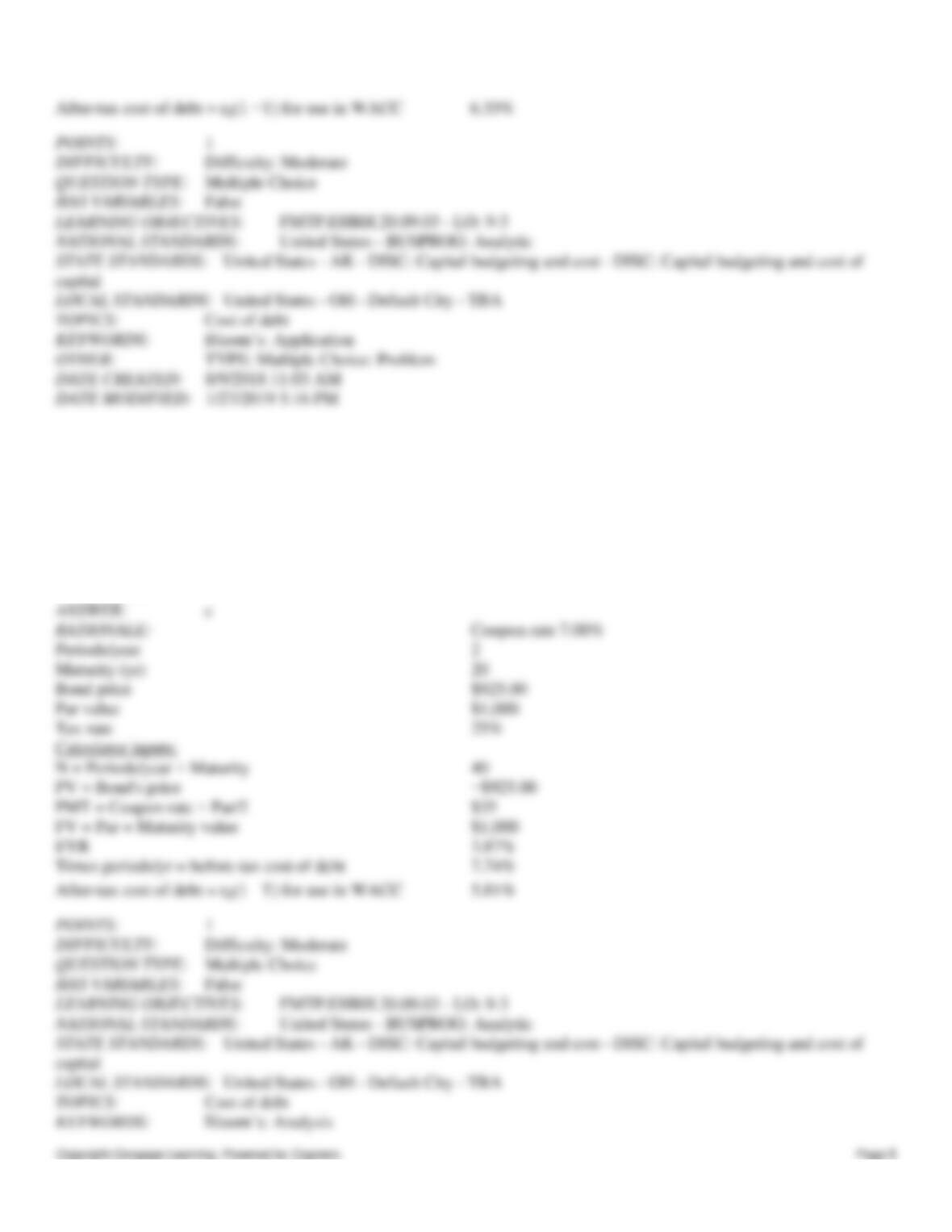
10. Kenny Electric Company’s noncallable bonds were issued several years ago and now have 20 years to maturity. These
bonds have a 9.25% annual coupon, paid semiannually, sells at a price of $1,075, and has a par value of $1,000. If the
firm’s tax rate is 25%, what is the component cost of debt for use in the WACC calculation?
a. 5.44%
b. 5.73%
c. 6.03%
d. 6.35%
e. 6.67%
Chapter 09: The Cost of Capital
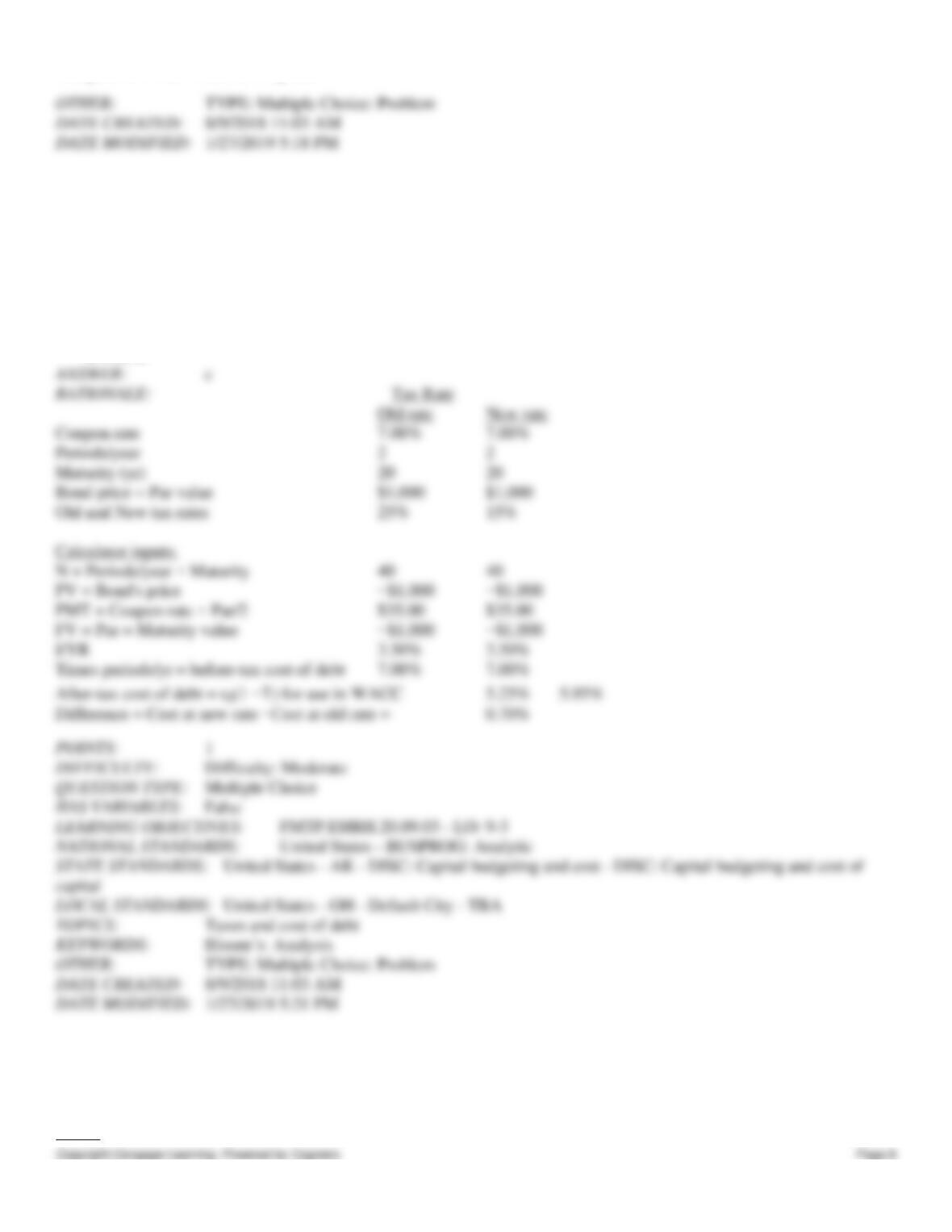
11. The Lincoln Company sold a $1,000 par value, noncallable bond several years ago that now has 20 years to maturity
and a 7.00% annual coupon that is paid semiannually. The bond currently sells for $925 and the company’s tax rate is
25%. What is the component cost of debt for use in the WACC calculation?
a. 5.35%
b. 5.58%
c. 5.81%
d. 6.04%
e. 6.28%
Chapter 09: The Cost of Capital
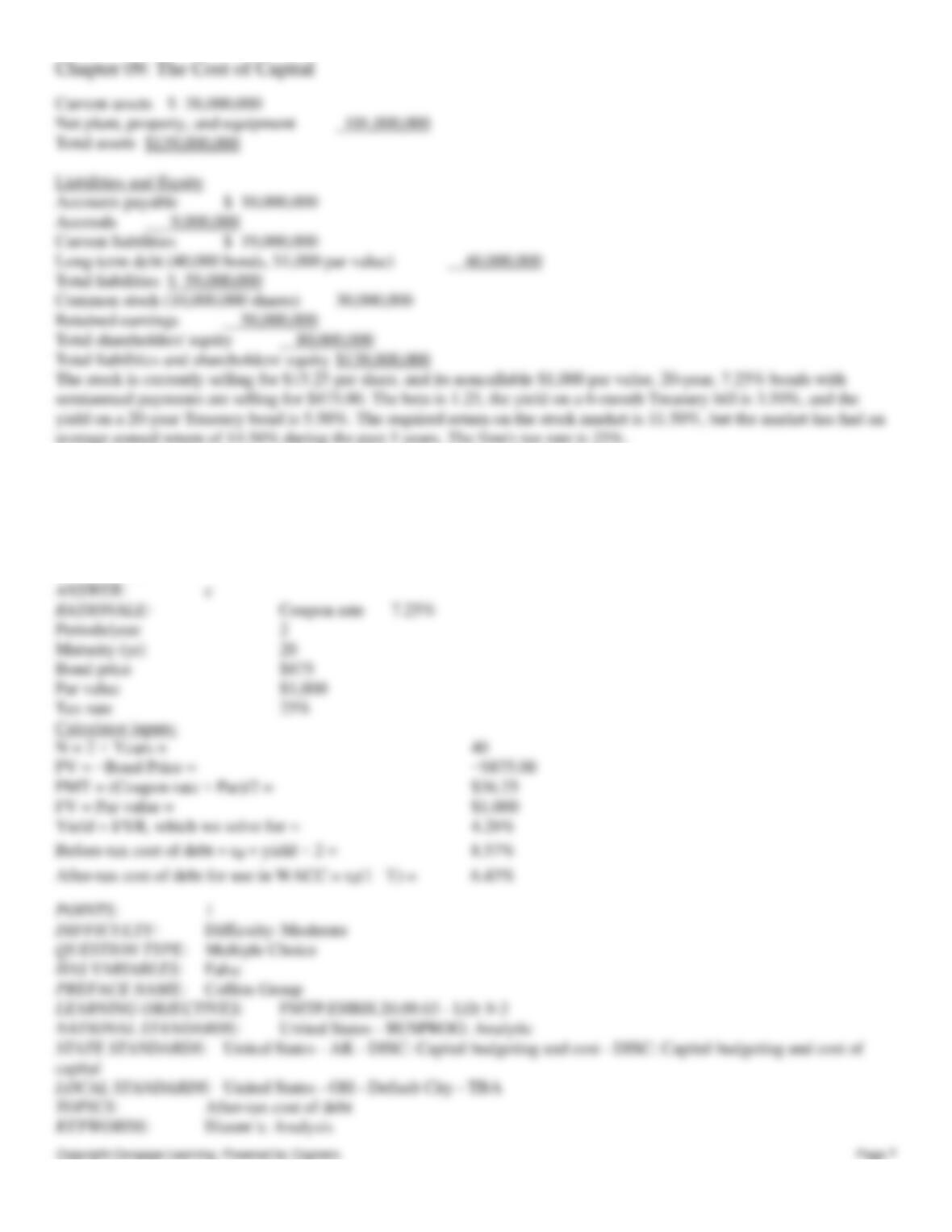
12. Westbrook’s Painting Co. plans to issue a $1,000 par value, 20-year noncallable bond with a 7.00% annual coupon,
paid semiannually. The company’s marginal tax rate is 25%, but Congress is considering a change in the corporate tax rate
to 15%. By how much would the component cost of debt used to calculate the WACC change if the new tax rate was
adopted?
a. 0.57%
b. 0.63%
c. 0.70%
d. 0.77%
e. 0.85%
Collins Group
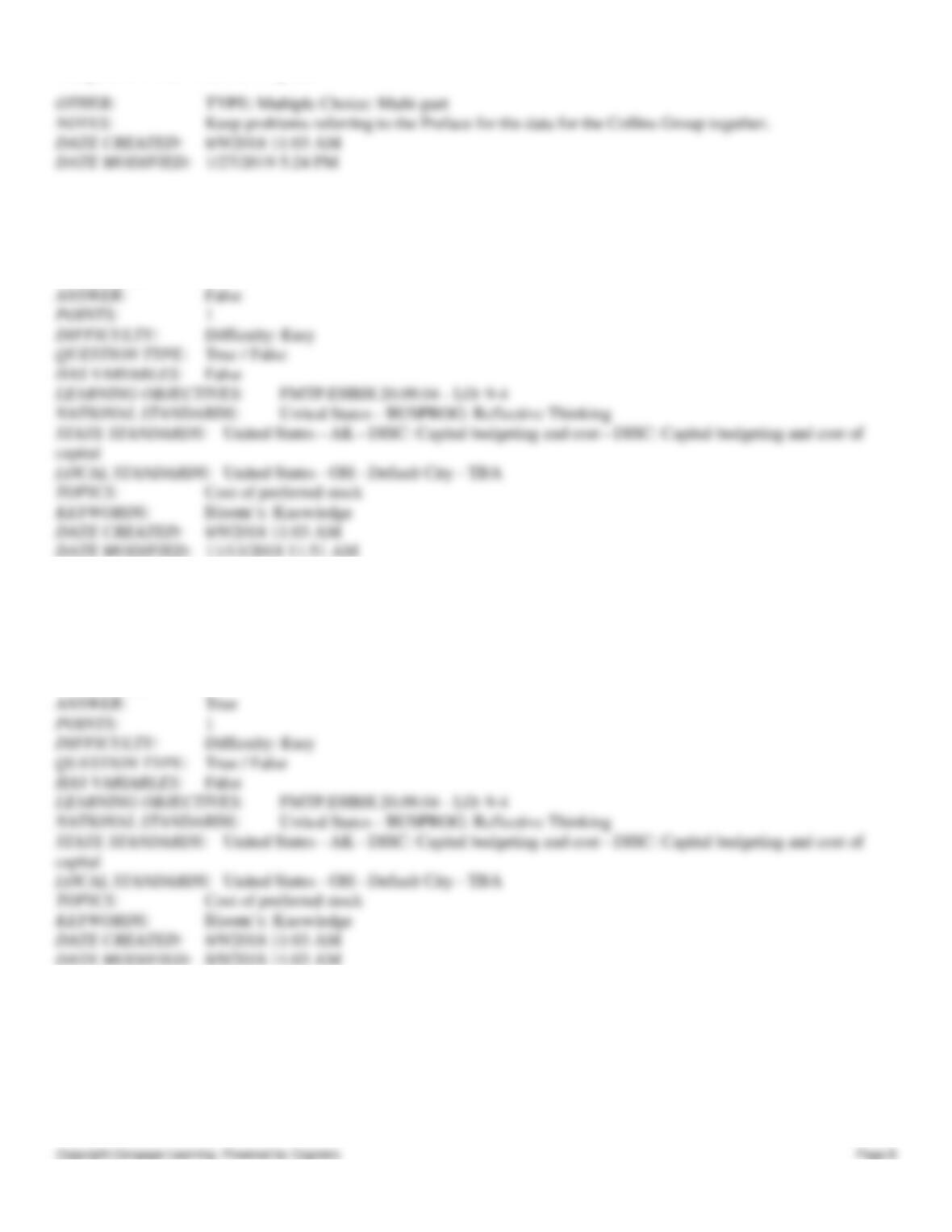
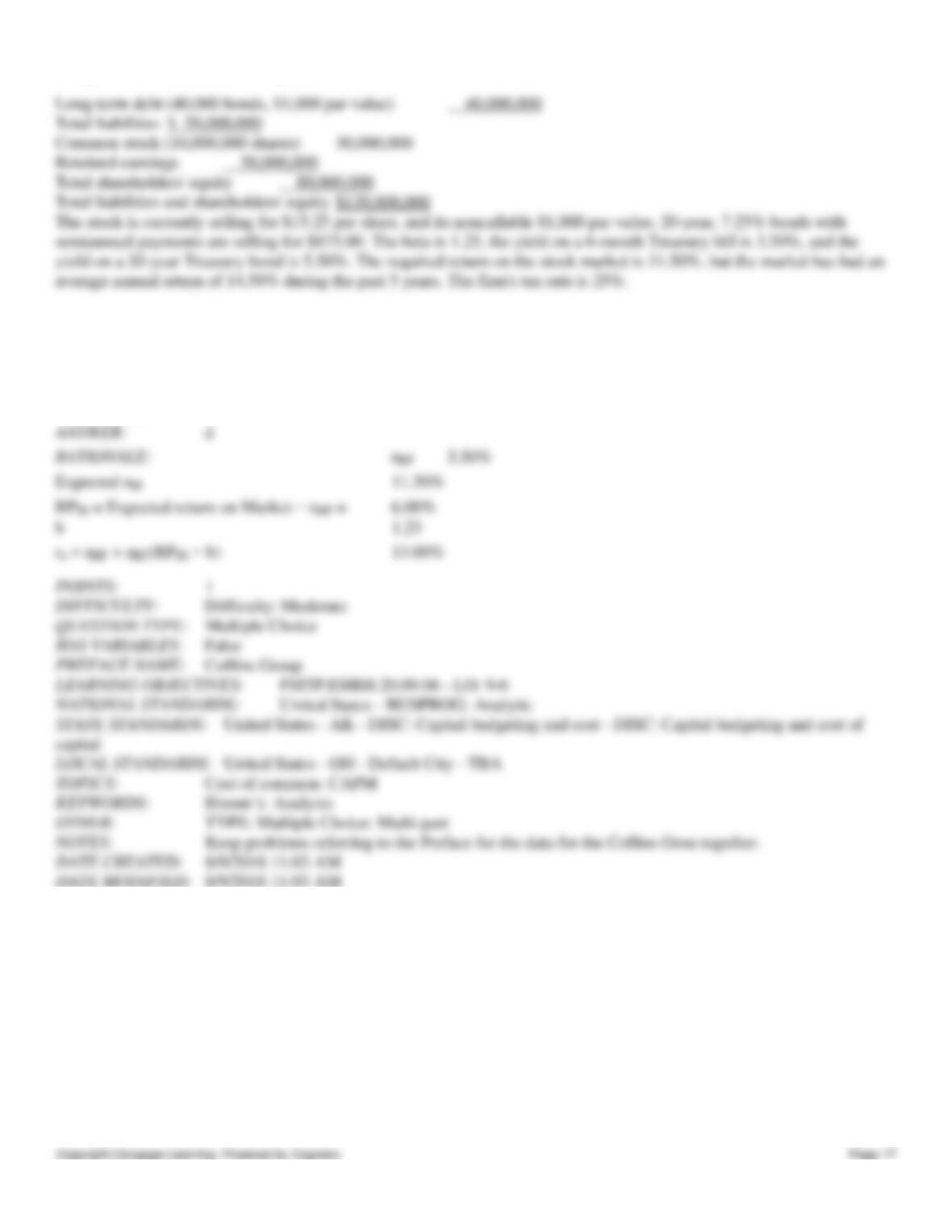
The Collins Group, a leading producer of custom automobile accessories, has hired you to estimate the firm’s weighted
average cost of capital. The balance sheet and some other information are provided below.
Assets
13. Refer to the data for the Collins Group. What is the best estimate of the after-tax cost of debt?
a. 5.80%
b. 6.10%
c. 6.43%
d. 6.75%
e. 7.08%
Chapter 09: The Cost of Capital
14. The cost of preferred stock to a firm must be adjusted to an after-tax figure because 50% of dividends received by a
corporation may be excluded from the receiving corporation’s taxable income.
a. True
b. False
15. The cost of perpetual preferred stock is found as the preferred’s annual dividend divided by the market price of the
preferred stock. No adjustment is needed for taxes because preferred dividends, unlike interest on debt, is not deductible
by the issuing firm.
a. True
b. False
16. Because 50% of the preferred dividends received by a corporation are excluded from taxable income, the component
cost of equity for a company that pays half of its earnings out as common dividends and half as preferred dividends
should, theoretically, be
Cost of equity = rs(0.30)(0.50) + rps(1 − T)(0.50)(0.50).
a. True
b. False
Chapter 09: The Cost of Capital
17. Perpetual preferred stock from Franklin Inc. sells for $97.50 per share, and it pays an $8.50 annual dividend. If the
company were to sell a new preferred issue, it would incur a flotation cost of 4.00% of the price paid by investors. What is
the company’s cost of preferred stock for use in calculating the WACC?
a. 8.72%
b. 9.08%
c. 9.44%
d. 9.82%
e. 10.22%
18. A company’s perpetual preferred stock currently sells for $92.50 per share, and it pays an $8.00 annual dividend. If the
company were to sell a new preferred issue, it would incur a flotation cost of 5.00% of the issue price. What is the firm’s
cost of preferred stock?
a. 7.81%
b. 8.22%
c. 8.65%
Chapter 09: The Cost of Capital
d. 9.10%
e. 9.56%
19. Which of the following statements is CORRECT?
a. Since its stockholders are not directly responsible for paying a corporation’s income taxes, corporations should
focus on before-tax cash flows when calculating the WACC.
b. An increase in a firm’s tax rate will increase the component cost of debt, provided the YTM on the firm’s bonds is
not affected by the change in the tax rate.
c. When the WACC is calculated, it should reflect the costs of new common stock, reinvested earnings, preferred
stock, long-term debt, short-term bank loans if the firm normally finances with bank debt, and accounts payable if the firm
normally has accounts payable on its balance sheet.
d. If a firm has been suffering accounting losses that are expected to continue into the foreseeable future, and
therefore its tax rate is zero, then it is possible for the after-tax cost of preferred stock to be less than the after-tax cost of
debt.
e. Since the costs of internal and external equity are related, an increase in the flotation cost required to sell a new
issue of stock will increase the cost of reinvested earnings.
Chapter 09: The Cost of Capital
20. The cost of common equity obtained by retaining earnings is the rate of return the marginal stockholder requires on
the firm’s common stock.
a. True
b. False
21. For capital budgeting and cost of capital purposes, the firm should always consider reinvested earnings as the first
source of capital⎯i.e., use these funds first⎯because reinvested earnings have no cost to the firm.
a. True
b. False
22. Funds acquired by the firm through retaining earnings have no cost because there are no dividend or interest payments
associated with them, and no flotation costs are required to raise them, but capital raised by selling new stock or bonds
does have a cost.
a. True
b. False
Chapter 09: The Cost of Capital
23. The cost of equity raised by retaining earnings can be less than, equal to, or greater than the cost of external equity
raised by selling new issues of common stock, depending on tax rates, flotation costs, the attitude of investors, and other
factors.
a. True
b. False
24. The firm’s cost of external equity raised by issuing new stock is the same as the required rate of return on the firm’s
outstanding common stock.
a. True
b. False
Chapter 09: The Cost of Capital
25. The reason why reinvested earnings have a cost equal to rs is because investors think they can (i.e., expect to) earn rs
on investments with the same risk as the firm’s common stock, and if the firm does not think that it can earn rs on the
earnings that it retains, it should distribute those earnings to its investors. Thus, the cost of reinvested earnings is based on
the opportunity cost principle.
a. True
b. False
26. When estimating the cost of equity by use of the CAPM, three potential problems are (1) whether to use long-term or
short-term rates for rRF, (2) whether or not the historical beta is the beta that investors use when evaluating the stock, and
(3) how to measure the market risk premium, RPM. These problems leave us unsure of the true value of rs.
a. True
b. False
27. The text identifies three methods for estimating the cost of common stock from reinvested earnings (not newly issued
stock): the CAPM method, the dividend growth method, and the bond-yield-plus-risk-premium method. However, only
the dividend growth method is widely used in practice.
a. True
b. False
Chapter 09: The Cost of Capital
28. If expectations for long-term inflation rose, but the slope of the SML remained constant, this would have a greater
impact on the required rate of return on equity, rs, than on the interest rate on long-term debt, rd, for most firms.
Therefore, the percentage point increase in the cost of equity would be greater than the increase in the interest rate on
long-term debt.
a. True
b. False
29. If investors’ aversion to risk rose, causing the slope of the SML to increase, this would have a greater impact on the
required rate of return on equity, rs, than on the interest rate on long-term debt, rd, for most firms. Other things held
constant, this would lead to an increase in the use of debt and a decrease in the use of equity. However, other things would
not stay constant if firms used a lot more debt, as that would increase the riskiness of both debt and equity and thus limit
the shift toward debt.
a. True
b. False
Chapter 09: The Cost of Capital
30. When working with the CAPM, which of the following factors can be determined with the most precision?
a. The beta coefficient, bi, of a relatively safe stock.
b. The most appropriate risk-free rate, rRF.
c. The expected rate of return on the market, rM.
d. The beta coefficient of “the market,” which is the same as the beta of an average stock.
e. The market risk premium (RPM).
31. Adams Inc. has the following data: rRF = 5.00%; RPM = 6.00%; and b = 1.05. What is the firm’s cost of common from
reinvested earnings based on the CAPM?
a. 11.30%
b. 11.64%
c. 11.99%
d. 12.35%
e. 12.72%
Chapter 09: The Cost of Capital
32. You have been hired as a consultant by Feludi Inc.’s CFO, who wants you to help her estimate the cost of capital. You
have been provided with the following data: rRF = 4.10%; RPM = 5.25%; and b = 1.30. Based on the CAPM approach,
what is the cost of common from reinvested earnings?
a. 9.67%
b. 9.97%
c. 10.28%
d. 10.60%
e. 10.93%
Collins Group
The Collins Group, a leading producer of custom automobile accessories, has hired you to estimate the firm’s weighted
average cost of capital. The balance sheet and some other information are provided below.
Assets
Current assets $ 38,000,000
Net plant, property, and equipment 101,000,000
Total assets $139,000,000
Liabilities and Equity
Accounts payable $ 10,000,000
Accruals 9,000,000
Current liabilities $ 19,000,000
Chapter 09: The Cost of Capital
33. Refer to the data for the Collins Group. Based on the CAPM, what is the firm’s cost of common stock?
a. 11.15%
b. 11.73%
c. 12.35%
d. 13.00%
e. 13.65%
34. Which of the following statements is CORRECT?
a. If the calculated beta underestimates the firm’s true investment risk⎯i.e., if the forward-looking beta that investors
think exists exceeds the historical beta⎯then the CAPM method based on the historical beta will produce an estimate of rs
and thus WACC that is too high.
b. Beta measures market risk, which is, theoretically, the most relevant risk measure for a publicly-owned firm that
seeks to maximize its intrinsic value. This is true even if not all of the firm’s stockholders are well diversified.
c. An advantage shared by both the dividend growth model and CAPM methods when they are used to estimate the
cost of equity is that they are both “objective” as opposed to “subjective,” hence little or no judgment is required.
d. The specific risk premium used in the CAPM is the same as the risk premium used in the bond-yield-plus-risk-
premium approach.
Chapter 09: The Cost of Capital
e. The discounted cash flow method of estimating the cost of equity cannot be used unless the growth rate, g, is
expected to be constant forever.
35. When estimating the cost of equity by use of the dividend growth method, the single biggest potential problem is to
determine the growth rate that investors use when they estimate a stock’s expected future rate of return. This problem
leaves us unsure of the true value of rs.
a. True
b. False
36. As a consultant to Basso Inc., you have been provided with the following data: D1 = $0.67; P0 = $27.50; and gL =
8.00% (constant). What is the cost of common from reinvested earnings based on the dividend growth approach?
a. 9.42%
b. 9.91%
c. 10.44%
d. 10.96%
e. 11.51%
Chapter 09: The Cost of Capital
37. To help them estimate the company’s cost of capital, Smithco has hired you as a consultant. You have been provided
with the following data: D1 = $1.45; P0 = $22.50; and gL = 6.50% (constant). Based on the dividend growth approach,
what is the cost of common from reinvested earnings?
a. 11.10%
b. 11.68%
c. 12.30%
d. 12.94%
e. 13.59%
38. To help estimate its cost of common equity, Maxwell and Associates recently hired you. You have obtained the
following data: D0 = $0.90; P0 = $27.50; and gL = 7.00% (constant). Based on the dividend growth model, what is the
cost of common from reinvested earnings?
a. 9.29%
Chapter 09: The Cost of Capital
b. 9.68%
c. 10.08%
d. 10.50%
e. 10.92%
39. As the assistant to the CFO of Johnstone Inc., you must estimate its cost of common equity. You have been provided
with the following data: D0 = $0.80; P0 = $22.50; and gL = 8.00% (constant). Based on the dividend growth model, what
is the cost of common from reinvested earnings?
a. 10.69%
b. 11.25%
c. 11.84%
d. 12.43%
e. 13.05%