a.
increases.
b.
decreases.
c.
is unaffected.
d.
cannot be determined with out knowing the discount rate.
55. The NPV method focuses on:
a.
sales.
b.
accounting returns.
c.
profits.
d.
cash flows.
56. The IRR method focuses on:
a.
sales.
b.
accounting returns.
c.
profits.
d.
cash flows.
57. Which method directly estimates the change in shareholder wealth?
a.
Payback
b.
IRR
c.
NPV
d.
PI
58. When the IRR is equal to the discount rate, the NPV is:
a.
positive.
b.
equal to zero.
c.
negative.
d.
cannot be determined without knowing the discount rate.
59. The IRR is analogous to:
a.
a bond’s current yield.
b.
a stock’s dividend yield.
c.
a bond’s yield–to–maturity.
d.
a stock’s yield to maturity.
60. The compound annual return on a project is known as its:
a.
NPV.
b.
PI.
c.
payback.
d.
IRR.
61. The hurdle rate used in IRR analysis should be:
a.
the risk-free rate.
b.
the current corporate bond rate.
c.
the prime rate.
d.
the discount rate used in NPV analysis.
62. Which of the following is a problem with the Internal Rate of Return?
a.
appropriate adjustment for the time value of money
b.
focus on cash flows
c.
multiple IRRs
d.
all of the above are problems with the Internal Rate of Return
63. NPV and IRR may give conflicting decisions for mutually exclusive projects because:
a.
the risk of the projects may differ.
b.
the scale of the projects may differ.
c.
the discount rates on the projects may differ.
d.
all of the above.
64. The NPV method is most likely to be used in:
a.
large firms.
b.
publicly traded firms.
c.
firms run by CFOs with MBAs.
d.
all of the above.
65. The payback method is more likely to be used by:
a.
younger CFOs.
b.
older CFOs.
c.
CFOs without an MBA
d.
b. and c.
NARRBEGIN: Commerce Company
Commerce Company
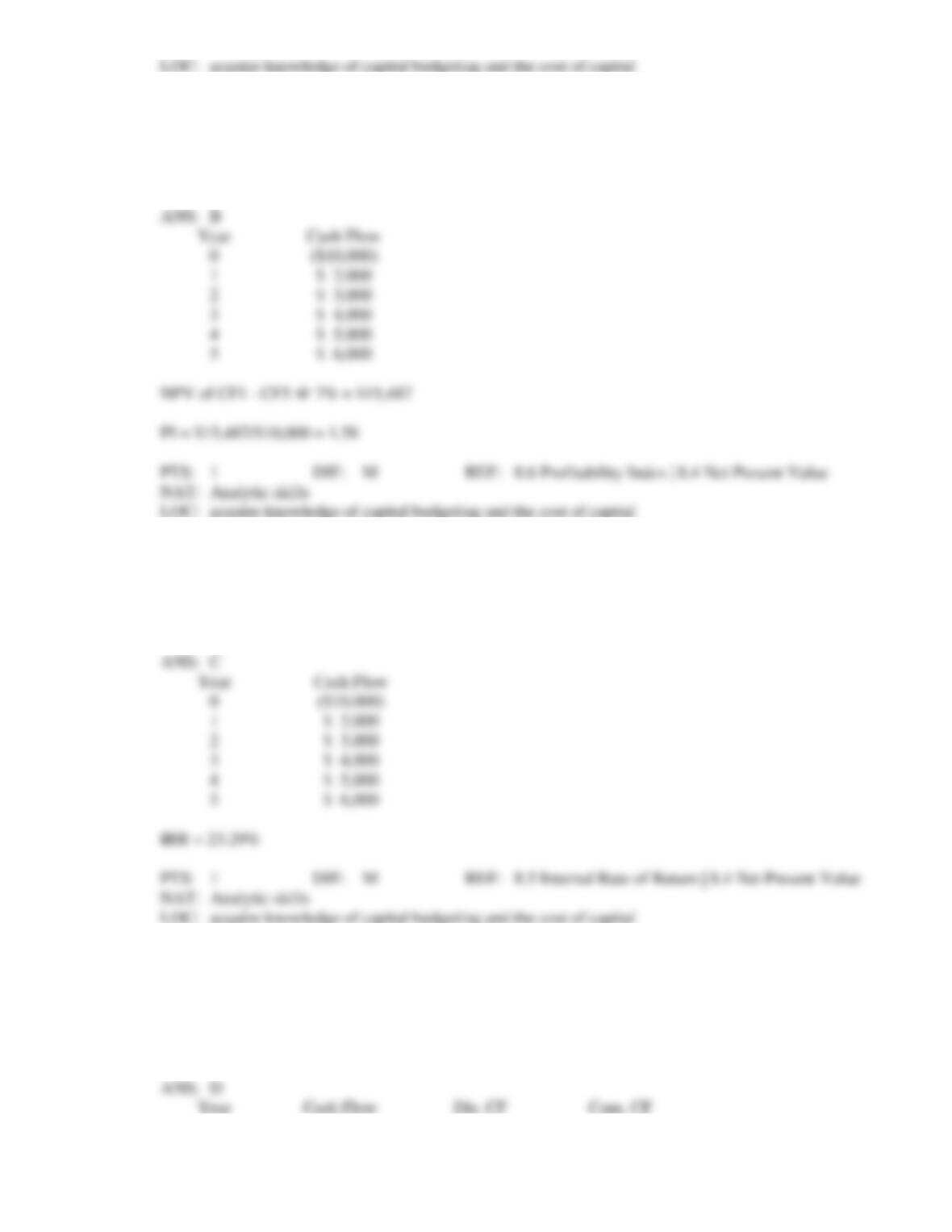
The Commerce Company is evaluating a project with the following cash flows:
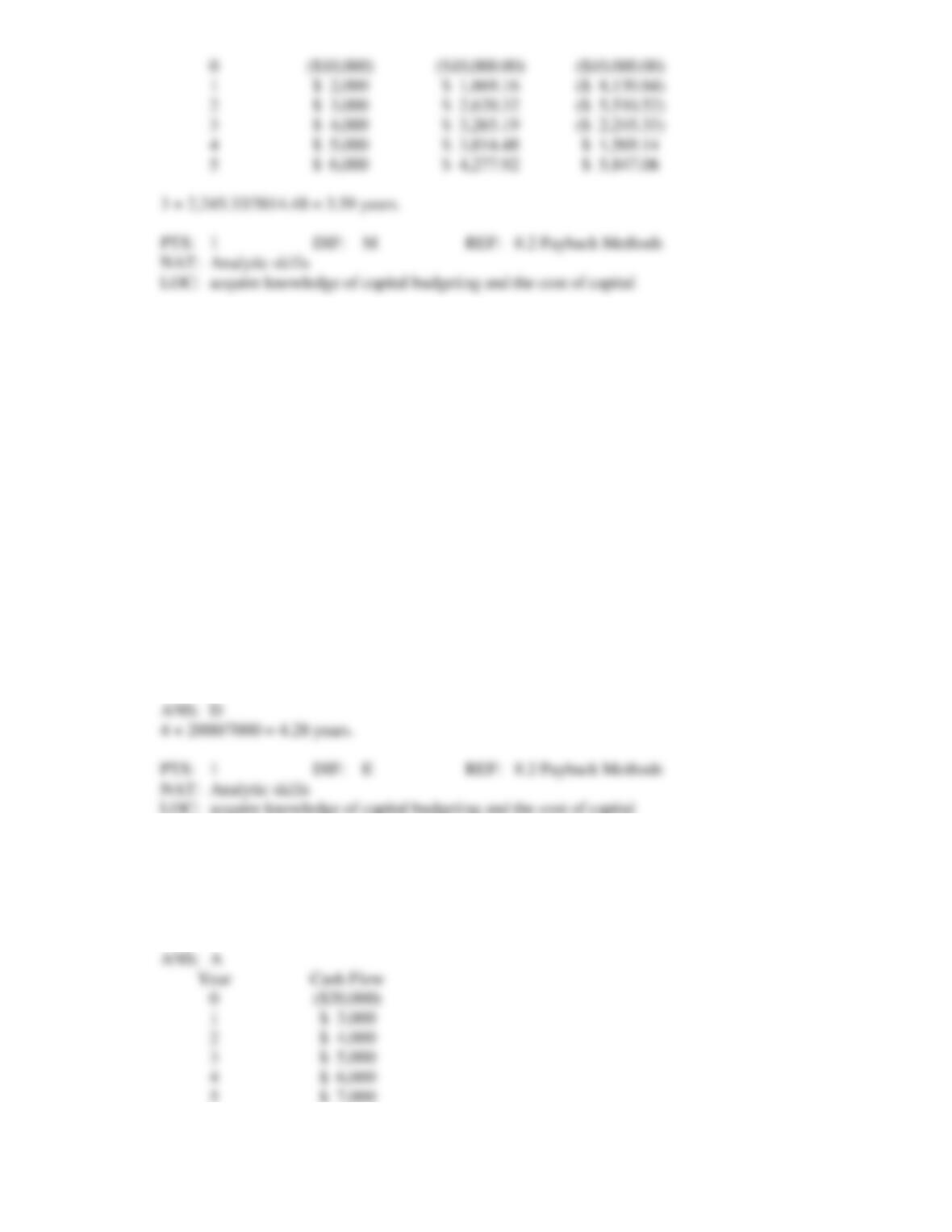
Year
Cash Flow
0
($10,000)
1
$ 2,000
2
$ 3,000
3
$ 4,000
4
$ 5,000
5
$ 6,000
NARREND
66. What is the payback period of the proposed Commerce Company project?
a.
1.5 years
b.
2.7 years
c.
3.2 years
d.
4.5 years
67. What is the net present value of the proposed Commerce Company project if the discount rate is 7%?
a.
$10,000
b.
$9,347
c.
$6,921
d.
$5,847
Cash Flow
0
1
2
3
4
5
68. What is the profitability index of the proposed Commerce Company project if the discount rate is 7%?
a.
.58
b.
1.58
c.
2.58
d.
3.58
69. What is the IRR of the proposed Commerce Company project?
a.
7.00%
b.
15.24%
c.
23.29%
d.
42.85%
70. What is the discounted payback period of the proposed Commerce Company project if the discount
rate is 7%?
a.
3.09 years
b.
3.19 years
c.
3.39 years
d.
3.59 years
NARRBEGIN: Swerling Company
Swerling Company
Swerling Company is considering a project with the following cash flows.
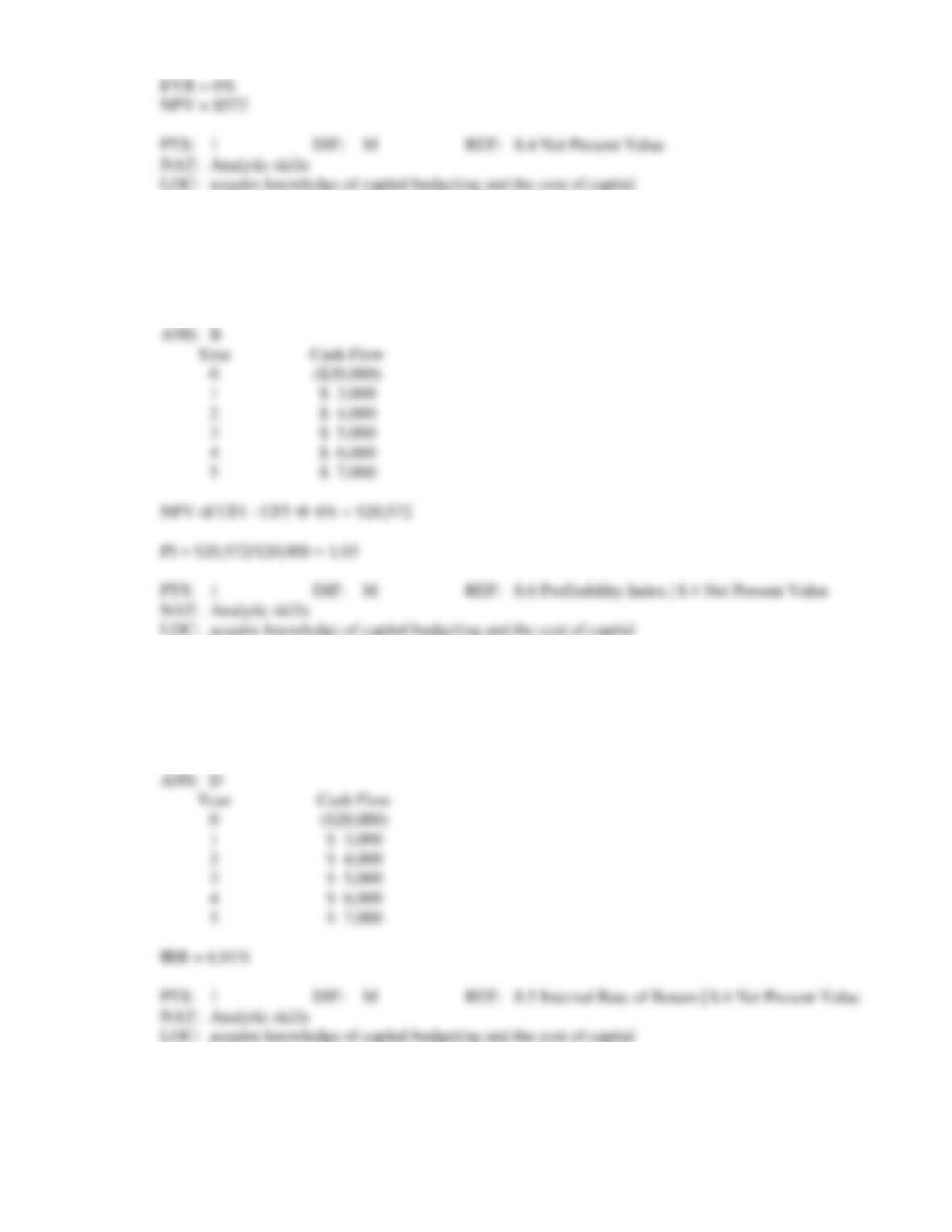
Year
Cash Flow
0
($20,000)
1
$ 3,000
2
$ 4,000
3
$ 5,000
4
$ 6,000
5
$ 7,000
NARREND
71. What is the payback period of the proposed Swerling Company project?
a.
1.28years
b.
2.28 years
c.
3.28 years
d.
4.28 years
72. What is the net present value of the proposed Swerling Company project if the discount rate is 6%?
a.
$572
b.
$1,572
c.
$10,572
d.
$100,572
0
1
2
3
4
0
1
2
3
4
5
73. What is the profitability index of the proposed Swerling Company project if the discount rate is 6%?
a.
.03
b.
1.03
c.
2.03
d.
3.03
74. What is the IRR of the proposed Swerling Company project?
a.
9.57%
b.
8.35%
c.
7.72%
d.
6.91%
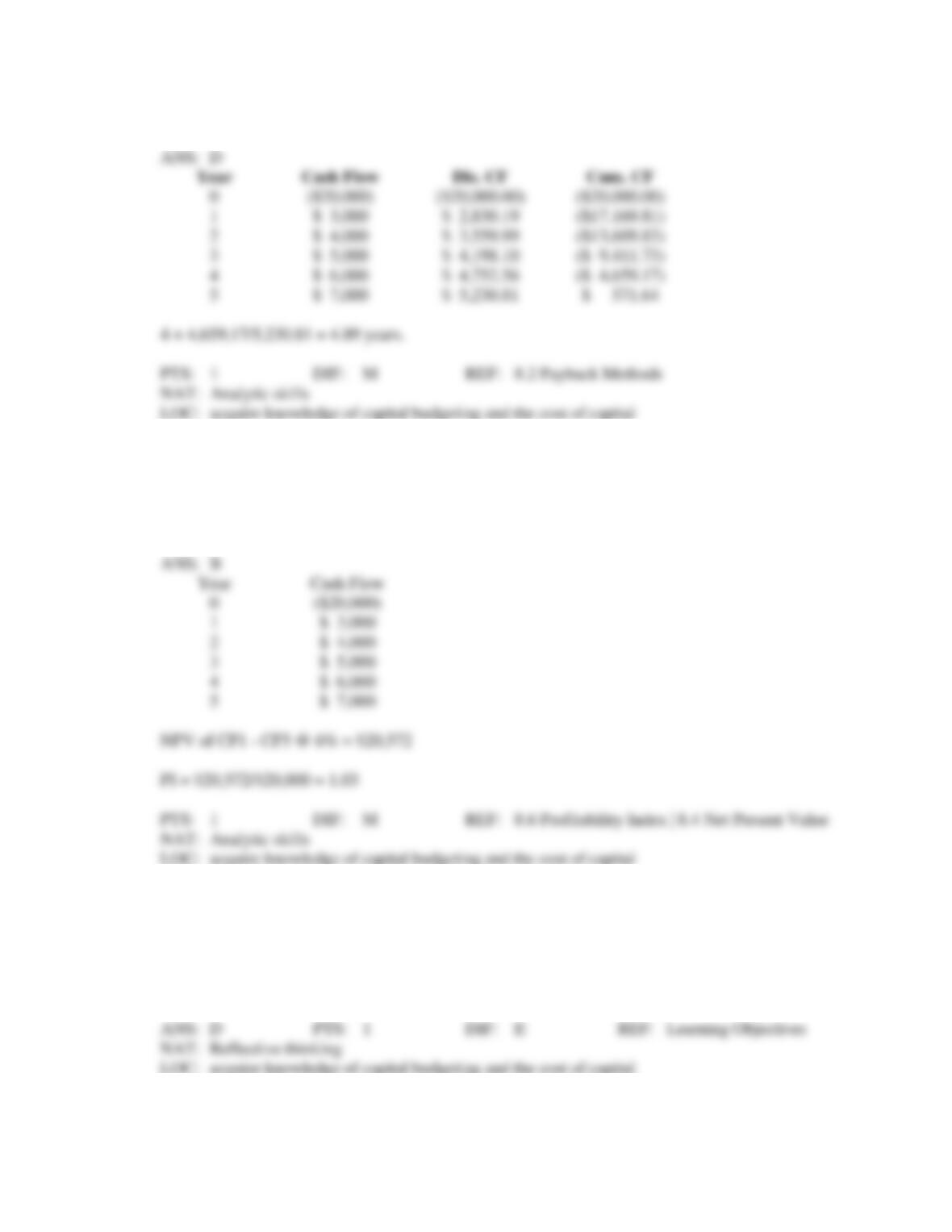
75. What is the discounted payback period of the proposed Swerling Company project if the discount rate
is 6%?
a.
6.89 years
b.
5.89 years
c.
3.89 years
d.
4.89 years
76. What is the profitability index of the proposed Swerling Company project if the discount rate is 6%?
a.
.03
b.
1.03
c.
2.03
d.
3.03
77. Which of the following statements is false?
a.
Ideas for investment projects stem mainly from the firm’s finance department.
b.
Capital projects by their nature are easily reversible.
c.
Once a capital project is approved, the role of a financial manager is non-existent.
d.
all of the above statements are false.
e.
Only (b) and (c) are false
78. Financial managers prefer a capital budgeting technique with which of the following characteristics?
a.
Easily-applied and considers cash flows
b.
Recognizes the time value of money and accounts for risk and return
c.
When applied leads to higher stock prices
d.
all of the above
e.
(a) and (b) only
79. When evaluating different capital budgeting techniques such as payback, net present value, internal
rate of return, profitability index and accounting rate of return,
a.
all techniques are equal and there is no reason to prefer one technique over another.
b.
some techniques have advantages over others.
c.
corporate managers have “stuck with” the same techniques over the last thirty years.
d.
both (a) and (b)
e.
all of the above
80. Which of the following is not a “con” of the Accounting Rate of Return method?
a.
The method makes no adjustment for the time value of money or project risk.
b.
The depreciation method used impacts both the numerator and denominator.
c.
It focuses on net income rather than a company’s ability to generate cash.
d.
The choice of the hurdle rate is arbitrary.
e.
All of the above are cons of the Accounting Rate of Return method.
81. Which of the following statements is false?
a.
The main virtue of the payback method is its simplicity.
b.
Some managers believe the payback method implicitly accounts for the riskiness of
longer-term projects.
c.
Some managers may prefer the payback method because it leads to accepting projects that
payback quickly which may be ideal for them in terms of building their short-term career.
d.
The payback method considers all cash flows for a project, even those occurring after the
payback period.
e.
Both (a) and (d) are false
82. While the NPV approach offers many advantages over some other capital budgeting techniques,
several cons exist with respect to the approach. Which of the following is (are) cons of the NPV
method?
a.
It fails to consider all of a project’s relevant cash flows.
b.
It fails to consider the time value of money.
c.
It focuses on net income and not cash flow.
d.
It seems less intuitive to many users than other methods.
e.
all of the above are cons of the NPV method.

83. Which of the following statements is true?
a.
The IRR method ignores the time value of money.
b.
The hurdle rate used with the IRR method is determined subjectively and therefore is
arbitrary.
c.
Many managers have difficulty comprehending the rate of return answer determined by
the IRR method.
d.
Multiple IRRs can result for some projects which can lead to a difficulty for the IRR
method.
e.
Both (b) and (d) are true
84. Which of the following statements is false?
a.
Multiple IRRs result when a project’s cash flows alternate between negative and positive
values.
b.
If a project has multiple IRRs its NPV profile will cross the x-axis more than once.
c.
The general rule of thumb is that a project will have as many IRRs are there are negative
cash flows.
d.
There are occasions when a project’s IRR may involve imaginary numbers.
e.
All of the above statements are true.
85. Louis is considering a new litter box factory with the following cash flows, what is the payback?
Year
CF
0
$ (150,000.00)
1
30,000.00
2
15,000.00
3
25,000.00
4
50,000.00
5
50,000.00
6
50,000.00
a.
3.4
b.
4.6
c.
4.0
d.
5.0

86. Louis is considering a new litter box factory with the following cash flows, if the discount rate is
10%, what is the NPV?
Year
CF
0
$ (150,000.00)
1
30,000.00
2
15,000.00
3
25,000.00
4
50,000.00
5
50,000.00
6
50,000.00
a.
$1,872.73
b.
$4,494.70
c.
$9,942.54
d.
$8,278.92
87. Louis is considering a new litter box factory with the following cash flows, what is the IRR?
Year
CF
0
$ (150,000.00)
1
30,000.00
2
15,000.00
3
25,000.00
4
50,000.00
0
$ (150,000.00)
1
30,000.00
2
3
25,000.00
(80,000.00)
4
50,000.00
(30,000.00)
5
50,000.00
6
50,000.00

5
50,000.00
6
50,000.00
a.
10.56%
b.
10.00%
c.
10.36%
d.
10.26%
88. Roxy is considering a new cat food factory with the following cash flows, what is the payback?
Year
CF
0
$
(250,000.00)
1
40,000.00
2
120,000.00
3
80,000.00
4
30,000.00
5
25,000.00
6
15,000.00
a.
3.4
b.
3.3
c.
4.0
d.
5.0
0
1
40,000.00
2
3
80,000.00
4
30,000.00
5
25,000.00
6
15,000.00

89. Roxy is considering a new cat food factory with the following cash flows, if the discount rate is 10%
what is the NPV?
Year
CF
0
$
(250,000.00)
1
40,000.00
2
120,000.00
3
80,000.00
4
30,000.00
5
25,000.00
6
15,000.00
a.
$ (2,895.30)
b.
$ (1,098.82)
c.
$ (7,007.03)
d.
$ (9,877.08)
90. Roxy is considering a new cat food factory with the following cash flows, if the discount rate is 10%
what is the PI?
Year
CF
0
$
(250,000.00)
1
40,000.00
2
120,000.00
3
80,000.00
4
30,000.00
5
25,000.00
6
15,000.00
a.
0.960
b.
0.956
c.
0.938
d.
0.917
91. Roxy is considering a new cat food factory with the following cash flows, what is the IRR?
Year
CF
0
$
(250,000.00)
1
40,000.00
2
120,000.00
3
80,000.00
4
30,000.00
5
25,000.00
6
15,000.00
a.
8.16%
b.
9.42%
c.
8.32%
d.
10.12%
92. Emma is considering a new cat nip factory with the following cash flows, what is the payback?
Year
CF
0
$(2,000,000.00)
1
200,000.00
2
650,000.00
3
500,000.00
4
500,000.00
5
500,000.00
6
350,000.00
a.
5.4
b.
5.0
c.
6.0
d.
5.2
Year
CF
0
1
200,000.00
2
650,000.00
3
500,000.00

93. Emma is considering a new cat nip factory with the following cash flows, if the disoucnt rate is 7%,
what is the NPV?
Year
CF
0
$(2,000,000.00)
1
200,000.00
2
650,000.00
3
500,000.00
4
500,000.00
5
500,000.00
6
350,000.00
a.
$ 35,772.42
b.
$ 100,459.11
c.
$ 133,960.47
d.
$ 16,947.33
94. Emma is considering a new cat nip factory with the following cash flows, if the disoucnt rate is 7%,
what is the PI?
Year
CF
0
$(2,000,000.00)
1
200,000.00
2
650,000.00
3
500,000.00
4
500,000.00
5
500,000.00
6
350,000.00
a.
1.067
4
500,000.00
6

b.
1.050
c.
0.943
d.
1.008
95. Emma is considering a new cat nip factory with the following cash flows, what is the IRR?
Year
CF
0
$(2,000,000.00)
1
200,000.00
2
650,000.00
3
500,000.00
4
500,000.00
5
500,000.00
6
350,000.00
a.
9.17
b.
9.07
c.
9.27
d.
9.37