
Corporate Finance, 4e (Berk / DeMarzo)
Chapter 8 Fundamentals of Capital Budgeting
8.1 Forecasting Earnings
1) Which of the following statements is FALSE?
A) A capital budget lists the projects and investments that a company plans to undertake during the
coming year.
B) Income Tax = EBIT × (1 – τc).
C) When sales of a new product displace sales of an existing product, the situation is often referred to as
cannibalization.
D) Overhead expenses are often allocated to the different business activities for accounting purposes.
2) Which of the following statements is FALSE?
A) Sales will ultimately decline as the product nears obsolescence or faces increased competition.
B) Managers sometimes continue to invest in a project that has a negative NPV because they have
already invested a large amount in the project and feel that by not continuing it, the prior investment
will wasted.
C) With straight-line depreciation the asset’s cost is divided equally over its life.
D) A projects unlevered net income is equal to its incremental revenues less costs and depreciation,
evaluated on an pre-tax basis.
3) Which of the following statements is FALSE?
A) We begin the capital budgeting process by determining the incremental earnings of a project.
B) The marginal corporate tax rate is the tax rate the firm will pay on an incremental dollar of pre-tax
income.
C) Investments in plant, property, and equipment are directly listed as expense when calculating
earnings.
D) The opportunity cost of using a resource is the value it could have provided in its best alternative
use.

4) Which of the following statements is FALSE?
A) When evaluating a capital budgeting decision, the correct tax rate to use is the firm’s average
corporate tax rate.
B) To determine the capital budget, firms analyze alternative projects and decide which ones to accept
through a process called capital budgeting.
C) A new product typically has lower sales initially, as customers gradually become aware of the
product.
D) Sunk costs have been or will be paid regardless of the decision whether or not to proceed with the
project.
5) Which of the following statements is FALSE?
A) Because value is lost when a resource is used by another project, we should include the opportunity
cost as an incremental cost of the project.
B) Sunk costs are incremental with respect to the current decision regarding the project and should be
included in its analysis.
C) Overhead expenses are associated with activities that are not directly attributable to a single business
activity but instead affect many different areas of the corporation.
D) When computing the incremental earnings of an investment decision, we should include all changes
between the firm’s earnings with the project versus without the project.
6) Which of the following statements is FALSE?
A) The firm deducts a fraction of the investments in plant, property, and equipment each year as
depreciation.
B) If securities are fairly priced, the net present value of a fixed set of cash flows is independent of how
those cash flows are financed.
C) Sunk cost fallacy is a term used to describe the tendency of people to ignore sunk costs in capital
budgeting analysis.
D) A good rule to remember is that if our decision does not affect a cash flow then the cash flow should
not affect our decision.

7) Which of the following statements is FALSE?
A) The ultimate goal in capital budgeting is to determine the effect of the decision to take a particular
project on the firm’s cash flows.
B) To the extent that overhead costs are fixed and will be incurred in any case, they are incremental to
the project and should be included in the capital budgeting analysis.
C) Unlevered Net Income = (Revenue – Costs – Depreciation) × (1 – τc).
D) Earnings are not cash flows.
8) Which of the following statements is FALSE?
A) Project externalities are direct effects of the project that may increase or decrease the profits of other
business activities of the firm.
B) Incremental earnings are the amount by which the firm’s earnings are expected to change as a result
of the investment decision.
C) The average selling price of a product and its cost of production will generally change over time.
D) Any money that has already been spent is a sunk cost and therefore irrelevant in the capital
budgeting process.
9) Which of the following statements is FALSE?
A) Many projects use a resource that the company already owns.
B) When evaluating a capital budgeting decision, we generally include interest expense.
C) Only include as incremental expenses in your capital budgeting analysis the additional overhead
expenses that arise because of the decision to take on the project.
D) As a practical matter, to derive the forecasted cash flows of a project, financial managers often begin
by forecasting earnings.
10) Which of the following statements is FALSE?
A) The simplest method used to calculate depreciation is the straight-line method.
B) A sunk cost is any unrecoverable cost for which the firm is already liable.
C) Unlevered Net Income = EBIT × τc.
D) The decision to continue or abandon should be based only on the incremental costs and benefits of
the project going forward.
11) Which of the following costs would you consider when making a capital budgeting decision?
A) Sunk cost
B) Opportunity cost
C) Interest expense
D) Fixed overhead cost
12) A decrease in the sales of a current project because of the launching of a new project is:
A) cannibalization.
B) a sunk cost.
C) an overhead expense.
D) irrelevant to the investment decision.
13) Money that has been or will be paid regardless of the decision whether or not to proceed with the
project is:
A) cannibalization.
B) considered as part of the initial investment in the project.
C) an opportunity cost.
D) a sunk cost.
14) The value of currently unused warehouse space that will be used as part of a new capital budgeting
project is:
A) an opportunity cost.
B) irrelevant to the investment decision.
C) an overhead expense.
D) a sunk cost.

Use the information for the question(s) below.
Ford Motor Company is considering launching a new line of Plug-in Electric SUVs. The heavy
advertising expenses associated with the new SUV launch would generate operating losses of $35
million next year. Without the new SUV, Ford expects to earn pre-tax income of $80 million from
operations next year. Ford pays a 30% tax rate on its pre-tax income.
15) The amount that Ford Motor Company will owe in taxes next year without the launch of the new
SUV is closest to:
A) $24.0 million
B) $56.0 million
C) $31.5 million
D) $13.5 million
16) The amount that Ford Motor Company will owe in taxes next year with the launch of the new SUV
is closest to:
A) $13.5 million
B) $31.5 million
C) $56.0 million
D) $24.0 million
Use the information for the question(s) below.
Food For Less (FFL), a grocery store, is considering offering one hour photo developing in their store.
The firm expects that sales from the new one hour machine will be $150,000 per year. FFL currently
offers overnight film processing with annual sales of $100,000. While many of the one hour photo sales
will be to new customers, FFL estimates that 60% of their current overnight photo customers will switch
and use the one hour service.
17) The level of incremental sales associated with introducing the new one hour photo service is closest
to:
A) $90,000
B) $150,000
C) $60,000
D) $120,000
18) Suppose that of the 60% of FFL’s current overnight photo customers, half would start taking their
film to a competitor that offers one hour photo processing if FFL fails to offer the one hour service. The
level of incremental sales in this case is closest to:
A) $60,000
B) $150,000
C) $90,000
D) $120,000
Use the information for the question(s) below.
Glucose Scan Incorporated (GSI) currently sells its latest glucose monitor, the Glucoscan 3000, to
diabetic patients for $129. GSI plans on lowering their price next year to $99 per unit. The cost of goods
sold for each Glucoscan unit is $50, and GSI expects to sell 100,000 units over the next year.
19) Suppose that if GSI drops the price on the Glucoscan 3000 immediately, it can increase sales over the
next year by 30% to 130,000 units. The incremental impact of this price drop on the firms EBIT is closest
to:
A) a decline of 1.5 million.
B) an increase of 1.5 million.
C) a decline of 2.4 million.
D) an increase of 2.4 million.
20) Suppose that if GSI drops the price on the Glucoscan 3000 immediately, it can increase sales over the
next year by 30% to 130,000 units. Also suppose that for each Glucoscan monitor sold, GSI expects
additional sales of $100 per year on glucose testing strips and these strips have a gross profit margin of
75%. Considering the increase in the sale of testing strips, the incremental impact of this price drop on
the firms EBIT is closest to:
A) a decline of 1.5 million.
B) a decline of 0.7 million.
C) an increase of 0.7 million.
D) an increase of 1.5 million.
Use the information for the question(s) below.
The Sisyphean Corporation is considering investing in a new cane manufacturing machine that has an
estimated life of three years. The cost of the machine is $30,000 and the machine will be depreciated
straight line over its three-year life to a residual value of $0.
The cane manufacturing machine will result in sales of 2000 canes in year 1. Sales are estimated to grow
by 10% per year each year through year three. The price per cane that Sisyphean will charge its
customers is $18 each and is to remain constant. The canes have a cost per unit to manufacture of $9
each.
Installation of the machine and the resulting increase in manufacturing capacity will require an increase
in various net working capital accounts. It is estimated that the Sisyphean Corporation needs to hold
2% of its annual sales in cash, 4% of its annual sales in accounts receivable, 9% of its annual sales in
inventory, and 6% of its annual sales in accounts payable. The firm is in the 35% tax bracket, and has a
cost of capital of 10%.
21) The incremental EBIT in the first year for the Sisyphean Corporation’s project is closest to:
A) $18,000
B) $8000
C) $11,700
D) $5200
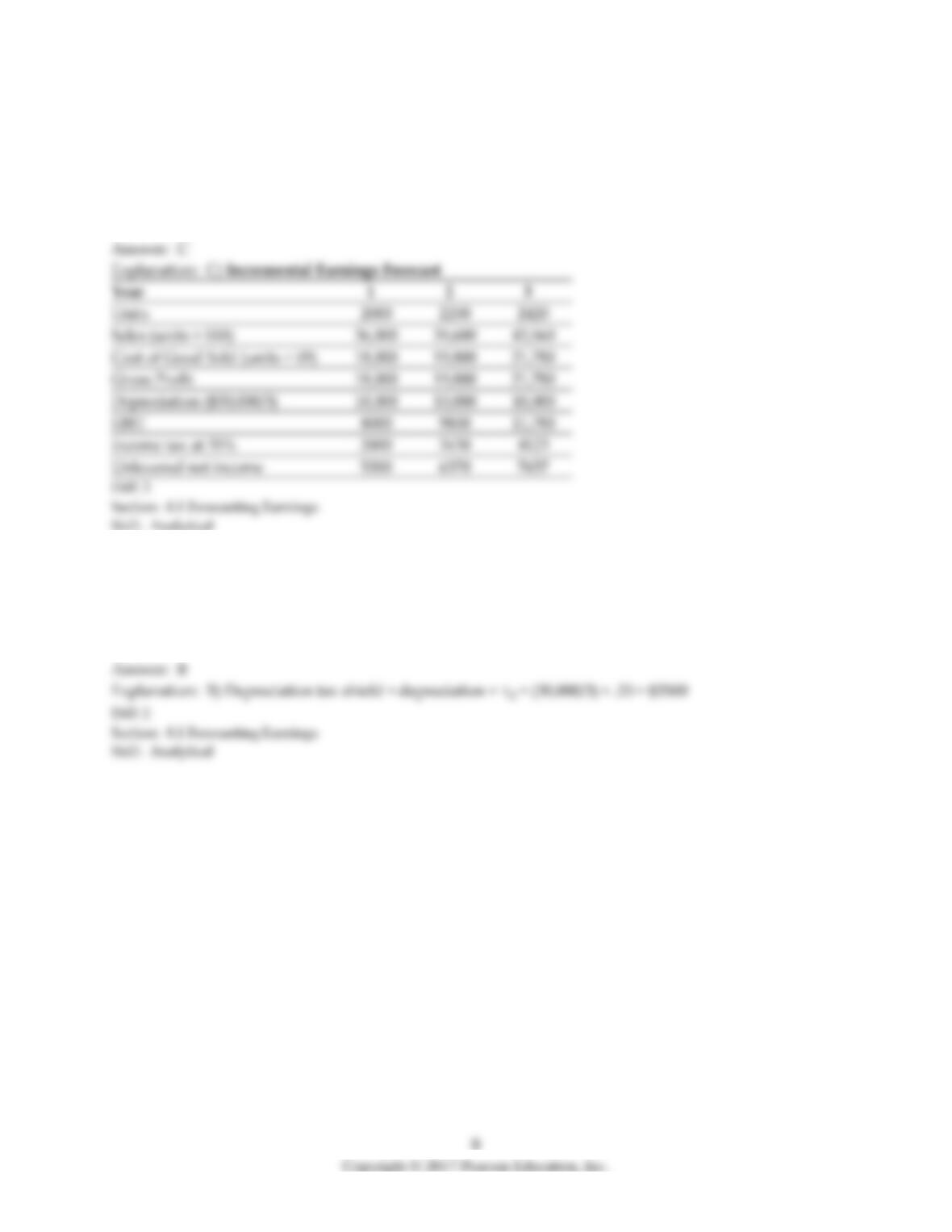
22) The incremental unlevered net income in the first year for the Sisyphean Corporation’s project is
closest to:
A) $8000
B) $18,000
C) $5200
D) $11,700
23) The depreciation tax shield for the Sisyphean Corporation’s project in the first year is closest to:
A) $8000
B) $3500
C) $2800
D) $5200
24) The amount of incremental income taxes that the Sisyphean Company will pay in the first year on
this new project is closest to:
A) $6300
B) $5200
C) $3500
D) $2800
25) What is a sunk cost? Should it be included in the incremental cash flows for a project? Why or why
not?
26) What is an opportunity cost? Should it be included in the incremental cash flows for a project? Why
or why not?
Use the information for the question(s) below.
The Sisyphean Corporation is considering investing in a new cane manufacturing machine that has an
estimated life of three years. The cost of the machine is $30,000 and the machine will be depreciated
straight line over its three-year life to a residual value of $0.
The cane manufacturing machine will result in sales of 2000 canes in year 1. Sales are estimated to grow
by 10% per year each year through year three. The price per cane that Sisyphean will charge its
customers is $18 each and is to remain constant. The canes have a cost per unit to manufacture of $9
each.
Installation of the machine and the resulting increase in manufacturing capacity will require an increase
in various net working capital accounts. It is estimated that the Sisyphean Corporation needs to hold
2% of its annual sales in cash, 4% of its annual sales in accounts receivable, 9% of its annual sales in
inventory, and 6% of its annual sales in accounts payable. The firm is in the 35% tax bracket, and has a
cost of capital of 10%.
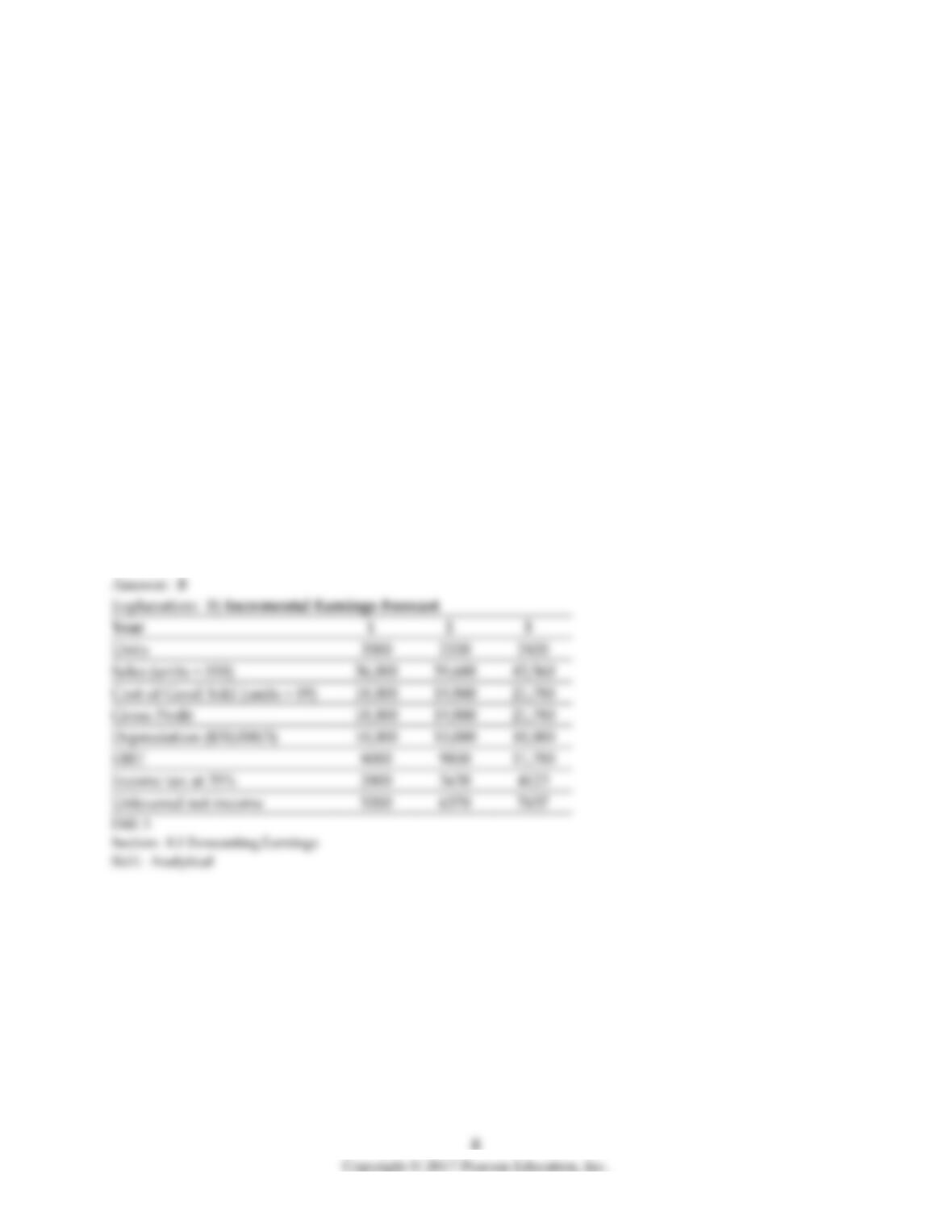
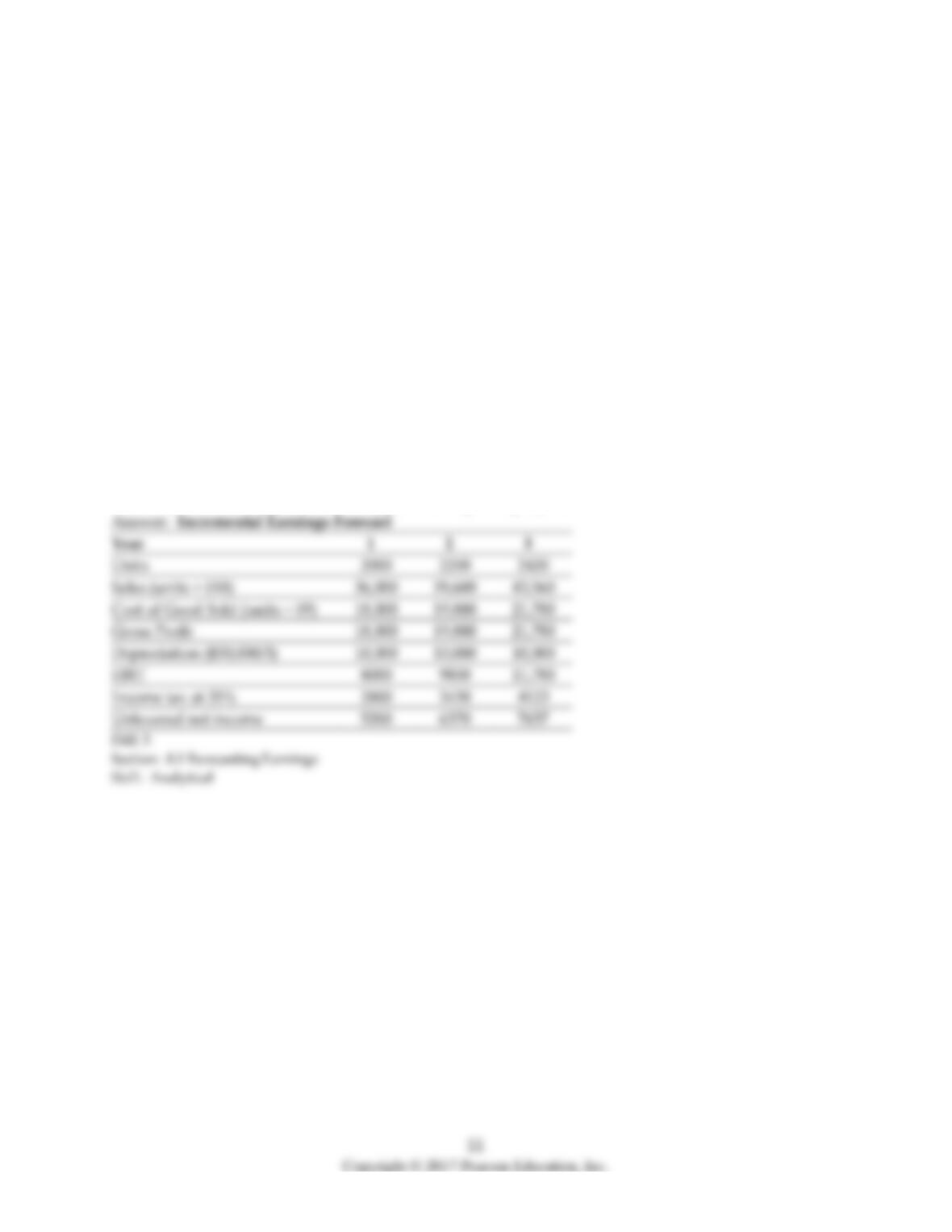
27) Construct a simple income statement showing the incremental EBIT and the incremental unlevered
net income for all three years of the Sisyphean Companies project.

8.2 Determining Free Cash Flow and NPV
1) Which of the following statements is FALSE?
A) Depreciation is not a cash expense paid by the firm.
B) Net Working Capital = Cash + Inventory + Payables – Receivables.
C) Since 1997, companies can “carry back” losses for two years and “carry forward” losses for 20 years.
D) Earnings do not represent real profits.
2) Which of the following questions is FALSE?
A) Net Working Capital = Current Assets – Current Liabilities.
B) Because depreciation is not a cash flow, we do not include it in the cash flow forecast.
C) Tax loss carry backs allow corporations to take losses during the current year and use them to offset
income in future years.
D) Earnings are an accounting measure of firm performance.
3) Which of the following statements is FALSE?
A) Depreciation is a method used for accounting and tax purposes to allocate the original purchase cost
of the asset over its life.
B) Sometimes the firm explicitly forecast free cash flow over a shorter horizon than the full horizon of
the project or investment.
C) Earnings include the cost of capital investments, but do not include non-cash charges, such as
depreciation.
D) Firms often report a different depreciation expense for accounting and for tax purposes.
4) Which of the following statements is FALSE?
A) Most projects will require the firm to invest in net working capital.
B) The main components of net working capital are cash, inventory, receivables, and property, plant
and equipment.
C) ΔNWCt = NWCt – NWCt – 1.
D) In the final year of a project, the firm ultimately recovers the investment in net working capital.

5) Which of the following statements is FALSE?
A) Depreciation expenses have a positive impact on free cash flow.
B) Free Cash Flow = (Revenues – Costs – Depreciation) × (1 – τc) – Capital Expenditures – ΔNWC + τc ×
Depreciation.
C) The firm cannot use its earnings to buy goods, pay employees, fund new investments, or pay
dividends to shareholders.
D) The depreciation tax shield is the tax savings that results from the ability to deduct depreciation.
6) Which of the following statements is FALSE?
A) Because only the tax consequences of depreciation are relevant for free cash flow, we should use the
depreciation expense that the firm will use for tax purposes in our free cash flow forecasts.
B) A firm generally identifies its marginal tax rate by determining the tax bracket that it falls into based
on its overall level of pre-tax income.
C) Free Cash Flow = (Revenues – Costs) × (1 – τc) – Capital Expenditures – ΔNWC + τc × Depreciation.
D) Net working capital is the difference between current liabilities and current assets.
7) Which of the following statements is FALSE?
A) The terminal or continuation value of the project represents the market value (as of the last forecast
period) of the free cash flow from the project at all future dates.
B) The incremental effect of a project on the firm’s available cash is the project’s free cash flow.
C) (1 – τc) × Depreciation is called the depreciation tax shield.
D) To evaluate a capital budgeting decision, we must determine its consequences for the firm’s available
cash.
8) Which of the following cash flows are relevant incremental cash flows for a project that you are
currently considering investing in?
A) The tax savings brought about by the project’s depreciation expense
B) The cost of a marketing survey you conducted to determine demand for the proposed project
C) Interest payments on debt used to finance the project
D) Research and Development expenditures you have made
9) Your firm is considering building a new office complex. Your firm already owns land suitable for the
new complex. The current book value of the land is $100,000, however a commercial real estate agent
has informed you that an outside buyer is interested in purchasing this land and would be willing to
pay $650,000 for it. When calculating the NPV of your new office complex, ignoring taxes, the
appropriate incremental cash flow for the use of this land is:
A) $650,000
B) $0
C) $100,000
D) $750,000
10) You are considering adding a microbrewery on to one of your firm‘s existing restaurants. This will
entail an increase in inventory of $8000, an increase in Accounts payable of $2500, and an increase in
property, plant, and equipment of $40,000. All other accounts will remain unchanged. The change in
net working capital resulting from the addition of the microbrewery is:
A) $45,500
B) $10,500
C) $6500
D) $5500
11) You are considering adding a microbrewery on to one of your firm‘s existing restaurants. This will
entail an investment of $40,000 in new equipment. This equipment will be depreciated straight line
over five years. If your firm’s marginal corporate tax rate is 35%, then what is the value of the
microbrewery’s depreciation tax shield in the first year of operation?
A) $2800
B) $14,000
C) $5200
D) $26,000

15
12) The Sisyphean Company is considering a new project that will have an annual depreciation expense
of $2.5 million. If Sisyphean’s marginal corporate tax rate is 40% and their average corporate tax rate is
30%, then what is the value of the depreciation tax shield on their new project?
A) $750,000
B) $1,000,000
C) $1,500,000
D) $1,750,000
Use the information for the question(s) below.
The Sisyphean Corporation is considering investing in a new cane manufacturing machine that has an
estimated life of three years. The cost of the machine is $30,000 and the machine will be depreciated
straight line over its three-year life to a residual value of $0.
The cane manufacturing machine will result in sales of 2000 canes in year 1. Sales are estimated to grow
by 10% per year each year through year three. The price per cane that Sisyphean will charge its
customers is $18 each and is to remain constant. The canes have a cost per unit to manufacture of $9
each.
Installation of the machine and the resulting increase in manufacturing capacity will require an increase
in various net working capital accounts. It is estimated that the Sisyphean Corporation needs to hold
2% of its annual sales in cash, 4% of its annual sales in accounts receivable, 9% of its annual sales in
inventory, and 5% of its annual sales in accounts payable. The firm is in the 35% tax bracket, and has a
cost of capital of 10%.
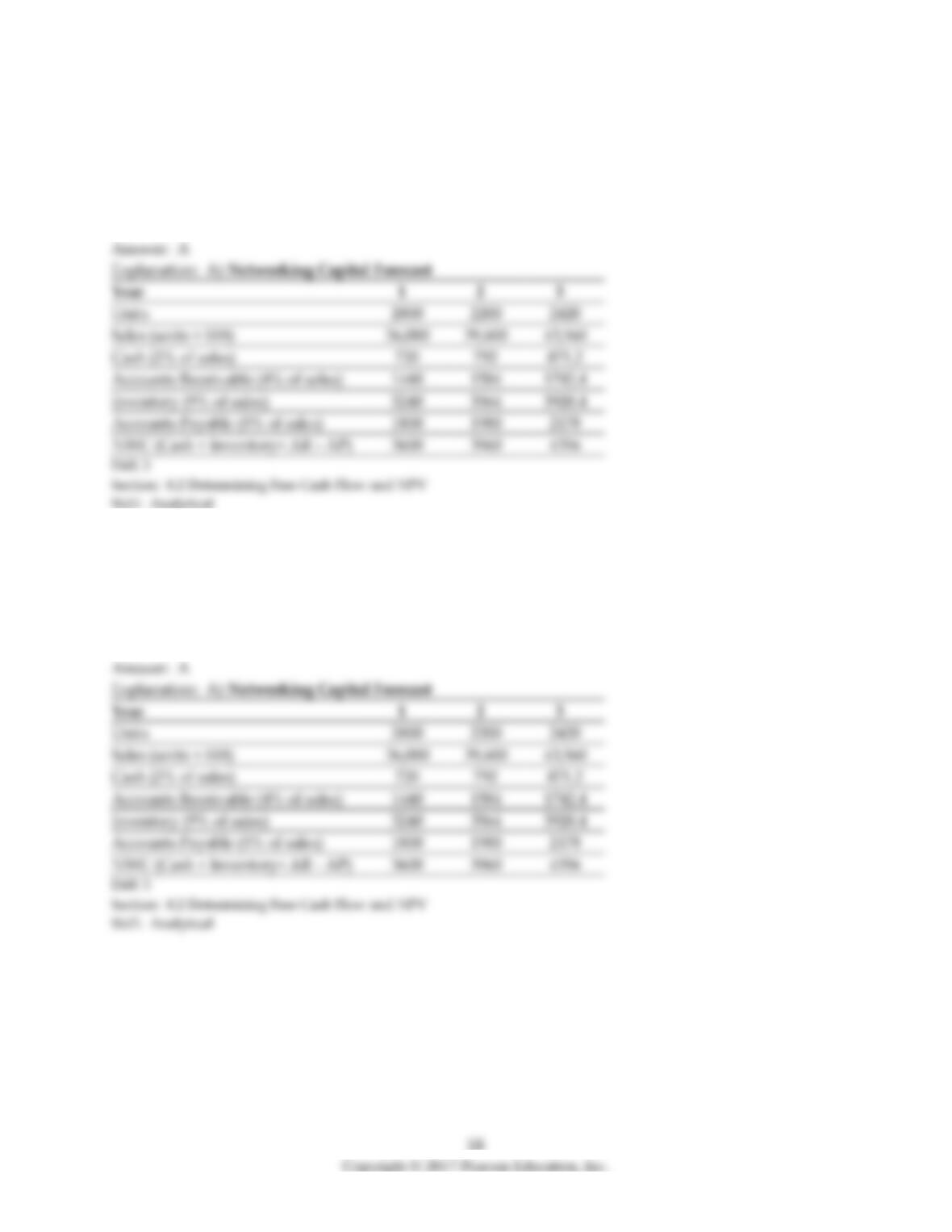
13) The required net working capital in the first year for the Sisyphean Corporation’s project is closest
to:
A) $3600
B) $3960
C) $2880
D) $5400
14) The required net working capital in the second year for the Sisyphean Corporation’s project is
closest to:
A) $3960
B) $4360
C) $3190
D) $5940
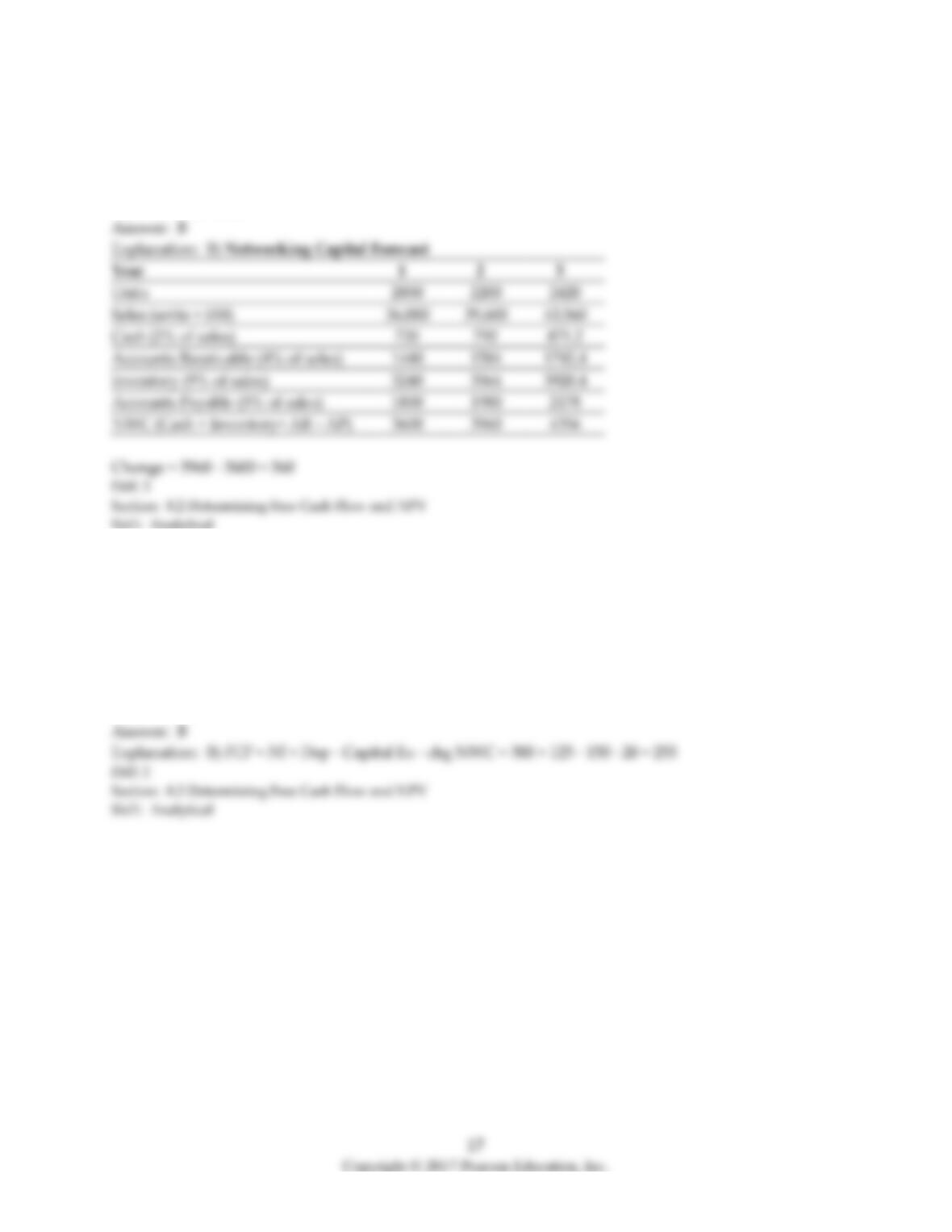
15) The change in Net working capital from year one to year two is closest to:
A) A decrease of $360
B) An increase of $360
C) An increase of $396
D) A decrease of $396
16) Bubba Ho-Tep Company reported net income of $300 million for the most recent fiscal year. The
firm had depreciation expenses of $125 million and capital expenditures of $150 million. Although they
had no interest expense, the firm did have an increase in net working capital of $20 million. What is
Bubba Ho-Tep’s free cash flow?
A) $170 million
B) $255 million
C) $150 million
D) $5 million
Use the information for the question(s) below.
Temporary Housing Services Incorporated (THSI) is considering a project that involves setting up a
temporary housing facility in an area recently damaged by a hurricane. THSI will lease space in this
facility to various agencies and groups providing relief services to the area. THSI estimates that this
project will initially cost $5 million to set up and will generate $20 million in revenues during its first
and only year in operation (paid in one year). Operating expenses are expected to total $12 million
during this year and depreciation expense will be another $3 million. THSI will require no working
capital for this investment. THSI’s marginal tax rate is 35%.
17) Ignoring the original investment of $5 million, what is THSI’s free cash flow for the first and only
year of operation?
A) $5.0 million
B) $3.75 million
C) $8.0 million
D) $6.25 million
18) Assume that THSI’s cost of capital for this project is 15%. The NPV of this temporary housing
project is closest to:
A) $435,000
B) -$650,000
C) $1,960,000
D) -$435,000

Use the information for the question(s) below.
Shepard Industries is evaluating a proposal to expand its current distribution facilities. Management
has projected the project will produce the following cash flows for the first two years (in millions).
Year
1
2
Revenues
1200
1400
Operating Expense
450
525
Depreciation
240
280
Increase in working capital
60
70
Capital expenditures
300
350
Marginal corporate tax rate
30%
30%
19) The incremental EBIT for the Shepard Industries project in year one is closest to:
A) $360
B) $750
C) $595
D) $510
Revenues
– Expenses
– Depreciation
= EBIT
20) The incremental EBIT for the Shepard Industries project in year two is closest to:
A) $415
B) $875
C) $595
D) $510
Revenues
– Expenses
– Depreciation
= EBIT
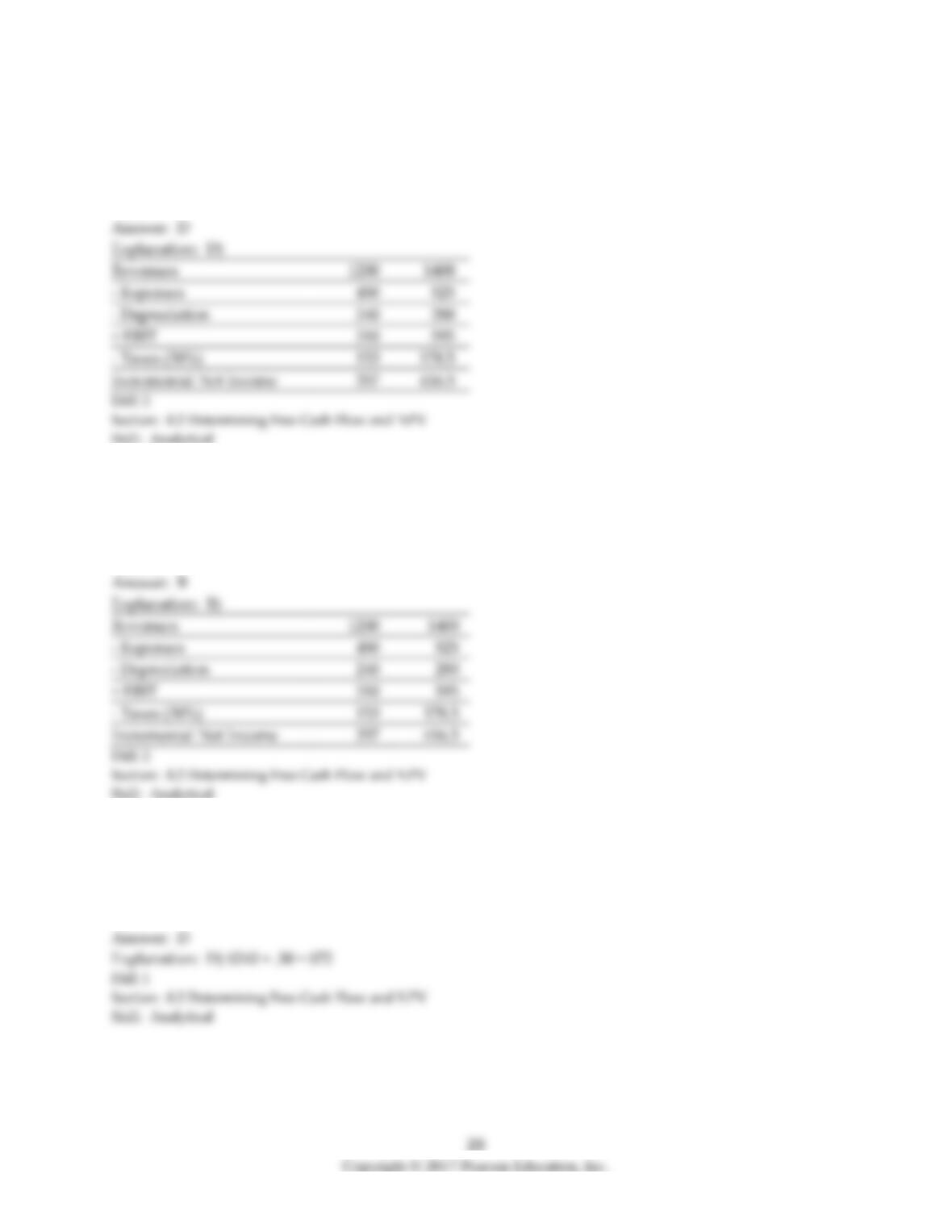
21) The incremental unlevered net income of the Shepard Industries project in year one is closest to:
A) $510
B) $415
C) $600
D) $355
22) The incremental unlevered net income of the Shepard Industries project in year two is closest to:
A) $355
B) $415
C) $600
D) $510
23) The depreciation tax shield for the Shepard Industries project in year one is closest to:
A) $84
B) $168
C) $96
D) $72