11) If the Krusty Krab’s opportunity cost of capital is 12%, then the IRR for upgrading to the new grill is
closest to:
A) 3.25%
B) 16.00%
C) 18.25%
D) 21.00%
12) If the Krusty Krab’s opportunity cost of capital is 12%, what decision should the Krusty Krab take
regarding the new grill?
A) Do not install the new grill since NPV is approximately = – $10,630
B) Install the new grill since NPV is approximately = + $10,630
C) Install the new grill since IRR is approximately = 15%
D) Don’t install the new grill since IRR is less than 12%
8.4 Further Adjustments to Free Cash Flow
Use the following information to answer the question(s) below.
(Include the MACRS Table from the Appendix.)
Casa Grande Farms is considering purchasing multiple tractors for a total purchase price of $540,000.
These tractors are expected to generate EBITDA of $250,000 for each of the next three years. Casa
Grande Farms has a 35% tax rate and has a cost of capital of 10%.
1) Assuming that Casa Grande Farms depreciates these tractors straight line over the three year life,
then the annual depreciation tax shield in year 2 is closest to:
A) 63,000
B) 80,000
C) 84,000
D) 117,000
2) Assuming that Casa Grande Farms depreciates these tractors using MACRS depreciation method for
three-year property starting immediately, then the annual depreciation tax shield in year 2 is closest to:
A) 20,785
B) 27,991
C) 84,000
D) 180,000
3) Assume that Casa Grande Farms is planning to sell the tractors after two years, when its book value
is $119,988, for a total price of $180,000. What is the effect on free cash flow in the year it is sold?
A) A cash inflow of $60,012
B) A cash outflow of $60,012
C) A cash inflow of $39,008
D) A cash outflow of $39,008
4) Assuming that Casa Grande Farms depreciates these tractors straight line over the three year life,
then the NPV of buying the tractors is closest to:
A) 20,785
B) 36,225
C) 81,715
D) 513,235
5) Assuming that Casa Grande Farms depreciates these tractors using MACRS depreciation method for
three-year property starting immediately, then the NPV of buying the tractors is closest to:
A) 20,785
B) 36,225
C) 81,715
D) 513,235
E) 560,785
Use the following information to answer the question(s) below.
Taggart Transcontinental is considering adding a trucking division to expand the coverage of its
existing rail lines. The trucking division will cost $1,000,000 and is expected to generate free cash flows
of $100,000 for each of the next five years. Taggart Transcontinental forecasts that future free cash flows
after year 5 will grow at 2% per year, forever. Taggart Transcontinental’s cost of capital is 10%.
6) The continuation value for the trucking division in year five is closest to:
A) 1,000,000
B) 1,250,000
C) 1,275,000
D) 1,375,000
7) The NPV for the trucking division is closest to:
A) 170,750
B) 200,000
C) 212,550
D) 250,000
E) 312,500
Use the following information to answer the question(s) below.
Really Big Conglomerate (RBC) is considering acquiring POP, Inc. a smaller unsuccessful Internet firm.
POP has outstanding tax loss carry forwards of $320 million from losses over the past six years. RBC has
pre-tax income of $100 million per year, a cost of capital of 10%, and pays 35% in taxes.
8) If RBC acquires POP, in what year will RBC be required to pay corporate taxes again?
A) 2 years
B) 3 years
C) 4 years
D) 5 years
9) If RBC acquires POP, then the NPV of POP tax loss carry forwards to RBC is closest to:
A) $92 million
B) $236 million
C) $262 million
D) $320 million

8.5 Analyzing the Project
1) Which of the following statements is FALSE?
A) The break-even level of an input is the level for which the investment has an IRR of zero.
B) The most difficult part of capital budgeting is deciding how to estimate the cash flows and the cost of
capital.
C) When evaluating a capital budgeting project, financial managers should make the decision that
maximizes NPV.
D) Sensitivity analysis reveals which aspects of the project are most critical when we are actually
managing the project.
2) Which of the following statements is FALSE?
A) Sensitivity analysis allows us to explore the effects of errors in our estimated inputs in our NPV
analysis for the project.
B) To compute the NPV for a project, you need to estimate the incremental cash flows and choose a
discount rate.
C) Estimates of the cash flows and cost of capital are often subject to significant uncertainty.
D) When we are certain regarding the input to a capital budgeting decision, it is often useful to
determine the break-even level of that input.
3) Which of the following statements is FALSE?
A) We can use scenario analysis to evaluate alternative pricing strategies for our project.
B) Scenario analysis considers the effect on NPV of changing multiple project parameters.
C) The difference between the IRR of a project and the cost of capital tells you how much error in the
cost of capital it would take to change the investment decision.
D) Scenario analysis breaks the NPV calculation into its component assumptions and show how the
NPV varies as each one of the underlying assumptions change.
4) The difference between scenario analysis and sensitivity analysis is that:
A) scenario analysis is based upon the IRR and sensitivity analysis is based upon NPV.
B) only sensitivity analysis allows us to change our estimated inputs of our NPV analysis.
C) only scenario analysis considers the effect on NPV of changing multiple project parameters.
D) only scenario analysis breaks the NPV calculation into its component assumptions.
5) An exploration of the effect on NPV of changing multiple project parameters is called:
A) scenario analysis.
B) IRR analysis.
C) accounting break-even analysis.
D) sensitivity analysis.
6) An analysis that breaks the NPV calculation into its component assumptions and shows how the
NPV varies as one of the underlying assumptions is changed is called:
A) scenario analysis.
B) IRR analysis.
C) accounting break-even analysis.
D) sensitivity analysis.
Use the information for the question(s) below.
Epiphany Industries is considering a new capital budgeting project that will last for three years.
Epiphany plans on using a cost of capital of 12% to evaluate this project. Based on extensive research, it
has prepared the following incremental cash flow projections:
Year
0
1
2
3
Sales (Revenues)
100,000
100,000
100,000
– Cost of Goods Sold (50% of Sales)
50,000
50,000
50,000
– Depreciation
30,000
30,000
30,000
= EBIT
20,000
20,000
20,000
– Taxes (35%)
7000
7000
7000
= unlevered net income
13,000
13,000
13,000
+ Depreciation
30,000
30,000
30,000
+ changes to working capital
-5000
-5000
10,000
– capital expenditures
-90,000
7) Epiphany would like to know how sensitive the project’s NPV is to changes in the discount rate.
How much can the discount rate vary before the NPV reaches zero?
A) 7.14%
B) 19.14%
C) 12.0%
D) 0%
Year
0
1
2
3
Sales (Revenues)
– Cost of Goods Sold (50% of Sales)
50,000
50,000
50,000
– Depreciation
30,000
30,000
30,000
= EBIT
20,000
20,000
20,000
– Taxes (35%)
7000
7000
7000
= unlevered net income
13,000
13,000
13,000
+ Depreciation
30,000
30,000
30,000
+ changes to working capital
10,000
– capital expenditures
33,929
30,293
37,724
discount rate
NPV =
11,946
IRR =
8) What is sensitivity analysis?
9) How does scenario analysis differ from sensitivity analysis?
Use the information for the question(s) below.
Epiphany Industries is considering a new capital budgeting project that will last for three years.
Epiphany plans on using a cost of capital of 12% to evaluate this project. Based on extensive research, it
has prepared the following incremental cash flow projections:
Year
0
1
2
3
Sales (Revenues)
100,000
100,000
100,000
– Cost of Goods Sold (50% of Sales)
50,000
50,000
50,000
– Depreciation
30,000
30,000
30,000
= EBIT
20,000
20,000
20,000
– Taxes (35%)
7000
7000
7000
= unlevered net income
13,000
13,000
13,000
+ Depreciation
30,000
30,000
30,000
+ changes to working capital
–5000
-5000
10,000
– capital expenditures
-90,000
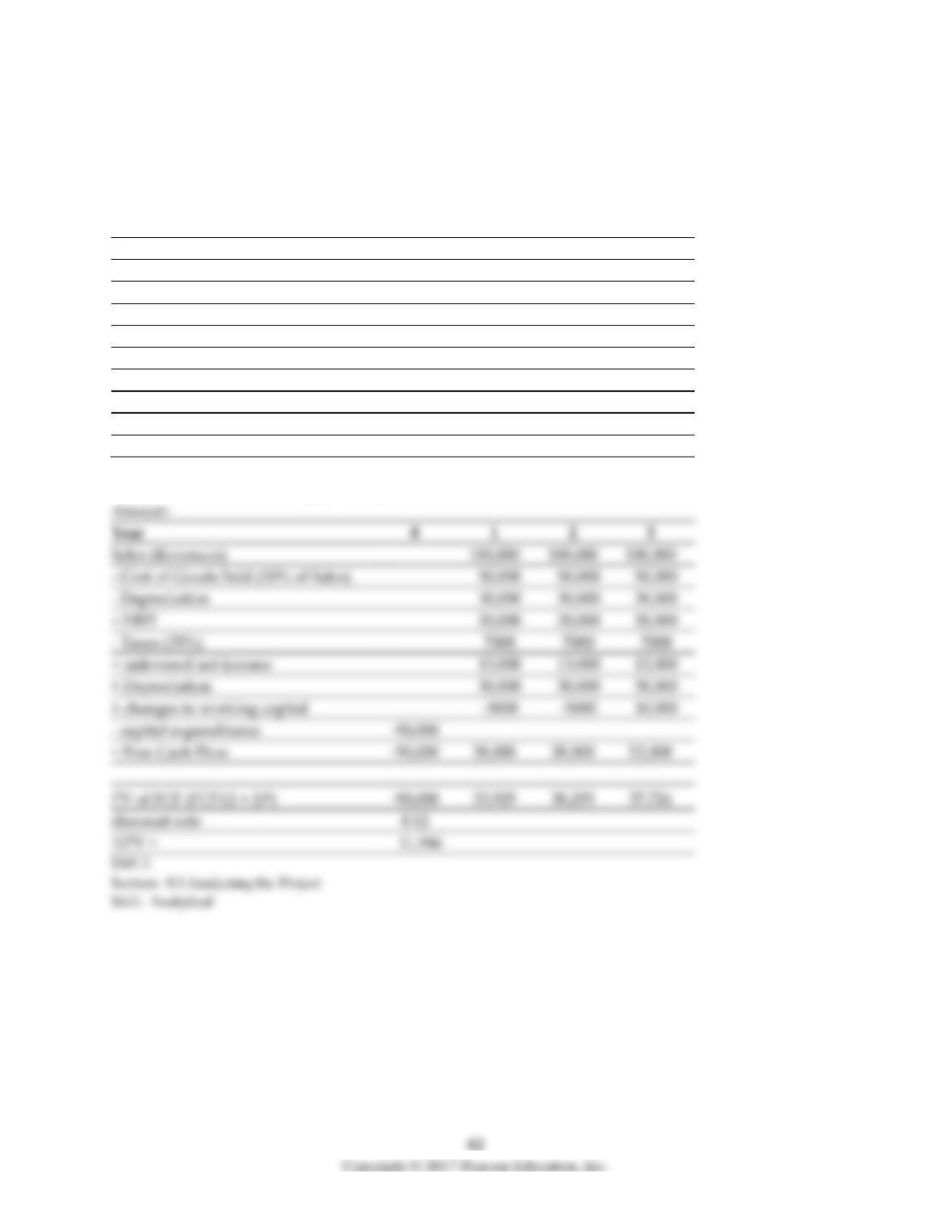
10) What is the NPV of the Epiphany’s project?
Sales (Revenues)
– Cost of Goods Sold (50% of Sales)
50,000
50,000
50,000
– Depreciation
30,000
30,000
30,000
= EBIT
20,000
20,000
20,000
– Taxes (35%)
= unlevered net income
13,000
13,000
13,000
+ Depreciation
30,000
30,000
30,000
+ changes to working capital
-5000
10,000
– capital expenditures
= Free Cash Flow
discount rate
NPV =
11,946
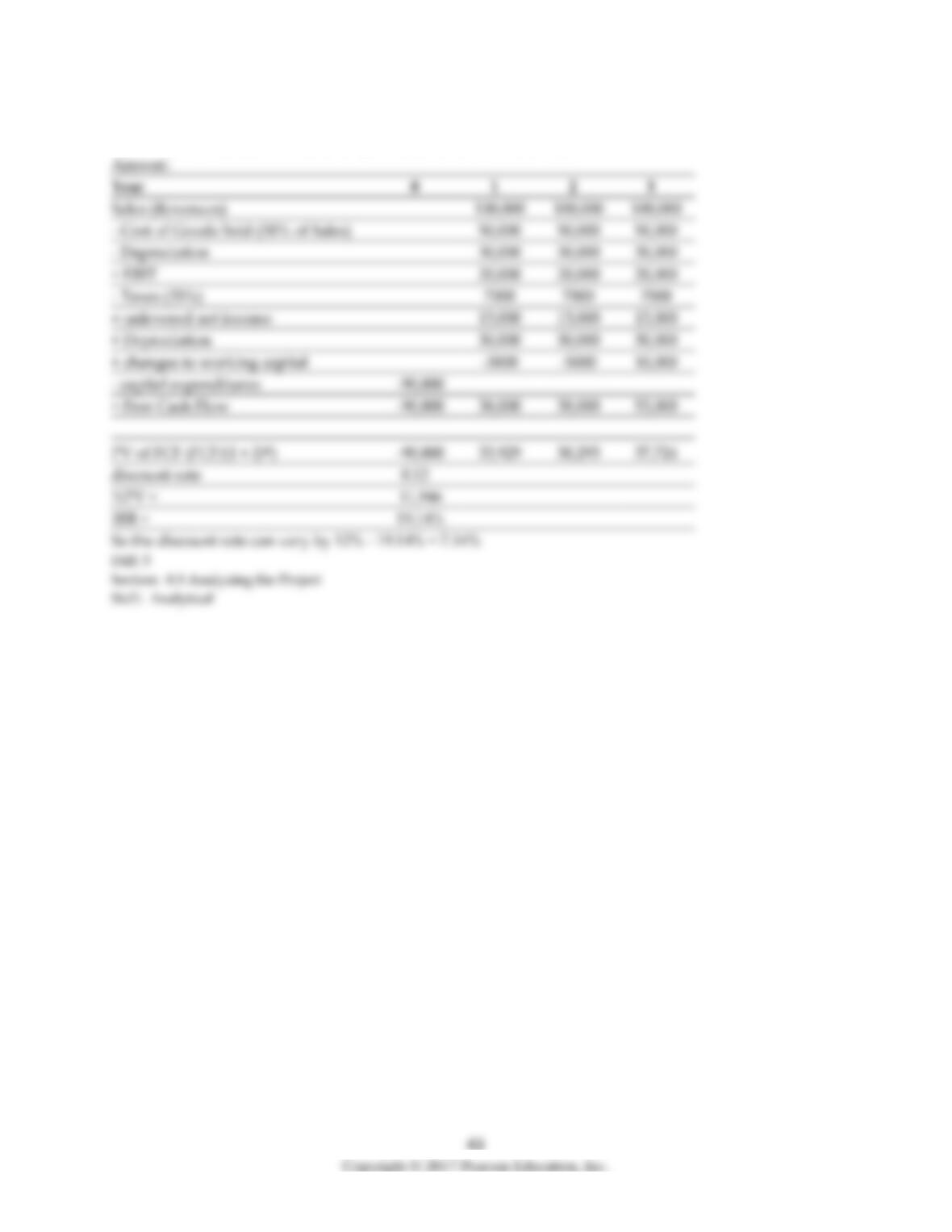
11) Epiphany would like to know how sensitive the project’s NPV is to changes in the discount rate.
How much can the discount rate vary before the NPV reaches zero?
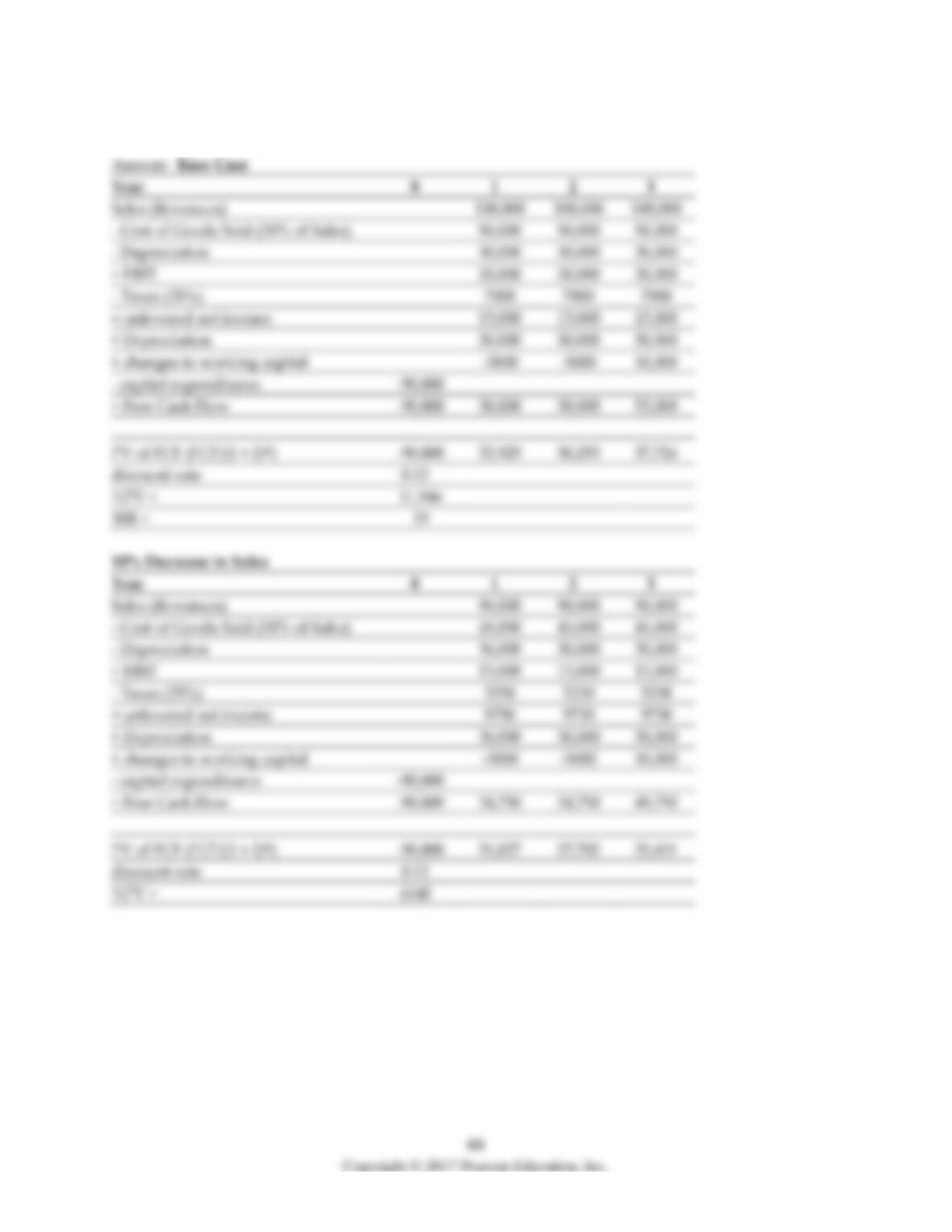
12) Epiphany is worried about the reliability of the sales forecast. How sensitive is the project’s NPV to
a 10% change in sales?