Reporting and Analyzing Receivables
8-41
198. The sale of receivables by a business
a. indicates that the business is in financial difficulty.
b. is generally the major revenue item on its income statement.
c. is an indication that the business is owned by a captive finance company.
d. can be a quick way to generate cash for operating needs.
199. If a retailer regularly sells its receivables to a factor, the service charge of the factor
should be classified as a(n)
a. selling expense.
b. interest expense.
c. other expense.
d. contra asset.
200. The sale or transfer of accounts receivable in order to raise funds is called
a. pledging.
b. factoring.
c. leasing.
d. collateralizing.
201. If a company sells its accounts receivables to a factor
a. the seller pays a commission to the factor.
b. the factor pays a commission to the seller.
c. there is a gain on the sale of the receivables.
d. the seller defers recognition of sales revenue until the account is collected.
202. A captive finance company refers to
a. a finance company that is owned by individuals who borrow money from the company.
b. finance companies that won’t allow early repayment of loans.
c. a company that is wholly owned by another company and provides financing to
purchasers of its owner company’s goods.
d. any company that issues a major credit card.
203. Receivables might be sold to
a. lengthen the cash-to-cash operating cycle.
b. take advantage of deep discounts on the cash realizable value of receivables.
c. generate cash quickly.
d. finance companies at an amount greater than cash realizable value.
Test Bank for Accounting: Tools for Business Decision Making, Fifth Edition
8-42
204. A company regularly sells its receivables to a factor who assesses a 2% service charge
on the amount of receivables purchased. Which of the following statements is true for the
seller of the receivables?
a. The loss section of the income statement will increase each time receivables are sold.
b. The credit to Accounts Receivable is less than the debit to Cash when the accounts
are sold.
c. Selling expenses will increase each time accounts are sold.
d. The other expenses section of the income statement will increase each time accounts
are sold.
205. Gipson Furniture factors $500,000 of receivables to Kwik Factors, Inc. Kwik Factors
assesses a 3% service charge on the amount of receivables sold. Gipson Furniture
factors its receivables regularly with Kwik Factors. What journal entry does Gipson make
when factoring these receivables?
a. Cash 485,000
Loss on Sale of Receivables 15,000
Accounts Receivable 500,000
b. Cash 485,000
Accounts Receivable 485,000
c. Cash 500,000
Accounts Receivable 485,000
Gain on Sale of Receivables 15,000
d. Cash 485,000
Service Charge Expense 15,000
Accounts Receivable 500,000
206. When customers make purchases with a national credit card, the retailer
a. is responsible for maintaining customer accounts.
b. is not involved in the collection process.
c. absorbs any losses from uncollectible accounts.
d. receives cash equal to the full price of the merchandise sold from the credit card
company.
207. On April 5 Donna’s Boutique accepted a Visa card for a $600 purchase. Visa charges a
2% service fee. The entry to record this transaction would include a
a. credit to Cash of $588.
b. debit to Cash of $600.
c. debit to Service Charge Expense of $12.
d. credit to Service Charge Expense of $12.
Reporting and Analyzing Receivables
FOR INSTRUCTOR USE ONLY
8-43
208. Schofield Retailers accepted $60,000 of Silver Bank MasterCard credit card charges for
merchandise sold on August 1. Silver Bank charges 4% for its credit card use. The entry
to record this transaction by Schofield Retailers will include a credit to Sales Revenue of
$60,000 and a debit(s) to
a. Cash for $57,600 and Service Charge Expense for $2,400.
b. Accounts receivable for $57,600 and Service Charge Expense for $2,400.
c. Cash for $60,000.
d. Accounts Receivable for $60,000.
209. The retailer considers Visa and MasterCard sales as
a. cash sales.
b. promissory sales.
c. credit sales.
d. contingent sales.
Answers to Multiple Choice Questions
Test Bank for Accounting: Tools for Business Decision Making, Fifth Edition
8-44
BRIEF EXERCISES
Be. 210
Presented below are various receivable transactions entered into by Renner Tool Company.
Indicate whether the receivables are reported as accounts receivable, notes receivable, or other
receivables on the balance sheet.
a. Advanced $1,000 to a trusted employee.
b. Accepted a $2,000 promissory note from a customer as payment on account.
c. Determined that a $10,000 income tax refund is due from the IRS.
d. Sold goods to a customer on account for $5,000.
e. Recorded $500 accrued interest on a note receivable due next year.
f. Loaned a company officer $4,000.
Be. 211
Finney had the following transactions during March 2012.
1. Finney sold and delivered $14,000 of merchandise to LJ Enterprises, terms 2/10, n30.
2. LJ Enterprises also ordered an additional $5,000 worth of goods on the last day of the month.
3. Finney lent $1,000 to its company president who promised to repay the loan on the 15th day of
the next month.
4. Finney sold old storage sheds to Alt Traders on 3/31. Alt Traders gave a $2,500 promissory
note to Finney agreeing to pay for the sheds in 3 months.
5. Other current assets totaled $50,000.
Finney received no cash arising from the above transactions during March. Based only on the
above transactions, and ingnoring beginning balances, compute the percentage Accounts
Receivable is of the total current assets as of month end.
Reporting and Analyzing Receivables
FOR INSTRUCTOR USE ONLY
8-45
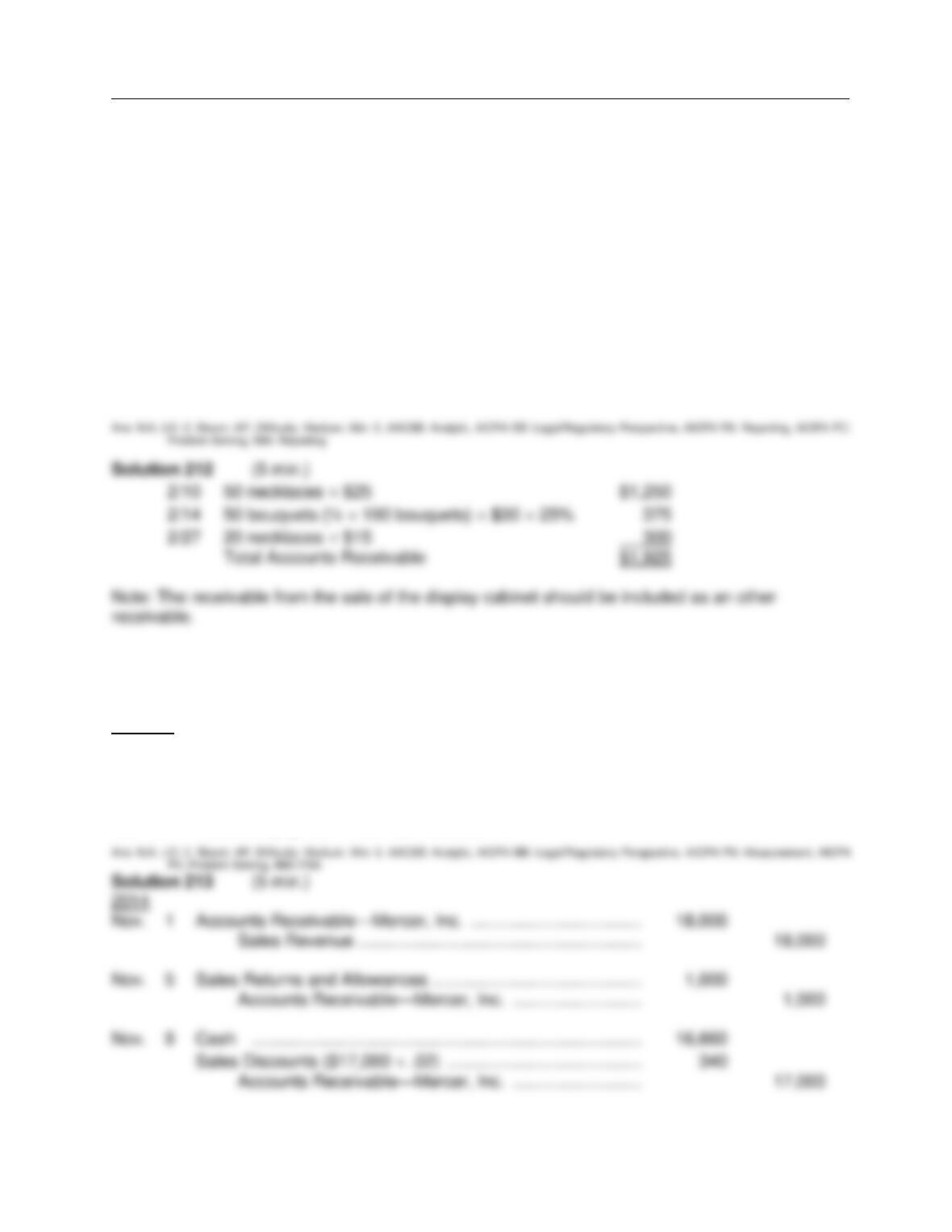
Be. 212
The following are sales of The Holiday Store during February. The Store sells seasonal holiday
items.
2/3 Sold 50 heart balloons for $5 cash each.
2/8 Sold 100 boxes of chocolates at $10 each, terms 2/10, n/30. Collected within the
discount period.
2/10 Sold 50 heart necklaces for $25 each with no discount. Have not collected as of month
end.
2/14 Sold 100 bouquets of roses at $30 per bouquet. Half the sales were on account. By month
end, 75% of the credit sales were collected.
2/27 Sold 20 leftover heart necklaces to a discount store for $15 each on credit.
2/28 Sold a display cabinet at a swap meet for $100 on account.
Determine the balance in Accounts Receivable at 2/28.
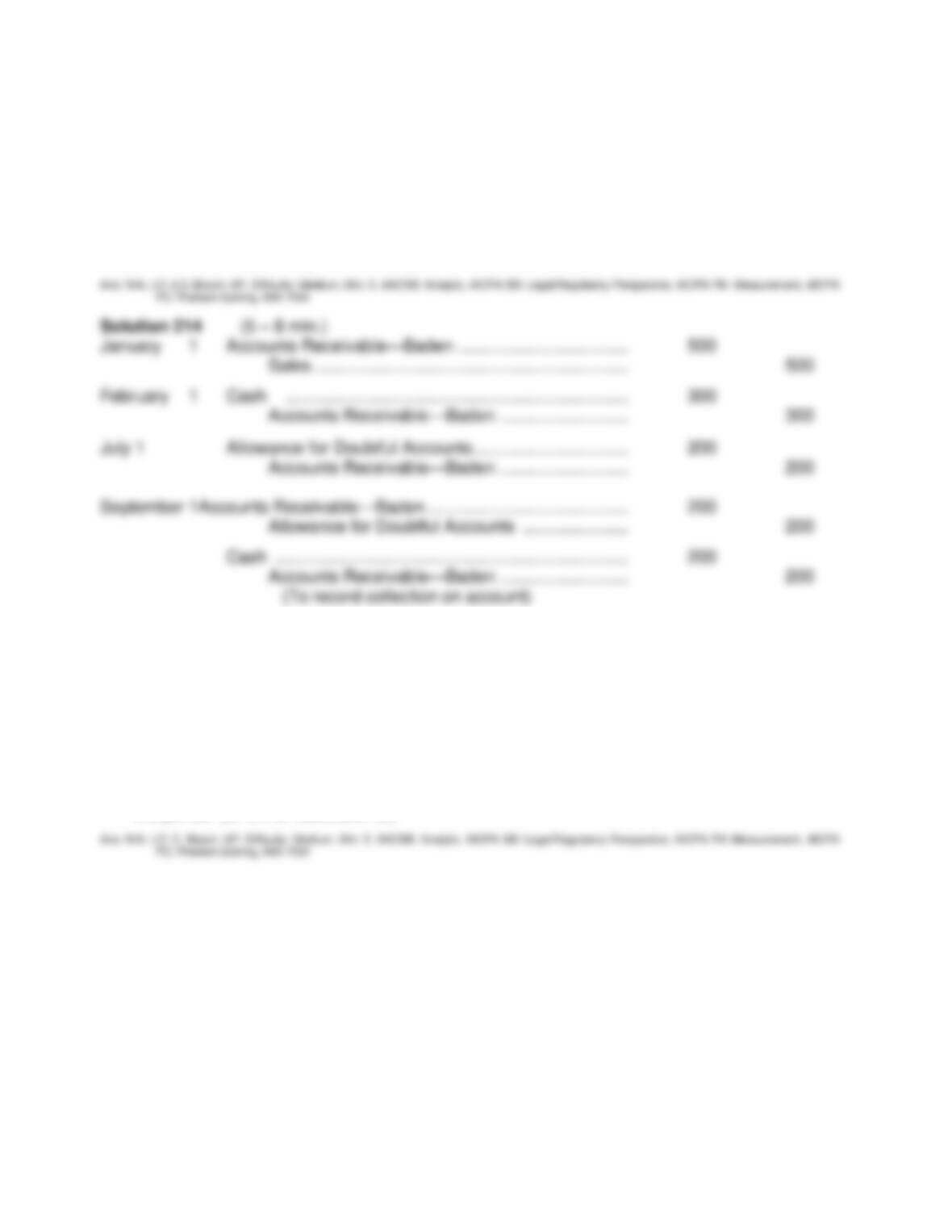
Be. 213
Prepare journal entries to record the following transactions entered into by the Castagno
Company:
2014
Nov. 1 Sold merchandise on account to Mercer, Inc., for $18,000, terms 2/10, n/30.
Nov. 5 Mercer, Inc., returned merchandise worth $1,000.
Nov. 9 Received payment in full from Mercer, Inc.
Test Bank for Accounting: Tools for Business Decision Making, Fifth Edition
FOR INSTRUCTOR USE ONLY
8-46
Be. 214
Assuming that the allowance method is being used, prepare general journal entries without
explanations to record the following transactions.
January 1 Sold merchandise to Mary Baden for $500 on account.
February 1 Received $300 from Baden.
July 1 Wrote off Baden’s account as uncollectible.
September 1 Unexpectedly received payment in full from Baden.
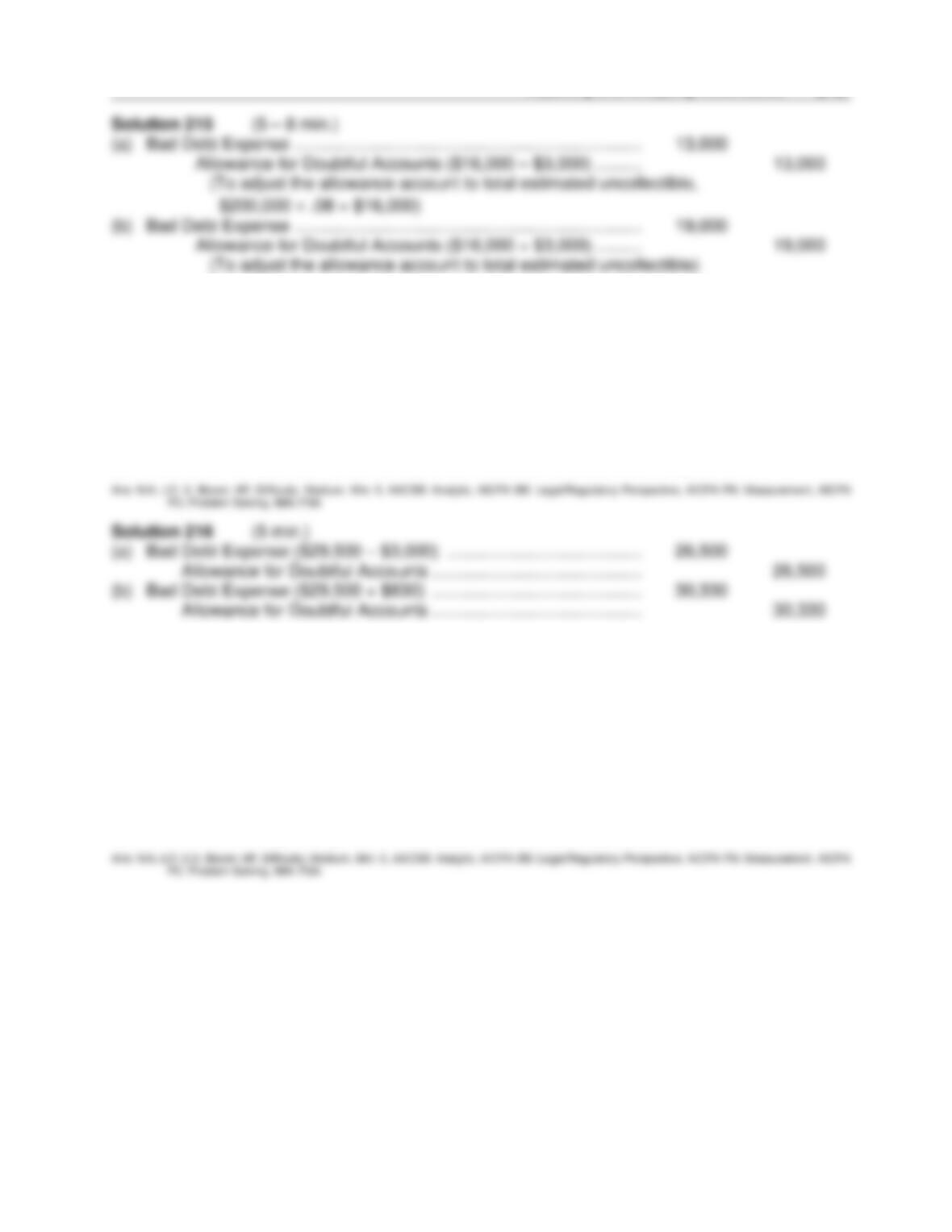
Be. 215
The ledger of the Ramirez Company at the end of the current year shows Accounts Receivable of
$200,000.
Instructions
(a) If Allowance for Doubtful Accounts has a credit balance of $3,000 in the trial balance and
bad debts are expected to be 8% of accounts receivable, journalize the adjusting entry for
end of the period. (Show all calculations.)
(b) If Allowance for Doubtful Accounts has a debit balance of $3,000 in the trial balance and bad
debts are expected to be 8% of accounts receivable, journalize the adjusting entry for end of
the period. (Show all calculations.)
Reporting and Analyzing Receivables
FOR INSTRUCTOR USE ONLY
8-47
Be. 216
Benson Products uses the allowance method in estimating uncollectible accounts. On December
31, 2014, the balance in Accounts Receivable was $650,000. An aging analysis of the accounts
receivable indicated that $29,500 in accounts are expected to be uncollectible.
Prepare the adjusting entry to record estimated bad debts expense using the percentage of
receivables basis under each of the following independent assumptions:
(a) Allowance for Doubtful Accounts has a credit balance of $3,000 before adjustment.
(b) Allowance for Doubtful Accounts has a debit balance of $830 before adjustment.
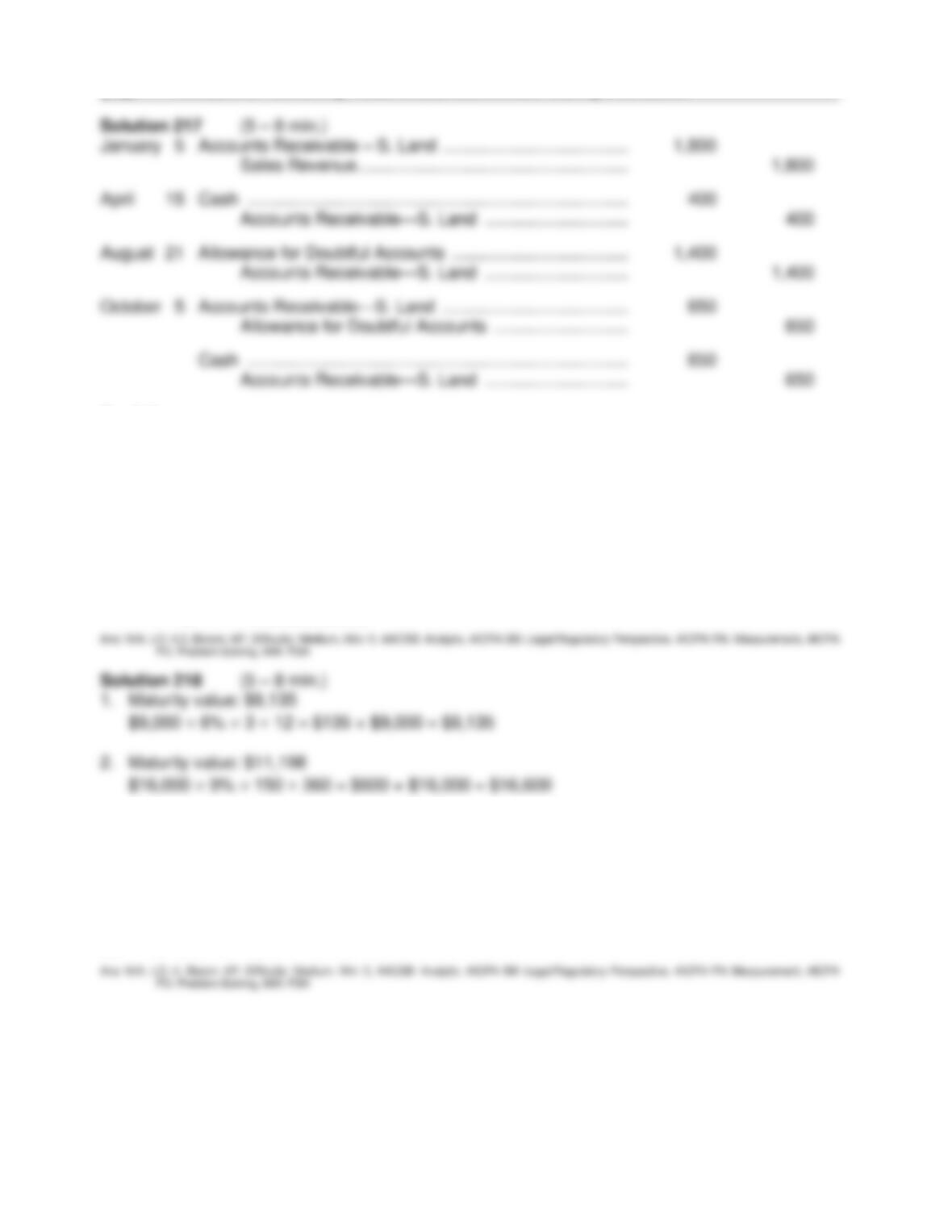
Be. 217
Strickman Company uses the allowance method for estimating uncollectible accounts. Prepare
journal entries to record the following transactions:
January 5 Sold merchandise to Sue Land for $1,800, terms n/15.
April 15 Received $400 from Sue Land on account.
August 21 Wrote off as uncollectible the balance of the Sue Land account when she
declared bankruptcy.
October 5 Unexpectedly received a check for $650 from Sue Land.
Test Bank for Accounting: Tools for Business Decision Making, Fifth Edition
FOR INSTRUCTOR USE ONLY
8-48
Be. 218
Compute the maturity value as indicated for each of the following notes receivable.
1. A $9,000, 6%, 3-month note dated July 20.
Maturity value $____________.
2. A $16,000, 9%, 150-day note dated August 5.
Maturity value $____________.
Be. 219
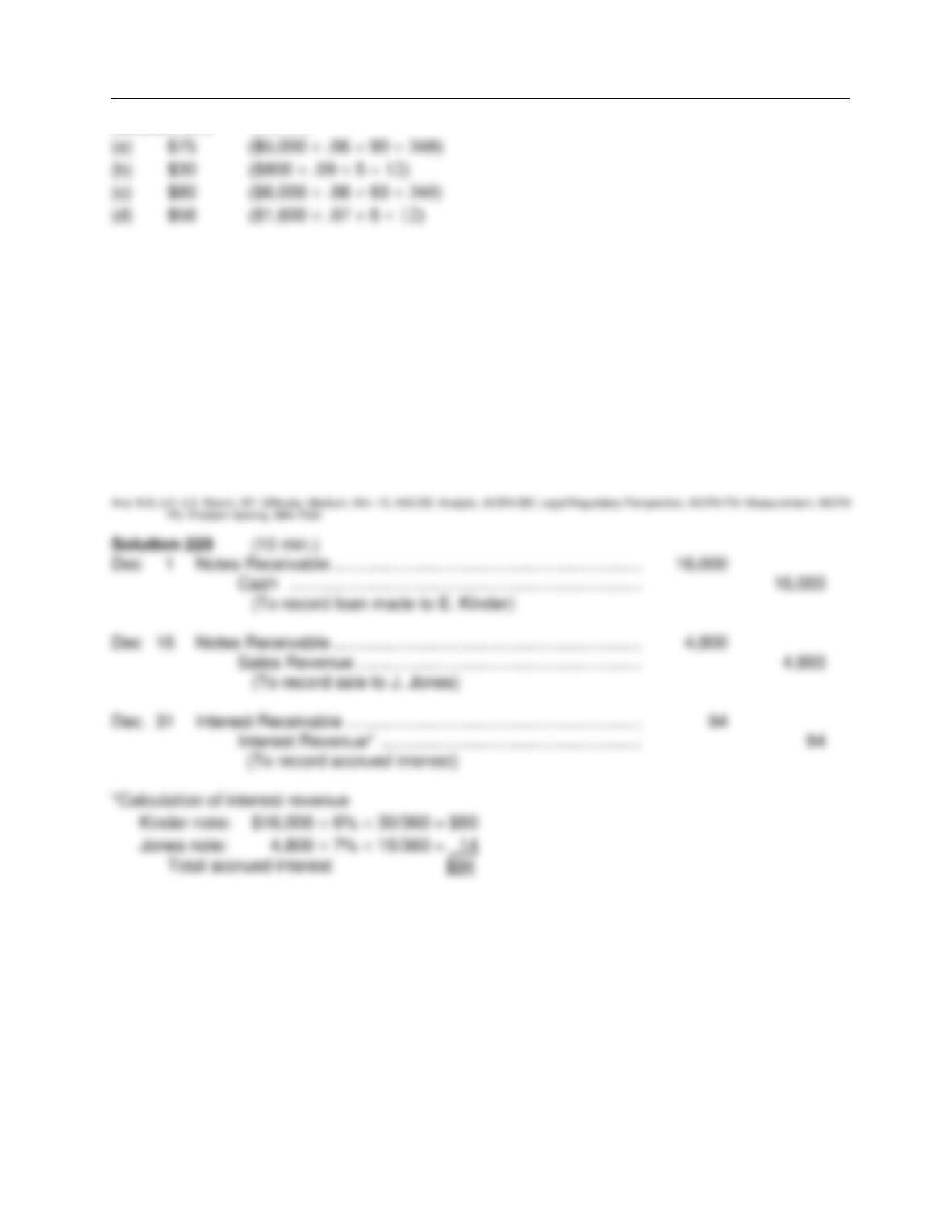
Determine the interest on the following notes:
(a) $5,000 at 6% for 90 days.
(b) $800 at 9% for 5 months.
(c) $6,000 at 8% for 60 days
(d) $1,600 at 7% for 6 months
Reporting and Analyzing Receivables
FOR INSTRUCTOR USE ONLY
8-49
Solution 219 (5 min.)
Be. 220
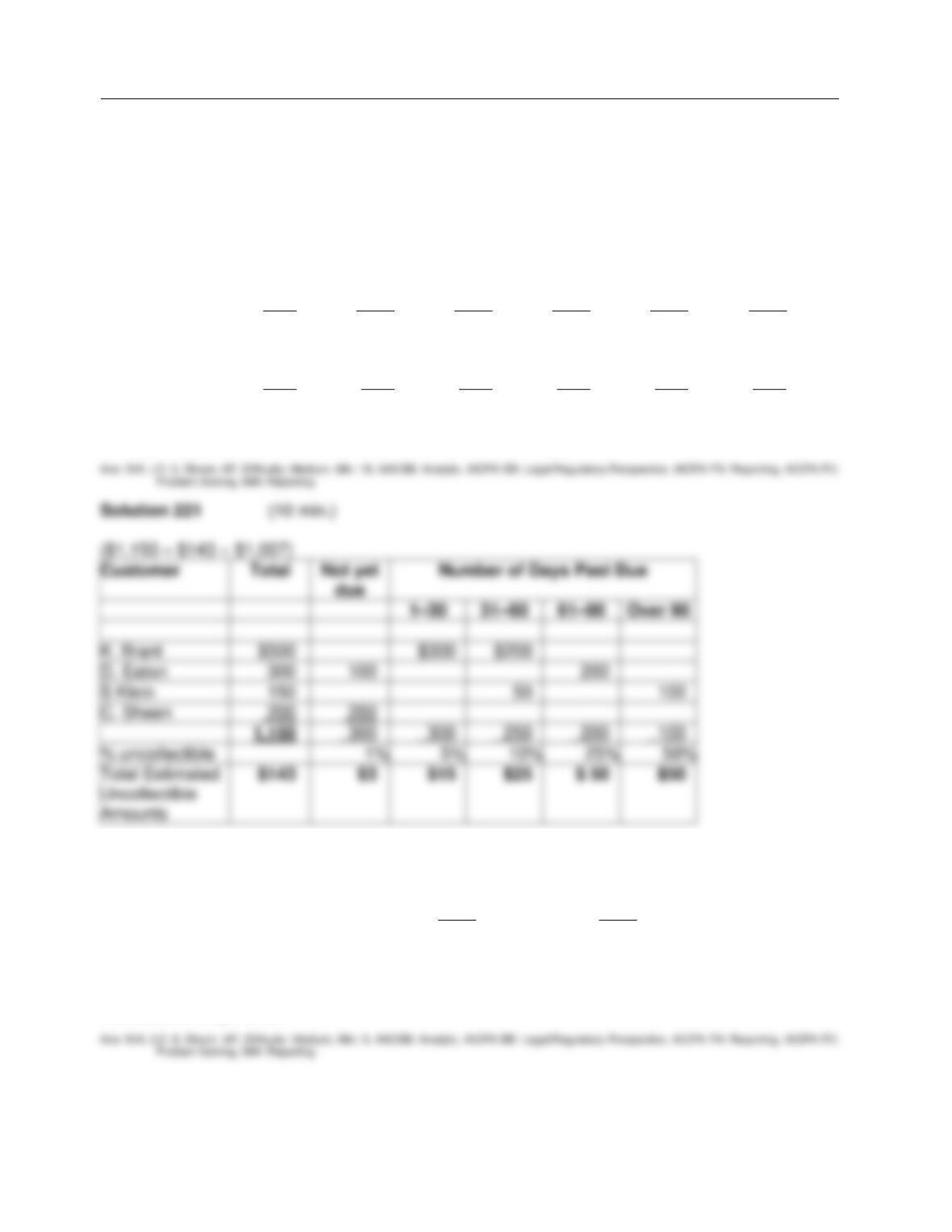
Trent Distributors has the following transactions related to notes receivable during the last two
months of the year.
Dec. 1 Loaned $16,000 cash to E. Kinder on a 1-year, 6% note.
16 Sold goods to J. Jones, receiving a $4,800, 60-day, 7% note.
31 Accrued interest revenue on all notes receivable.
Instructions
Journalize the transactions for Trent Distributors.
Test Bank for Accounting: Tools for Business Decision Making, Fifth Edition
FOR INSTRUCTOR USE ONLY
8-50
Be. 221
Merry Co. sells Christmas angels. Merry determines that at the end of December, they have the
following aging schedule of Accounts Receivable:
Customer Total Number of Days Past Due
Not yet due 1–30 31–60 61–90 Over 90
K. Brant $500 $300 $200
D. Eaton 300 100 200
S Klein 150 50 100
C. Sheen 200 200
? 300 300 250 200 100
% uncollectible 1% 5% 10% 25% 50%
Total Estimated Uncollectible
Amounts ? ? ? ? ? ?
Compute the net receivables based on the above information at the end of December (There was
no beginning balance in the Allowance for Doubtful Accounts).
Be. 222
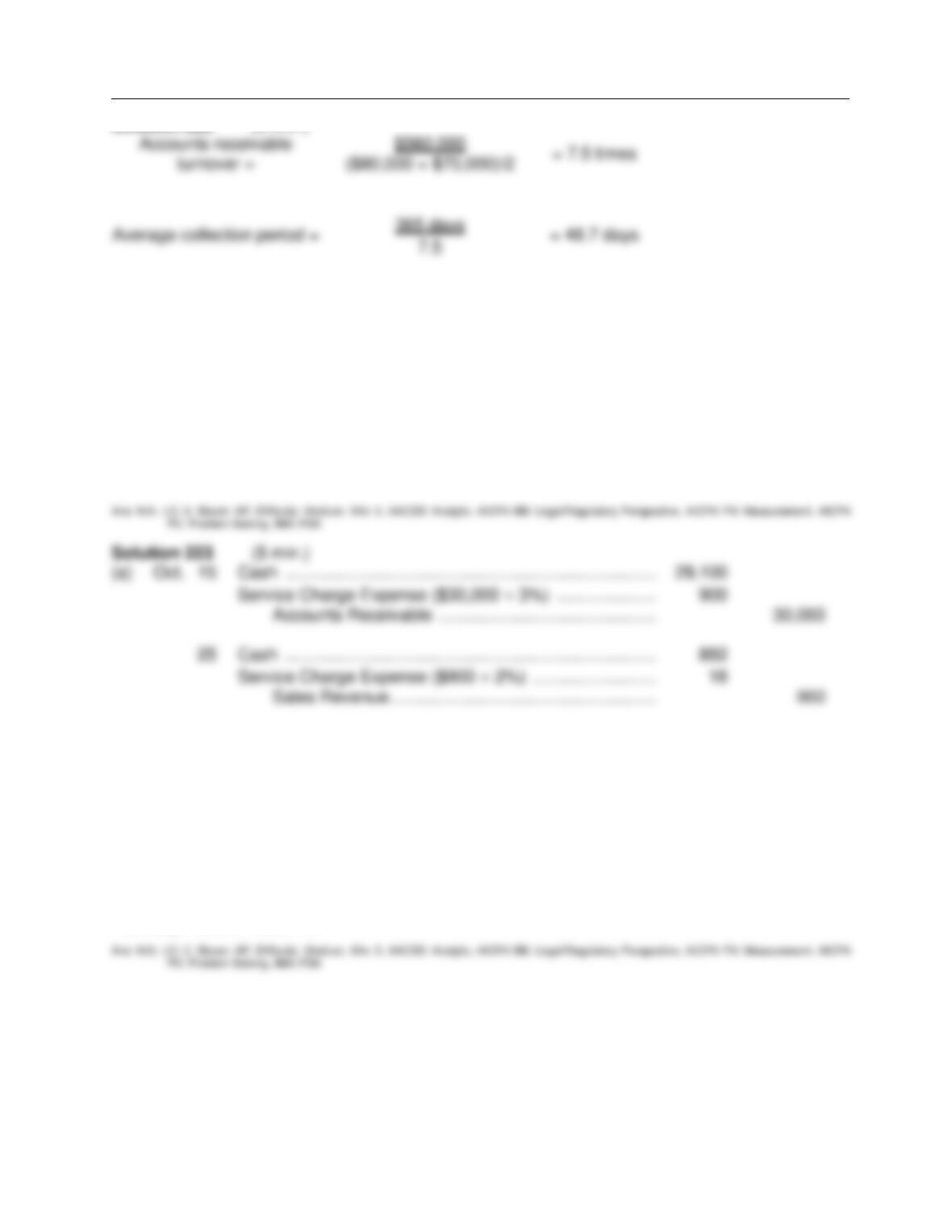
The following data exists for Mather Company.
2014 2013
Accounts Receivable $ 80,000 $ 70,000
Net Sales 560,000 410,000
Calculate the accounts receivable turnover and the average collection period for accounts
receivable in days for 2014.
Reporting and Analyzing Receivables
FOR INSTRUCTOR USE ONLY
8-51
Solution 222 (5 min.)
Be. 223
Donaldson Company has the following accounts in its general ledger at July 31: Accounts
Receivable $40,000 and Allowance for Doubtful Accounts $2,500. During August, the following
transactions occurred.
Oct. 15 Sold $30,000 of accounts receivable to Fast Factors, Inc. who assesses a 3% finance
charge.
25 Made sales of $900 on Visa credit cards. The credit card service charge is 2%.
Instructions
Journalize the transactions.
EXERCISES
Ex. 224
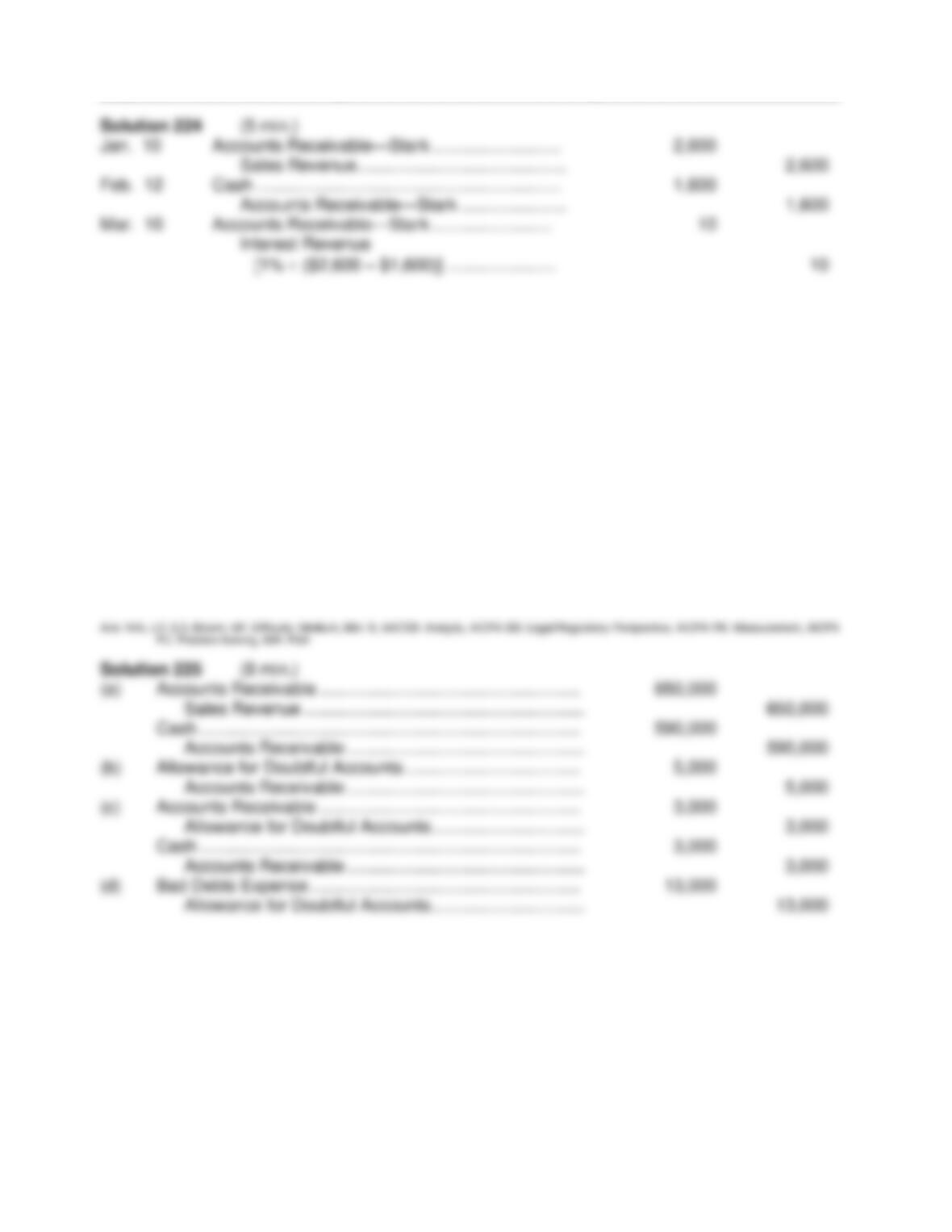
On January 10 Donna Stark uses her Baver Co. credit card to purchase merchandise from Baver
Co. for $2,600. On February 10, she is billed for the amount due of $2,600. On February 12 Stark
pays $1,600 on the balance due. On March 10 Stark is billed for the amount due, including
interest at 1% per month on the unpaid balance as of February 12.
Instructions
Prepare the entries on Baver Co.’s books related to the transactions that occurred on January 10,
February 12, and March 10.
Test Bank for Accounting: Tools for Business Decision Making, Fifth Edition
FOR INSTRUCTOR USE ONLY
8-52
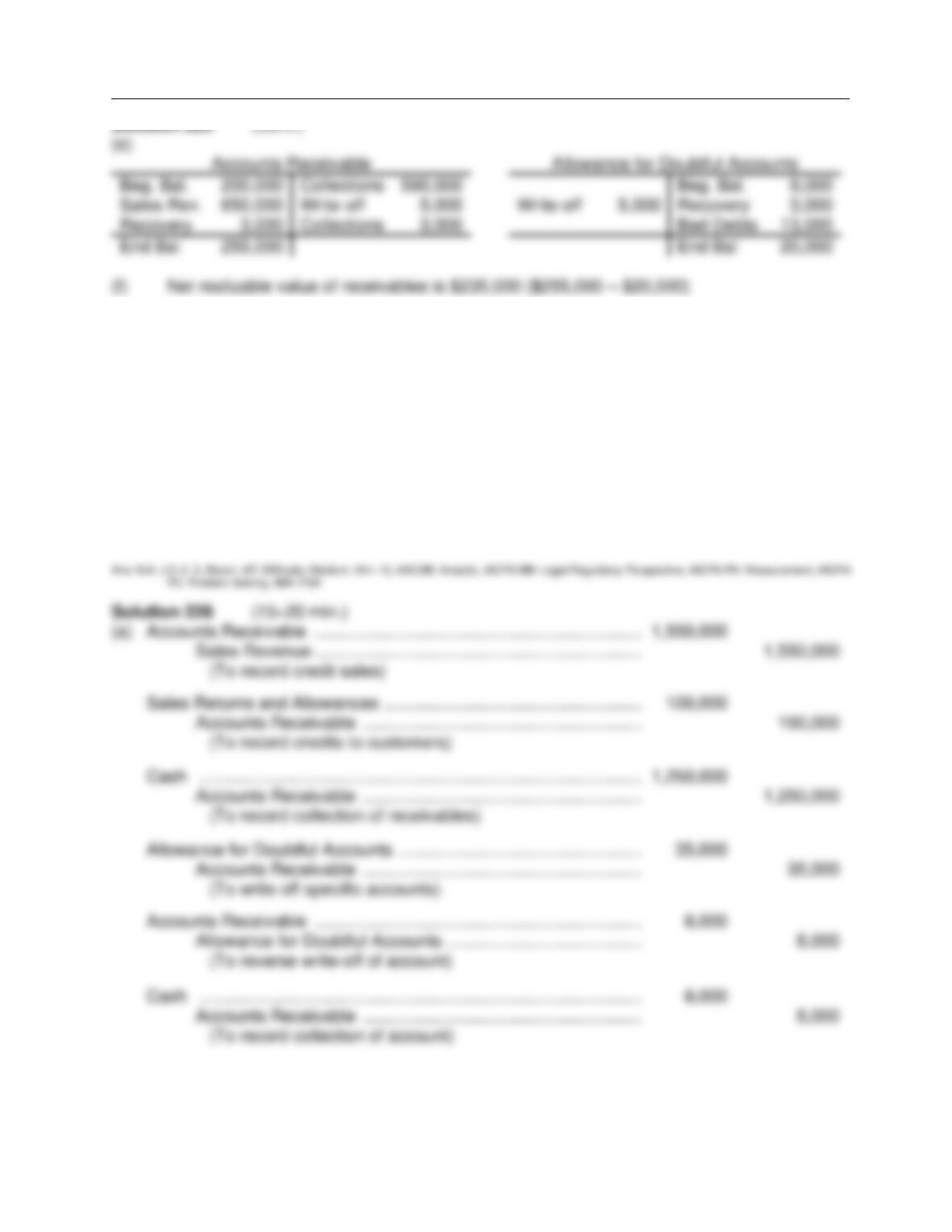
Ex. 225
At the beginning of the current period, Emler Corp. had balances in Accounts Receivable of
$200,000 and in Allowance for Doubtful Accounts of $9,000 (credit). During the period, it had net
credit sales of $650,000 and collections of $590,000. It wrote off as uncollectible accounts
receivable of $5,000. However, a $3,000 account previously written off as uncollectible was
recovered before the end of the current period. Uncollectible accounts are estimated to total
$20,000 at the end of the period.
Instructions
(a) Prepare the entries to record sales and collections during the period.
(b) Prepare the entry to record the write–off of uncollectible accounts during the period.
(c) Prepare the entries to record the recovery of the uncollectible account during the period.
(d) Prepare the entry to record bad debts expense for the period.
(e) Determine the ending balances in Accounts Receivable and Allowance for Doubtful
Accounts.
(f) Calculate the net realizable value of the receivables at the end of the period.
Reporting and Analyzing Receivables
FOR INSTRUCTOR USE ONLY
8-53
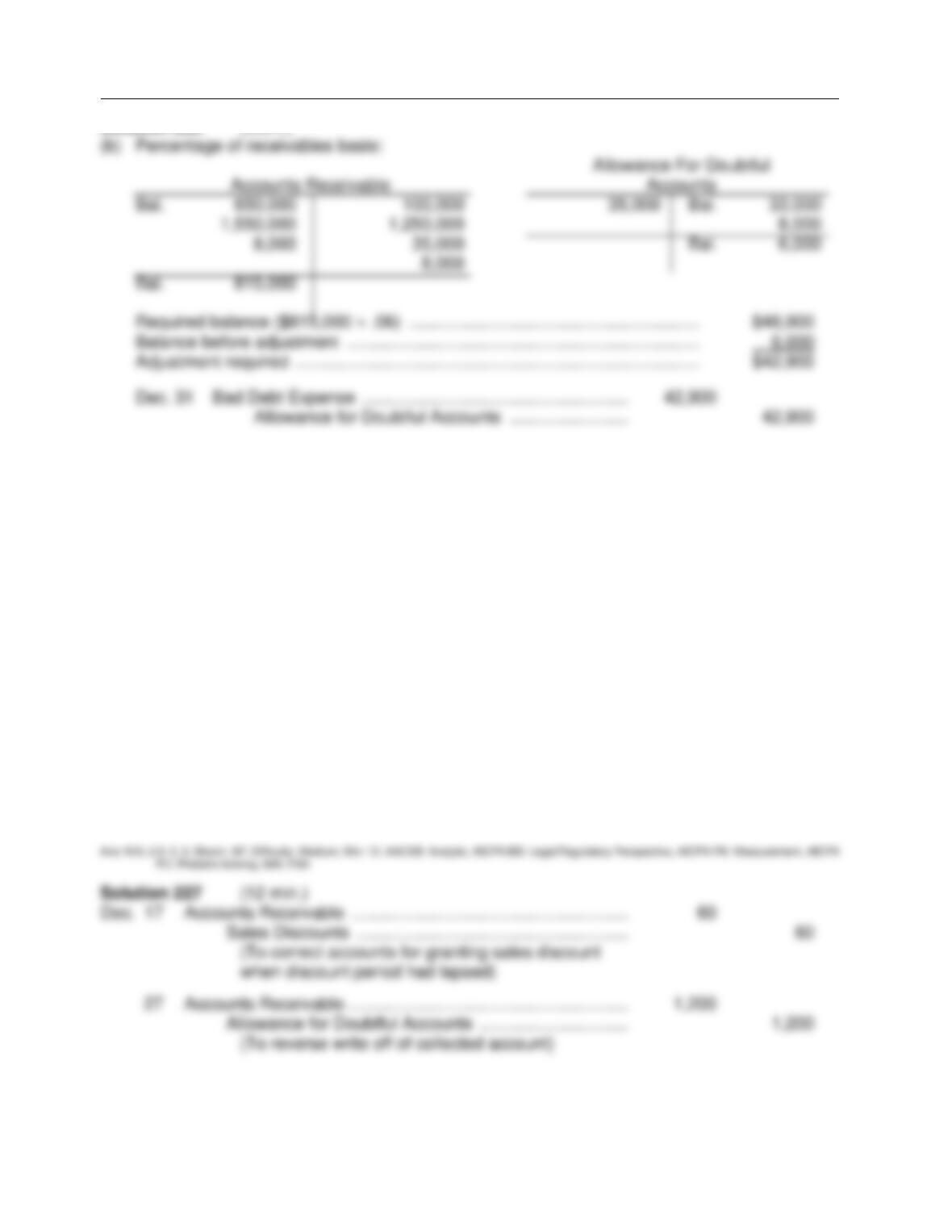
Ex. 226
The December 31, 2013, balance sheet of the Kramer Company had Accounts Receivable of
$650,000 and a credit balance in Allowance for Doubtful Accounts of $33,000. During 2014, the
following transactions occurred: sales on account $1,550,000; sales returns and allowances,
$100,000; collections from customers, $1,250,000; accounts written off, $35,000; previously
written off accounts of $8,000 were collected.
Instructions
(a) Journalize the 2014 transactions.
(b) If the company uses the percentage of receivables basis to estimate bad debt expense and
determines that uncollectible accounts are expected to be 6% of accounts receivable, what is
the adjusting entry at December 31, 2014?
Test Bank for Accounting: Tools for Business Decision Making, Fifth Edition
FOR INSTRUCTOR USE ONLY
8-54
Solution 226 (Cont.)
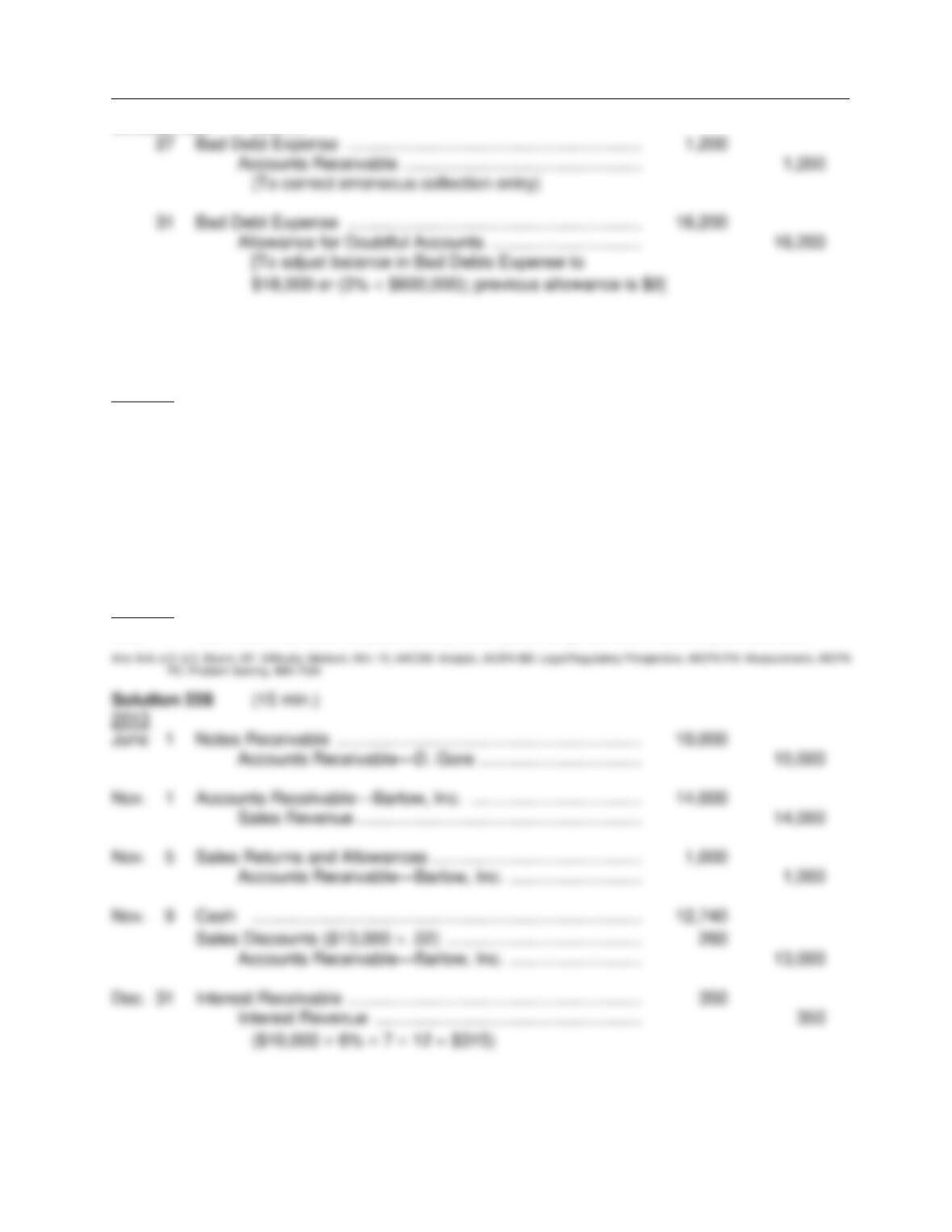
Ex. 227
An inexperienced accountant made the following entries. In each case, the explanation to the
entry is correct.
Dec. 17 Cash ………………………………………………………………………… 2,940
Sales Discounts …………………………………………………………… 60
Accounts Receivable ……………………………………………. 3,000
(To record collection of 12/4 sales, terms 2/10, n/30)
27 Cash ………………………………………………………………………… 1,200
Bad Debt Expense ……………………………………………….. 1,200
(Collection of account previously written off as
uncollectible under allowance method)
31 Bad Debt Expense ……………………………………………………….. 1,800
Allowance for Doubtful Accounts ……………………………. 1,800
(To recognize estimated bad debts based on 3% of
accounts receivable of $600,000)
Instructions
Prepare the correcting entries.
Reporting and Analyzing Receivables
FOR INSTRUCTOR USE ONLY
8-55
Solution 227 (Cont.)
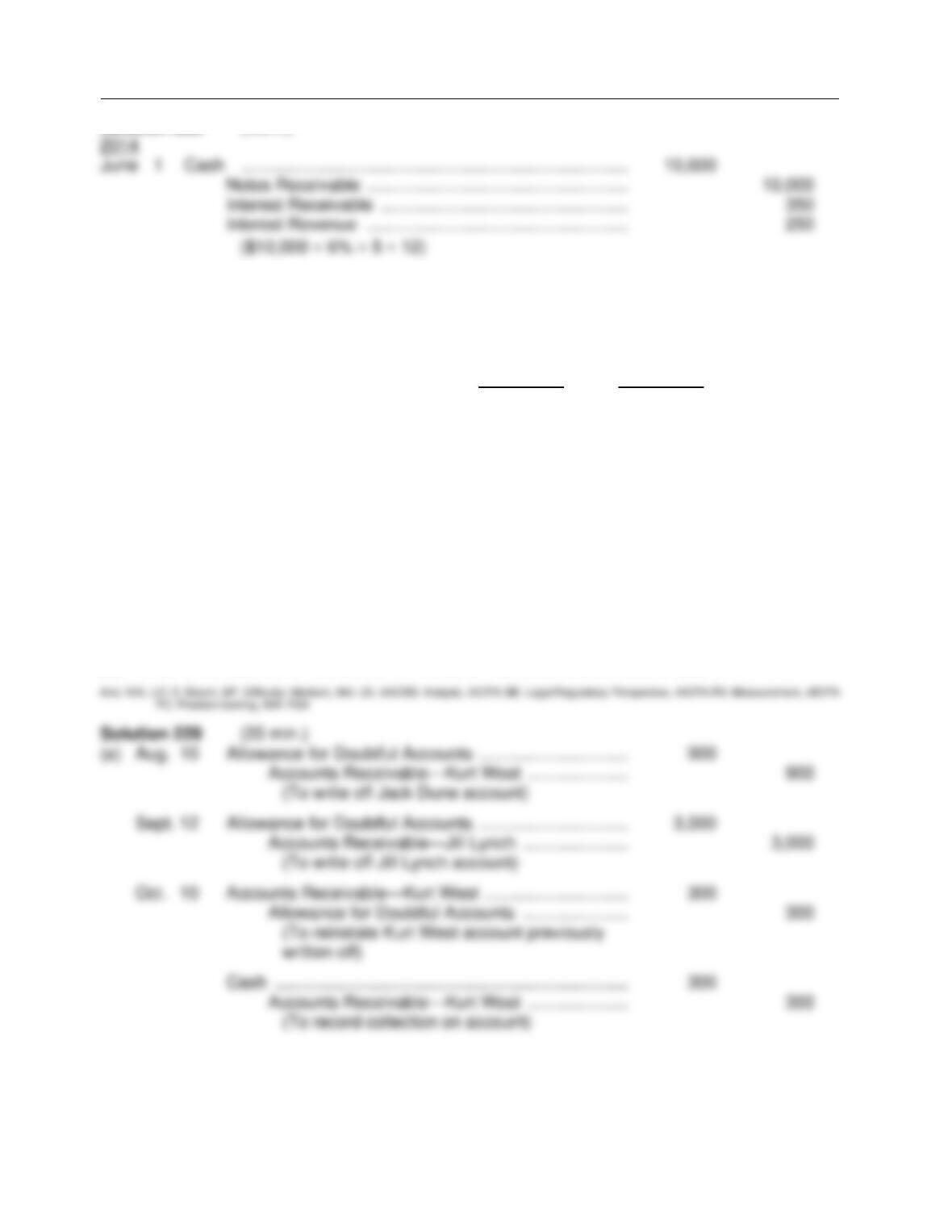
Ex. 228
Prepare journal entries to record the following transactions entered into by the Merando
Company:
2013
June 1 Received a $10,000, 6%, 1-year note from Dan Gore as full payment on his account.
Nov. 1 Sold merchandise on account to Barlow, Inc., for $14,000, terms 2/10, n/30.
Nov. 5 Barlow, Inc., returned merchandise worth $1,000.
Nov. 9 Received payment in full from Barlow, Inc.
Dec. 31 Accrued interest on Gore’s note.
2014
June 1 Dan Gore honored his promissory note by sending the face amount plus interest.
Test Bank for Accounting: Tools for Business Decision Making, Fifth Edition
FOR INSTRUCTOR USE ONLY
8-56
Solution 228 (Cont.)
Ex. 229
The Garvey Sign Company uses the allowance method in accounting for uncollectible accounts.
Past experience indicates that 6% of accounts receivable will eventually be uncollectible.
Selected account balances at December 31, 2013, and December 31, 2014, appear below:
12/31/2013 12/31/2014
Net Credit Sales $400,000 $500,000
Accounts Receivable 80,000 100,000
Allowance for Doubtful Accounts 4,000 ?
Instructions
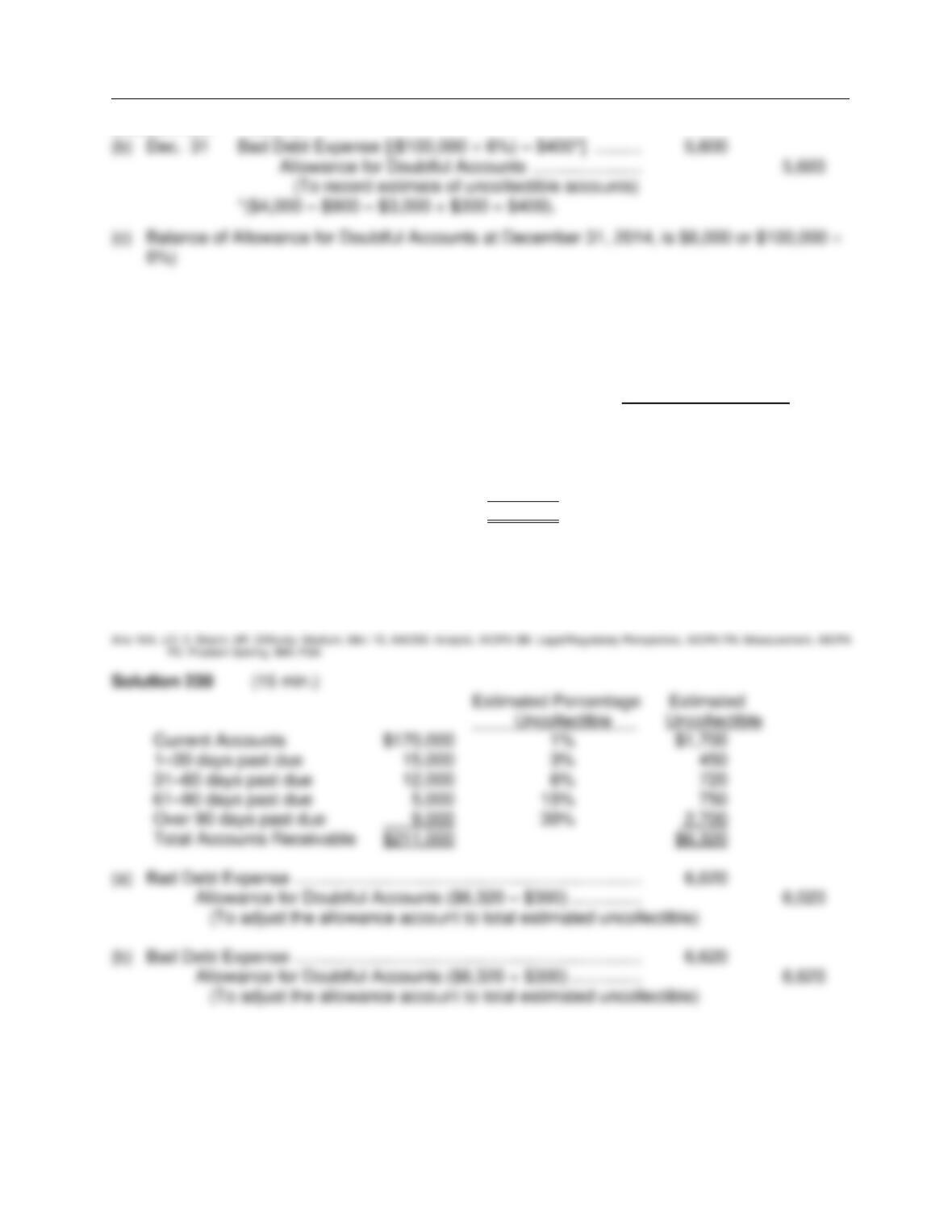
(a) Record the following events in 2014.
Aug. 10 Determined that the account of Kurt West for $900 is uncollectible.
Sept. 12 Determined that the account of Jill Lynch for $3,000 is uncollectible.
Oct. 10 Received a check for $300 as payment on account from Kurt West, whose
account had previously been written off as uncollectible.
(b) Prepare the adjusting journal entry to record the bad debt provision for the year ended
December 31, 2014.
(c) What is the balance of Allowance for Doubtful Accounts at December 31, 2014?
Reporting and Analyzing Receivables
FOR INSTRUCTOR USE ONLY
8-57
Solution 229 (Cont.)
Ex. 230
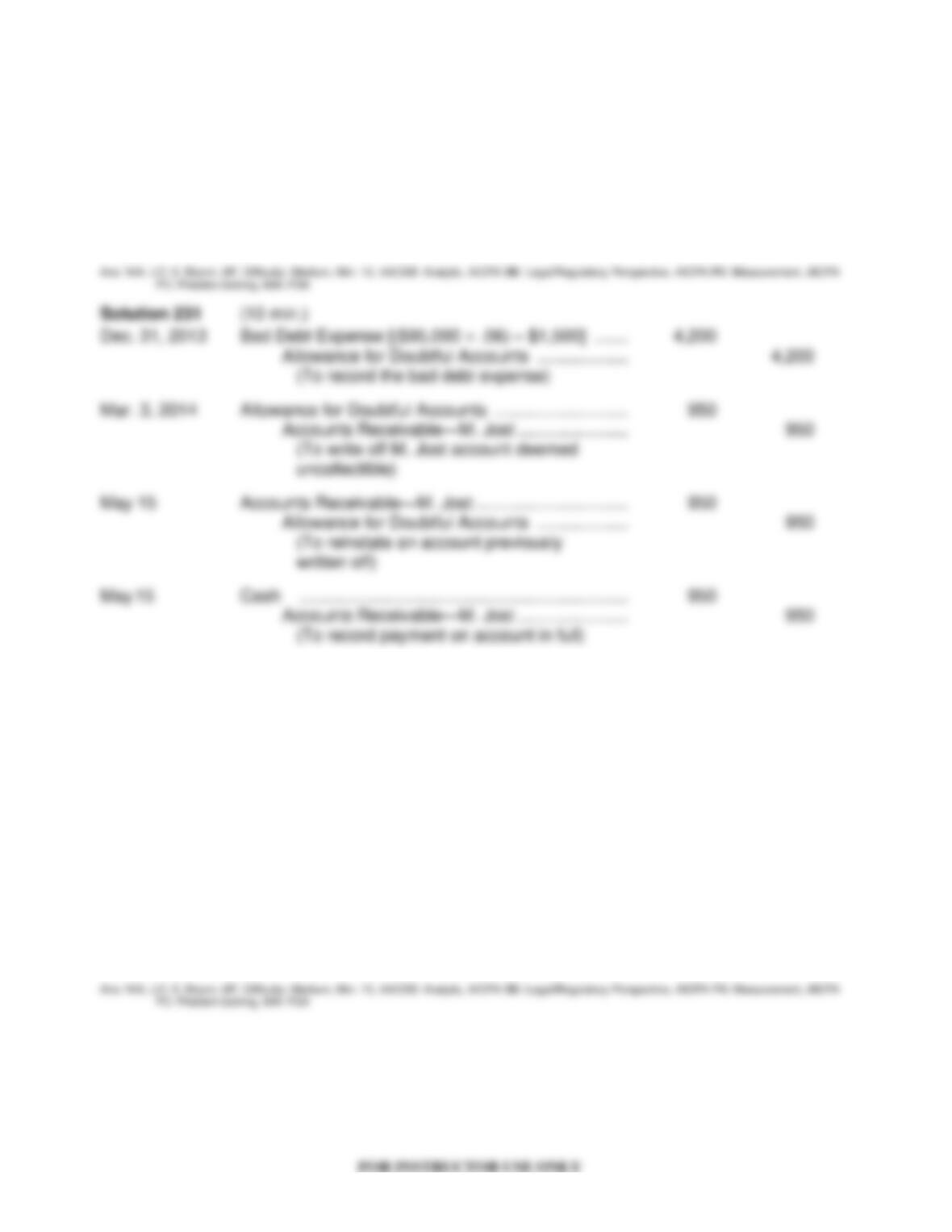
Erickson Company had a $300 credit balance in Allowance for Doubtful Accounts at December
31, 2014, before the current year’s provision for uncollectible accounts. An aging of the accounts
receivable revealed the following:
Estimated Percentage
Uncollectible
Current Accounts $170,000 1%
1–30 days past due 15,000 3%
31–60 days past due 12,000 6%
61–90 days past due 5,000 15%
Over 90 days past due 9,000 30%
Total Accounts Receivable $211,000
Instructions
(a) Prepare the adjusting entry on December 31, 2014, to recognize bad debts expense.
(b) Assume the same facts as above except that the Allowance for Doubtful Accounts account
had a $300 debit balance before the current year‘s provision for uncollectible accounts.
Prepare the adjusting entry for the current year’s provision for uncollectible accounts.
Test Bank for Accounting: Tools for Business Decision Making, Fifth Edition
8-58
Ex. 231
On December 31, 2013, when its Allowance for Doubtful Accounts had a credit balance of
$1,500, Leeds Company estimates that 6% of its accounts receivable balance of $95,000 will
become uncollectible. On March 3, 2014, Leeds Company determined that Megan Jost’s account
of $950 was uncollectible. On May 15, 2014, Jost paid the amount previously written off.
Instructions
Prepare the journal entries for December 31, 2013, March 3, 2014 and May 15, 2014.
Ex. 232
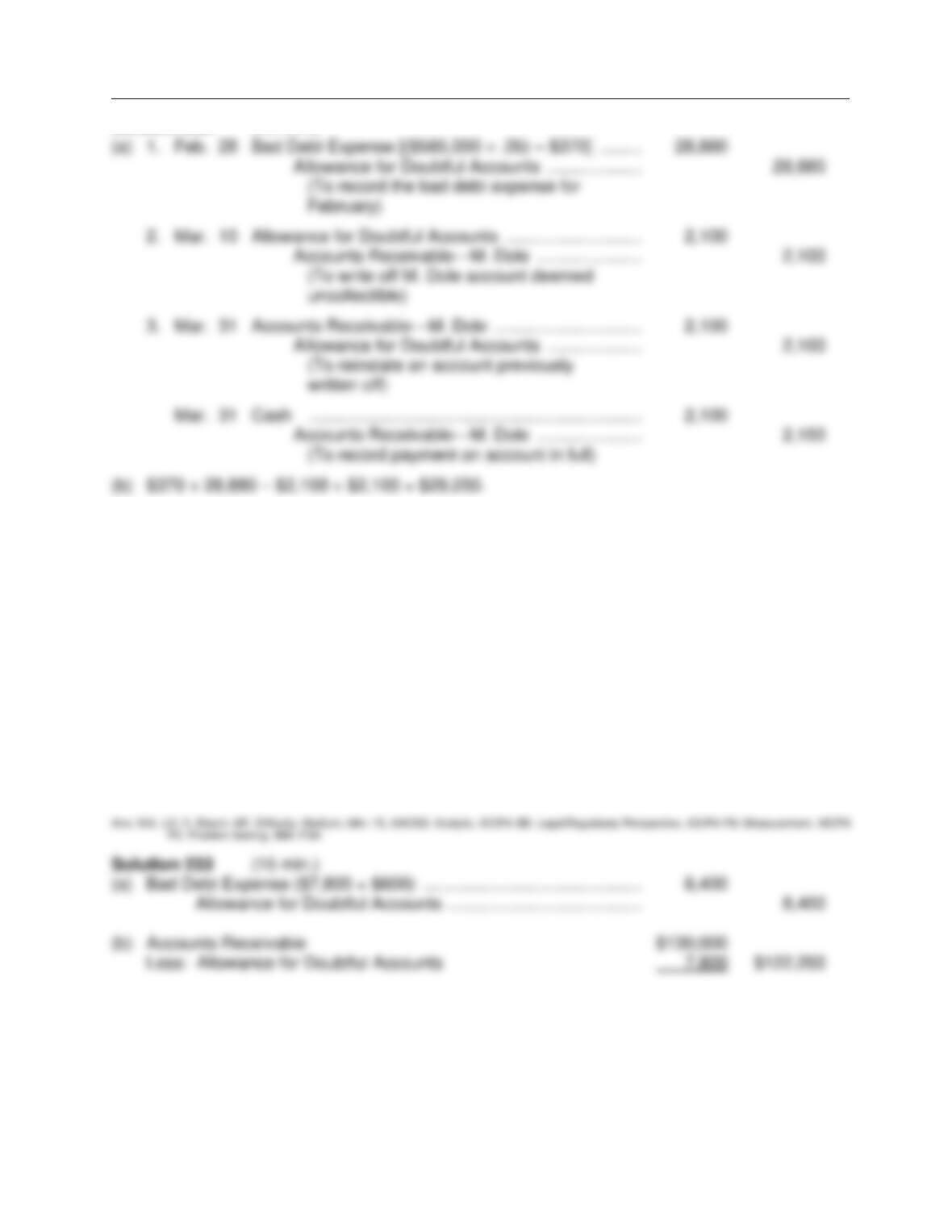
The percentage of receivables approach to estimating bad debts expense is used by Hayes
Company. On February 28, the firm had accounts receivable in the amount of $585,000 and
Allowance for Doubtful Accounts had a credit balance of $370 before adjustment. Net credit sales
for February amounted to $3,000,000. The credit manager estimated that uncollectible accounts
would amount to 5% of accounts receivable. On March 10, an accounts receivable from Mark
Dole for $2,100 was determined to be uncollectible and written off. However, on March 31, Dole
received an inheritance and immediately paid his past due account in full.
(a) Prepare the journal entries made by Hayes Company on the following dates:
1. February 28
2. March 10
3. March 31
(b) Assume no other transactions occurred that affected the allowance account during March.
Determine the balance of Allowance for Doubtful Accounts at March 31.
Reporting and Analyzing Receivables
FOR INSTRUCTOR USE ONLY
8-59
Solution 232 (15 min.)
Ex. 233
Hess Computer Store has credit sales of $450,000 in 2013 and a debit balance of $600 in the
Allowance for Doubtful Accounts at year end. As of December 31, 2013, $130,000 of accounts
receivable remain uncollected. The credit manager of Hess prepared an aging schedule of
accounts receivable and estimates that $7,800 will prove to be uncollectible.
On March 4, 2014 the credit manager authorizes a write-off of the $1,000 balance owed by A.
Myers.
Instructions
(a) Prepare the adjusting entry to record the estimated uncollectible accounts expense in 2013.
(b) Show the balance sheet presentation of accounts receivable on December 31, 2013.
(c) On March 4, before the write-off, assume the balance of Accounts Receivable account is
$145,000 and the balance of Allowance for Doubtful Accounts is a credit of $5,000. Make the
appropriate entry to record the write off of the Myers account. Also show the balance sheet
presentation of accounts receivable before and after the write–off.