15
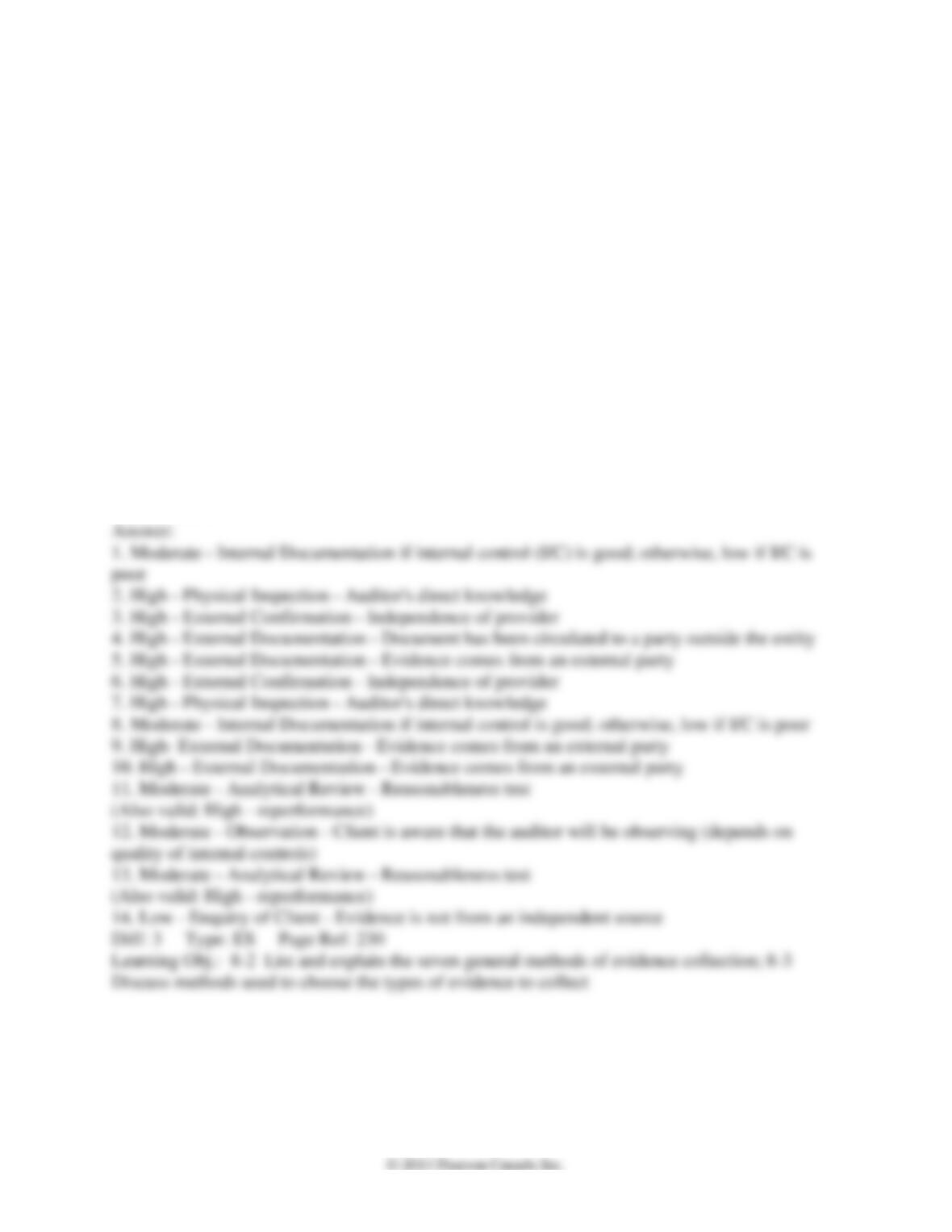
18) Following are examples of evidence that could be collected during an audit of financial
statements.
1. Duplicate copies of sales invoices.
2. Inspection of new $100,000 cutting machine.
3. Bank confirmation.
4 Remittance advices.
5. Vendor’s invoices.
6. Standard letter from lawyer to auditor.
7. Auditor inventory count sheets.
8. Shipping documents.
9. Payroll cheques.
10. Long-term debt agreements review notes.
11. Auditor interest expense calculation worksheet.
12. Observation by auditor of computer error message (invalid supplier number).
13. Gross margin calculation.
14. Interview notes from interview with credit manager.
Required:
Classify each type of evidence as to its reliability (1 – high, 2 – moderate, 3 – low). Justify your
classification.

16
19) An auditor is conducting the audit of the financial statements of a retail department store.
The auditor is aware that he must obtain sufficient appropriate evidence with respect to various
audit assertions associated with management assertions and thus with material financial
statement amounts.
The following is a list of specific audit procedures the accountant plans to perform:
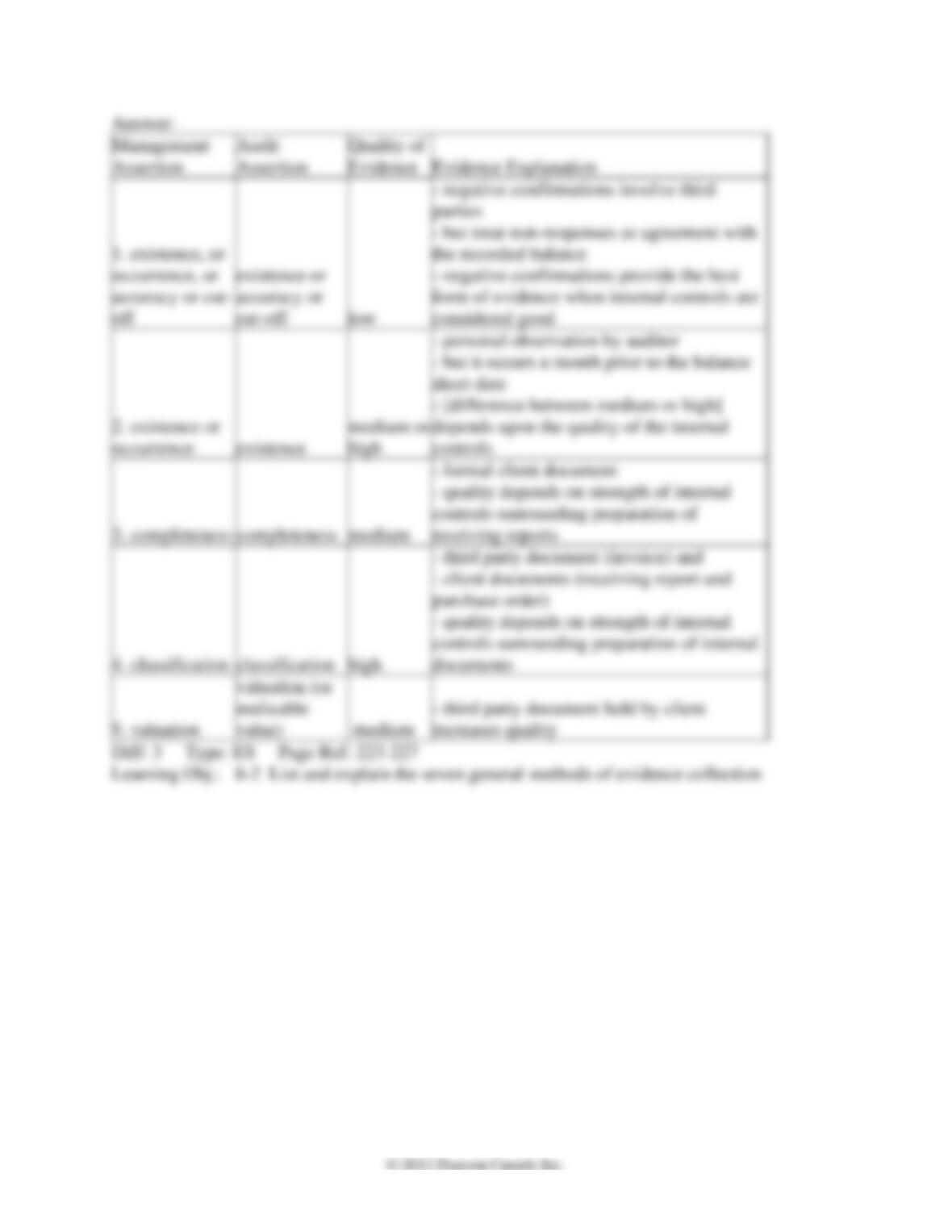
1. Send negative external confirmation requests to a large sample of the store’s customers with
balances due on account at year end.
2. Perform test counts of goods on hand during the company’s normal physical inventory taking,
one month prior to the year end.
3. Examine receiving reports dated prior to the year end which have not been matched to
vendor’s invoices.
4. Review paid invoices and supporting documents for amounts classified as repair and
maintenance expense for large or unusual items.
5. Examine audited financial statements of several foreign companies in which the client owns
shares, and which are being held as temporary investments.
Required:
For each of the five audit procedures listed, describe only the PRIMARY management assertion
being tested, the PRIMARY audit assertion being tested, and the quality of evidence (high,
medium, low) obtained, explaining WHY the evidence is the quality level you specify.
17

18
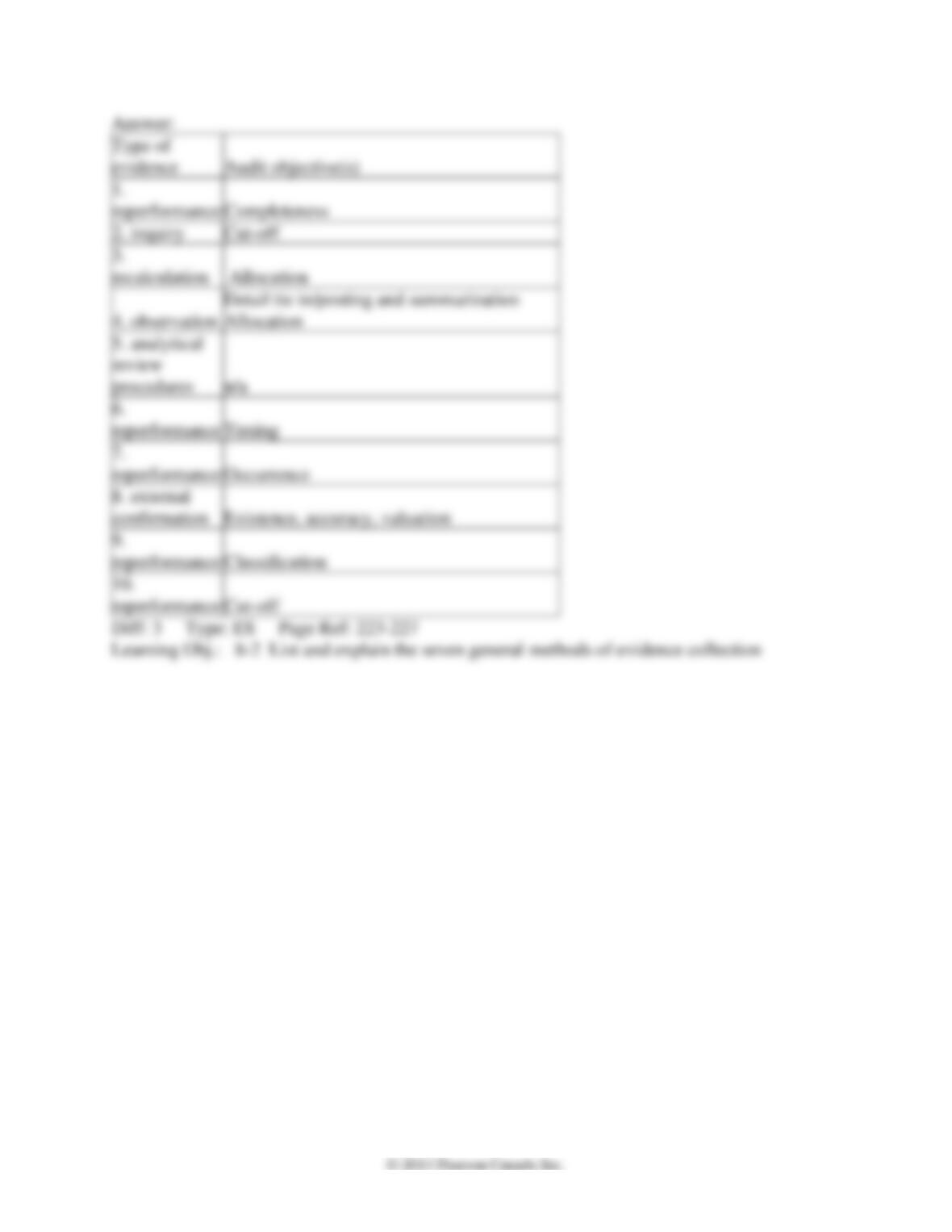
20) The following are audit procedures in the sales and collection cycle.
1. Inspect a sample of shipping documents to determine if each has a sales invoice number
included on it.
2. Discuss with the sales manager whether any sales allowances have been granted after the
balance sheet date that may apply to the current period.
3. Add the columns on the aged trial balance and compare the total with the general ledger.
4. Observe whether the controller makes an independent comparison of the total in the general
ledger with the trial balance of accounts receivable.
5. For the month of May, count the approximate number of shipping documents filed in the
shipping department, and compare the total with the number of sales invoices in the sales
journal.
6. Compare the date on a sample of shipping documents throughout the year with related
duplicate sales invoices and the accounts receivable master file.
7. Examine a sample of customer orders and see if each has a credit authorization.
8. Send letters directly to former customers whose accounts have been written off as
uncollectible to determine if any have actually been paid.
9. Examine the master file of accounts receivable to see if each has an indication of “C” for a
regular customer, “N” for interest-bearing receivables, and “R” for related parties.
10. Compare the date on a sample of shipping documents a few days before and after the balance
sheet date with related sales journal transactions.
Required:
For each procedure, identify the type of evidence being used. For each procedure, identify either
the transaction-related audit objective(s) being met or the balance-related audit objective(s) being
met.
19
20
8.3 Discuss methods used to choose the types of evidence to collect
1) Which one of the following forms of evidence would be least persuasive in forming the
auditor’s opinion?
A) the auditor’s count of marketable securities
B) correspondence with a stockbroker regarding the quantity of client’s investments held in street
name by the broker
C) minutes of the board of directors authorizing the purchase of stock as an investment
D) responses to auditor’s questions by the president and controller regarding the investments
account
2) Audit evidence can come in different forms with different degrees of persuasiveness. Which
of the following is the least persuasive type of evidence?
A) bank statement obtained from the client
B) computations made by the auditor
C) prenumbered client sales invoices
D) vendor’s invoice
3) Which one of the following forms of evidence would be least reliable?
A) monthly bank statement
B) positive confirmation of customer’s balance
C) a letter from client’s lawyer stating that there are no known lawsuits pending against client
D) client’s file copy of a purchase requisition
4) Most auditors prefer to replace external confirmation with analytical procedures whenever
possible because the
A) analytical procedures are more reliable.
B) external confirmations are more expensive.
C) analytical procedures are more persuasive.
D) tests of details are more difficult to interpret.
21
5) The Bank of New Haven relies heavily on computers to calculate the settlements of amounts
due to other banks. Given that the process is highly automated, the auditor would not be able to
obtain sufficient evidence with substantive procedures. The auditors of the Bank of New Haven
should
A) design and perform tests of controls.
B) qualify the opinion for the section on settlements.
C) hire a specialist to give an opinion on the proper functioning of the system.
D) perform a walkthrough of the system.
22
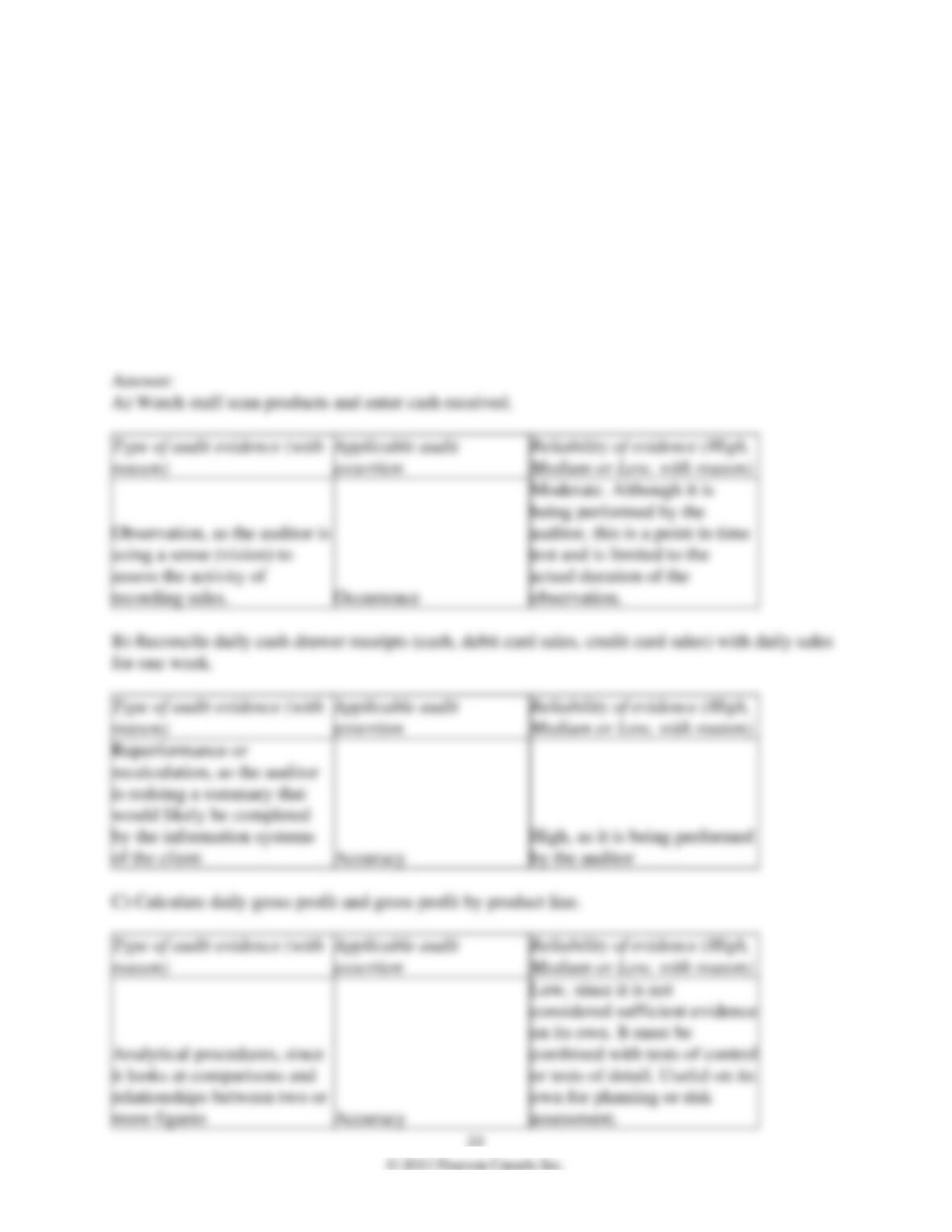
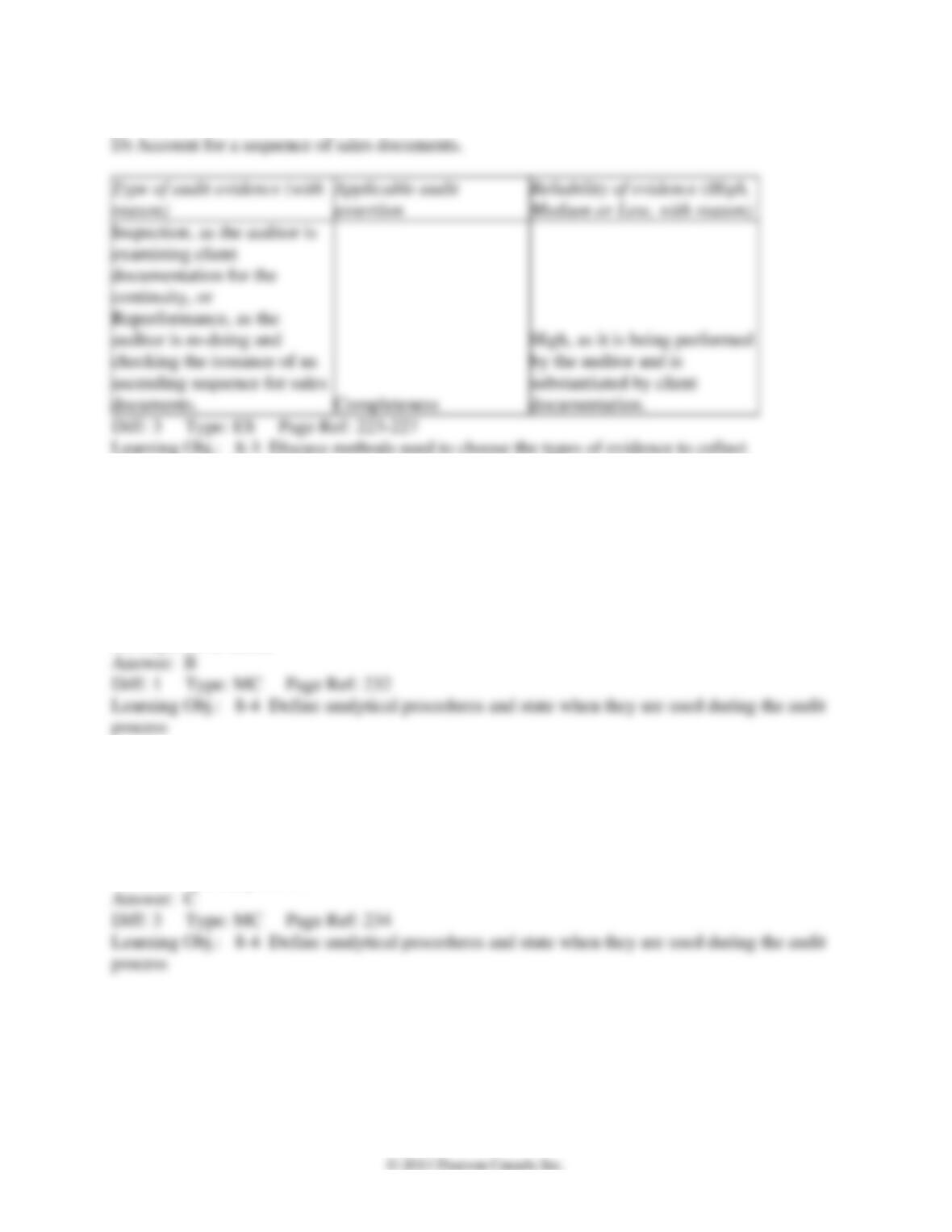
6) For each of the following audit procedures, state and describe the type of audit evidence, state
the audit assertion that it applies to, and describe the reliability of the evidence (with reasons).
A) Watch staff scan products and enter cash received.
B) Reconcile daily cash drawer receipts (cash, debit card sales, credit card sales) with daily sales
for one week.
C) Calculate daily gross profit and gross profit by product line.
D) Account for a sequence of sales documents.
23
8.4 Define analytical procedures and state when they are used during the audit process
1) When an auditor calculates the gross margin as a percent of sales and compares it with
previous periods, this type of evidence is called
A) physical examination.
B) analytical procedures.
C) observation.
D) enquiries of client.
2) When a higher than normal ratio of long-term debt to net worth is coupled with a lower than
average ratio of profits to total assets, the company
A) is highly successful.
B) is comparable with industry standards.
C) has a high risk of financial failure.
D) has a liquidity problem.
24
3) An aspect of analytical procedures is referred to as “attention-directing” when it highlights
A) errors.
B) irregularities.
C) areas of improvement.
D) areas that need more detailed procedures.
4) For some audit objectives and in some circumstances, analytical procedures may be the most
effective procedure to apply. The objectives that most likely would benefit from the use of
analytical review with respect to the allowance for uncollectible accounts would be
A) validity of sales transactions recorded for individual customer accounts.
B) classification and completeness of transactions, accuracy of judgments and estimates.
C) collectability of individual customer account balances.
D) allocation of transactions to the proper accounting period.
5) During final review of working papers and financial statements, possible oversights in the
audit can be identified by
A) the partner’s knowledge of the client’s business combined with effective analytical
procedures.
B) conducting a closing interview with management of the client.
C) conducting a meeting with the audit team.
D) review the minutes from the board meetings.
6) An important benefit of industry comparisons is as
A) an aid to understanding the client’s performance.
B) an indicator of errors.
C) an indicator of irregularities.
D) a least-cost indicator for audit procedures.
25
7) If most companies in the industry use FIFO inventory valuation and straight-line depreciation,
and the audit client uses LIFO and double-declining balance, comparisons of client and industry
data
A) will be a meaningful highlight of the result of these differences in accounting methods.
B) will enable the auditor to spot errors but not irregularities.
C) will enable the auditor to spot irregularities but not errors.
D) may not be meaningful, affecting the comparability of data.
8) When the current year’s unaudited trial balance amounts are compared to the prior year’s
audited trial balance amounts,
A) errors are identified.
B) discrepancies are discovered.
C) irregularities become apparent.
D) significant changes in balances are highlighted.
9) A common comparison occurs when the auditor calculates the expected balance and compares
it with the actual balance. The auditor’s expected account balance may be determined by
A) using industry standards.
B) using credit bureau reports.
C) relating it to some other balance sheet or income statement account or accounts.
D) inquiry of the client.
10) The most common statistical technique for analytical procedures is
A) analysis of variance.
B) bell-curve analysis.
C) time-series analysis.
D) regression analysis.
26
11) A major benefit of computerized analytical procedures is the
A) ease of doing the calculations.
B) ease of updating the calculations.
C) ease of correcting math calculations.
D) ability to push the work down to lower levels of the audit staff to do the analysis.
27
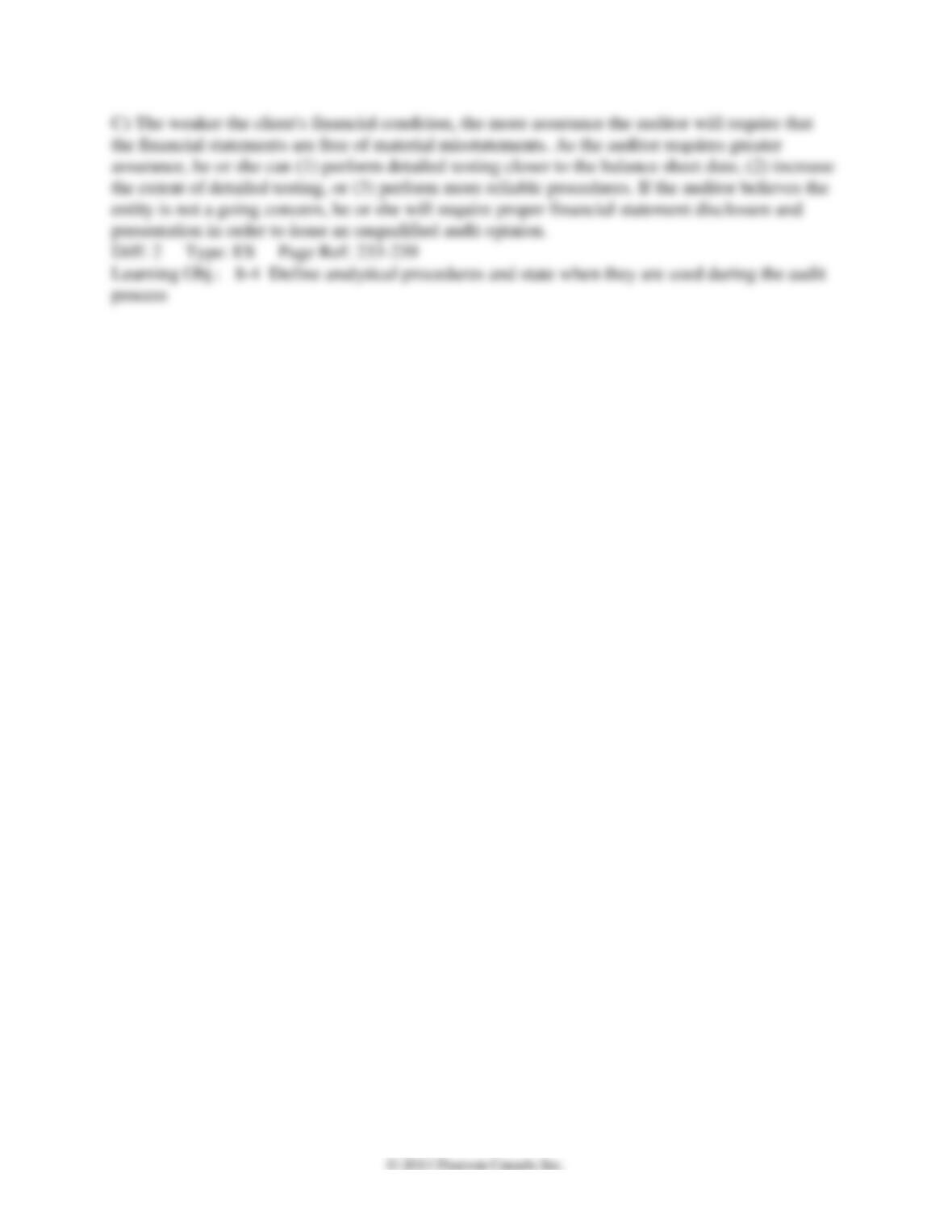
12) A) There are four important purposes of analytical procedures. Identify each of these four
purposes and, for each purpose, give a specific example of an analytical procedure that an
auditor might perform.
B) Identify each of the five major types of analytical procedures and give an example of each.
C) One purpose of performing analytical procedures in the planning phase of an audit is to assess
the client’s financial condition. Explain how the assessment of a client’s financial condition can
affect the auditor’s decisions concerning evidence accumulation in later phases of the audit.
28