60.
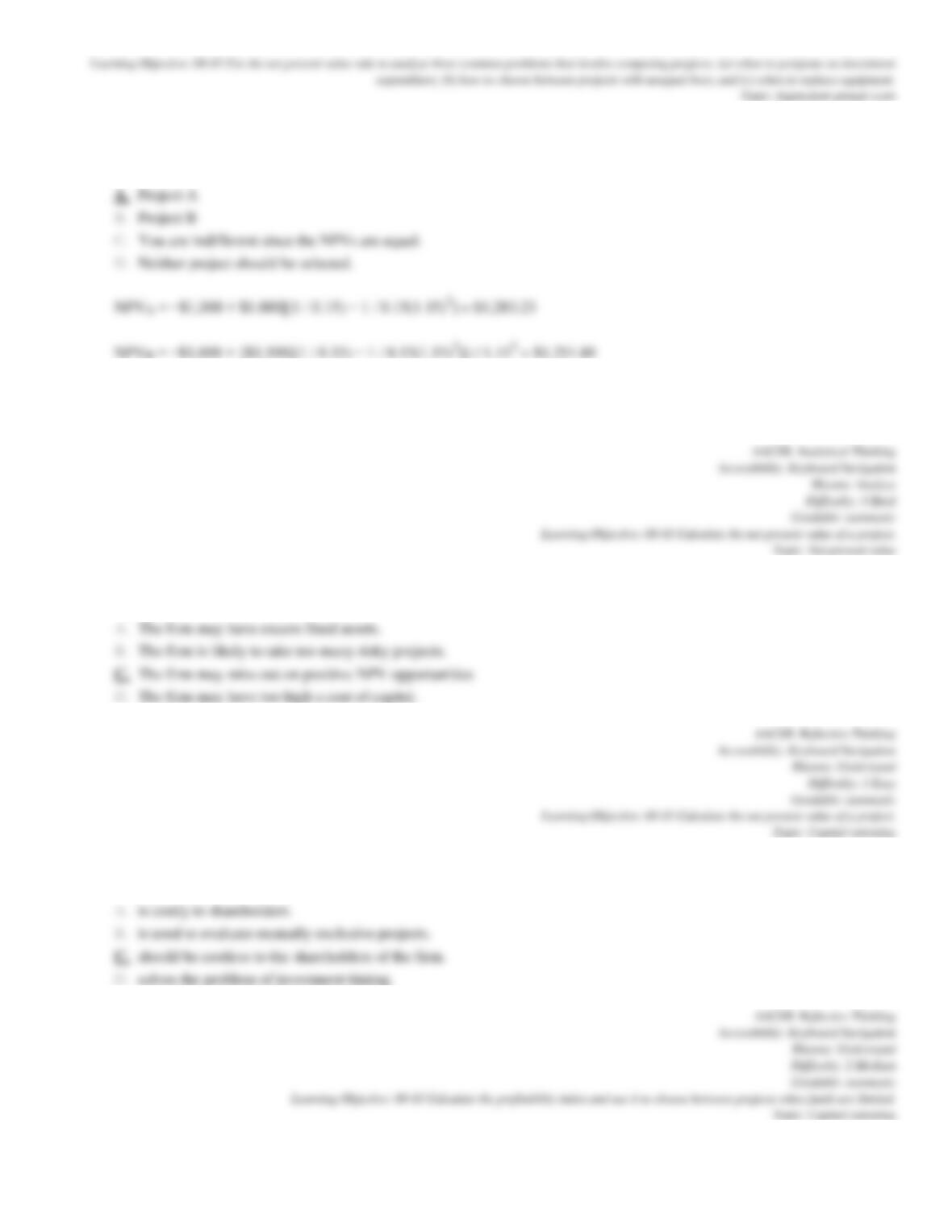
Which mutually exclusive project would you select, if both are priced at $1,000 and your required return is 15%: Project A
with three annual cash flows of $1,000; or Project B, with 3 years of zero cash flow followed by 3 years of $1,500 annually?
61.
What is the possible cost of capital rationing?
62.
Soft capital rationing:
63.
Soft capital rationing is imposed upon a firm by _____, while hard capital rationing is imposed by _____.
64.
If a project has a cost of $50,000 and a profitability index of 2, then:
65.
In simple cases when hard capital rationing exists, projects may be evaluated by :
66.
Use of a profitability index to evaluate mutually exclusive projects in the absence of capital rationing:
67.
The profitability index selects projects based on the:
68.
Which of the following investment criteria takes the time value of money into consideration?
69.
When calculating a project’s payback period, cash flows are:
70.
What is the profitability index for a project costing $40,000 and returning $15,000 annually for 4 years at an opportunity cost
of capital of 12%?
71.
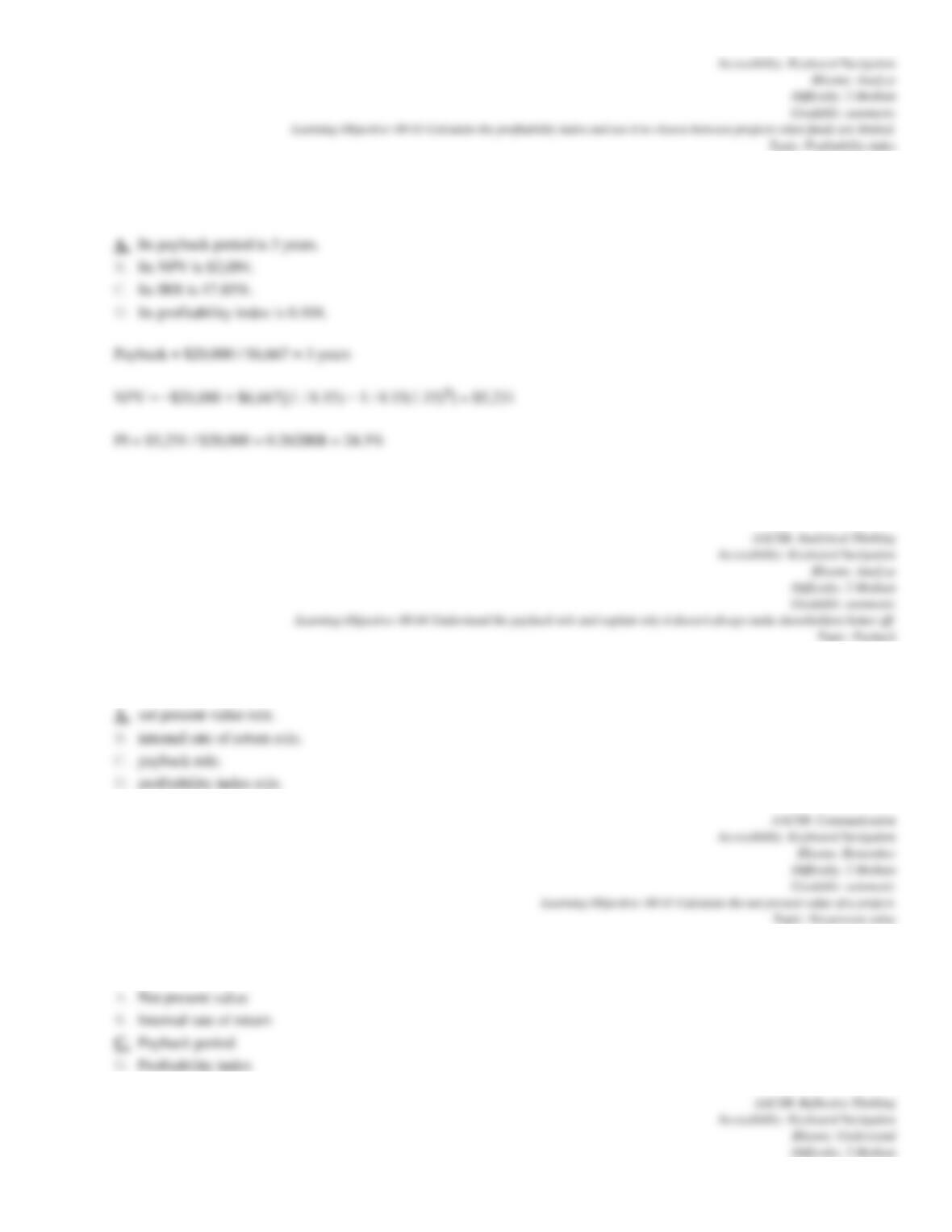
Which of the following statements is true for a project with a $20,000 initial cost, cash inflows of $6,667 per year for 6
years, and a discount rate of 15%?
72.
The “gold standard” of investment criteria refers to the:
73.
Which of the following investment decision rules tends to improperly reject long-lived projects?
74.
The ratio of net present value to initial investment is known as the:
75.
For mutually exclusive projects, the IRR can be used to select the best project:
76.
The opportunity cost of capital is equal to:
77.
Occasionally projects may have positive initial cash flows. Such projects:
78.
A project with an IRR that is less than the opportunity cost of capital should be:
79.
If a project’s expected rate of return exceeds its opportunity cost of capital, one would expect:
80.
Which one of the following should be assumed about a project that requires a $100,000 investment at time zero, then returns
$20,000 annually for 5 years?
81.
If two projects offer the same positive NPV, then they:
82.
What is the minimum cash flow that could be received at the end of year 3 to make the following project “acceptable”?
Initial cost = $100,000; cash flows at end of years 1 and 2 = $35,000; opportunity cost of capital = 10%.
83.
According to the NPV rule, all projects should be accepted if NPV is positive when discounted at the:
84.
If a project’s IRR is 13% and the project provides annual cash flows of $15,000 for 4 years, how much did the project cost?
85.
A project’s payback period is determined to be 4 years. If it is later discovered that additional cash flows will be generated in
years 5 and 6, then the project’s payback period will:
86.
A polisher costs $10,000 and will cost $20,000 a year to operate and maintain. If the discount rate is 10% and the polisher
will last for 5 years, what is the equivalent annual cost of the tool?
87.
Selecting the project(s) with the highest NPV(s) is not the correct decision rule when:
88.
The investment timing problem arises when:
89.
A company owns a tract of timber that will keep growing for a number of years. It calculates that the timber’s value less the
cost of harvesting is currently $50,000 and that this figure will grow by 10% in the next year and by 5% in the following
year. If the cost of capital is 8%, when should the company harvest the timber?
90.
To justify postponing a project for one year, the NPV needs to increase over that year by a rate that is equal to or greater
than:
91.
What happens to the equivalent annual cost of a project as the opportunity cost of capital decreases?
92.
What is the equivalent annual cost for a project that requires a $40,000 investment at time zero, and a $10,000 annual
expense during each of the next 4 years, if the opportunity cost of capital is 10%?
93.
A currently used machine costs $10,000 annually to run. What is the maximum that should be paid to replace the machine
with one that will last 3 years and cost only $4,000 annually to run? The opportunity cost of capital is 12%.
94.
Because of its age, your car costs $4,000 annually in maintenance expense. You could replace it with a newer vehicle costing
$8,000. Both vehicles would be expected to last 4 more years, at which point they will be valueless. If your opportunity cost
is 8%, by how much must maintenance expense decrease on the newer vehicle to justify its purchase?
95.
Projects A and B are mutually exclusive lending projects. Project A has an IRR of 20% while Project B has an IRR of 30%.
You would be more likely to choose B unless:
96.
What is the decision rule in the case of sign changes that produce multiple IRRs for a project?
97.
If a project has a payback period of 5 years and a cost of capital of 10%, then the discounted payback will:

98.
You can continue to use your less efficient machine at a cost of $8,000 annually. Alternatively, you can purchase a more
efficient machine for $12,000 plus $5,000 annual maintenance. If the new machine lasts 5 years and the cost of capital is
15%, you should:
99.
A firm is considering a project with the following cash flows: Time 0 = +$20,000, Years 1–5 = −$4,500. Should the project
be accepted if the cost of capital is 10%?
100.
A firm plans to use the profitability index to select between two mutually exclusive investments. If no capital rationing has
been imposed, which project should be selected?

Chapter 08 Test bank – Static Summary
Category
# of Questio
ns
AACSB: Analytical Thinking
16
AACSB: Communication
9
AACSB: Reflective Thinking
68
AACSB: Technology
7
Accessibility: Keyboard Navigation
100
Blooms: Analyze
17
Blooms: Apply
15
Blooms: Remember
11
Blooms: Understand
57
Difficulty: 1 Easy
18
Difficulty: 2 Medium
75
Difficulty: 3 Hard
7
Gradable: automatic
100
Learning Objective: 08–01 Calculate the net present value of a project.
36
Learning Objective: 08–02 Calculate the internal rate of return of a project and know what to look out for when
using the internal rate of return rule.
24
Learning Objective: 08–03 Calculate the profitability index and use it to choose between projects when funds are limited.
12
Learning Objective: 08–04 Understand the payback rule and explain why it doesn’t always make shareholders better off.
11
Learning Objective: 08–05 Use the net present value rule to analyze three common problems that involve competing
projects: (a) when to postpone an investment expenditure; (b) how to choose between projects with unequal lives; and (c) when to repla
ce equipment.
17
Topic: Capital budgeting
4
Topic: Capital rationing
6
Topic: Discounted payback
1
Topic: Equivalent annual costs
10
Topic: Internal rate of return
21
Topic: Modified internal rate of return
1
Topic: Mutually exclusive projects
7
Topic: Net present value
31
Topic: Payback
10
Topic: Profitability index
9