14) The law of one price does not hold for
A) agricultural goods.
B) tradeable goods.
C) differentiated goods.
D) goods whose production causes pollution.
15) Differences in price levels
A) explain well actual exchange rate movements.
B) are not capable of explaining well actual exchange rate movements, particularly in the short
run.
C) have been small for most countries in the post-World War II period.
D) only can be explained by the fact that little foreign trade actually takes place.
16) Purchasing power parity’s assumption that the real exchange is constant
A) is correct in nearly all instances.
B) would be correct were it not for the existence of trade barriers.
C) is not reasonable.
D) is correct for trade between the United States and Japan, but incorrect in most other bilateral
trading relations.
17) Though useful, purchasing power parity does not completely explain long-run movements in
exchange rates due to
A) some goods being nontradeable.
B) changes in the real exchange rate.
C) differentiated products.
D) all of the above.
18) The process by which identical products that are tradeable converge to the same price is
called
A) arbitrage.
B) hedging.
C) speculation.
D) risk aversion.
19) What would happen to the value of the dollar if prices in the U.S. increased more rapidly
relative to prices in other countries?
20) What real-world complications keep purchasing power parity from being a complete
explanation of exchange rates ?
8.4 A Demand and Supply Model of Short-Run Movements in Exchange Rates
1) A key assumption behind the explanation of exchange rate determination in the short run is
A) trade barriers are unimportant in the short run.
B) changes in price levels are unimportant in the short run.
C) exchange rates represent prices of financial assets in one currency relative to prices of similar
financial assets in another currency.
D) trade barriers and changes in price levels are unimportant in the short run.
2) Suppose that you expect during the next year the dollar will appreciate against the pound from
0.5 pound to the dollar to 0.75 pound to the dollar. How much will you expect to make on an
investment of $10,000 in British government securities that will mature in one year and pay
interest of 8%?
A) -59.5%
B) -28%
C) 8%
D) 28%
3) Suppose the exchange rate is 10 pesos per dollar and you use $1000 to purchase a one-year
Mexican bond that pays 10% interest. Next year, the exchange rate is 11 pesos per dollar.
Assuming you convert your funds back to U.S. dollars, how much money will you have in one
year?
A) $1000
B) $1100
C) $91
D) $0
4) If you are indifferent between investing $1000 for one year in a U.S. Treasury security that
has an interest rate of 5% or in a Canadian government security that has an interest rate of 8%,
you must be expecting
A) the inflation rate in the United States will be higher than the inflation rate in Canada during
the year.
B) the U.S. dollar to depreciate against the Canadian dollar by 3% during the year.
C) the U.S. dollar to appreciate against the Canadian dollar by 3% during the year.
D) productivity growth in Canada to be greater than productivity growth in the United States
during the year.
5) When deciding between domestic and foreign financial investments, investors typically
consider
A) domestic and foreign inflation rates and expected changes in the exchange rate.
B) domestic and foreign budget deficits.
C) shifts in the relative demand for foreign and domestic goods.
D) domestic and foreign interest rates and expected changes in the exchange rate.
6) International capital mobility refers to
A) the ease with which manufacturing equipment can be transported across countries.
B) the ease with cash may be transferred from one country to another without having to be
converted into a foreign currency.
C) the ease with which investors move funds among international financial markets.
D) the ease with which exchange rates may be adjusted to reflect changes in the relative
economic strengths of countries.
7) We would not expect a Japanese financial asset and a U.S. financial asset with identical risk,
liquidity, and information characteristics to have different expected returns because
A) the U.S. and Japanese governments have pledged themselves to avoid this outcome.
B) traders would buy the asset with the higher expected yield and sell the asset with the lower
expected yield until the yields were brought into equality.
C) traders would sell the asset with the higher expected yield and buy the asset with the lower
expected yield until the yields were brought into equality.
D) the exchange rate between the dollar and the yen would adjust automatically to eliminate any
difference in yields.
8) The nominal interest rate parity condition states that
A) domestic and foreign assets must have nominal returns that are identical, irrespective of the
characteristics of the assets.
B) when domestic and foreign assets have identical risk, liquidity, and information
characteristics, their nominal returns must also be identical.
C) while nominal returns are equalized across all foreign and domestic assets, real returns may
vary widely.
D) while real returns are equalized across all foreign and domestic assets, nominal returns may
vary widely.
9) If the German interest rate is 4% and the U.S. interest rate is 5%, what is the expected change
in the value of the dollar in terms of the euro?
A) 1%
B) -1%
C) 9%
D) -9%
10) What would happen in the foreign exchange market if the European Central Bank raises
European interest rates?
A) There will be a decline in the value of the euro.
B) There will be a decline in the value of the dollar.
C) There will be an increase in the value of the dollar.
D) U.S. interest rates will decline
11) If the nominal interest rate parity condition is not met,
A) imports will exceed exports.
B) the return from holding domestic assets must exceed the expected return from holding foreign
assets.
C) the return from holding domestic assets must be less than the expected return from holding
foreign assets.
D) the return from holding domestic assets must be greater or less than the expected return from
holding foreign assets.
12) If the interest rate in the United States rises
A) investors increase their demand for dollars and the U.S. exchange rate appreciates.
B) investors increase their demand for dollars and the U.S. exchange rate depreciates.
C) investors decrease their demand for dollars and the U.S. exchange rate appreciates.
D) investors decrease their demand for dollars and the U.S. exchange rate depreciates.
13) If foreign interest rates rise
A) the demand for domestic currency rises, causing it to appreciate.
B) the demand for domestic currency falls, causing it to depreciate.
C) the demand for domestic currency rises, causing it to depreciate.
D) the demand for domestic currency falls, causing it to appreciate.
14) If a currency’s foreign exchange value is expected to fall, then
A) demand for the currency will rise in anticipation.
B) the current foreign-exchange value of the currency will rise.
C) the current foreign-exchange value of the currency will fall.
D) the country’s nominal interest rate will rise.
15) If foreign exchange traders become convinced that the value of the yen will rise against the
dollar in the future, the likely result is that
A) demand for the yen will fall in anticipation.
B) the current value of the yen against the dollar will rise.
C) the current value of the yen against the dollar will fall.
D) nominal interest rates in Japan will fall.
16) The currency premium in foreign-exchange markets
A) helps to offset anticipated declines in exchange rates.
B) helps to offset anticipated increases in exchange rates.
C) indicates investors’ collective preference for financial instruments denominated in one
currency relative to those denominated in another.
D) rises as domestic interest rates fall.
17) The situation in which investors choose to put their funds in a safe asset during uncertain
times is known as
A) hedging.
B) speculation.
C) flight to quality.
D) arbitrage.
18) Which of the following will take place in the foreign exchange market if there is an increase
in the demand for products made in the United States?
A) The supply of dollars will decrease.
B) The demand for dollars will decrease.
C) The demand for dollars will increase.
D) The dollar will decrease in value.
19) Which of the following is most likely to lead to an increase in the value of the dollar?
A) decline in U.S. interest rates
B) increase in imports to the United States
C) decrease in exports from the United States
D) increase in U.S. interest rates compared to foreign interest rates
20) Which of the following has the largest impact on short-run movements in exchange rates?
A) growth rate of exports
B) growth rate of imports
C) investment opportunities
D) changes in the trade deficit
21) Suppose that short-term real interest rates fall in Japan. Is this likely to be good news or bad
news for the tourism industry in Hawaii?
22) Suppose that the one-year Treasury bill rate in the United States is 6%, the one-year
government bond rate in Canada is 4%, and investors expect the U.S. dollar to depreciate against
the Canadian dollar by 4% over the coming year. Is the nominal interest rate parity condition
violated?
23) In 2010, fears were growing that the dollar would experience a significant decline in value.
What are the likely implications for the euro-dollar exchange rate?
24) Suppose you invest $5,000 in a one-year Japanese bond that pays 1% interest. At the time of
your purchase, 85 yen equals $1 while one year later, 80 yen equals $1. What will be the value of
your investment in one year when measured in dollars?
25) What are three reasons that the interest-rate parity condition may not always hold?
26) Suppose interest rates in the US are 3% while interest rates on comparable bonds in Japan
are 1%. By how much is the exchange rate between the yen and dollar expected to change
according to the interest-rate parity condition?
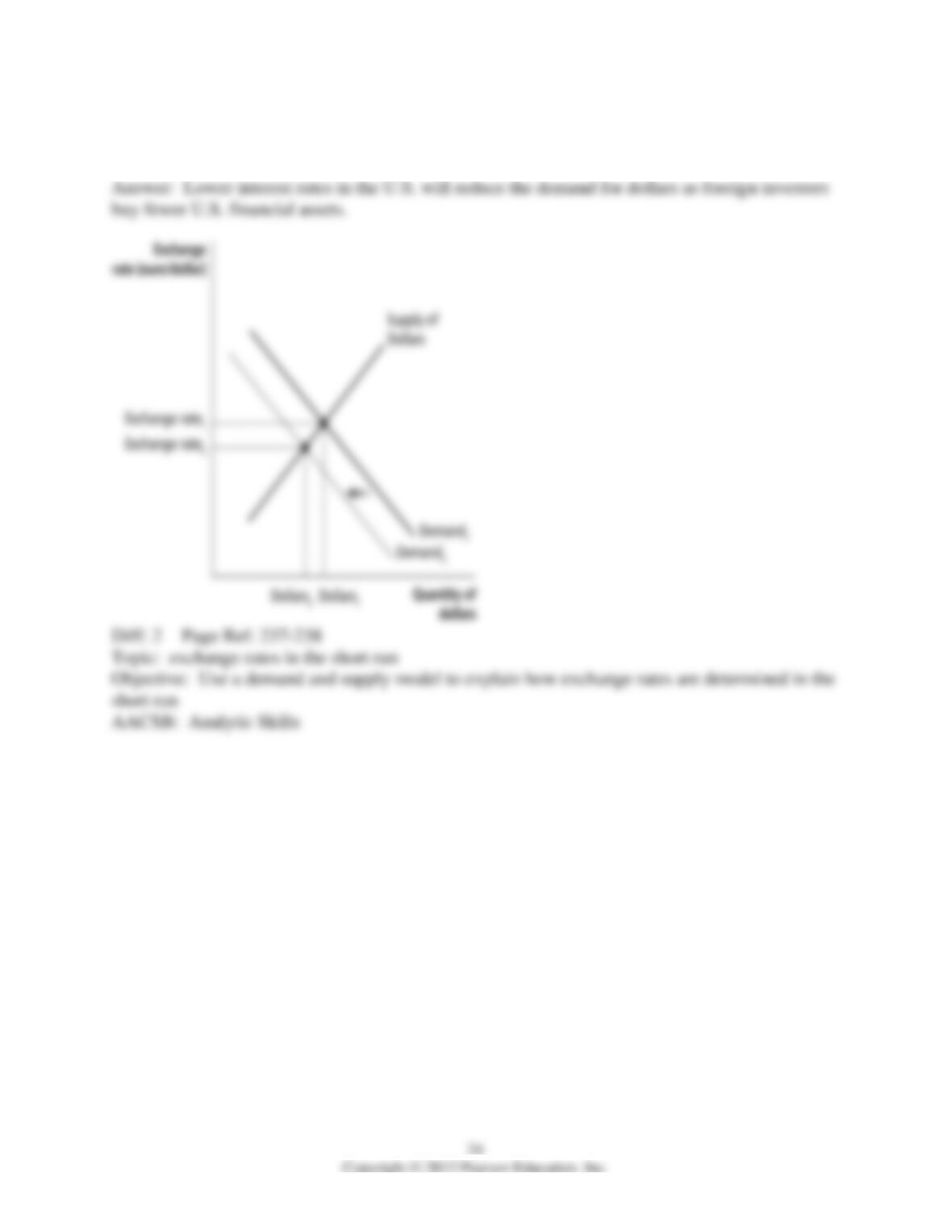
27) Suppose the Federal Reserve reduces interest rates while interest rates in Europe do not
change. Make use of a graph of the foreign exchange market to show how this will affect the
value of the dollar.
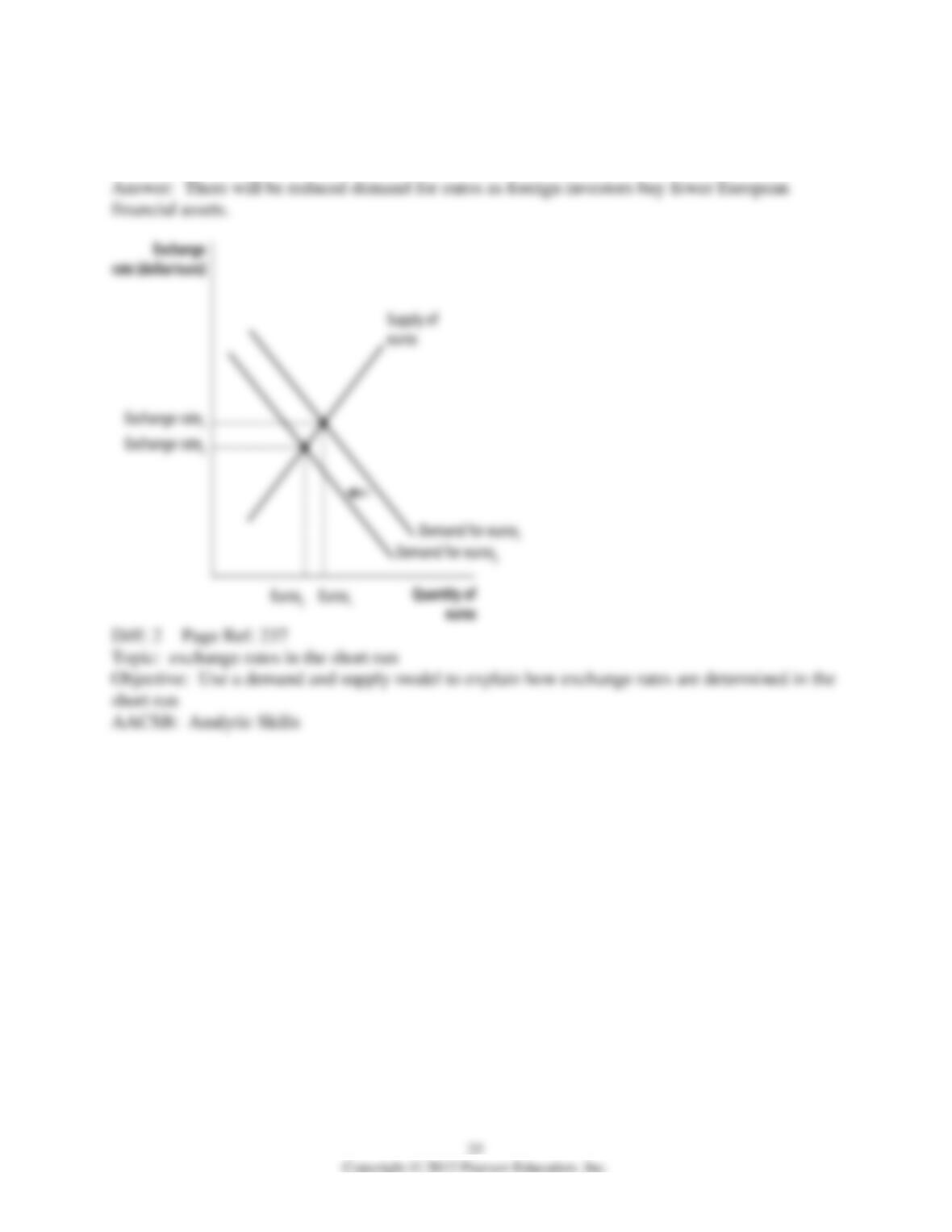
28) Suppose that investor’s perceive a higher risk of investing in Europe as a result of a sovereign
debt crisis. Make use of a graph of the foreign exchange market to show how this will affect the
value of the euro.