Auditing, 12e (Arens)
Chapter 8 Audit Evidence
8.1 Describe five evidence decisions made during the audit process
1) CAS 330, the auditor’s response to assessed risks, explains that the auditor needs to link
completed audit work to the assessed risks at the assertion level and
A) document the conclusions and results of the audit procedures.
B) perform substantive procedures in areas where there is a high risk of fraud.
C) have the reviewing partner sign off on the assessed risk.
D) ensure that they test the entire population for areas that are considered to have a high risk of
errors.
2) “The detailed instructions for the collection of a particular type of audit evidence” that is to be
obtained at some time during the audit is the definition of a(n)
A) sampling plan.
B) audit procedure.
C) audit plan.
D) audit program.
3) How frequently does the auditor make a decision with respect to the sample size to be
selected?
A) once for the entire audit
B) for each transaction cycle
C) once for each type of audit procedure
D) for each audit procedure
4) Those procedures specifically outlined in an audit program are primarily designed to
A) prevent litigation.
B) detect errors or irregularities.
C) test internal controls.
D) collect evidence.
5) “The detailed instructions for the entire collection of evidence for an audit area” is the
definition of a(n)
A) sampling plan.
B) audit procedures.
C) audit plan.
D) audit program.
6) In determining the quantity and quality of evidence to gather, the auditor will be satisfied
when the evidence is
A) irrefutable.
B) conclusive.
C) highly persuasive.
D) sufficiently convincing.
7) Audit evidence is generally considered sufficient when
A) it is appropriate.
B) there is enough of it to afford a reasonable basis for an opinion on financial statements.
C) it has the qualities of being relevant, objective, and free from known bias.
D) it has been obtained by random selection.
8) The decision of how many items to test must be made by the auditor for each audit procedure.
The sample size for any given procedure
A) will be the same if the same level of assurance is required.
B) must cover the entire period under audit.
C) is focused on high dollar items only.
D) is likely to vary from audit to audit.
9) The two most important factors that determine the appropriate sample size in audits are
A) the auditor’s expectation of errors and the effectiveness of the client’s internal controls.
B) the auditor’s expectation of errors and materiality.
C) the effectiveness of the client’s internal controls and materiality.
D) materiality and the type of audit procedure to be applied to the population.
10) Which of the following characteristics of samples would make the sample more sufficient?
Samples that contain
A) at least one of each type of transaction that is in the population, and have a high number of
sample items.
B) items with a high likelihood of error and have large dollar values, as well as being
representative of the population.
C) multiple items from different layers of the population (strata), as well as all items that are
above the materiality threshold.
D) items that have a high likelihood of error, as well as being related to the audit assertions that
are being tested.
11) Evidence is generally considered appropriate when
A) it has the qualities of being relevant, objective, and free from known bias.
B) there is enough of it to afford a reasonable basis for an opinion on financial statements.
C) it has been obtained by random selection.
D) it consists of written statements made by managers of the enterprise under audit.
12) To improve the appropriateness of audit evidence, the auditor should
A) make sure to select a larger sample size for the items being tested.
B) add additional population items into the sample, improving sample variety.
C) select audit procedures that improve the reliability of the evidence.
D) select a smaller sample size that is statistically valid.
13) The auditor is tracing from the duplicate sales invoices to related shipping documents with
respect to the occurrence transaction-related audit objective. This type of evidence is
A) independent.
B) relevant.
C) timely.
D) related to external documentation.
14) Which of the following audit techniques would the auditor use to test the completeness of
sales (i.e. test whether shipments have been billed to customers)?
A) trace shipping documents to duplicate sales invoices
B) trace duplicate sales invoices to shipping documents
C) match data file versions of sales invoices to paper records
D) look at subsequent payments after the year end for payments for outstanding invoices
15) Which of the following types of evidence is most appropriate in the audit of fixed assets?
A) recalculation of the amortization schedule provided by the client
B) auditor inspection of recently acquired fixed assets
C) reperformance of the posting of depreciation expenses to the general ledger
D) analytical review to assess the reasonableness of depreciation expense
16) Which of the following types of evidence would be considered most reliable in the audit of
accounts payable?
A) review of internal budgets for the period under audit
B) inquiry of management with respect to recent purchases
C) inspection of client purchase orders
D) inspection of supplier invoices
17) Last year, the client’s internal controls were weak. This year, the internal controls are
stronger. This means that information recorded on internal documentation is
A) more timely.
B) less reliable.
C) more reliable.
D) less timely.
18) Evidence can be obtained from others, or provided by the auditor, who has good knowledge
of each industry but is not an expert. Which of the following types of evidence is considered to
be most reliable?
A) examination of diamond inventory by the auditor
B) external confirmations from individual owners of condominium units
C) examination of oil and gas reserves by the auditor
D) external confirmations from financial institutions
19) Gina is performing the audit of the payables section of Reno Inc. She wants to confirm the
payables from an independent source. Which of the following sources would represent an
independent provider?
A) Confirm an interco payable with the CEO of the US branch of Reno Inc.
B) Confirm the account payable with Clarkson Corp. The CFO of Clarkson is the wife of the
controller of Reno.
C) Confirm the line of credit balance with Citizen Bank. Reno does all its banking with Citizen
and it also has a long-term loan there.
D) Confirm the account payable to Suco Inc. The CEO of Reno owns 30% of the outstanding
shares of Suco.
20) Which of the following is the best example of objective evidence?
A) a letter written by a client’s lawyer discussing the likely outcome of outstanding lawsuits
B) the physical count of securities and cash by the auditor
C) inquiries of the credit manager about the collectability of noncurrent accounts receivable
D) observation of cobwebs on some inventory bins
21) Which of the following is an example of subjective evidence?
A) a positive confirmation of an account receivable
B) a bank confirmation
C) inquiries of the credit manager about the collectability of noncurrent accounts receivable
D) the physical count of securities and cash
22) Evidence is usually more persuasive for balance sheet accounts when it is obtained
A) from various times periods throughout the client’s year.
B) only from transactions occurring on the balance sheet date.
C) as close to the balance sheet date as possible.
D) from the time period when transactions in that account were most numerous during the fiscal
period.
23) For income statement accounts, evidence is more persuasive if there is a sample from
A) the entire period under audit.
B) the period closest to the end of the fiscal period.
C) at least three months of the fiscal year.
D) December, since this would include large holiday sales.
24) Inspection of assets is not a sufficient form of evidence when the auditor wants to determine
the
A) existence of the asset.
B) quantity and description of the asset.
C) condition or quality of the asset.
D) ownership of the asset.
25) The auditor’s decisions regarding evidence accumulation can be broken into five
subdecisions. One decision relates to determining the nature of the audit procedure to be used to
collect the evidence; i.e., “which audit procedures to use.” Identify and discuss the remaining
four audit evidence decisions that the auditor makes.
26) Identify and explain the three determinants of the persuasiveness of evidence.
27) There are six factors that affect the reliability of audit evidence. One factor is the
independence of the provider; i.e., evidence obtained from a source outside the client company is
more reliable than that obtained within. Identify and discuss the remaining five factors that affect
the appropriateness of evidence.
8.2 List and explain the seven general methods of evidence collection
1) Observation is an important audit technique where the auditor can use sight, hearing, touch,
and smell. Observation needs to be used together with other audit techniques because
A) employees will often perform their procedures consistently over time.
B) it is a high cost technique that is rarely used by auditors.
C) it is a point in time technique limited to the time of the observation.
D) auditors may not accurately observe and interpret what is happening.
2) Confirmations from outside organizations such as banks and law firms are
A) a highly regarded and often-used type of evidence.
B) expensive and rarely used during the audit.
C) difficult to obtain and infrequently required.
D) internal documents that provide low quality evidence.
3) Mary is entering a fictitious transaction in the sales data entry system to see if the system will
reject the order for a client that is already exceeding its credit limit. Mary is using
A) observation.
B) analytical procedures.
C) test data.
D) generalized audit software.
4) Reperformance is often conducted using computer-assisted audit techniques. The most
effective use of generalized audit software for reperformance would be to
A) recalculate a whole class of transactions, helping to quantify dollar errors.
B) determine on a test basis whether posting and summarization is performed accurately.
C) confirm whether evidence has been recorded for the entire period under audit.
D) select a sample of transactions for recalculation.
5) An abnormal fluctuation in gross profit that might suggest the need for extended audit
procedures for sales and inventories would most likely be identified in the planning phase of the
audit by the use of
A) tests of details of balances.
B) procedures to obtain an understanding of internal controls.
C) specialized audit programs.
D) analytical procedures.
6) “Use of comparisons and relationships to determine whether account balances or other data
appear reasonable” is a definition of
A) auditing.
B) tests of balances.
C) tests of controls.
D) analytical procedures.
7) Although considerable evidence is obtained from the client through inquiry, it usually cannot
be regarded as conclusive because
A) the client may not have sufficient knowledge to answer the question.
B) it is not from an independent source and may be biased.
C) there is a risk that the auditor will misinterpret what the client said.
D) the client cannot be trusted to provide persuasive information.
8) Inquiry is a valuable technique during the planning phase of the audit because it
A) involves the rechecking of controls to ensure that they are conducted accurately.
B) is a type of audit evidence that provides a very high level of assurance.
C) is conclusive evidence from an independent source.
D) helps obtain information about how procedures and internal controls operate.
9) An example of an internal document is
A) a cancelled cheque.
B) a bank statement.
C) a bill of lading for purchases.
D) employees’ time reports.
10) An example of an external document is
A) a cancelled cheque.
B) employees’ time reports.
C) inventory receiving reports.
D) the minutes of the Board of Directors’ meetings.
11) A document which the auditor receives from the client, but which was prepared by someone
outside the client’s organization, is a(n)
A) external confirmation.
B) copy of sales invoice.
C) copy of bank note payable.
D) inventory receiving report.
12) When comparing the reliability of external versus internal documents, the external
documents are generally considered
A) more reliable.
B) less reliable.
C) equally reliable.
D) unreliable.
13) When the auditor examines the client’s documents and records to support recorded
transactions or amounts, it is commonly referred to as
A) inquiry.
B) confirmation.
C) vouching.
D) physical examination.
14) An example of vouching would be to trace from
A) receiving reports to the acquisitions journal.
B) the acquisitions journal to supporting vendors’ invoices.
C) duplicate bank deposit slips to the cash receipts journal.
D) cancelled cheques to the cash disbursement journal.
15) Identify and define the seven methods of audit evidence collection. Which two types of
evidence are the most expensive? Which three types of evidence are the least expensive? Which
type of evidence would be most persuasive when testing the existence objective for long-term
assets?
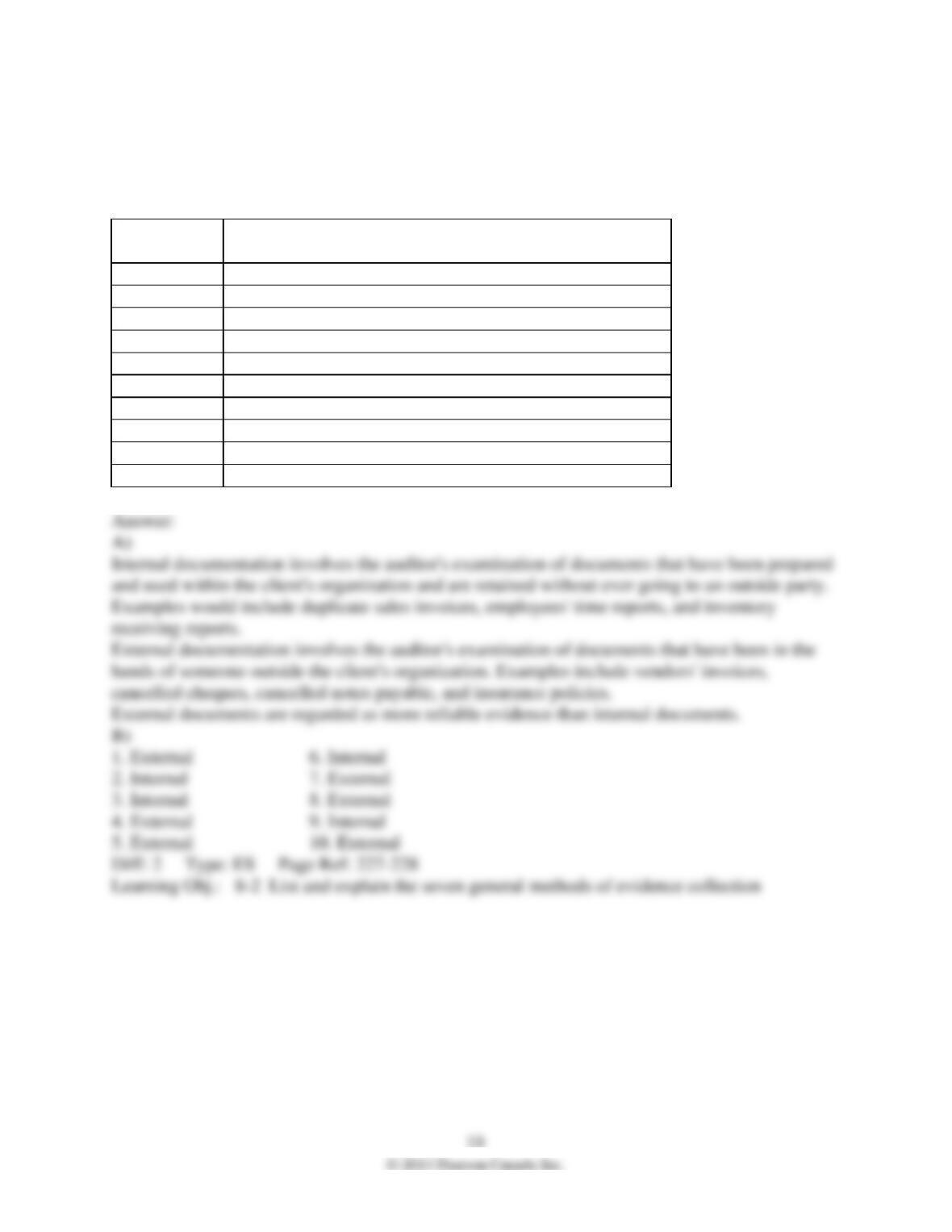
16) A) Distinguish between internal documentation and external documentation as types of audit
evidence. Give two examples of each. Which type is considered more reliable?
B) Below are 10 documents typically examined by auditors. Classify each document as either
internal or external.
Type of
Document
Documents
1. Cancelled cheques for payments of accounts payable.
2. Payroll time cards.
3. Duplicate sales invoices.
4. Vendor’s invoices.
5. Bank statements.
6. Minutes of the board of directors’ meetings.
7. Signed lease agreements.
8. Notes receivable
9. Subsidiary accounts receivable records.
10. Customer payment remittance advices.
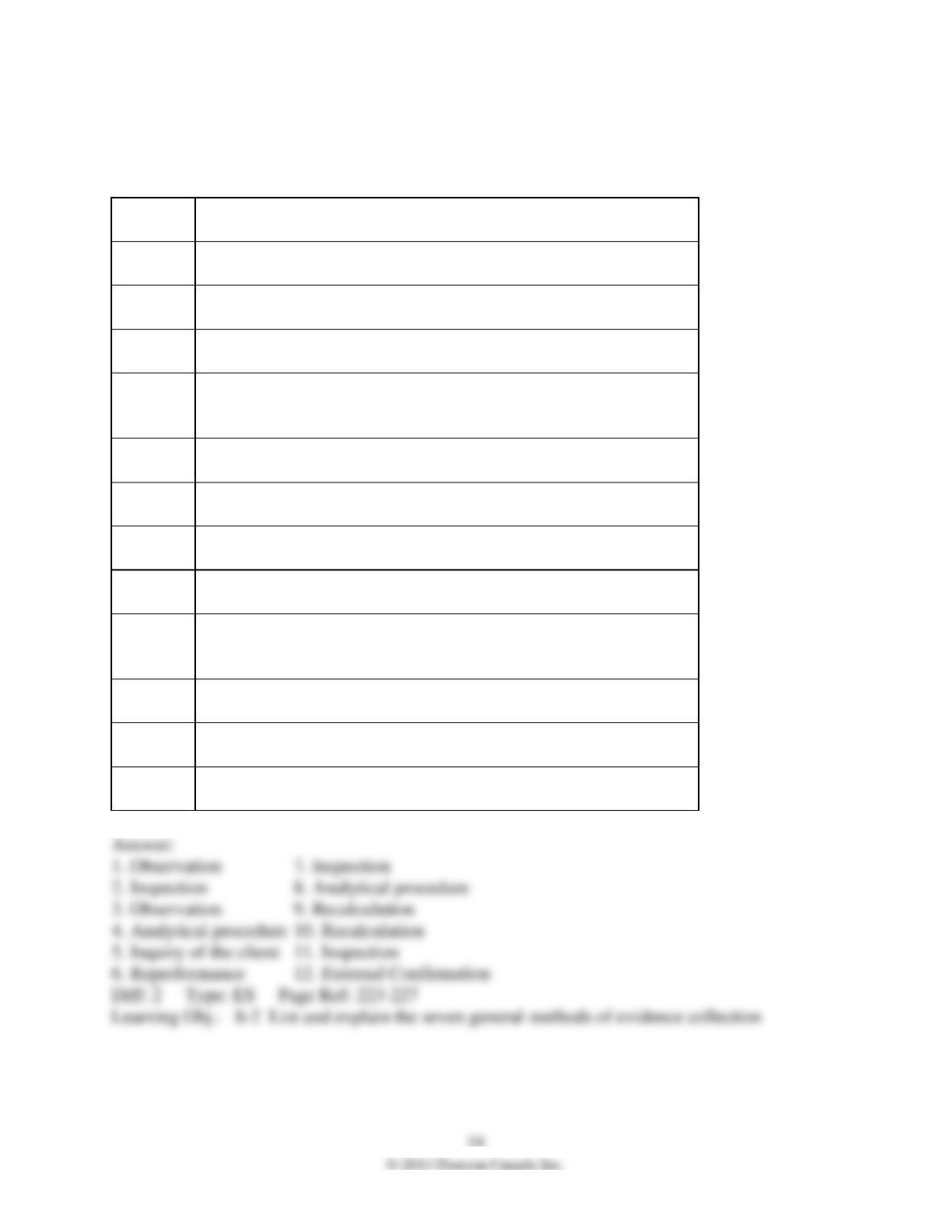
17) Below are 12 audit procedures. Classify each procedure according to the following types of
audit evidence: (1) inspection, (2) external confirmation, (3) recalculation, (4) observation, (5)
inquiry of the client, (6) reperformance, and (7) analytical procedure.
Type of
Evidence
Audit Procedures
1. Watch client employees count inventory to determine whether
company procedures are being followed.
2. Count inventory items and record the amount in the audit
working papers.
3. Stand by the payroll time clock to determine whether any
employee “punches in” more than one time.
4. Calculate the ratio of cost of goods sold to sales as a test of
overall reasonableness of gross margin relative to the preceding
year.
5. Obtain information about the client’s internal controls by asking
questions of client personnel.
6. Trace totals from the cash disbursements journal to the general
ledger.
7. Examine a piece of equipment to make sure a recent purchase of
equipment was actually received and is in operation.
8. Review the total of repairs and maintenance for each month to
determine whether any month’s total was unusually large.
9. The auditor computes the debt covenant based on the financial
information to ensure that the client’s calculation was performed
correctly.
10. Re-foot entries in the sales journal to determine whether they
were correctly totalled by the client.
11. Make a surprise count of petty cash to verify that the amount of
the petty cash fund is intact.
12. Obtain a written statement from the client’s bank stating the
client’s year-end balance on deposit.