7.5 Project Selection with Resource Restraints
1) Which of the following statements is FALSE?
A) If there is a fixed supply of a resource available, you should rank projects by the profitability index,
selecting the project with the lowest profitability index first and working your way down the list until
the resource is consumed.
B) Practitioners often use the profitability index to identify the optimal combination of projects when
there is a fixed supply of resources.
C) If there is a fixed supply of resources available, so that you cannot undertake all possible
opportunities, then simply picking the highest NPV opportunity might not lead to the best decision.
D) The profitability index is calculated as the NPV divided by the resources consumed by the project.
2) Which of the following statements is FALSE?
A) The profitability index measures the value created in terms of NPV per unit of resource consumed.
B) The profitability index is the ratio of value created to resources consumed.
C) The profitability index can be easily adapted for determining the correct investment decisions when
multiple resource constraints exist.
D) The profitability index measures the “bang for your buck.”
3) You are opening up a brand new retail strip mall. You presently have more potential retail outlets
wanting to locate in your mall than you have space available. What is the most appropriate tool to use
if you are trying to determine the optimal allocation of your retail space?
A) IRR
B) Payback period
C) NPV
D) Profitability index
Use the table for the question(s) below.
Consider a project with the following cash flows:
Year
Cash Flow
0
-10,000
1
4000
2
4000
3
4000
4
4000
4) Assume the appropriate discount rate for this project is 15%. The profitability index for this project is
closest to:
A) .14
B) .22
C) .60
D) .15
Use the table for the question(s) below.
Consider the following two projects:
Project
Year 0
Cash
Flow
Year 1
Cash
Flow
Year 2
Cash
Flow
Year 3
Cash
Flow
Year 4
Cash
Flow
Discount
Rate
A
–100
40
50
60
N/A
.15
B
–73
30
30
30
30
.15
5) The profitability index for project A is closest to:
A) 0.12
B) 21.65
C) 0.17
D) 12.04
6) The profitability index for project B is closest to:
A) 23.34
B) 12.64
C) 0.17
D) 0.12

Use the table for the question(s) below.
Consider the following list of projects:
Project
Investment
NPV
A
135,000
6000
B
200,000
30,000
C
125,000
20,000
D
150,000
2000
E
175,000
10,000
F
75,000
10,000
G
80,000
9000
H
200,000
20,000
I
50,000
4000
7) Assuming that your capital is constrained, which investment tool should you use to determine the
correct investment decisions?
A) Profitability Index
B) Incremental IRR
C) NPV
D) IRR
8) Assuming that your capital is constrained, which project should you invest in first?
A) Project C
B) Project G
C) Project B
D) Project F
9) Assuming that your capital is constrained, what is the fifth project that you should invest in?
A) Project H
B) Project I
C) Project B
D) Project A
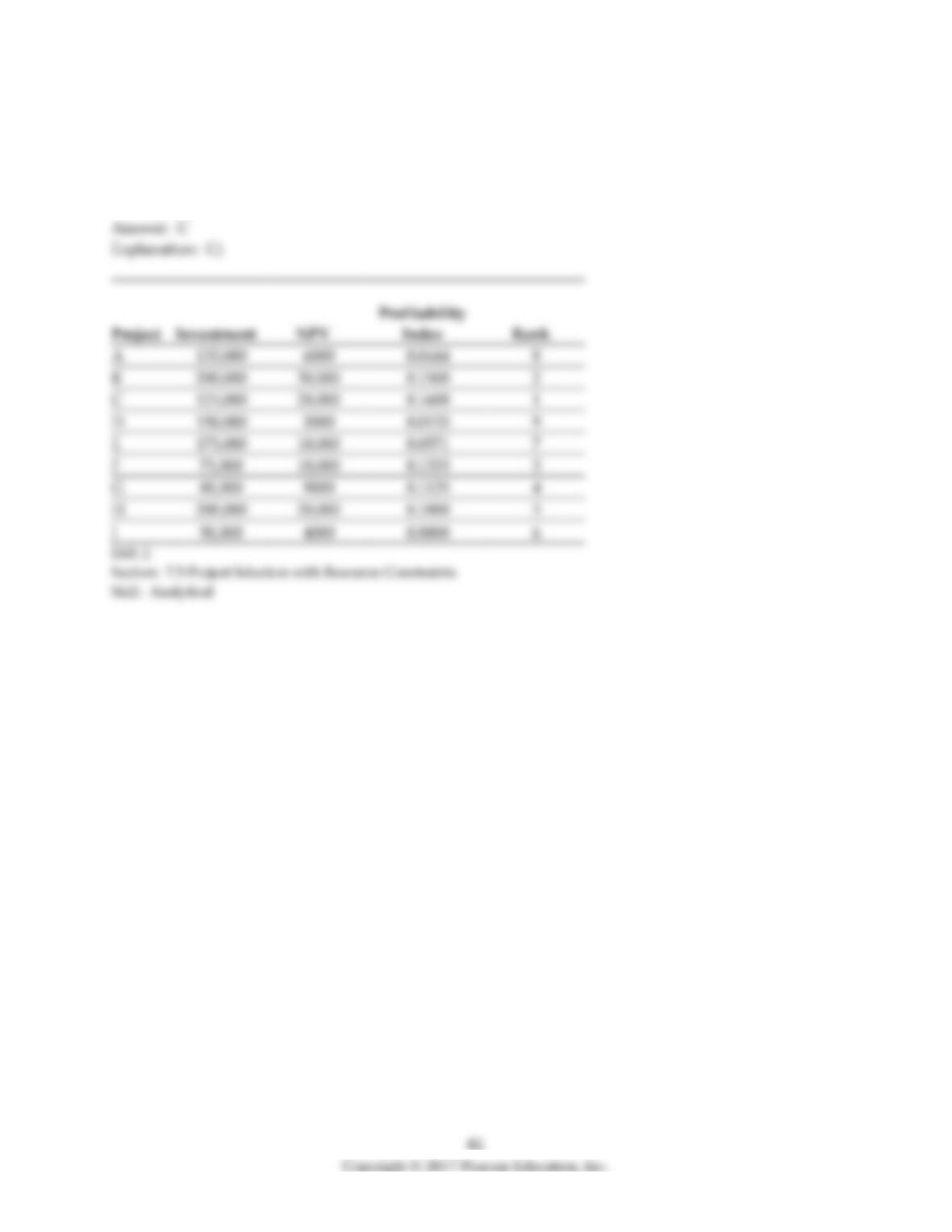
10) Assuming that your capital is constrained, which project should you invest in last?
A) Project A
B) Project I
C) Project D
D) Project C
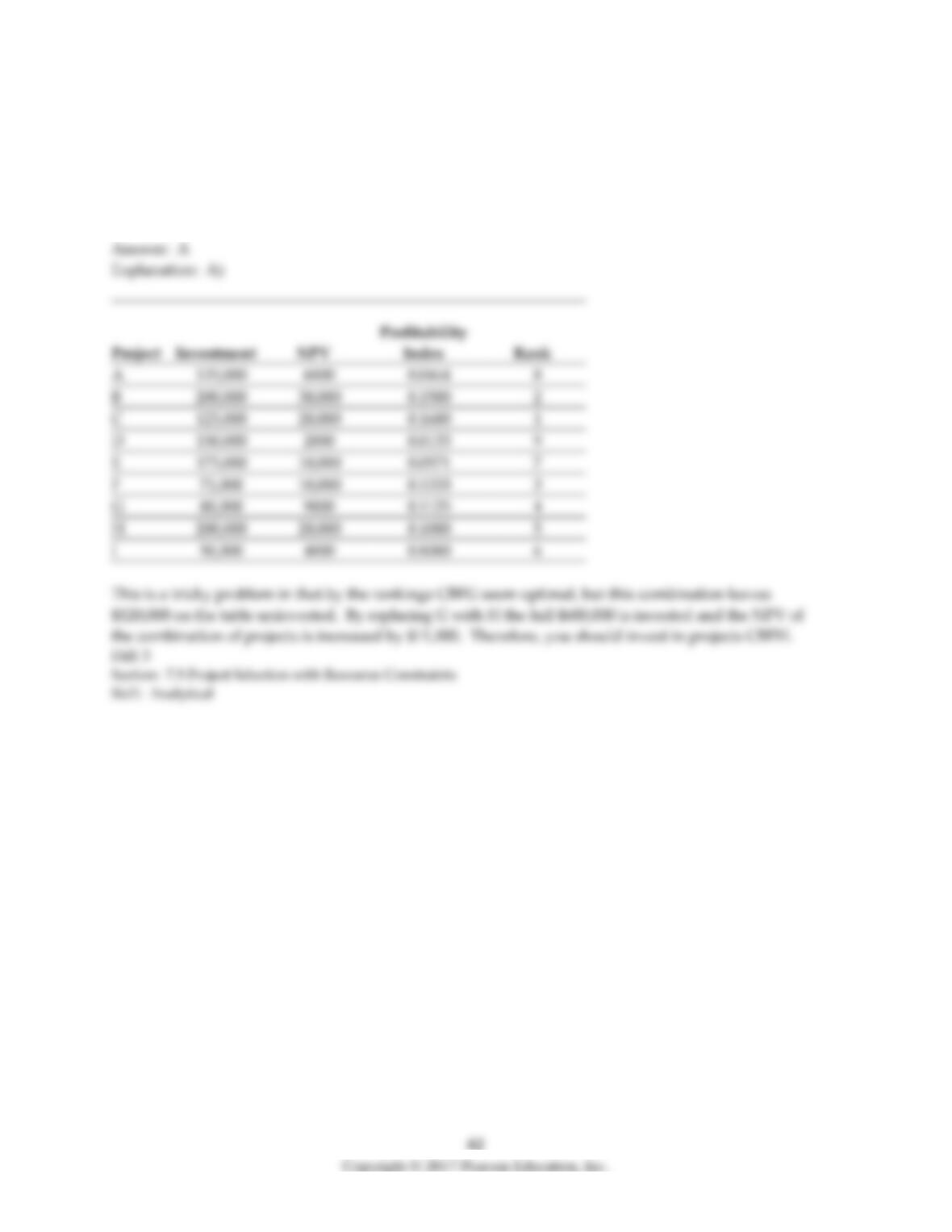
11) Assuming that your capital is constrained, so that you only have $600,000 available to invest in
projects, which projects should you invest in and in what order?
A) CBFH
B) CBGF
C) BCFG
D) CBFG
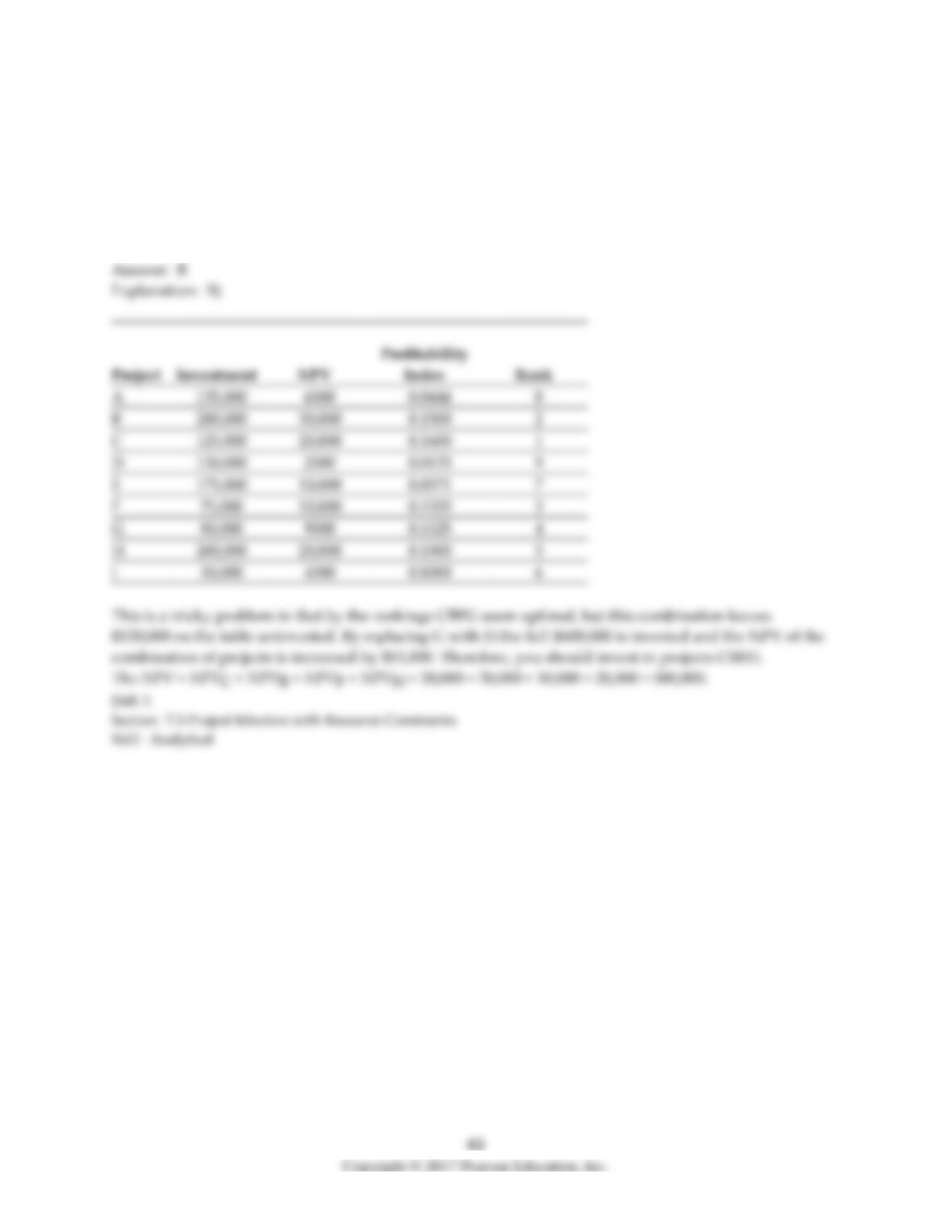
12) Assume that your capital is constrained, so that you only have $600,000 available to invest in
projects. If you invest in the optimal combination of projects given your capital constraint, then the total
NPV for all the projects you invest in will be closest to:
A) $65,000
B) $80,000
C) $69,000
D) $111,000
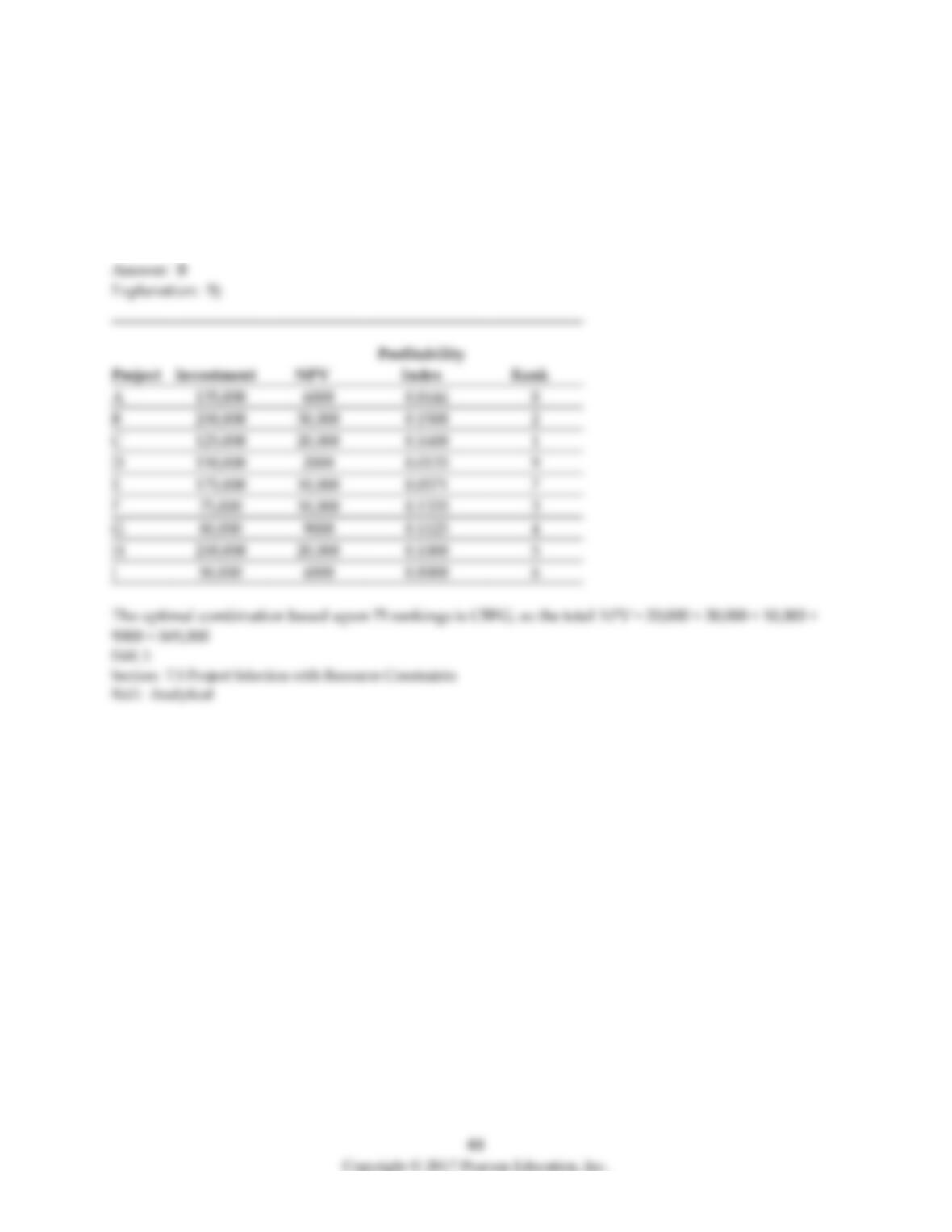
13) Assume that your capital is constrained, so that you only have $500,000 available to invest in
projects. If you invest in the optimal combination of projects given your capital constraint, then the total
NPV for all the projects you invest in will be closest to:
A) $111,000
B) $69,000
C) $80,000
D) $58,000
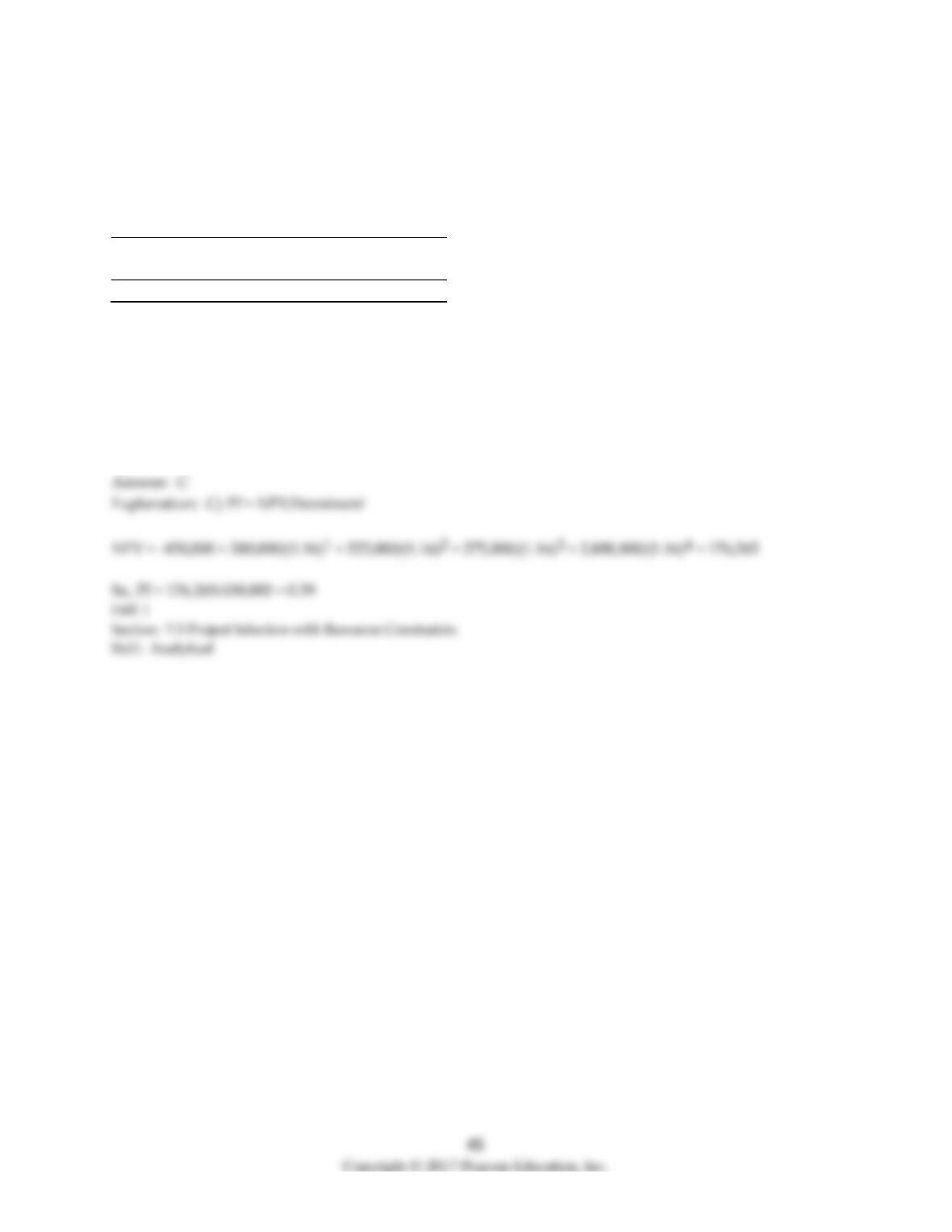
Use the information for the question(s) below.
The Sisyphean Company is planning on investing in a new project. This will involve the purchase of
some new machinery costing $450,000. The Sisyphean Company expects cash inflows from this project
as detailed below:
Year One
Year Two
Year
Three
Year Four
$200,000
$225,000
$275,000
$200,000
The appropriate discount rate for this project is 16%.
14) The profitability index for this project is closest to:
A) .44
B) .26
C) 0.39
D) .34

46
Use the information for the question(s) below.
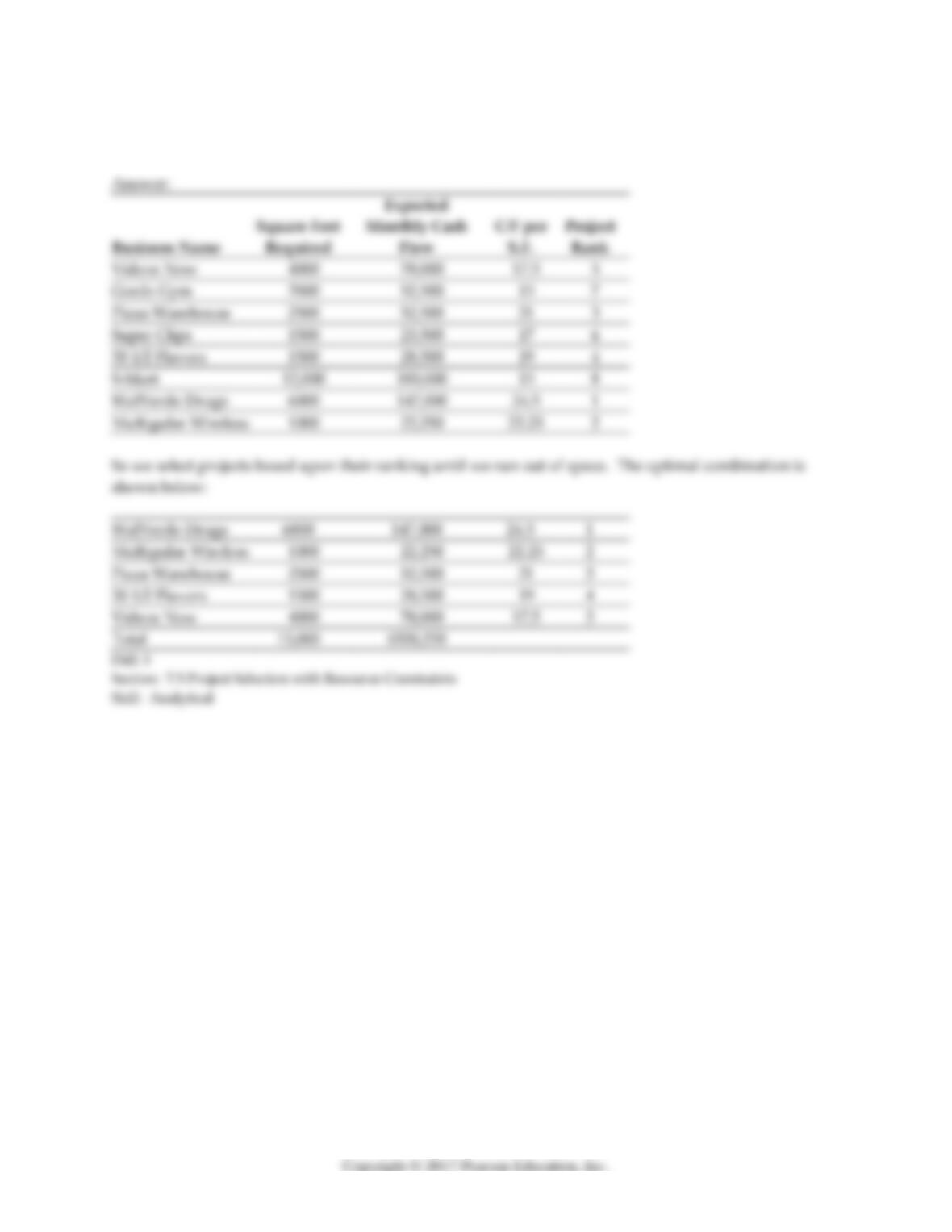
Your firm is preparing to open a new retail strip mall and you have multiple businesses that would like
lease space in it. Each business will pay a fixed amount of rent each month plus a percentage of the
gross sales generated each month. The cash flows from each of the businesses has approximately the
same amount of risk. The business names, square footage requirements, and monthly expected cash
flows for each of the businesses that would like to lease space in your strip mall are provided below:
Business Name
Square Feet
Required
Expected
Monthly Cash
Flow
Videos Now
4000
70,000
Gords Gym
3500
52,500
Pizza Warehouse
2500
52,500
Super Clips
1500
25,500
30 1/2 Flavors
1500
28,500
S-Mart
12,000
180,000
WalVerde Drugs
6000
147,000
Multigular Wireless
1000
22,250
47
15) If your new strip mall will have 15,000 square feet of retail space available to be leased, to which
businesses should you lease and why?
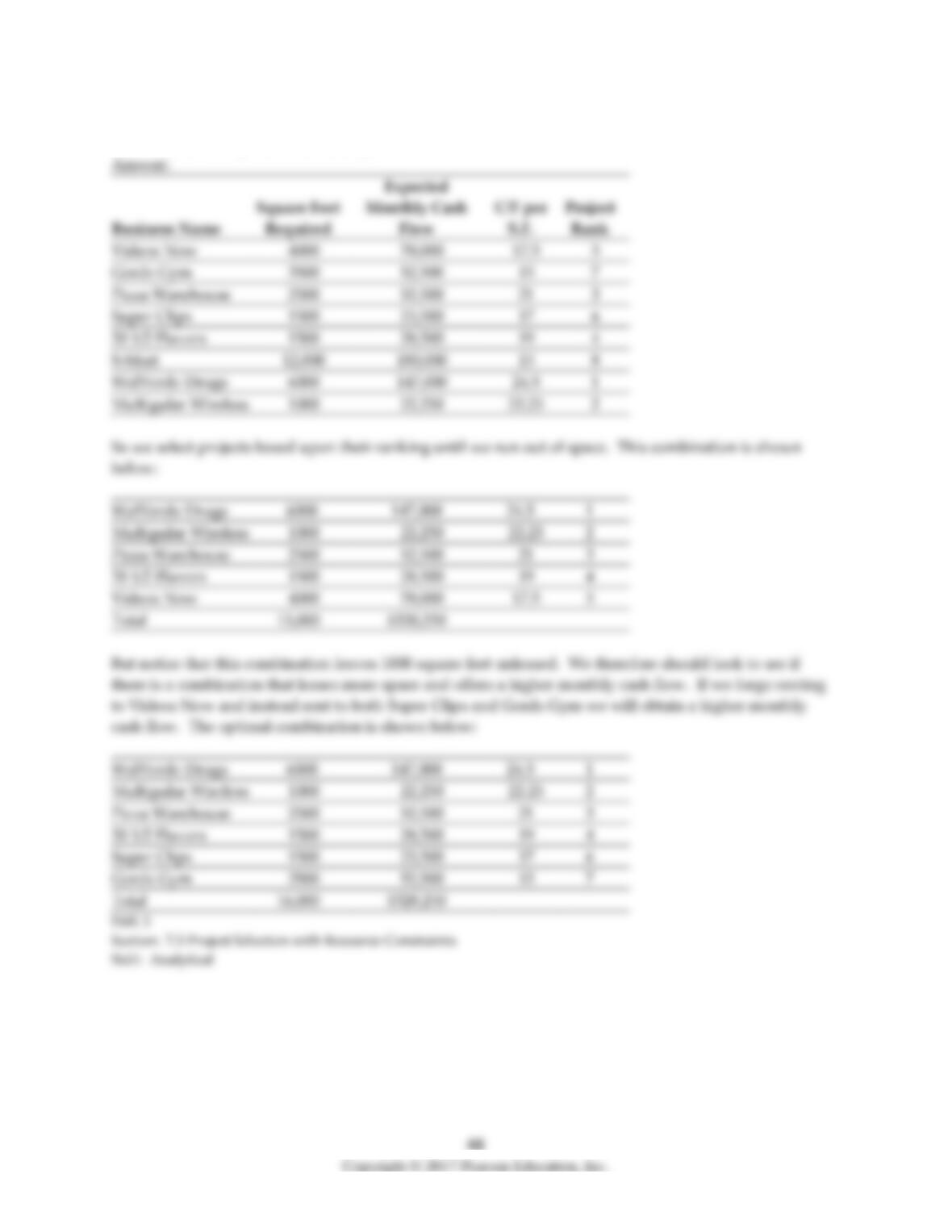
16) If your new strip mall will have 16,000 square feet of retail space available to be leased, to which
businesses should you lease and why?
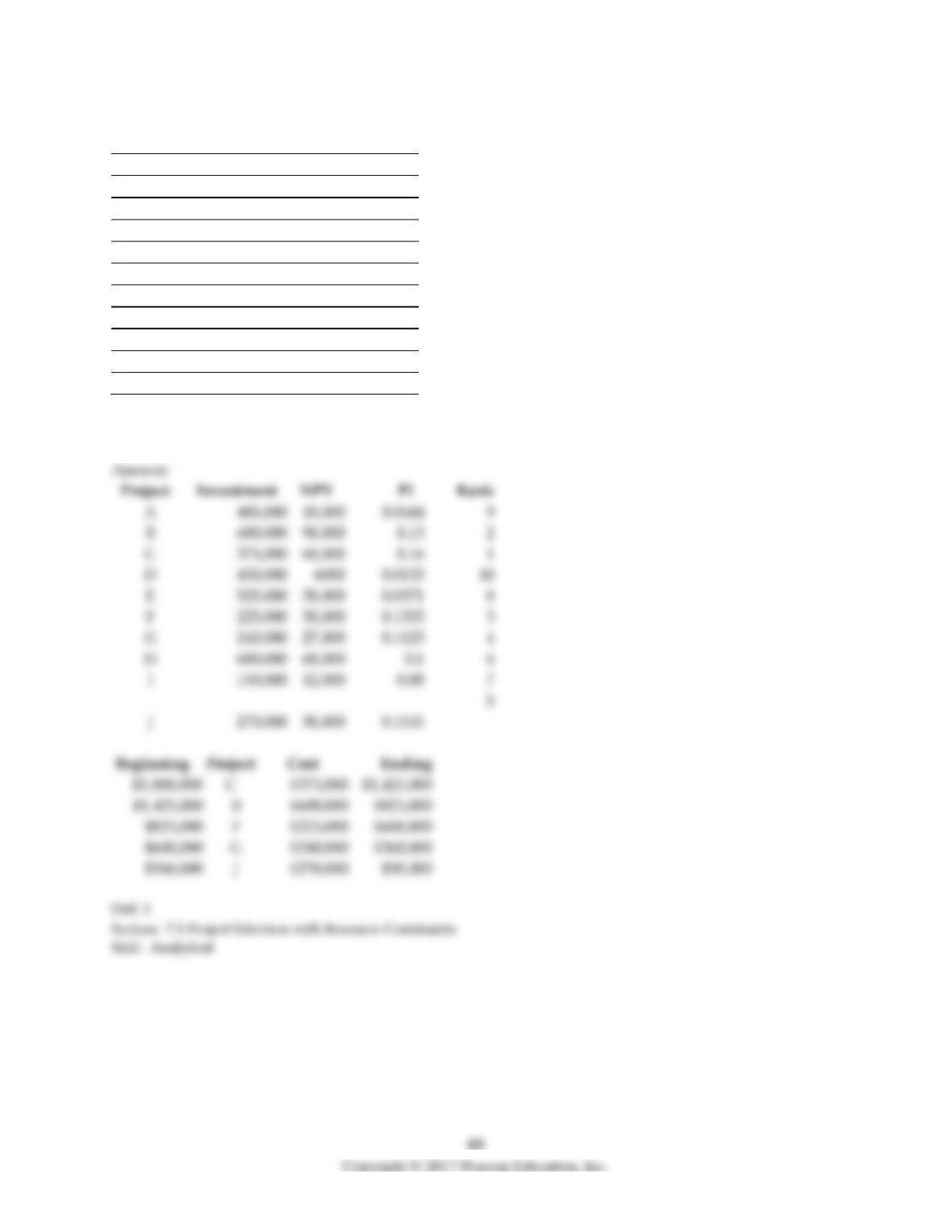
17) Consider the following list of projects:
Project
Investment
NPV
A
405,000
18,000
B
600,000
90,000
C
375,000
60,000
D
450,000
6000
E
525,000
30,000
F
225,000
30,000
G
240,000
27,000
H
600,000
60,000
I
150,000
12,000
J
270,000
30,000
You are given a budget of only $1,800,000 to invest in projects. Which projects will you select, in what
order will you select them, and why?