Test Bank Questions, Chapter 7
1. Borrowing helps by providing funds that allow one to:
a. Raise one’s standard of living today.
b. Make investments such as those for the house and its possessions.
c. Finance a business.
d. All of the above.
e. Both a and b.
2. Which of the following is not a characteristic of debt?
a. It may make it possible to balance the peaks and valleys in one’s spending
pattern.
b. It does not help one even out life cycle style needs.
c. It allows an outlay for a significant capital expenditure.
d. All of the above are characteristics of debt.
e. None of the above are characteristics of debt.
3. The amount of debt outstanding relative to one’s assets is which of the following?
a. Operating risk.
b. Debt risk.
c. Financial risk.
d. Interest rate risk.
e. None of the above.
4. Operating leverage is greater:
a. The greater the percentage of non-discretionary costs.
b. The lower the percentage of non-discretionary costs.
c. The greater the percentage of discretionary costs.
d. The lower the percentage of discretionary costs.
e. None of the above.
5. The higher fixed costs are as a percentage of total costs:

a. The lower the operating leverage.
b. The greater the operating leverage.
c. Financial leverage remains unchanged.
d. Operating leverage remains unchanged.
e. None of the above.
6. Financial leverage is greater:
a. The lower the amount of interest expense and debt repayment commitments.
b. The greater the amount of interest expense commitments but not debt repayment
commitments.
c. The lower the amount of debt repayment commitments but not interest expense
commitments.
d. The greater the amount of interest expense and debt repayment commitments.
e. Both b and c
7. What are the two effects associated with undertaking additional debt?
a. Increased risk and increased potential returns.
b. Decreased risk and increased potential returns.
c. Increased risk and decreased potential returns.
d. Decreased risk and decreased potential returns.
e. None of the above.
8. Consider a situation where you borrow $40,000. The interest paid is $3,000, and is
deducted at the beginning of the period. What is the interest rate?
a. 12.11%
b. 7.5%
c. 8.11%
d. 11.5%
e. 0
Answer: c

9. If the interest paid is $20,000, the cash available at the beginning of the period is
$230,000, and the cash available at the end of the period is $10,000, what is the
approximate interest rate?
a. 18.18%
b. 36.36%
c. 17.39%
d. 13.39%
e. 17.17%
10. Which of the following is not included in the APR?
a. Closing fee.
b. Points.
c. Appraisal fees.
d. Undefined costs.
e. All of the above are included in the APR.
11. A loan that provides a loan limit which can be utilized for multiple purchases over
time is:
a. Closed end retail credit.
b. Open end credit.
c. Exemplified by an auto loan.
d. Both b and c.
e. None of the above.
12. Which of the following statements is not accurate?
a. Loan applicants are placed into two risk classes with one rejected and the other
accepted.
b. Lender may be basing the interest rate on the average quality of the loans.
c. Lenders present an array of interest rates with the rate offered appropriate to the
risk of non-payment that the individual household presents.
d. All of the above statements are accurate.
e. None of the above statements is accurate.

13. Which of the following best describes unrationed borrowers?
a. Borrowers that have sufficient internal cash flow and assets to be able to select
the loan maturity offering the most attractive rates.
b. Borrower that are short of internal cash flow and would like to borrow more
credit at comparable interest rates than is available.
c. Borrowers that are allowed to borrow as much money as they wish, as they are in
the lowest risk class.
d. None of the above.
e. Both b and c.
14. Which of the following types of borrowers are constantly seeking more funds and
may have to take any payment terms offered?
a. Unrational borrowers.
b. Rational borrowers.
c. Discrete borrowers.
d. Surplus borrowers.
e. None of the above.
15. Which of the following is not use to assess whether credit should be extended to a
household?
a. The amount of income earned.
b. The amount of debt outstanding.
c. The history of timely repayments of debt owed.
d. Whether the loan is secured by an asset.
e. All of the above are used to assess credit.
16. Which of the following is known as “Fannie Mae”?
a. The Federal Home Loan Mortgage Corporation.
b. The Government National Mortgage Association
c. The Federal National Mortgage Association.
d. The Federal National Home Loan Association.
e. None of the above.

17. The net effect of government supported organizations such as Fannie Mae, Ginnie
Mae, and Freddie Mac is to:
a. To broaden credit and offer it at a cheaper rate than might otherwise prevail.
b. To narrow credit but offer it at a cheaper rate than might otherwise prevail.
c. To broaden credit but offer it at a more expensive rate than might otherwise
prevail.
d. To narrow credit and offer it at a more expensive rate than might otherwise
prevail.
e. None of the above.
18. Which of the following is true when the mortgage loan is an amortizing loan?
a. At the beginning of the term of the loan the largest part of the payment is a
paydown of principal, but a payments progress a rising portion is applied to
interest payments.
b. Interest payments and paydown of principal remain constant during the loan.
c. At the beginning of the term of the loan the largest part of the payment is
interest, but a payments progress a rising portion is applied to the paydown of
principal.
d. Paydown of principal occurs at the end of the loan.
e. None of the above.
19. Which of the following is not a consideration when deciding whether to prepay one’s
mortgage?
a. The after-tax interest cost on the debt retired should be compared with the after–
tax return on investment alternatives.
b. The riskiness of prepayment and investment alternatives.
c. Marketability risk.
d. Liquidity risk.
e. All of the above are considerations.
20. Which of the following is not a benefit associated with a fixed rate mortgage?
a. They lock in a rate of interest that will be unaffected by a rise in market rates.
b. The borrower received a lower rate to compensate for assuming the risk of
interest rate fluctuations.
c. They provide the opportunity to refinance should market rates decline.
d. All of the above are benefits associated with a fixed rate mortgage.
e. None of the above is a benefit associated with a fixed rate mortgage.
21. Why is it easier for homeowners to qualify to purchase a larger house with an
adjustable rate mortgage?
a. Because lenders tend to look at total interest costs in relation to household
income in the first year of the loan.
b. Because lenders tend to look at total interest costs in relation to household
expenses in the first year of the loan.
c. Because lenders tend to look at total interest costs in relation to household
income in the first five years of the loan.
d. Because lenders tend to look at total interest costs in relation to household
expenses in the first five years of the loan.
e. None of the above.
22. What is a hybrid ARM?
a. An investment that is tied to mortgage rates which can be used to hedge the risk
associated with an adjustable rate mortgage.
b. A mortgage that offers a fixed rate for a fixed period of years and then reverts to
an adjustable rate.
c. A mortgage that offers an adjustable rate for a fixed period and then offers an
adjustable rate for a period that is based on the principal outstanding.
d. All of the above are examples of hybrid ARMs.
e. None of the above.
23. Up to how much are home equity loans for real estate activities deductible for two
personal properties?
a. $1,000,000
b. $1,200,000
c. $100,000
d. $50,000
e. None of the above.
23. Which of the following is not a reason for the popularity of credit cards?
a. Convenience.
b. It can be used to even out flows of expenditures.
c. It is an alternative to holding large cash balances.
d. Bank loans are more costly for amounts under a few thousand dollars when fixed
costs and transaction costs are included.
e. All of the above are reasons for the popularity of credit cards.
24. What is the maximum amount of margin debt that the Federal Reserve allows one to
borrow?
a. 50% of the fair market value of the securities on margin upon original purchase
and 25% of the value of the collateral on an ongoing basis.
b. 25% of the fair market value of the securities on margin upon original purchase
and 25% of the value of the collateral on an ongoing basis.
c. 25% of the fair market value of the securities on margin upon original purchase
and 50% of the value of the collateral on an ongoing basis.
d. 75% of the fair market value of the securities on margin upon original purchase
and 25% of the value of the collateral on an ongoing basis.
e. None of the above.
25. What are the overall limits associated with pension loans?
a. 50% of the borrower’s vested account balance or $50,000, whichever is less.
b. 50% of the borrower’s vested account balance or $100,000, whichever is less.
c. 75% of the borrower’s vested account balance or $50,000, whichever is less.
d. 75% of the borrower’s vested account balance or $50,000, whichever is less.
e. None of the above.
26. Which of the following types of credit is not closed end?
a. Bank Loan.
b. Pension Loan.
c. Insurance Loan.
d. Credit Association Loan.
e. All of the above loans are closed end.
27. Which of the following factors will result in a lower credit score?
a. Married.
b. Children.
c. One wage earner.
d. Favorable credit history.
e. All of the above will result in a higher credit score.
28. Which of the following in not a major credit bureau?
a. Equifax.
b. Experian.
c. Trans Union.
d. Standard and Poors.
e. All of the above are major credit bureaus.
29. 30Which of the following steps will not help in improving your credit rating?
a. Pay all bills when due.
b. Increase the number of credit cards outstanding.
c. Obtain and review your credit report.
d. Plan future of credit.
e. All of the above steps will help in improve you credit rating.
30. Under which form of personal bankruptcy are all existing debts wiped out?
a. Chapter 7.
b. Chapter 13.
c. Chapter 14.
d. All of the above.
e. None of the above.
31. What is the expected result of the Bankruptcy Abuse Prevention and Consumer Act
of 2005?
a. It will be more difficult for a lender to collect unpaid principal when a borrower
files for bankruptcy.
b. It will be more difficult to file for bankruptcy.
c. It will be easier to file for bankruptcy.
d. The number of Chapter 14 bankruptcy filings will increase.
e. Both a and d above.
32. What is the benchmark by the debt coverage ratio?
a. Take home pay.
b. The amount available after deducting normal household overhead expenses from
take-home pay.
c. The amount available after deducting unusual household overhead expenses
from take-home pay.
d. Household expenses.
e. None of the above.
Essay questions:
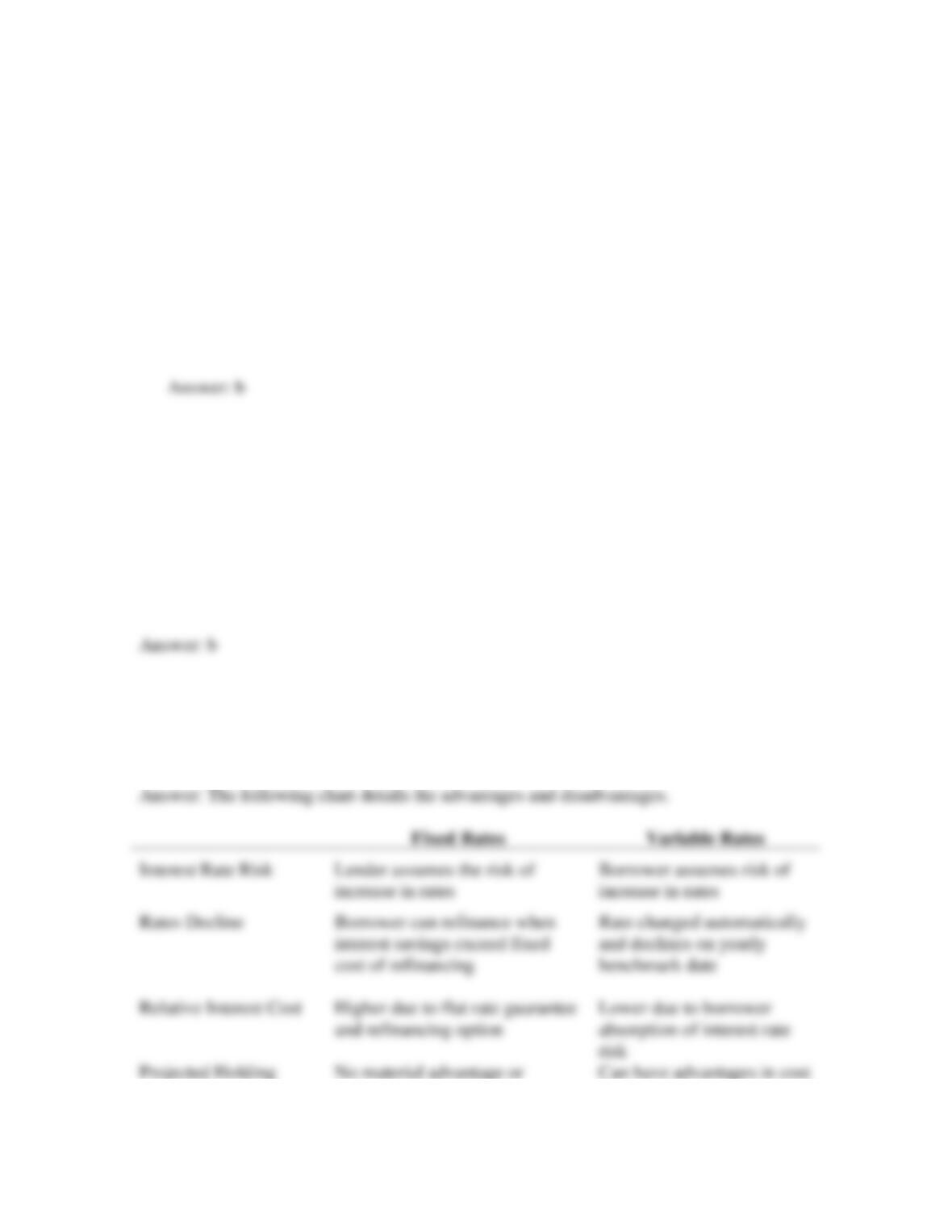
33. What are the advantages and disadvantages associated with fixed rate and variable
rate mortgages?
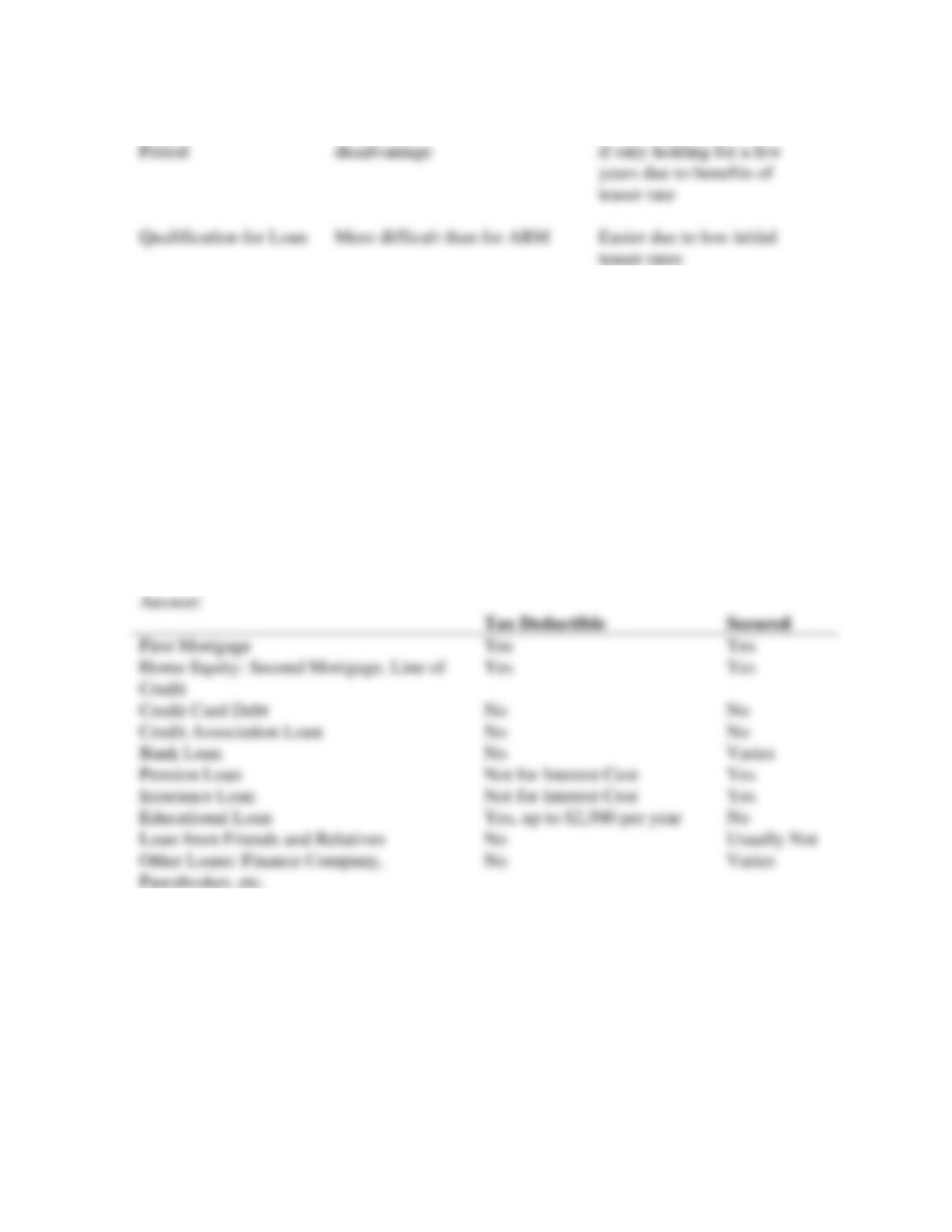
34. For each of the following types of debt, please indicate whether the debt is (a) tax
deductible and (b) secured.
• First Mortgage
• Home Equity: Second mortgage line of credit.
• Credit Card Debt
• Credit Association Loan
• Bank Loan
• Pension Loan
• Insurance Loan
• Educational Loan
• Loan from Friends and Relatives
• Other Loans: Finance Company, Pawnbroker , etc.