Chapter 7—Risk, Return, and the Capital Asset Pricing Model
MULTIPLE CHOICE
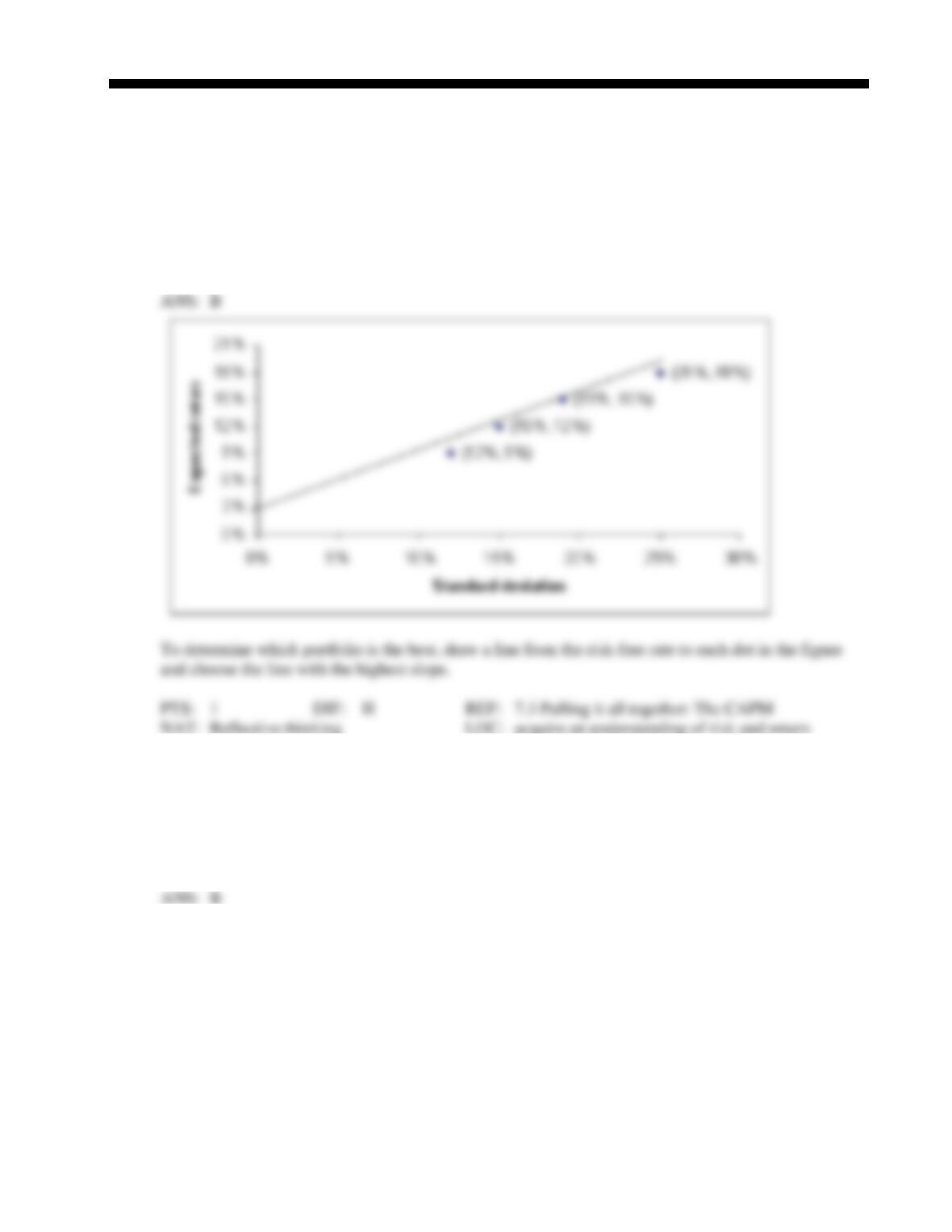
1. Suppose Sarah can borrow and lend at the risk free-rate of 3%. Which of the following four risky
portfolios should she hold in combination with a position in the risk-free asset?
a.
portfolio with a standard deviation of 15% and an expected return of 12%
b.
portfolio with a standard deviation of 19% and an expected return of 15%
c.
portfolio with a standard deviation of 25% and an expected return of 18%
d.
portfolio with a standard deviation of 12% and an expected return of 9%
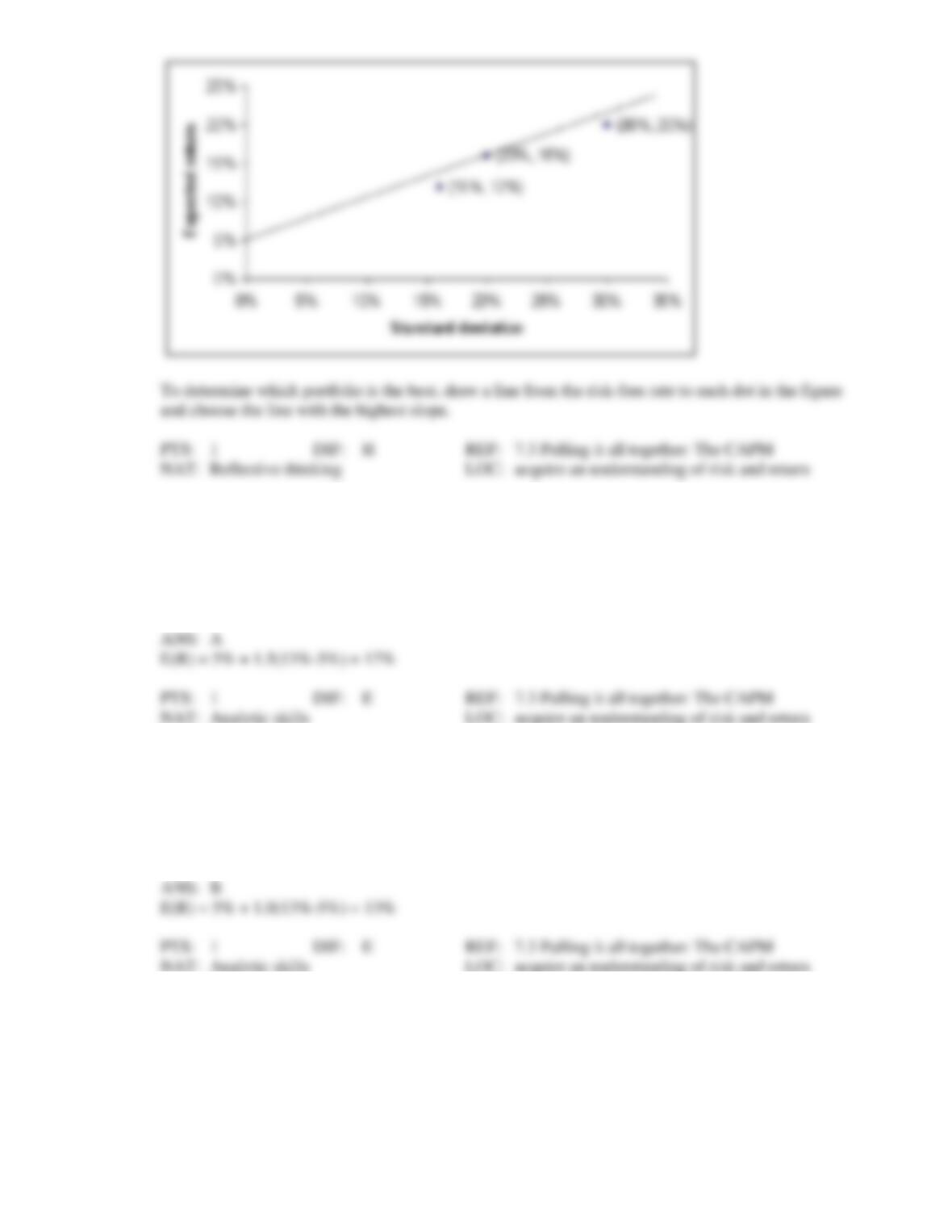
2. Suppose David can borrow and lend at the risk-free rate of 5%. Which of the following three risky
portfolios should he hold in combination with a position in the risk-free asset?
a.
portfolio with a standard deviation of 16% and an expected return of 12%
b.
portfolio with a standard deviation of 20% and an expected return of 16%
c.
portfolio with a standard deviation of 30% and an expected return of 20%
d.
he should be indifferent in holding any of the three portfolios
3. The risk-free rate is 5% and the expected return on the market portfolio is 13%. A stock has a beta of
1.5, what is its expected return?
a.
17%
b.
12%
c.
19.5%
d.
24.5%
4. The risk-free rate is 5% and the expected return on the market portfolio is 13%. A stock has a beta of
1.0, what is its expected return?
a.
8%
b.
13%
c.
5%
d.
none of the above
5. The risk-free rate is 5% and the expected return on the market portfolio is 13%. A stock has a beta of
0, what is its expected return?
a.
0%
b.
5%
c.
13%
d.
none of the above
6. According to the CAPM (capital asset pricing model), the security market line is a straight line. The
intercept of this line should be equal to
a.
zero
b.
the expected risk premium on the market portfolio
c.
the risk-free rate
d.
the expected return on the market portfolio
7. According to the CAPM (capital asset pricing model), the security market line is a straight line. The
slope of this line should be equal to
a.
zero
b.
the expected risk premium on the market portfolio
c.
the risk-free rate
d.
the expected return on the market portfolio
8. According to the CAPM (capital asset pricing model), what is the single factor that explains
differences in returns across securities?
a.
the risk-free rate
b.
the expected risk premium on the market portfolio
c.
the beta of a security
d.
the expected return on the market portfolio
e.
the volatility of a security
9. If the market portfolio has an expected return of 0.12 and a standard deviation of 0.40, and the
risk-free rate is 0.04, what is the slope of the security market line?
a.
0.08
b.
0.20
c.
0.04
d.
0.12
10. A particular asset has a beta of 1.2 and an expected return of 10%. The expected return on the market
portfolio is 13% and the risk-free is 5%. Which of the following statement is correct?
a.
This asset lies on the security market line.
b.
This asset lies above the security market line.
c.
This asset lies below the security market line.
d.
Cannot tell from the given information.
11. A particular asset has a beta of 1.2 and an expected return of 10%. The expected return on the market
portfolio is 13% and the risk-free is 5%. The stock is
a.
overpriced
b.
underpriced
c.
appropriately priced
d.
Cannot tell from the given information
12. An asset has a beta of 2.0 and an expected return of 20%. The expected risk premium on the market
portfolio is 5% and the risk-free is 7%. The stock is
a.
overpriced
b.
underpriced
c.
appropriately priced
d.
Cannot tell from the given information
13. A stock that pays no dividends is currently priced at $40 and is expected to increase in price to $45 by
year end. The expected risk premium on the market portfolio is 6% and the risk-free is 5%. If the stock
has a beta of 0.6, the stock is
a.
overpriced
b.
underpriced
c.
appropriately priced
d.
Cannot tell from the given information
14. A particular stock has a beta of 1.4 and an expected return of 13%. If the expected risk premium on the
market portfolio is 6%, what’s the expected return on the market portfolio?
a.
10.6%
b.
4.6%
c.
8.4%
d.
9.3%
15. A particular stock has an expected return of 18%. If the expected return on the market portfolio is
13%, and the risk-free rate is 5%, what’s the stock’s CAPM beta?
a.
1.000
b.
1.625
c.
2.250
d.
1.385
16. A particular stock has an expected return of 11%. If the expected risk premium on the market portfolio
is 8%, and the risk-free rate is 5%, what’s the stock’s CAPM beta?
a.
1.375
b.
0.750
c.
0.846
d.
0.462
17. The stock of Alpha Company has an expected return of 15.5% and a beta of 1.5, and Gamma
Company stock has an expected return of 13.4% and a beta of 1.2. Assume the CAPM holds. What’s
the expected return on the market?
a.
12%
b.
7%
c.
10.3%
d.
11.2%
18. The stock of Alpha Company has an expected return of 18% and a beta of 1.5, and Gamma Company
stock has an expected return of 15.6% and a beta of 1.2. Assume the CAPM holds. What’s the
risk-free rate?
a.
8.0%
b.
6.0%
c.
0%
d.
4.7%
19. The CAPM (capital asset pricing model) assumes that:
a.
all assets can be traded
b.
investors are risk-averse
c.
investors have homogeneous expectations
d.
all of the above
20. A portfolio has 40% invested in Asset 1 and 60% invested in Asset 2. If Asset 1 has a beta of 1.2 and
Asset 2 has a beta of 1.8, what’s the beta of the portfolio?
a.
1.50
b.
1.56
c.
1.20
d.
1.80
e.
cannot tell from the given information
21. A portfolio has 40% invested in Asset 1, 50% invested in Asset 2 and 10% invested in Asset 3. Asset 1
has a beta of 1.2, Asset 2 has a beta of 0.8 and Asset 3 has a beta of 1.8, what’s the beta of the
portfolio?
a.
1.27
b.
0.80
c.
1.06
d.
1.20
e.
Cannot tell from given information
22. A portfolio consists 20% of a risk-free asset and 80% of a stock. The risk-free return is 4%. The stock
has an expected return of 15% and a standard deviation of 30%. What’s the expected return
a.
12.8%
b.
9.5%
c.
15.0%
d.
4.0%
23. The stock of Alpha Company has an expected return of 0.10 and a standard deviation of 0.25. The
stock of Gamma Company has an expected return of 0.16 and a standard deviation of 0.40. The
correlation coefficient between the two stock’s return is 0.2. If a portfolio consists of 40% of Alpha
Company and 60% of Gamma Company, what’s the expected return of the portfolio?
a.
0.126
b.
0.136
c.
0.160
d.
0.130
24. Asset 1 has a beta of 1.2 and Asset 2 has a beta of 0.6. Which of the following statements is correct?
a.
Asset 1 is more volatile than Asset 2.
b.
Asset 1 has a higher expected return than Asset 2.
c.
In a regression with individual asset’s return as the dependent variable and the market’s
return as the independent variable, the R-squared value is higher for Asset 1 than it is for
Asset 2.
d.
All of the above statements are correct.
25. An investor put 40% of her money in Stock A and 60% in Stock B. Stock A has a beta of 1.2 and
Stock B has a beta of 1.6. If the risk-free rate is 5% and the expected return on the market is 12%,
what’s the investor’s expected return?
a.
22.28%
b.
14.80%
c.
15.08%
d.
21.80%
26. You have the following data on the securities of three firms:
Return last year
Beta
Firm A
10%
0.8
Firm B
11%
1.0
Firm C
12%
1.2
If the risk-free rate last year was 3%, and the return on the market was 11%, which firm had the best
performance on a risk-adjusted basis?
a.
Firm A
b.
Firm B
c.
Firm C
d.
There is no difference in performance on a risk-adjusted basis
27. Expected returns are:
a.
always positive.
b.
always greater than the risk-free rate.
c.
inherently unobservable.
d.
usually equal to actual returns.
28. Which of the following is not a method used by analysts to estimate an asset’s expected return?
a.
historical approach
b.
probabilistic approach
c.
risk-based approach
d.
estimation approach
29. A drawback to the historical approach of estimating an asset’s expected return is:
a.
the risk of the firm may have changed over time.
b.
history always repeats itself.
c.
that the range of potential outcomes is often very broad.
d.
all of the above are drawbacks to the historical approach.
30. An advantage of the probabilistic approach to estimating an asset’s returns is:
a.
history always repeats itself.
b.
it does not require one to assume that the future will look like the past.
c.
recent history is more important than future risk.
d.
exact probabilities are easy to estimate.
31. A disadvantage of the probabilistic approach to estimating an asset’s returns is:
a.
history always repeats itself.
b.
it does not require one to assume that the future will look like the past.
c.
recent history is more important than future risk.
d.
that the range of possible outcomes is often broader than the scenarios used.
32. Suppose that over the last 20 years, company XYZ has averaged a return of 13%. Over the same
period, the Treasury bond rate has averaged 4%. The current estimate of the Treasury bond rate is
6.5%. Using the historical approach, what is the estimate of XYZ’s expected return.
a.
13.0%
b.
16.5%
c.
15.5%
d.
19.5%
33. Suppose that over the last 30 years, company ABC has averaged a return of 10%. Over the same
period, the Treasury bond rate has averaged 3%. The current estimate of the Treasury bond rate is 5%.
Using the historical approach, what is the estimate of ABC’s expected return.
a.
13.0%
b.
12.5%
c.
12.0%
d.
11.0%
34. Suppose that over the last 25 years, company DEF has averaged a return of 7.5%. Over the same
period, the Treasury bond rate has averaged 1.5%. The current estimate of the Treasury bond rate is
4%. Using the historical approach, what is the estimate of DEF’s expected return.
a.
13.0%
b.
12.5%
c.
12.0%
d.
10.0%
NARRBEGIN: Exhibit 7-1
Exhibit 7-1
Outcome
Probability
Return
Recession
25%
-30%
Expansion
40%
15%
Boom
35%
55%
NARREND
35. Given Exhibit 7-1, what is the expected return?
a.
13.00%
b.
15.96%
c.
16.00%
d.
17.75%
36. Given Exhibit 7-1, what is the expected variance?
a.
957.38%
b.
1058.69%
c.
49.27%
d.
32.54%
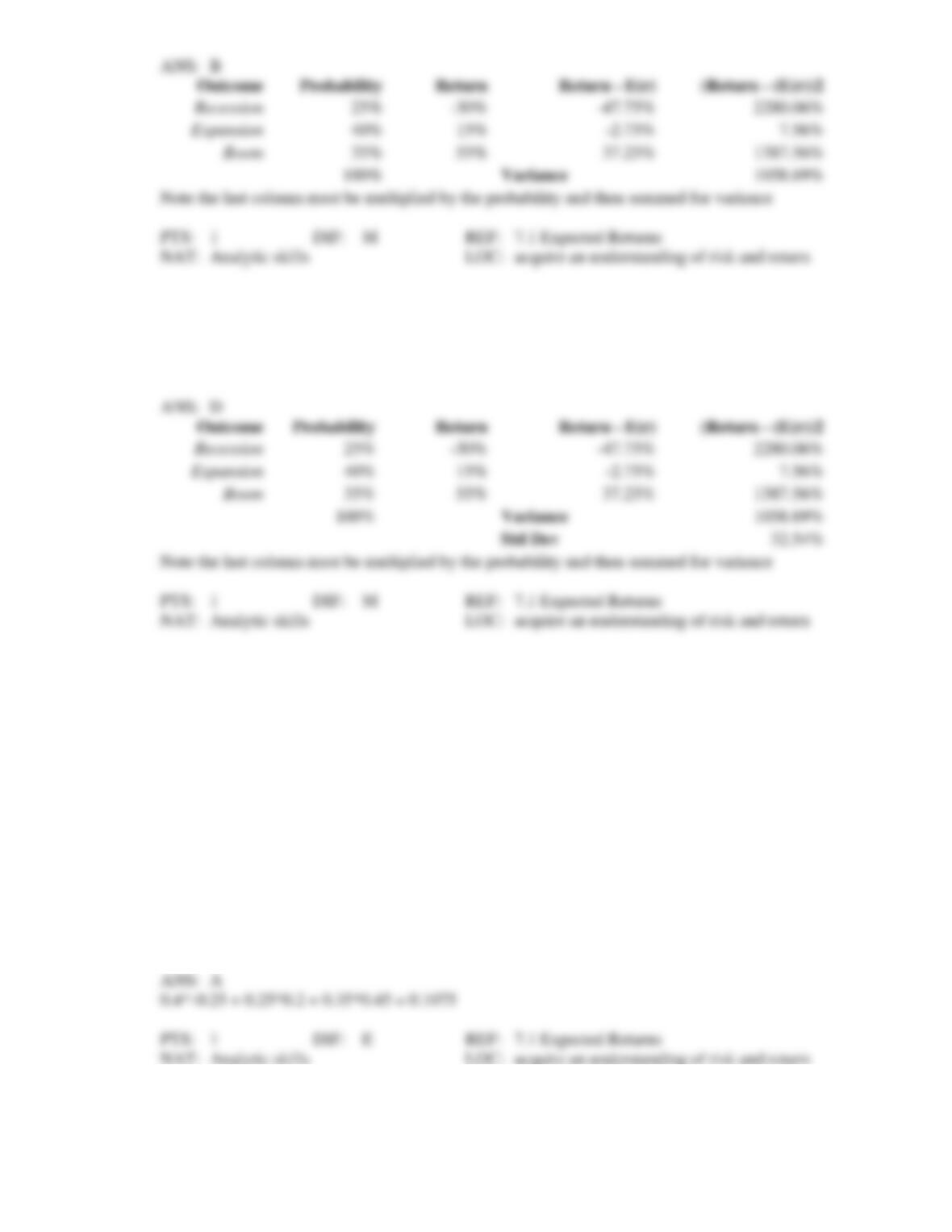
37. Given Exhibit 7-1, what is the expected standard deviation?
a.
957.38%
b.
1058.69%
c.
49.27%
d.
32.54%
Recession
Expansion
37.25%
32.54%
NARRBEGIN: Exhibit 7-2
Exhibit 7-2
Outcome
Probability
Return
Recession
40%
-25%
Expansion
25%
20%
Boom
35%
45%
NARREND
38. Given Exhibit 7-2, what is the expected return?
a.
10.75%
b.
13.00%
c.
16.00%
d.
17.75%
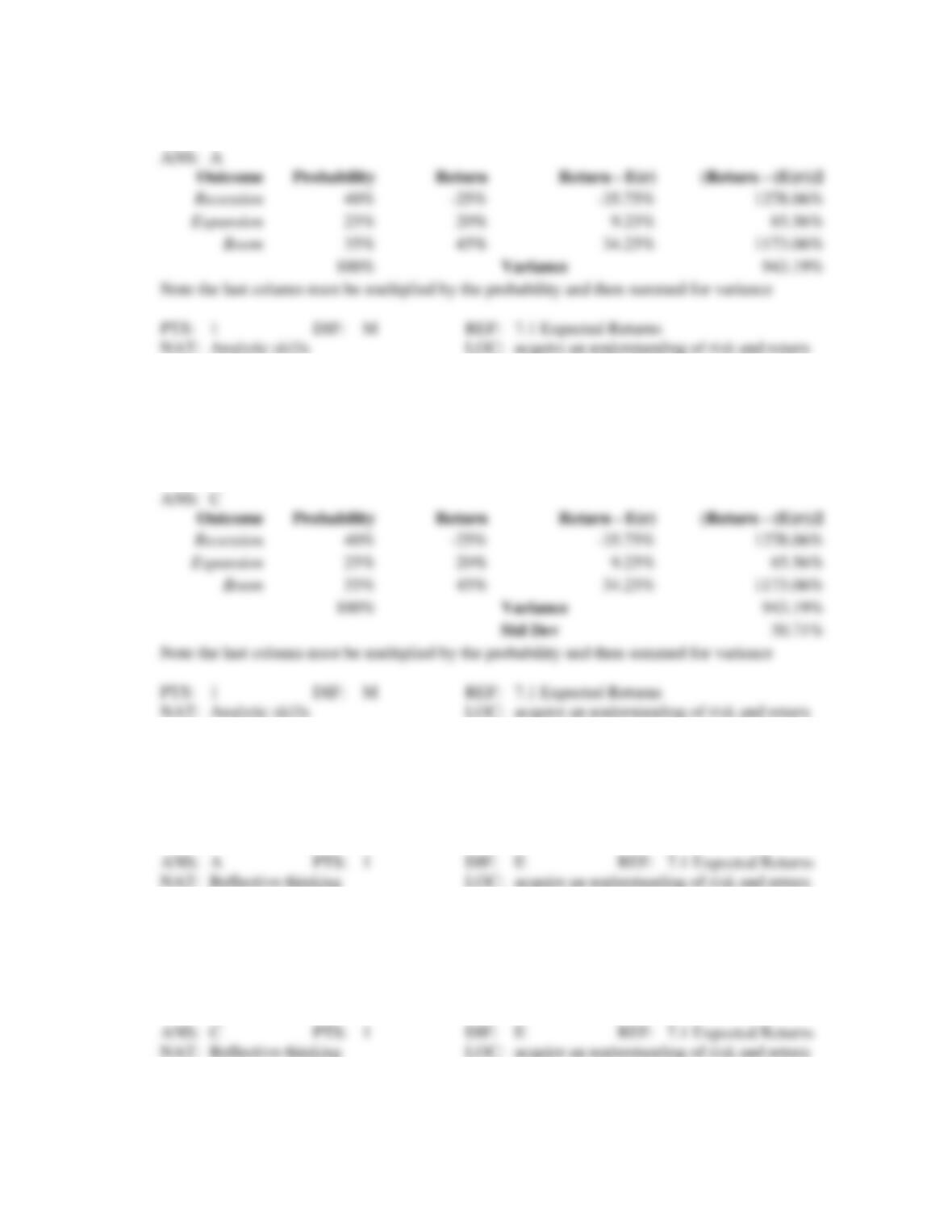
39. Given Exhibit 7-2, what is the expected variance?
Outcome
(Return – (E(r))2
Recession
25%
Expansion
40%
35%
37.25%
a.
943.19%
b.
1058.69%
c.
49.27%
d.
32.54%
40. Given Exhibit 7-2, what is the expected standard deviation?
a.
957.38%
b.
1058.69%
c.
30.71%
d.
32.54%
41. The first step in the risk-based approach to estimating a security’s expected return is to:
a.
define what is meant by “risk” and to measure it.
b.
quantify how much return we should expect on an asset with a given amount of risk.
c.
estimate the risk-free rate.
d.
define what is meant by return.
42. Standard deviation measures:
a.
systematic risk.
b.
unsystematic risk.
c.
total risk.
d.
beta risk.
43. Investors can eliminate what type of risk by diversifying?