Chapter 7—Using Consumer Loans
112. 529 plans are best suited for a child [already in college | with several years left before going to college].
113. A 529 plan is a [savings | lending] plan.
114. The majority of consumer loans are made with [fixed | variable] interest rates.
115. When interest rates are rising, you would prefer a [fixed-rate | variable-rate] loan.
Chapter 7—Using Consumer Loans
116. When interest rates are falling, you would prefer a [fixed-rate | variable-rate] loan.
117. The majority of single-payment loans [are | are not] secured by collateral.
118. Almost half of all consumer loans are made by [commercial banks | finance companies].
119. You must be a member of a [credit union | S&L] in order to borrow money there.
Chapter 7—Using Consumer Loans
120. [Consumer finance companies | Credit unions] obtain funds from their stockholders and through open market
borrowing.
121. A [sales finance company | consumer finance company] purchases notes drawn up by sellers of big-ticket items.
122. Borrowing from relatives is [highly | seldom] recommended by financial advisors.
123. Loans to relatives and friends should be [verbal | written] agreements.
124. Your budget should be considered [before | after] taking on a large consumer loan.
Chapter 7—Using Consumer Loans
125. The longer the loan maturity, the [lower | higher] the monthly payments will be.
126. The longer the loan maturity, the [lower | higher] the total finance costs will be.
127. You are borrowing $1,000, the APR is 10%, and the loan term is one year. Total interest charges will be higher if
[you pay off the loan in 12 monthly installments | you make one payment in full at the end of the year].
128. It is [legal | illegal] for a lender to charge a prepayment penalty.
Chapter 7—Using Consumer Loans
129. Borrowers are more likely to ask for a(n) [single payment | installment payment] consumer loan.
130. [Installment | Single-payment] loans are used as interim financing when the funds to be used for repayment are
known to be forthcoming.
131. Calculating interest using the [discount | simple interest] method will result in the higher APR on a single-payment
loan.
132. Credit life insurance [is | is not] a good financial deal from the perspective of the borrower.
133. Using [simple | add-on] interest would be less expensive for the borrower when determining the total to be paid to the
lender.
Chapter 7—Using Consumer Loans
134. The Rule of 78 loads an inordinate amount of interest charges to the [early | later] months of the loan.
135. A finance company uses the discount method of calculating interest. The loan principal is $5,000, the interest rate is
10%, and repayment is expected in two years. You will receive [$5,000 | $4,000] from the lender.
136. You are borrowing $5,000 at 9%. You may choose a 24- or 36-month repayment plan. Monthly payments will be
higher with the [24-month | 36-month] plan.
137. You are borrowing $5,000 at 9%. You may choose a 24- or 36-month repayment plan. The total finance cost will be
higher with the [24-month| 36-month] plan.
Chapter 7—Using Consumer Loans
138. When the interest rate on savings is higher than the interest rate on a loan, it is less expensive to [borrow | use
savings] to make a purchase.
139. When the interest rate on savings is lower than the interest rate on a loan, it is less expensive to [borrow | use
savings] to make a purchase.
140. The recent average annual cost of a college education at a private college is [under $40,000 | over $45,000].
141. About [25% | 33%] of student loans are past due.
Chapter 7—Using Consumer Loans
142. There are now about [$5.3 billion | $1.2 trillion] in student loans outstanding.
143. Students borrowing to pay for college should base the amount borrowed on [current income | expected future salary].
144. [Public lenders | private lenders] of student loans are more flexible in providing financial relief when borrowers are
under pressure.
145. Jamil is purchasing a new truck for $30,000. Jamil is making a $2,000 down payment, and he will make 60 monthly
payments of $541 each. What are the total finance costs on this loan?
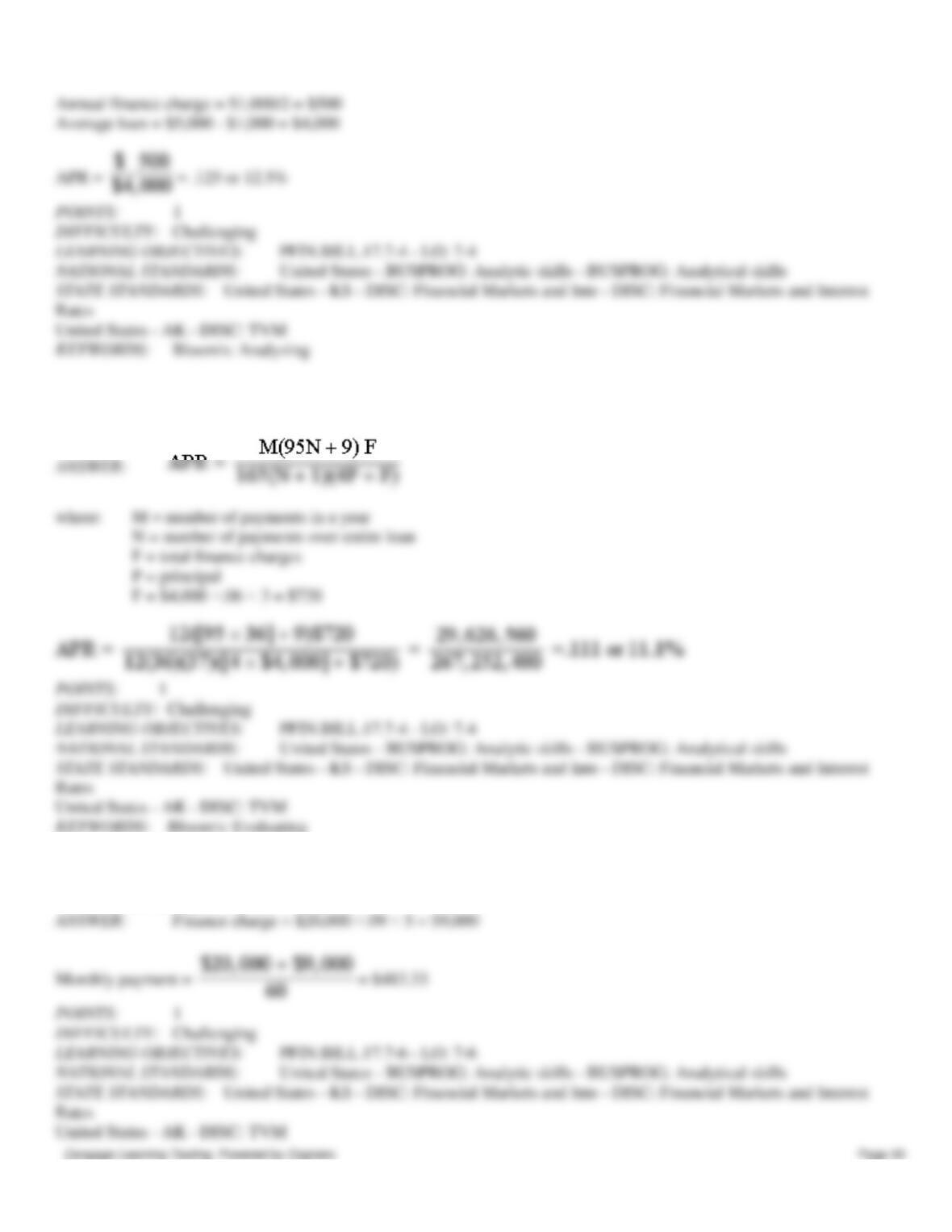
146. Jamie is going to buy some furniture with a single-payment loan that is discounted. The loan will be for $5,000 for 2
years at 10% interest. Calculate the APR on this loan. (Show all work.)
Chapter 7—Using Consumer Loans
147. Calculate the average percentage rate (APR) for an add-on loan with 36 monthly installments. The principal is
$4,000; the stated interest rate is 6%. (Show all work.)
148. Calculate the finance charge and the monthly payment on a $20,000 add-on installment loan with an interest rate of
9% and a term of 5 years. (Show all work.)
Chapter 7—Using Consumer Loans
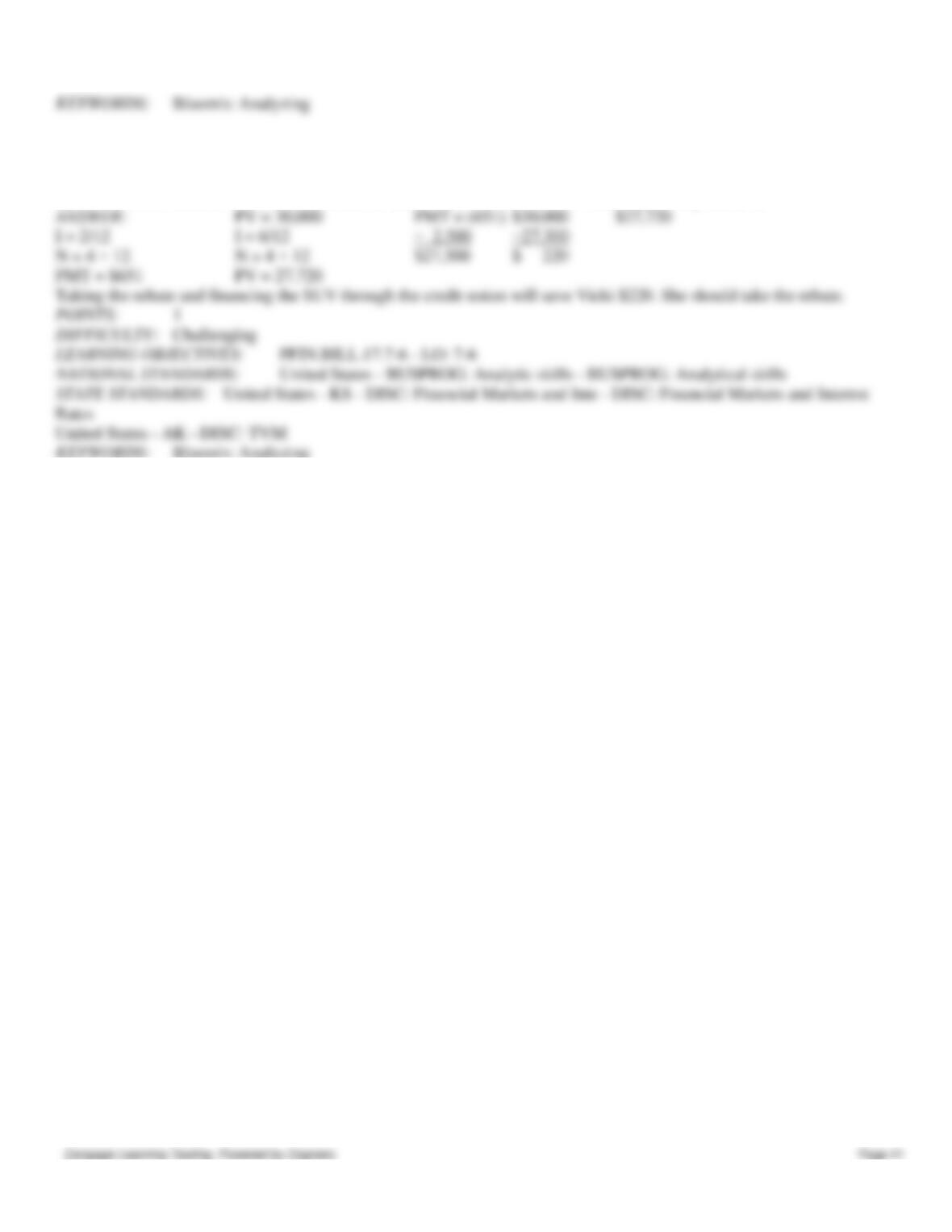
149. Downward Motors has offered Vicki either a $2,500 rebate or a 2%, 4-year loan on the new SUV she is purchasing
for $33,000 with a $3,000 down payment. Vicki has done her homework and knows that she can get a 6%, 4-year loan at
her credit union. Should Vicki take the rebate or the 2% loan from the dealer? (Show your key strokes.)