Chapter 7: Merger and Acquisition Cash Flow Valuation Basics
Answers to End of Chapter Discussion Questions
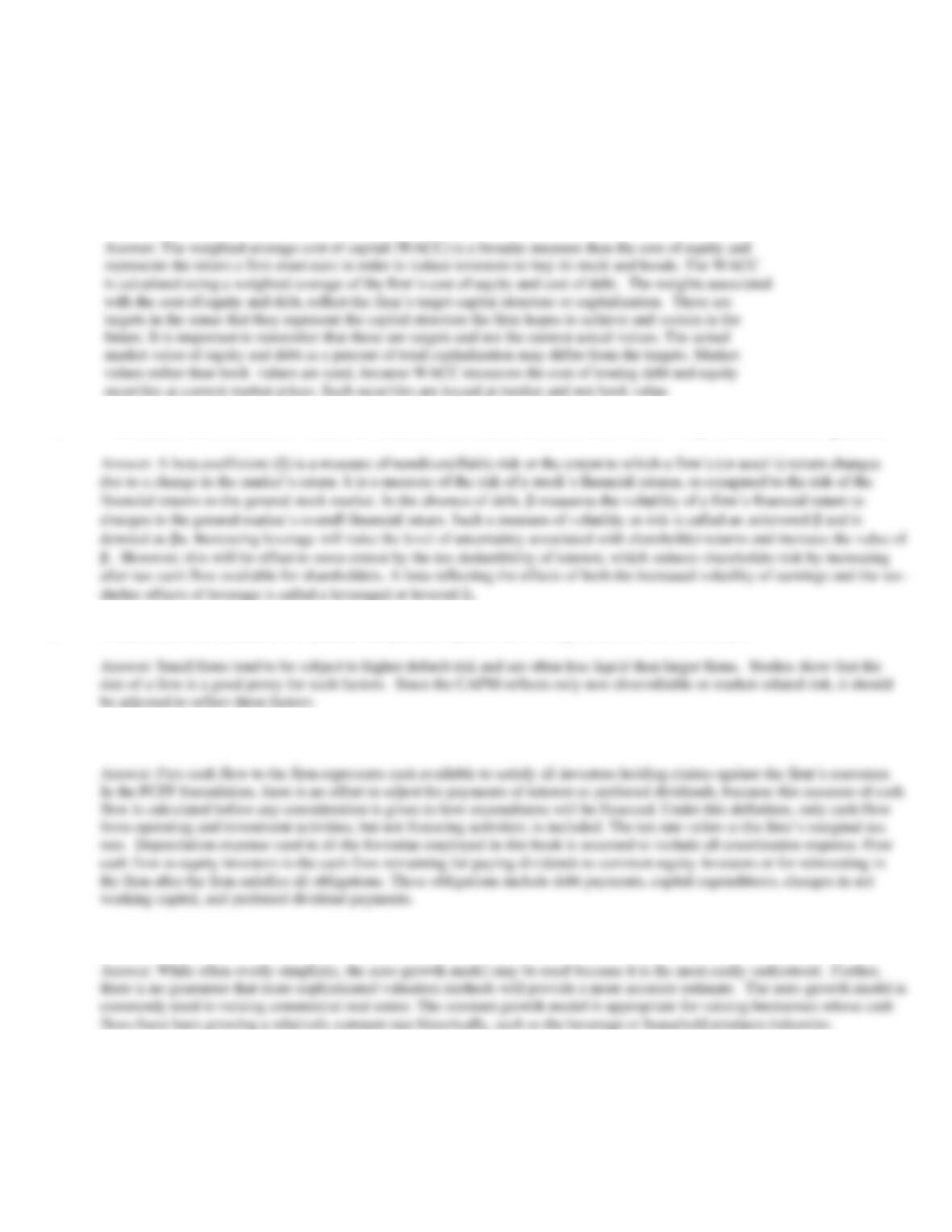
7.1 What is the significance of the weighted average cost of capital? How is it calculated? Do the weights reflect the firm’s actual or
target debt to total capital ratio? Why?
7.2 What does a firm’s ß measure? What is the difference between an unlevered and levered ß? Why is this distinction significant?
7.3 Under what circumstances is it important to adjust the Capital Asset Pricing Model for firm size? Why?
7.4 What are the primary differences between FCFE and FCFF?
7.5 Explain the conditions under which it makes most sense to use the zero growth and constant growth DCF models. Be specific.
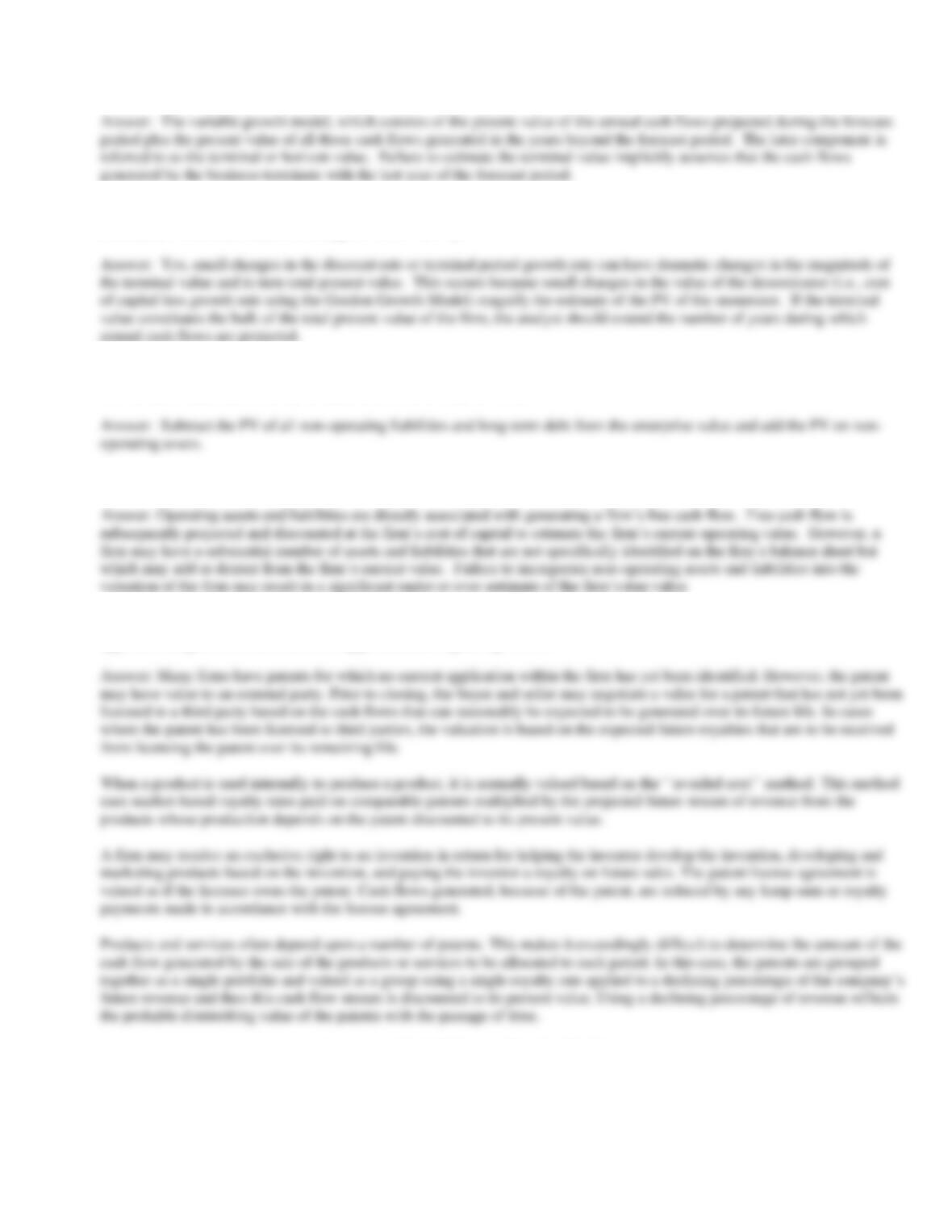
7.6 Which discounted cash flow valuation methods require the estimation of a terminal value? Why?
2
7.7 Do small changes in the assumptions pertaining to the estimation of the terminal value have a significant impact on the
calculation of the total value of the target firm? If so, why?
7.8 How would you estimate the equity value of a firm if you knew its enterprise value and the present value of
all non-operating assets, non-operating liabilities, and long-term debt?
7.9 Why is it important to distinguish between operating and on-operating assets and liabilities when valuing a firm? Be specific.
7.10 Explain how you would value a patent under the following situations: a patent without any current
application, a patent linked to an existing product, and a patent portfolio.
7.11 ABC Incorporated shares are currently trading for $32 per share. The firm has 1.13 billion shares outstanding. In addition, the
market value of the firm’s outstanding debt is $2 billion. The 10–year Treasury bond rate is 6.25%. ABC has an outstanding
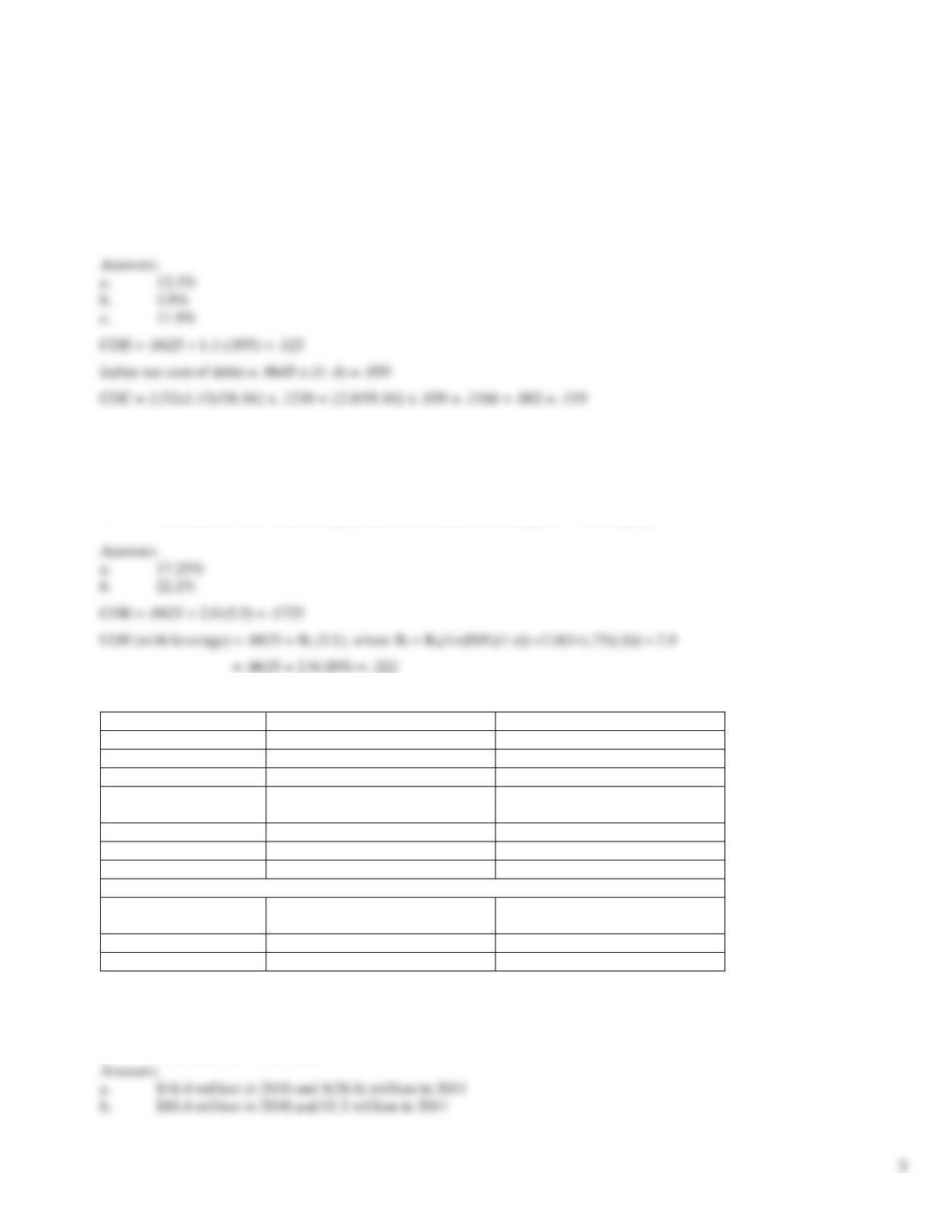
credit record and has earned an AAA rating from the major credit rating agencies. The current interest rate on AAA corporate
bonds is 6.45%. The historical risk premium for stocks over the risk-free rate of return is 5.5 percentage points. The firm’s beta
is estimated to be 1.1 and its marginal tax rate, including federal, state, and local taxes is 40%.
a. What is the cost of equity?
b. What is the after-tax cost of debt?
c. What is the cost of capital?
7.12 HiFlyer Corporation does not currently have any debt. Its tax rate is .4 and its unlevered beta is estimated by examining
comparable companies to be 2.0. The 10-year Treasury bond rate is 6.25% and the historical risk premium over the risk free rate
is 5.5%. Next year, HiFlyer expects to borrow up to 75% of its equity value to fund future growth.
a. Calculate the firm’s current cost of equity.
b. Estimate the firm’s cost of equity after it increases its leverage to 75% of equity?
7.13 Abbreviated financial statements are given for Fletcher Corporation in the following table:
2010
2011
Revenues
$600.0
$690.0
Operating expenses
520.0
600.0
Depreciation
16.0
18.0
Earnings before
interest and taxes
64.0
72.0
Less Interest Expense
5.0
5.0
Less: Taxes
23.6
26.8
Equals: Net income
35.4
40.2
Addendum:
Yearend working
capital
150
200
Principal repayment
25.0
25.0
Capital expenditures
20
10
Yearend working capital in 2009 was $160 million and the firm’s marginal tax rate is 40% in both 2010 and 2011. Estimate the
following for 2010 and 2011:
a. Free cash flow to equity.
b. Free cash flow to the firm.
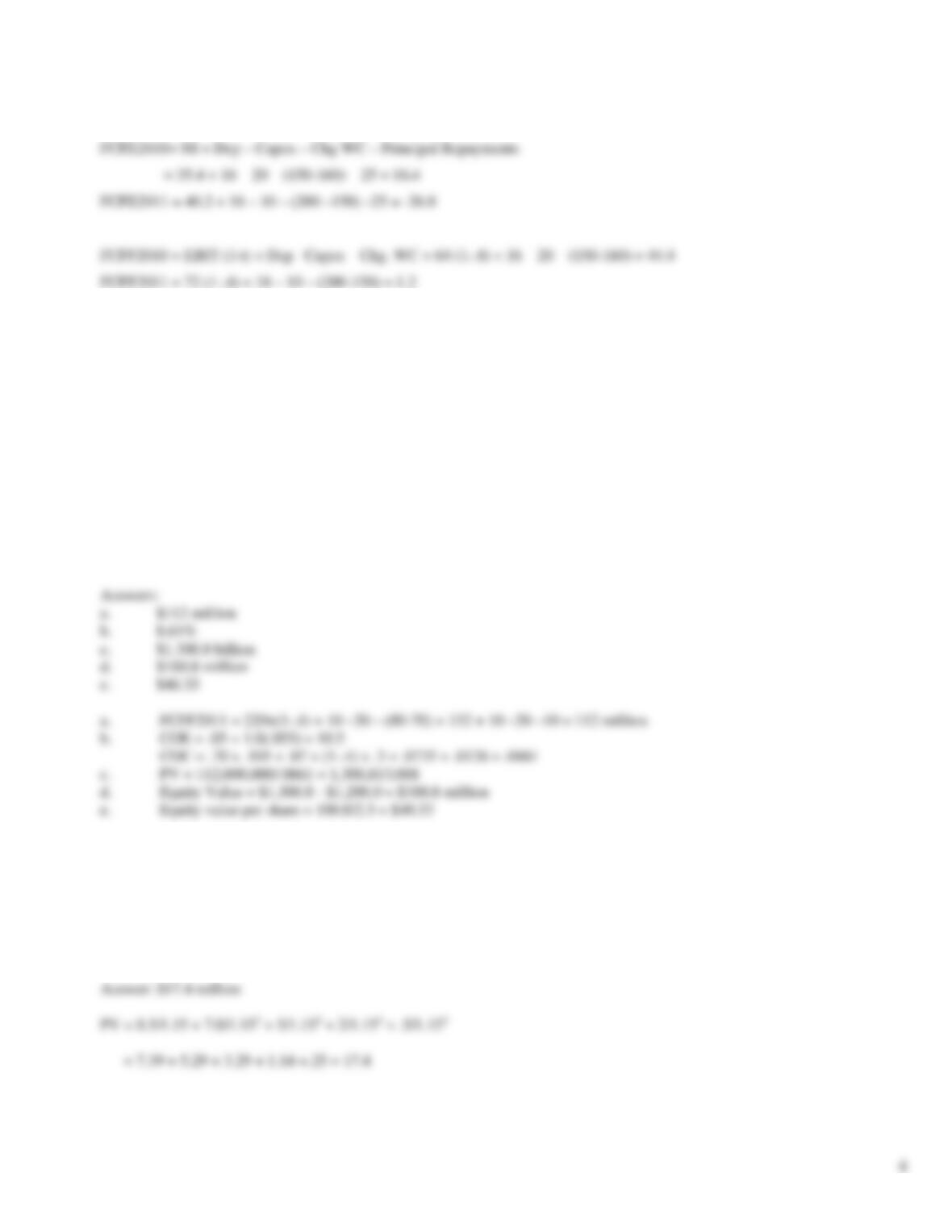
7.14 No Growth Incorporated had operating income before interest and taxes in 2011 of $220 million. The firm was expected to
generate this level of operating income indefinitely. The firm had depreciation expense of $10 million that same year. Capital
spending totaled $20 million during 2011. At the end of 2010 and 2011, working capital totaled $70 and $80 million,
respectively. The firm’s combined marginal state, local, and federal tax rate was 40% and its debt outstanding had a market
value of $1.2 billion. The 10-year Treasury bond rate is 5% and the borrowing rate for companies exhibiting levels of
creditworthiness similar to No Growth is 7%. The historical risk premium for stocks over the risk free rate of return is 5.5%. No
Growth’s beta was estimated to be 1.0. The firm had 2,500,000 common shares outstanding at the end of 2011. No Growth’s
target debt to total capital ratio is 30%.
a. Estimate free cash flow to the firm in 2011.
b. Estimate the firm’s cost of capital.
c. Estimate the value of the firm (i.e., includes the value of equity and debt) at the end of 2011, assuming that it will
generate the value of free cash flow estimated in (a) indefinitely.
d. Estimate the value of the equity of the firm at the end of 2011.
e. Estimate the value per share at the end of 2011.
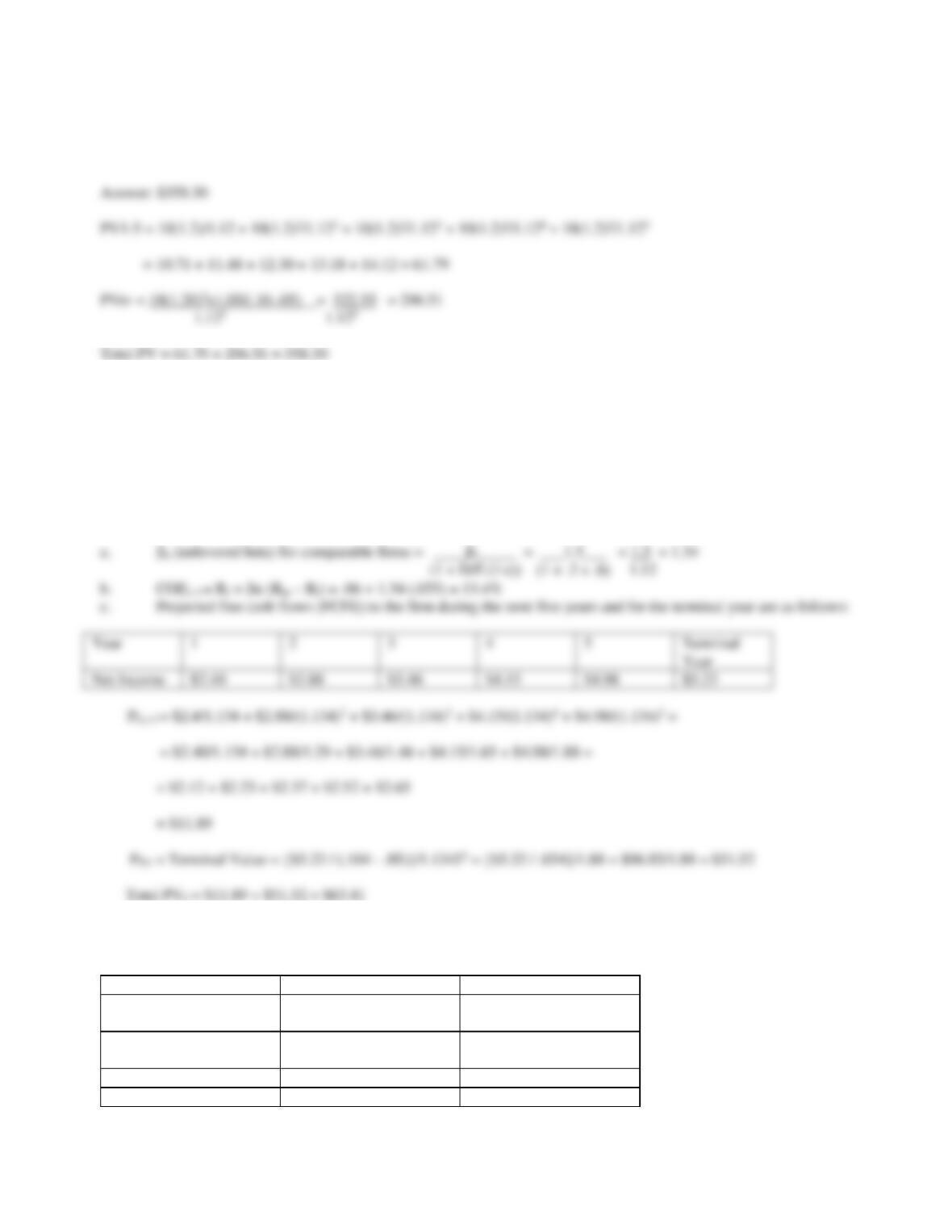
7.15 Carlisle Enterprises, a specialty pharmaceutical manufacturer, has been losing market share for three years since several key
patents have expired. The free cash flow to the firm in 2002 was $10 million. This figure is expected to decline rapidly as more
competitive generic drugs enter the market. Projected cash flows for the next five years are $8.5 million, $7.0 million, $5
million, $2.0 million, and $.5 million. Cash flow after the fifth year is expected to be negligible. The firm’s board has decided
to sell the firm to a larger pharmaceutical company interested in using Carlisle’s product offering to fill gaps in its own product
offering until it can develop similar drugs. Carlisle’s cost of capital is 15%. What purchase price must Carlisle obtain to earn its
cost of capital?
5
7.16 Ergo Unlimited’s current year’s free cash flow is $10 million. It is projected to grow at 20% per year for the next five years. It is
expected to grow at a more modest 5% beyond the fifth year. The firm estimates that its cost of capital is 12% during the next
five years and then will drop to 10% beyond the fifth year as the business matures. Estimate the firm’s current market value.
7.17 In the year in which it intends to go public, a firm has revenues of $20 million and net income after taxes of $2 million. The firm
has no debt, and revenue is expected to grow at 20% annually for the next five years and 5% annually thereafter. Net profit
margins are expected remain constant throughout. Capital expenditures are expected to grow in line with depreciation and
working capital requirements are minimal. The average beta of a publicly traded company in this industry is 1.50 and the
average debt/equity ratio is 20%. The firm is managed very conservatively and does not intend to borrow through the
foreseeable future. The Treasury bond rate is 6% and the tax rate is 40%. The normal spread between the return on stocks and
the risk free rate of return is believed to be 5.5%. Reflecting the slower growth rate in the sixth year and beyond, the firm’s
discount rate is expected to decline to the industry average cost of capital of 10.4%. Estimate the value of the firm’s equity.
Net Income
$2.40
$2.88
$3.46
$4.15
$4.98
$5.23
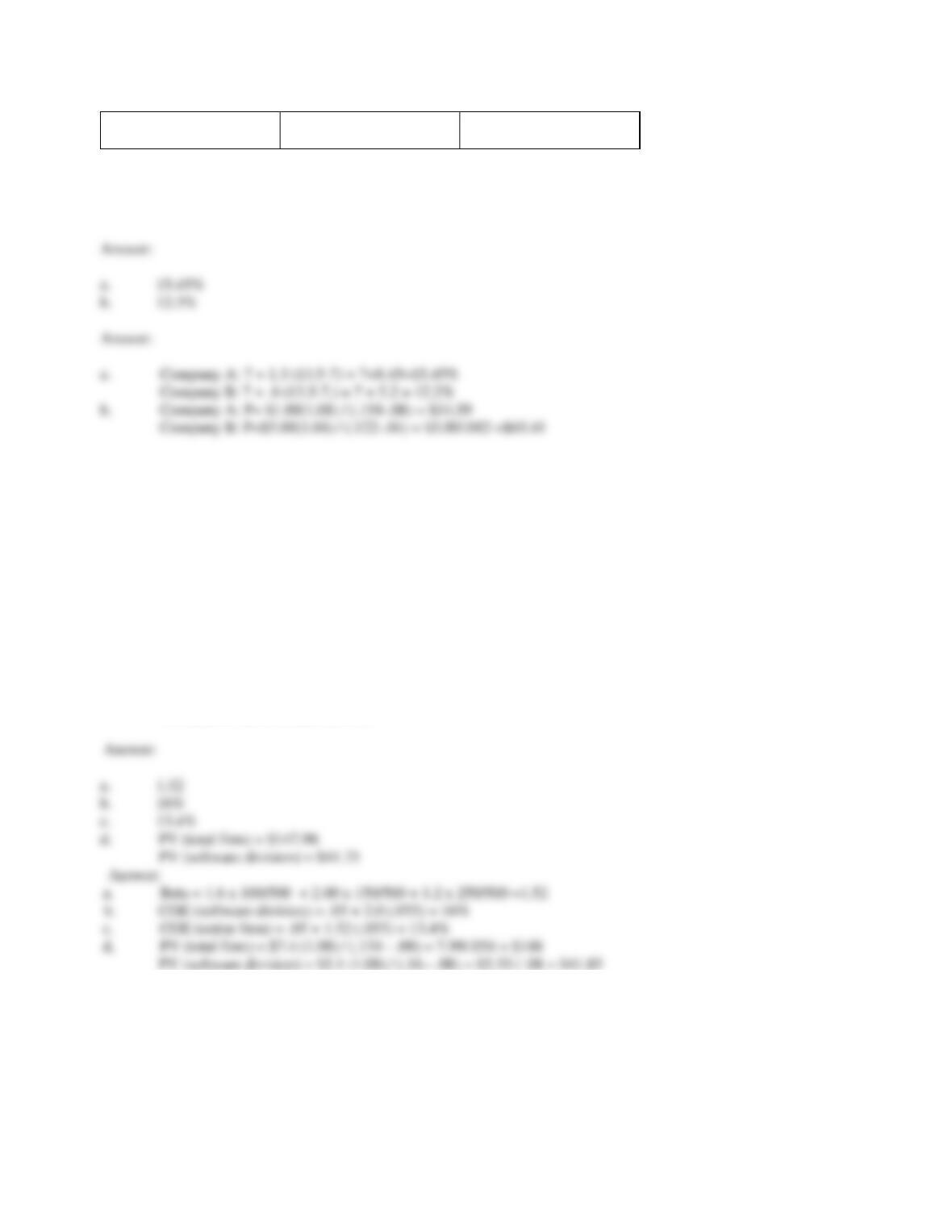
7.18 The following information is available for two different common stocks: company A and Company B.
Company A
Company B
Free cash flow per share
in the current year
$1.00
$5.00
Growth rate in cash flow
per share
8%
4%
Beta
1.3
.8
Risk-free return
7%
7%
6
Expected return on all
stocks
13.5%
13.5%
a. Estimate the cost of equity for each firm.
b. Assume that the companies’ growth rates will continue at the same rate indefinitely. Estimate the per share value of
each companies common stock.
7.19 You have been asked to estimate the beta of a high-technology firm, which has three divisions with the following characteristics.
Division
Beta
Market Value
Personal Computers
1.6
$100 million
Software
2.00
$150 million
Computer Mainframes
1.2
$250 million
a. What is the beta of the equity of the firm?
b. If the risk free return is 5% and the spread between the return on all stocks is 5.5%, estimate the
cost of equity for the software division?
c. What is the cost of equity for the entire firm?
d. Free cash flow to equity investors in the current year (FCFE) for the entire firm is $7.4 million
and for the software division is $3.1 million. If the total firm and the software division are
expected to grow at the same 8% rate into the foreseeable future, estimate the market value of the
firm and of the software division.
7.20 Financial Corporation wants to acquire Great Western Inc. Financial has estimated the enterprise value of Great Western at $104
million. The market value of Great Western’s long-term debt is $15 million, and cash balances in excess of the firm’s normal
working capital requirements are $3 million. Financial estimates the present value of certain licenses that Great Western is not
currently using to be $4 million. Great Western is the defendant in several outstanding lawsuits. Financial Corporation’s legal
department estimates the potential future cost of this litigation to be $3 million, with an estimated present value of $2.5 million.
Great Western has 2 million common shares outstanding. What is the value of Great Western per common share?
End of Chapter Case Study
Hewlett-Packard Outbids Dell Computer to Acquire 3PAR
Answers to Discussion Questions:
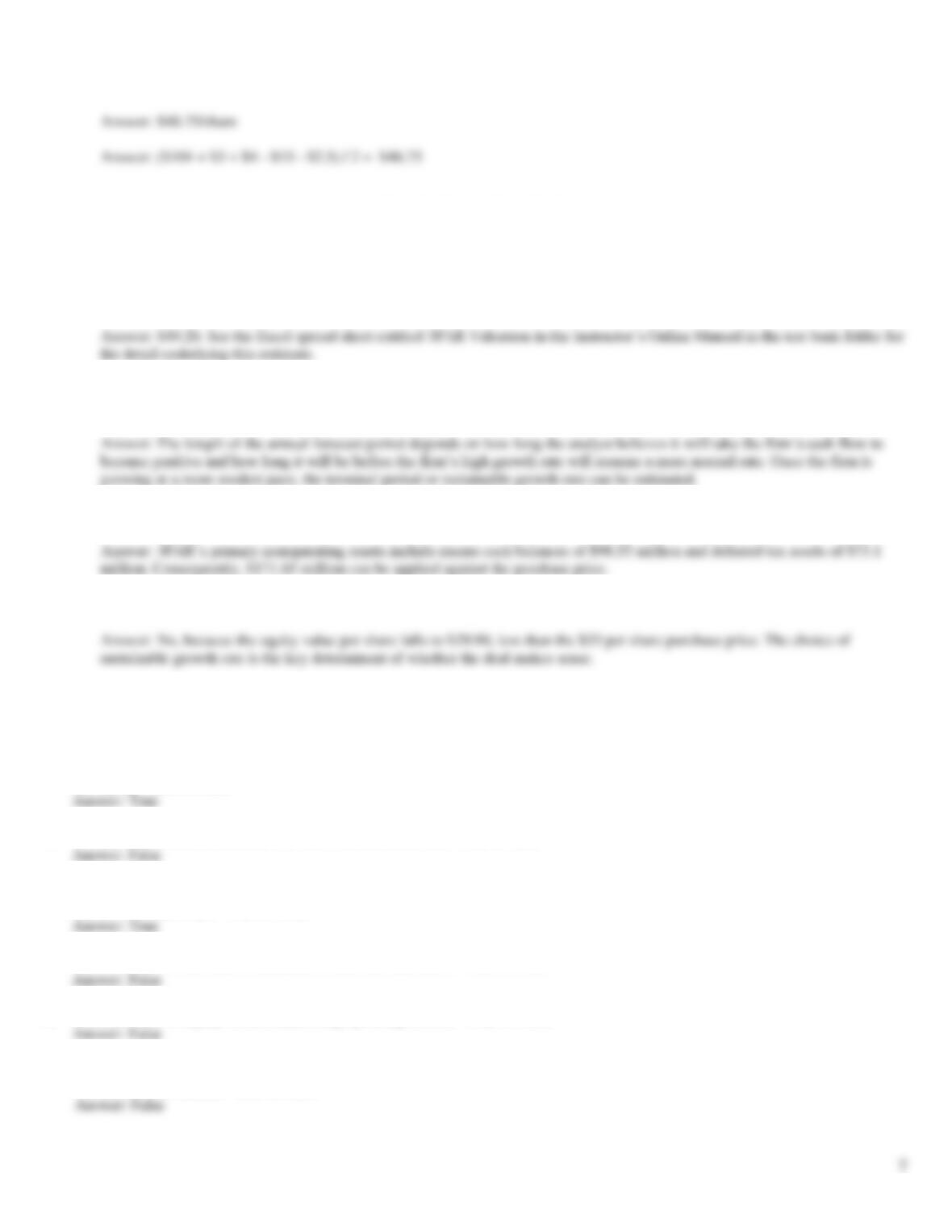
1. Estimate 3PAR’s equity value per share based on the assumptions and selected 3PAR data provided in Table 7.12?
2. Why is it appropriate to utilize at least a 10-year annual time horizon before estimating a terminal value in valuing firm’s such as
3PAR?
3. What portion of the purchase price can be financed by 3PAR’s nonoperating assets?
4. Does the deal still make sense to HP if the terminal period growth rate is 3 percent rather than 5 percent? Explain your answer.
Examination Questions and Answers
True and False Questions: Answer true or false to the following questions: (Circle True or False)
1. In calculating the weighted average cost of capital, the weights should be estimated using the market value of the target firm’s debt
and equity. True or False
2. A beta coefficient is a measure of a firm’s diversifiable risk. True or False
3. In the absence of debt, the unlevered beta measures the volatility of the firm’s financial return to changes in the general stock
market’s overall return. True or False
4. Free cash flow to the firm is calculated before debt and taxes. True or False
5. Free cash flow to equity is calculated using operating income. True or False
6. If free cash flow to the firm is expected to remain at $10 million indefinitely and the firm’s cost of equity is .10, the present value of
the firm is $100 million. True or False

7. The constant growth valuation model is primarily applicable to firms in mature markets. True or False
8. The estimation of present value using the constant growth model involves the calculation of a terminal value. True or False
9. It is possible to determine the equity value of the firm if you know the present value of free cash flow to the firm and the book value
of the firm’s outstanding shares. True or False
10. The discounted cash flow method for valuing a firm adjusts for differences in the magnitude and timing of cash flows and for risk.
True or False
11. The cost of equity is the minimum financial return required by investors to invest in stocks of comparable risk.
True or False
12. The capital asset pricing model is commonly used to estimate the cost of equity. True or False
13. Interest payments are tax deductible to firms in the U.S. True or False
14. A firm’s beta is affected by the amount of debt a firm maintains relative to its equity. True or False
15. Free cash flow to the firm is also called enterprise cash flow. True or False
16. A risk-free rate of return is one for which the expected return is certain. True or False
17. If an investor anticipates a future cash flow stream of five or ten years, she needs to use either a five– or ten-
year Treasury bond rate as the risk-free rate. True or False
18. Studies show that it is generally unnecessary to adjust the capital asset pricing model for the size of the firm
. True or False
19. The size factor used to adjust the capital asset pricing model serves as a proxy for factors such as smaller firms
being subject to higher default risk and generally being less liquid than large capitalization firms. True or
False
20. Preferred stock exhibits some of the characteristics of long-term debt in that its dividend is generally constant
and preferred stockholders are paid before common shareholders in the event the firm is liquidated. True or
False
21. Viewing preferred dividends as paid in perpetuity, the cost of preferred stock can be calculated as dividends
per share of preferred stock divided by the market value of the preferred stock. True or False

9
22. The weighted average cost of capital consists only of debt and equity. True or False
23. The after-tax cost of borrowed funds to the firm is estimated by multiplying the pretax interest rate, i, by (1 –
t), where t is the marginal tax rate for the firm. True or False
24. The weights used to calculate the weighted average cost of capital for a firm with common equity and debt
only represent the book value of equity and debt. True or False
25. The cost of capital formula can be generalized to include hybrid sources of funds available to firms such as
convertible preferred and debt. True or False
26. According to the capital asset pricing model, risk consists of both diversifiable and non-diversifiable
components. True or False
27. Both public and private firms are subject to non-diversifiable risk. True or False
28. In the absence of debt, measures the volatility of a firm’s financial return to changes in the general
market’s overall financial return. True or False
29. Net debt is defined as all of the firm’s interest bearing debt less the value of cash and marketable securities.
True or False
30. When the firm increases its debt in direct proportion to the market value of its equity, the level of the debt is
perfectly correlated with the firm’s market value. True or False
31. Beta is a measure of non-diversifiable risk. True or False
32. Free cash flow to the firm is often called enterprise cash flow. True or False
33. The enterprise or free cash flow to the firm approach to valuation discounts the after-tax free cash flow available to the firm from
operations at the weighted average cost of capital to obtain the enterprise value. True or False
34. The constant growth model is most applicable to firms in mature markets. True or False
35. The variable growth model would be most appropriate for valuing firms in the growth phase of their product life cycle. True or
False
36. Growth rates can be calculated based on the historical experience of the firm or industry. True or False
37. Intuition suggests that the length of the high-growth period when applying the variable growth model should be shorter the
greater the current growth rate of the firm’s cash flow. True or False

38. When cash flow is temporarily depressed due to strikes, litigation, warranty claims, or other one-time events, it is generally safe
to assume that cash flow will recover in the near term. True or False
39. The projected cash flow of firms in highly cyclical industries can be distorted depending on where the firm is in the business
cycle. True or False
40. The constant growth model may be used to estimate the risk premium component of the cost of equity as an alternative to relying
on historical information as is done in the capital asset pricing model. True or False
41. Discounted cash flow and the asset-oriented valuation methods necessarily provide identical results. True
or False
42. Investors require a minimum rate of return on an investment to compensate them for the level of perceived risk associated with
that investment. True or False
43. The cost of equity can also be viewed as an opportunity cost. True or False
44. For a return to be considered risk-free over some future time period it must be free of default risk and there must not be any
uncertainty about the reinvestment rate (i.e., the rate of return that can be earned at the end of the investor’s holding period).
True or False
45. Whether an analyst should use a short or long-term interest rate for the risk free rate in calculating the
CAPM depends on when the investor receives their future cash flows. True or False
46. A three-month Treasury bill rate is not free of risk for a five– or ten-year period, since interest and principal received at maturity
must be reinvested at three month intervals. True or False
47. The market risk or equity premium refers to the additional rate of return in excess of the weighted average cost of capital that
investors require to purchase a firm’s equity. True or False
48. Betas do not vary over time and are quite insensitive to the time period and methodology employed in their estimation. True or
False
49. Studies show that the market risk premium is unstable, lower during periods of prosperity and higher during periods of economic
slowdowns. True or False
50. For firms whose market value is less than $50 million, the adjustment to the CAPM in estimating the cost of equity can be as
large as 2 percentage points. True or False

51. Assume the firm size premium for a firm with a market value of $20 million is 7.2%. Also, assume the risk-free rate of return,
equity premium, and are 5.0%, 5.5%, and 1.75 respectively. The firm’s cost of equity using the CAPM method adjusted for
firm size is 21.8%. True or False
52. A firm’s credit rating is a poor measure of a firm’s default risk. True or False
53. For non-rated firms, the analyst may estimate the pretax cost of debt for an individual firm by comparing debt–to-equity or total
capital ratios, interest coverage ratios, and operating margins with those of similar rated firms. True or False
54. Preferred dividends are tax deductible to U.S. corporations. True or False
55. The weighted average cost of capital (WACC) is the broadest measure of the firm’s cost of funds and represents the return that a
firm must earn to induce investors to buy its common stock. True or False
56. The relationship between the overall market and a specific firm’s beta may change significantly if a large sector of stocks that
make up the overall index increase or decrease substantially. True or False
57. The reduction in the firm’s tax liability due to the tax deductibility of interest is often referred as a tax
shield. True or False
58. When the firm increases its debt in direct proportion to the market value of its equity, the level of the debt is perfectly correlated
with the firm’s market value. Consequently, the risk associated with the tax shield (resulting from interest paid on outstanding
debt) is the same as that associated with the firm. True or False
59. The effective tax rate is calculated from actual taxes paid based on accounting statements prepared for tax reporting purposes.
True or False
60. Whatever the analyst chooses to do with respect to the selection of a tax rate, it is critical to use the marginal rate in calculating
after-tax operating income in perpetuity. Otherwise, the implicit assumption is that taxes can be deferred indefinitely. True or
False
61. The levered beta reflects the firm’s degree of cyclicality, operating and financial leverage. True or False
62. The unlevered beta reflects the firm’s degree of cyclicality and operating leverage but not financial leverage. True or False
1. Which one of the following factors is not considered in calculating the firm’s cost of equity?
a. risk free rate of return
b. beta
c. interest rate on corporate debt
d. expected return on equities
e. difference between expected return on stocks and the risk free rate of return

12
2. Which one of the following factors is not considered in calculating the firm’s cost of capital?
a. cost of equity
b. interest rate on debt
c. the firm’s marginal tax rate
d. book value of debt and equity
e. the firm’s target debt to equity ratio
3. A firm’s leveraged beta reflects all of the following except for
a. unleveraged beta
b. the firm’s debt
c. marginal tax rate
d. the firm’s cost of equity
e. the firm’s equity
4. Which of the following factors is excluded from the calculation of free cash flow to the firm?
a. Principal repayments
b. Operating income
c. Depreciation
d. The change in working capital
e. Gross plant and equipment spending
5. Which of the following is not true about the constant growth valuation model?
a. The firm’s free cash flow is assumed to be unchanged in perpetuity
b. The firm’s free cash flow is assumed to grow at a constant rate in perpetuity
c. Free cash flow is discounted by the difference between the appropriate discount rate and the expected growth rate of
cash flow.
d. The constant growth model is sometimes referred to as the Gordon Growth Model.
e. If the analyst were using free cash flow to the firm, cash flow would be discounted by the firm’s cost of capital less the
expected growth rate in cash flow.
6. Which of the following is not true about the variable growth valuation model?
a. Assumes a high growth period followed by a stable growth period.
b. Assumes that the discount rate during the high and stable growth periods is the same.
c. Is used primarily to evaluate firms in high growth industries.
d. Involves the calculation of a terminal value.
e. The terminal value often comprises a substantial percentage of the total present value of the firm.
7. The cost of capital reflects all of the following except for
a. Cost of equity
b. The firm’s beta
c. The book value of the firm’s debt
d. The after-tax cost of interest paid by the firm
e. The risk free rate of return
8. The calculation of free cash flow to the firm includes all of the following except for
a. Net income
b. Marginal tax rate
c. Change in working capital
d. Gross plant and equipment spending
e. Depreciation

13
9. The calculation of free cash flow to equity includes all of the following except for
a. Operating income
b. Preferred dividends
c. Change in working capital
d. Gross plant and equipment spending
e. Principal repayments
10. All of the following are true about the marginal tax rate for the firm except for
a. The marginal tax rate in the U.S. is usually about 40%.
b. The effective tax rate is usually less than the marginal tax rate.
c. Once tax credits have been used and the ability to further defer taxes exhausted, the effective rate
can exceed the marginal rate at some point in the future.
d. It is critical to use the effective tax rate in calculating after–tax operating income in perpetuity.
e. It is critical to use the marginal rate in calculating after-tax operating income in perpetuity.
11. For a firm having common and preferred equity as well as debt, common equity value can be estimated in which of the following
ways?
a. By subtracting the book value of debt and preferred equity from the enterprise value of the firm
b. By subtracting the market value of debt from the enterprise value of the firm
c. By subtracting the market value of debt and the market value of preferred equity from the
enterprise value of the firm
d. By adding the market value of debt and preferred equity to the enterprise value of the firm
e. By adding the market value of debt and book value of preferred equity to the enterprise value of
the firm
12. The zero growth model is a special case of what valuation model?
a. Variable growth model
b. Constant growth model
c. Delta growth model
d. Perpetuity valuation model
e. None of the above
13. Which of the following is true of the enterprise valuation model?
a. Discounts free cash flow to the firm by the cost of equity
b. Discounts free cash flow to the firm by the weighted average cost of capital
c. Discounts free cash flow to equity by the cost of equity
d. Discounts free cash flow to equity by the weighted average cost of capital
e. None of the above
14. Which of the following is true of the equity valuation model?
a. Discounts free cash flow to the firm by the weighted average cost of capital
b. Discounts free cash flow to equity by the cost of equity
c. Discounts free cash flow the firm by the cost of equity

14
d. Discounts free cash flow to equity by the weighted average cost of capital
e. None of the above
15. Which of the following is true about the variable growth model?
a. Present value equals the discounted sum of the annual forecasts of cash flow
b. Present value equals the discounted sum of the annual forecasts of cash flow plus the discounted value of the terminal
value
c. Present value equals the discounted value of the next year’s cash flow grown at a constant rate in perpetuity
d. Present value equals the current year’s free cash flow discounted in perpetuity
e. None of the above
16. When evaluating an acquisition, you should do which of the following:
a. Ignore market values of assets and focus on book value
b. Ignore the timing of when the cash flows will be received
c. Ignore acquisition fees and transaction costs
d. Apply the discount rate that is relevant to the incremental cash flows
e. Ignore potential losses of management talent
17. The incremental cash flows of a merger can relate to which of the following:
a. Working capital
b. Profits
c. Capital spending
d. Income taxes
e. All of the above
Answer: E
Additional Problems/Case Studies
Valuation Methodologies and Fairness Opinion Letters
____________________________________________________________________________________________________________
Key Points
Parties to transactions often employ investment bankers to provide opinions about whether a proposed purchase price is “fair” to their
shareholders.
Alternative valuation methods often result in very different estimates of value, reflecting different assumptions about risk and the amount
and timing of future cash flows.
____________________________________________________________________________________________________________
In July 2011, investment bank Goldman Sachs was hired by Immucor Inc., a manufacturer of blood-testing products, to certify that the
$27 price per common share offered by well–known buyout firm TPG was fair. These “fairness opinions” represent third-party assertions
about the suitability of proposed deals. Goldman assessed Immuncor’s fair value by applying discounted cash flow (DCF) analysis to the
firm’s projected after-tax cash flows between 2012 and 2015 and by comparing it to “similar” publicly traded firms and to recent
comparable deals. The analysis involved judgments about differences in financial and operating characteristics affecting the trading
values of the firms to which Immucor was compared.
A typical fairness opinion letter provides a range of “fair” prices, with the presumption that the actual deal price should fall within that
range. These valuation estimates were presented to Immuncor’s board of directors with the usual caveats, that is, the estimates of fair
value should reflect an amalgam of the methods used. Goldman also noted that in performing its analyses, it considered industry
performance, business conditions, and other matters, many of which are beyond the control of Immucor and that the estimates of fair
value are not necessarily indicative of actual values or actual future results.
The Importance of Distinguishing Between Operating and Nonoperating Assets
15
In 2006, Verizon Communications and MCI Inc. executives completed a deal in which MCI shareholders received $6.7 billion for 100%
of MCI stock. Verizon’s management argued that the deal cost their shareholders only $5.3 billion in Verizon stock, with MCI having
agreed to pay its shareholders a special dividend of $1.4 billion contingent on their approval of the transaction. The $1.4 billion special
dividend reduced MCI’s cash in excess of what was required to meet its normal operating cash requirements.
To understand the actual purchase price, it is necessary to distinguish between operating and nonoperating assets. Without the special
dividend, the $1.4 billion in cash would have transferred automatically to Verizon as a result of the purchase of MCI’s stock. Verizon
would have had to increase its purchase price by an equivalent amount to reflect the face value of this nonoperating cash asset.
Consequently, the purchase price would have been $6.7 billion. With the special dividend, the excess cash transferred to Verizon was
reduced by $1.4 billion, and the purchase price was $5.3 billion.
In fact, the alleged price reduction was no price reduction at all. It simply reflected Verizon’s shareholders receiving $1.4 billion less in
net acquired assets. Moreover, since the $1.4 billion represents excess cash that would have been reinvested in MCI or paid out to
shareholders anyway, the MCI shareholders were simply getting the cash earlier than they may have otherwise.
The Hunt for Elusive Synergy—@Home Acquires Excite
Background Information
Prior to @Home Network’s merger with Excite for $6.7 billion, Excite’s market value was about $3.5 billion. The new company
combined the search engine capabilities of one of the best-known brands (at that time) on the Internet, Excite, with @Home’s agreements
with 21 cable companies worldwide. @Home gains access to the nearly 17 million households that are regular users of Excite. At the
time, this transaction constituted the largest merger of Internet companies ever. At the time of the transaction, the combined firms, called
Excite @Home, displayed a P/E ratio in excess of 260 based on the consensus earnings estimate of $0.21 per share. The firm’s market
value was $18.8 billion, 270 times sales. Investors had great expectations for the future performance of the combined firms, despite their
lackluster profit performance since their inception. @Home provided interactive services to home and business users over its proprietary
network, telephone company circuits, and through the cable companies’ infrastructure. Subscribers paid $39.95 per month for the service.
Assumptions
• Excite is properly valued immediately prior to announcement of the transaction.
• Annual customer service costs equal $50 per customer.
• Annual customer revenue in the form of @Home access charges and ancillary services equals $500 per customer. This assumes that
declining access charges in this highly competitive environment will be offset by increases in revenue from the sale of ancillary
services.
• None of the current Excite user households are current @Home customers.
• New @Home customers acquired through Excite remain @Home customers in perpetuity.
• @Home converts immediately 2 percent or 340,000 of the current 17 million Excite user households.
• @Home’s cost of capital is 20 percent during the growth period and drops to 10 percent during the slower, sustainable growth period;
its combined federal and state tax rate is 40 percent.
• Capital spending equals depreciation; current assets equal current liabilities.
• FCFF from synergy increases by 15 percent annually for the next 10 years and 5 percent thereafter. Its cost of capital after the high–
growth period drops to 10 percent.
• The maximum purchase price @Home should pay for Excite equals Excite’s current market price plus the synergy that results from the
merger of the two businesses.
Discussion Questions
16
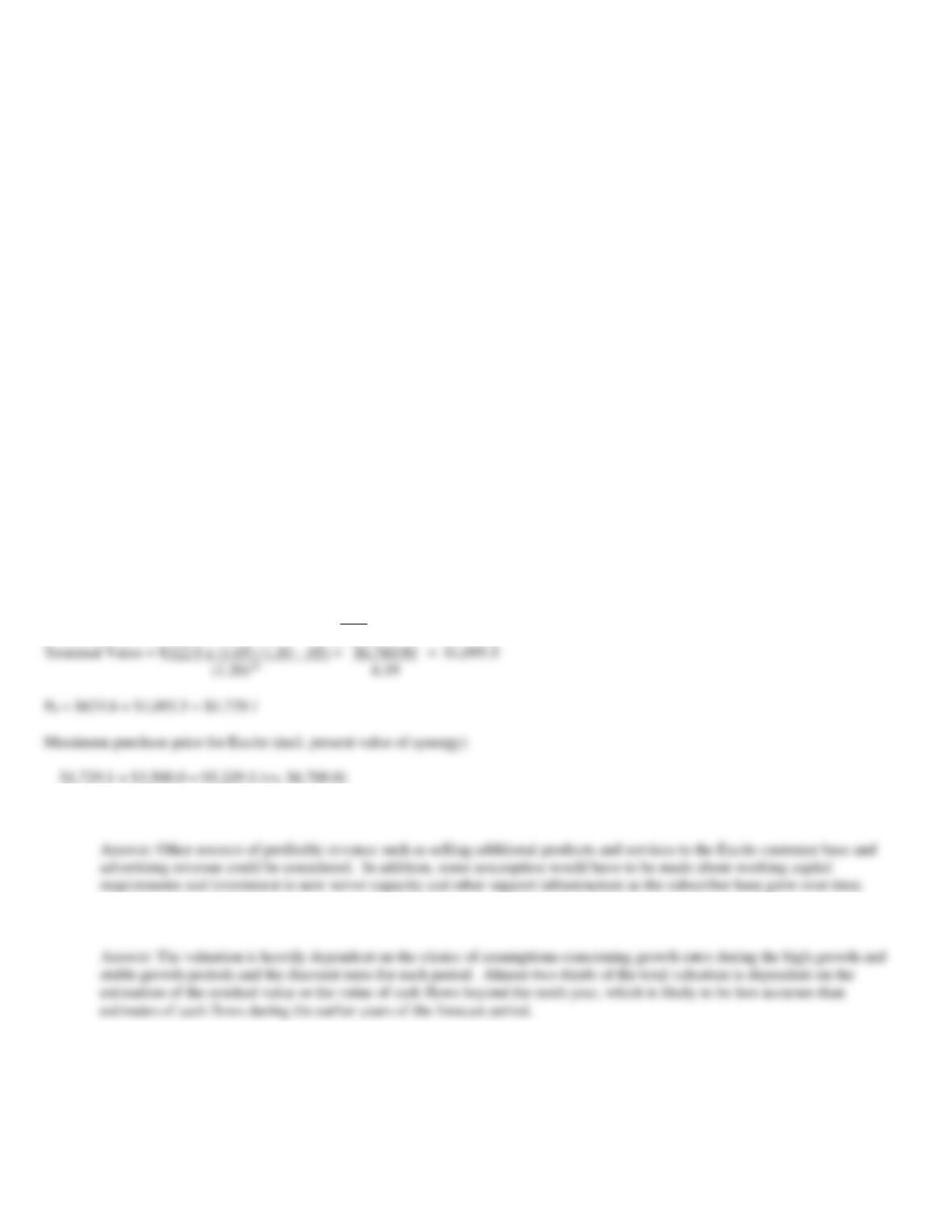
1. Use discounted cash flow (DCF) methods to determine if @Home overpaid for Excite.
2. What other assumptions might you consider in addition to those identified in the case study?
3. What are the limitations of the discounted cash flow method employed in this case?
Answers to Case Study Questions:
1. Did @Home overpay for Excite?
Answer: To answer the question of whether @Home overpaid, it is necessary to estimate the value of synergy, add this estimate
to the market value of Excite, and compare the resulting sum to the $6.7 billion purchase price. Note that free cash flow to the
firm in the first full year of operation following the merger equals ($500 – $50) x (1 – .4) x 340,000 or $91.8 million.
Using the variable growth model, we can calculate the present value of potential synergy (P0) as follows:
Year: FCFF Present Value Present Value
($Millions) Interest Factor ($Millions)
1 91.8 .83 76.2
2 105.6 .69 73.3
3 121.4 .58 70.4
4 139.6 .48 67.0
5 160.6 .40 64.2
6 184.6 .33 61.8
7 212.3 .28 59.4
8 244.2 .23 56.2
9 280.8 .19 53.4
10 322.9 .16 51.7
$633.6
2. What other assumptions might you consider?
3. What are the limitations of the valuation methodology employed in this case?
Creating a Global Luxury Hotel Chain
Fairmont Hotels & Resorts Inc. announced on January 30, 2006, that it had agreed to be acquired by Kingdom Hotels and Colony Capital
in an all-cash transaction valued at $45 per share. The transaction is valued at $3.9 billion, including assumed debt. The purchase price
represents a 28% premium over Fairmont’s closing price on November 4, 2005, the last day of trading when Kingdom and Colony
expressed interest in Fairmont. The combination of Fairmont and Kingdom will create a luxury global hotel chain with 120 hotels in 24
countries. Discounted cash-flow analyses, including estimated synergies and terminal value, value the firm at $43.10 per share. The net
asset value of Fairmont’s real estate is believed to be $46.70 per share.
Discussion Questions
1. Is it reasonable to assume that the acquirer could actually be getting the operation for “free,” since the value of the real estate per share
is worth more than the purchase price per share? Explain your answer.
2. Assume the acquirer divests all of Fairmont’s hotels and real estate properties but continues to manage the hotels and properties under
long-term management contracts. How would you estimate the net present value of the acquisition of Fairmont to the acquirer? Explain
your answer.
Answers to Case Study Questions:
1. Is it reasonable to assume that the acquirer could actually be getting the operation for “free,” since the value of the real estate per
share is worth more than the purchase price per share? Explain your answer.
2. Assume the acquirer divests all of Fairmont’s hotels and real estate properties but continues to manage the hotels and properties
under long-term management contracts. How would you estimate the net present value of the acquisition of Fairmont to the
acquirer? Explain your answer.